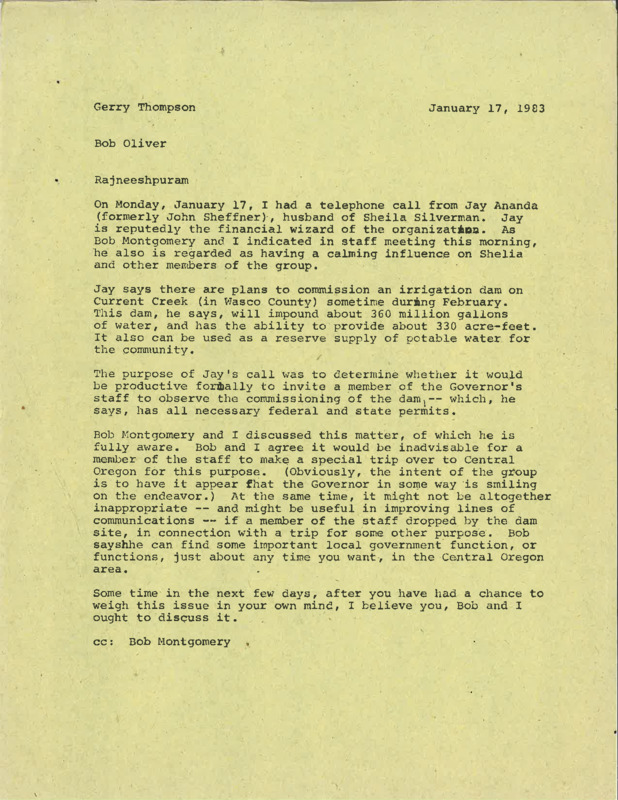
Memo from Bob Oliver, Governor Atiyeh's legal counsel, to Gerry Thompson, the governor's chief of staff. He discusses a telephone conversation he had with Jay Ananda, formerly John Sheffner, who works in the financial department of the Rajneesh organization. The conversation covered the plans to commission an irrigation dam on Current Creek in Wasco County, and further, whether on not a representative of the Governor's staff would be willing to make an appearance. Bob Oliver requests they explore the possibilities of a representative participating. This item was a part of the papers of Bob Oliver.
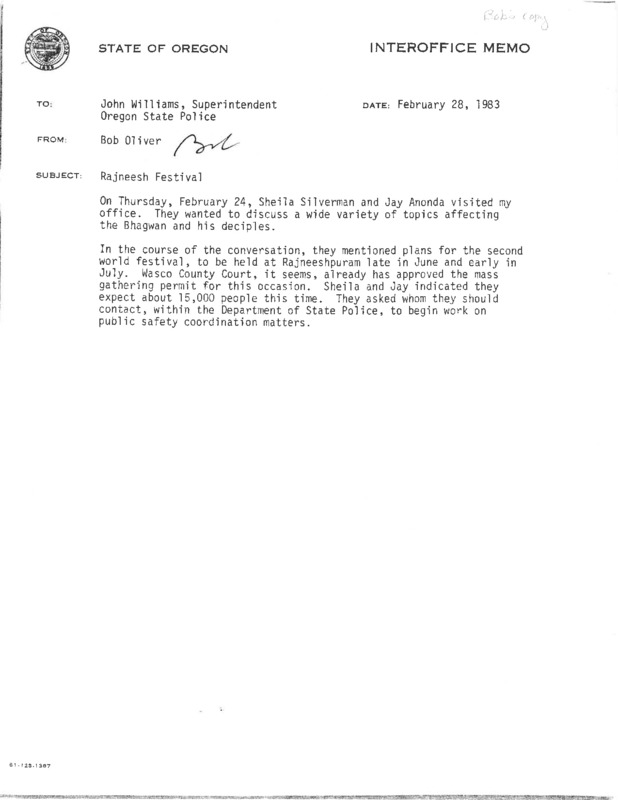
Memo from Bob Oliver, legal counsel to the Governor, to John Williams, superintendent for Oregon State Police. The memo discusses the Rajneesh festival and a recent visit from Sheila Silverman and Jay Anonda. The representatives from the community requested information on whom they should contact about public safety issues for the Second World Festival. Also included is the response received from John C. Williams, instructing Bob to inform the individuals they should contact Major Kenneth Lamkin. This item was a part of the papers of Bob Oliver.
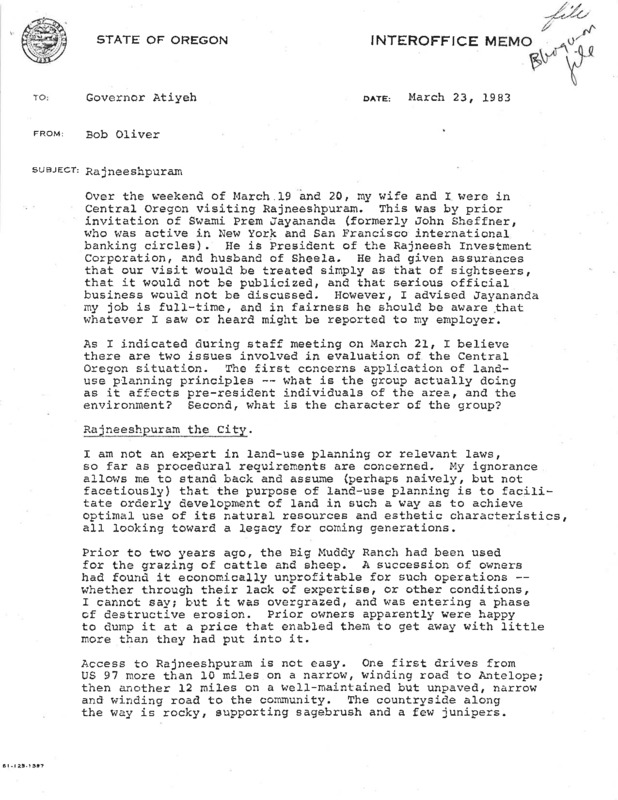
Memo to Governor Atiyeh from Bob Oliver, his legal counsel. Oliver writes to the Governor after a weekend visit to the city of Rajneeshpuram. He describes the atmosphere of the Ashram and the community. Further into the letter, Bob Oliver deliberates on the social classes and hierarchy existing within the city as well as the overall demeanor of the citizens. He states that he does not believe that there is any reason to be concerned about potential violence occurring on behalf of the Rajneesh. This item was a part of the papers of Bob Oliver.
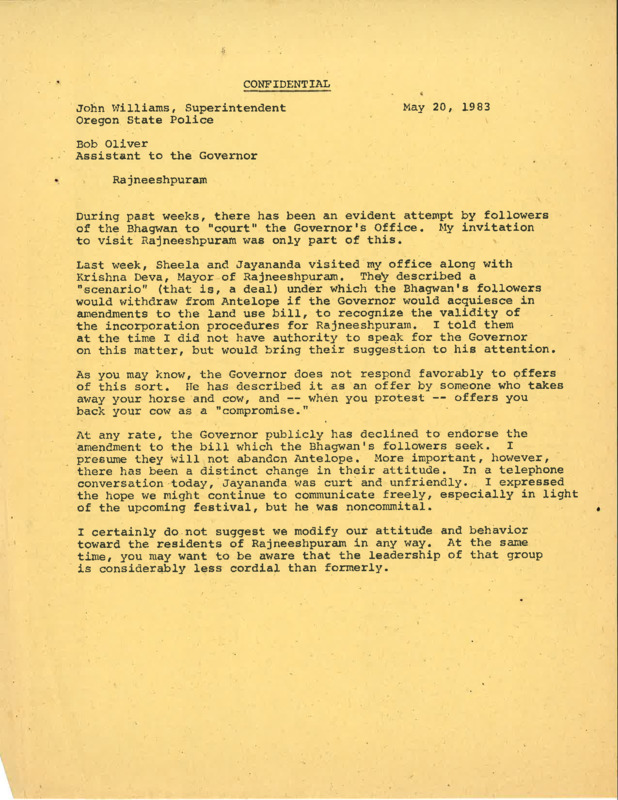
Memo from John Williams, superintendent for the Oregon State Police, to Bob Oliver, legal counsel Governor Atiyeh. The memo is labeled confidential and discusses a meeting had with Sheela, Jayananda, representatives from Rajneeshpuram and Krishna Deva the mayor of Rajneeshpuram. The meeting pertained to the possibility of their withdrawing from Antelope. Bob Oliver further explains that the attitude and manner of the Rajneesh has altered, and that suggest the Governor's office not change their manner at all. This item was a part of the papers of Bob Oliver, Governor Atiyeh's legal counsel.
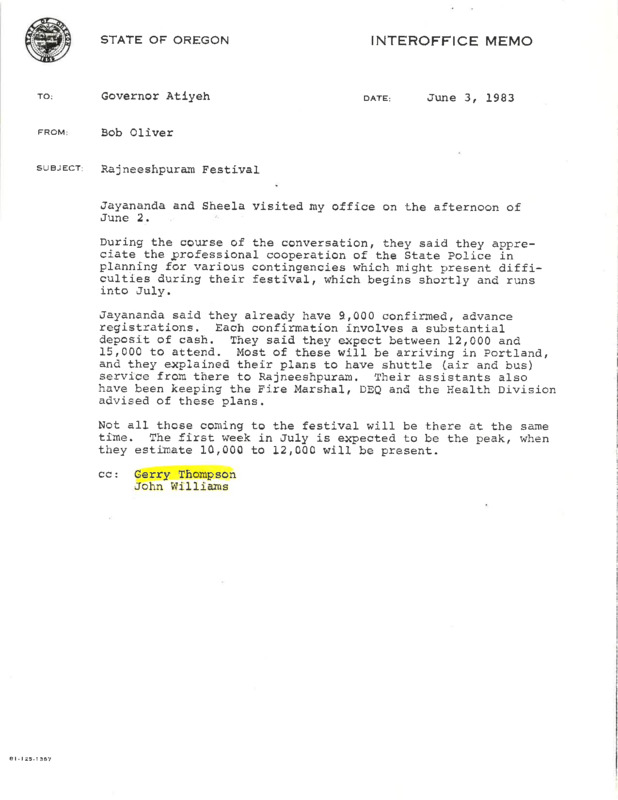
Memo to Governor Atiyeh from his legal counsel, Bob Oliver. Oliver reports on a meeting he had with Jayananda and Sheela from the Rajneesh community. During the course of the meeting they discussed the cooperation between the Rajneesh Foundation and the State Police, as well as the amount of attendees confirmed for the 1983 festival, and how many participants are estimated to be there at one time. This item was a part of the papers of Bob Oliver, Governor Atiyeh's legal counsel.
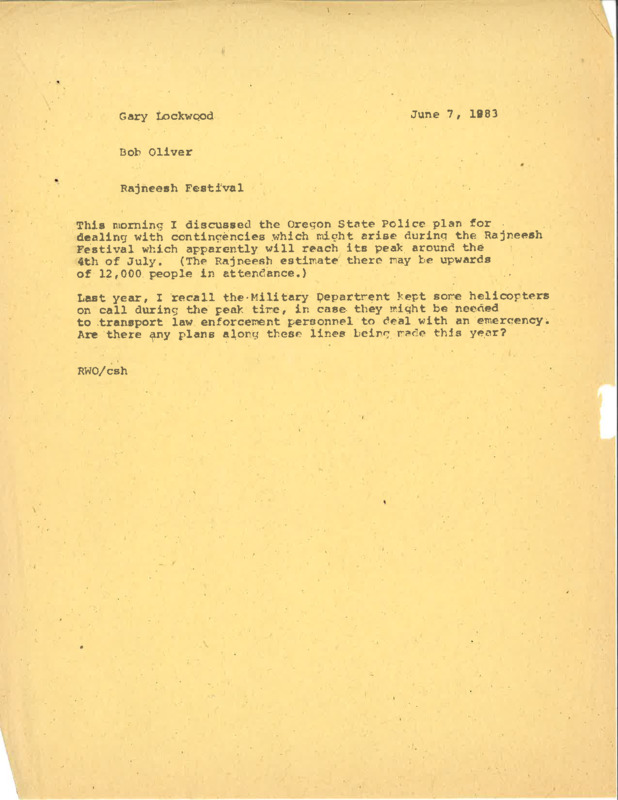
Memo from Gary Lockwood to Bob Oliver explaining a discussion had with the Oregon State Police. The discussion explained the Police plan for dealing with potential issues that might occur during the Rajneesh Festival. Lockwood also inquires as to whether or not there will be helicopters available to transport law enforcement in case of an emergency. This item was a part of the papers of Bob Oliver, Governor Atiyeh's legal counsel.
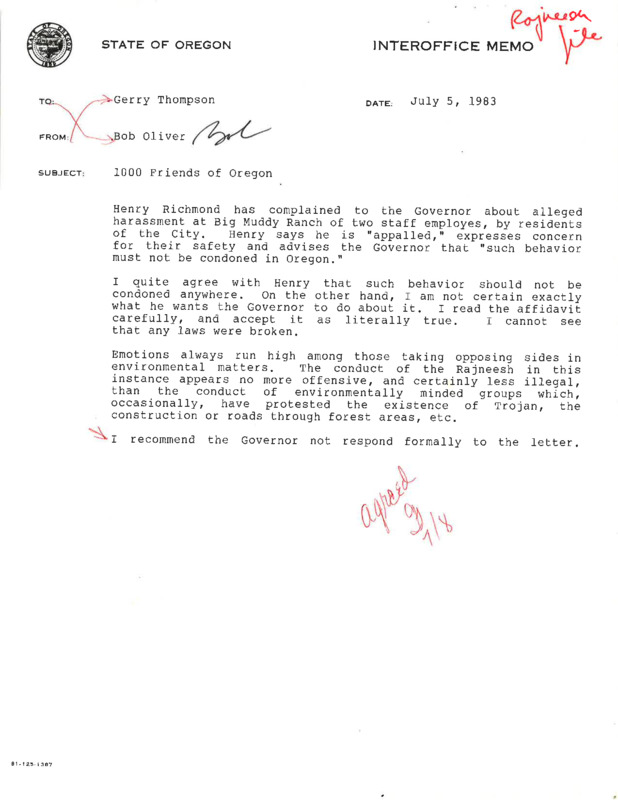
An interoffice memo from Bob Oliver, legal counsel to Governor Atiyeh, to Gerry Thompson, Atiyeh's Chief of Staff. He discusses alleged harassment complaints against the Rajneesh community by Henry Richmond of 1000 Friends of Oregon. Richmond asks that the Governor not condone the behavior of the Rajneesh. Bob Oliver writes in agreement with this, but because there was no illegal conduct, recommends the Governor does not respond to the letter. The letter appears to have been returned to Bob Oliver with Gerry Thompson's note of agreement. This item was a part of the papers of Bob Oliver.
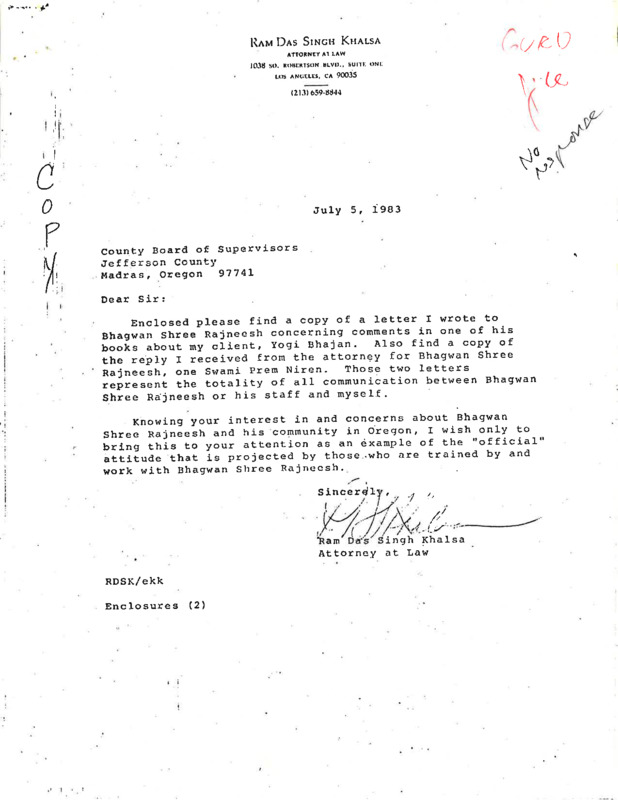
Letter from Ram Das Singh Khalsa, attorney for the Rajneesh, to the Jefferson County Board of Supervisors. Enclosed was a copy of a reply from Bhagwan Shree Rajneesh's attorney Swami Prem Niren. The reply was to a letter also attached that had been written to Bhagwan Shree Rajneesh regarding comments made in The Goose Is Out, a book written by Bhagwan. Certain comments in the book were considered by one of Khalsa's clients, Yogi Bhagwan, as defamatory. This item was a part of the papers of Bob Oliver, Governor Atiyeh's legal counsel.
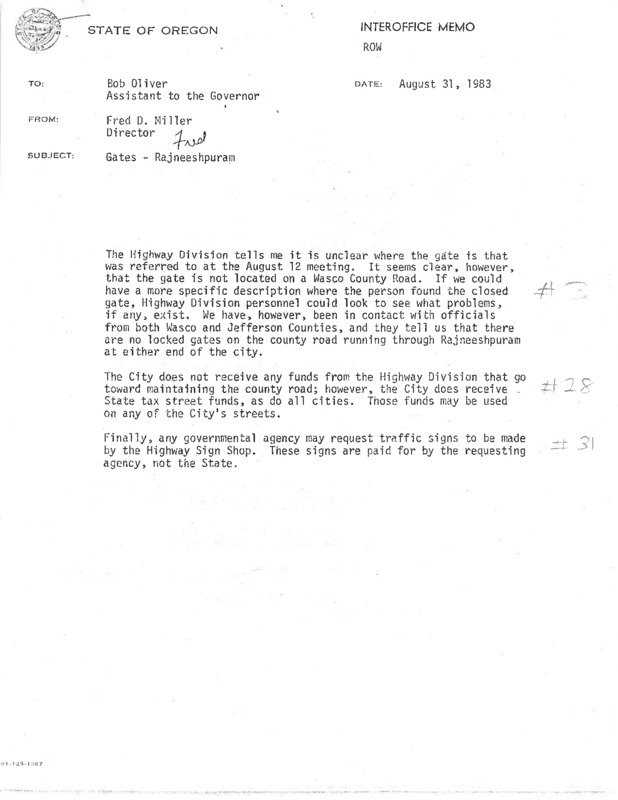
Interoffice memo from Fred D. Miller, director to Bob Oliver, assistant to the Governor regarding rumored gates on Wasco County Road. The memo acts as a response to inquires made by a local anti-Rajneesh group about gates, city funds from the Highway Division and traffic signs. This item was a part of the papers of Bob Oliver, Governor Atiyeh's legal counsel.
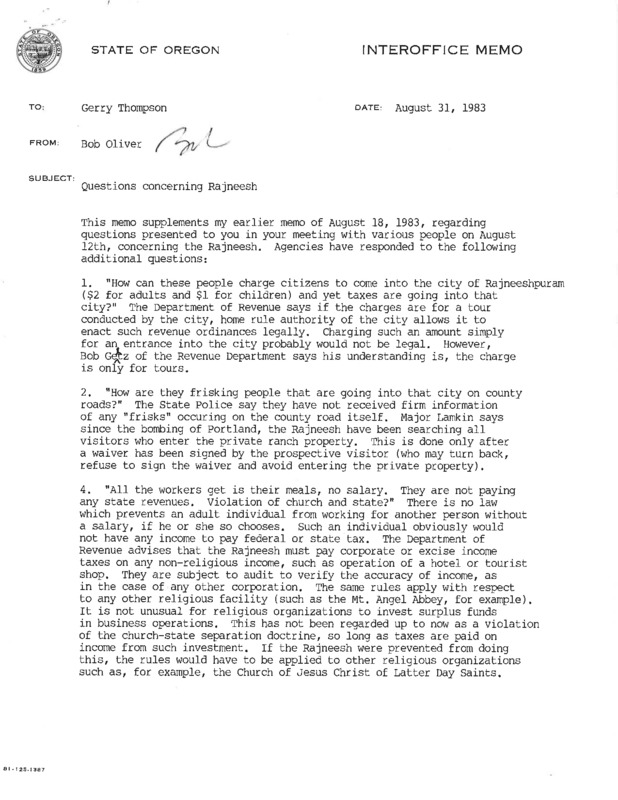
Interoffice memo from Bob Oliver, Governor Atiyeh's legal counsel, to Gerry Thompson, the governor's chief of staff. The memo acts as a supplement to a previously sent memo regarding the questions presented by an anti-Rajneesh group. In further response to the inquiries of the group, some of the concerns are answered by Government agencies. Several of the departments were not yet able to provide correspondence on issues that fall under their jurisdiction, but they report that as information is received it will be compiled into a report. This item was a part of the papers of Bob Oliver, Governor Atiyeh's legal counsel.
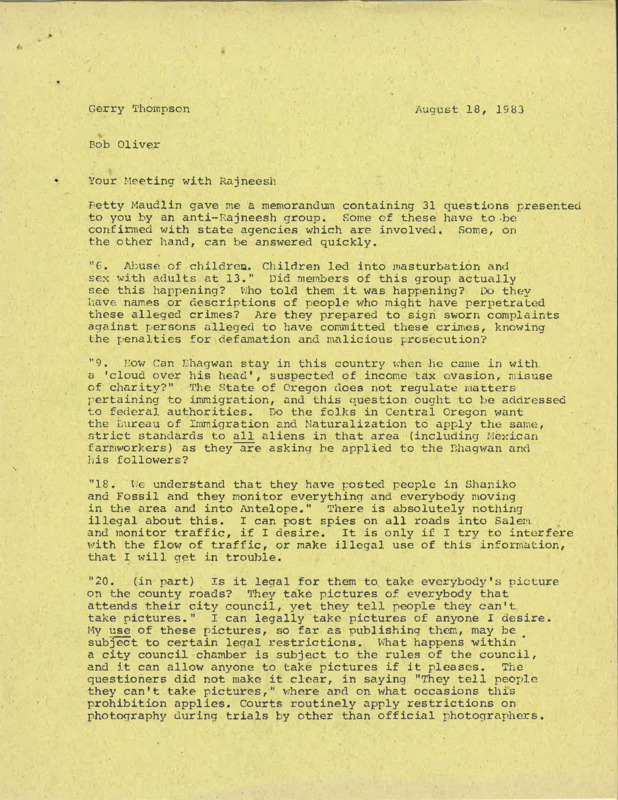
A memo from Gerry Thompson, chief of staff for Governor Atiyeh to Bob Oliver, the Governor's legal counsel, responding to a recent meeting with an anti-Rajneesh group. The group is unnamed, but may have been the 1000 Friends of Oregon. The memo provides replies to several of the group's questions and attempts to dispel rumors circulating within the community. She notes that the group has so far failed to specific proof of illegal activity by the Rajneesh. However, after the consideration of comments made during the meeting about potential violations of Oregon state law, it had been determined that an inventory needs to be taken of all agencies involved. This item was a part of the papers of Bob Oliver, Governor Atiyeh's legal counsel.
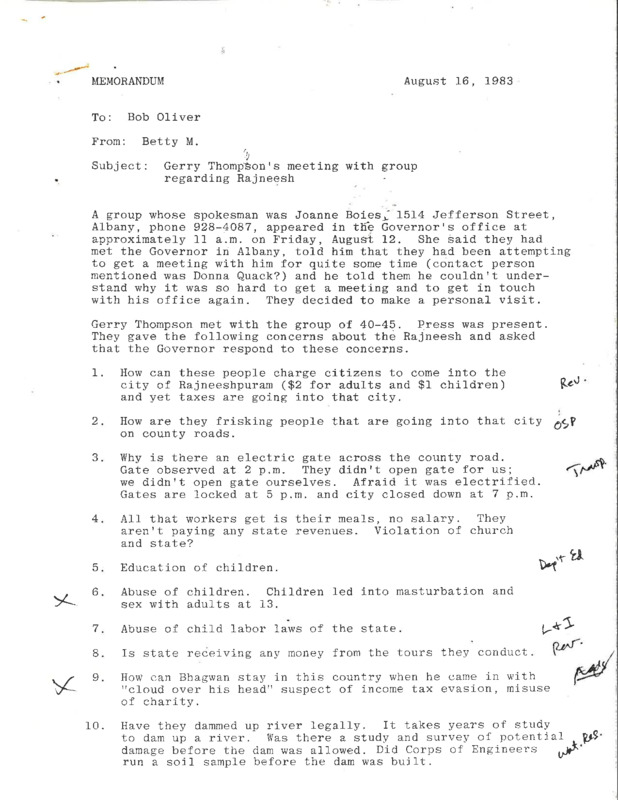
Inter-office memo from Betty Maudlin, who was apparently an assistant in the Oregon Governor's Office, to Bob Oliver, Governor Atiyeh's legal counsel. She reports on a meeting between Governor Atiyeh's chief of staff Gerry Thompson and a local anti-Rajneesh group. The group is not named, but may have been the 1000 Friends of Oregon. The group had been attempting to get a meeting with the Governor to discuss the Rajneesh problem. Press was present at the meeting and the group provided a list of questions and concerns that they asked the Governor to respond to. Gerry Thompson requested that Bob Oliver prepare answers or a referral be sent to authorities prior to the Governor's potential meeting with the group of residents. This item was a part of the papers of Bob Oliver, Governor Atiyeh's legal counsel.
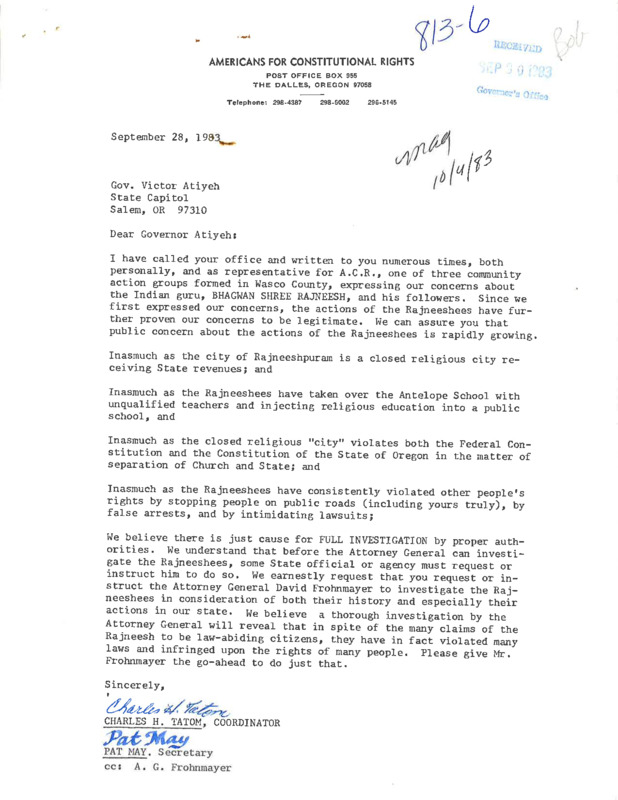
Letter from Charles H. Tatom, coordinator for Americans for Constitutional Rights, to Governor Atiyeh. The letter expresses the concerns of various community action groups regarding Bhagwan Shree Rajneesh and his followers. The group further requests that Governor Atiyeh instruct the Attorney General, Dave Frohnmayer to conduct an investigation, based upon the violation of the First Amendment, by harassing the community, as well as the city of Rajneeshpuram receiving State revenues. Also included is the Americans for Constitutional Rights statement of purpose. This item was a part of the papers of Bob Oliver, Governor Atiyeh's legal counsel.
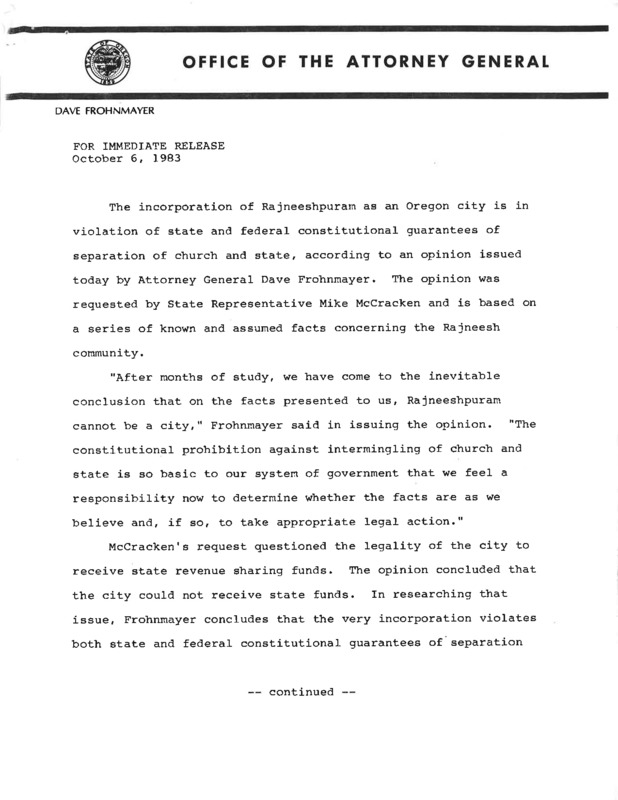
A press release and legal opinion from the office of Oregon Attorney General Dave Frohnmayer concerning the incorporation of Rajneeshpuram as a city. Frohnmayer is quoted as saying that Rajneeshpuram cannot be incorporated because the community was 'a total fusion of government and of religious functions,' and as such would violate the constitutional principle of separation of church and state. The press release is followed by the text of Frohnmayer's legal opinion. This item was a part of the papers of Bob Oliver, Governor Atiyeh's legal counsel.
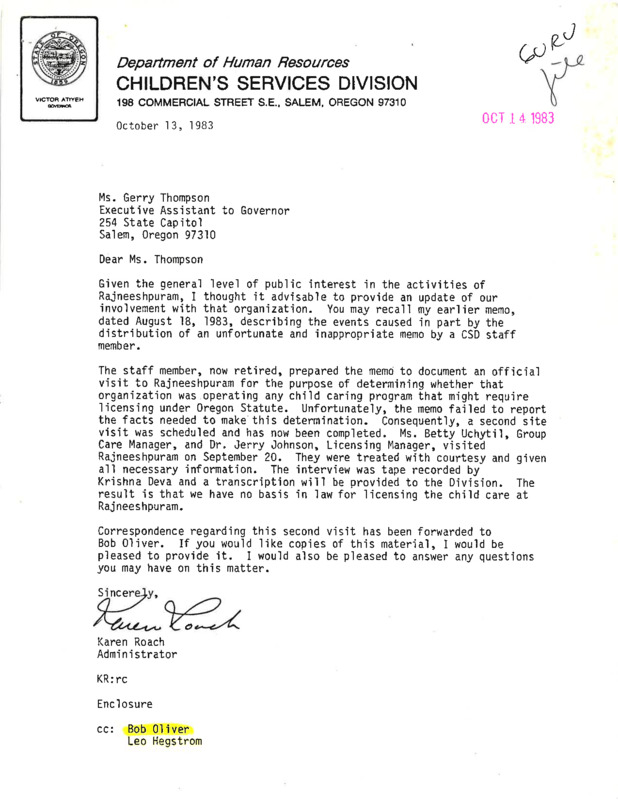
Letter from Karen Roach, an Administrator in the Oregon Children's Services Division, to Gerry Thompson, Chief of Staff for Governor Atiyeh. The letter explains that a previous memo sent out by a member of the staff contained incorrect information regarding the childcare program in Rajneeshpuram. A second site visit was scheduled and new information is available for the Governor's office to review. This item was a part of the papers of Bob Oliver, Governor Atiyeh's legal counsel.
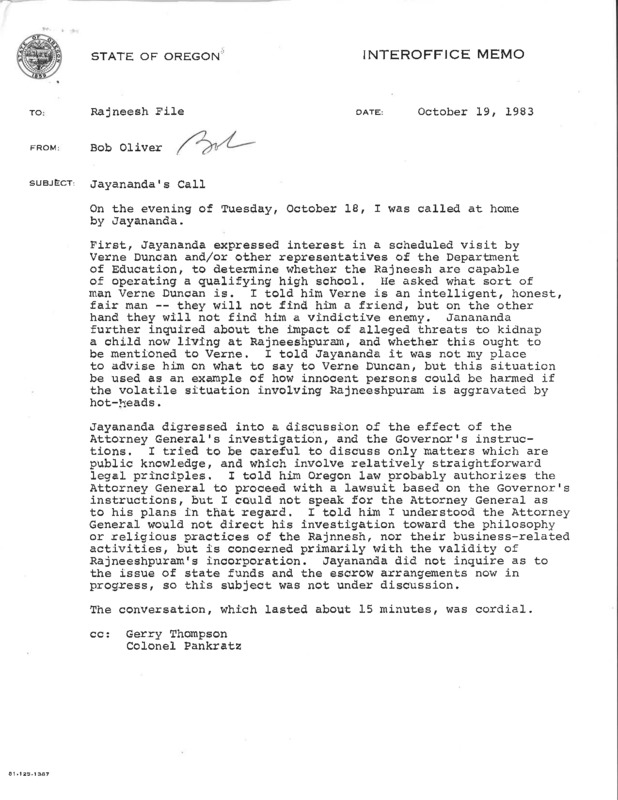
Interoffice memo for the Rajneesh file written by Bob Oliver, legal counsel to Governor Atiyeh, reporting on a telephone call from Jayananda, a member of the Rajneeshpuram community. Jayananda called him at his home to inquire about several issues including whether the Rajneesh might be able to operate a highschool, the background of a Rajneesh opponent named Verne Duncan, and recent threats of kidnapping. They also discussed the state's lawsuit blocking Rajneeshpuram's incorporation. An attached memo from Bob Oliver to Gerry Thompson, the Governor's Chief of Staff, concerning the possibility of a decline the Rajneesh leader Bhagwan's health, as well as rumors about drug use. This item was a part of the papers of Bob Oliver.
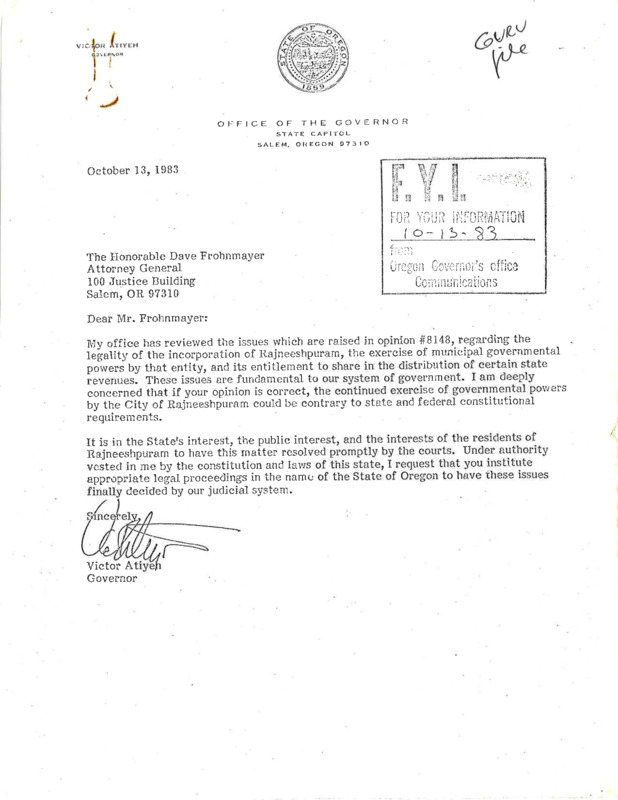
A letter from Governor Atiyeh to Oregon Attorney General Dave Frohnmayer covering the developing issue of allotting state funds to the city of Rajneeshpuram while its legal incorporation is being called into question. The Governor requests that for the good of the state, as well as for the good of the public interest, the issue be finally resolved in the courts through appropriate legal proceedings. This item was a part of the papers of Bob Oliver, Governor Atiyeh's legal counsel.
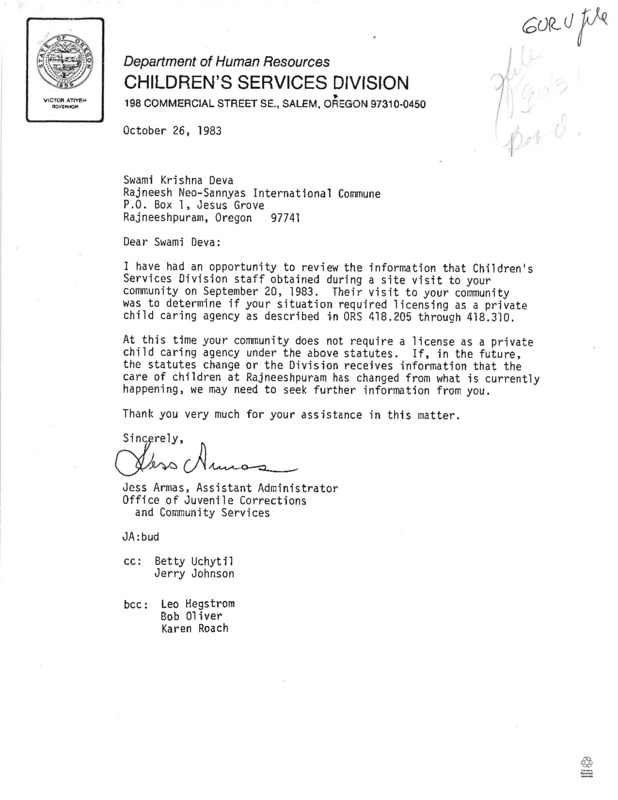
Letter from Jess Armas, an Administrator within the Oregon Children's Services Division, to Swami Krishna Deva, the mayor of Rajneeshpuram. The letter informs the mayor that after review, the Children's Services Division staff determined that the childcare facility within the community did not require licensing as a private agency, as long as the current state of care is not subject to change. This item was a part of the papers of Bob Oliver, Governor Atiyeh's legal counsel.
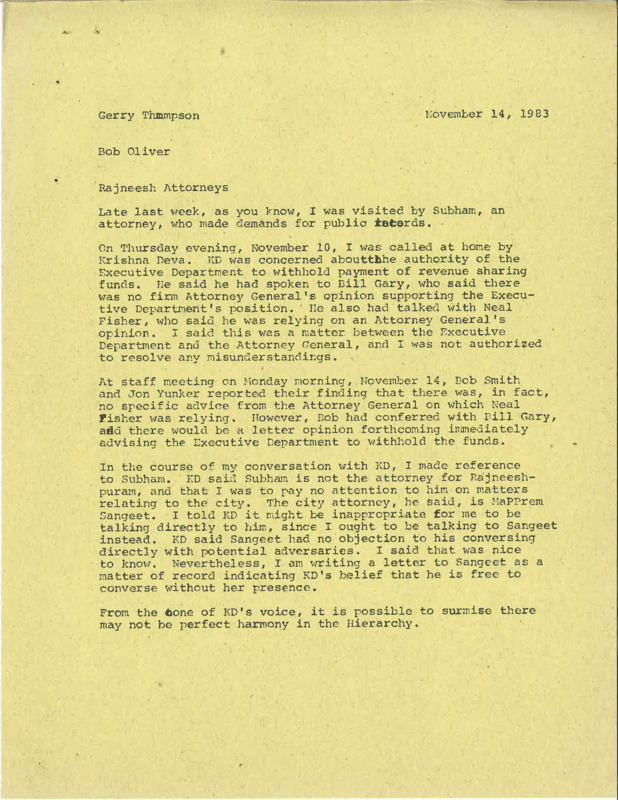
A memo from Bob Oliver, legal counsel to Governor Atiyeh, to Gerry Thompson, the Governory's Chief of Staff. The memo relays information regarding a conversation with Krishna Deva, the mayor of Rajneeshpuram, who had expressed concern over state funds being withheld. The withholding was due to the state's legal objections over the community's attempt to incorporate itself as a city. Krishna Deva also advises that the Governor's office should not communicate with Swami Prartho Subhan as he is not the attorney for Rajneeshpuram; the city's attorney is Ma Prem Sangett. Included is a memo from Bob Oliver to attorney Ma Prem Sangett advising him of the conversations had with Mayor Krishna Deva. This item was a part of the papers of Bob Oliver.
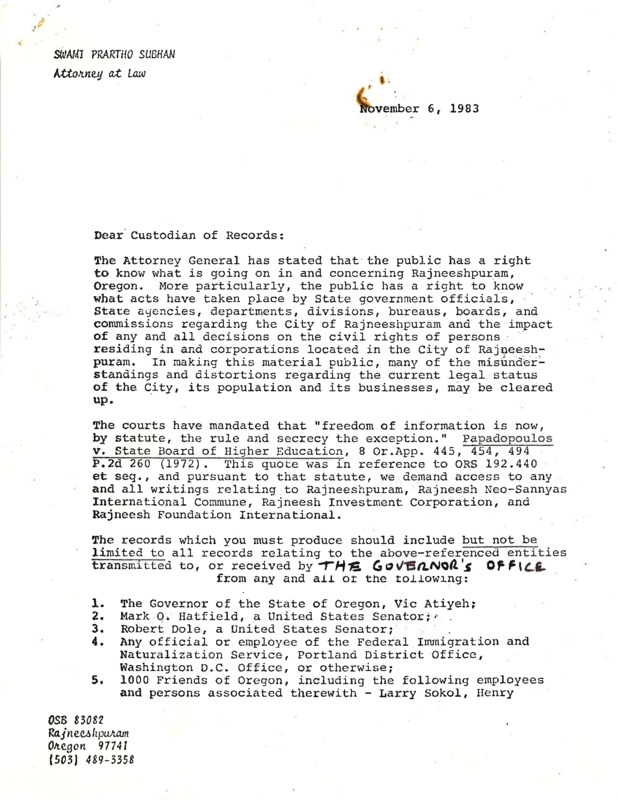
Letter from Swami Prartho Subhan, who represents himself as an attorney for the community of Rajneeshpuram, to the custodian of records in the Oregon Governor's office. Subhan argues that precedents set in previous cases have mandated access to government records. He requests all writings and records dealing with the Rajneesh to be produced. This item was a part of the papers of Bob Oliver, Governor Atiyeh's legal counsel.
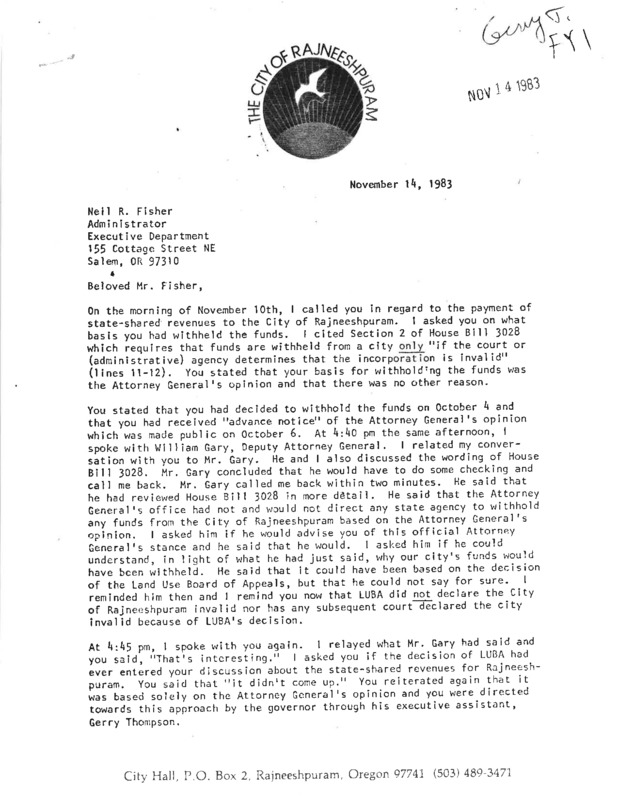
Letter from Swami Krishna Deva, the mayor of Rajneeshpuram, to Neal R. Fisher, of the Oregon Governor's Accounting Division. The letter summarizes a series of interactions had between the two about the withheld state funds. Bill 3028 states that agencies cannot withhold funds based solely upon the opinion of an Attorney General, rather, only if the Land Use Board of Appeals had declared the city invalid. As the city was not labeled invalid, the City of Rajneeshpuram demands that the state-shared revenues be released and the mistake rectified. This item was a part of the papers of Bob Oliver, Governor Atiyeh's legal counsel.
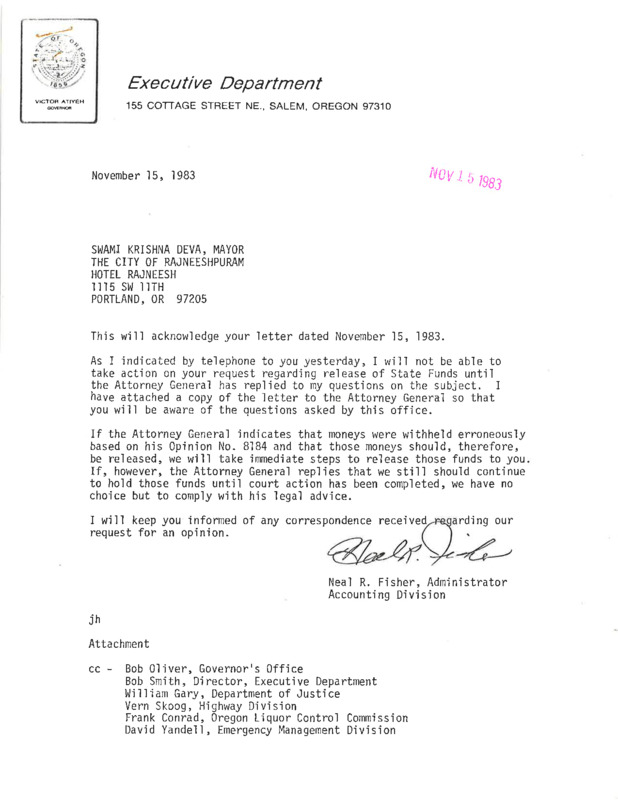
A letter from Neal R. Fisher of the Oregon Executive Department's Accounting Division to Swami Krishna Deva, the Mayor of Rajneeshpuram. He responds to Rajneeshpuram's request regarding state funds, explaining that no state funds can be released until his office receives a reply from the Attorney General. Also included is a letter from Fisher to Attorney General Dave Frohnmayer inquiring as to whether or not various agencies should continue to withhold distributions of funds to the city of Rajneeshpuram. This item was a part of the papers of Bob Oliver, Governor Atiyeh's legal counsel.
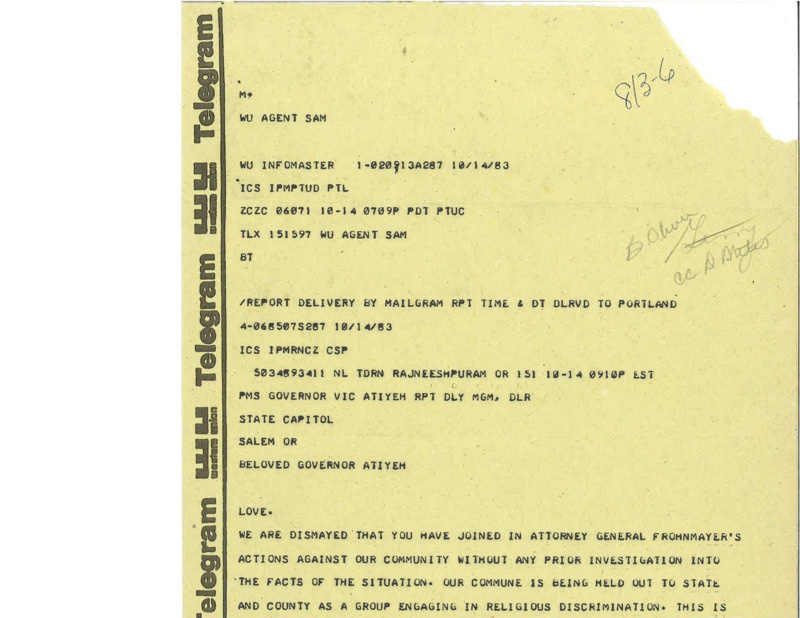
Telegram from Na Yoga Didya, President of the Rajneesh Neo-Sannyasin International Commune, to Governor Atiyeh. The telegram explains the shock the Rajneesh community experienced upon discovery of the Governor's involvement in the case against them. The case, filed by Oregon Attorney General Dave Frohnmayer, was an attempt to prevent the community of Rajneeshpuram from incorporating as a city. This item was a part of the papers of Bob Oliver, Governor Atiyeh's legal counsel.
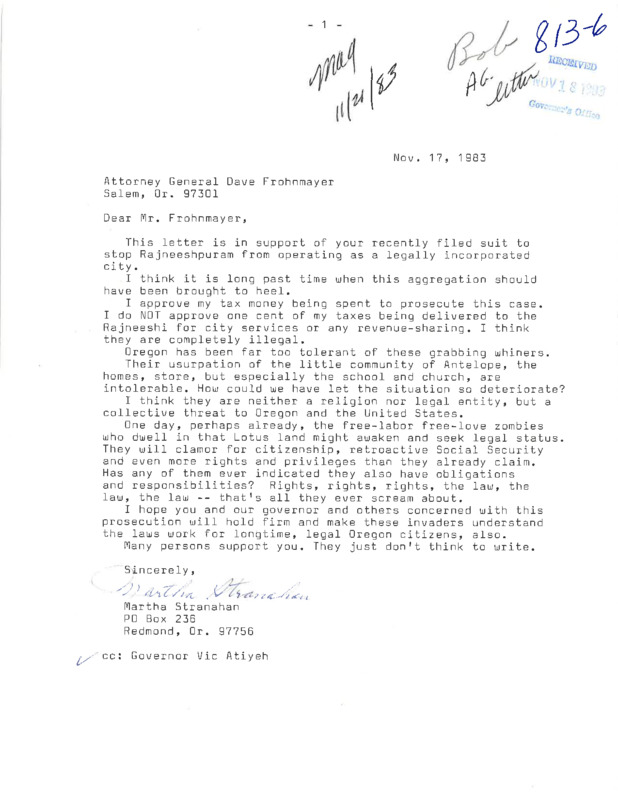
Letter from Martha Stranahan, a journalist from Redmond, to Oregon Attorney General Dave Frohnmayer explaining her support for his suit filed to prevent the community of Rajneeshpuram from operating as an incorporated city. She also expresses her dislike for the Rajneesh and belief that they pose a threat. This item was a part of the papers of Bob Oliver, Governor Atiyeh's legal counsel.