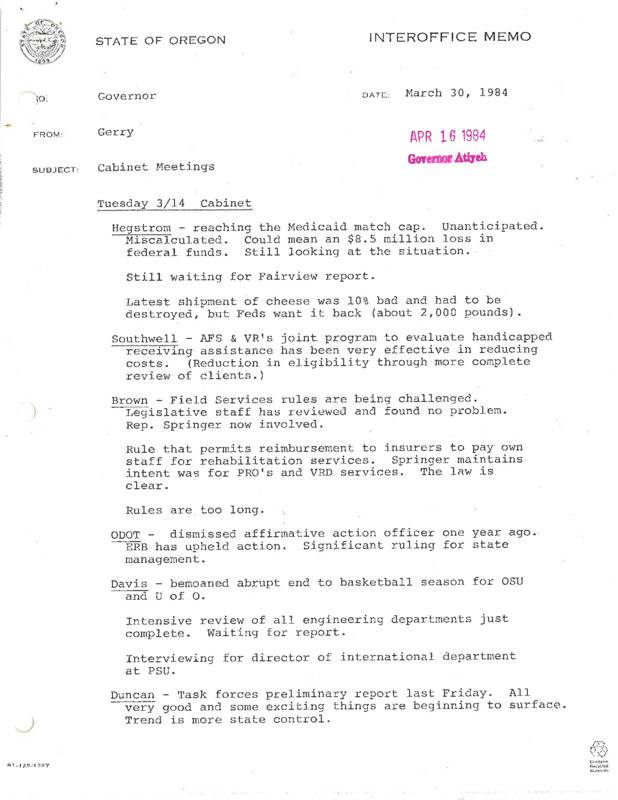
A memo prepared by Gerry Thompson reporting to Governor Atiyeh. The report dates from March 14, 1984 - March 30, 1984 and address topics including: AFS & VR joint program; Field Services rules; Sauvie Island Industrial heating oil incident; ODOT; 'I-5 Killer' book; HB 4170 Mortgage Tax Subsidy Bond act; Harney County; SB 710; Worker's Comp.; Starve Mountain Ranch; Winchester Dam; and the Rajneeshpuram Court of Appeals. This is one document from a binder containing selected daily reports to the Governor, which was compiled by Gerry Thompson.
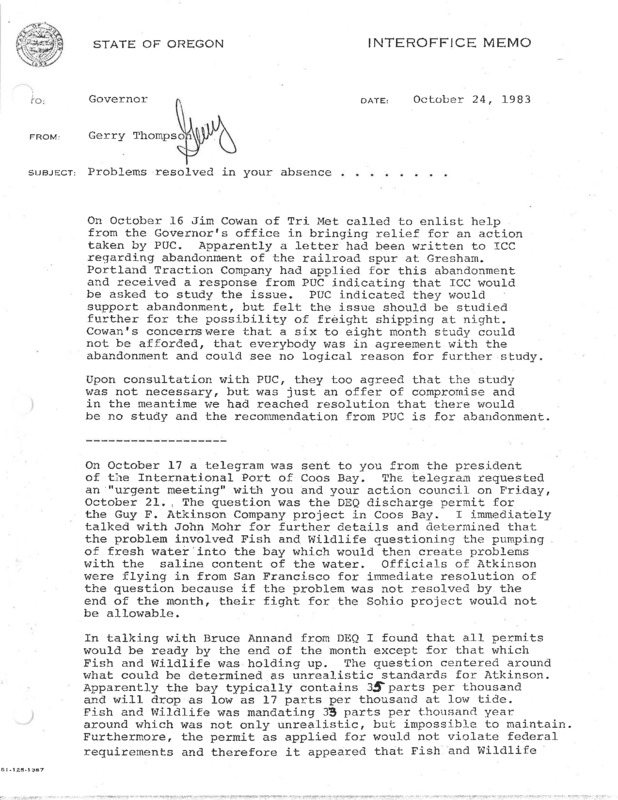
A memo on a report update by Gerry Thompson reporting to Governor Atiyeh on October 24, 1983. This report was written due to Governor Atiyeh's absence on October 16 through October 19. Topics addressed in this report include: the Trimet, PUC, and Transportation Department; Guy F. Atkinson Company project in Coos Bay; the federal Fish and Wildlife; Tongue Point Crown Zellerbach project; LUBA; Rajneeshpuram; the Real Estate Commissioner and the Oregon Association of Realtors; Tongue Point; and Intel. This is one document from a binder containing selected daily reports to the Governor, which was compiled by Gerry Thompson.
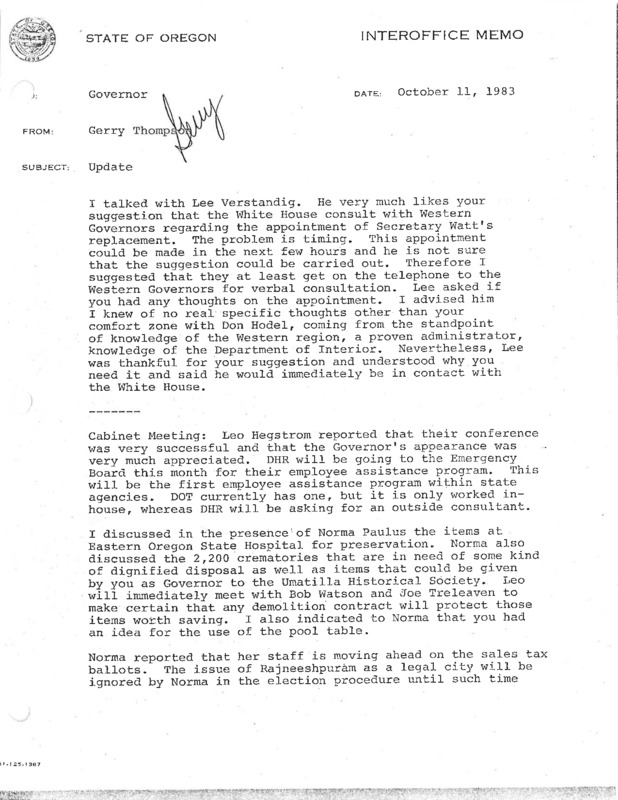
A memo on a daily update report by Gerry Thompson reporting to Governor Atiyeh on October 11, 1983. This report covers topics including: Secretary Watt's replacement; Emergency Board employee assistance program under the DHR; Eastern Oregon State Hospital; Rajneeshpuram; University of Oregon; the racing bill; and LUBA. This is one document from a binder containing selected daily reports to the Governor, which was compiled by Gerry Thompson.
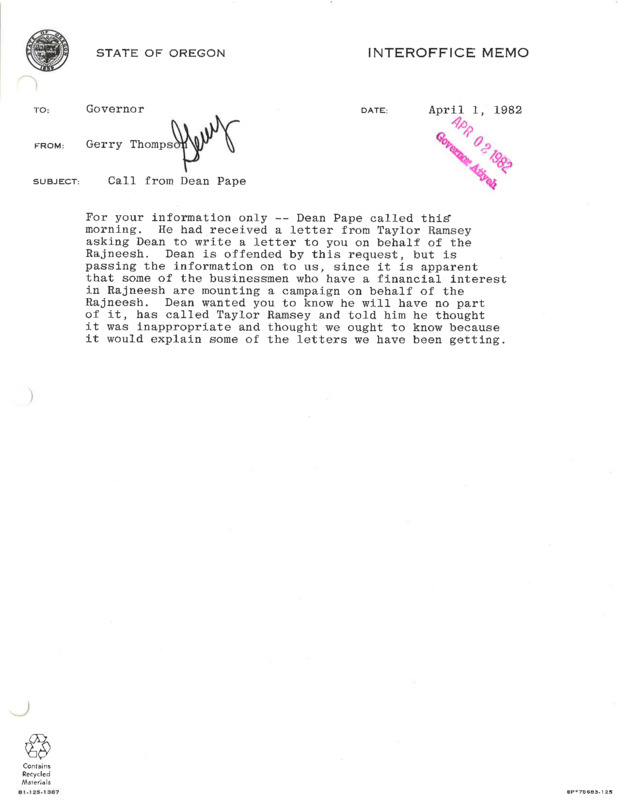
A memo prepared by Gerry Thompson reporting a conversation from Dean Pape to Governor Atiyeh on April 1, 1982. This report concerns an interest in Rajneesh that is sparking a campaign. This is one document from a binder containing selected daily reports to the Governor, which was compiled by Gerry Thompson.
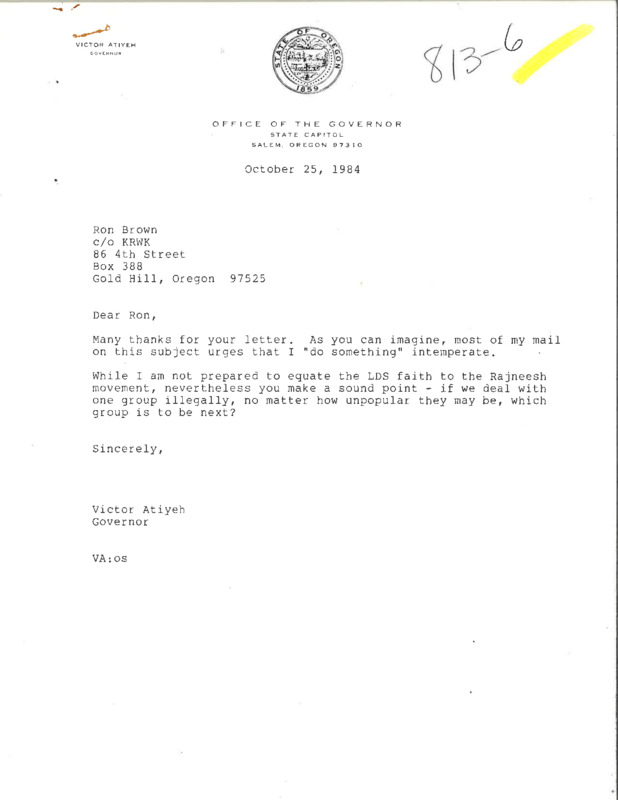
Letters relating to the Rajneesh crisis between Rob Brown, reporter for 100 FM, and Governor Atiyeh. Brown had recently heard Atiyeh speak about the Rajneesh at a Medford Rotary meeting and is writing with additional thoughts. He compares the Rajneeshees, as an unpopular religious sect, to the Mormons in 1800s America. Brown warns that there is a danger in responding too harshly to the Rajneesh, and as an example, he encloses a copy of an 'Extermination Order' that Governor Boggs of Missouri issued against the Mormons in 1838. Brown expresses respect for Oregon officials's moderate handling of the Rajneesh situation and hopes that violence will not erupt in Wasco County. In a letter of response, Atiyeh agrees that all groups, even unpopular ones, must be handled through legal means. This item was a part of the papers of Bob Oliver, Governor Atiyeh's legal counsel.
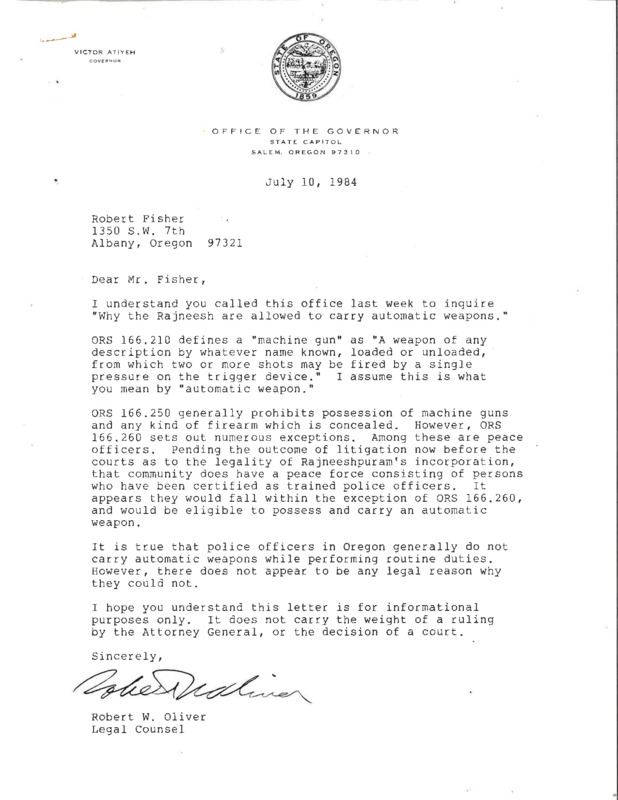
Letter from Bob Oliver, Governor Atiyeh's legal counsel, to Robert Fisher, Oregon resident. The letter responds to a phone call from Robert Fisher in which he questioned the legality of the Rajneesh carrying automatic weapons. In the letter, Oliver explains that under certain Oregon codes, until the incorporation of Rajneeshpuram is determined, their peace force may legally carry these weapons. Included is the original call slip and phone memo. This item was a part of the papers of Bob Oliver, Governor Atiyeh's legal counsel.
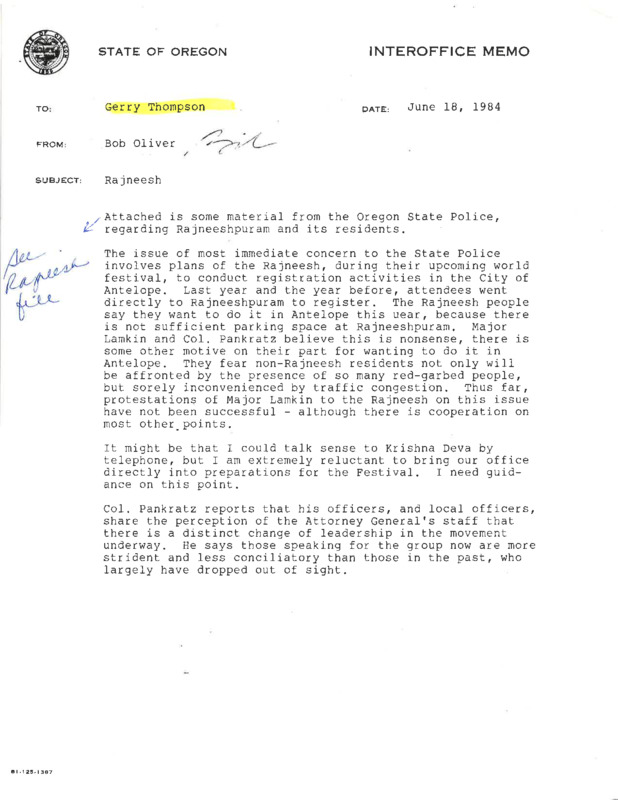
A memo from Bob Oliver, legal counsel for Governor Atiyeh to Gerry Thompson, the governor's chief of staff. He describes concerns of the Oregon State Police in reference to the 1984 Rajneesh World Festival. One of their main concerns is that the Rajneesh intended conduct voter registration in the city of Antelope, in preparation for the November 1984 elections. Oliver expresses concern in regards to the turn in temperament of the group due to leadership changes. This item was a part of the papers of Bob Oliver.
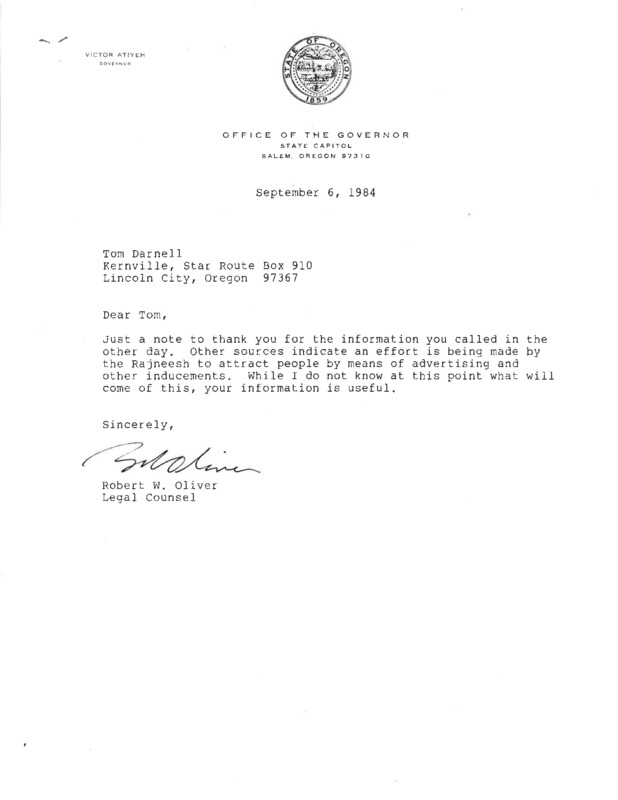
Letter from Bob Oliver, legal counsel for Governor Atiyeh to local resident Tom Darnell. The letter thanks Mr. Darnell for calling in information regarding Rajneesh advertising. This item was a part of the papers of Bob Oliver, Governor Atiyeh's legal counsel.
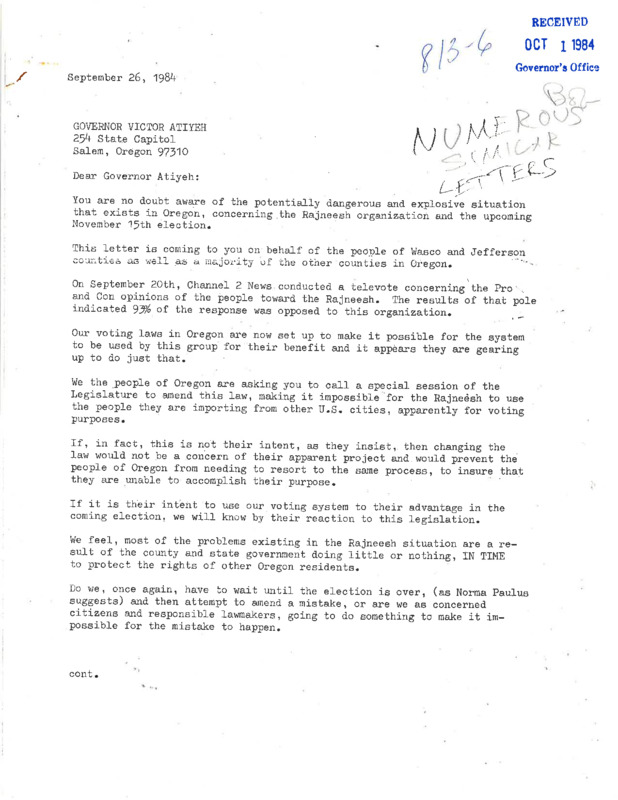
A letter from Reata A. Horney of Concerned Oregon Citizens to Governor Atiyeh. She writes about the upcoming election and the rising tensions related to the Rajneesh crisis. The organization encourages the Governor to rewrite the law that would allow for the Rajneesh to abuse the system, warning that there may be an outbreak of violence amongst the groups. This item was a part of the papers of Bob Oliver, Governor Atiyeh's legal counsel.
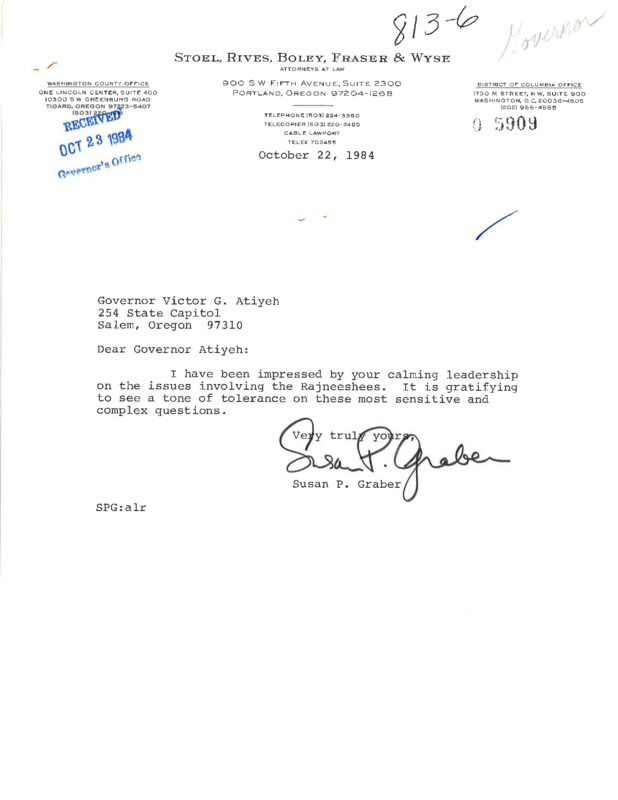
Letter from Susan P. Graber, a partner at Stoel, Rives LLP, to Governor Atiyeh. The letter expresses how impressed she was with the Governor's handling of the complex Rajneesh issue. This item was a part of the papers of Bob Oliver, Governor Atiyeh's legal counsel.
A typed message supposedly signed by Laura Bentley on behalf of an anti-Rajneesh group named the Concerned Oregonians of Wasco County. Copies of this typed message were distributed in the Dalles in 1984. This copy came into the hands of Bob Oliver, legal counsel to Governor Atiyeh. The message is overtly racist. It states that the Concerned Oregonians of Wasco County admires the Ku Klux Klan and is making plans to keep Oregon 'pure and white.' The message connects these racist views to the group's opposition towards the Rajneesh community of Wasco County.
Though the message is supposedly signed by Laura Bentley, who was a leader of the Concerned Oregonians of Wasco County group, it was more likely written by Rajneesh followers who were trying to undermine her. Laura Bentley had publicly opposed the Rajneesh during their attempt to flood the county's voter registration rolls with Rajneesh followers in 1984.
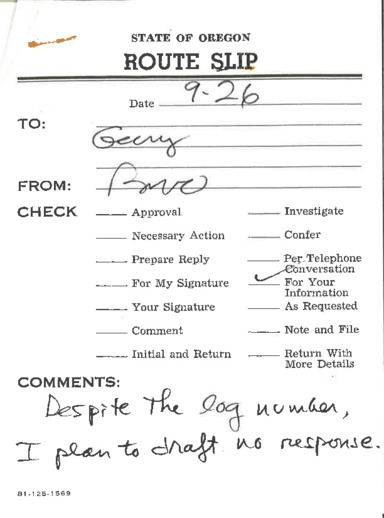
Attached to the telegram is a routing slip, showing that Oliver forwarded the telegram to Governor Atiyeh's chief of staff, Gerry Thompson. This item was a part of the papers of Bob Oliver.
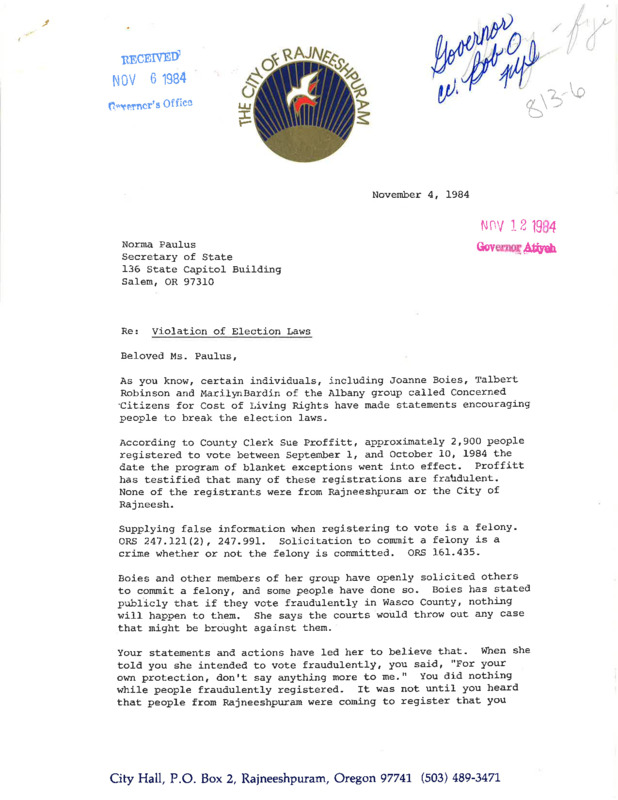
Letter from Ma Prem Sangeet, attorney for the city of Rajneeshpuram to Oregon's Secretary of State, Norma Paulus. Sangeet writes regarding the Rajneesh Foundation's belief that unfair voting practices were being implemented during a voter registration period. The Rajneeshpuram community felt that fraudulent registration was encouraged and requests that the Secretary of State take steps to enforce the law. This item was a part of the papers of Bob Oliver, Governor Atiyeh's legal counsel.
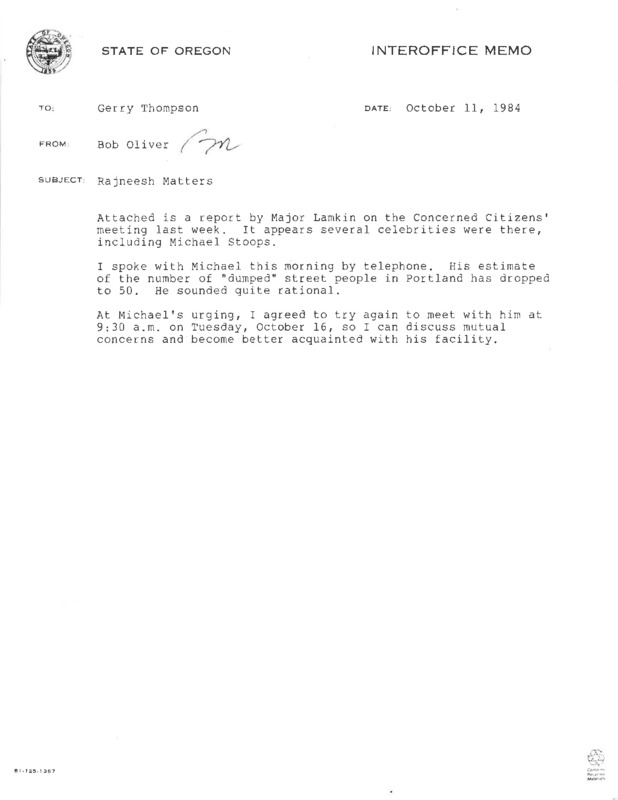
Memo from Bob Oliver, Governor Atiyeh's legal counsel, to Gerry Thompson, the governor's chief of staff. He describes a report done by Major Lamkin on the Concerned Citizen's meeting regarding the Rajneesh community. Oliver planned to further discuss matters with local celebrity and activist, Michael Stoops. This item was a part of the papers of Bob Oliver.
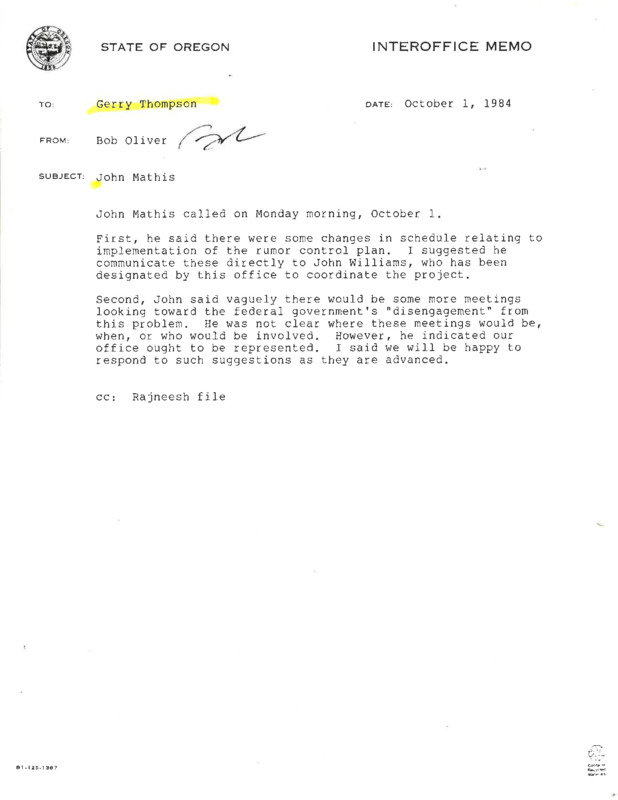
Memo from Bob Oliver, Governor Atiyeh's legal counsel, to Gerry Thompson, the governor's chief of staff. Bob Oliver writes an account of a phone call he received from John Mathis, who was a part of the Rajneesh department of community relations in Seattle. The conversation covered updates for a rumor-control network and a need for a representative from the Governor's office to be present at future meetings about the federal government's 'disengagement'. This item was a part of the papers of Bob Oliver.
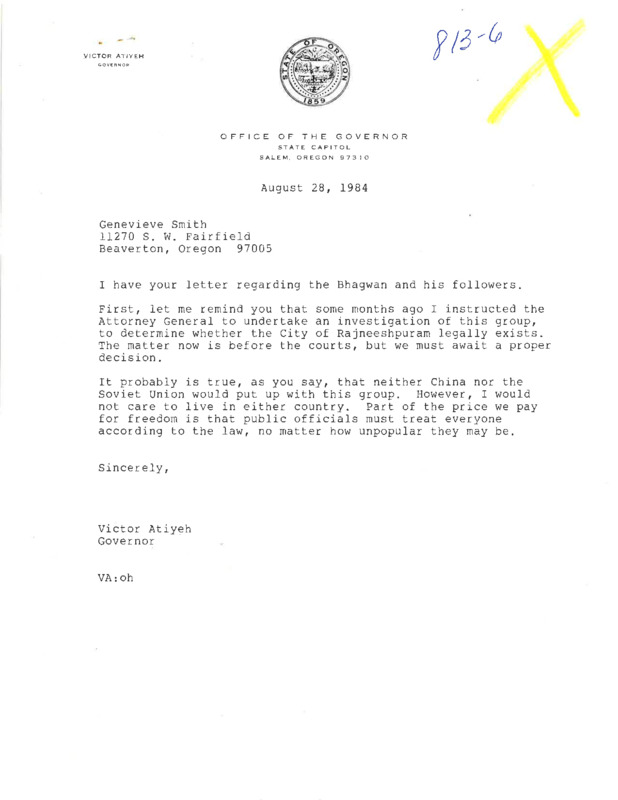
Letter of response from Governor Atiyeh to Genevieve Smith, a resident of Beaverton, Oregon. Atiyeh responds to comments she made regarding the ongoing court case about the legality of Rajneeshpuram. The letter closes with a statement that these sacrifices of comfort must be made for equality and freedom. This item was a part of the papers of Bob Oliver, Governor Atiyeh's legal counsel.
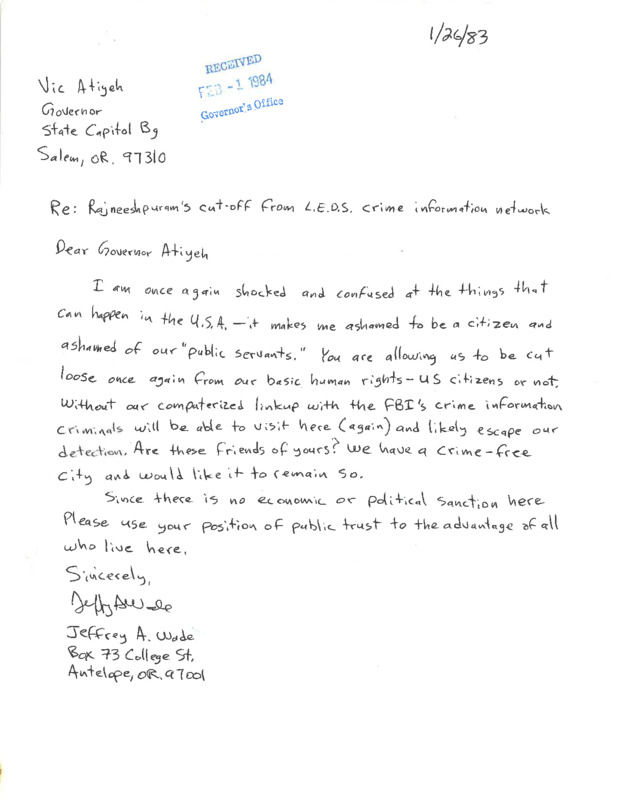
Letter from Jeffrey Wade, a pro-Rajneesh resident of Antelope, to Governor Atiyeh. He expresses his frustration that the Governor allowed Rajneeshpuram to be cut off from the F.B.I.'s National Crime Information Center database. This cut-off had occurred in mid-1984 after the state's attorney general, David Frohnmayer, had filed a suit against the incorporation of Rajneeshpuram. Jeffrey Wade argues that the lack of access to the crime database will result in criminals entering Rajneeshpuram undetected. This item was a part of the papers of Bob Oliver, Governor Atiyeh's legal counsel.
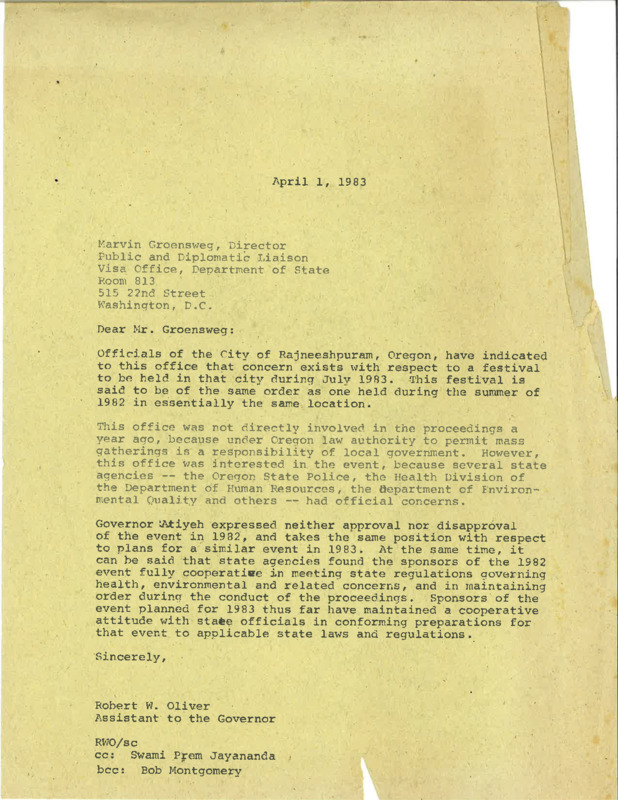
Memo from Bob Oliver, legal counsel for Governor Atiyeh, to Marvin Groensweg, Director, Public and Diplomatic Liaison in the Visa Office. The memo covers the concerns of several state agencies regarding another festival being held in Rajneeshpuram. At current projection the regulations were being met and followed as they had previously. This item was a part of the papers of Bob Oliver, Governor Atiyeh's legal counsel.
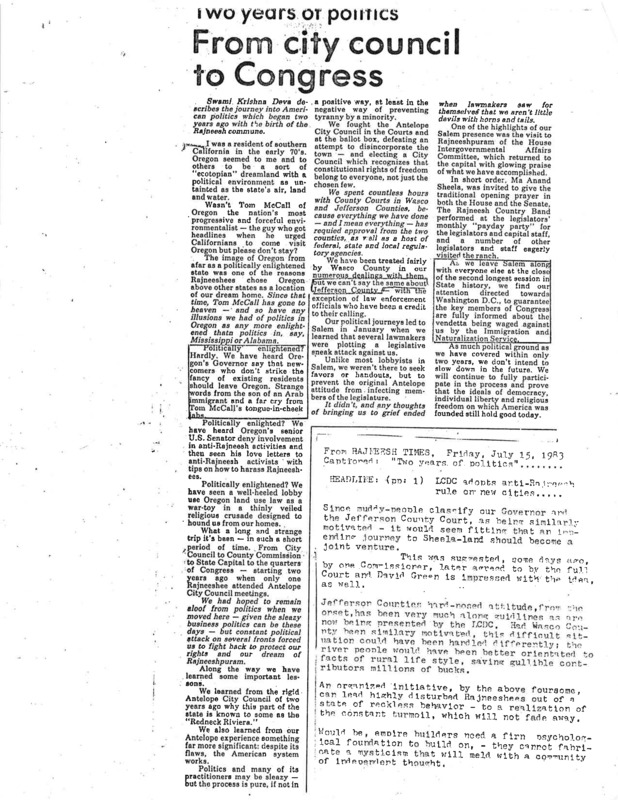
An article written in the Rajneesh Times on Swami Krishna Deva's evolution in American politics, from the point of view of the Rajneesh community. It describes the battle between the residents of Antelope and the citizens of Rajneeshpuram over incorporation. The article closes with the promise on behalf of the Rajneesh to continue participating in the process and their intentions to become further involved in local politics. This item was a part of the papers of Bob Oliver, Governor Atiyeh's legal counsel.
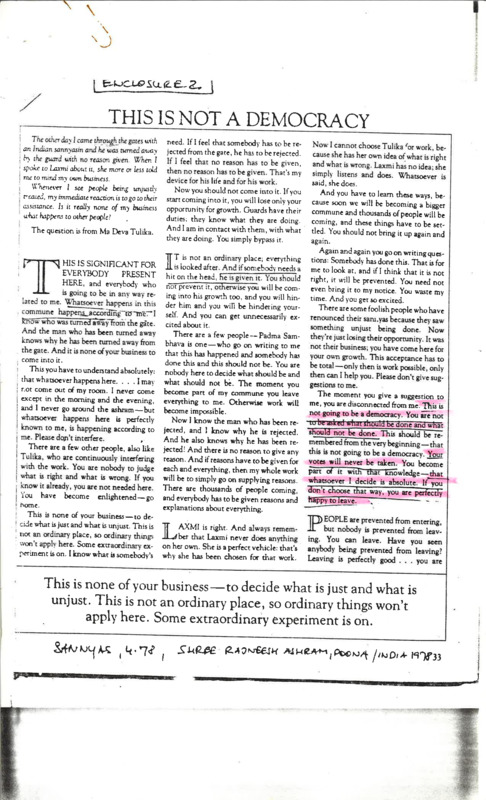
A statement apparently released on behalf of Bhagwan Shree Rajneesh in regards to a situation in which an Indian male sannyasin was removed from the premises of the Rajneesh ashram in Poona, India. This incident resulted in some tension surrounding the ashram. Specific portions in the writing have been highlighted, one section states that the ashram is not a democracy and Bhagwan is the absolute vote. Similar writings are underlined throughout the rest of the article. This item was a part of the papers of Bob Oliver, Governor Atiyeh's legal counsel.
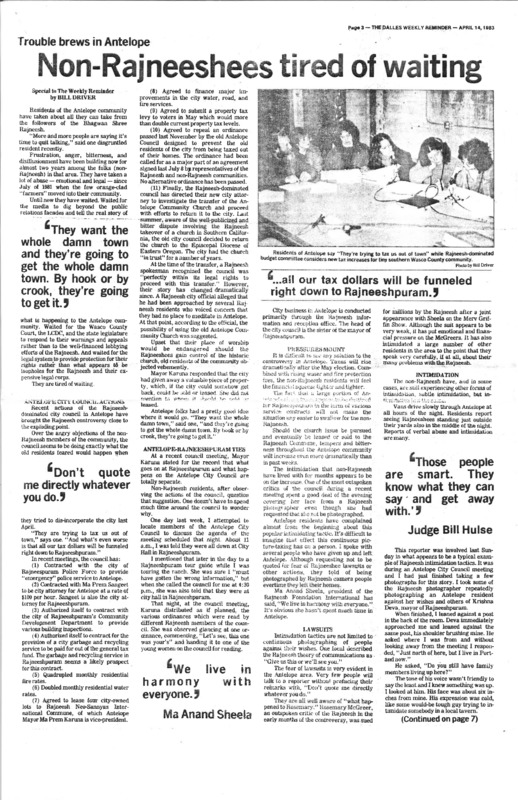
The article written by Bill Driver in the Dalles Weekly Reminder, titled 'Non-Rajneesh tired of waiting' overviews many of the frustrations of Antelope residents. He writes about the results of the Antelope residents' attempt to disincorporate their city the previous year. Several different residents provided statements for the article in regards to their interactions with the Rajneesh. They describe intimidation tactics, threats of lawsuits and talks of violence by the Rajneesh. The article points out the local residents' belief that there is urgent need for intervention. This item was a part of the papers of Bob Oliver, Governor Atiyeh's legal counsel.
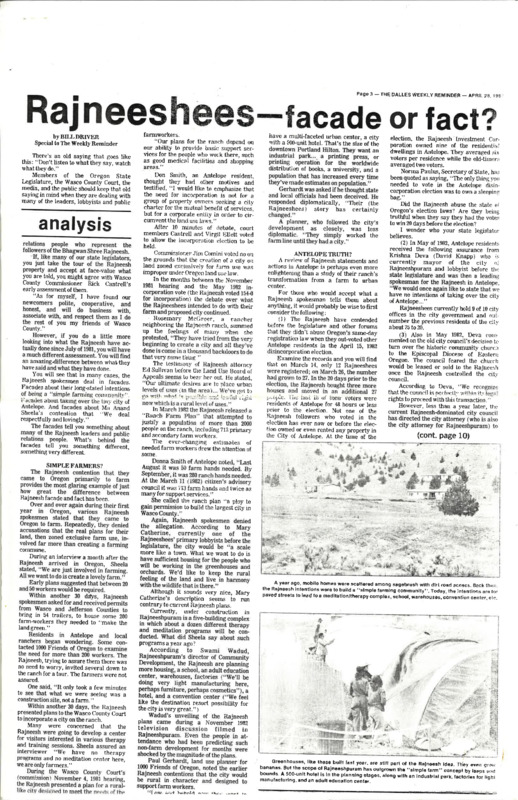
A newspaper article by Bill Driver from the Dalles Weekly Reminder covering many of the rumors surrounding the commune. The author attempts to explore the actions of the Rajneesh and the reasons for their behavior. He notes that the Rajneesh claim to be simple farmers, leaving the town of Antelope alone, as well as the general temperament of the community. Included within the article are several different statements from locals and photographs from within Rajneeshpuram. This item was a part of the papers of Bob Oliver, Governor Atiyeh's legal counsel.
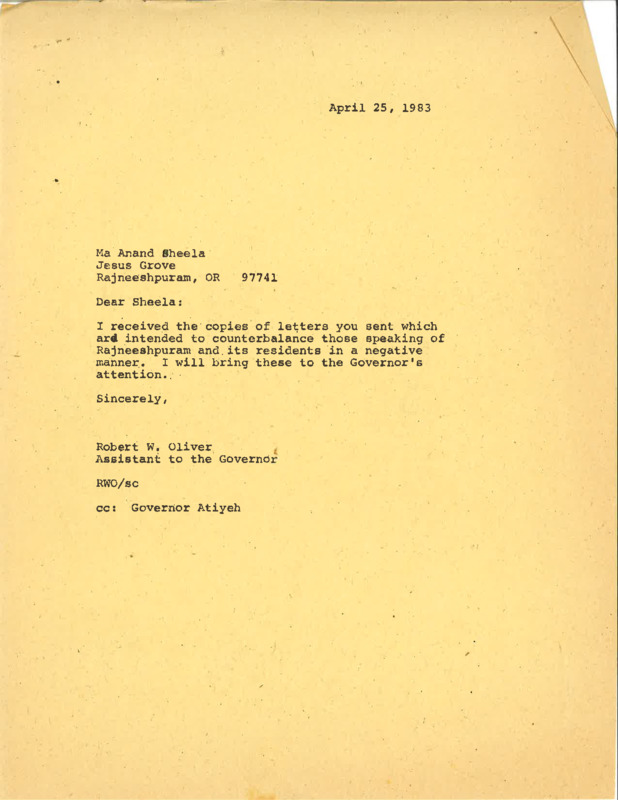
Memo from Bob Oliver, legal counsel for Governor Atiyeh, to Ma Anand Sheela of the Rajneesh. The memo discusses some copies of letters received by the Governor's office that were sent in response to complaints. Bob informs Sheela that the letters will be brought to the Governor's attention. Also included is the initial letter sent from Ma Anand Sheela about the letters. This item was a part of the papers of Bob Oliver, Governor Atiyeh's legal counsel.
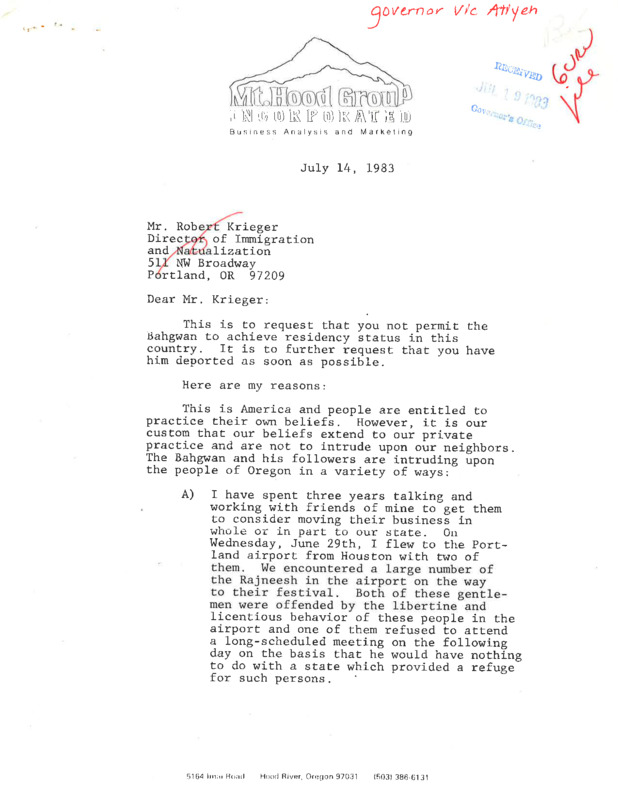
Letter from Robb Bell of Mt. Hood Group Inc., requesting that Robert Krieger, Oregon Director of Immigration and Naturalization, not allow Bhagwan to achieve residency. The letter explains why Bhagwan Shree Rajneesh should not only be denied residency but also why the state should deport him as soon as possible. The letter covers Robb Bell's belief that the Rajneesh have ill-intent and that the overall economy and lives of residents are being disturbed by their presence. This item was a part of the papers of Bob Oliver, Governor Atiyeh's legal counsel.
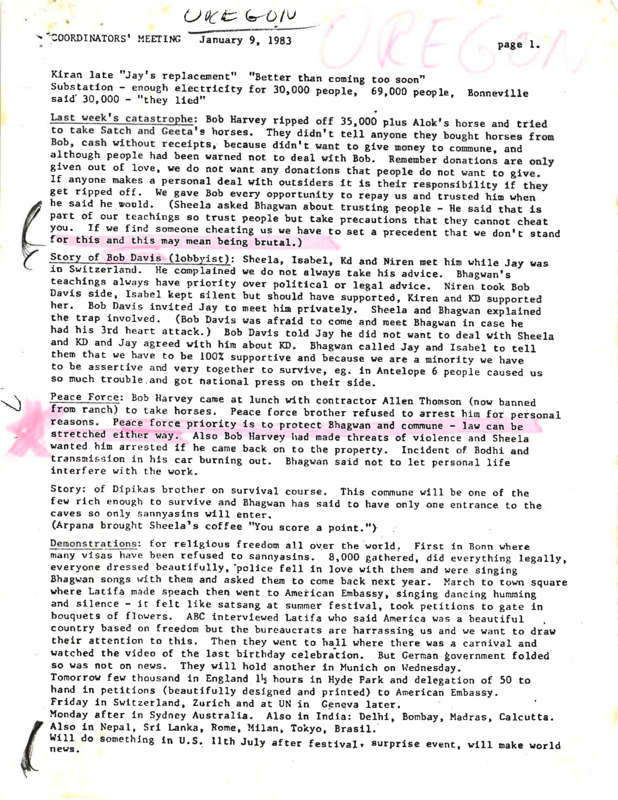
Notes from a Rajneesh Foundation's Coordinators meeting covering various topics, updates and current events within the Rajneeshpuram community. Some sections of the notes are highlighted, generally noting the more violent side of the Rajneesh, such as their beliefs that laws can be stretched in order to protect the Bhagwan, the war they are in against bureaucrats, and justice for being cheated out of money. The notes close stating that they are to be shredded after use. This item was a part of the papers of Bob Oliver, Governor Atiyeh's legal counsel.