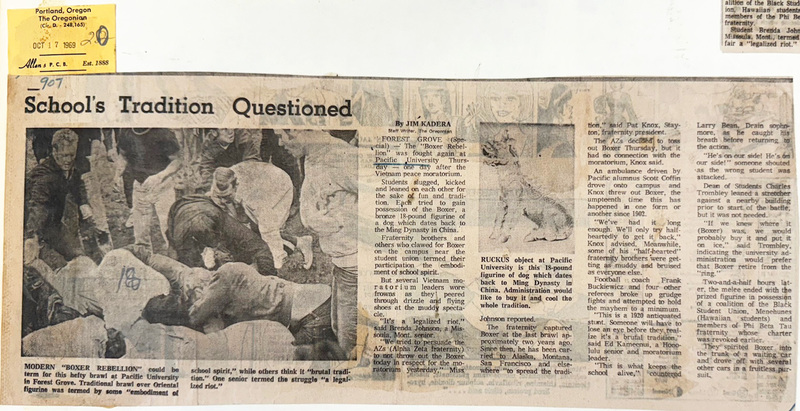
A newspaper article from The Oregonian titled "School's Tradition Questioned," regarding a "Boxer Toss" which occurred on Pacific University's campus on October 16, 1969. This would be the last time that the original Boxer statue was seen in public for 55 years, until it was returned in 2024. The article describes how the Alpha Zeta fraternity "threw out" Boxer into a crowd of students who fought over it. This had been a tradition at Pacific University for decades. However, this Boxer Toss took place one day after anti-Vietnam activists had organized a "Peace Moratorium" march in Forest Grove. The article describes how several students involved in organizing the march opposed the tradition as violent and antiquated.
A photograph of US Congressman Les AuCoin riding the MAX light rail in Portland, Oregon in 1990. Congressman AuCoin contributed to the development of the Metropolitan Area Express (MAX), particularly the west side transit system. This photograph was featured in an edition of The AuCoin Report newsletter.
A clipping of an Oregonian article by Huntly Collins titled "Skid Road hotels visit staggers Rep. AuCoin," published on October 14, 1975. The article describes US Congressman Les AuCoin's visit to the Burnside area and Lownsdale Square hotels of Portland in order to witness those in crisis facing homelessness and addiction. Describing his encounter with one man as "the most profound experience I have ever had," he also discussed possible solutions: "Public funds simply cannot do the job alone.... Private capital has to be put to work, also....The aim would be a national housing policy....Currently, I think we have none....But if we are going to save the cities, we are going to have to provide decent housing, strengthen neighborhoods and allow a mix of people."
A collection of newspaper articles from the 1992 US Senate race in Oregon. The collection includes an Oregonian article on Congressman AuCoin's endorsement by the National Organization for Women, an Oregonian article titled "Packwood in Peril" by Jeff Mapes, a Register-Guard article titled "AuCoin: Play fair or we'll raise our trade barriers" by Brent Walth, a Roll Call article titled "Political Briefing" by Tim Curran, an Oregonian article titled "AuCoin advocates health-care system similar to Canada's" by Jeff Mapes, and a Corvallis Gazette-Times article titled "AuCoin calls for huge defense cut."
A clipping of an Oregonian newspaper article titled "AFL-CIO endorses AuCoin" by Jeff Mapes, published on October 26, 1991. As the Democratic candidate for the 1992 US Senate election in Oregon, US Congressman Les AuCoin received an endorsement from the American Federation of Labor and Congress of Industrials Organizations (AFL-CIO).
A clipping of an Oregonian newspaper article describing US Congressman Les AuCoin's emergence as a national leader in Congress after 15 years in the US House of Representatives. The article, which was published on January 22, 1990, describes his legislative history, including his leading of pro-choice activists in the House, his role on the House Appropriations Committee, and his future legislative goals relating to forest research, timber appeals, timber communities, the Tri-Met expansion to downtown Hillsboro, export licensing, and capital gains tax legislation. The article features a photograph of AuCoin in Portland.
An excerpt of the Oregonian article "We don't have time for this" by Steve Duin, first published on March 19, 1992, and reprinted by the Les AuCoin for Senate Committee. Duin's article analyzes the 1992 House banking scandal in Congress, of which AuCoin was later cleared of any wrongdoing by the US Department of Justice. In 1992, an investigation discovered that hundreds of members of Congress had overdrafted their House bank accounts numerous times, although it was found that the vast majority did so unintentionally -- as the House bank system did not properly alert members of their overdrafts and delayed processing deposits -- and did not break any laws. Duin describes the scandal as "absurdly overblown," defending both Congressman Peter DeFazio and Congressman Les AuCoin.
A clipping of an Oregonian newspaper article by staff writer Les AuCoin covering the defeat of Howard Morgan for the Democratic nomination in the 1968 US Senate primary election in Oregon. The article's title is cut off from the clipping, but it may perhaps be "The Annoucement of Defeat" or "The Statement of Defeat."
A news article published by the Oregonian that includes handwritten notes prepared by Gerry Thompson to Governor Atiyeh on April 12, 1984. The article explains the veterans home loan program and limitations due to the Tax Reform Act of 1984. This article also addressed government officials including: Republicans Denny Smith and Bob Smith; Democrats Les AuCoin, Ron Wyden and Jim Weaver; Oregon Senator Bob Packwood; and Rostenkowski. This is one document from a binder containing selected daily reports to the Governor, which was compiled by Gerry Thompson.
News clippings from the Oregonian on Oregon's unemployment and Dr. John V. Byrne attached together with handwritten notes done by presumably Gerry Thompson on April 11, 1984. There is emphasis on improving wood products industry to help create jobs and emphasis on Dr. Byrne leaving his position as the head of National Oceanic and Atmospheric Administration. Topics addressed in these articles also included Raymond Thorne, the Oregon Employment Division administrator and the Oregon State Board of Higher Education. This is one document from a binder containing selected daily reports to the Governor, which was compiled by Gerry Thompson.
A news article on the China Arts & Cultural burglary by Steven Amick, an Oregonian staff member, on November 2, 1983. Topics that are addressed in this article include: Kafung F. Yap, director of the CACC; the International Trade Division of the Oregon Department of Economic Development; Fujian officials and Chinese trade; the Oregon Legislature; and Taiwan as the sister state claimed by Governor Atiyeh. This is one document from a binder containing selected daily reports to the Governor, which was compiled by Gerry Thompson.
Newspaper article from the Oregonian on Governor Victor Atiyeh's thoughts on the violence between Israel and Syria during his Middle East trade mission.
Newspaper clipping from the Oregonian during Governor Victor Atiyeh's Middle East trade mission. Atiyeh dances during celebrations in Amar, Syria, the home of his father.
Newspaper clipping from the Oregonian during Governor Victor Atiyeh's Middle East trade mission in Amar, Syria, the home of Atiyeh's father. In both images, the left from 1984 and the right from 1929, Atiyeh stands below a welcome sign.
Newspaper clipping from the Oregonian during Governor Victor Atiyeh's Middle East trade mission. Atiyeh and his wife, Dolores, are visible among the celebrating crowd in Amar, Syria, the home of Atiyeh's father.
Newspaper clipping from the Oregonian during Governor Victor Atiyeh's Middle East trade mission. Pictured are Edward and Richard, the brothers of Governor Victor Atiyeh, during their 1929 visit to Amar, Syria, the home of Atiyeh's father.
Newspaper article from the Oregonian during Governor Victor Atiyeh's Middle East trade mission. It discusses the connections of Amar, Syria, the home of Atiyeh's father, which he visited during his trip, and the many Oregon residents with roots in the village.
Newspaper article from the Oregonian discussing Governor Victor Atiyeh's visit to the ruins of Quneitra, Syria during his Middle East trade mission. The Syrians held the Israelis responsible for the demolition of the town in 1974.
Newspaper article from the Oregonian discussing the political challenges necessary for Governor Victor Atiyeh's visit to Syria during his Middle East trade mission.
Newspaper article from the Oregonian discussing the scheduling mix-up that resulted in Governor Victor Atiyeh arriving at a deserted airport in Syria during his Middle East trade mission.
Newspaper article from the Oregonian discussing Governor Victor Atiyeh's attempt to avoid politics during his Middle East trade mission and the refusal of his accompanying businessmen to travel to Israel.