Postcard photograph of the Forest Grove Hotel probably dating from around 1910, with a letter from Edith Pechin written on the reverse. The hotel stood in downtown Forest Grove on the south side of Pacific Avenue between A and Main streets, approximately where the Community School stands today. It was also known as "Mrs. Sloan's Hotel" or "The Sloan." Based on the sign, this photographs dates from after the Sloan family had sold the hotel around 1905. In earlier years, it had been a stagecoach stop on the route between Tillamook and Portland. The tracks in the street appear to be from a trolley that ran through downtown Forest Grove. It was a cross-gabled, Carpenter Gothic building with gingerbread trim around the front porch posts and the eaves. Built in 1862, it had been replaced with another building by the 1930s.
A photograph of the Forest Grove Hotel probably taken around 1900. The name of the proprietor, "Mrs. S.A. Sloan," appears on the sign, which is hanging from a large oak tree. The hotel was also known as "Mrs. Sloan's Hotel" or "The Sloan." It stood in downtown Forest Grove on the south side of Pacific Avenue between A and Main streets, approximately where the Community School stands today. It was a stagecoach stop on the route between Tillamook and Portland; steps to get on/off a coach can be seen in this photograph. The hotel was a cross-gabled, Carpenter Gothic building with gingerbread trim around the front porch posts and the eaves. Three women sit on the front porch, two in light-colored blouses and skirts, one wearing a hat. Another woman sits next to them, and appears to wear a darker dress with 'leg-o'-mutton' sleeves. The Forest Grove Hotel was built in 1862 and had been replaced with another building by the 1930s.
Black and white image of a two-story, square, hip-roofed building. A row of people stands in front, including several children and one man holding a bicycle. Several boys in hats sit on the boardwalk in front of the hotel. 'Cornelius Hotel.' [sic] is emblazoned between the floors on each visible side of the hotel.
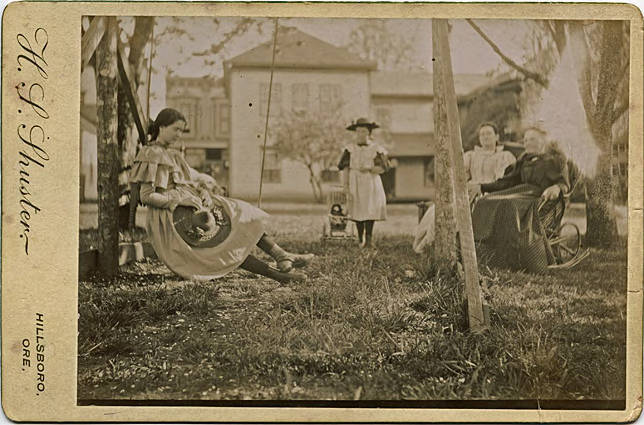
Sepia-toned image of two women and three girls sitting in a yard behind a building. One women wears a dark dress and sits in a rocking chair; the woman sitting next to her wears a light-colored dress. Both have their hair up in buns, and their sleeves have large puffs on the upper arm. The girl in the middle of the image wears a dark, knee-length dress with a white pinafore skirt and a flat-brimmed hat. She has a doll carriage with a doll sitting in it. The other young woman also wears a knee-length dress and has a flat-brimmed hat. She leans on a board attached to a tree, and her dress has large puffed sleeves and a shoulder ruffle. The building behind them is two-stories with three sections, built in a cross-gabled style.
Black and white image of a group of men gathered in front of a building. The men, largely wearing suits and hats, stand along the porch while some sit in chairs and others along the edge of the porch. One man in a light-colored shirt and wearing kepi is kneeling on one knee and holds a small dog in his arms. A streetlamp stands on the opposite edge of the boardwalk from the hotel. Numbers are written one or near most of the men, linking them to a list on the back.
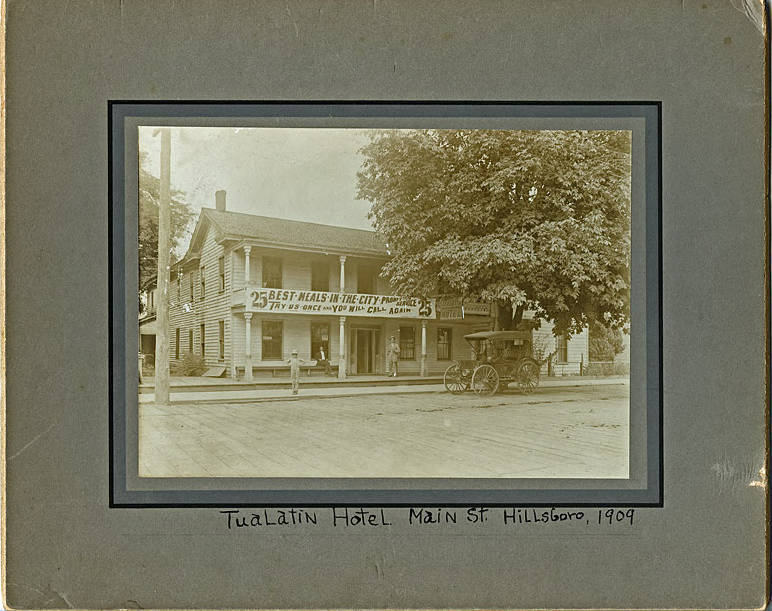
Sepia-toned image of a two-story, cross-gabled building with covered porches along both floors on the front. A man sits on a bench on the porch in front of the hotel, just outside the open door, and another man in a suit and a Panama-style hat stands on the porch. A young boy stands, arms akimbo, on the boardwalk in front of the hotel. A large banner covers most of the second-story porch railing and reads, '25 Best Meals in the City, Prompt Service. Try Us Once and You Will Call Again. 25.' Just beyond that a sign protrudes from the same railing. It reads, 'Tualatin Hotel.' Just beneath that sign is parked a four seater automobile with a cover and large spoked wheels that are larger in the back than the front. It features brass lamps and other fixtures on the front. The road is plank, and a large maple tree in full leaf obscures most of the other half of the building.
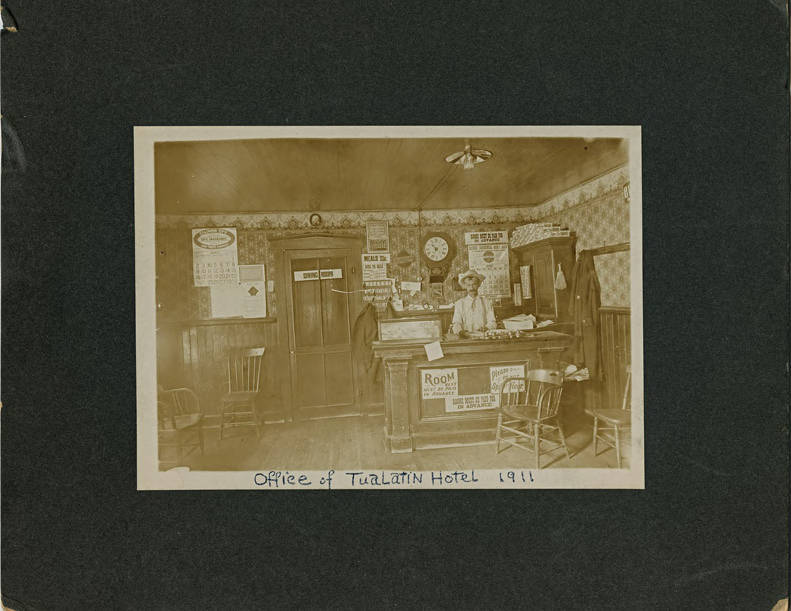
Sepia-toned image on heavy mat showing an interior hotel office with a clerk behind the desk. All three calendars on the wall are turned to July, 1911. The man behind the desk wears a short necktie tucked into his white shirt and suspenders and a light-colored hat. He stands behind a desk in a room with wainscoting; the wallpaper is dark stripes with geometric and foliage patterns, with a light-colored border along the top of the wall. A man's long coat hangs from a hook in the right side of the image. An electric light bulb is set into a fixture on the wooden ceiling, and flypaper hangs on a cabinet door. A door in the center of the wall bears a sign reading 'Dining Room,' and a sign next to the door state 'Meals, 25' and the hours for meals. Several signs state that rooms must be paid for in advance, and another asks patrons 'Please do not spit on the floor.' Three calendars with advertisements hang on the wall, including Illinois Commercial Men's Association, Columbia Life and Trust Company, and Bankers Reserve Life Company. One sign advertises 'Bulletin 5 Cigar,', and a board with numbered hooks, some sporting skeleton keys, hangs beneath that. An inverted horseshoe hangs over the dining room door.
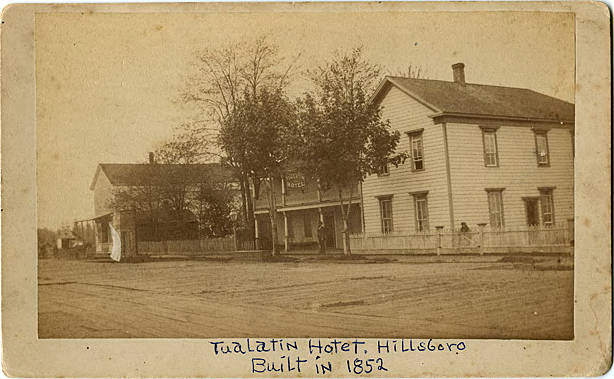
Sepia-toned image of a two-story, cross-gabled building behind a picket fence along a plank road. The building has a covered porch running along both stories on the main section, and double-hung windows along each story in the second section. A man in a suit and hat stands on the step of the front porch, and a young girl in a hat and short dress hangs over the fence beside the building. Two trees in front of the hotel are in full leaf; another, larger tree to one side appears to be just leafing out. Just beyond the building is another, smaller, single-story building with a square front, and then another single-gabled, two-story building with a covered porch and a team tied to the posts. A sign bearing the legend 'Tualatin Hotel' hangs from the second floor porch.
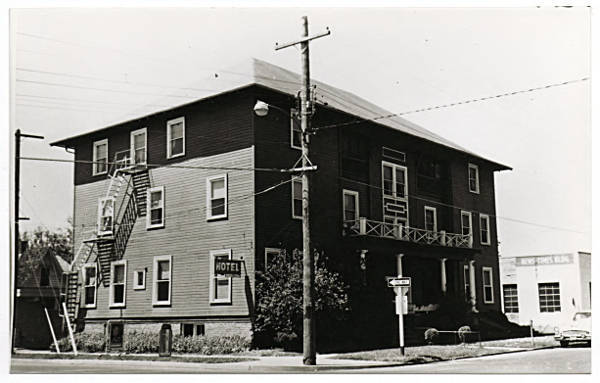
Hotel Oregon was a three story hotel on the corner of Pacific and A Street in Forest Grove until 1959. This was once known as the Laughlin Hotel until a name change in the 1920s. The top floor and roof of the structure are not the original due to a fire that required reconstruction in 1914.
The Laughlin hotel with a street car parked on tracks directly in front of the building. A group of people are on the porch and front steps. Another man is standing on the side of the streetcar. The building is a three story wooden structure with a sign that reads 'THE LAUGHLIN'. The top of a water tower can be seen behind the building.
A white 2-story Victorian hotel building, with cross cathedral floor plan, with spindle work on the matching hipped gabled roofs. Italianate windows on first story. 5 smaller gabled windows are visible on east side, on the second story. Trees in foreground. This building was located on the south side of Pacific Avenue between Main Street and A Street. Street is packed dirt with no curb, sidewalk is probably wood. Street car tracks are visible in the street A two story house can be seen on the right, just beyond the hotel. This is the home of Joseph Marsh.
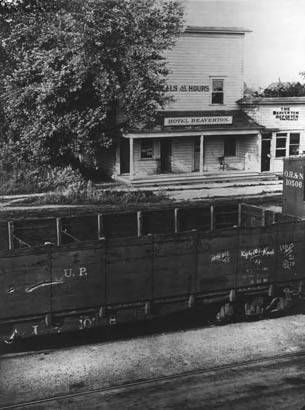
The two-story Hotel Beaverton and Beaverton Reporter were located on Farmington Road and Washington Street, east of Watson Avenue and across (south) from the train depot. Construction date has been tentatively identified as the 1880s. George Thyng owned the hotel about 1907 and sold it by 1910. This building was later known as the Commercial Hotel that was owned and operated by the Merlo family. An early address was 103 SW Farmington Road. The building was extensively renovated and later converted into apartments. It was torn down circa 1969.