Photograph of several residences in Banks, Oregon. Along the right side of the street are, left to right, the Davies House, Galaway House, Grindle House, and the Willis house. Across the street, on the left side of the photo, is the John Carstens House and hop house.
Black and white image of a city street with cars parked along the sides and in the street itself. To the right is a sign for Commercial National Bank and to the left is a Piggly Wiggly grocery store. A truck parked in front of the store has a sign that reads 'Morehouse Glass Co.' on it. In the distance can be seen the Venetian Theater, Perfection Bakery, the offices of the Argus newspaper, the First National Bank, Kramien's and Delta Rexall's drug stores, and a number of other businesses, ranging from drug stores to card rooms and billiards and a malt shop.
Black and white image of four members of the Hillsboro Fire Department standing in front of a stage, on which sits a piano and a number of chairs. Behind them flowers decorate the edge of the stage, with fire hose nozzles at either end. A horseshoe shaped floral arrangement with ribbons indicating it has been awarded to 'Hillsboro Fire Department and City Officials' sits in the center of the image.
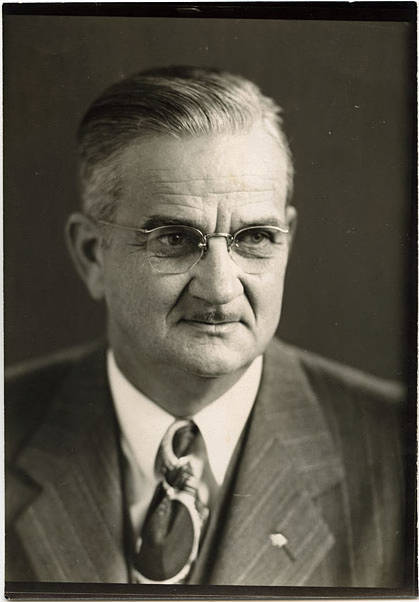
Black and white image of a man, shoulders up, wearing a pin-striped suit and wire framed glasses. The man is identified in museum records as J. W. Barney, City Manager of Hillsboro from 1939 - 1972.
Sepia-toned image mounted on heavy card stock. Several boys in suits and hats stand on a boardwalk in front of a dirt road. An African American man stands with them, and other men stand about the street or sit in front of the Tualatin Hotel, located on the other side of the dirt road. A horse and buggy stand in the middle of the road, and a large wagon with three rows of seating stands a little further down the road. The sign on the building to the image left reads 'Farmers Exchange' and just behind that a sign reads 'Jackson's Billiard Hall.' There appears to only be two buildings on the right side of the street, and possibly four or five on the left side, before trees and fields take over the landscape.
Black and white aerial photograph of Downtown Hillsboro. The courthouse can be seen in the upper right of the image, with the four tall Sequoia trees to one side.
Black and white photograph of a street with a railroad on one side and a few, two-story buildings on the other. Signs advertise meats, ladies, men's, and children's wear, as well as Coca-cola and sandwiches. A grain elevator is visible in the background, and a number of cars are parked along the road. A fire hydrant sits in front of the building on the corner.
A photograph of downtown Hillsboro, Oregon taken looking north from the intersection of Second and Washington Streets circa 1880. In the foreground, three girls hold hands while standing on a wooden sidewalk. The Commercial Hotel, built around 1866, is on the left, with a gas streetlamp nearby. The Feed & Livery shop, which had an opera house above it, is on the right. A group of four boys and two men are standing in front of the Feed & Livery shop. A gas lamp stands just behind the group. This photograph was donated to the museum by Verne McKinney, a local businessman whose family had lived in the area since at least the early 1900s.
Sepia-toned image of a plank street, lined by square-fronted buildings. Most are two-story, though single-story buildings have facades that approximate a second story. The building at the corner right of the street has 'Druggist' lettered in one window. Three men in suits and hats stand on the boardwalk outside this building. A bu8ilding just down from the drugstore advertises 'Furniture. Wall Paper [sic], Picture Framed Glass. Across the street, the first building bears a sign reading 'Post Office,' and just down from that is a striped barber pole, a boot shop, and a meat market. A single gaslight is visible on the far left of the street, and two power poles stand beside buildings on the image right of the street. The planked area is in the middle of the road, with boardwalks running in front of the buildings, and large ditches crossed by wooden ramps between the two. Rows of trees in full leaf line the street beyond the block of businesses.
Black and white image of a street lined with cars. Trolley tracks run parallel to each other in the middle of the street, and a number of people stand on the sidewalks. Buildings are mostly brick, and large power poles dominate both sides of the street. A neon sign for Palm Confectionary is visible on the right edge of the image.
Sepia-toned image of a wooden street with plank sections. Two streetlights sit on either side of the street in the foreground; and a number of two-story buildings line the street. A sign reading 'City Drug Store' extends from the second story of one storefront. A few men in suits stand about in front of the businesses.
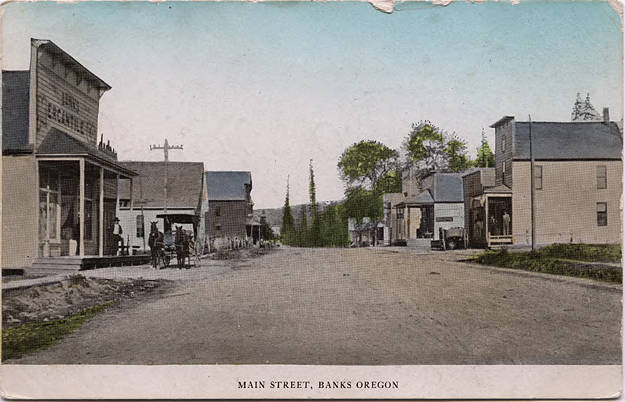
Colorized photo card print of Banks, Oregon. Photo shows a packed dirt road and a clear sky. On the right of the image is a vacant lot and a single pole with a power line running to and from it. Across a dirt street, a series of two-story wooden buildings with tall, square fronts and small windows. People stand on the covered porch of the first building. On the left of the image, another building with a pitched roof and square front has '[?] Mercantile' lettered over a covered porch, where a man leans against the railing. On the street in front of him waits a wagon with a two horse hitch. Visible just beyond the building and before the next is a power pole with a single cross-bar and glass power line insulators. Boardwalks link the buildings, with steps leading up to the porches. Visible in the background is a low hill and a number of leafy trees, pine and deciduous.
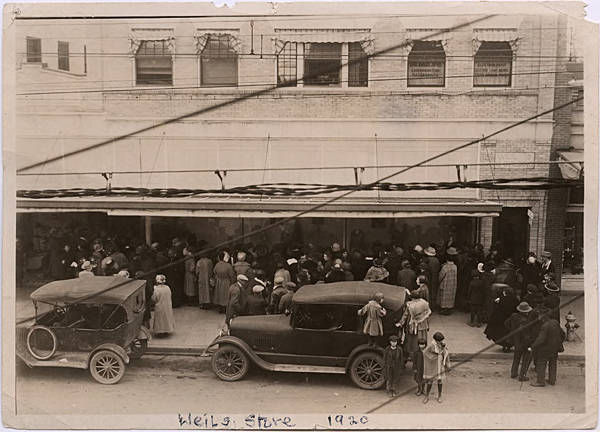
Photo taken from above and across from a group of men, women, and children lined along in front of a store. All are facing the store, wearing coats and hats. Two cars are parked along the dirt street in front of the concrete sidewalk; one resembles a 'jalopy' and has a spare tire rim alongside the driver's side door. The second has a longer wheelbase and a more substantial cab. A child in a long coat and a hat stands on the back rear wheel well; a young boy leans against the car beside her. Two other children stand at the back of the car, facing the street. Two women also stand next to the car, watching the line of people. One of the women has a fur shawl around her shoulders. A fire hydrant is visible on the utmost right of the photo, and power lines criss-cross the image. The building is brick painted white, and awnings shelter glass windows that make up the front of the first floor. Double hung windows with awnings are spaced along the second story, with the window in the middle being multiple paned and having two smaller oblong windows on either side of it.
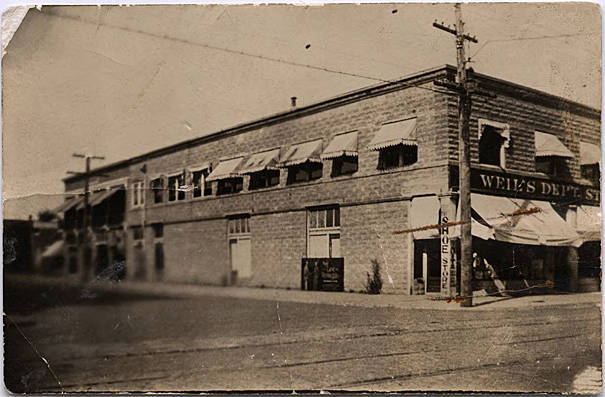
Photo of a two-story brick building on a street corner. The road appears to be dirt, and trolley tracks run from the foreground to the right front of the image. There is a poured concrete sidewalk on both sides of the building. The bricks appear to be roughly cut and larger. The first floor of the building has two larger wooden freight doors topped by four small clerestory windows, one blocked by a metal gate. A second building adjoins on to it at the left rear of the photo. The corner of the building is a recessed entryway, with a support posts reading 'Shoe Store.' Windows take up the right front of the building, with a white awnings overhanging them. A sign reading 'Weil's Dept. Store' rests above the awnings. Pairs of double hung, recessed windows are spaced evenly along the left side of the second story of the building; single double hung windows decorate the front of the second floor. All windows feature awnings that, when extended, shade the top half of the window; most are open, four are furled. A power pole sits on the corner sidewalk in front of the building; it has two cross-struts with multiple transformers, and several power lines run to and from the pole out of the image and down toward another pole just visible in the rear of the image.
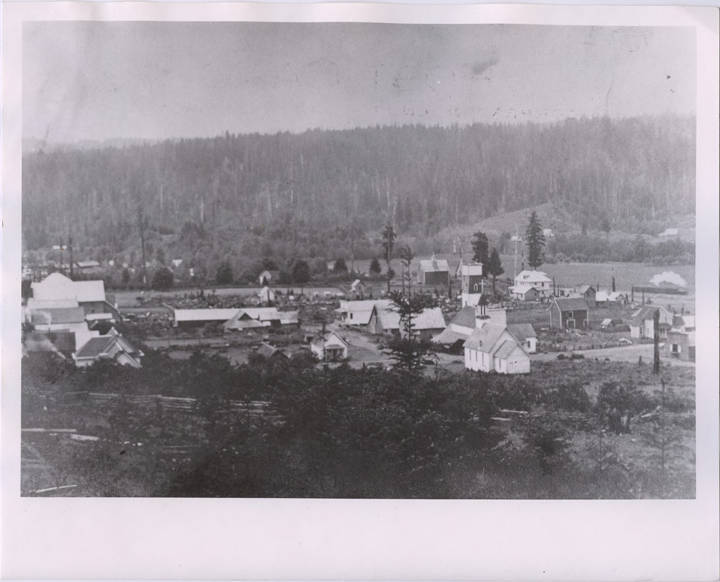
Black & white photo of the town of Buxton, taken from a nearby ridge. A number of houses, ranging from small dwellings to larger two-story structures with nearby barns and outbuildings, and commercial buildings are visible. One is recognizably a church, with a steeple and cross. A wooded ridge rises to the back of the photo, and to the right a train with smoke coming from its smokestack is visible. A split rail fence runs across the lower front of the image.
Newsprint photo mounted on a card of a two-story building. The building is made of rough stone and sits on a street corner with a concrete sidewalk. The road appears to be packed dirt. Down the left side of the building are two large freight doors, with transom windows above. The corner is a recessed entryway, with a stone pillar supporting the overhanging second story. A sign on the lower portion of the pillar states 'Clothing' and 'Dry Goods,' white letters on a dark background. There is a large, glass storefront window, then a door in the middle of the story, with another transom window above it. A second set of windows frames another recessed door, and awnings hang out over both storefront windows. The second story has single, double-hung windows in the front with awnings furled back. The left side has double sets of double-hung windows down the side, also with furled windows. A sign between the floors states 'The People's Store,' and as it wraps around the side, it reads '[illegible] Suits.'
Commemorative postcard showing Banks in 1902 and in 2002. The Post Office was created in 1902, although the town was not officially incorporated until 1921. The photo on the left shows Market and Main Streets in Banks as they appeared in 1902, and the photo on the right show Main Street in 2002, with one of the many logging trucks that pass through town each day.
Main Street in Banks, circa 1910-1912. On the left the blacksmith shop, Kinton & Schulmerich Grocery and Powne & Jensen Grocery and Dry Goods, and Dance Hall are visible. On the right, the Millers Hotel and Bar, Banks Herald office, Washington County Bank and the pharmacy of Dr. William Munford are visible.
Greenville, Oregon in the 1870s. The town had growth enough by this time to justify a post office, but the town dwindled as Banks and Forest Grove prospered, and the post office in Greenville was moved to Banks in 1907.
Main Street in Banks, circa 1910. Buildings on the left: blacksmith shop, Kinton & Schulmerich grocery, Powne & Jenson grocery (with dry goods), and the Dance Hall. On the right: Millers Hotel and Bar, the Banks Herald building, the Washington County Bank, and the pharmacy of Dr. William B. Munford.