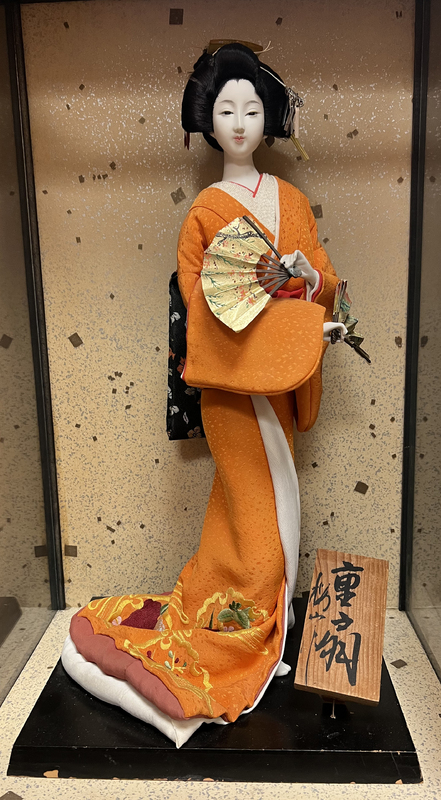
A Japanese doll in a glass case. A gift to President Hallick from Fred Scheller, probably circa 2010. This was a gift bought in Japan by Fred's wife which Fred thought should be given to Pacific University.
A short video of a parade and attendees during the Gay Nineties Festival in downtown Forest Grove, Oregon sometime between 1962-1965. The Gay Nineties Festival was a community event that took place in Forest Grove from the late 1940s to the early 1990s. Celebrating the era of the 1890s, it was originally held in conjunction with the town's Barbershop Quartet Contest. During its heyday, the festival featured a parade, stage shows, and carnival, and attracted thousands of attendees.
The footage was shot from Pacific Avenue near the corner of College Way. People appearing in this video before the parade begins include Don Conrad (wearing a straw flat hat) and other Conrad Family members. Parade participants include: marching bands; a covered wagon; classic cars; floats from St. Anthony's School and Central School; unicyclists; and people in various historic costumes. Locations appearing in the background include the Standard Oil Gas Station, a service station on the corner of College and Pacific, the Grove Theatre, Gimre's Shoes and Floyd's Music. The Tip Top Cafe's blinking neon sign is partially visible near the 1:24 mark: the "O" and "I" in Tip/Top blink on and off.
This video is one of three that was created by local area resident Irene Conrad between 1962-1965 on 8mm film. The family transferred the films to DVD format and then extracted clips in MP4 format. Copies of the MP4 format were given to Pacific University. The videos do not have sound, and no higher resolution version is available.
A short video of a parade held during the Gay Nineties Festival in downtown Forest Grove, Oregon sometime between 1962-1965. The Gay Nineties Festival was a community event that took place in Forest Grove from the late 1940s to the early 1990s. Celebrating the era of the 1890s, it was originally held in conjunction with the town's Barbershop Quartet Contest. During its heyday, the festival featured a parade, stage shows, and carnival, and attracted thousands of attendees.
Parade participants visible in this video include a marching band, a majorette, and horseback riders. The parade footage was shot from Pacific Avenue near the corner of College Way. Locations appearing in the background include the Standard Oil Gas Station and Pacific University's Carnegie Hall.
This video is one of three that was created by local area resident Irene Conrad between 1962-1965 on 8mm film. The family transferred the films to DVD format and then extracted clips in MP4 format. Copies of the MP4 format were given to Pacific University. The videos do not have sound, and no higher resolution version is available.
A short video of a parade held during the Gay Nineties Festival in downtown Forest Grove, Oregon sometime between 1962-1965. The Gay Nineties Festival was a community event that took place in Forest Grove from the late 1940s to the early 1990s. Celebrating the era of the 1890s, it was originally held in conjunction with the town's Barbershop Quartet Contest. During its heyday, the festival featured a parade, stage shows, and carnival, and attracted thousands of attendees.
Parade participants visible in this video include costumed performers portraying pioneers, cowboys and Native Americans. Marching bands, horse-drawn wagons, classic cars and other displays also appear. The parade footage was shot from Pacific Avenue near the corner of College Way. Towards the end of the video, there is footage of Don Conrad opening the door of Gimre Shoes, which stood on the south side of Pacific Avenue between Main and Council Streets. Locations appearing in the background include The Grove Theatre, Standard Oil Gas Station, Gimre's Shoes, a music shop, a coffee shop, and Pacific University's Carnegie Hall.
This video is one of three that was created by local area resident Irene Conrad between 1962-1965 on 8mm film. The family transferred the films to DVD format and then extracted clips in MP4 format. Copies of the MP4 format were given to Pacific University. The videos do not have sound, and no higher resolution version is available.
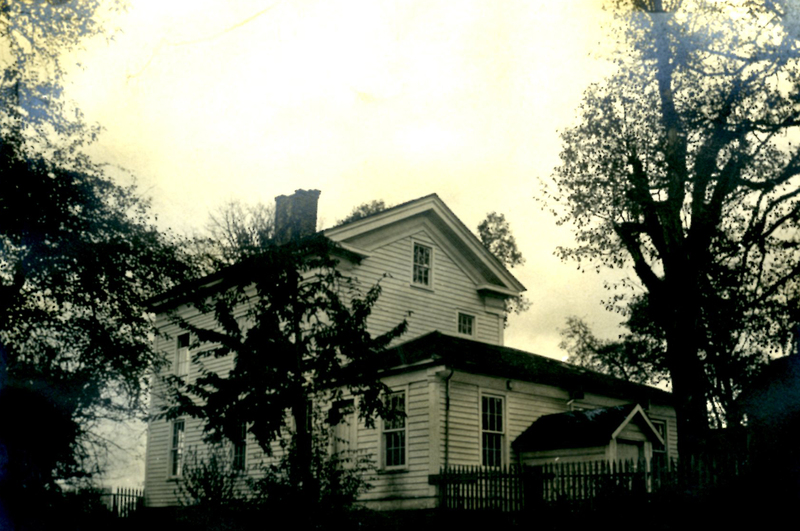
The house of Alvin T. Smith at the south end of what is now Elm Street in Forest Grove, Oregon. This photograph shows the back, or western side, of the house as it appeared circa 1900.
The house was built by Alvin T. or "A.T." Smith between 1854-1856 on his donation land claim, which he first occupied in 1841. He earlier had several log cabins on the property. Smith was a former missionary, a minister, and a carpenter by trade. He lived there with his first wife, Abigail; and then with his second wife, Jane. The house remained in the Smith Family until around 1920. It was placed on the National Register of Historic Places on November 8, 1974, but was abandoned around 1990. Since 2005, it was been owned by the Friends of Historic Forest Grove, who have done extensive stabilization and restoration work.
This photograph is part of the Nettie Shipley Haines photograph album. Some members of the Shipley Family lived near this house in the early 1900s.
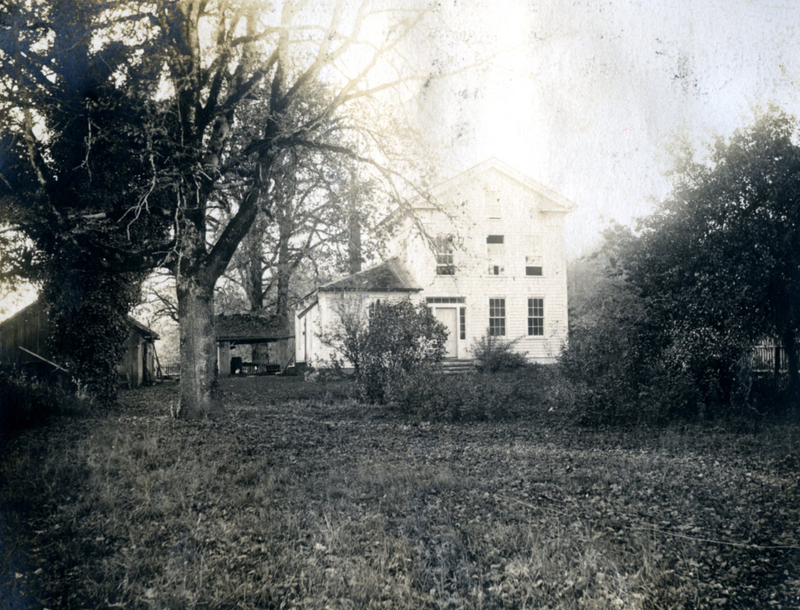
The house of Alvin T. Smith at the south end of what is now Elm Street in Forest Grove, Oregon. This photograph shows the front, or eastern side, of the house as it appeared circa 1890-1910. This photograph was likely taken by or on behalf of one of the members of the Manley Shipley Family, who lived on the property around that time.
The house was built by Alvin T. or "A.T." Smith between 1854-1856 on his donation land claim, which he first occupied in 1841. He earlier had several log cabins on the property; possibly including the cabin structures visible on the left side of this image. Smith was a former missionary, a minister, and a carpenter by trade. He lived in this home with his first wife, Abigail; and later with his second wife, Jane. The house remained in the Smith Family until around 1920, though it was rented out to several families. It was placed on the National Register of Historic Places on November 8, 1974, but was abandoned around 1990. Since 2005, it was been owned by the Friends of Historic Forest Grove, who have done extensive stabilization and restoration work.
This photograph is part of the Nettie Shipley Haines photograph album. Some members of the Shipley Family lived near this house in the early 1900s.
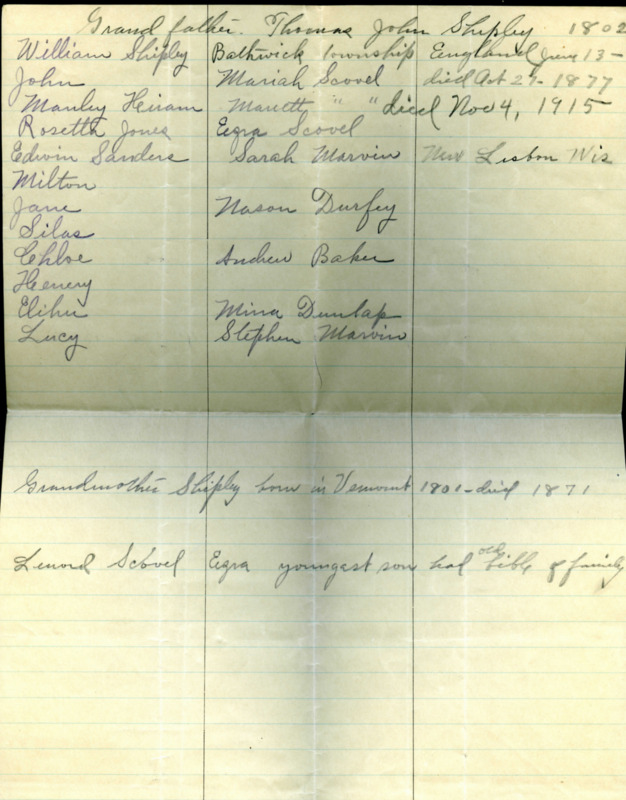
A handwritten note that contains Shipley family genealogical information. This document was tucked into the back of the Nettie Shipley Haines photograph album. This item is part of the Nettie Shipley Haines photograph album.
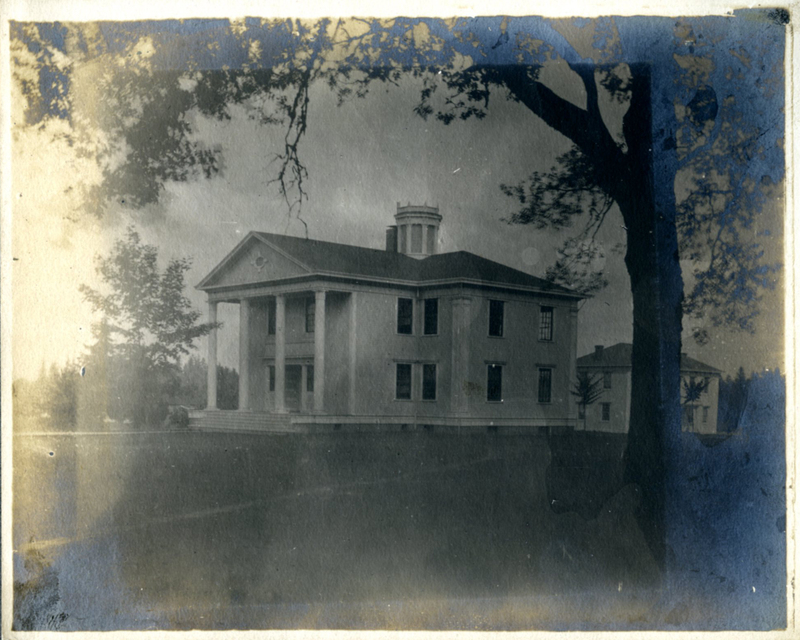
A photograph of Academy Hall located on the Pacific University campus, as it appeared around 1900. Academy Hall was a twin structure to Old College Hall, which can also be seen in the background of this image. Academy Hall was built in 1864 and housed the classrooms of Tualatin Academy, which was the college preparatory high school attached to Pacific University. Academy Hall burned down in 1910.
This photograph is part of the Nettie Shipley Haines photograph album.
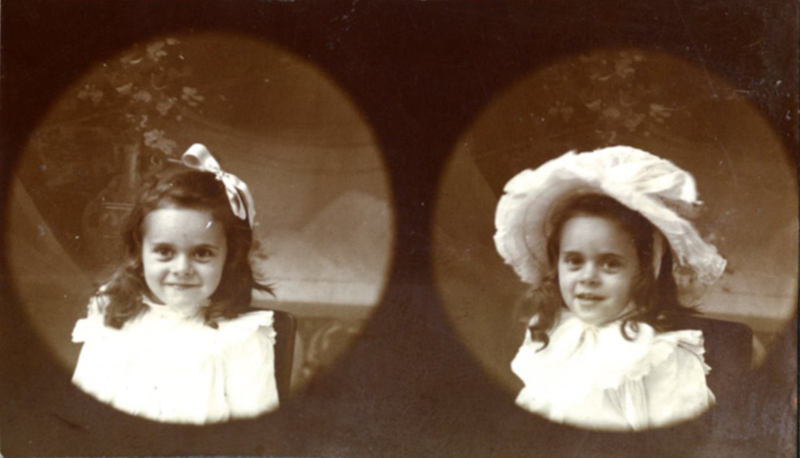
A dual portrait that depicts two portraits of the same girl. In one of the portraits the girl is wearing a hat. This photograph is part of the Nettie Shipley Haines photograph album.
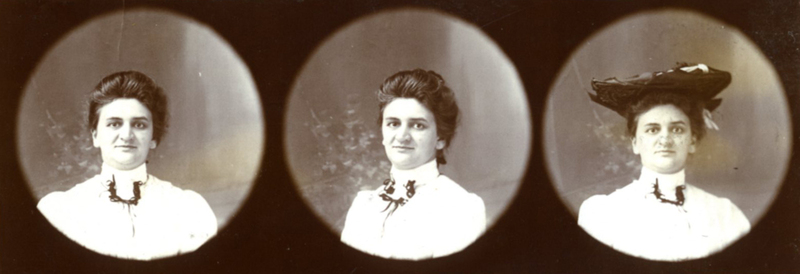
A series of portraits of Nettie Shipley Haines. There are three portraits in the series. This photograph is part of the Nettie Shipley Haines photograph album.
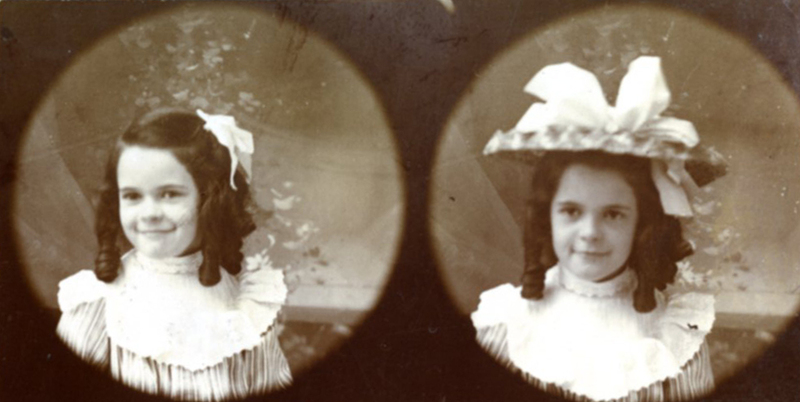
A dual portrait that depicts two portraits of the same girl. In one of the portraits the girl is wearing a hat. This photograph is part of the Nettie Shipley Haines photograph album.
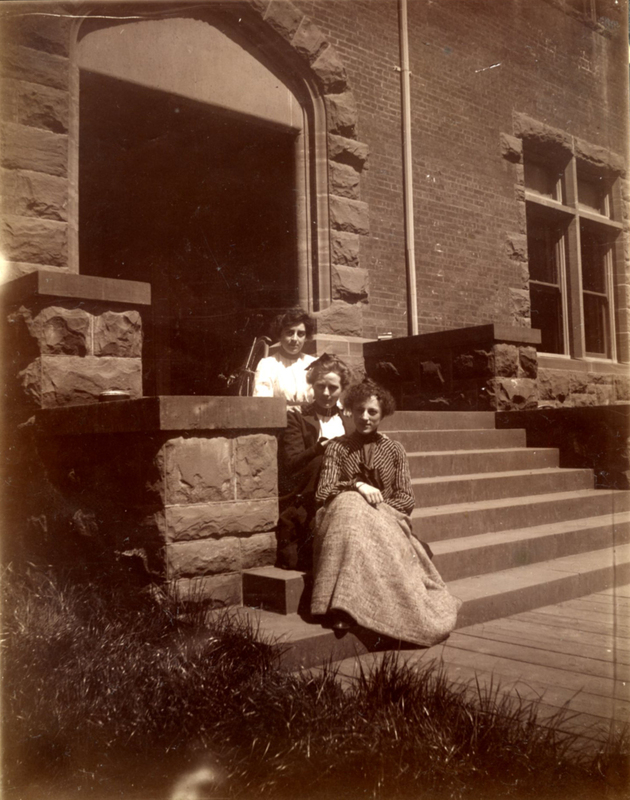
A photograph of three women sitting on the front steps of Marsh Hall located on the Pacific University campus. Marsh Hall was built in 1895 and named after Pacific University president, Sidney Harper Marsh. Marsh Hall housed the university's chapel, recitation rooms, classrooms, administration offices and rooms for the literary societies and the Christian Associations. This photograph is part of the Nettie Shipley Haines photograph album.
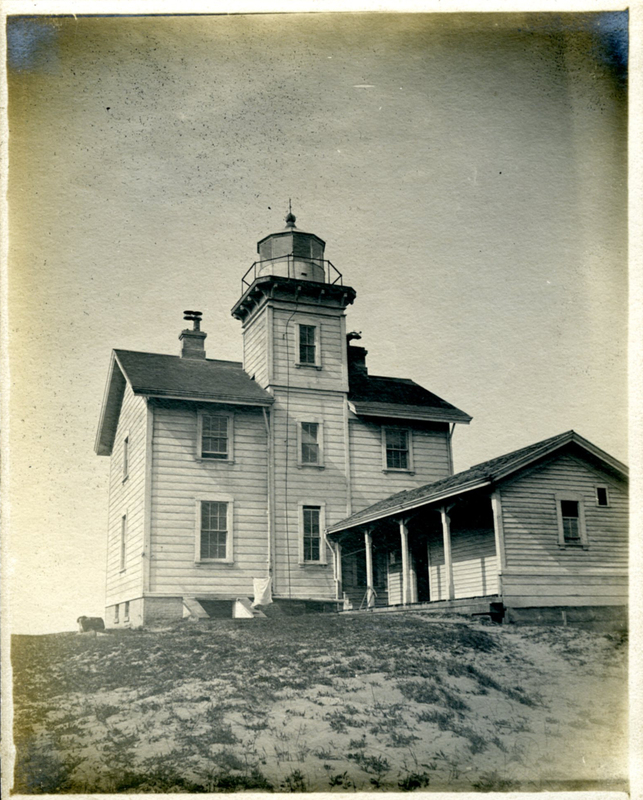
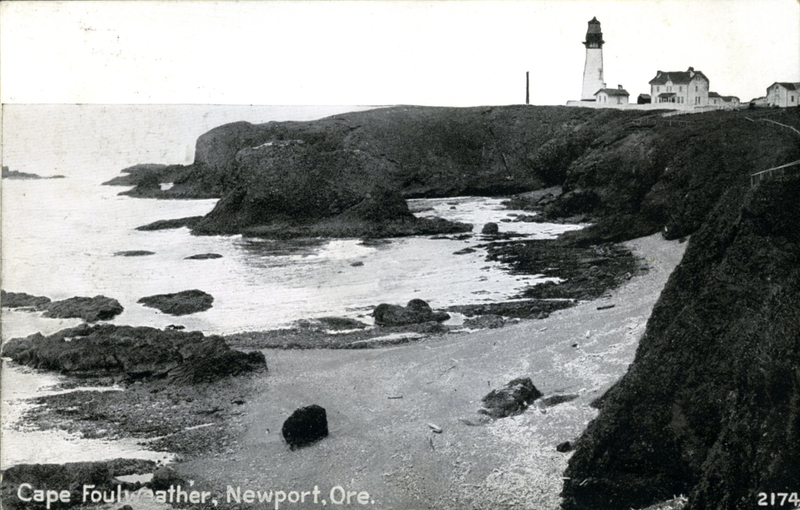
The back side of the Yaquina Bay Lighthouse located in Newport, Oregon. Based on the format of the photograph and its context within the album where it was found, this image likely dates from 1890-1910.
This photograph is part of the Nettie Shipley Haines photograph album.
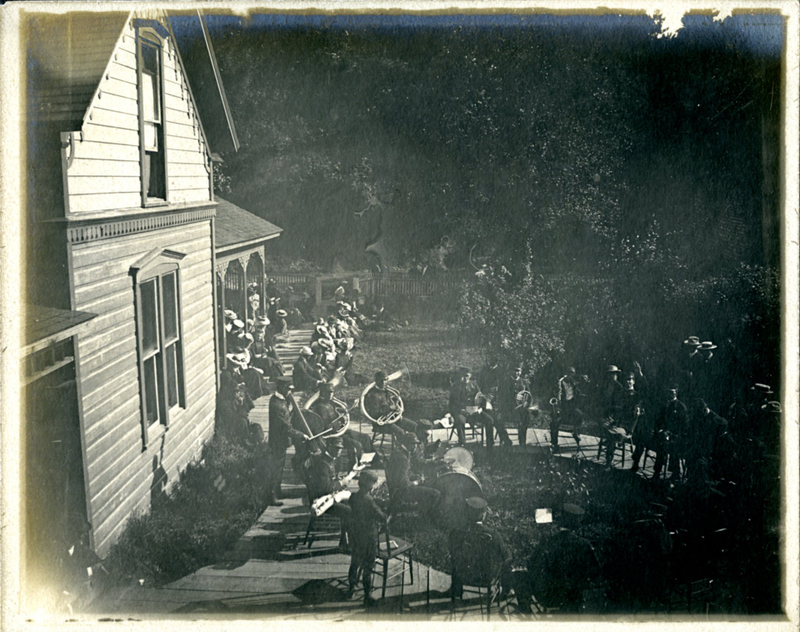
A black and white photograph of a band playing on the lawn of a large home, probably in Forest Grove, Oregon. The band members, who are all male, are wearing military-style uniforms. They resemble the uniforms worn by the Chemawa Indian School band, but it is unclear if this is that group. The band and spectators are seated on wooden walkways. This photograph likely dates to between 1900-1919.
This photograph is part of the Nettie Shipley Haines photograph album.
Two people, possibly a man and a woman, standing on "Jump-Off Joe," a sea stack rock formation that formerly stood near Newport, Oregon. This photograph was likely taken around 1895, based on the state of the rock formation.
Jump-Off Joe was a famous arched rock formation that attracted many tourists visiting the beach near Newport, Oregon. It eroded rapidly between the 1890s-1910s, until the arch collapsed in 1916. There are little to no traces of the formation left today.
This photograph is part of the Nettie Shipley Haines photograph album.
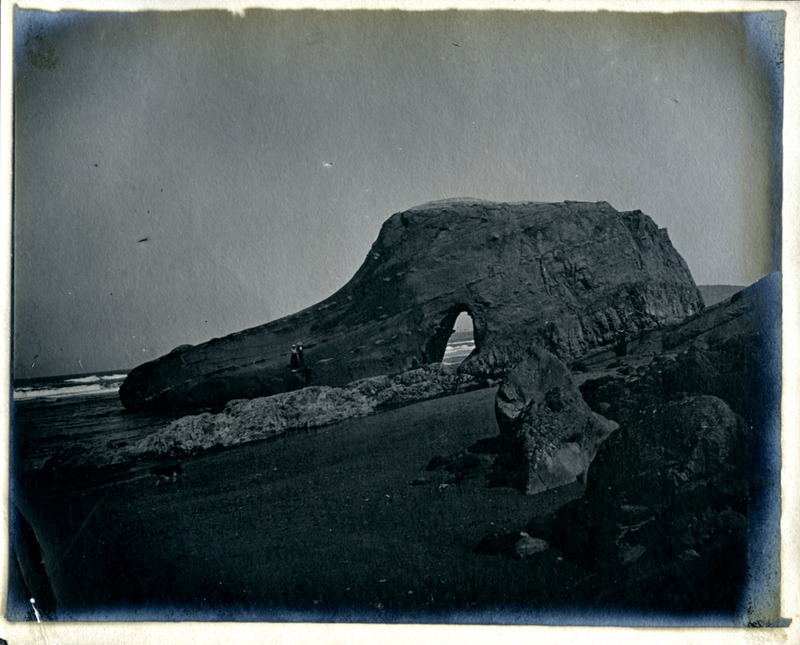
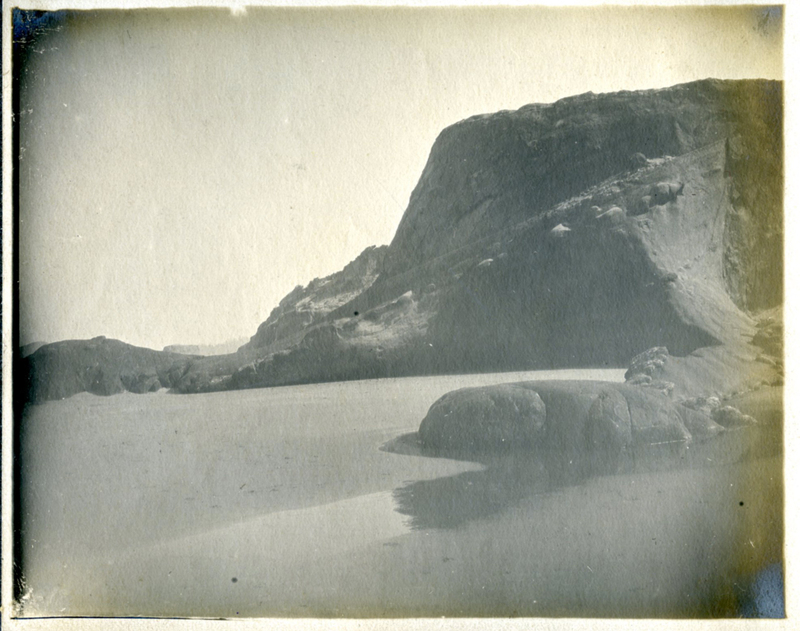
A black and white photograph of a rock formation on the Oregon Coast. Based on other photographs from the same collection, this was likely taken on a beach near Newport, Oregon. This photograph is part of the Nettie Shipley Haines photograph album.
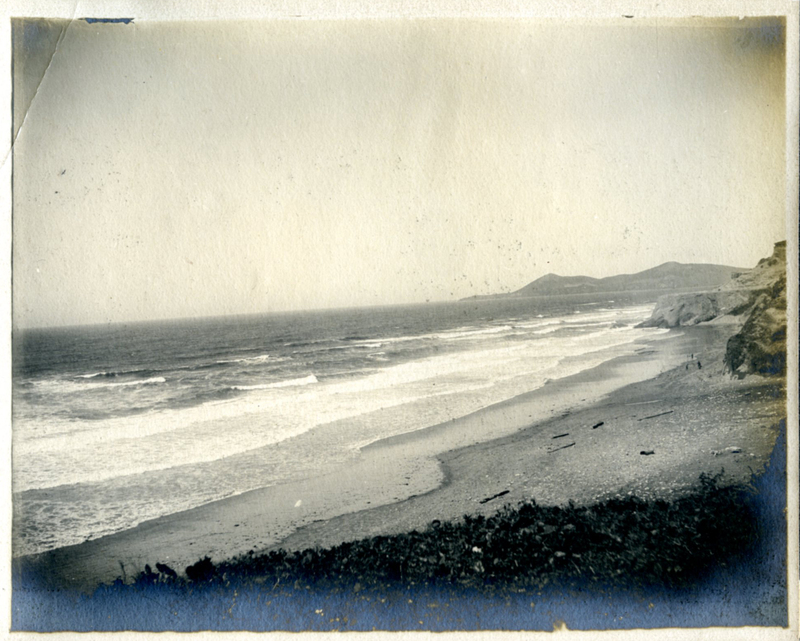
A photograph of Yaquina Head in the distance, probably taken on Nye Beach at Newport, Oregon. The Yaquina Head Lighthouse is not clearly visible, but would have been on the end of the headland. This photograph was probably taken sometime between 1895-1910. It is part of the Nettie Shipley Haines photograph album.
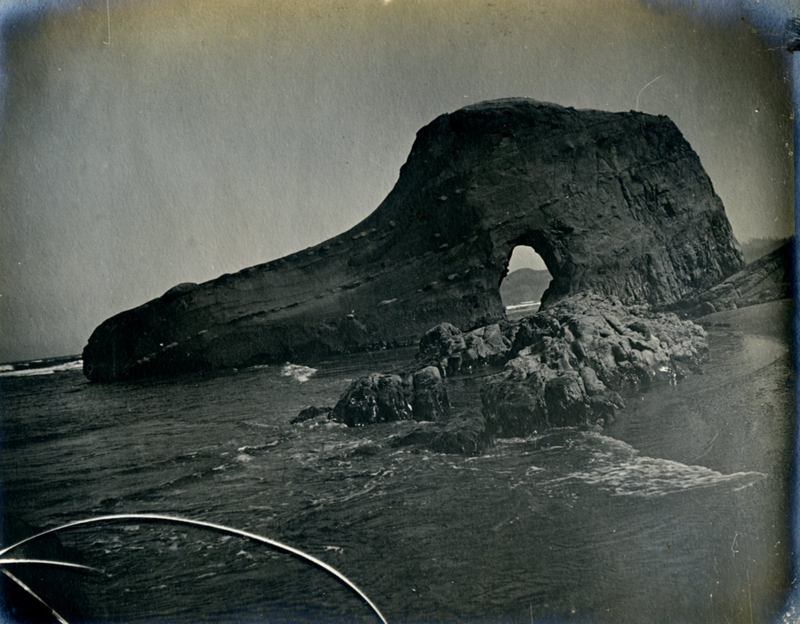
"Jump-Off Joe," a sea stack rock formation that formerly stood near Newport, Oregon. This photograph was likely taken in the late 1890s, based on the state of the rock formation. Jump-Off Joe was a famous arched rock formation that attracted many tourists visiting the beach near Newport, Oregon. It eroded rapidly between the 1890s-1910s, until the arch collapsed in 1916. There are little to no traces of the formation left today.
This photograph is part of the Nettie Shipley Haines photograph album.
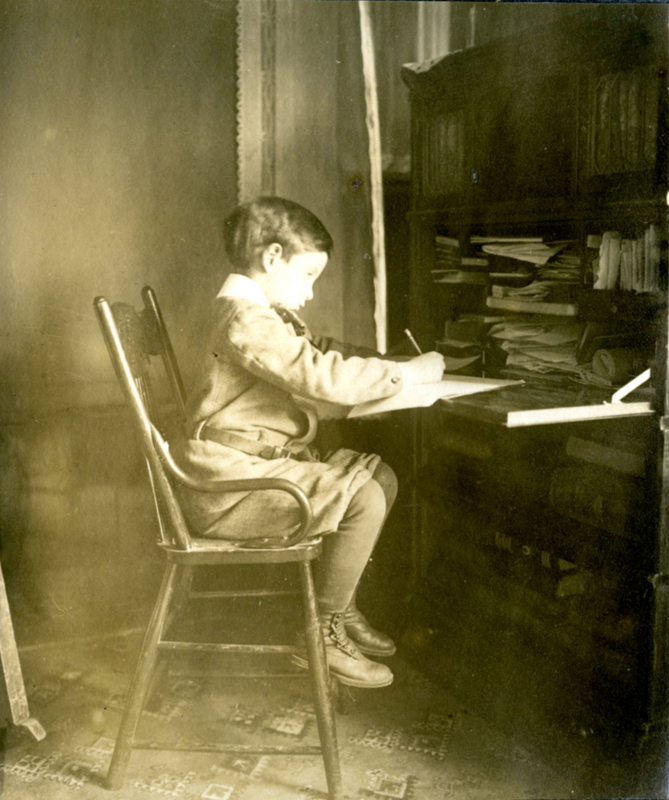
A sepia photograph of a young boy sitting at a desk. He is writing on a piece of paper. This photograph is part of the Nettie Shipley Haines photograph album.