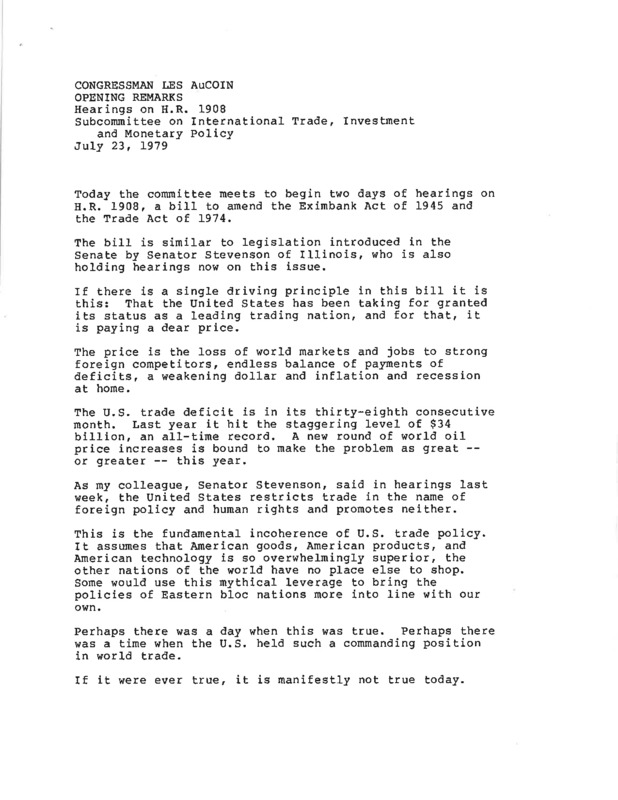
A speech by U.S. Congressman Les AuCoin at the hearings of H.R. 1908, given to the Subcommittee on International Trade, Investment, and Monetary Policy on July 23, 1979. H.R. 1908 was sponsored by Congressman AuCoin, and was officially titled "A bill to amend the Export-Import Bank Act of 1945 with respect to credit to Communist countries, and for other purposes." The bill would have additionally amended the Trade Act of 1974. This is one of a collection of digitized objects from the Les AuCoin Papers (MS.147) at the Pacific University Archives. AuCoin served in the Oregon House of Representatives (1971-1975) and in the United States House of Representatives from Oregon's 1st District (1975-1993).
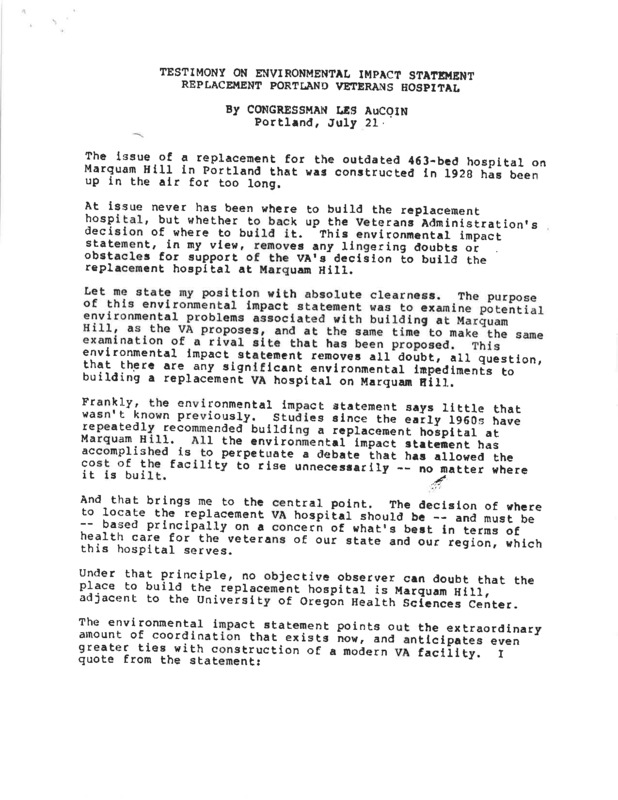
A speech by U.S. Congressman Les AuCoin regarding the discussion of a replacement Veterans Administration hopsital on Marquam Hill in Portland, Oregon, and the potential addition of an environmental impact statement for it. In his speech, Congressman AuCoin explained how an environmental impact statement would remove "any lingering doubts or obstacles for support of the VA's decision to build the replacement hospital at Marquam Hill." This is one of a collection of digitized objects from the Les AuCoin Papers (MS.147) at the Pacific University Archives. AuCoin served in the Oregon House of Representatives (1971-1975) and in the United States House of Representatives from Oregon's 1st District (1975-1993).
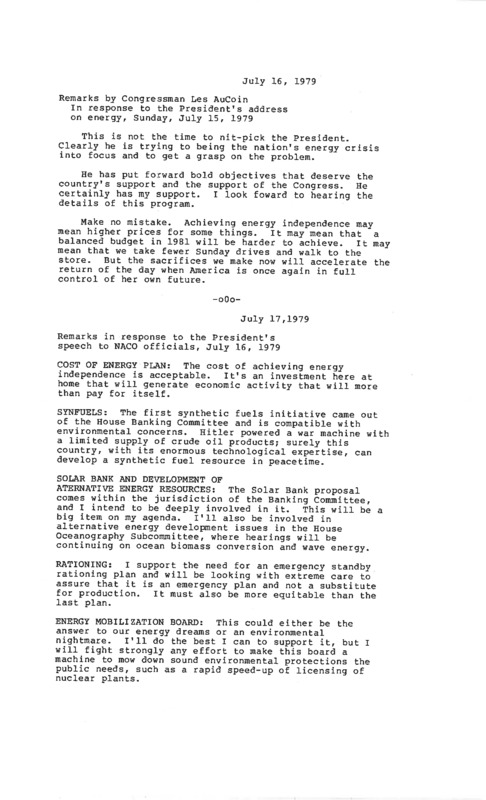
A set of remarks from U.S. Congressman Les AuCoin in response to President Jimmy Carter's speeches on energy and to NACo officials in July 1979. President Carter's speech on energy was held on July 15, 1979, and Congressman AuCoin expresssed his support in his remarks, stating how Carter was attempting to bring "the nation's energy crisis into focus and to get a grasp on the problem." The president's speech to NACo officials was also in regards to the energy crisis, and was held on July 16, 1979. In his remarks, Congressman AuCoin generally supported Carter's ideas regarding a cost of energy plan, synfuels (synthetic fuels), the solar bank and development of alternative energy resources, rationing, and an energy mobilization board. This is one of a collection of digitized objects from the Les AuCoin Papers (MS.147) at the Pacific University Archives. AuCoin served in the Oregon House of Representatives (1971-1975) and in the United States House of Representatives from Oregon's 1st District (1975-1993).
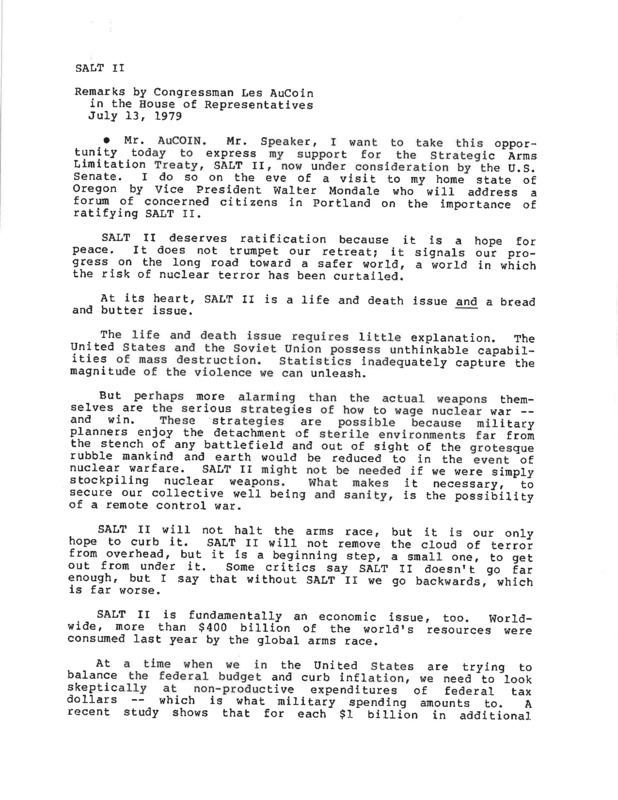
A speech given on the U.S. House floor by Congressman Les AuCoin. In his speech, Congressman AuCoin advocated for the Strategic Arms Limitation Talks (SALT II). SALT II was a treaty signed by President Jimmy Carter and the Soviet Union's Leonid Brezhnev. The agreement, which never went into effect, addressed issues of the SALT I treaty of 1972 and attempted to slow down the nuclear arms race. This is one of a collection of digitized objects from the Les AuCoin Papers (MS.147) at the Pacific University Archives. AuCoin served in the Oregon House of Representatives (1971-1975) and in the United States House of Representatives from Oregon's 1st District (1975-1993).
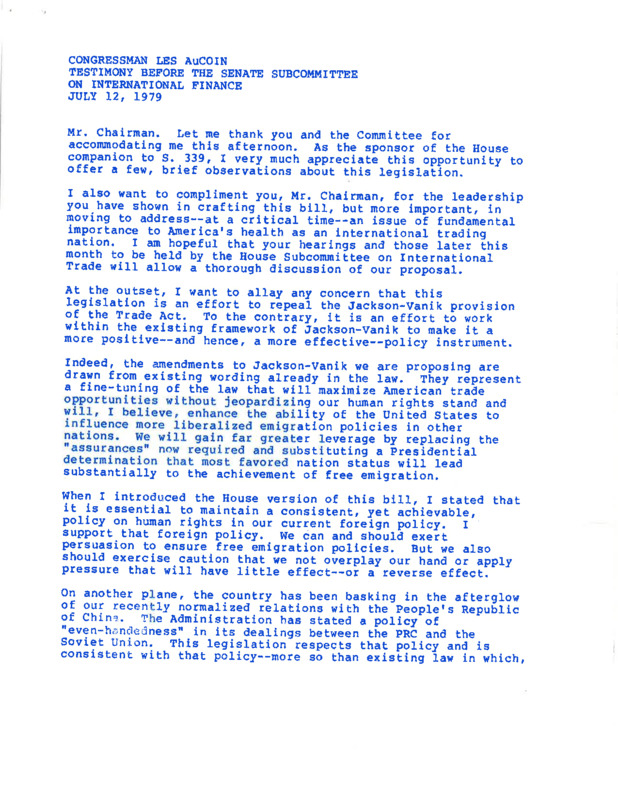
Testimony of U.S. Congressman Les AuCoin before the Senate Subcommittee on International Finance advocating for S.339 and the House of Representatives equivalent which he sponsored, H.R.1835. The bills were both titled "A bill to amend the Export-Import Act of 1945 with respect to credit to communist countries, and for other purposes." Neither bill came to a vote in Congress. This is one of a collection of digitized objects from the Les AuCoin Papers (MS.147) at the Pacific University Archives. AuCoin served in the Oregon House of Representatives (1971-1975) and in the United States House of Representatives from Oregon's 1st District (1975-1993).
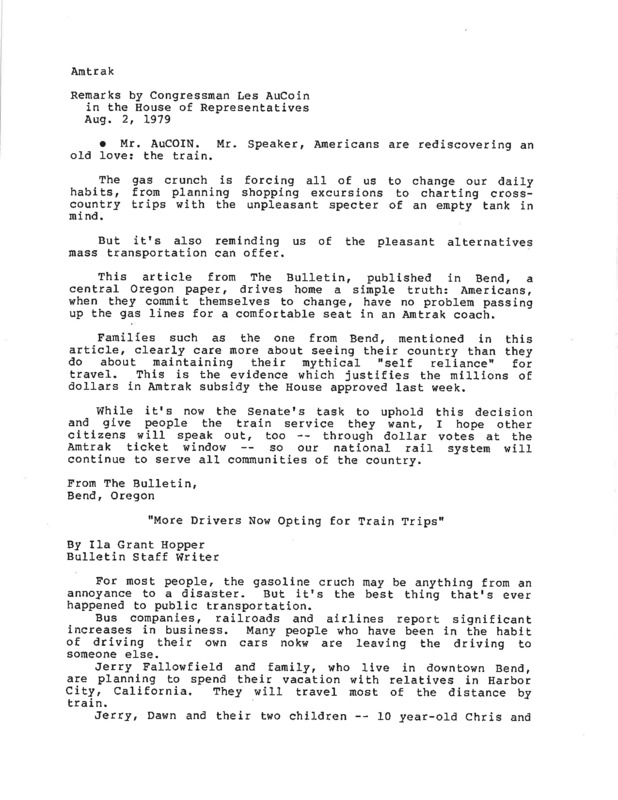
Congressional testimony of U.S. Congressman Les AuCoin advocating for Amtrak, formally known as the National Railroad Passenger Corporation. He described Amtrak as one of mass transportation's "pleasant alternatives" in the wake of the gasoline crisis of the 1970s. As part of his testimony, Congressman AuCoin shared an article from the Bend, Oregon newspaper, The Bulletin. The Bulletin article, titled "More Drivers Now Opting for Train Trips" was written by staff writer Ila Grant Hopper. This is one of a collection of digitized objects from the Les AuCoin Papers (MS.147) at the Pacific University Archives. AuCoin served in the Oregon House of Representatives (1971-1975) and in the United States House of Representatives from Oregon's 1st District (1975-1993).
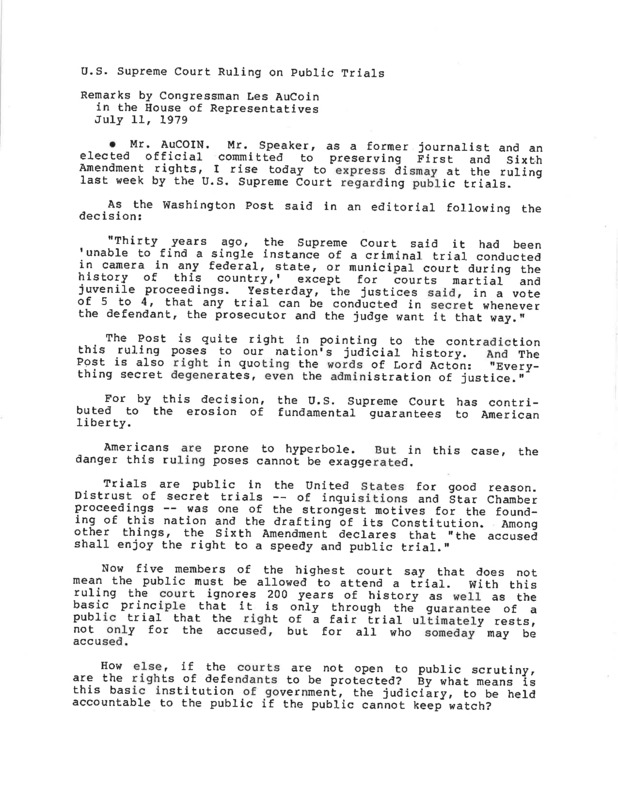
In a speech on the U.S. House floor, Congressman Les AuCoin expressed disappointment in the U.S. Supreme Court's 1979 ruling regarding public trials, Gannett Company, Inc. v. DePasquale. The Court ruled 5-4 that members of the public, including the press, were not guaranteed the right to attend criminal trials by the Sixth Amendment of the U.S. Constitution. However, the Court ruled that the Sixth Amendment did guarantee that defendants had the right to a public trial. This is one of a collection of digitized objects from the Les AuCoin Papers (MS.147) at the Pacific University Archives. AuCoin served in the Oregon House of Representatives (1971-1975) and in the United States House of Representatives from Oregon's 1st District (1975-1993).
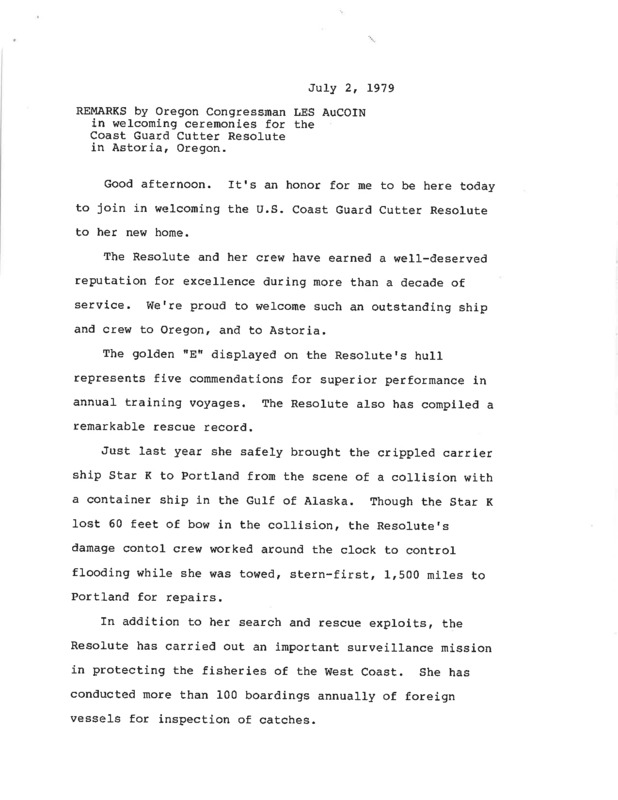
Remarks by U.S. Congressman Les AuCoin "in welcoming ceremonies for the Coast Guard Cutter Resolute in Astoria, Oregon" on July 2, 1979. A cutter is a type of ship commissioned by the U.S. Coast Guard longer than 65 feet in length and designed to have permanent crew accomadations. Commissioned in 1966, the USCGC Resolute has had homeports in California, Oregon, and Florida. This is one of a collection of digitized objects from the Les AuCoin Papers (MS.147) at the Pacific University Archives. AuCoin served in the Oregon House of Representatives (1971-1975) and in the United States House of Representatives from Oregon's 1st District (1975-1993).
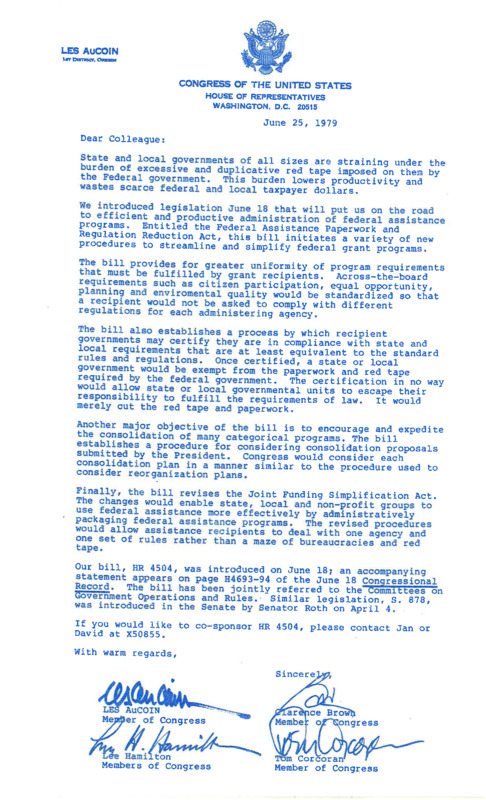
In a letter to a congressional colleague, U.S. Congressman Les AuCoin advocated for the Federal Assistance Paperwork and Regulation Reduction Act (H.R. 4504). Congressman AuCoin explained how the bill aimed to initiate "a variety of new procedures to streamline and simplify federal grant programs." The bill was also known as the Integrated Grant Development Act of 1979. This is one of a collection of digitized objects from the Les AuCoin Papers (MS.147) at the Pacific University Archives. AuCoin served in the Oregon House of Representatives (1971-1975) and in the United States House of Representatives from Oregon's 1st District (1975-1993).
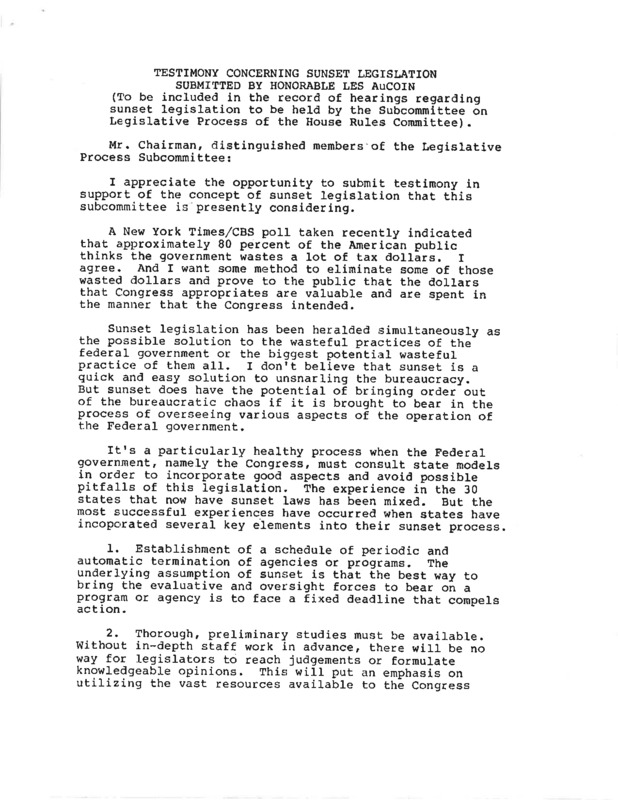
Testimony of U.S. Congressman Les AuCoin advocating for sunset legislation before the Subcommittee on Legislative Process of the House Rules Committee. The sunset method of legislation requires laws and agencies of government to be periodically reconsidered in order to avoid keeping laws in place that become unnecessary over time. Congressman AuCoin explained how "a strict schedule of automatic terminations, thorough preliminary staff work, a phased-in approach and review of programs according to policy area -- are vital to the success of the sunset method." Sunset legislation was widely discussed in the 1970s. This is one of a collection of digitized objects from the Les AuCoin Papers (MS.147) at the Pacific University Archives. AuCoin served in the Oregon House of Representatives (1971-1975) and in the United States House of Representatives from Oregon's 1st District (1975-1993).
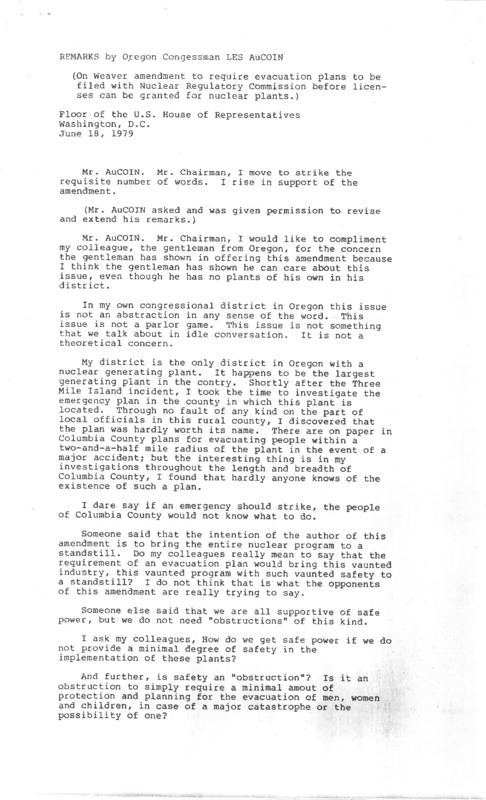
In a speech given on the U.S. House floor, Congressman Les AuCoin advocated for the Weaver amendment, which aimed to "require evacuation plans to be filed with the Nuclear Regulatory Commission before licenses can be granted for nuclear plants." In his speech Congressman AuCoin mentioned the Three Mile Island nuclear accident, the most severe nuclear accident in U.S. history. Oregon's 1st congressional district, which Congressman AuCoin represented, was home to the first and only nuclear power plant in Oregon, the Trojan Nuclear Power Plant in Rainier, Oregon. The Trojan Nuclear Power Plant closed in 1992. This is one of a collection of digitized objects from the Les AuCoin Papers (MS.147) at the Pacific University Archives. AuCoin served in the Oregon House of Representatives (1971-1975) and in the United States House of Representatives from Oregon's 1st District (1975-1993).
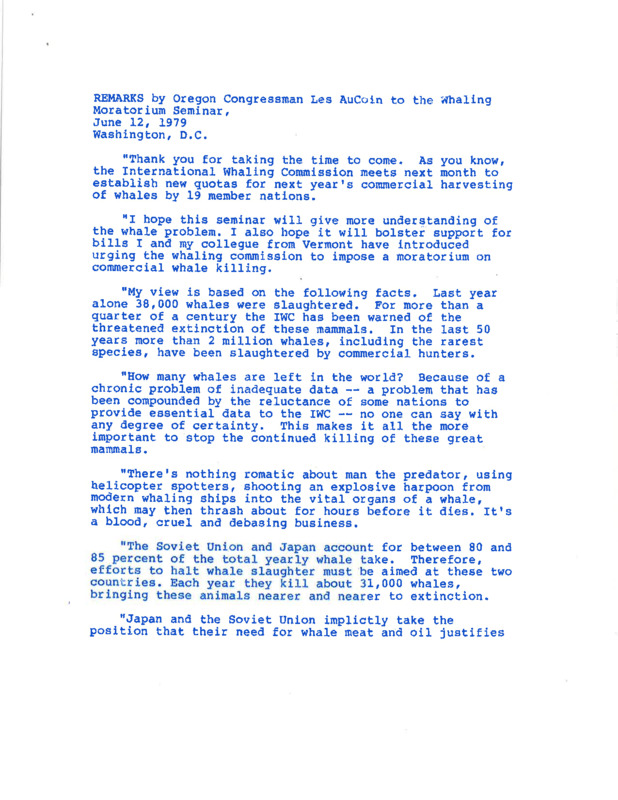
Remarks by U.S. Congressman Les AuCoin at the Whaling Moratorium Seminar in Washington, D.C., on June 12, 1979. In his remarks, Congressman AuCoin advocated for a moratorium of the commercial killing of whales, including through the sponsoring of House Concurrent Resolution 92 of the 96th Congress, which aimed to put such a moratorium in effect. He explained how Japan and the Soviet Union accounted for the vast majority of whales killed per year, with the Soviet Union primarily taking interest in whale oil. This is one of a collection of digitized objects from the Les AuCoin Papers (MS.147) at the Pacific University Archives. AuCoin served in the Oregon House of Representatives (1971-1975) and in the United States House of Representatives from Oregon's 1st District (1975-1993).
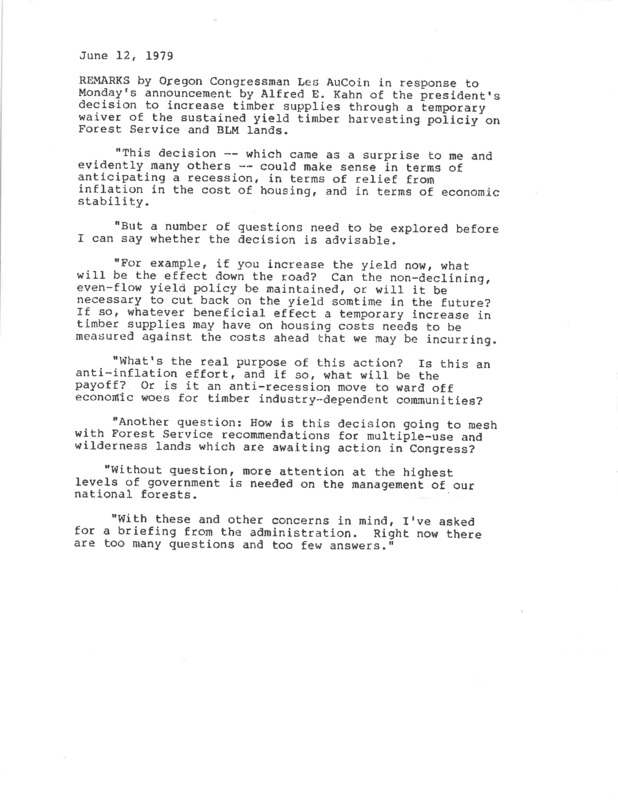
Remarks by U.S. Congressman Les AuCoin on the "president's decision to increase timber prices through a temporary waiver of the sustained yield timber harvesting policy on Forest Service and BLM lands." Congressman AuCoin's remarks included questioning the decision. The president's decision was announced by Alfred E. Kahn, who was the Advisor to the President on Inflation under the Carter administration. This is one of a collection of digitized objects from the Les AuCoin Papers (MS.147) at the Pacific University Archives. AuCoin served in the Oregon House of Representatives (1971-1975) and in the United States House of Representatives from Oregon's 1st District (1975-1993).
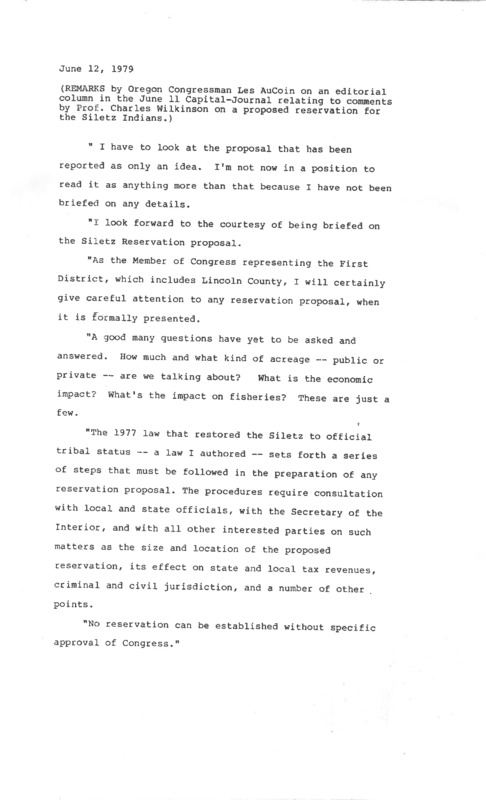
Remarks by U.S. Congressman Les AuCoin on a Capital-Journal editorial column "relating to comments by Prof. Charles Wilkinson on a proposed reservation for the Siletz Indians." The editorial column was published June 11, 1979. During his time as a congressman, AuCoin advocated for the Siletz Indians, including helping the tribe regain recognition on the federal level. This is one of a collection of digitized objects from the Les AuCoin Papers (MS.147) at the Pacific University Archives. AuCoin served in the Oregon House of Representatives (1971-1975) and in the United States House of Representatives from Oregon's 1st District (1975-1993).
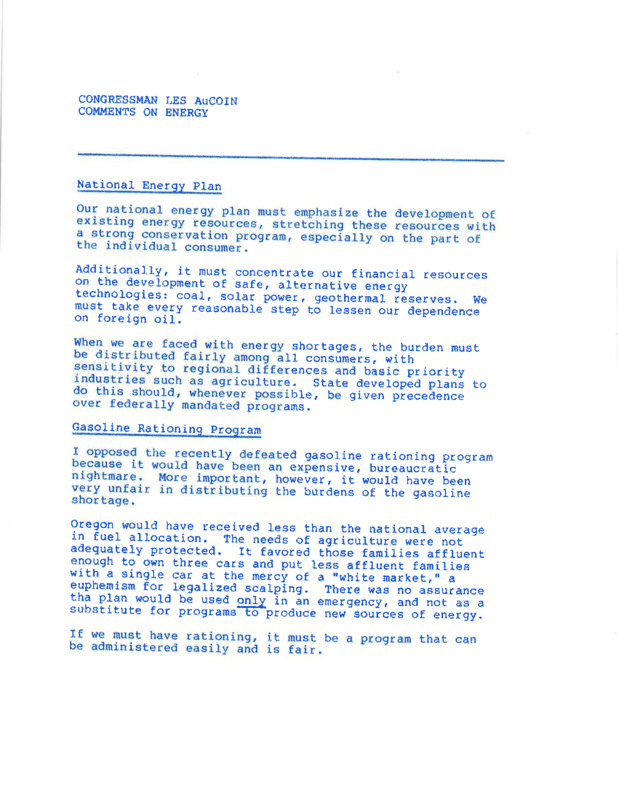
Comments by U.S. Congressman Les AuCoin regarding the national energy plan and the gasoline rationing program. Congressman AuCoin advocated for a "strong conservation program" and the "development of safe, alternative energy technologies" in regards to the national energy plan. For the gasoline rationing program, Congressman AuCoin called the gasoline rationing program "an expensive, bureaucratic nightmare," pointing out how Oregon would not have benefited and "would have received less than the national average in fuel allocation." This is one of a collection of digitized objects from the Les AuCoin Papers (MS.147) at the Pacific University Archives. AuCoin served in the Oregon House of Representatives (1971-1975) and in the United States House of Representatives from Oregon's 1st District (1975-1993).
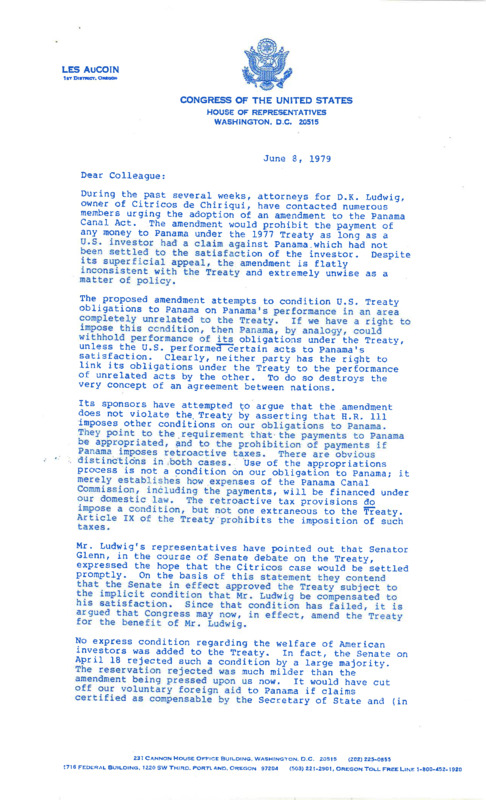
In a letter to a congressional colleague, U.S. Congressman Les AuCoin rejected a proposed amendment to the Panama Canal Act, which would "prohibit the payment of any money to Panama under the 1977 Treaty as long as a U.S. investor had a claim against Panama which had not been settled to the satisfaction of the investor." The proposed amendment was controversial, as it was lobbied by the attorneys of U.S. billionaire D.K. Ludwig, who would have benefited from such an amendment. This is one of a collection of digitized objects from the Les AuCoin Papers (MS.147) at the Pacific University Archives. AuCoin served in the Oregon House of Representatives (1971-1975) and in the United States House of Representatives from Oregon's 1st District (1975-1993).
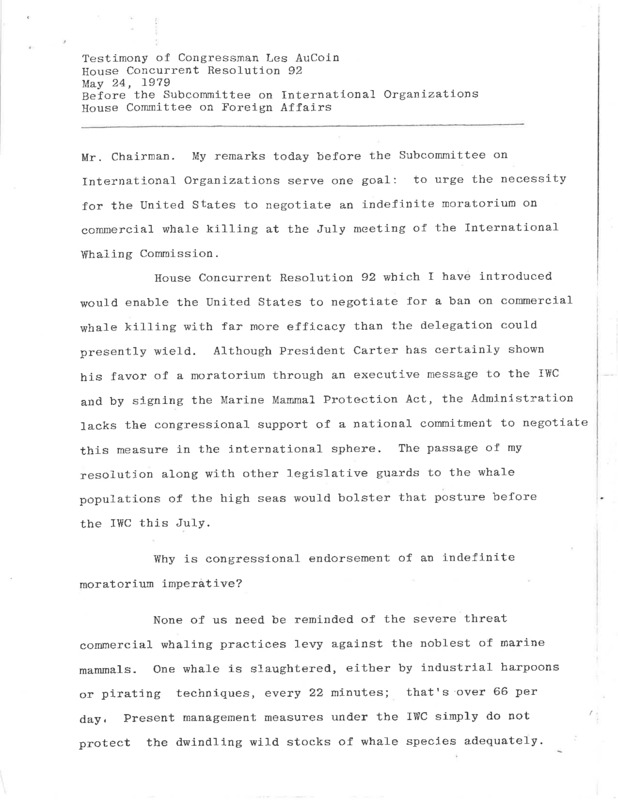
Testimony of U.S. Congressman Les AuCoin regarding House Concurrent Resolution 92 before the Subcommittee on International Organizations House Committee on Foreign Affairs. Before the subcommittee, Congressman AuCoin advocated for the resolution, which he sponsored, arguing for negotiations for "an indefinite moratorium on commercial whale killing at the July meeting of the International Whaling Commission." House Current Resolution 92 of the 96th Congress never came to a vote, but the International Whaling Commission did vote to execute a pause on commercial whaling in 1982. This is one of a collection of digitized objects from the Les AuCoin Papers (MS.147) at the Pacific University Archives. AuCoin served in the Oregon House of Representatives (1971-1975) and in the United States House of Representatives from Oregon's 1st District (1975-1993).
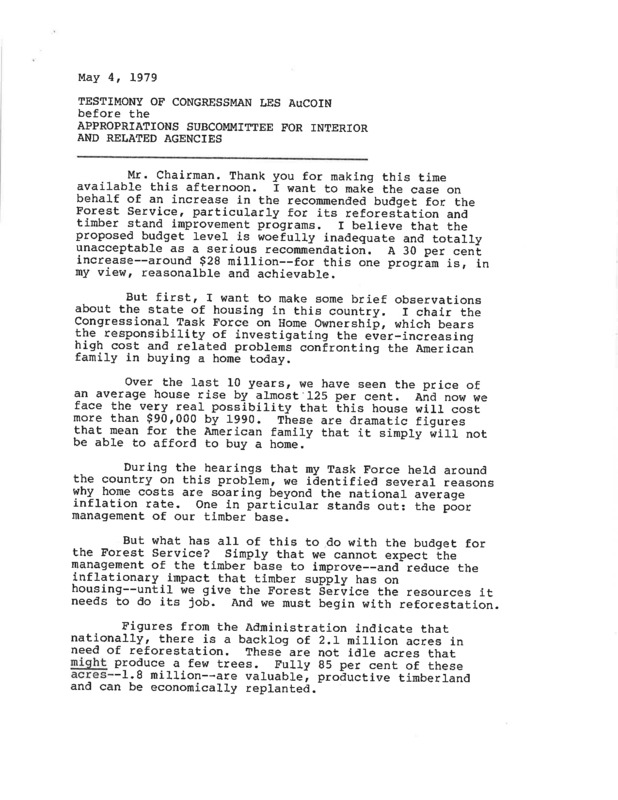
Testimony of U.S. Congressman Les AuCoin before the Appropriations Subcommittee for Interior and Related Agencies regarding the Forest Service budget. In his statement, Congressman AuCoin argued for a 30% increase in the Forest Service budget in response to what he called a "woefully inadequate" budget proposed by the the Office of Management and Budget. Congressman AuCoin described the importance of such a budget, briefly mentioning Oregon's role in the timber industry. This is one of a collection of digitized objects from the Les AuCoin Papers (MS.147) at the Pacific University Archives. AuCoin served in the Oregon House of Representatives (1971-1975) and in the United States House of Representatives from Oregon's 1st District (1975-1993).
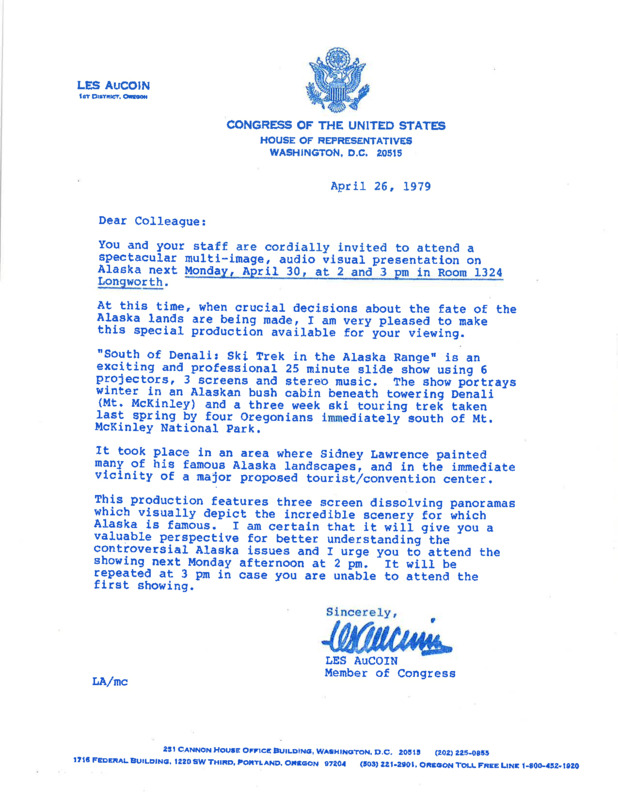
An invitation given by U.S. Congressman Les AuCoin to a congressional colleague inviting them and their staff to an audio and visual presentation on Alaska, titled "South of Denali: Ski Trek in the Alaska Range." This is one of a collection of digitized objects from the Les AuCoin Papers (MS.147) at the Pacific University Archives. AuCoin served in the Oregon House of Representatives (1971-1975) and in the United States House of Representatives from Oregon's 1st District (1975-1993).
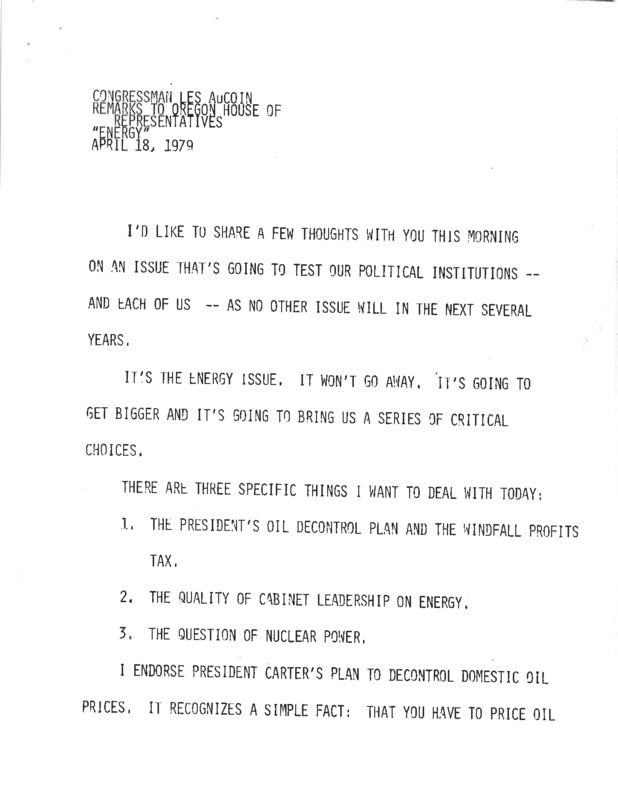
A speech by U.S. Congressman Les AuCoin titled "Energy" given at the Oregon House of Representatives on April 18, 1979. In his speech, Congressman AuCoin discusssed "1. The president's oil decontrol plan and the windfall profits tax. 2. The quality of cabinet leadership on energy. 3. The question of nuclear power." This is one of a collection of digitized objects from the Les AuCoin Papers (MS.147) at the Pacific University Archives. AuCoin served in the Oregon House of Representatives (1971-1975) and in the United States House of Representatives from Oregon's 1st District (1975-1993).
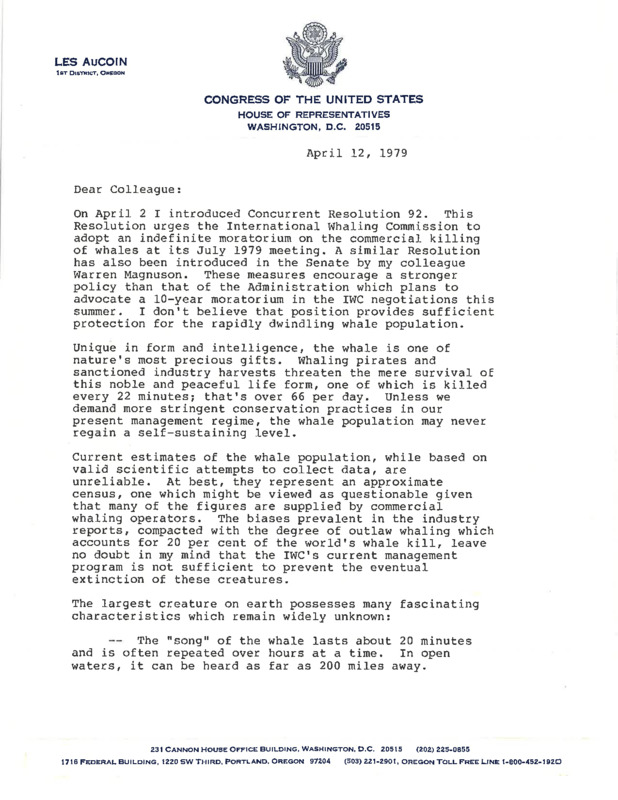
In a letter to a congressional colleague, U.S. Congressman Les AuCoin advocated for Concurrent Resolution 92, which would urge "the International Whaling Commission to adopt an indefinite moratorium on the commercial killing of whales at its July 1979 meeting." This is one of a collection of digitized objects from the Les AuCoin Papers (MS.147) at the Pacific University Archives. AuCoin served in the Oregon House of Representatives (1971-1975) and in the United States House of Representatives from Oregon's 1st District (1975-1993).
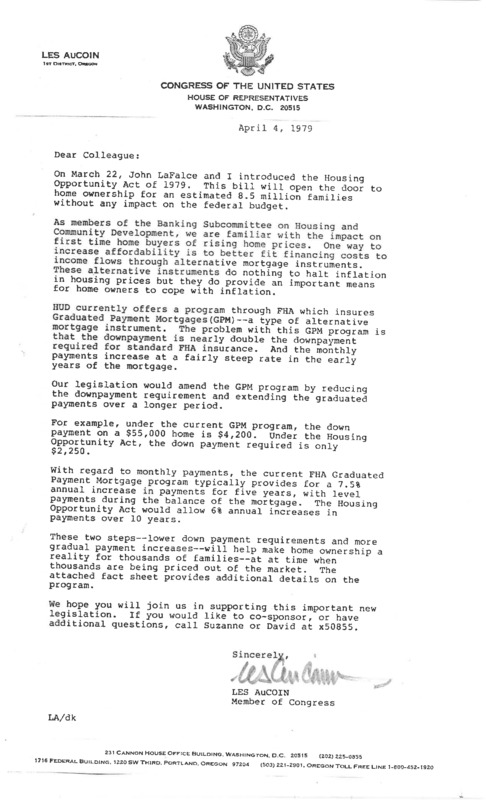
In a letter to a congressional colleague, U.S. Congressman Les AuCoin advocated for his bill, the Housing Opportunity Act of 1979. The bill aimed to increase the number of American home owners, with an estimated 8.5 million families benefiting. Congressman AuCoin explained how first time home buyers were struggling with the increases in home prices. As part of the letter, he also attached a "Fact Sheet on the Housing Opportunity Act of 1979." This is one of a collection of digitized objects from the Les AuCoin Papers (MS.147) at the Pacific University Archives. AuCoin served in the Oregon House of Representatives (1971-1975) and in the United States House of Representatives from Oregon's 1st District (1975-1993).
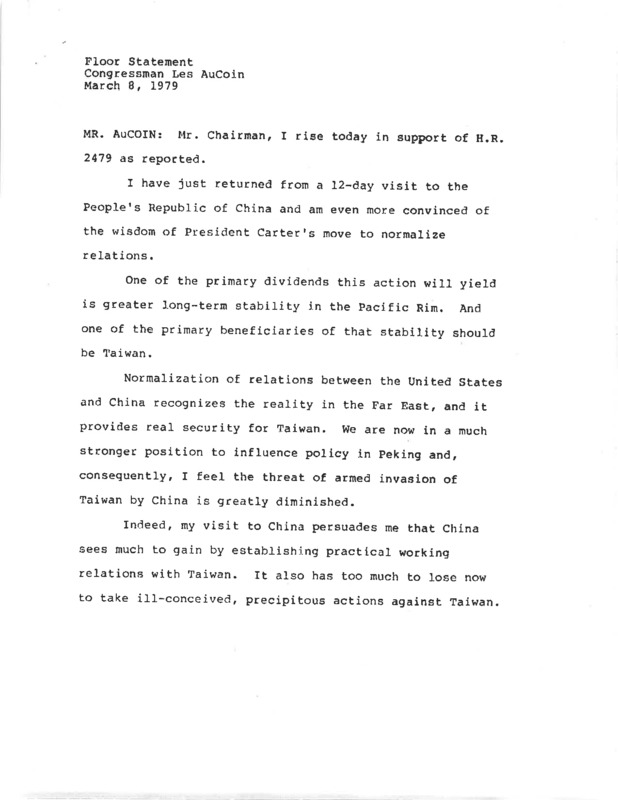
In a speech on the U.S. House Floor, Congressman Les AuCoin advocated for H.R. 2479, the Taiwan Relations Act, which allowed relations with the people on Taiwan without recognizing the country of Taiwan (Republic of China) officially or diplomatically. Congressman AuCoin advocated for normalized relations between the U.S. and China, and noted that peaceful reunification between China and Taiwan seemed likely. The speech was made after Congressman AuCoin's 12-day visit to China. This is one of a collection of digitized objects from the Les AuCoin Papers (MS.147) at the Pacific University Archives. AuCoin served in the Oregon House of Representatives (1971-1975) and in the United States House of Representatives from Oregon's 1st District (1975-1993).
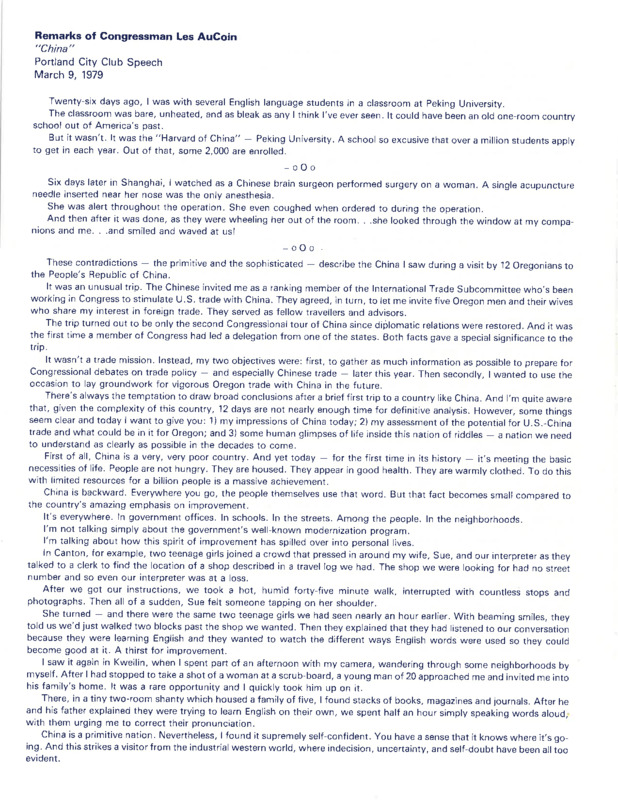
A speech by U.S. Congressman Les AuCoin to the Portland City Club in Portland, Oregon, on March 9, 1979. In his speech, titled "China," Congressman AuCoin described his recent trip to China, and explained how the goal of the trip was "to gather as much information as possible to prepare for Congressional debates on trade policy" and "to use the occassion to lay groundwork for vigorous Oregon trade with China in the future." In his speech, he explained how he saw signs of societal improvements during his trip to China. This is one of a collection of digitized objects from the Les AuCoin Papers (MS.147) at the Pacific University Archives. AuCoin served in the Oregon House of Representatives (1971-1975) and in the United States House of Representatives from Oregon's 1st District (1975-1993).