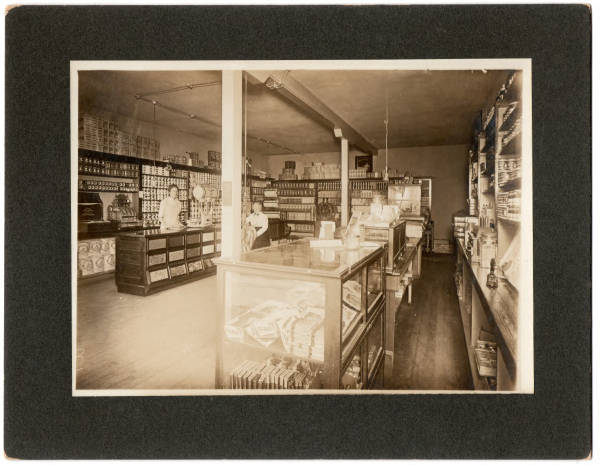
Picture taken inside a store from the front looking towards the back of the store. Two women are in the picture, one standing behind the left counter/showcase and the other sitting on the customer side of the same counter/showcase. This showcase contains bins of bulk consumables. There is an ornate cash register on the left wall along with shelves of canned goods. A scale is on the counter top next to the woman behind the counter and there is a dispenser for three sizes of paper for wrapping good is. A hand operated coffee grinder is next to the back wall. There is also a counter/showcase on the right side and the right wall is included in the picture. The close end of this showcase contains cigars. There is a Tip Top Bread cabinet at the fare end of the counter and shelves of canned goods on right side wall.
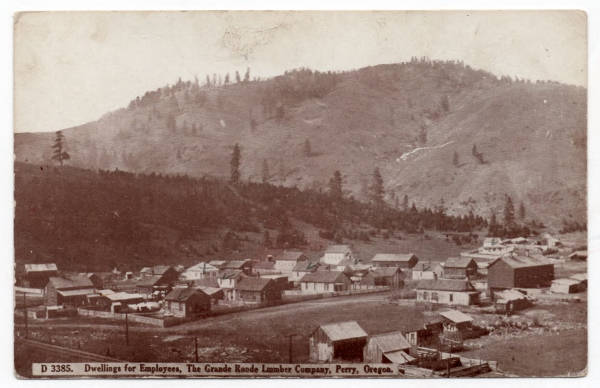
Picture taken from an elevated view of a lumber company town. Houses and building have been built in a shallow valley with a low ridge and a larger hill in the background
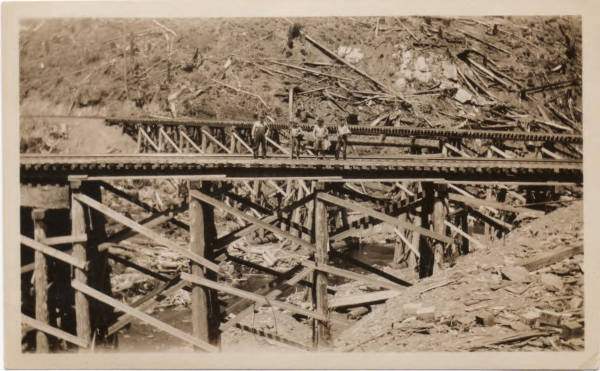
Four men standing in the middle of a logging trestle in a logged off area. There is a second trestle in the background with a small creek below both trestles.
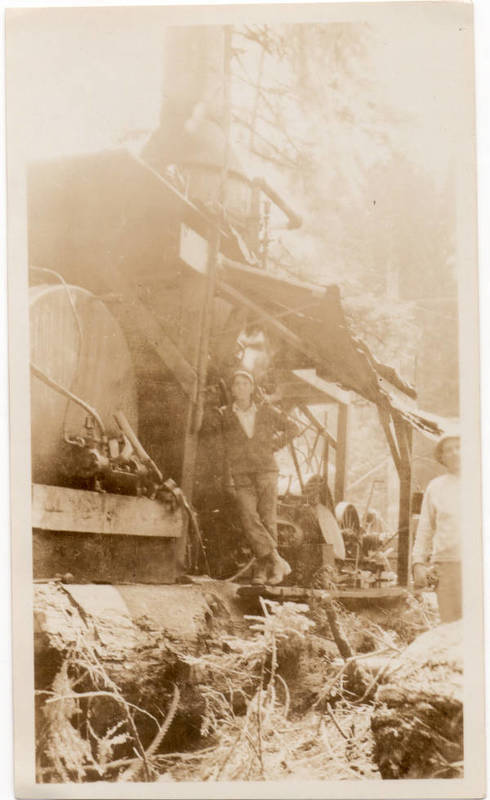
Two men standing beside a steam donkey in the woods. One man is standing on the donkey sled beside the engine and the other man is standing on the ground beside the sled.
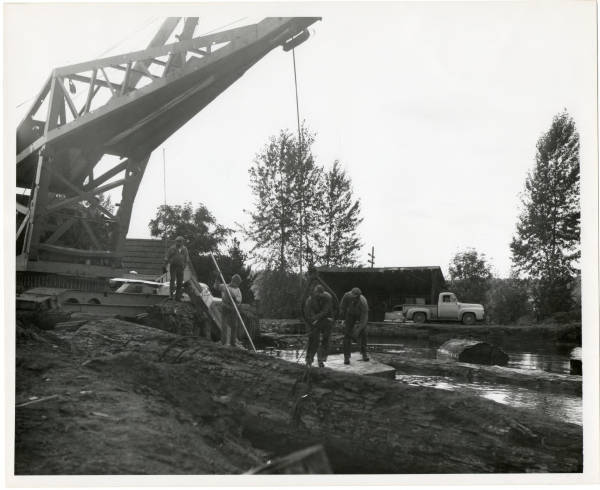
8 of 8 of a series of photographs showing unloading logs from a logging truck at Gales Peak Lumbermill. This picture shows two men standing on a log in the millpond. They have just unhooked the grappling hook while a third man steadies the log with a pole. A fourth man is standing by. The boom is off to the left in the picture. In the background is a 1953 or 1954 Ford pickup. This boom, produced by Wallace Dozers in Forest Grove, became the “Heel Boom” known throughout the Northwest for its advantages over older style booms in loading and unloading logging trucks.
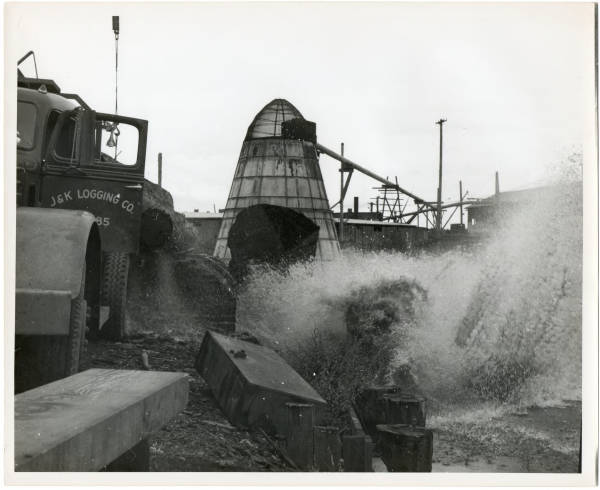
7 of 8 of a series of photographs showing unloading logs from a logging truck at Gales Peak Lumbermill. This picture shows the remainder of the log truck load being dumped in the mill pond. A cable is strung under the remainder of the logs on the truck and then pulled up to flip the logs off the truck and into the pond. Logs are splashing into the millpond. J & K Logging Co. is printed on the driver’s door. In the background is a wigwam burner.
6 of 8 of a series of photographs showing a prototype boom unloading logs from a logging truck at Gales Peak Lumbermill. In this picture the boom is picking up a log from a J & K Logging Co. logging truck trailer. There is a man sitting on a log at the front of the load on the truck. Two more men are standing to the right of the truck watching the demonstration. This boom, produced by Wallace Dozers in Forest Grove, became the “Heel Boom” known throughout the Northwest for its advantages over older style booms in loading and unloading logging trucks.
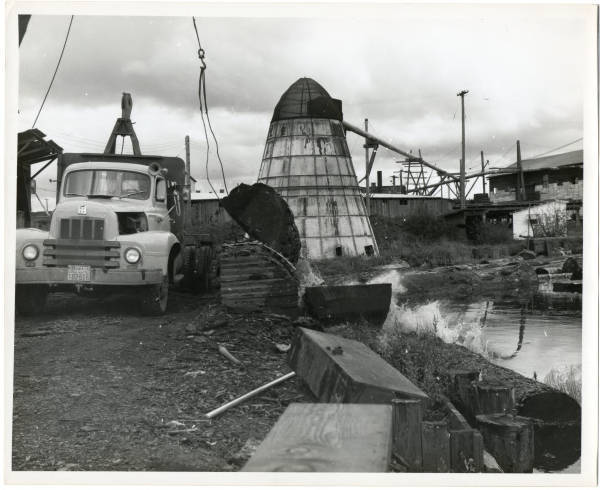
5 of 8 of a series of photographs showing unloading logs from a logging truck at Gales Peak Lumbermill. This picture shows the remainder of the log truck load being dumped in the mill pond. A cable is strung under the remainder of the logs on the truck and then pulled up to flip the logs off the truck and into the pond. In the background is a wigwam burner.
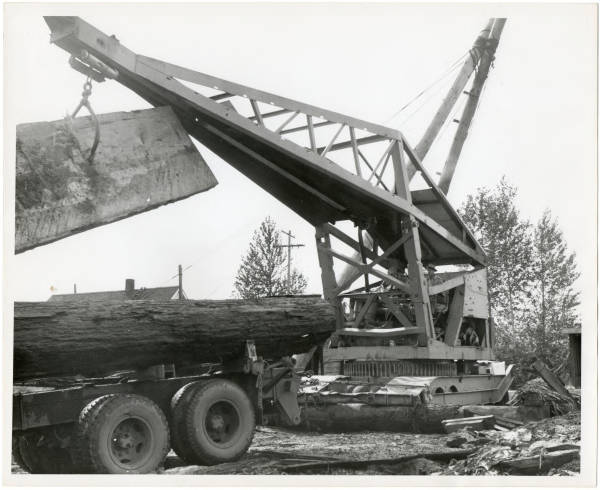
4 of 8 of a series of photographs showing a prototype boom unloading logs from a logging truck at Gales Peak Lumbermill. This picture is a close up of the underside of the boom showing how it can control the log and keep it from swinging. This boom, produced by Wallace Dozers in Forest Grove, became the “Heel Boom” known throughout the Northwest for its advantages over older style booms in loading and unloading logging trucks.
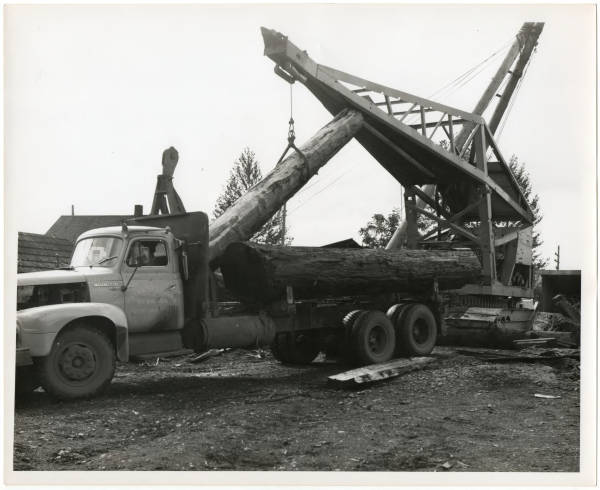
3 of 8 of a series of photographs showing a prototype boom unloading logs from a logging truck at Gales Peak Lumbermill. In this picture the boom is positioned over the logs on an International Harvester logging truck. A log is being removed from the truck. This picture demonstrates how the underside of the boom can control the log and keep it from swinging. This boom, produced by Wallace Dozers in Forest Grove, became the “Heel Boom” known throughout the Northwest for its advantages over older style booms in loading and unloading logging trucks.
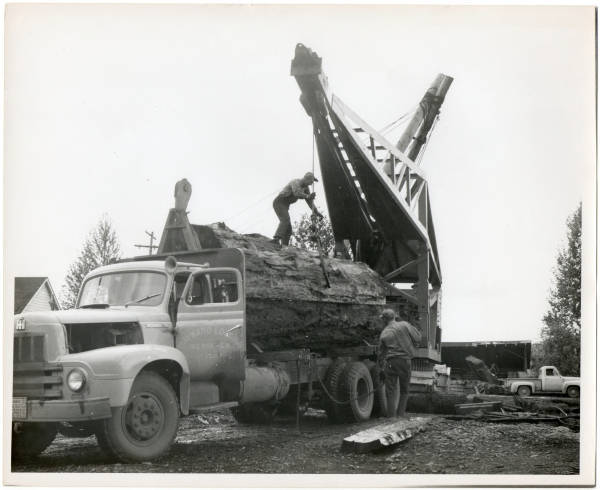
2 of 8 of a series of photographs showing a prototype boom unloading logs from a logging truck at Gales Peak Lumbermill. In this picture the boom is positioned over the logs on an International Harvester logging truck. A man is standing on the top log positioning the grappling hook to ready for unloading the log. Another man is removing the tiedown chains from the load. There is a 1953 or 1954 Ford pickup in the background. This boom, produced by Wallace Dozers in Forest Grove, became the “Heel Boom” known throughout the Northwest for its advantages over older style booms in loading and unloading logging trucks.
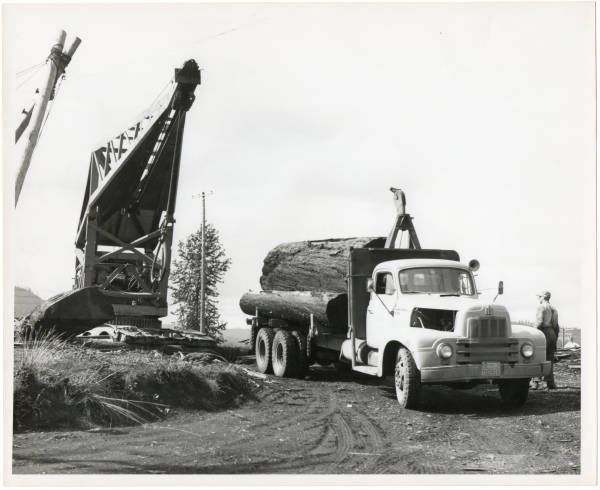
1 of 8 of a series of photographs showing a prototype boom unloading logs from a logging truck at Gales Peak Lumbermill. In this picture an International Harvester logging truck has arrived to have its logs unloaded. To the side of the truck is a machine equipped with the prototype boom, ready for the demonstration. This boom, produced by Wallace Dozers in Forest Grove, became the “Heel Boom” known throughout the Northwest for its advantages over older style booms in loading and unloading logging trucks.
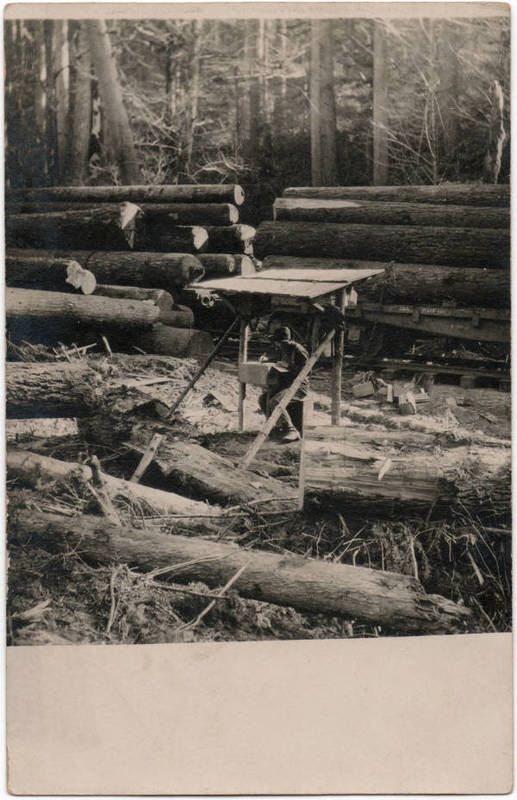
Picture taken at a log deck with two railroad log cars loaded in the background. In the foreground is a man sitting on a box using a dovetailed box attached to a roof support as a desktop. He is making an entry in a thin book. Above him is a makeshift roof for shade. The closest log car has ????ern Pacific stenciled in the side.
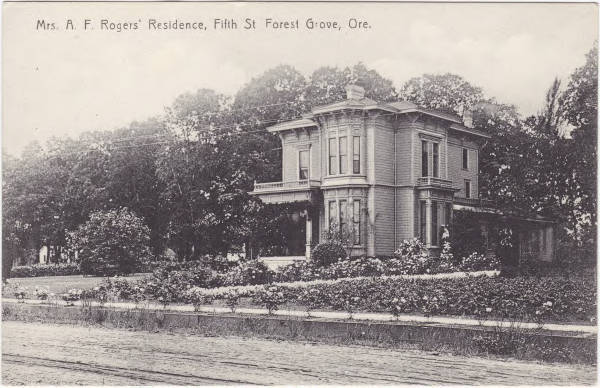
Photograph of the Rogers mansion that faced Fifth Street (Elm Street) between Second Avenue South (18th Avenue) and Third Avenue South (17th Avenue). This house was built around 1890 in the Italiante style. The street is packed dirt with some shallow ruts. There is a definite curb that looks to be about 12 inches high. The sidewalk could be concrete. Flowering rose? Bushes are planted between the curb and sidewalk. The yard looks to be well kept. The house fell into disrepair and was dismantled with materials going to other homes during WWII. Later the four-acre block became Rogers Park. The concrete steps and some of the path that lead to the front door still remain.
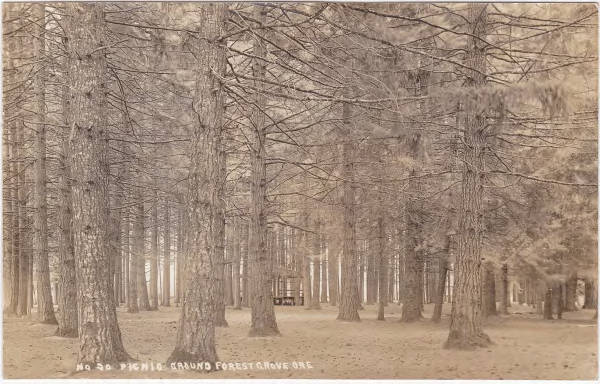
Photograph of a heavily wooded area of fir trees with a gazebo partially visible in the center of the picture. The ground is cleared of any brush and is packed earth. On the extreme left it looks like two benches or tables up side down on the ground an a box next to one of them. There may be one or two more tables in the background on the left side of the picture. Also on the left side of the gazebo in the far background is a building that could be a shop or house. There is a stack of wood, possibly lumber in front of the building.
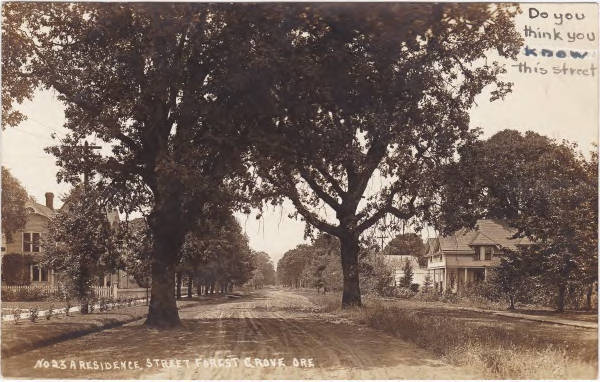
A residential Street in Forest Grove, Oregon. This photograph was taken from the middle of South Fifth Street (which has since been renamed 15th Avenue) looking West. The Street is packed dirt and on the left there is a raised bed of dirt with possibly roses planted along the sidewalk. This raised bed looks like it forms an earthen curb along the street. There is a sidewalk on both sides of the street. The left side could be concrete and the right side is wood. A short distance down the street there is a large oak tree on each side of the street and the left one is in the street with the curb going behind it. Wheel/tire tracks in the street indicate some had to alter course slightly because of the tree.
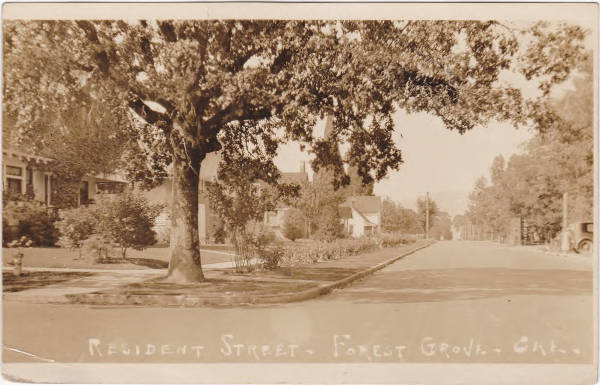
Photograph of a residential street in Forest Grove, Oregon, taken from the middle of the intersection of Third Avenue (which has since then been renamed 17th Avenue) and First Street (since renamed Ash Street), looking West. The street is paved with curbs and sidewalks. There is a fire hydrant on the lift on the corner in front of the nearest house. This house is identified as the John A. Thornberg house. Mr. Thornberg was President of the Forest Grove National Bank. Other houses line the block on the left following the Thornberg house. On the right of the photograph a woman in a long coat stands at the back of a mid to late 1920s car. A railroad crossing sign can be seen down the street in the distance.
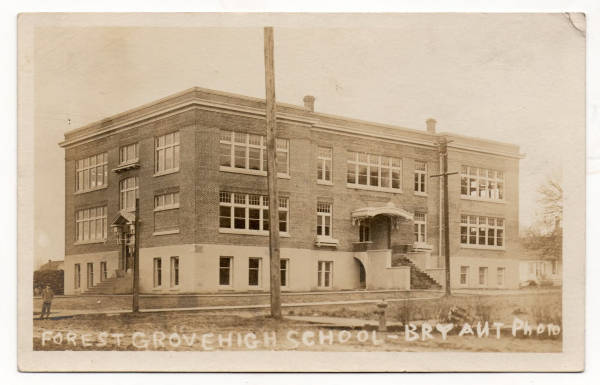
This brick three story building facing Elm Street was the first dedicated High School building and it was called South Park High School. There is a sidewalk in front and across the street, from where this picture was taken. This sidewalk looks to be boards and the street is packed dirt. There is also a fire hydrant on the same side of the street where the photographer took the picture. The main entrance is in the middle of the front of the building and there is an entrance on the left side, which can be seen in the photograph. There is are flower boxes at the two windows that are on each side of the entrance. A man is standing at the extreme left of the picture facing the camera. The building was sold to the Catholic Church and was being converted when it was destroyed by fire in 1956. The gymnasium, across Elm Street, was torn down in the mid 1980's.
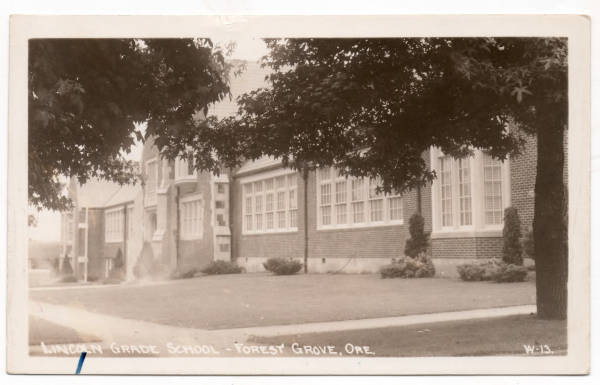
Picture was taken at the corner of Main Street and University Avenue. A large brick building which is quite wide on the front side that faces Main Street. There is a paved sidewalk in front and along the side. This building replaced the former wood building of the same name in 1938. The building was sold to Pacific University and was vacant when it burned to a total loss in June 1970. Location was on the East side of Main Street at the intersection of B Street.
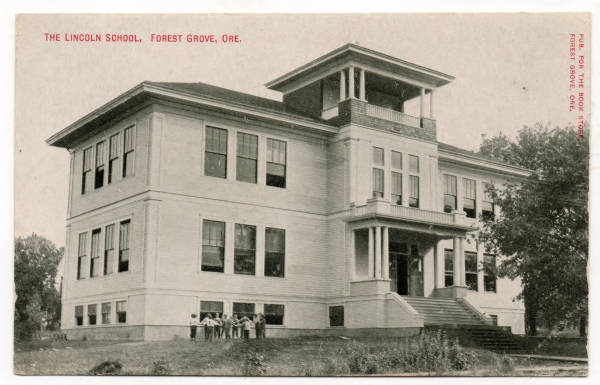
A large two story wood building with a covered open area on the roof above the main entrance. Children are present in the front yard, standing in a circle holding hands. Grades 9 and 10 were added in 1904 and grades 11 and 12 in 1907. This building was later replaced with a brick building in 1938.
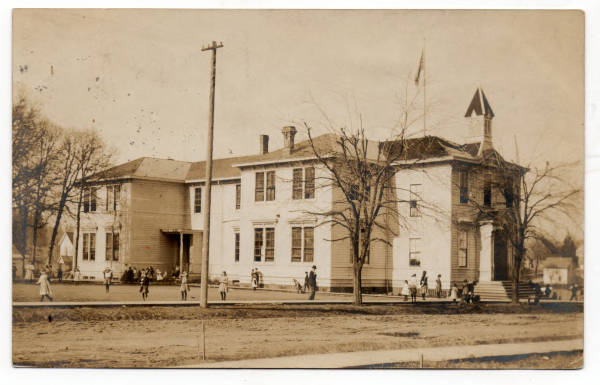
A large wood building with a steeple above the main entrance. Children are present in the side yard along with a few adults. There is a board sidewalk on each side of the street and the street is dirt and very rough. This was the first Central School. The land was purchased in 1876 and school started in 1895. The school was torn down and the new brick Central School was built in its place.
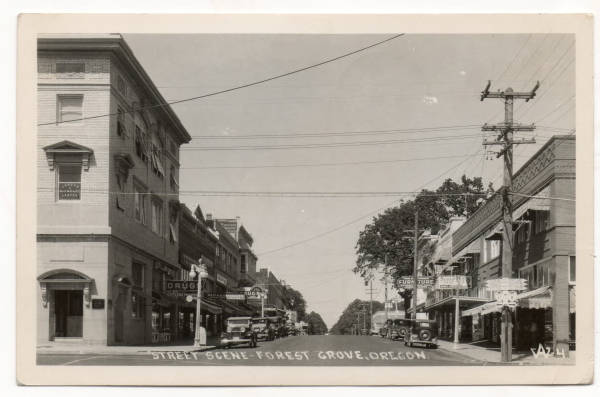
Picture was taken in the middle of Main Street probably from south side of Pacific Avenue. View is looking north with both sides of the street visible. Vehicles parked at the curb are early to mid 1930s. On the left is the Forest Grove National Bank. Next is Littler’s Pharmacy then another sign followed by MEATS & GROCERIES INDEPENDENT DEALERS another sign then REXALL DRUGS then FOREST GROVE HARDWARE. On the right is a street sign with Clatskane, Vernonia and Gales Creek for Highway Oregon 47 and Portland, Beaverton and Hillsboro for Highway Oregon 8. There are two men standing in the entry of the first store. A couple doors down is a sign SUNF??? ICE CREAM and HUGHE’S CO?? (CONFECTIONERY) on the same sign. Next is GEO. G. PATERSON FURNITURE.
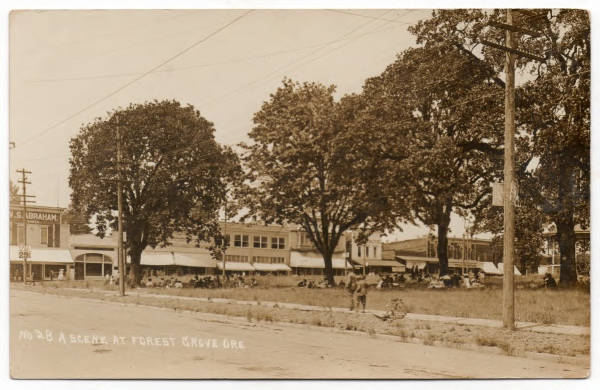
In the foreground there are many people sitting on the grass enjoying the shad provided by some oak trees. In the background is the west side of north Main Street. V. S. ABRAHAM SHOES is on the corner of Main Street and Pacific Avenue.
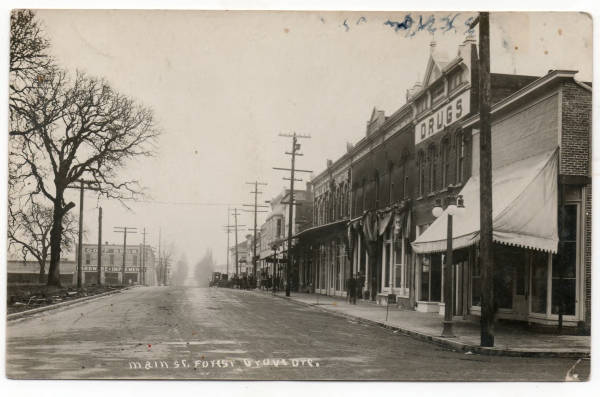
Picture taken from center of the intersection of Main Street and 21st Avenue. The view is of Main Street looking towards Pacific Avenue. The street looks to be paved with cement curb and sidewalk on the right and a curb on the left side. On the right side about three doors down a couple of men are standing. Next is CHAS O?. ROE?/POE? & CO FURNITURE. Farther down the street there is a group of people and at least three horse drawn wagons. The two banks can be seen on the right in the distance. On the left is some debris off the street just beyond the curb. Farther down is GOFF BROS. HARDWARE & IMPLEMENTS