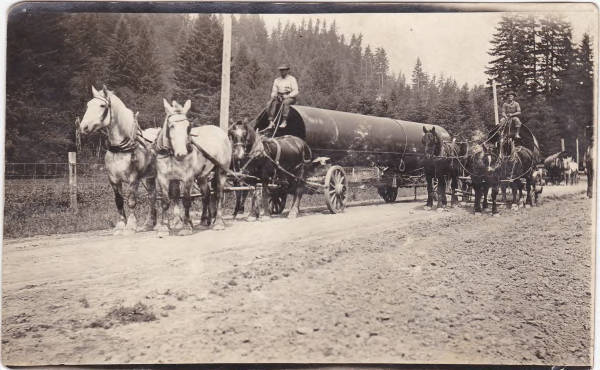
Three 4-horse teams each transporting a single large metal tube (pipe). The team of horses is hitched to a two-wheel, single axle. This would be like the typical front wheel section of a horse drawn wagon. A draw bar from this set of wheels connects a rear set of wheels to suspend and transport the large pipe. The drive sits on top of the leading edge of the pipe to guide the horses.
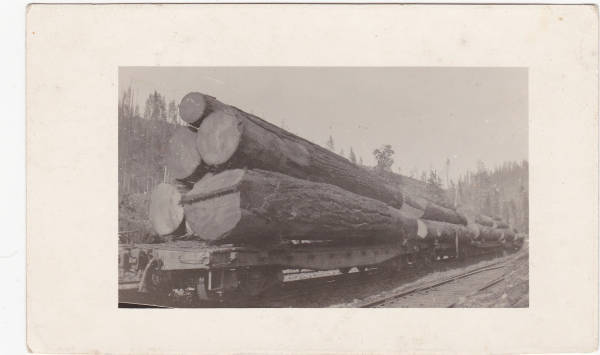
Five flatbed railcars each loaded with large logs sitting by themselves. The scene is in a hilly, wooded area. There looks to be three sets of parallel tracks at this point with the right track having a switch. The closest railcar looks to have NORTHERN on its side.
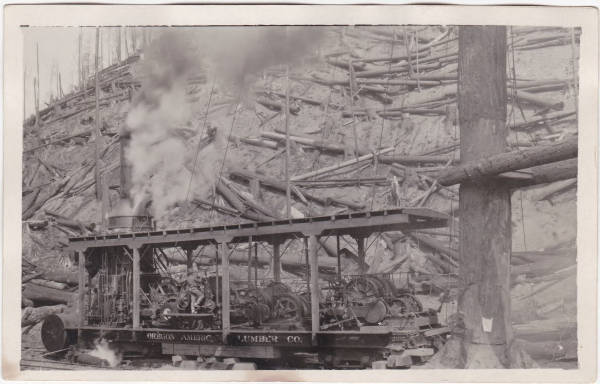
A large steam donkey mounted on a flatbed railcar with the trucks removed. The engine is at the back with multiple reels of cable throughout the remainder of the railcar. A man is standing by one of the larger reels toward the back and appears to be looking toward the front of the railcar. The donkey is snugged up to a stout tree that has been rigged into a spar tree and derrick. Behind the donkey is a hill littered with logs. Oregon American Lumber Co. is on the side of the railcar
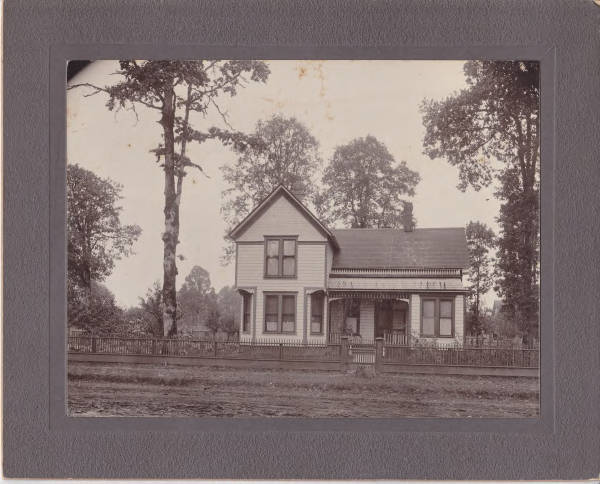
A two story house that was located on the north side of 16th Avenue between Birch Street and Cedar Street. The house has a gable on the left side of the front with a roof on the right side sloping down to the front porch. The porch does not extend to the end of the house as there is a windowed wall on the right of the porch. An interesting feature is the wall treatment under the front gable on the ground floor. The front corner walls are angled at what looks like a 45 degree angle to form a bay window of sorts. This creates a rectangular overhang of the second story above the angled walls. There is a gable on the right side of the house. The house has fine gingerbread detail and ornate spindles. The Gable is shingled with the same ornate pattern as the porch roof. A bicycle is on the porch and the screen door is open and against the wall. A spindle picket fence is in front of the house with an ornate spindle gate and boxed posts. The street is packed dirt and is lower than the property by six to eight inches. There is on curb or sidewalk.
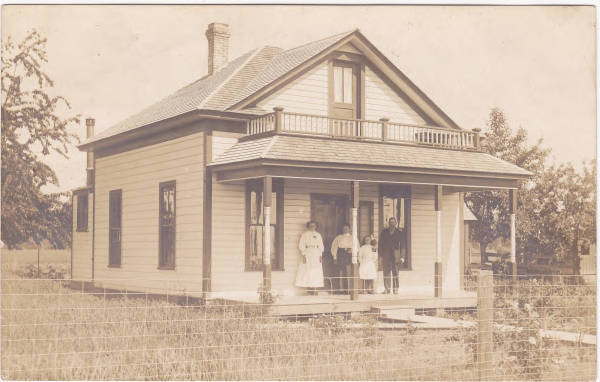
Four people on the front porch of a house. Two women and a girl are dressed in their finest dresses. Hemline on one woman’s dress is above ankle length. This woman and the girl are each wearing a flower pinned on their dresses. The other woman is wearing a blouse and ankle length skirt. The man has a beard and is wearing a tie and suit. The house has a gable front and does not have a full second story. There is a second story door in the middle of the gable that leads to an open area above the porch that is enclosed with a short railing. The covered porch extends across the entire front of the house. The front yard is tall grass with some flowers and plants along the board walkway to the front porch. A wire fence runs across the front of the yard.
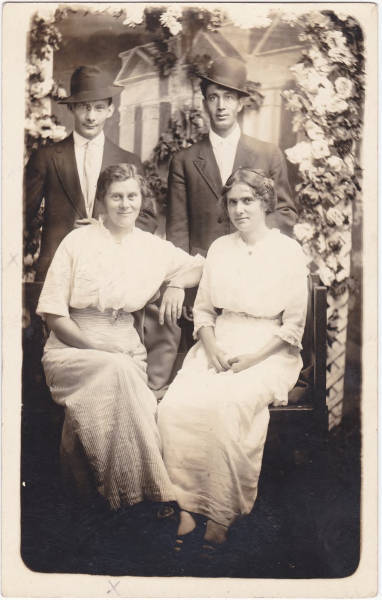
Two men and two women posing for a studio portrait. The two men are each standing behind the women who are seated side by side. The men are dressed in ties and suits. The man on the left has the brim of his hat turned down and is at a rakish angle. The man on the right is wearing his hat at a jaunty angle to the side. The are dressed in long dresses. All are looking at the camera. The backdrop is of a stately house with flowers bordering the backdrop.
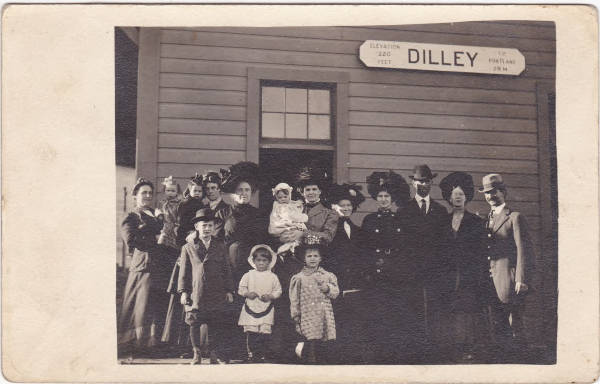
A group of men, women and children are standing outside the Dilley railroad station near Forest Grove, Oregon. They are dressed in their finest and all are wearing hats. A sign on the wall behind then states: "DILLEY, Elevation 220 feet, To Portland 28 M." This photograph was published as a postcard.
Portrait of Josephine Baber MacLeod (1886-d. March 1964, Forest Grove) as a girl of about three. Josephine was the daughter of Granville and Wilhelmina Baber, and was married to Duncan Matheson MacLeod (1868-1929). Josephine and her mother lived on 1st Ave south, in Block 20, Forest Grove. She is buried in the Forest View Cemetery.
In this portrait, Josephine appears with blond hair parted in middle, in a pleated dress with a lace collar and black boots. She stands on faux marble block, and rests her right arm on faux marble podium. She stands in front of a painted backdrop depicting a lakeside scene.
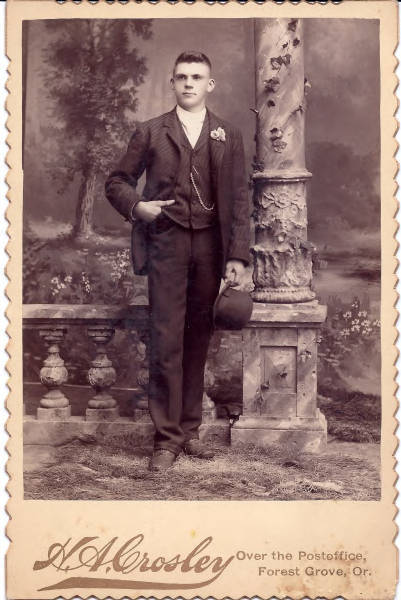
Full-body portrait photograph of young man, dressed in fine suit, as though a graduation picture. White flower stuck in lapel. right hand in pants pocket, left hand holding derby/bowler hat. Standing next to faux pillar and in front of faux antique fence. Robert Bruce “Bob” Porter (1872-d. 6 May 1944, Washington County, OR), farmer of land between Verboort and Forest Grove. Married to Margaret M. Porter.
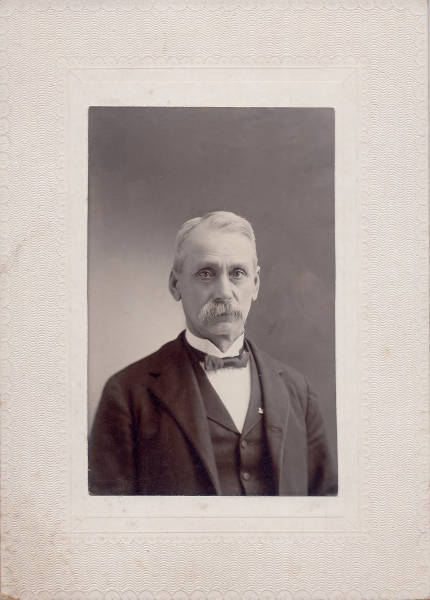
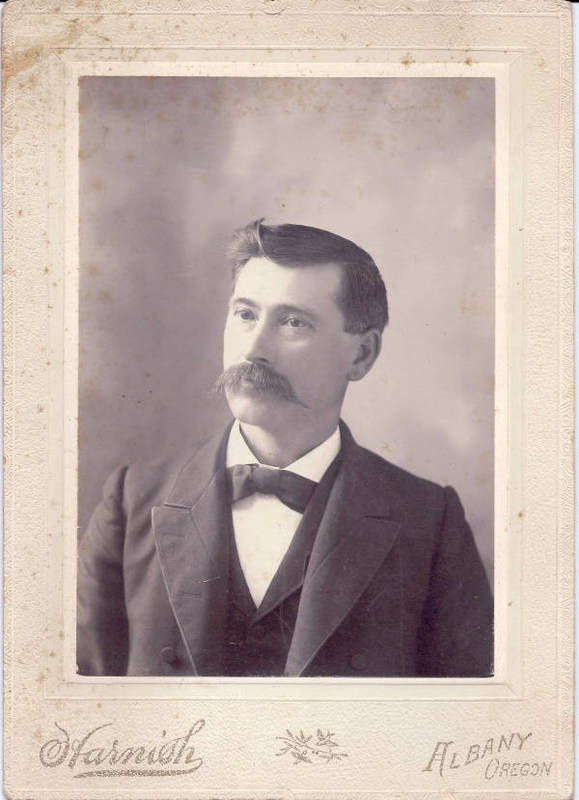
Portrait-style photograph of man, approx. 40 years old, looking to his right, with prominent mustache, wearing dark suit jacket, low collar, and black bow tie. J. N. Hoffman, father-in-Law of Fred Watrous. John Nathan Hoffman (1856-1927, d. in forest grove), Forest Grove lawyer, resident; married to Jeanette “Nettie” (Pitman) Hoffman (professional photographer)(1861-d. 21 July 1931, Washington County).
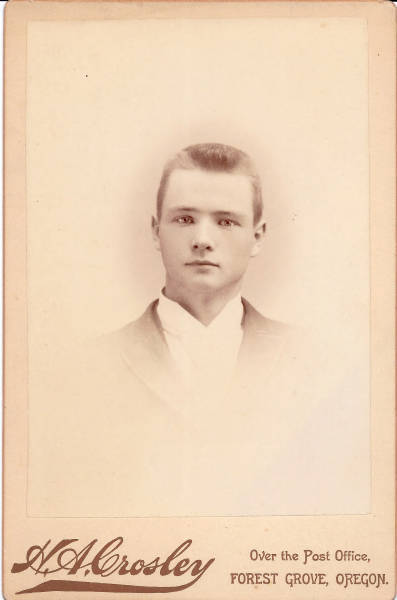
A portrait of Pembroke M. “Pem” Patton (1871-1939), who farmed hops in Patton Valley near Cherry Grove, west of Gaston, Oregon. Pem Patton's parents were among the earliest white settlers to claim land in the area. This photograph was made in the studio of H. A. Crosley in Forest Grove, who was active from the late 1880s-1890s. This photograph probably dates to circa 1890.
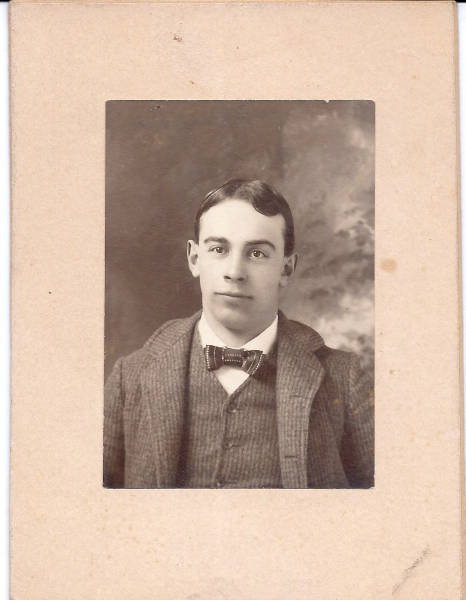
Portrait style photo of young man, maybe a high school senior portrait, wearing short dark hair, bow tie, wool suit jacket and vest. Forest Grove graduate, student of PU in 1900, living on Block 10 of Walker’s Addition, Forest Grove, OR; son of Oscar and Harriet Brown, and brother of Clifford and Gordon Brown.
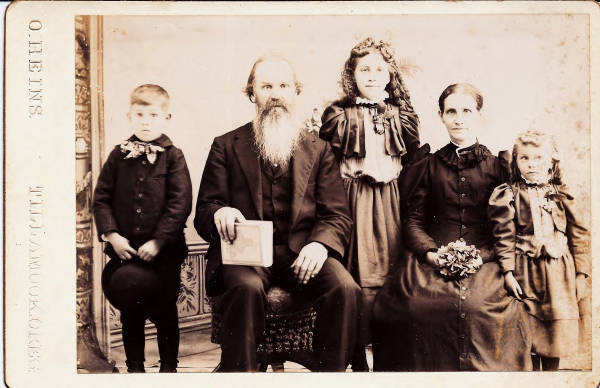
Group photograph of family (in studio), husband and wife sitting, their three children standing. Man, bearded and dressed in black suit, holds book in right hand; wife holds a bouquet of flowers. Daughter in center (age 9) wears a fine, decorative dress, and her hair in curls. Boy (age 7) on far left looks anxious, holds his bowler hat, wears nice black suit, and tied bandana around neck. Daughter on far right (age 4) looks similarly concerned, also wearing fancy dark dress. Isaac Chauncy Quick (1832-1917), dairy farmer; wife Frances Adeline (Simmons) Quick (1847-1943, died in Yamhill); married in Yamhill, 20 May 1863. (Children shown are likely Addie Dove Quick, Ladd Cuthbert Quick and Rosa D. Quick, based on date of photo, ages and the Tillamook address)
A wagon loaded with what looks like hay is hitched to two horses. Two people are on top of the hay. A late 1920’s car can be seen on the right, behind the wagon.
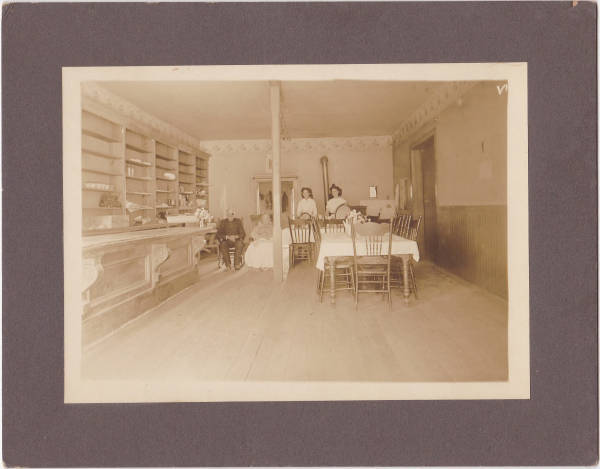
Four people in a store, possibly an eating establishment. At the back of the room an older couple are seated on the left and two women are standing on the right, behind two tables with table cloths, place settings and a center piece. Each of the two women are holding up large platters. On the left is a counter with shelves behind the counter. The shelves are mostly bare. There is a paper roll on the counter for wrapping. On the ceiling are two electrical wires separated by a couple of inches as they were in the day.
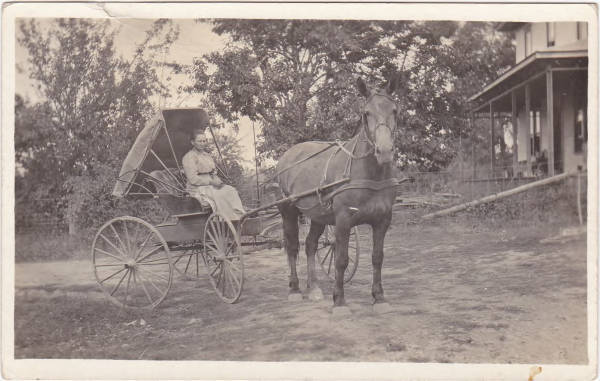
A woman in a one horse drawn buggy posing for a picture. The woman is wearing a dress of simple design. A portion of a house is located on the far right of the picture. The top for the buggy is up but tilted back.
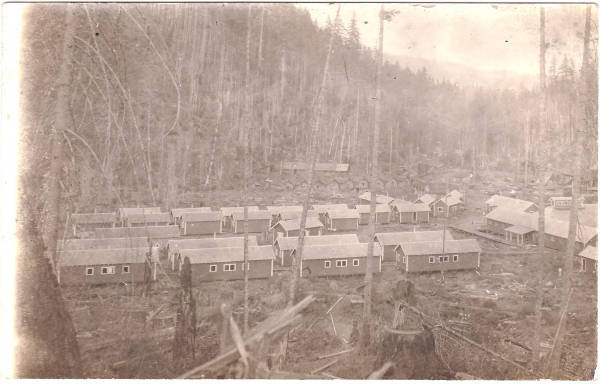
The back side of the office buildings of the Gales Creek Logging Company are on the right. Many smaller buildings are lined up in rows. Most of these would be living quarters for the workers.
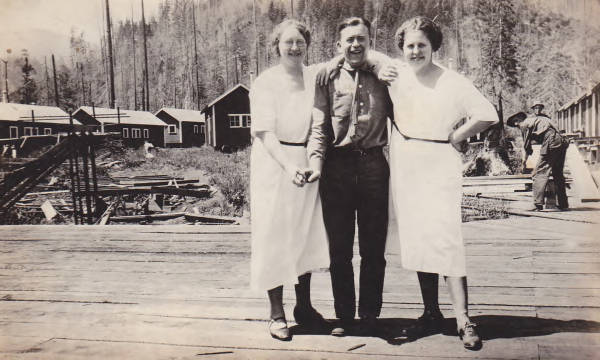
A man and two women, one on each side of the man, who have their arms over his shoulders are standing on a wood platform posing for the photographer. A logging camp can be seen in the background along with a couple of men who are working but stopped to look toward the camera. The man is wearing a tie and clothes not suitable for working in the woods. The women are in white or light colored dresses.
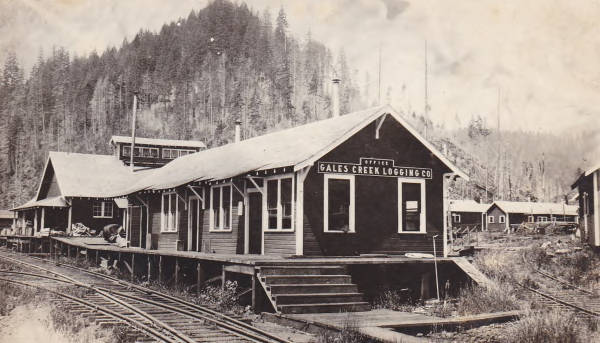
Office buildings of the Gales Creek Logging Company. Two sets of railroad tracks pass in front of the two buildings. Another set of tracks go behind the office and into the back. There are three smaller buildings on the right side of the picture
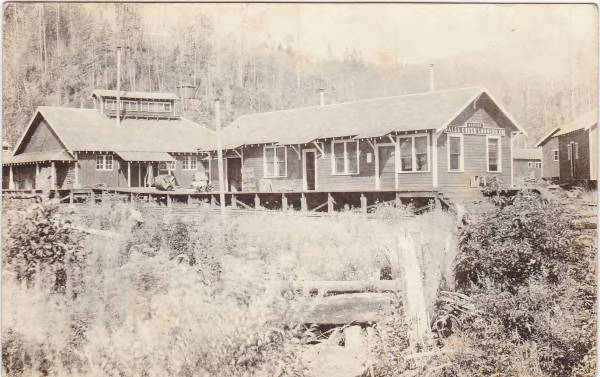
Office buildings of the Gales Creek Logging Company. Two sets of railroad tracks pass in front of the two buildings. Another set of tracks go behind the office and into the back. There are three smaller buildings on the right side of the picture
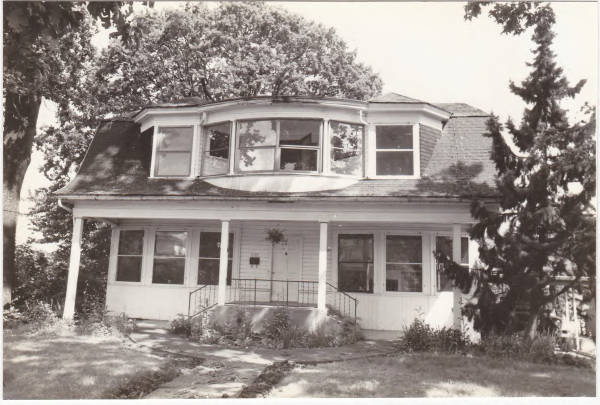
Built in 1905, this home served as the Congregational Church parsonage until 1964 when the house was sold. The style is Dutch Colonial Revival with a side gabled roof, two unusual dormers on the front are connected by a curved center balcony. This house is located on 18th Avenue