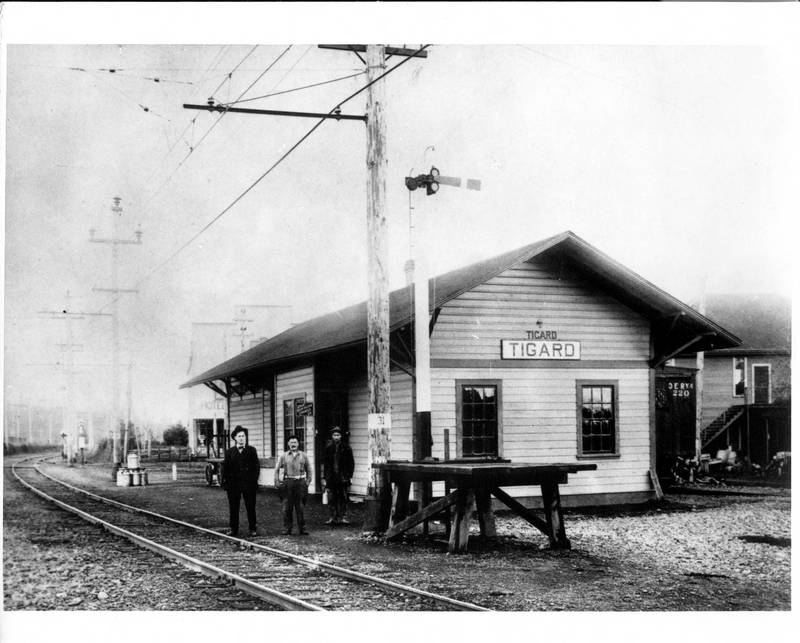
A view of three men standing just outside the Oregon Electric Railway's Tigard Depot. On the end of the building a sign reads 'Tigard.' Train tracks and electric power lines run along the left side of the building. The Germania Hall hotel can be seen to the back and left of the depot. The Tigard depot was located on the south side of the rail line, and was bounded by present day Main ST. (to the east), Pacific Highway (to the west) and Tigard St. (to the south). According to a November 20, 1907 article in the Oregonian, the electric railway's last spike connecting Portland and Salem was driven "near Tigardville."
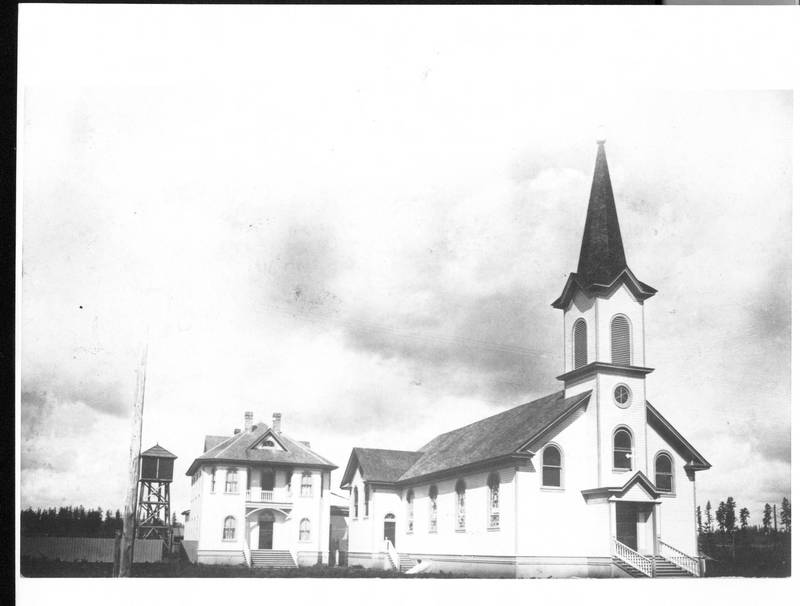
Photograph of a wooden church with a large, square bell tower at the front. Arched, double panes windows bracket a small, roofed front porch. Stairs with railings lead up on either side of the porch. An arched window and circular window are located above the front porch. Four arched, stained-glass windows run the length of the church. The rectory, a square, two-story building, is located to the back and left of the church. The first St. Anthony's Church was constructed on what is now SW Pacific Highway between 1910-1911. The first mass celebrated was on Easter Sunday, 1911. In 1959, as the number of parishioners increased, a new, larger church was constructed next door.
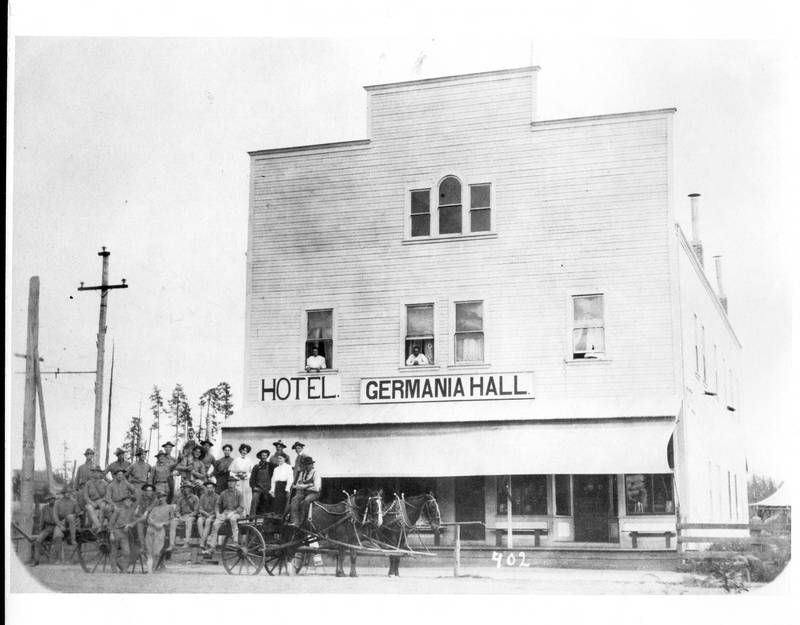
A view of multiple men and women seated on and in front of a horse and buggy at Germania Hall. Germania Hall's facade has two sign reading "Hotel" and "Germania Hall." Germania Hall was built by the Schamoni family and was the first building constructed on Main Street (sometime between 1908-1910) after the arrival of the Oregon Electric Railway in Tigard. Germania Hall was located south of the railroad tracks on the east side on Main Street. The main floor contained a restaurant and grocery store; upstairs was a dance hall and hotel rooms.
Charles F. Tigard, his wife Rosa, and daughter Grace stand at the entrance to the Tigardville General Store & Post Office. A dog lies at their feet. To their right, a man sits on a stack of boxes in front of a large window. To the left of the Tigard family, two men sit on a wood bench in front of a large window. To the left of the window is a sign reading "Tigardville Post Office--Portland 10 1/2 m." To the left of the store is a large tree that stands in front of Charles Tigard's home. The Tigardville Post Office was established in 1886. Charles F. Tigard owned and operated both the post office and the store, formerly located on the northeast corner of what is now SW McDonald Street and Pacific Highway.
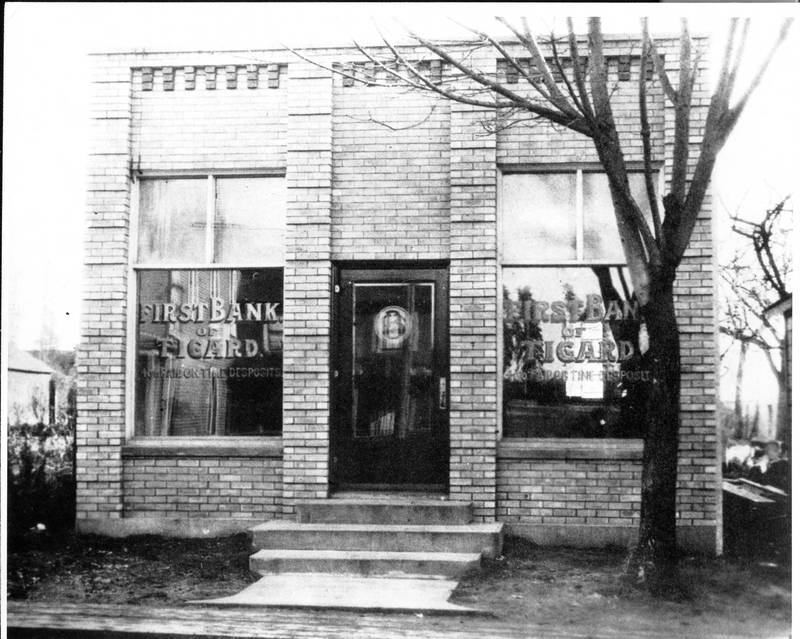
The First Bank of Tigard, located on Main Street between Burnham and Commercial Streets, was constructed in 1919. Charles F. Tigard was the bank's first president. The building is located at 12390 SW Main Street.
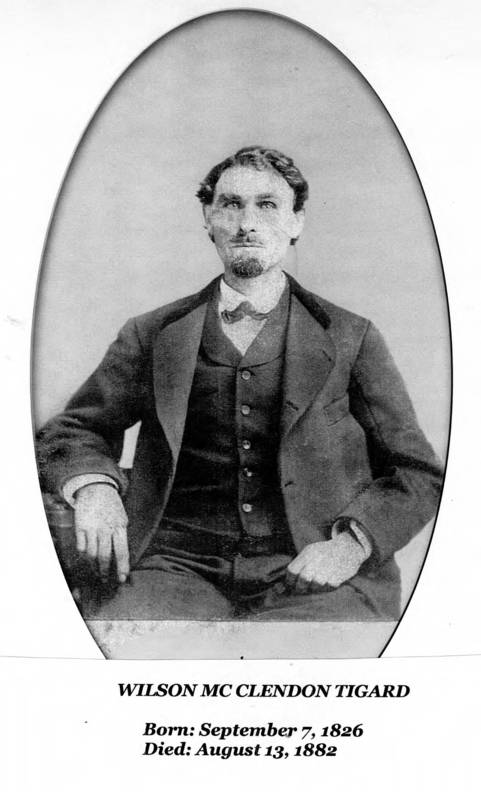
Wilson M. Tigard arrived in Oregon in 1852 from Arkansas and took up a donation land claim near the present site of Tigard. In 1853 he built a log school house with the help of neighbors. Tigard was then known as East Butte and the school was called Butte School. Wilson Tigard is buried in Crescent Grove Cemetery, Tigard, Oregon.
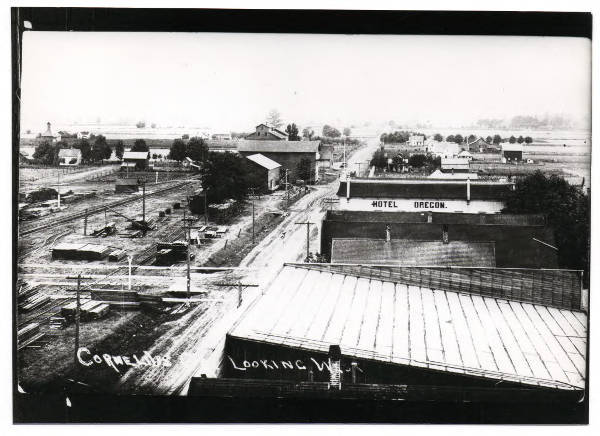
This photo is most likely taken from a tower. It is a view of land, railroads, roads, and buildings in Cornelius, Oregon. Numerous wooden buildings, both homes and businesses, line the dirt roads of Cornelius. 'Hotel Oregon' is written in large letters on one of the structures. Piles of lumber lie in the dirt near the railroad tracks. Wooden electrical poles line the main dirt road.
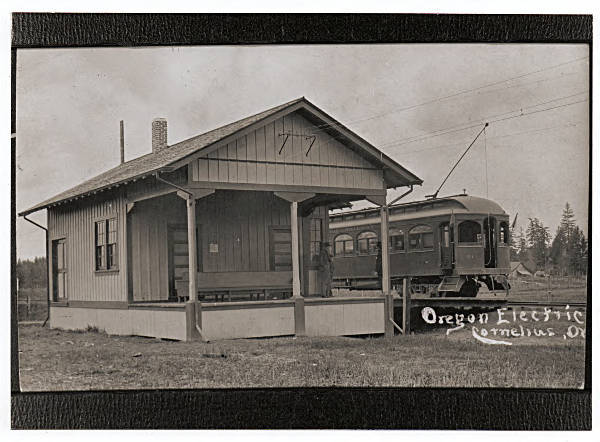
Two men and a boy wait at the Cornelius electric trolley station. The station is a small wooden building with a platform leading to the trolley tracks and a large bench for passengers to wait. An electric trolley is stopped at the station. The trolley is labeled with the number '51'.
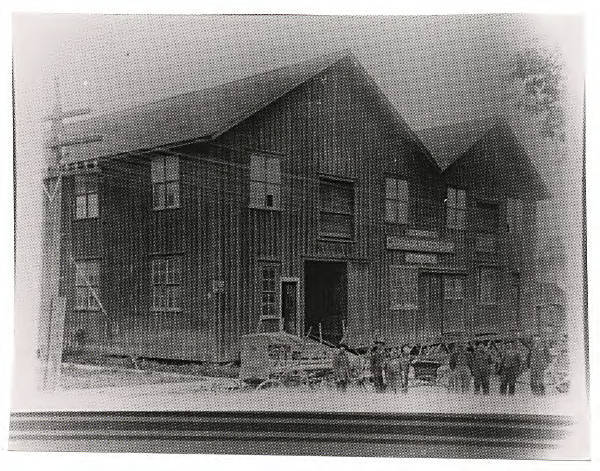
A group of men are gathered in front of Stribich's Carriage and Wagon Shop in Forest Grove. The building is a large two-story wooden structure with many windows and a large door. A large sign on the front of the building reads 'Stribich's Wagon & Carriage Shop' with a smaller indecipherable sign underneath. Carriages and wagons are parked in front of the shop. John Stribich was the owner of the store.
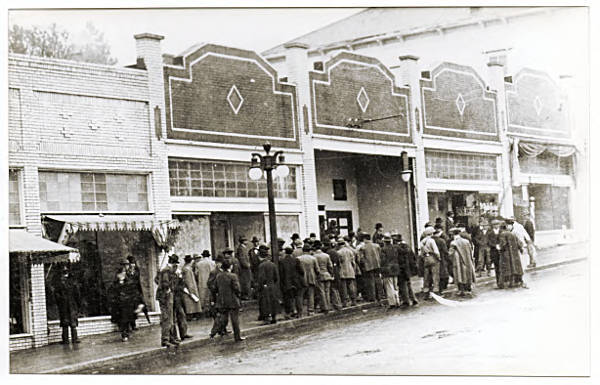
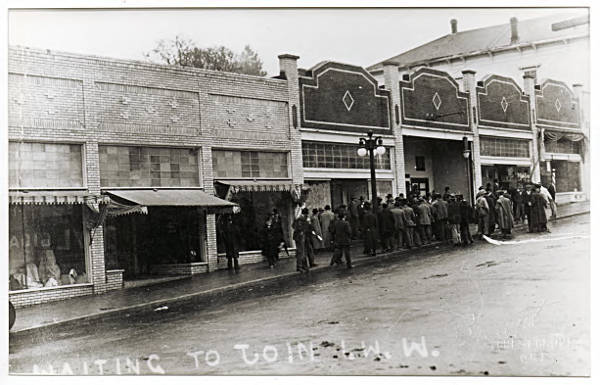
A large group of men are lined up on the sidewalk and gathering in the street to join the Industrial Workers of the World union. All the men are wearing hats and coats.
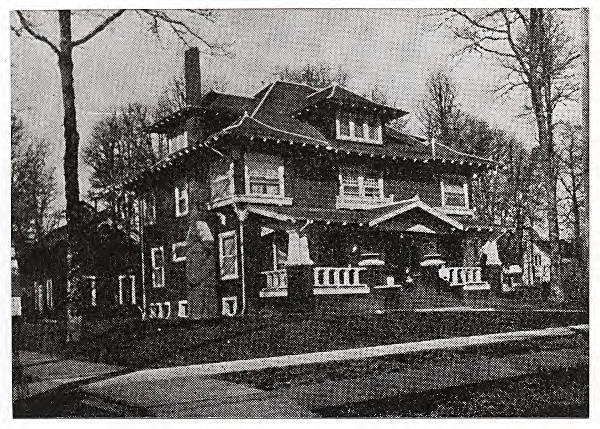
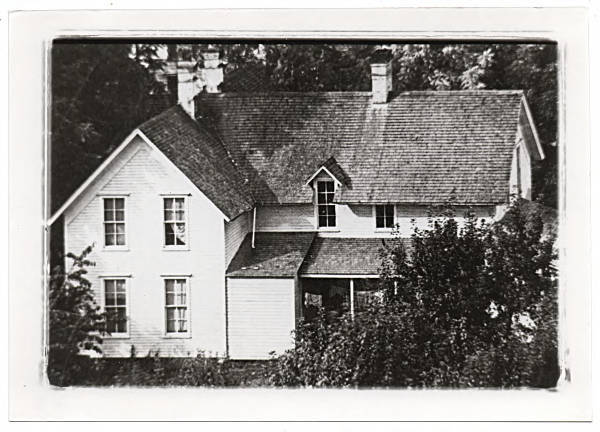
The F. J. Miller house was built by F. J. Miller in 1909. It is located at 1506 Cedar Street in Forest Grove. The house has numerous tall trees around the back and sides. A sidewalk runs next to and in front of the house, part of it looks like it may be wooden.
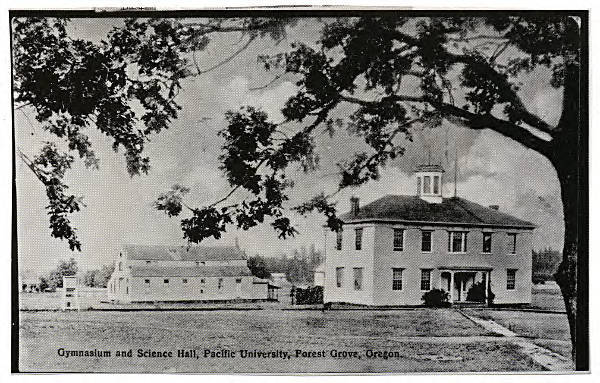
Two buildings on the Pacific University campus. The building on the left is the old Gymnasium. On the right is the Science Hall, now known as Old College Hall.
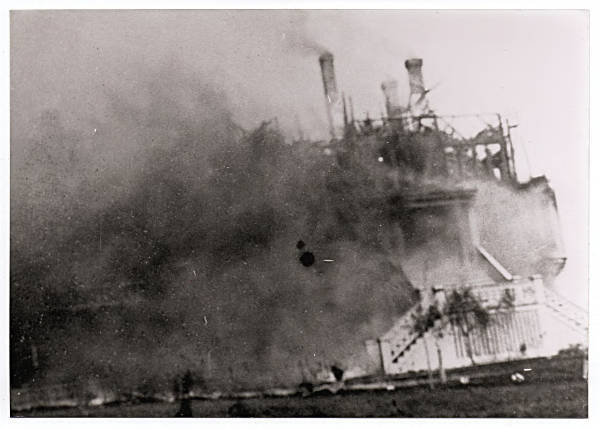
Pacific University's Herrick Hall building on fire. Smoke covers most of the building. The upper floors have nearly burned away except for a bit of charred frame and three chimneys. The stairway up the the front doors are still intact in this photo.
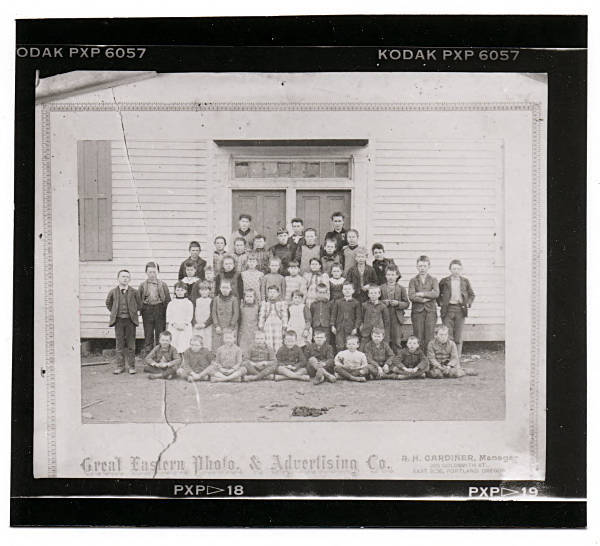
A group of school children, boys and girls, posing for a class photo in front of the doors to their school building. There is no identifying information as to where this school is located, although the address for the photographer is east side Portland.
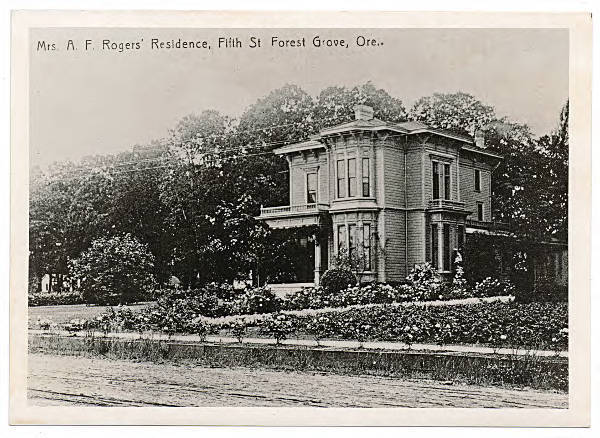
The Rogers' house was located on Fifth Street in Forest Grove. The house is surrounded by a garden with well-kept bushes and flowers. Large trees line the back of the house. A sidewalk lined with small flowering bushes runs in front of the house, elevated on a high curb along the dirt road. The house was dismantled during World War II and the lot is now Rogers Park.
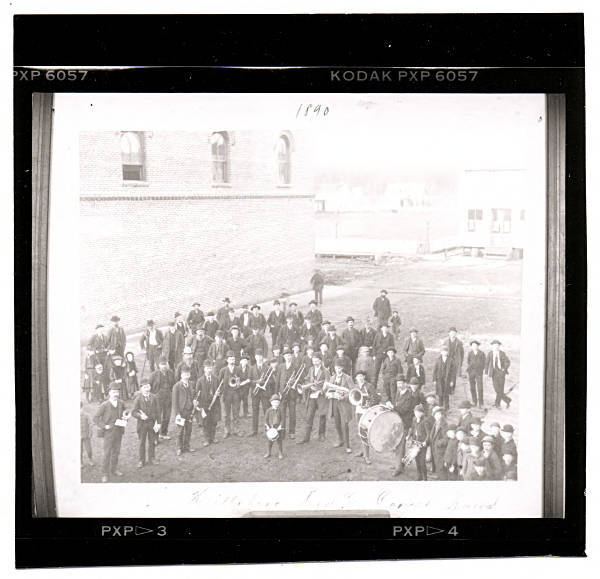
A marching band posing with their instruments. The band is made up of mostly men but a few boys are also holding instruments. Other men and children are next to and behind the band. It is difficult to tell if they are also a part of the band or if they are spectators. All the men and boys are wearing suits and hats. '1890' is handwritten at the top. There is more writing at the bottom but it is very faint. The first word appears to be 'Hillsboro' and the last word is most likely 'Band', but the two or three words in between are indeciperable.
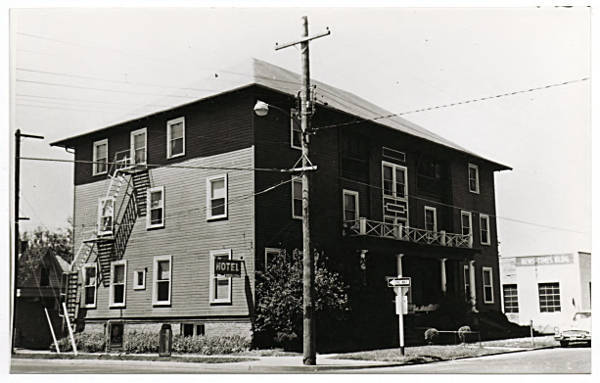
Hotel Oregon was a three story hotel on the corner of Pacific and A Street in Forest Grove until 1959. This was once known as the Laughlin Hotel until a name change in the 1920s. The top floor and roof of the structure are not the original due to a fire that required reconstruction in 1914.
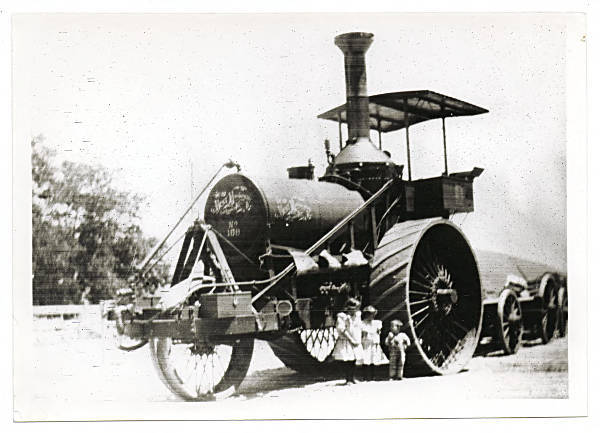
Three children stand next to a Best Manufacturing steam tractor. Two girls and one boy are next to the enormous wheel of the tractor. 'The Best Manufacturing Co' and 'No 168' can barely be seen on the front of the engine. It looks like there may be more writing that can not be deciphered due to the quality of the photograph.
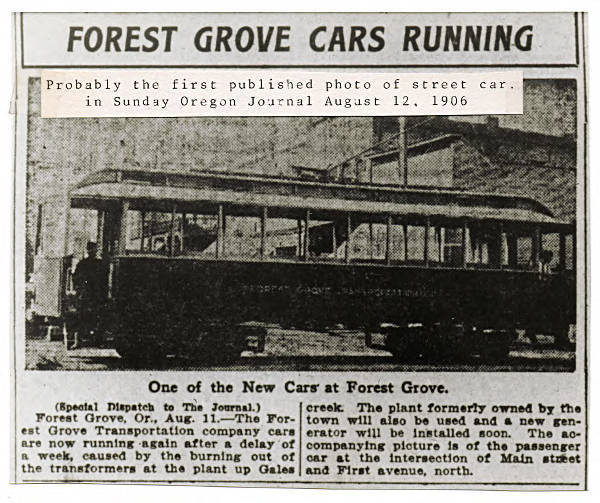
A photo of an old newspaper clipping showing one of the first published photographs of a Forest Grove street car and of the story that accompanied it. The street car is shown with the driver standing at the entrance. 'Forest Grove Transportation' is written on the side of the car. The article title is 'FOREST GROVE CARS RUNNING' with the dateline 'Forest Grove, Or., Aug. 11.' The article reads 'The Forest Grove Transportation company cars are now running again after a delay of a week, caused by the burning out of the transformers at the plant up Gales creek. The plant formerly owned by the town will also be used and a new generator will be installed soon. The accompanying picture is of a passenger car at the intersection of Main street and First avenue, north.'
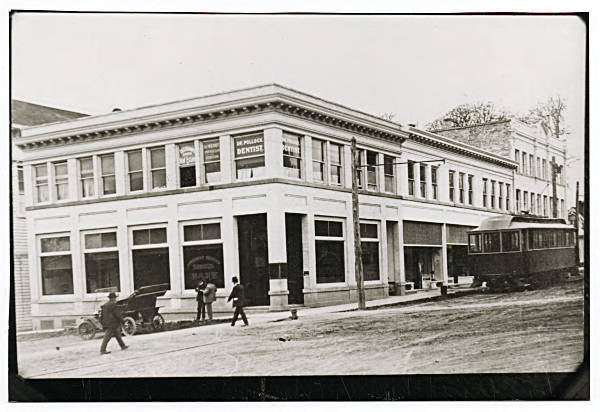
A street corner in Forest Grove. An early automobile is parked outside the Forest Grove National Bank. Three men are on the street corner and one other is crossing the dirt road. An electric trolley is parked on the other side of the building. Names of businesses are written in the windows above the bank including 'Dr. Pollock Dentist', 'Dr. Wend[e] Physician Surgeon', and a real estate business whose name is indecipherable.