Photo of two men standing in a grassy area before a wire fence fronting a cemetery. Both men wear three-piece suits with vests, ties, and white shirts, and their hats are shading their faces. The older man to the left wears glasses and a fedora and stands with his hands in his pockets. The younger man to the right wears a newsboy hat. The cemetery behind them has numerous grave markers of varying sizes, and a large stand of pine trees is visible on the other side of the graveyard.
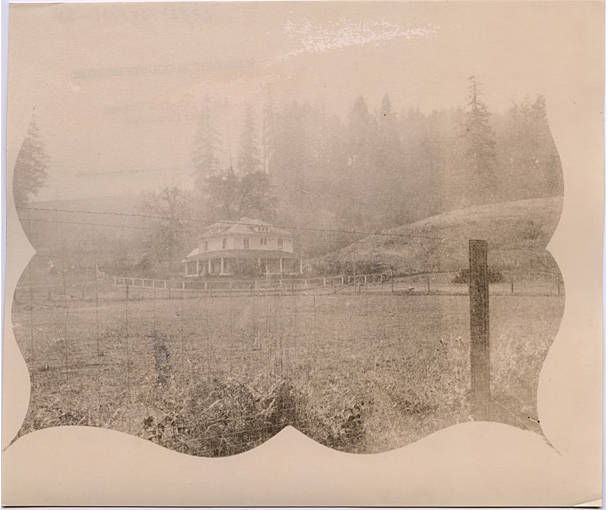
A large bungalow style house, two story with dormer windows, sits at the back of a large field. A porch wraps around the first story of the house, and a white rail fence runs around the building. A square wire fence is visible in the foreground, and hills rise to the right and behind the house. A thick grove of pine trees stands between the two hillsides. Image is scalloped on edges and printed on glossy white paper.
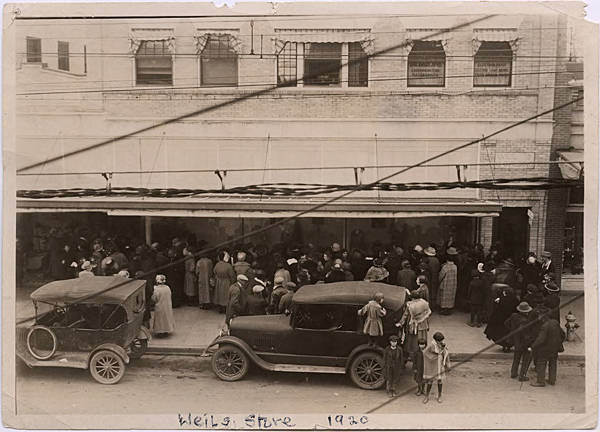
Photo taken from above and across from a group of men, women, and children lined along in front of a store. All are facing the store, wearing coats and hats. Two cars are parked along the dirt street in front of the concrete sidewalk; one resembles a 'jalopy' and has a spare tire rim alongside the driver's side door. The second has a longer wheelbase and a more substantial cab. A child in a long coat and a hat stands on the back rear wheel well; a young boy leans against the car beside her. Two other children stand at the back of the car, facing the street. Two women also stand next to the car, watching the line of people. One of the women has a fur shawl around her shoulders. A fire hydrant is visible on the utmost right of the photo, and power lines criss-cross the image. The building is brick painted white, and awnings shelter glass windows that make up the front of the first floor. Double hung windows with awnings are spaced along the second story, with the window in the middle being multiple paned and having two smaller oblong windows on either side of it.
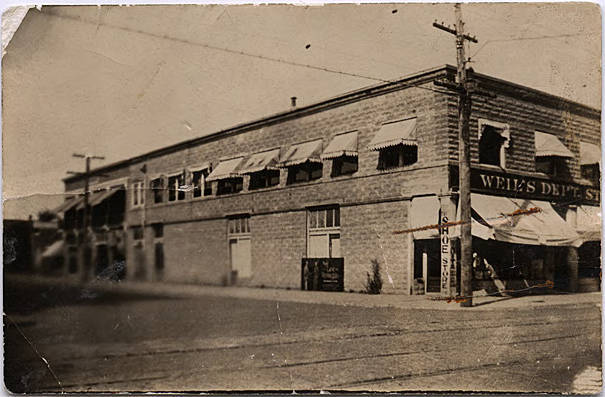
Photo of a two-story brick building on a street corner. The road appears to be dirt, and trolley tracks run from the foreground to the right front of the image. There is a poured concrete sidewalk on both sides of the building. The bricks appear to be roughly cut and larger. The first floor of the building has two larger wooden freight doors topped by four small clerestory windows, one blocked by a metal gate. A second building adjoins on to it at the left rear of the photo. The corner of the building is a recessed entryway, with a support posts reading 'Shoe Store.' Windows take up the right front of the building, with a white awnings overhanging them. A sign reading 'Weil's Dept. Store' rests above the awnings. Pairs of double hung, recessed windows are spaced evenly along the left side of the second story of the building; single double hung windows decorate the front of the second floor. All windows feature awnings that, when extended, shade the top half of the window; most are open, four are furled. A power pole sits on the corner sidewalk in front of the building; it has two cross-struts with multiple transformers, and several power lines run to and from the pole out of the image and down toward another pole just visible in the rear of the image.
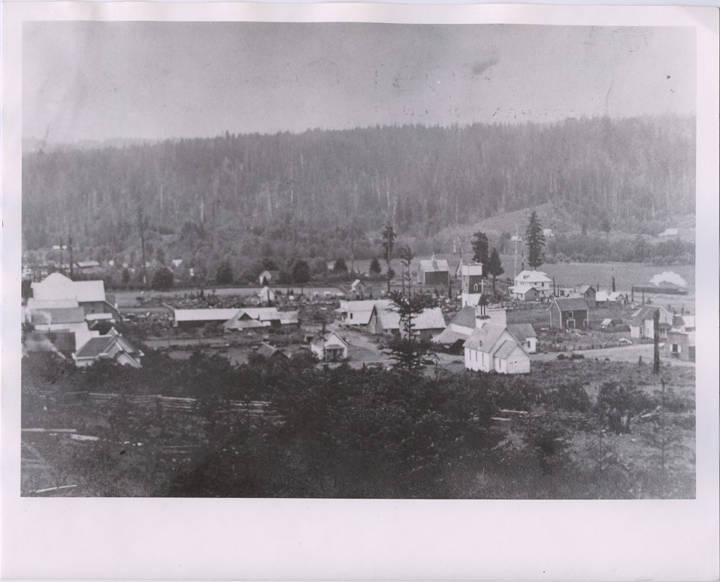
Black & white photo of the town of Buxton, taken from a nearby ridge. A number of houses, ranging from small dwellings to larger two-story structures with nearby barns and outbuildings, and commercial buildings are visible. One is recognizably a church, with a steeple and cross. A wooded ridge rises to the back of the photo, and to the right a train with smoke coming from its smokestack is visible. A split rail fence runs across the lower front of the image.
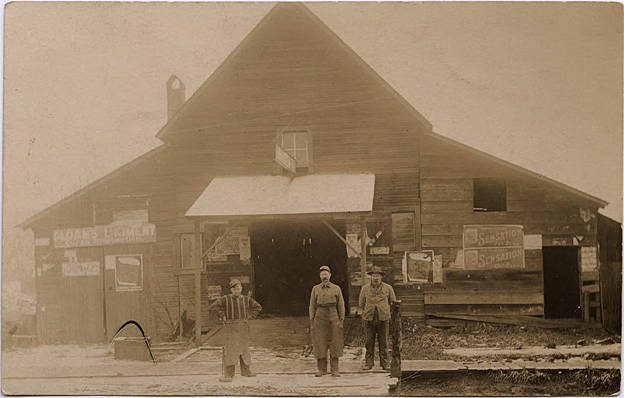
Three men stand in front of an elongated gable-roofed barn. An awning-style roof extends over an open barn door with a wooden ramp leading into the building. To the left is a set of closed doors, and a dead sapling. Posters and printed material adorn the open doors of the middle section. A glass double pained window is above the awning, with a sign suspended perpendicular to the building. The right section of the building has a window-sized opening and then an empty doorway. The men stand on a boardwalk or planked road. The man on the left stands akimbo and wears a dark shirt with white stripes, long-sleeved, with a leather apron over dark pants, and a cap. The man in the middle has a mustache, and a dark shirt with a leather apron over dark pants and a cap. The third man stands with his hands behind him and wears a buttoned coat over dark pants and a fedora. Signs on the building advertise 'Sloan's Liniment' and 'Sensation [illegible].'
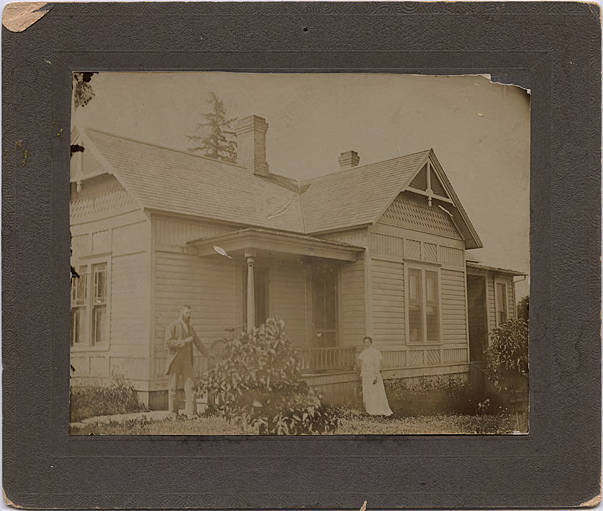
A man and a woman pose outside a small gabled home. He wears a suit coat over a vest and trousers, and has short hair and a longish beard. She wears a long white dress with puffed upper sleeves. The small porch on the front of the house has a short railing, and two doors with screens open out to it. The gables feature decorative shingling in a scale pattern, while vertical areas on the outer walls features bands of diagonally placed boards. A third door opening is just visible beyond the main front portion of the house. Sets of two, double-hung windows decorate each end of the two visible sections of the house, each pane featuring smaller rectangles of glass bordering a single larger piece. Two chimneys are visible, one entirely and one behind the peaked roof of the front of the home. There is a sidewalk leading up to the porch, and the yard is grassy with leafy bushes placed on the corners.
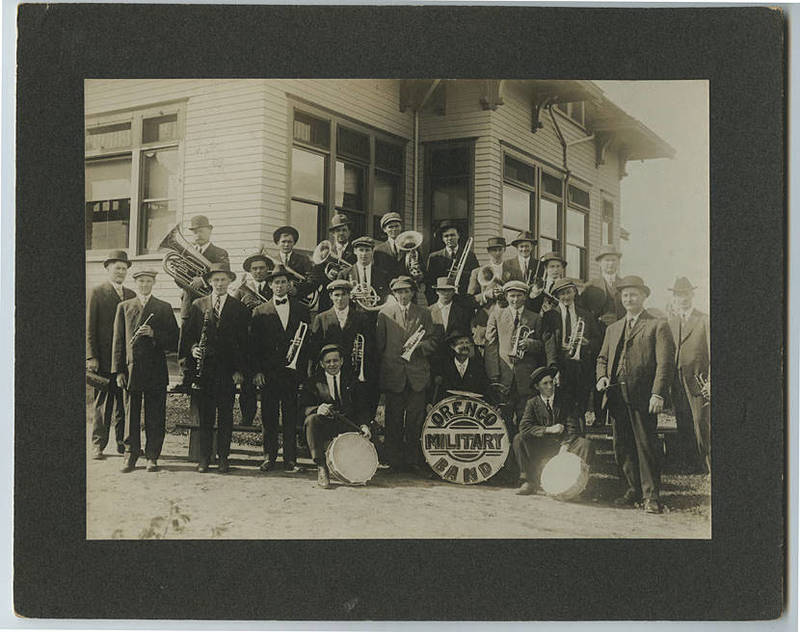
A men's band poses for a picture outside of a building. Band members wear plain dark suits over white shirts with either bow or straight ties, and all have short hair with newsboy caps, fedoras, bowlers, or other felt, brimmed hats. All instruments other than three drums are brass. The man in the lower right of the picture holds a conductor's baton. The bass drum in the center of the group reads 'Orenco Military Band.'
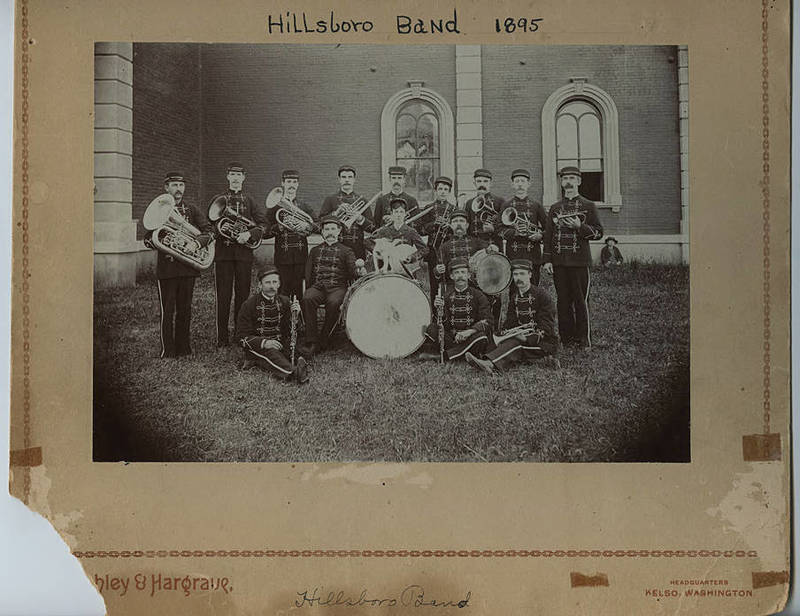
Portrait of band members, all men, in uniform, standing on a grassy yard in front of a brick wall with arched windows set in decorative stone frames. Their uniforms are dark, long-sleeved, with light stripes down the pants' legs and with five braided frog fasteners across the front, as well as decorative braid on the sleeves. Instruments are mostly brass, trumpets, tubas, trombones, cornets, etc, with two drums (bass and snare) and a clarinet and a flute. In the background, a small boy leans against the foundation of the building. Photo is on dark cardstock, with '[Chure]hley & Hargrave, headquarters Kelso, Washington' printed on the bottom. 'Hillsboro Band 1895' is printed in black ink across the top of the cardstock, and 'Hillsboro Band' is written in pencil in cursive on the bottom.
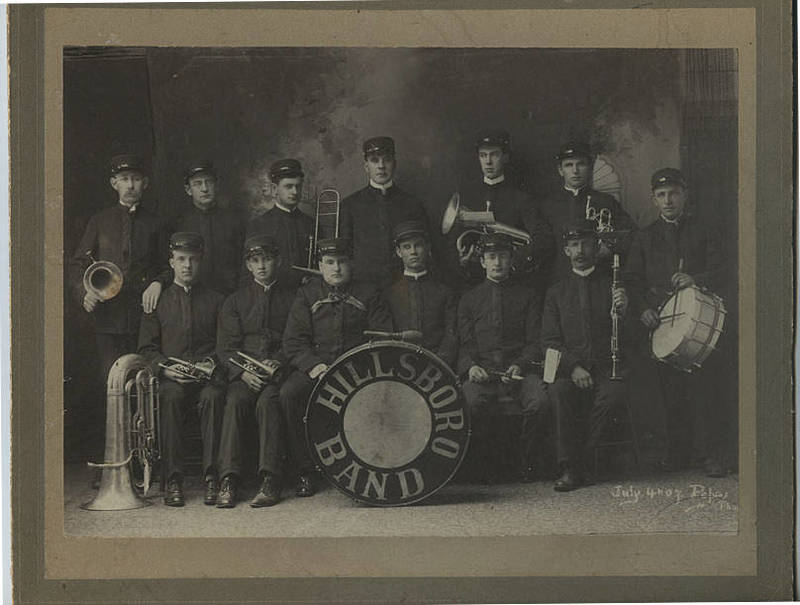
Portrait of band members, all men, in uniform taken indoors. Six members seated in front with seven standing behind. Band members hold a variety of brass instruments, trumpets, trombones, baritones, and two wind instruments. One man holds a snare drum. Uniforms are dark and plain, long-sleeved and buttoned to the neck with a white collar visible, and conductor style hats. All the men have short hair. Bass drum in front of group says, 'Hillsboro Band.' In white in print on photo says, 'July 4, '07. Pope's Photo.'
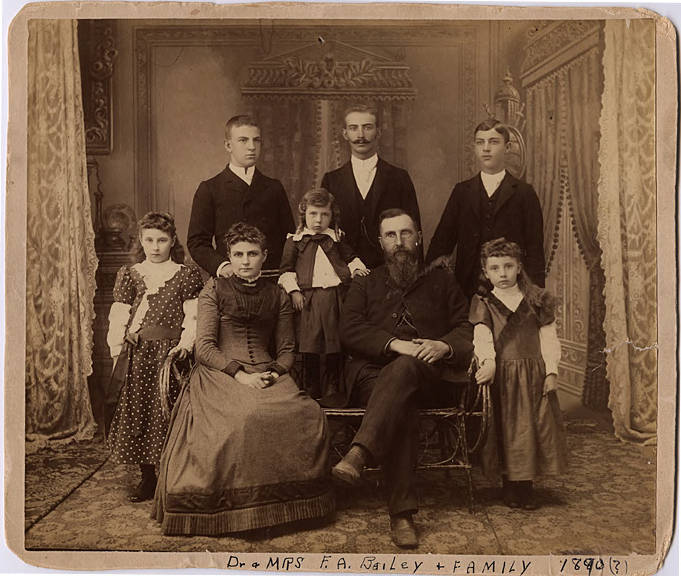
Group portrait of Dr. Francis Alonzo Bailey and his family. Francis Bailey was a prosperous doctor who founded the Hillsboro Pharmacy in 1873. He also served three terms as the mayor of Hillsboro, Oregon, including around the time this photograph was taken, circa 1890. Back row, left to right: Dr. A. B. Bailey, Dr. F. J. Bailey, John Bailey. Front row, left to right: Louise Bailey, Mrs. Bailey, Tommy 'Dr. Tom' Bailey, Dr. Francis G. Bailey, Eva Bailey.
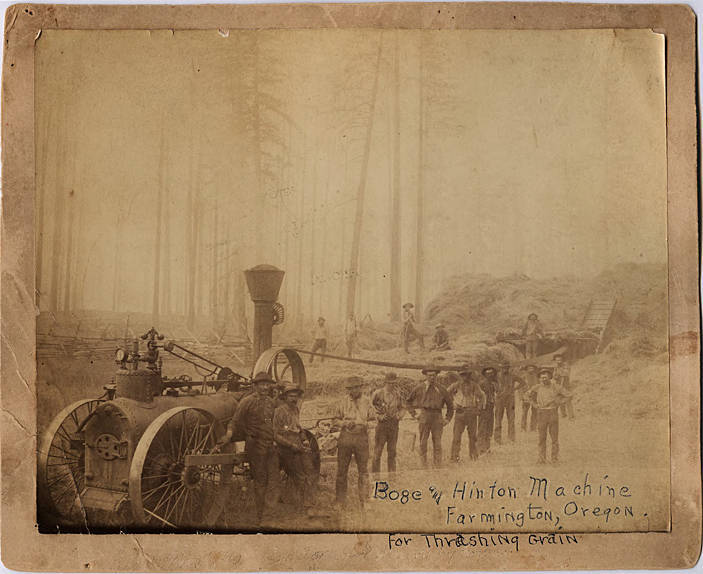
A large wheeled engine dominates a field surrounded by tall, bare pine trees. The engine consists of a round, riveted barrel, with a smokestack at one end and a protrusion with gauges and handles at the fore end. A door with a round vent occupies the front end, which is bracketed by large metal spoke wheels. Smaller wheels are placed at the other end, beneath a smokestack and a large gear which supports a long belt. The belt stretches across the picture to disappear under a platform which is covered over with a large amount of dried plant material. About a dozen men stand along side the belt, which runs above their heads. One man with a pitchfork stands on the haystack; another stands beside the opening where the belt disappears into the haystack. All the men wear pants, hats with brims, and long-sleeved work shirts buttoned up to the neck. A fence made of poles fastened to triangular supports runs behind the group of workers, separating the work area from the trees. Written in black ink on the bottom right is 'Boge and Hinton Machine. Farmington, Oregon. For Threshing Grain.'
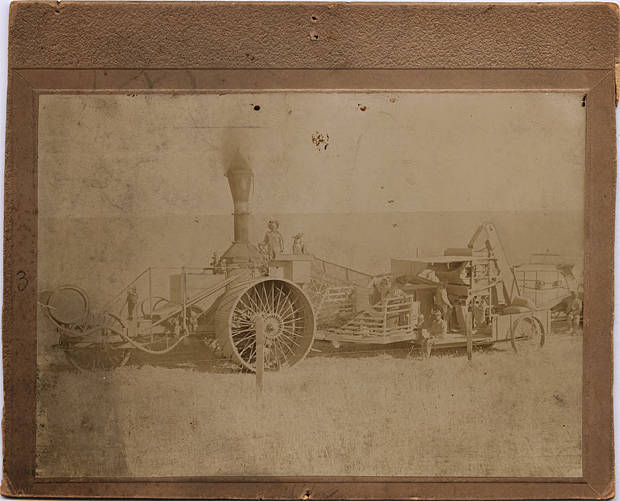
A large, steam-powered harvester in a harvested field. One man stands on the deck of the machine, hand on a steering wheel. Black smoke issues from the round smokestack in front of him; a little girl in a hat with a wide brim, uplifted in back and sporting a feather, stands next to him. On the lower level, a woman leans over a rail, looking toward two other men at the back of the machine; one man sits on a deck with his feet on the ground; the other stands behind him working with the machine. The machine has metal wheels with spokes, one appears to be about the height of a grown man. Hoses and metal gears are visible. A barbed wire fence runs across the foreground of the image.
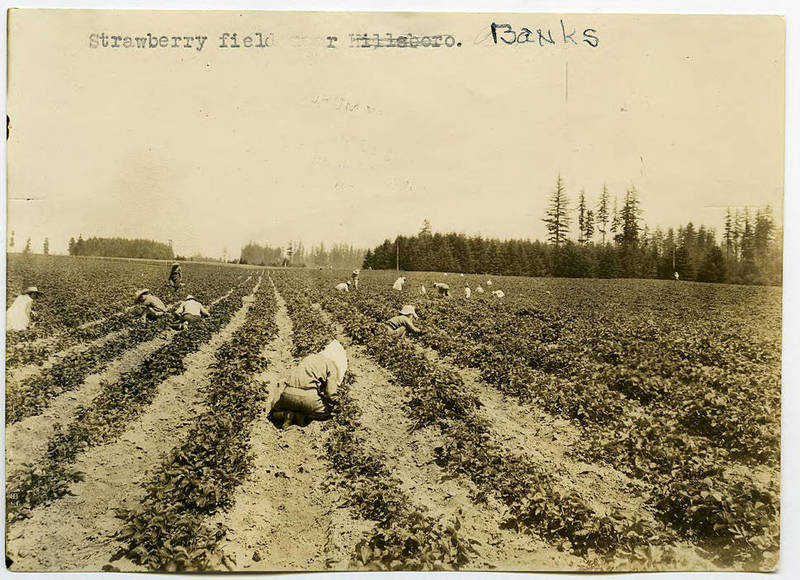
A large field of strawberries, rows running into the distance. Various unidentified people are at work in the field, kneeling and working with the plants. Most are men, though two are identifiably women in skirts. Almost all wear hats; some have fabric draped over their heads. The ground appears dry and dusty. In the background, thick stands of pine trees are visible. 'Strawberry field near Hillsboro [struck out] Banks' is typed across the top of the image.
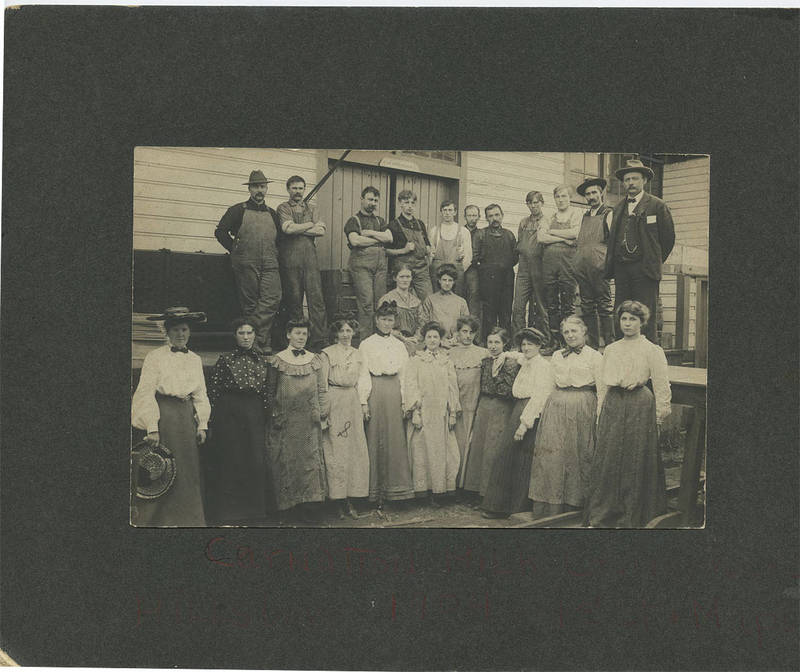
A group of about two dozen adults of various ages pose in front of a building. Eleven women stand in an angled line before a raised porch. Two more women sit on the porch, and eleven men stand on the porch behind the women. The women wear long skirts with full, tucked in blouses, and all wear their hair up; their clothes appear worn and dirty. Two have their hair pulled back in snoods with large bows tied on top of their head, two others appear to have large, shapeless hats on the back of their heads. The woman at the left end of the line has a crisp white shirt tucked into a dark skirt, a bow tie, and wears a low-crowned hat with a wide, stiff brim. She holds a second hat like the first. Next to her, a woman wears a dark shirt with white polka-dots and a necktie, tucked into a dark skirt. All but one of the men wear overalls and work shirts. Two wear hats. One man at the right side of the group wears a three-piece suit with a bow tie, a watch on a fob, and a light-colored fedora. The building in the background is wooden, with large double doors and windows visible above the porch level. Written in dark ink on the mat below the image is: 'Carnation Milk Co. workers, Hillsboro 1904 - 1st St. & Maple.'
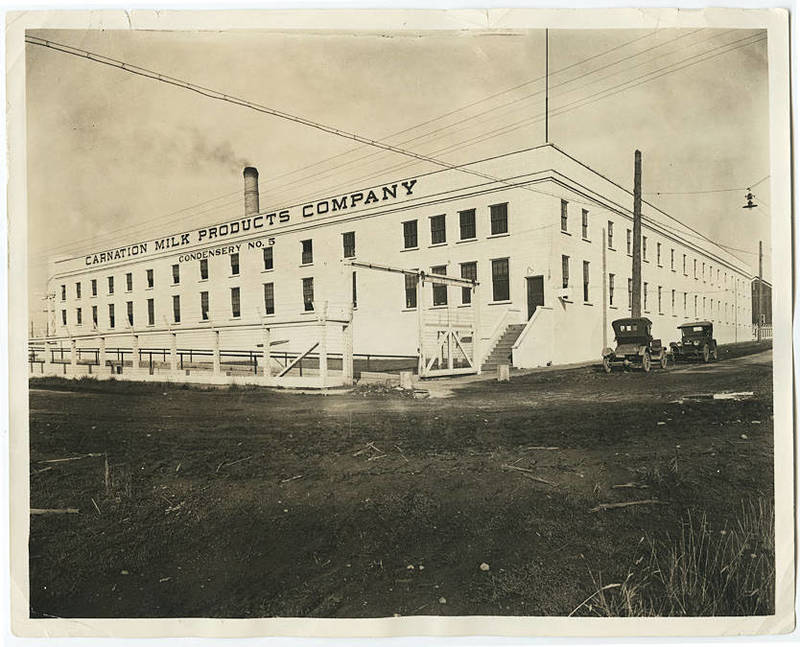
A large square three-story building with 'CARNATION MILK PRODUCTS COMPANY' lettered across the top fills most of the picture. 'CONDENSARY NO. 5' is lettered below. Wire fences with barbed wire surround a driveway along one side of the building, with a large gate. Smoke rises from a smokestack behind the building, and power lines criss-cross the area above and beside the building. Stairs lead up to a door in the corner. Two cars are parked alongside the building, and muddy ground fills the foreground of the image.
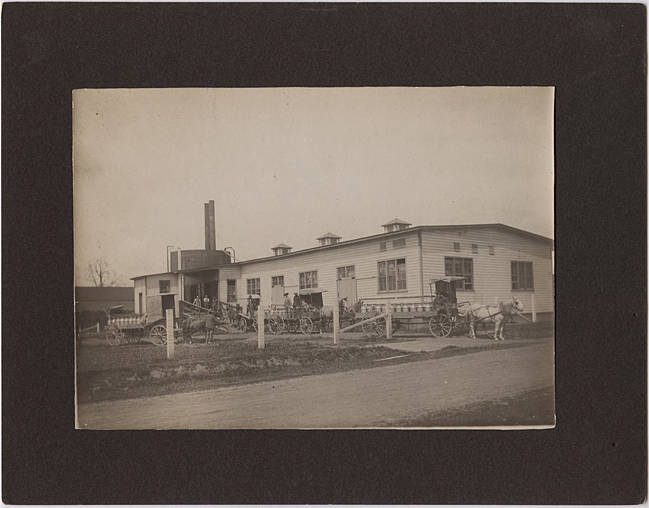
Three wagons with two-horse hitches, their beds filled with milk cans, stand in front of a large white wooden building. Several men in hats and work clothes stand around the wagons and on the porch at the rear of the building. The building has large windows and square vents on top; at the back a large tank with chimney-like extensions. A packed dirt road runs through the foreground of the image, and bare trees are visible on the skyline in the rear.
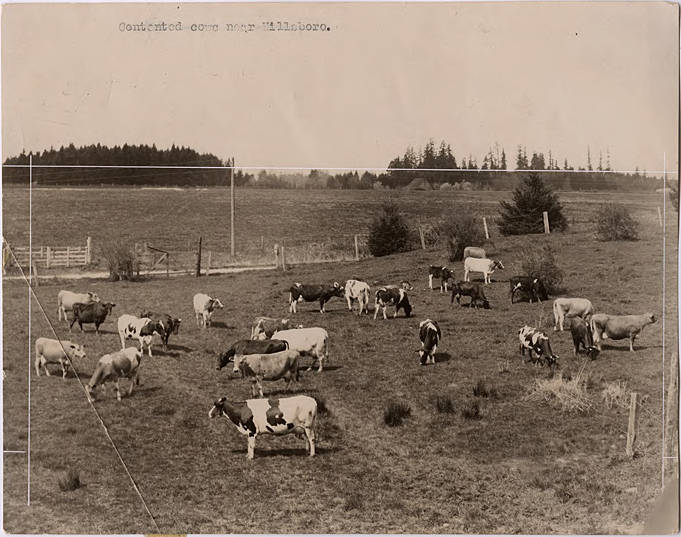
A mixed herd of dairy cows graze in a field fenced with barbed wire. In the distance is another field and groves of pine and other trees. Typed near the top of the photo is 'Contented cows near Hillsboro.'
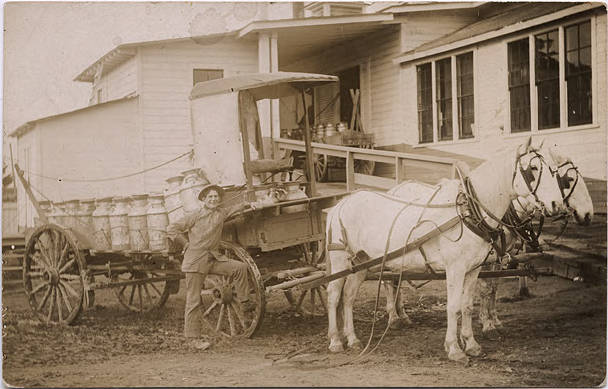
A smiling young man in work clothes with a hat on his head stands with a delivery wagon with a canvas cover over the driver's seat. Two white horses are hitched the wagon, which is full of milk cans. In the background is a white building with two sets of windows, and a covered porch where a small wagon with more milk cans is visible. The ground is muddy and appears rutted.
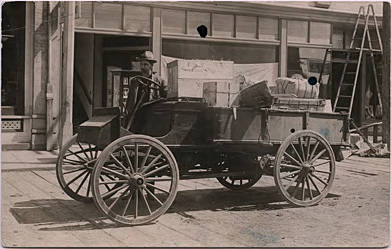
A truck loaded with large packages is parked on a plank road in front of a building with glass fronted windows. The truck is wooden, with wooden, carriage-style wheels, and an open body and cab. Gears and a chain are visible on the rear wheel in the picture, and a steering wheel projects up over a wagon-style seat. An unidentified man stands on the other side of the truck, wearing a fedora and a dark shirt and loose jacket.
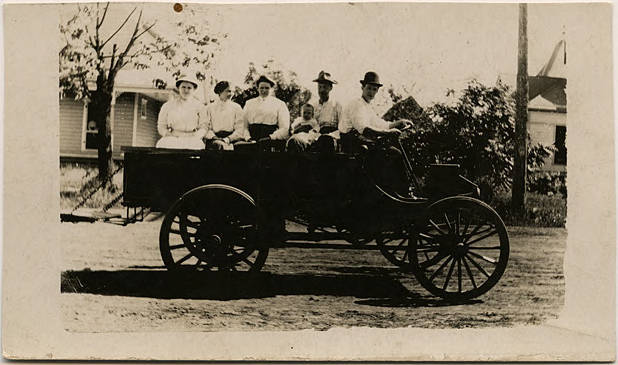
Six people sit in an open, flat-bed wood-paneled truck. The truck has spoke wheels with rubber trim and no cab. One man sits at the steering wheel, while four other adults, three women and one man, who is holding a baby, sit along the sides of the back section. All are facing the camera. The men wear white shirts and dark pants; one wears a bowler, the other a dark hat. One woman wears a hat, all have white shirtwaists, two with dark skirts and one with a white skirt. Their hair is up though not pulled back severely. The street is dirt, and a power pole and two houses are visible behind the vehicle, along with leafy bushes and trees. circa 1905.
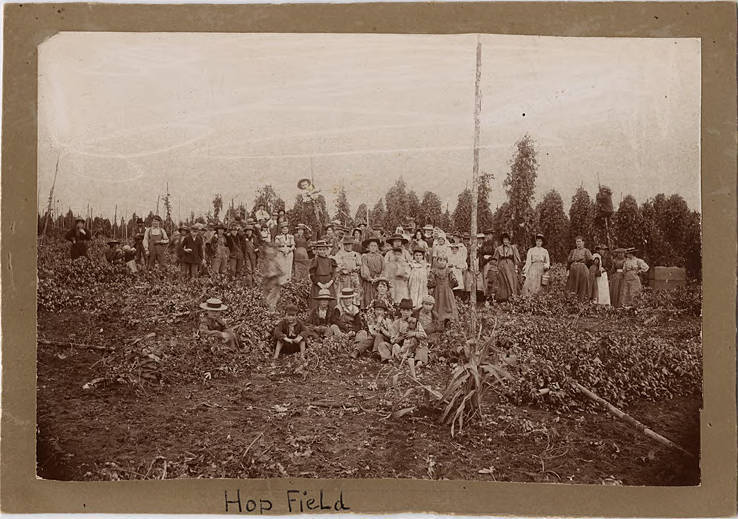
A large group of mostly women and children pose in a harvested hops field. One child seated in front has their arms around a dog; another child behind the first group has climbed a pole to be visible above them. In the background are more hops vines on poles, not yet harvested. The women and girls wear dresses with full sleeves and skirts; the boys and young men mostly wear overalls. Most have on hats ranging from boaters and fedora on the men, to straw and other wide-brimmed hats worn by the women and girls. In the left side of the image is a woman with an infant in her lap and a toddler. 'Hop Field' is written on the mat below the image.