Photo of the gravestone of Harvey Clark, an early Oregon pioneer and missionary. A white obelisk rises from a square white block placed on a larger concrete block. The name 'Clarke' is incised on the stone block; faded but legibly carved on the obelisk is the following: 'Rev Harvey Clarke. Born in Vermont, Oct. 2, 1807. Died March 24, 1858.' The Clark/Clarke last name is spelled with or without an 'e' in various contexts. Based on a similar photograph from the same cemetery (see WCMpic_000292), this photograph may have been taken circa 1926, possibly by Albert Tozier.
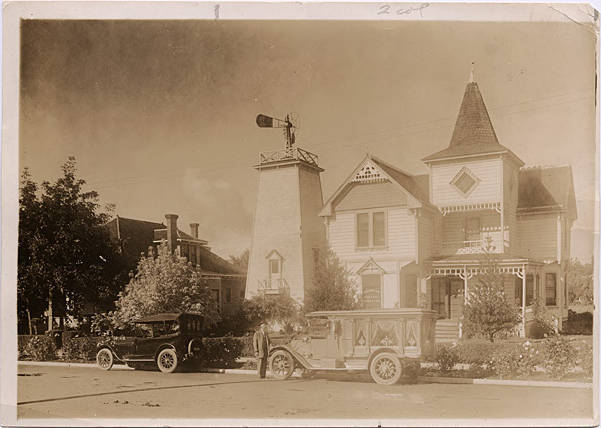
Photograph of a large, elaborate, two-story Queen Anne style building. Stairs lead up to a porch with decorative trim that wraps around the front corner section of the house. A single door opens to the front, with an open screen door; stairs lead down at the rear of the porch to the side of the house. A square tower with a diamond-shaped window and a conical steeple sits atop a widows walk on the second story. A window in the front first floor of the house bears the legend 'W.O. Donelson, Funeral Director.' Gingerbread trim decorates the gables and the roofline of both sections of the t-shaped house. Beveled corners feature single, double-hung windows through the first floor. On the left of the image a large, square tower with sloping sides is attached to the house. A single door with a window opens out of the second floor front of the tower, and a railing runs around the edge of the roof. A scaffolding supports a windmill with a weathervane at its rear. Two vehicles are parked on the packed dirt street next to the curb. One is a four-door, brass age automobile. The other is a hearse, featuring side lamps and curtained windows in the back. an unidentified man dressed in a suit with a bowler hat, white shirt with upright collar and tie stands in front of the car. Pine trees and other bushes decorate the flat, grassy yard, and a sidewalk is set just beyond the curb, with blooming roses and other bushes separating it from the street.
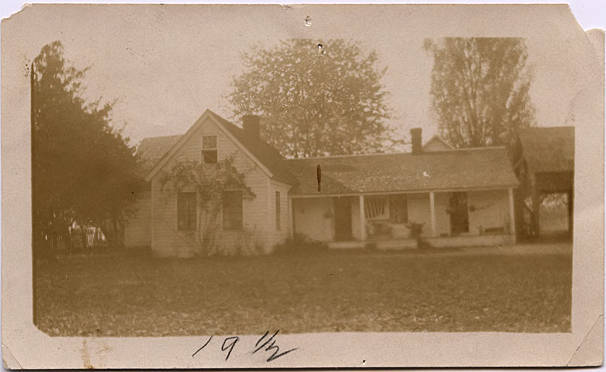
Portrait of a light-colored, t-shaped, gabled roof house. The main leg of the house has a pitched roof and a porch that runs along the entirety of the side. Two doors open directly out to the porch, with a single, double-hung window between them. A bench sits near the second door, and hanging plants decorate the eaves. What looks the striped portion of a United States flag hangs against the wall beside the window. A chimney sits atop the roof, and another peaked roof is visible behind the first roofline. To the right of the image, a large, open barn like structure sits. the cross-bar portion of the house is two-storied, with a higher peaked roof than the other portion. Single double-hung windows appear in the side, next to each other in the front, and in the upper story. What appears to be a door leads into this part of the house from the roof. A leafy vine trails up the side of the house and spreads out over the first floor windows and beneath the second floor window, which is open. A chimney sits atop this roof, and a second, matching portion protrudes from this section of the house to the left of the image. A large, leafy bush and a picket fence fill the left side of the image, and large, leafy trees fill the skyline on the right. The yard in front of the house is grassy, with a bare section extending to the right from the very end of the main leg in front of and then along underneath the open structure next to it.
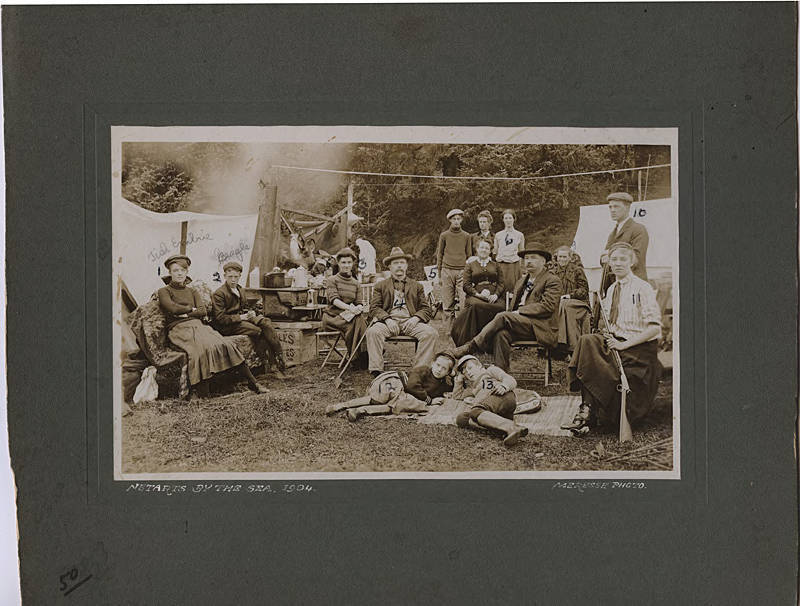
Group portrait of Imbrie and Sewell Families camping. A group of men and women pose around a campsite, identified by numbers written in ink. Boxes and chairs are spaced around the camp, with two canvas tents set up in the background. A rack hold pans and rifles, and a silver coffee pot sits on a stove in the middle of the image. Smoke rises from a fire, and the ground is grassy. Leafy trees and bushes cover a rise in the background. At the left of the image, a young woman ('1 - Tish Imbrie') in a turtleneck and mid-calf length skirt sits next to an older boy ('2 - Beagle') on a blanket covered bench; her hair is pulled back with a large bow. He wears short pants and long drawers; they both wear newsboy hats. Next to them a woman ('3') is seated on a camp stool; she also wears a dark turtleneck, a long skirt, and her hair is up in a pompadour. Next to her is a man ('4') in overalls and a dark jacket seated on a folding chair with an axe leaning against his thigh. An older woman stands between two young adults in the background; the boy ('5') wears long pants, a turtleneck and a newsboy hat, the young woman ('6') a light shirt tucked into a dark skirt. In front of them sit two women, one ('7') in a dark blouse with a white lace collar and long full sleeves tucked snugly into a long skirt, the other ('9') in a loose, dark-striped jacket over a long skirt. A man ('9') in a suit and bowler hat sits on a chair in front of them. Two adults on the right side of the image hold guns: a man ('10') in a suit with newsboy cap, standing with his hands resting on the muzzle of the gun, and a young woman ('11') with a striped shirt and necktie tucked into a mid-length skirt. She is seated, one leg crossed over the other, both hands holding the muzzle of a rifle that leans against her lap. A girl ('12') and a boy ('13') recline on a blanket on the ground in front of the group; she wears a light-colored short skirt, a dark sweater with white stripes on the waist and wrists, and a newsboy hat. He wears a light sweater, short pants over drawers. They both wear boots.
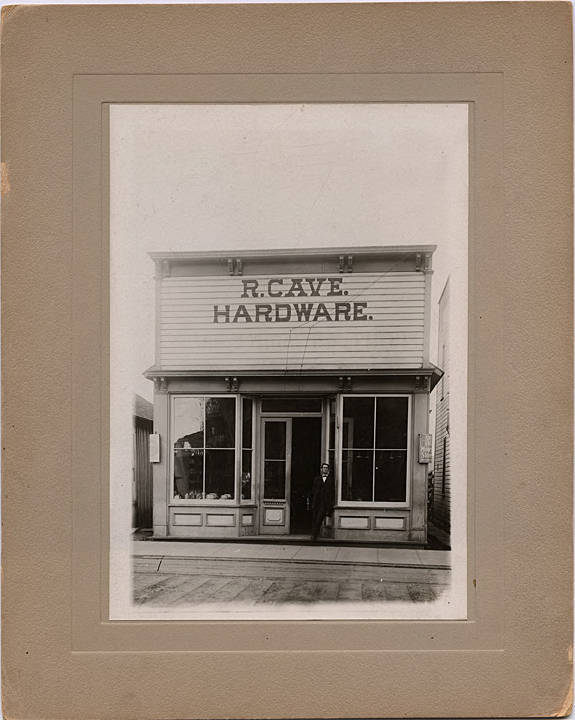
A man stands in front of a store, facing a boardwalk and a plank road. A man in a dark suit leans against one window frame to the right of the door. He wears a white shirt and bow tie, with folded corners on his collar, and a full, short beard. The store is single story, with a square wooden front bearing the legend 'R. Cave. Hardware.' Beneath a decorative eave, two four-paned windows surround a recessed door with a transom and windows on the corners. Decorative molding frames the bottom sections of the wall.
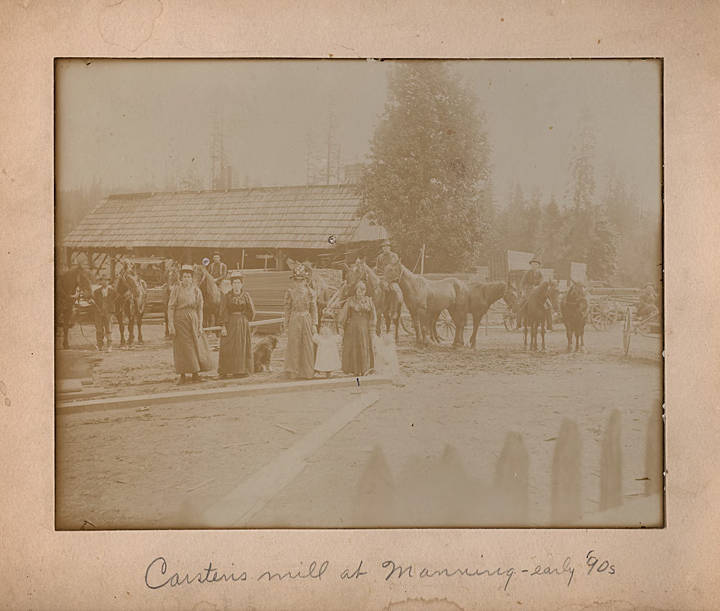
Men, women, and two children stand with a number of horses in a dirt yard in front of a long, low open-sided building. Four women stand behind a plank in a row in the center of the image. They wear full, ankle-length skirts, and long mutton sleeves. Their hats are low-crowned and flat-brimmed, and one is decorated with flowers. Two small children stand one between the last two women on the right and one at the end of the line. They wear full white long-sleeved dresses. A dog sits at feet of the second woman to the left. Behind the second woman on the left, a dog sits on the ground. Behind the row of women, there is a row of men and horses. On the left, a man stands between two horses, holding each of their reins. Next to them, there is another horse and a man on a horse next to that. The next two horses are tied to a wagon and a man sits on the horse to the right while holding the reins of a third horse to his right. Another man sits on a middle horse while holding the reigns of two rider less horses. Just to the very right of the photo, a man sits in a wagon. In the background of the image, cut lumber is stacked, and a wagon appears to be loaded with logs. In the far right, a two-wheeled carriage with a woman seated in it is just visible. The top of a picket fence runs through the very foreground of the image. A thick stand of pine trees fills in the background.
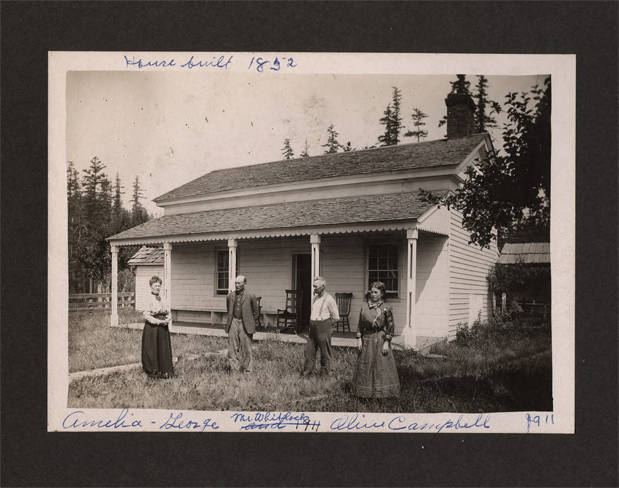
Four people stand in a grassy yard before a small white house. Two women, one on either end of the group, wear long dark skirts. One woman has a light colored shirt with mutton-leg sleeves tucked into her skirt, and wears her hair in a pompadour bun. The other woman's blouse matches her skirt, and buttons to her left with a shield tab. She wears her hair back. Two men stand between them, one wearing baggy pants, a suit jacket, and a dark shirt buttoned to the neck. The second man wears dark pants and suspenders over a white long-sleeved shirt. There is a porch on the front of the hous4e, and two rail back chairs sit on the porch. Double-hung, paned windows sit on either side of the door. The house is plank, painted white, with carved porch supports. the porch roof sits below the house roof, and there are no visible windows on the sides of the house. Pine trees are visible behind the house, and a rail fence runs along the left background of the image.
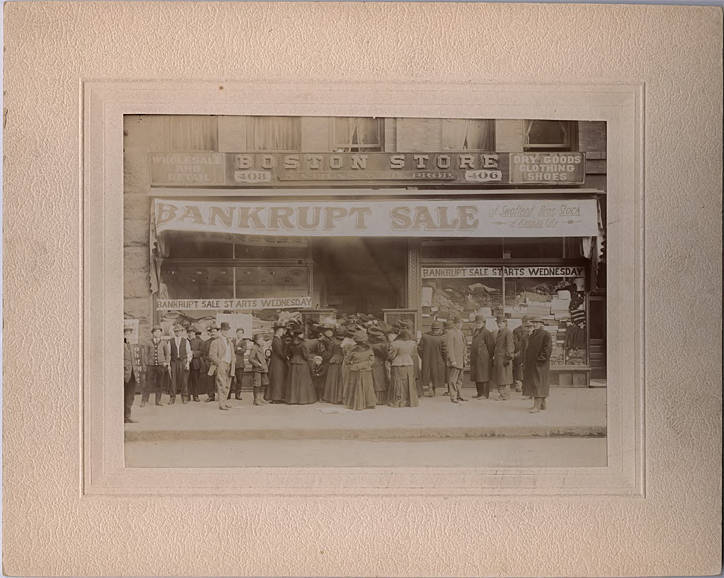
Photo of a group of men, women, and children in front of a store. The store building is rough cut stone blocks, two-story. The upper floor has single, double-hung windows with curtains on the inside. A sign declaring 'wholesale and retail: Boston Store, Nathan Weil, Prop., Dry Goods, Clothing, Shoes' and the numbers 408 and 406 sits between the floors. The lower front has large glass windows beneath a furled awning, surrounding a double door entrance, recessed into the building. A large banner proclaiming 'BANKRUPT SALE of Swofferd Bros Stock of Kansas City' is stretched across the front. The first floor windows are piled high with boxes and hats and stacks of fabric, and each feature banners stating 'Bankrupt Sale Starts Wednesday.' Women in long, full, dark skirts with puffed sleeve jackets and peplums, and large hats crowd the entrance of the store. Several men stand around sidewalk around the group; all on one side are wearing coats and hats. On the left side of the image, the men wear sweaters, vests and hats. Several children are in the crowd.
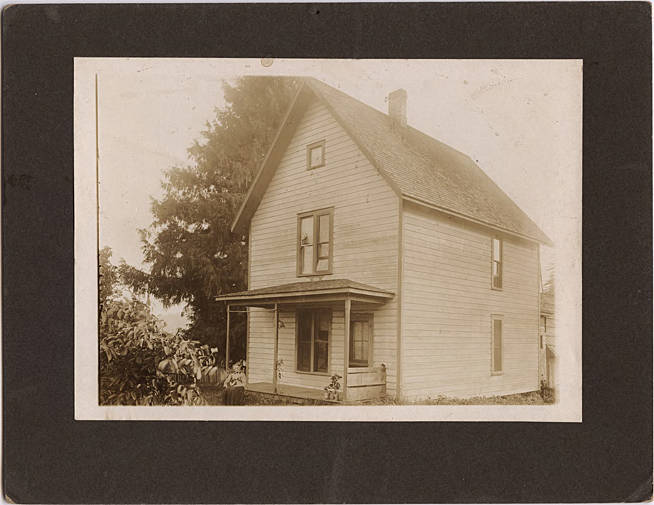
A woman sits on the edge of a covered front porch of a two-story, gabled house with an attic window. She wears a dark skirt and a lighter, long-sleeved shirt. Her hair is pulled back and up. A door with an upper window and a screen is visible at the lower left of the house, and pairs of double-hung windows are placed on the front of each story, with a small, square single-paned window opening from the attic area. A single double-hung window is visible on the side of each floor. A chimney sits at the top of the house, and a single-story addition is just visible at the back of the image. A large evergreen rises behind the house, and leafy bushes fill the lower left of the image. Two potted plants rest on the front of the porch, with another plant being trained up on the middle porch support post.
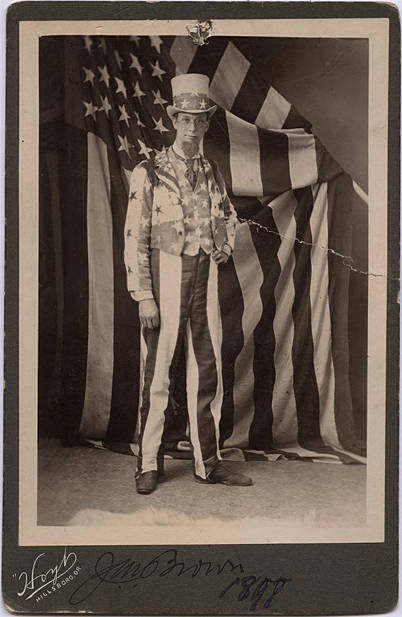
A man poses with one hand on his hip, standing before a large United States flag, draped and falling to the floor. He wears pants that match the red and white stripes on the flag, and a tuxedo jacket made of fabric alternating light stars on dark background with dark stars on light background. The lapels are smaller white stars on dark background. His vest is white stars on a medium background; a hatband of the same material goes around the base of his white top hat. He has a darker cravat tied around a white shirt with a standing collar, and dark shoes. He wears wire-framed glasses and a full goatee.
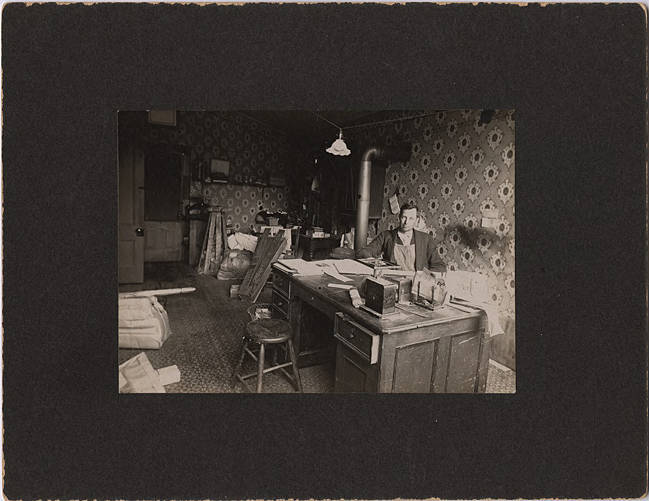
A man sits behind a wooden desk in a room. The floor is carpeted, and the walls have a medallion-patterned wallpaper. He wears a loose dark suit jacket over a vest and white shirt and an apron. Papers are scattered over the desk and boxes and packages of various sorts are piled around the room. Most packages are wrapped in paper and tied with string, with groups being tied together with yet more string. A wooden stove sits just behind his desk, and a wire wastebasket is just visible behind a short stool at the front of the desk. A table and shelf covered with books, packages, and other gear fills the rear right corner of the image. Two other doors are in the upper left of the image. A single light bulb with a floral-shaped sconce hangs from a wire near the ceiling in the middle of the room.
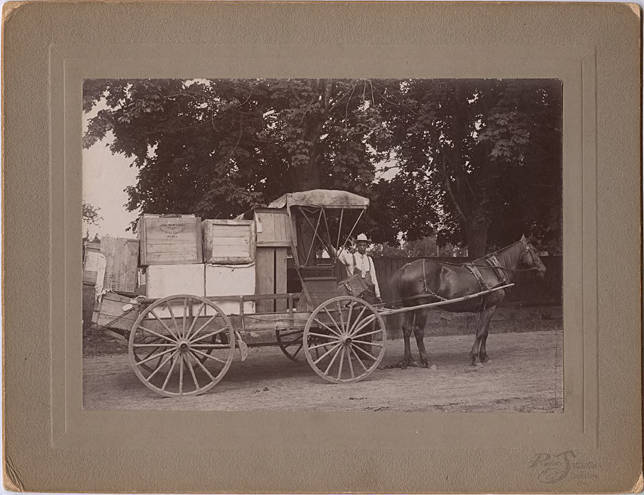
A man stands behind a wagon on a packed dirt road. He wears a white hat, a long-sleeved white shirt, and overalls. A horse is hitched to the wagon, and a triangular frame holds a canvas cover over the wagon seat. The front wheels are smaller than the back wheels. Boxes are stacked two-high, filling the wagon bed and the tailgate. Leafy trees fill the background, behind a plank fence with a small strip of grass running in front of it.
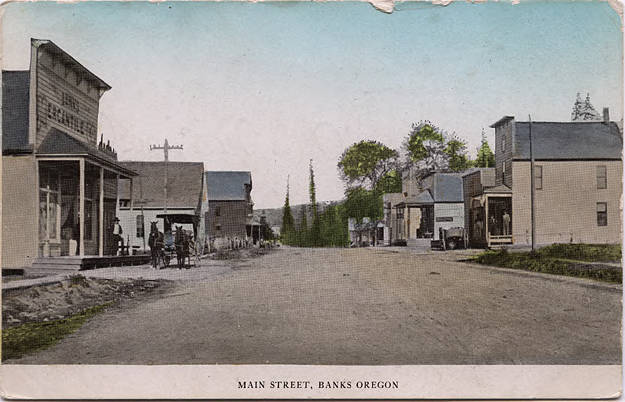
Colorized photo card print of Banks, Oregon. Photo shows a packed dirt road and a clear sky. On the right of the image is a vacant lot and a single pole with a power line running to and from it. Across a dirt street, a series of two-story wooden buildings with tall, square fronts and small windows. People stand on the covered porch of the first building. On the left of the image, another building with a pitched roof and square front has '[?] Mercantile' lettered over a covered porch, where a man leans against the railing. On the street in front of him waits a wagon with a two horse hitch. Visible just beyond the building and before the next is a power pole with a single cross-bar and glass power line insulators. Boardwalks link the buildings, with steps leading up to the porches. Visible in the background is a low hill and a number of leafy trees, pine and deciduous.
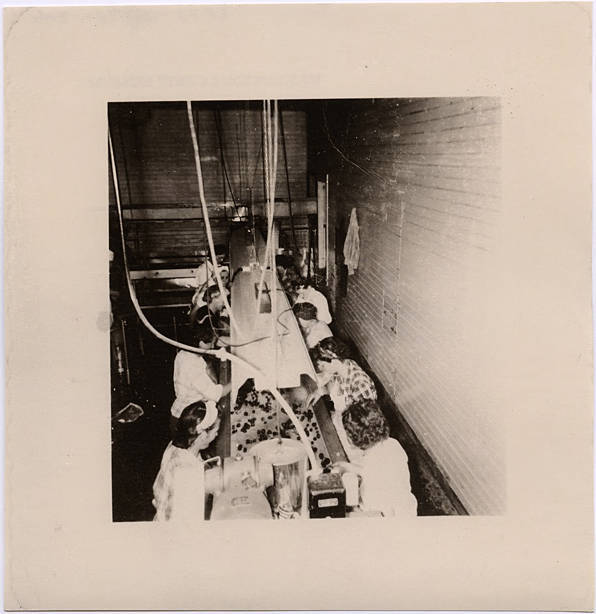
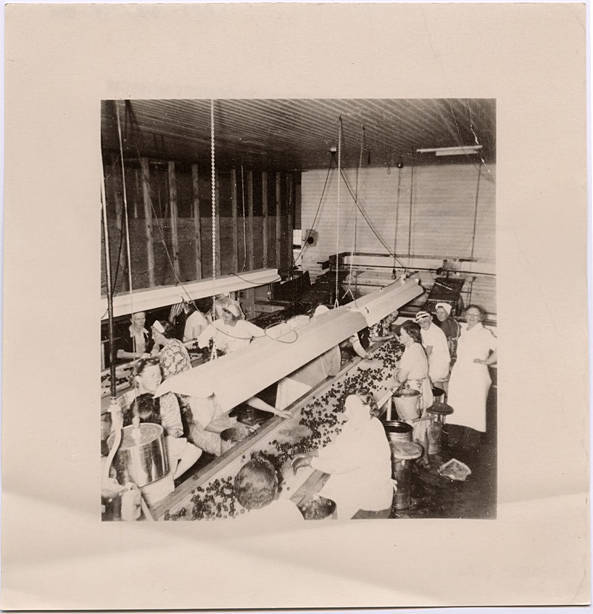
Women working on either side of a container belt, appearing to sort small fruit. Elongated covered lights are suspended from a high ceiling to hang above the belts, and the floor appears to be concrete. A white wall runs down the right side of the image, and a double set of conveyor belts/shelves appear at the back of the image. the women wear light-colored shirts, and have their hair held back with scarves and/or up in hair nets. All have shorter hair, curlier on the bottom than at the top.
Workers of various ages sit along both sides of two cannery belts, sorting small fruits. All but one elderly man in the upper right of the image are women. They wear white shirts and hair nets; one has a dark sweater on and another a flowered shirt. All have shorter hairstyles, most straight on top and curly towards the bottom; most have hairnets, but several wear their hair held back by headscarves. Elongated covered lights are suspended from a high ceiling to hang over the conveyor belts, and the women sit on stools with cans at their sides. One woman holds a bucket over her arm. In the left background is a bare plank wall, with studs visible; the back right wall shows unidentifiable machinery. Some of the women wear glasses.
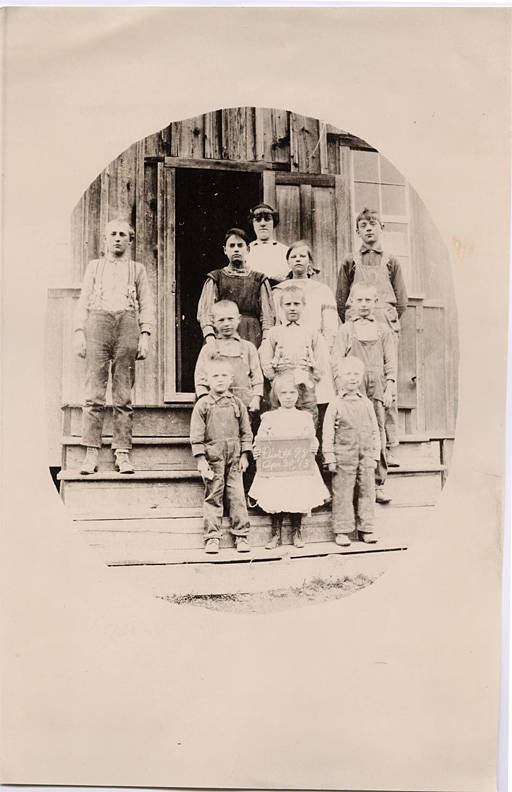
A group of children, four girls and eight boys, stand on the steps to a wooden building. The children on the lower steps are younger than those toward the top. The boys wear overalls and long-sleeved shirts, buttoned to the neck. A small girl with a light colored dress and a large white ribbon in her hair holds a chalkboard with the school's name and date written on it. The three older girls at the top of the image wear pinafores over long-sleeved dresses. One is dark, and the dress dark with light stripes. Their hair is either short, or pulled back into pony tails and tied with large bows. The boys all have short hair. The door into the building is open, and a window with a half-cafe curtain is visible to the right of the image. Oval printed on white paper.
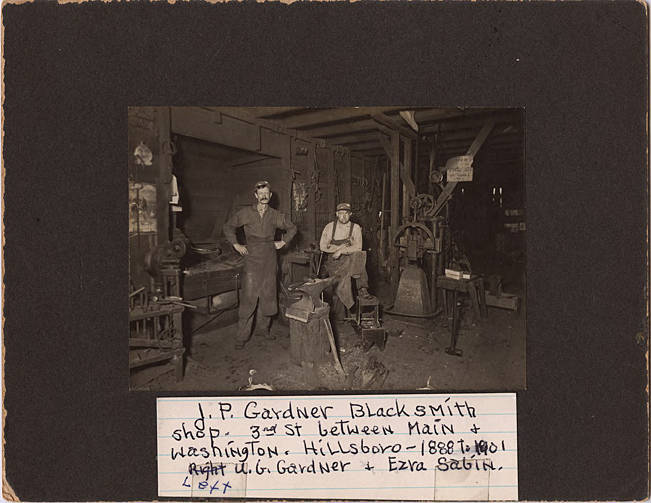
Two men stand in a blacksmith shop. The mustached man standing akimbo wears dark pants, a dark shirt, and a leather apron, with a cap on his head. Another man has one foot up on a shelf or stool, wears a long apron over overalls and a light-colored shirt, and has a cap. Various tools are hanging on a table to the front of the image, and an anvil with a hammer resting on it stands in front of and between the men. The shop disappears into the background of the image, with studs holding up the ceiling, bare rafters overhead, and plank walls with bare studs. A sign with illegible writing is posted on one support, while posters are visible on the wall at the front of the image. Photo on cardstock, with handwritten label taped beneath.
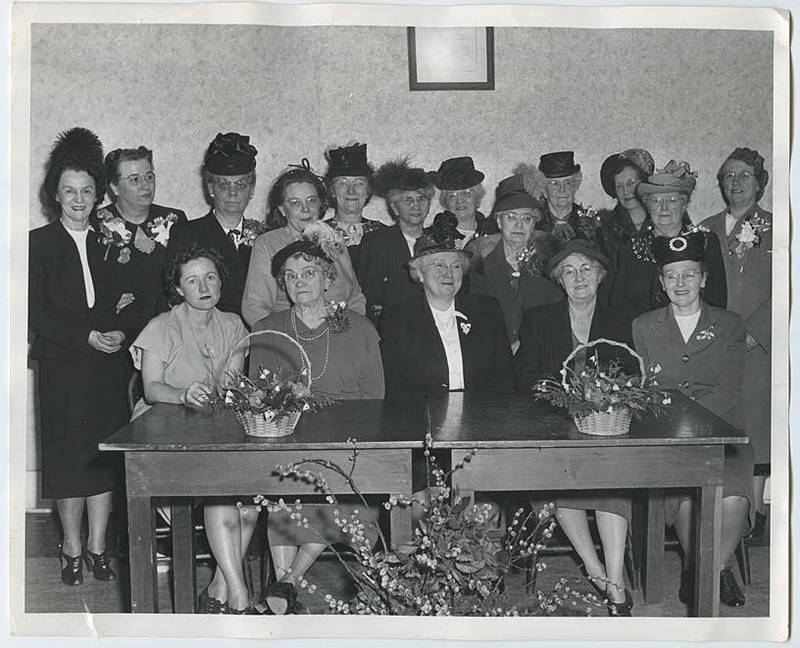
A group of seventeen women pose in an interior room. Five are seated behind two square tables; a basket of flowers rests on each table and a larger arrangement is visible in the foreground of the image. the rest are arrayed in two rows behind the seated women. All are dressed up, and all but two of the women wear hats and corsages, and most are older. The hats are small, with narrow brims and all have some sort of ornamentation, floral or feathered. The skirts visible are just below the knee, and the women wear heels and stockings.
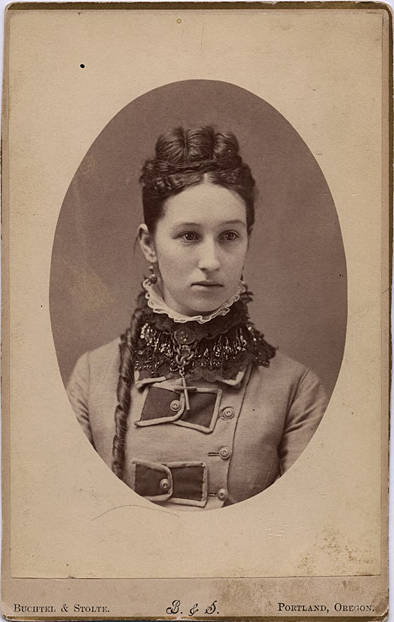
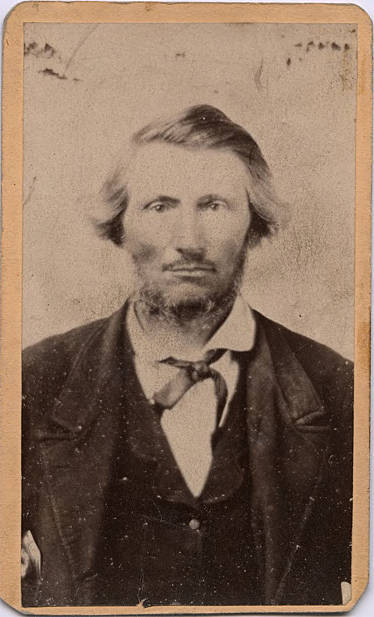
Portrait of William M. Brown, an early Washington County pioneer who settled in the area in 1852. Before moving to Oregon, he served the United States during the Mexican War. He held a variety of positions in Washington County, including School Clerk, Road Supervisor, and Justice of the Peace. He died in Washington County in 1872.
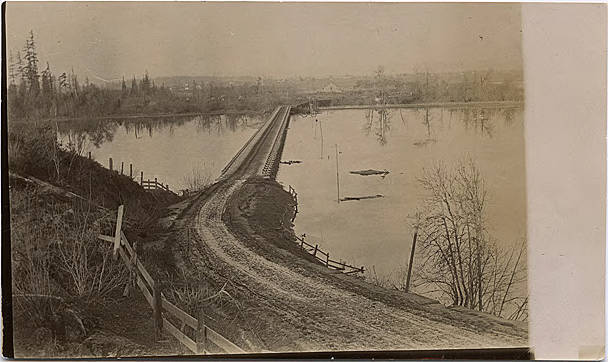
A dirt road leads to a bridge across a body of water. A rail fence runs beside the road and across the bridge. Bare branches of trees poke up alongside the road, and on the opposite side trees, buildings and mountains are visible. Power poles appear to be protruding from the water, which is still and reflecting the trees and foliage along the banks.
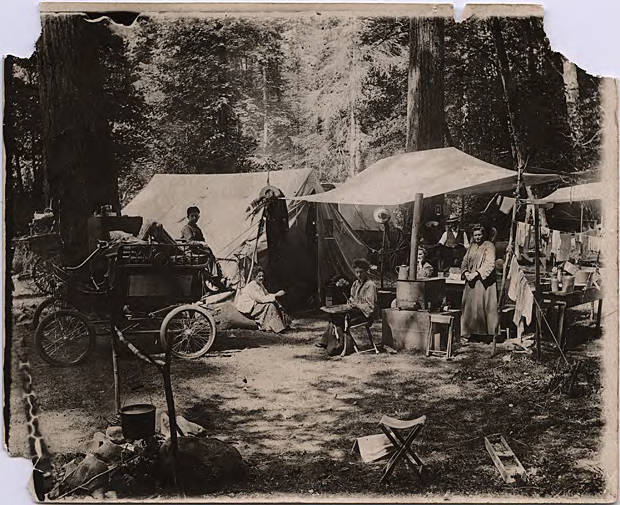
A group of people outdoors, with tents and camping gear in a heavily wooded area. Three women sit or stand near a makeshift set amidst several tables underneath a small awning. Pots and pans sit on the tables ,and a coffee pot on the stove. Another awning is set up behind the first, and laundry hangs from several lines strung about the camp. All the women are wearing long full skirts with full-sleeved jackets, and their hair is up. One has a tray and appears to be painting. Another woman sits nearby with her arms resting on her upraised knees. In the background a man stands, wearing a white shirt, vest, and bow tie with a hat. To one side, a young boy sits on the back of a small, wicker-paneled wagon-like vehicle with tiller steering and wire-spoked wheels. Decorative iron rims extend above the side panels of the back of the vehicle. What appears to be a bicycle is parked beyond the tree beside the vehicle. In the foreground, a pot hangs from a rack and steams over a fire. A folding campstool sits nearby, with a folded newspaper on the ground beside it.