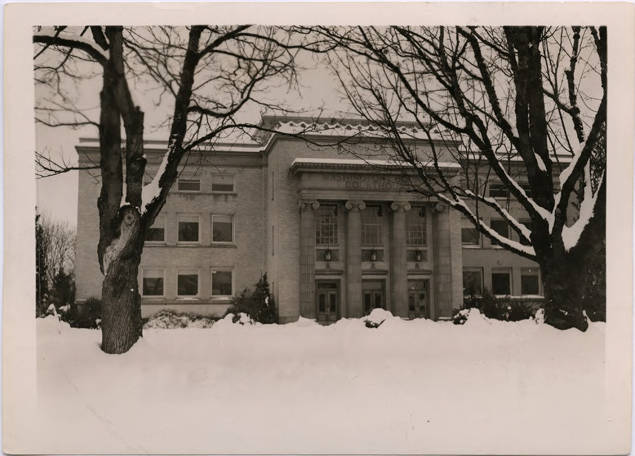
East entrance of Washington County courthouse showing heavy snow. Building is three stories tall, traditional classic style, with a protruding central arm ending in a pediment supported by four Doric columns. Three double doors open out between the columns, topped by large, paned glass windows. To either side four large, single-paned windows line each floor. Bare trees covered in snow frame the image from the front.
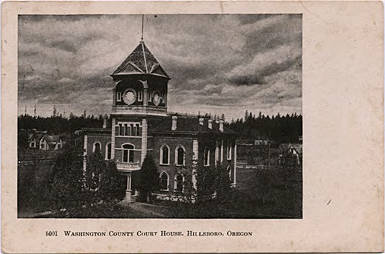
Photographic postcard of the Washington County Courthouse beneath a cloudy sky. Building is later, more elaborate version, dark stone with light colored supports and decorations. Porch has columns leading up to roof that provides balcony for the second floor. Sequoias are about even with the middle of the second floor, and a number of other large trees are placed about the yard surrounding it. A sidewalk leads up to it, and beaten dirt paths lead away from the front porch to the left. A number of houses are visible behind the building, and roads run parallel to the building in the background. Thick trees fill in behind the houses.
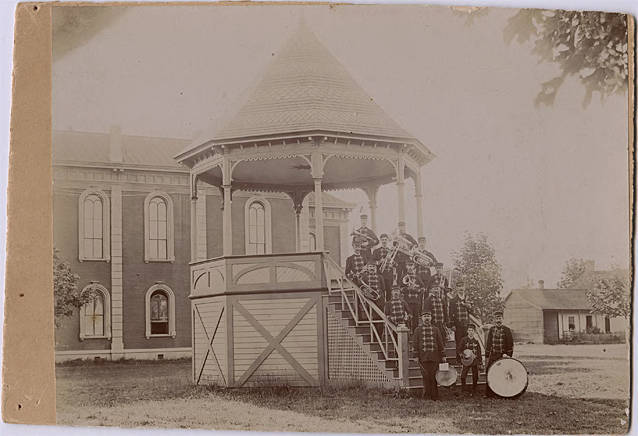
Sepia-toned image of a band standing on the steps of an octagonal bandstand in front of a large brick building. The fourteen band members wear dark, long-sleeved uniforms with braid and frogs on the fronts and hats. Two drummers stand in front, one with a bass drum and one with a smaller drum; between them stands a boy carrying symbols. Other visible instruments are brass, trombones, cornets, etc. The bandstand is light-colored wood with darker wood accents on each panel. Behind the grandstand the Hillsboro Courthouse is visible. To the right of the image is a white house with a gabled roof. The field is grassy, and trees are in the background are in full leaf.
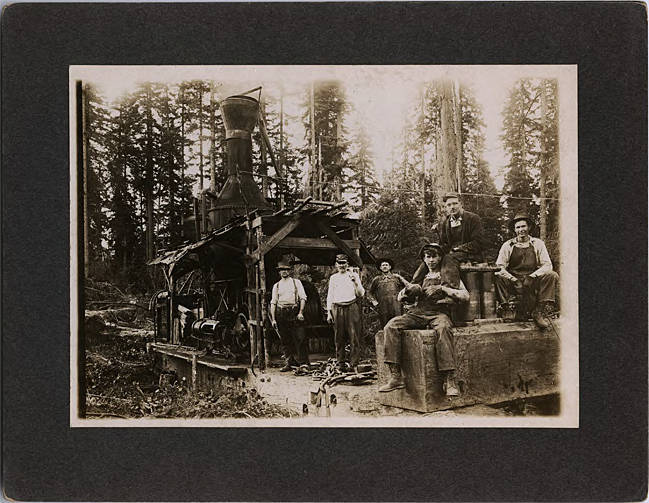
Six men pose in front of a machine in a forest. The machine consists of a boiler with a boiler with a smokestack extending above machinery under a framed porch, and a cable wound onto a spool. The entire mechanism sits on two large, squared off logs that are partially buried in the ground beneath it. A cable runs from a lever extending above the front of the machine out of the image to the right. Three men stand in front of the machine on the foundation logs, large chains with links as big as their feet on the wood below them. Two are dressed in work clothing, light shirts and dark pants with hats or caps. The third man wears overalls and a hat pushed back on his head. In the foreground, one man sits with his feet dangling over the edge of a large log laid across the support logs for the boiler. A man sits on a block behind him, feet dangling over the first man's shoulders. A third man sits on a block nearby. All wear overalls over light shirts, and various styles of hat. Pine trees of various sizes fill the background of the image, and the ground in the left of the image is covered with debris and tree limbs.
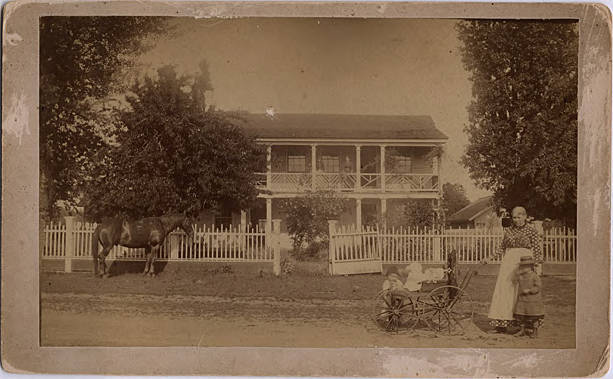
A house identified in a handwritten note as the "William Connell House at Glencoe about 1887," and as the "Hoover Homestead." Glencoe is a neighborhood on the northwest side of Hillsboro, Oregon, near what is now Connell Avenue.
Notes on the verso identify the people appearing in the photograph as: Leona Victor and Helen Victor, standing on the balcony in the background; [Illegible, possibly "Mrs.?'] Connell; and Ann, Hattie and Grace Connell [children], foreground. The elder Connell is the woman in a long, dark print dress and a white apron standing by the baby carriage with the three small children. She might be Letitia Hoover Connell, their mother; or could be another female relative. The photograph was donated to the Washington County Museum by Charles Deichman; probably the son of Leona Victor Deichman, who appears in the image.
The house has covered porches running the length of both floors, each with two doors opening out onto the porch. The doors are each bracketed by two paned windows. The railing on the upper porch appears to be partially broken out. A dark horse is tied to the front fence near an open gate. Plants hang from the eaves of both levels of the porch, and the trees and bushes in the frame are bushy, with a large, flowered bush blooming in the front center yard. Another small building can be seen just behind and to the image-right of the house.
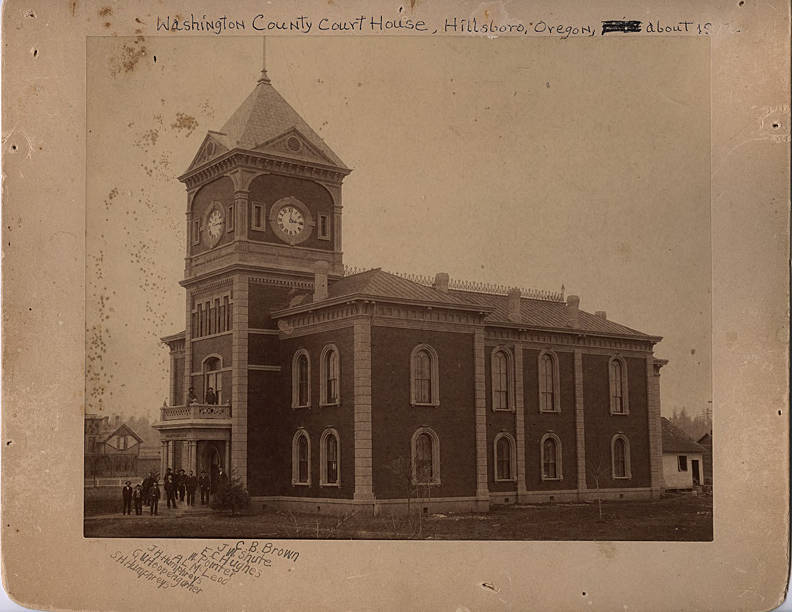
Photo of a large, two-story stone building with a clock tower with a group of men standing in front of it. The building is Romanesque in style, with a t-shaped construction featuring dark brick walls and lighter brick corners and ornamentation. Windows are arched with decorative cornices of lighter stone. The front features a covered porch with a second story balcony in place of the roof. The third floor has four small clerestory windows, and the clock tower is square, with a clock face on each visible sight. Its roof is peaked and four-sided. Several chimneys jut from the edges of the roof, and the ridge line features an ornamental fence. The men in front of the building are all wearing dark suits. The building is surrounded by grass, and a paved path leads from the front. Two small pine trees bracket either side of the porch, and a small white building with a door and single paned window is visible at the rear of the building.
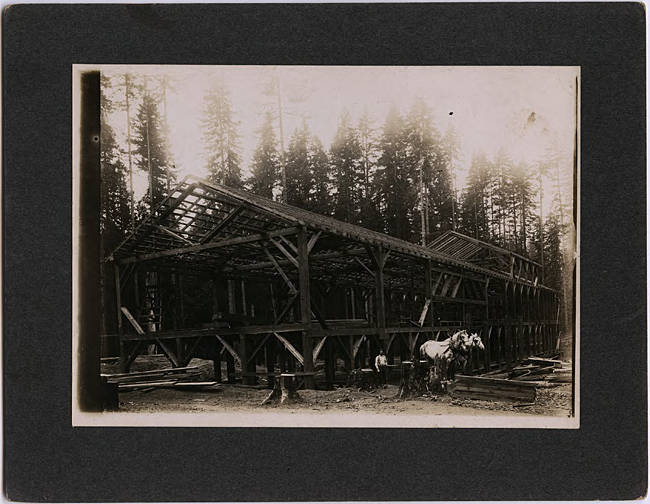
A man with a double team of white horses poses in front of a large, two-story plus frame building. Cut lumber is piled to the right of the image and in the foreground before the mill. Lumber can also be seen piled on the board floor of the first building. Cut stumps line along beside the building. He wears a light-colored shirt and dark pants. Tall, back-lit pine trees fill the background of the image, and the ground is generally bare with some vague debris littered to the left.
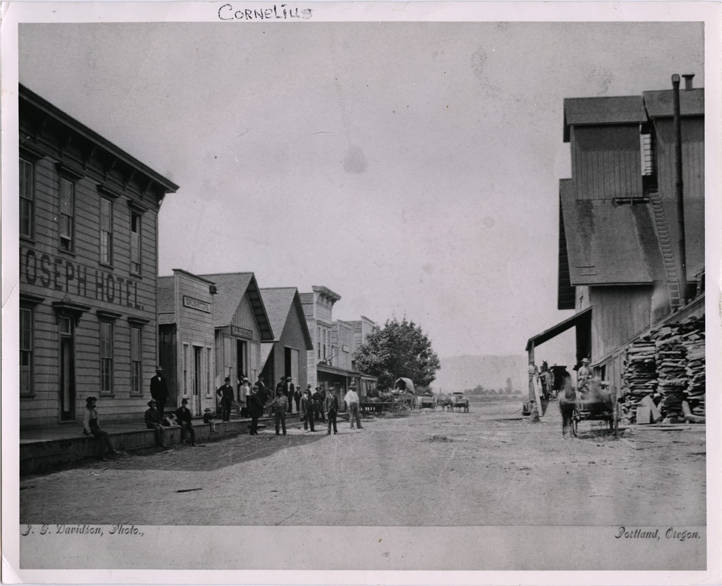
Downtown Cornelius, Oregon around the 1880s. This photograph was taken looking west at what is now the intersection of Alpine Street and 12th Avenue, on the south side of the railroad tracks. On the right side of the photograph is a large grain warehouse belonging to the town’s namesake, T.R. Cornelius. According to notes on the back of the photograph, the buildings from foreground to background on the left side of the photograph are: St. Joseph Hotel; Dr. Clark Smiths’ Drugstore; a store owned by T.R. Cornelius; a warehouse; a saloon; and Keim’s store. None of the buildings pictured appear to have survived today. Notes identify several of the people standing in the photograph: “T.R. Cornelius, black hat, in front of door; Scott Cornelius in doorway; Dr. Smith, tall man near corner of hotel; Alec Couture sitting on platform, first in picture.” Several horse-drawn wagons appear in the background. The grain warehouse was the place where farmers from surrounding communities brought their wheat so that it could be moved to market via the railroad nearby. The photograph was taken by the I.G. Davidson Studio of Portland. This appears to be a black-and-white copy print of an earlier albumen card print. It was donated to the museum by Lester Mooberry, a prominent area resident who wrote a book on the history of Forest Grove and Cornelius.
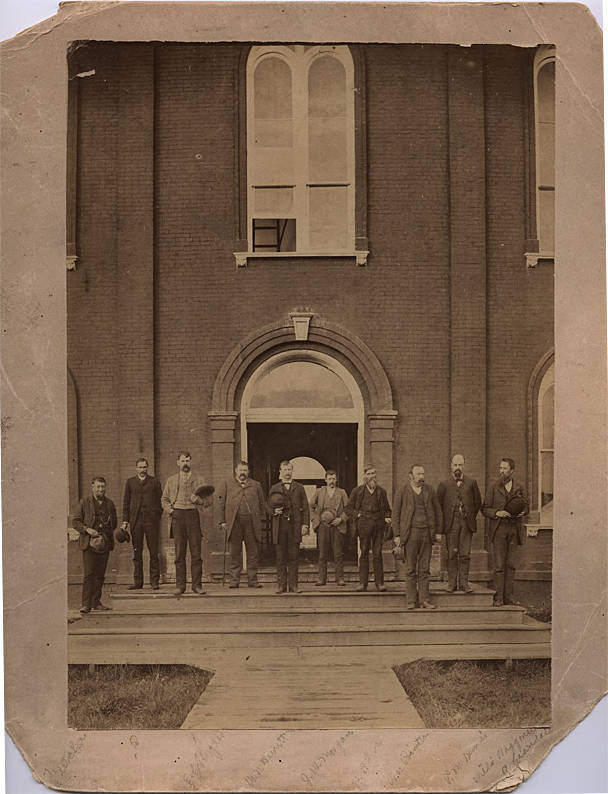
Sepia-toned image of a group of men on the Hillsboro Courthouse steps. A boardwalk leads up to graduated steps that culminate in a wide porch. Strung across the porch and down the steps on either side are ten men in suits, arranged so that they appear to be of the same height. Two men stand at least one step down so that they do not tower over everyone else . All the men wear three piece suits, some in the sack suit style and others in a three piece vested style. All hold their hats, which are bowlers, fedoras, and other stiff-brimmed hats. About half have full, bushy mustaches; the rest have full beards, some in the Van Dyke style. One man leans on a cane. The building behind them is solid brick, all of one tone, and the courthouse doors are open.
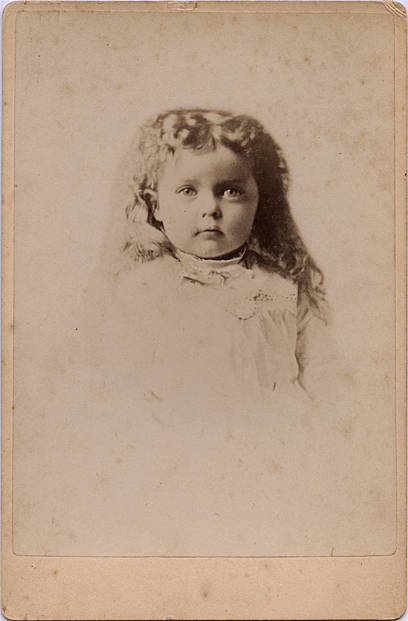
Portrait of Letitia Hoover as a young child. She was born to Jacob and Malinda Hoover in 1849, on their Donation Land Claim in Washington County. She later married William H. Connell and they had six children. She passed away in 1907, in Washington County.
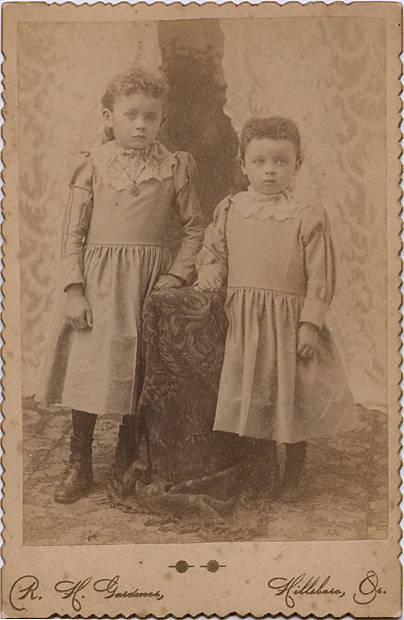
Portrait of Hattie and Annie Connell. Their parents were Letitia Hoover Connell and Will Connell. Letitia's parents were among the first settlers in Washington County.
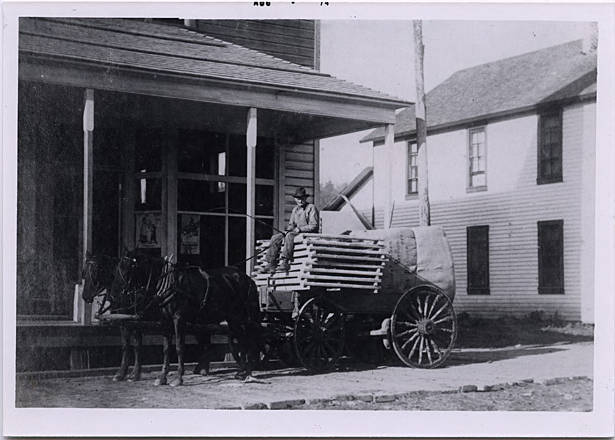
A man sits on a load of wooden pallets in a wagon hitched to a two-horse team. On the back of the wagon is a large, cloth-covered bale. The man holds the reins for a two-horse team and a whip or goad of some sort. The road is plank, and the building behind the wagon has a raised porch, carved spindles that support the roof, and a large, double window that frames a recessed doorway. A power pole stands by the corner of the building, and the side of the next building shows paned, double-hung windows in a series of three on each of two floors beneath a gabled roof.
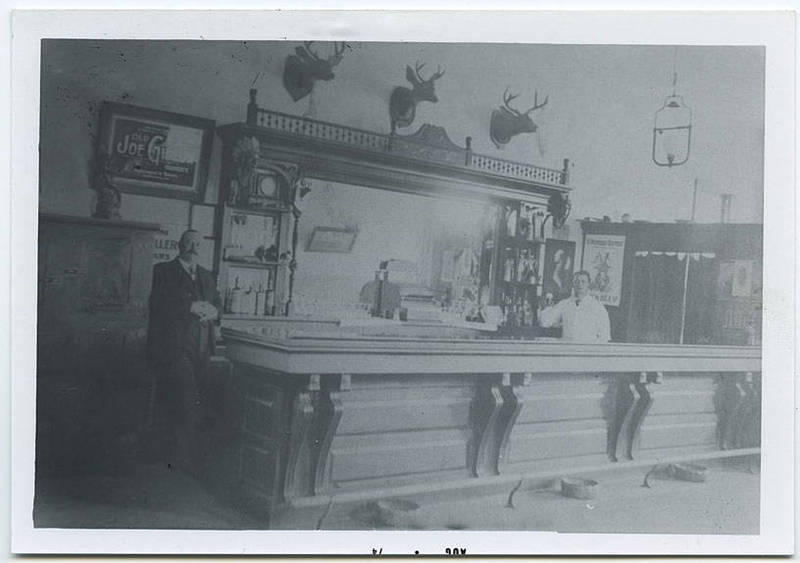
Two men stand inside a saloon. One man in a business suit, with a thick mustache and wire-rimmed glasses, stands at the end of the bar, his hands, with fingers interlaced, resting on his stomach. Behind the bar on the other side of the image, a man in a white jacket and tie stands, holding aloft a foaming glass of beer. Between the men on the back wall is a large mirror, with an ornate metal cash register and a number of glasses arranged in front of it. Shelves adorn each end of the mirror, and a wooden framework with carved spindles rises above it. To the left of the man in the suit sits an old fashioned icebox style cabinet. Spittoons are set on the floor along the bar's bottom rail, and three deer-head trophies line the wall above the bar. Advertisements for 'Old Joe Gi[illegible] Whisky' and 'H. Weinhard Brewery Buck Beer' adorn the walls, along with a large print of a woman in a fluffy feathered hat. A curtained entrance segregates the section of the bar to the right of the image from the rest of the area.
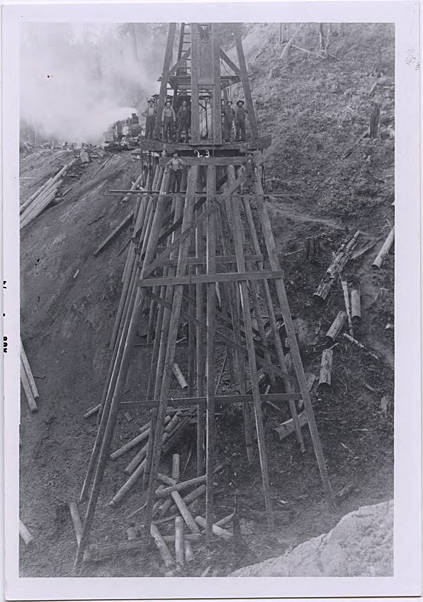
A group of men stand on top of an incomplete wooden railroad trestle. They wear pants, long-sleeved shirts and hats. Two men stand on either end of a cross-bar below the platform itself, and the number '23' is painted in white paint just below the platform. The trestle is built of logs and stands in a steep defile about 60 feet high, and cut logs are scattered about its base. Equipment for building the trestle rises above the men on the platform, and in the background a train sits with smoke pouring from its smokestack. The hillside below the track and trestle is bare, while vegetation covers the hill on the upper side.
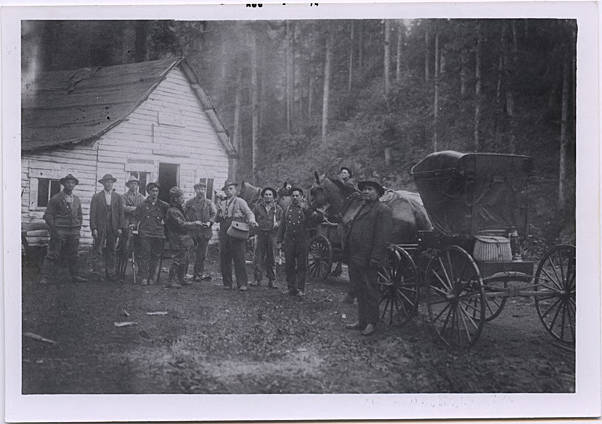
Group of men in front of a wood building in the woods with a buggy and a team with a wagon. The men wear casual clothes, pants or overalls, sweaters, and hats. One man has a rifle, and another carries a wicker fishing creel. The man holding the buggy horse's bridle wears a dark shirt with buttoned 'shield' front. buggy is single horse, four-wheeled, and a second wicker fishing creel and a lantern are fastened on a shelf on the back. The wagon appears to have a canvas covered load filling the bed and is pulled by a two-horse team, but is otherwise obscured. In the background, the cabin is gabled with an elongated roofline on the left which covers a second section. The main section has an open door and sliding windows on either side of it; a third sliding window is set in the second portion. The ground is muddy, and a steep hill with timber and brush rises in the background.
Portrait of Thomas R. Cornelius, son of early Oregon pioneer Benjamin Cornelius. Born in Missouri in 1827, he travelled with his family on the Oregon Trail in 1845. He became a colonel during the course of his service in the Oregon Volunteers during the Indian Wars of the 1840s and 1850s. After the war he served in the Oregon State legislature and became a successful farmer and businessman. In 1872, the town of Cornelius was founded and named after him. He lived there with his family; in 1850 he married Florintine Wilkes, and after she died in 1864 he married Missouri Smith in 1866. He had six children, and lived the rest of his life in Cornelius, dying there in 1899.
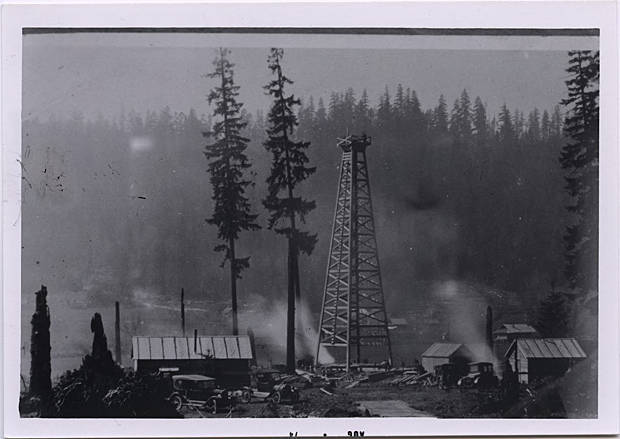
A wooden oil derrick stands amongst small wooden buildings in an open meadow. Two tall pine trees stand next to it. Several cars are parked in the area, and there are several cars parked on the grassy area around the buildings. A wooded hillside rises in the background of the image.
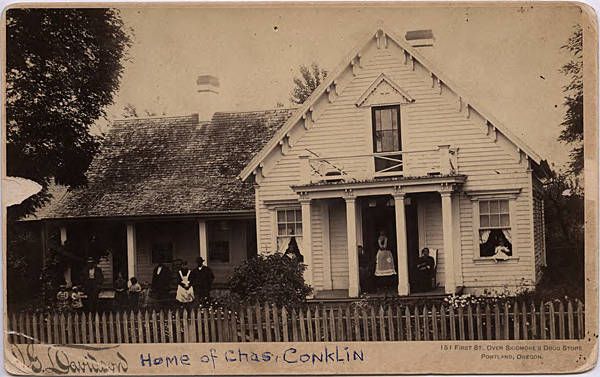
Photograph of a two-story gabled home with family members. A white house sits behind a picket fence and a yard with flowers and bushes. The house is t-shaped, and a sidewalk leads up to the front entrance where a covered porch extends over an entrance. The roof of the porch is a balcony reached by a door out of the second floor of the home. Two double-hung windows rest on either side of a double front door on the first floor, and a woman in a dark dress and white pinafore apron stands in the door, while two women sit in chairs on the porch on either side of the door. Someone holds a baby in a white dress sitting on the sill in one open window, and another person is just visible inside the other first floor window. The house has decorative struts on the eaves, and two chimneys are visible, one in the middle of each section. The oblong section of the house has a porch with an extended roof down its entire length, and two double-hung windows and a door are visible beneath that roof. The porches are raised, with steps leading up to them. Nine people stand in front of the second porch: three small children, with short hair and in skirts, one plaid, a man with a dark jacket and light shirt and hat, two more children, a girl in a dark dress and a young boy in a shirt and pants, two men in dark jackets and hats, and another woman in a dark dress with a white pinafore apron. Leafy vines are draped over the end of the second porch, and a large leafy tree fills the left of the image.
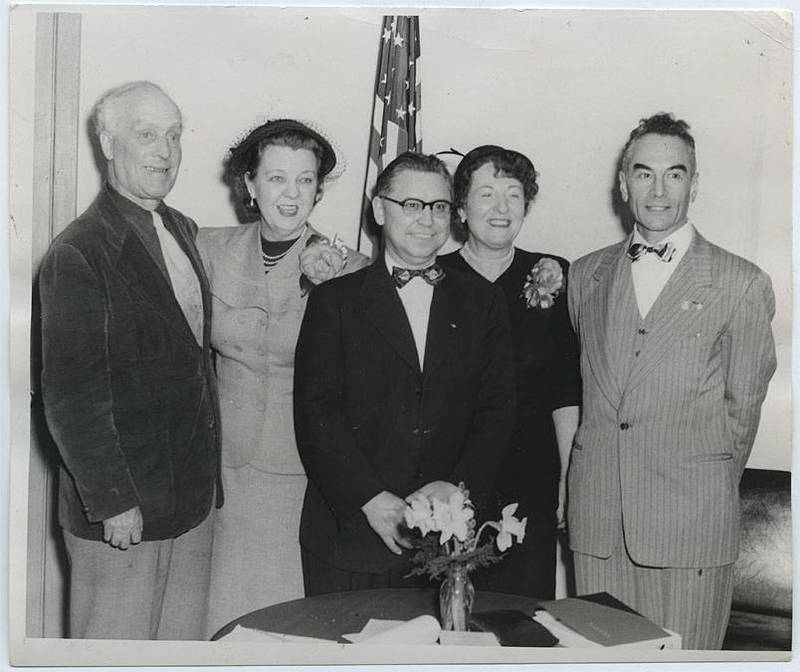
Black and White photograph of two women and three men standing in a room in front of a United States flag. All are smiling The men wear suits, two with white shirts and bow ties, one with a dark shirt and white necktie. One wears glasses with half-wired rims. The women stand interspersed between the men. One woman wears a light colored suit jacket with a skirt and a dark blouse and pearls. She also wears light colored earrings and a dark hat with netting, and her hair is pulled back from her face. The second woman wears a dark dress with a small dark hat with a slender upright feather. She has a single strand of pearls and small earrings and appears to have on dark lipstick. Both women wear large floral corsages on their left front shoulders. On the table before them is a vase with three fresh daffodils and other unidentifiable greenery, and some papers and a book. The walls are white, and a leather-like chair sits behind the man in the right of the photo.
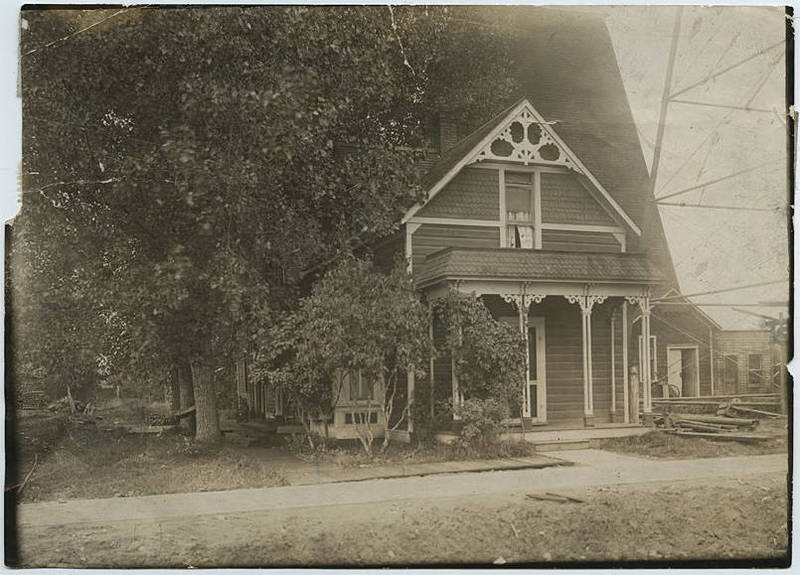
Photograph of a building identified in a handwritten note as the "Old Coffee Club building" in Hillsboro, Oregon, located on "N. Second Ave. between Lincoln and Jackson." The large roofed building just behind it is identified as the "Hillsboro Water Tower." The Hillsboro Coffee Club was a women's social group that was active in the early 20th century. Based on the format of the photograph and contextual clues, this photograph may have been taken between 1910-1930.
The Coffee Club building likely no longer stands; its modern address would have been around 257 NE 2nd Avenue. The building is a dark, two-story wooden gabled home with white gingerbread trim. The front porch is covered, with a squared-off, shingled roof, and the posts are carved and painted white with dark interiors and white curlicues on either side where they meet the eaves. A door with a screen is just visible behind a vine on the front porch, and an open, double-hung window is directly above the porch. A bay window is visible on the side of the house, behind several bushes, and three large deciduous trees are spaced evenly down the side yard along side a boardwalk that begins in the front of the house and turns down the side. That boardwalk ends at a side entrance, which is just visible behind the vegetation. A hammock hangs between the first two trees. A poured sidewalk leads up to the main entrance of the house, with mud and vegetation visible on the other side. Boards are piled to the right of the image, and a scaffolding rises out of the picture. A large, sloped sided building dominates the background of the image, with a smaller gabled entrance featuring a white door at the front.
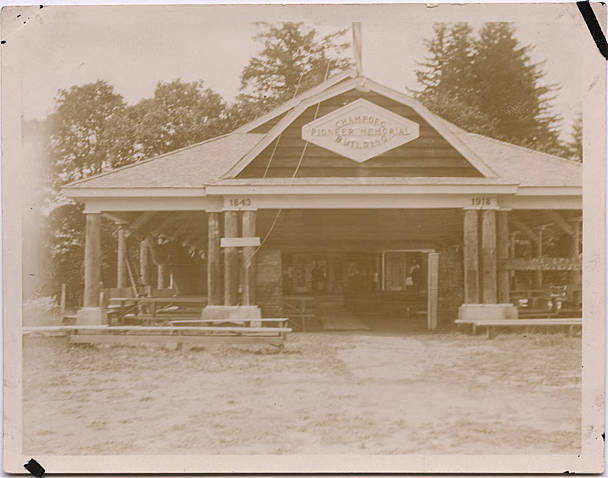
Photograph of the Champoeg Pioneer Memorial Building, which was built in 1922 to commemorate the vote that created the Provisional Government of Oregon, which took place at Champoeg on May 2, 1843. “Provisional Government Park,”
as it was officially known, was established at Champoeg in 1918. The dates 1843 and 1918 which appear on the building refer to these two years. The park is now known as the Champoeg State Heritage Area. Tables and benches line the visible open area, and a flag appears to be suspended from above the building. A man is just visible standing inside the open double doors to the right of the building's interior.
This photograph appears to have been taken sometime between the later 1920s and the 1950s, based on its format and the wear on the walkway in front of the building. The photograph was donated to the Washington County Museum in 1972.
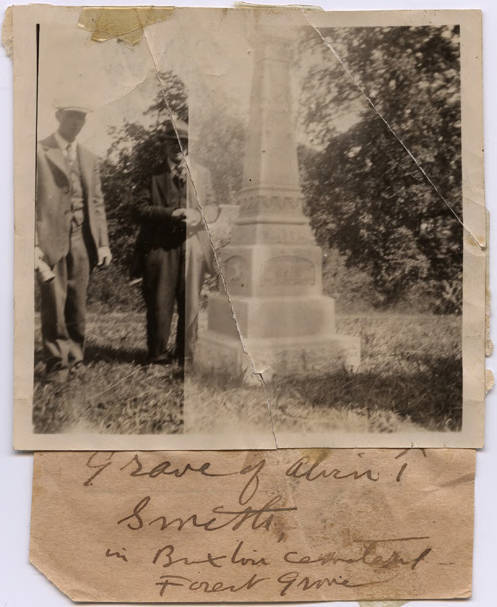
Gravestone of Alvin T. Smith, which is in what is now called the Mountain View Memorial Gardens in Forest Grove. Alvin T. Smith traveled to Forest Grove with Harvey Clark, where they pursued missionary work, founded a church, and helped found Tualatin Academy. Smith died in 1888, at age 85, in Forest Grove.