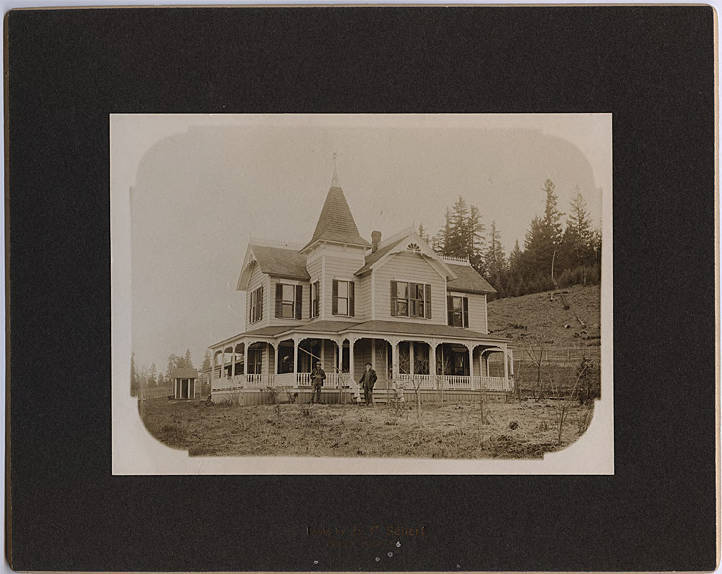
Black and white image of a large, Queen Ann style Victorian home. The two storied house is cross-gabled, with a square turret set in the front corner. A covered porch runs around the visible portions of the house, decorated with a white picket railing. Gingerbread ornamentation decorations the peak of each gable section, and runs around the eaves of the porch. Double-hung, paned windows with shutters decorate all visible facades, and the turret is capped with a tall, pyramidal roof. Two men stand in front of the house, wearing suits and hats, and a small outbuilding is visible just behind the house. The yard is bare mud, with bare saplings planted in a straight row out from the porch stairs. The hillside behind the house is bare to the ridge, where heavy pine forest takes over.
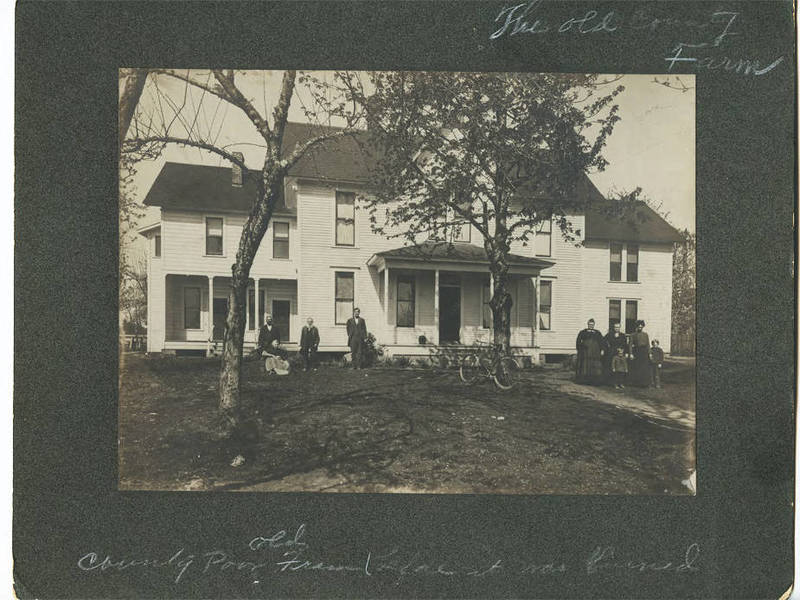
Black and white image of a large, cross-gabled wooden house with two extensions. A number of people stand in the yard before the house, three men, four women, and two boys. The men stand along the left side of the house and wear dark suits and are bareheaded. An elderly woman sits on a chair in front of the leftmost man; she wears a light colored skirt and a dark jacket and her hair is up. The other three women stand in a group with the boys in the right of the image. They wear dark blouses with full sleeves tucked into full skirts. Two have lace at the front neck, and all wear their hair up, one in a pompadour style. the two boys wear pants and jackets, buttoned up. The ground appears bare, and the two trees in front of the building have only a few leaves. The building is two-storied, with double-hung windows spaced along each section. The front door opens out onto a covered porch beneath the central cross gable. Two doors, each with an accompanying window, open out onto a recessed porch on the leftmost side of the building. A bicycle leans up against one of the two trees in front of the building.
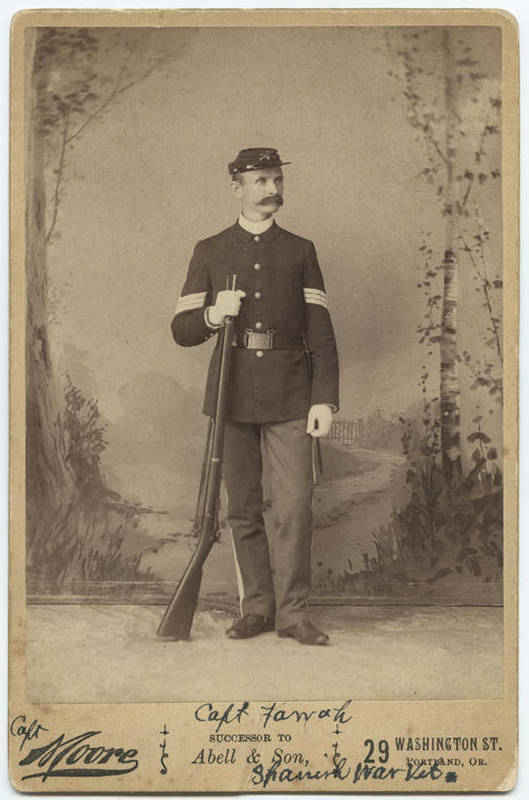
Studio portrait of an officer with a rifle. He wears a United States Army uniform typical of Spanish-American War: hip-length tunic with a mandarin collar, brass buttons, and a three stripes in a 'V' shape on each sleeve. His pants have stripes down each side; the belt has a rectangular brass buckle bearing the letters 'U. S.' and a bayonet is just visible hanging from the belt behind his left arm. His patrol cap bears an insignia of crossed rifles beneath a number '1', and he holds a Springfield model rifle. His hair is short and he has a full handlebar mustache.
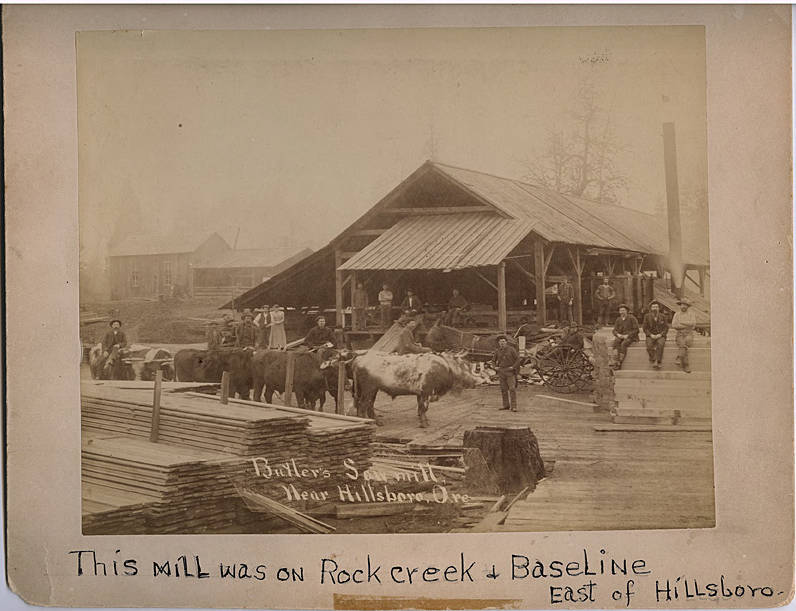
Sepia-toned image of a number of people posed around the yard of a sawmill. One man to the left of the image sits on an ox, part of an eight-ox team. Several other men stand around the yard. One man sits on a pile of lumber, holding an ax. A man and a woman stand just beneath the eaves of the building; he wears a white shirt with a vest and dark pants; she has on a long, light-colored dress with leg of mutton sleeves and wears her hair up. Two men sit in a buggy pulled by donkeys. Three other men sit on top of stacked, cut lumber in the right of the image. Stacks of thin cut lumber fill the foreground of the image, and inside the building machinery is visible. The building itself is open framed, with a wide, gabled roof with an extension down on the left. A small smokestack emits smoke from another roof on the lower image right of the building. Another gabled building in the left image background has two narrow paned windows and what appears to be an open stable attached to the back. The two buildings are separated by a yard with a path. Bare deciduous trees rise up behind the sawmill, and full pine trees are visible beyond the second building.
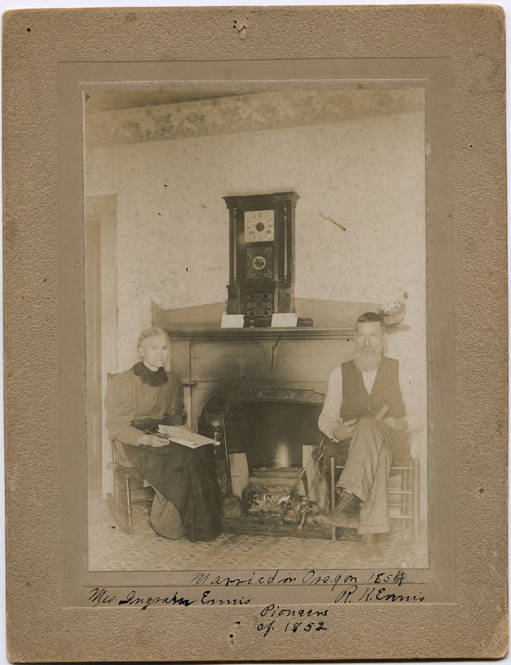
Portrait of Riley Killigan and Eathalinda Ingram Ennis. They were early Oregon pioneers who settled in the area that is now Washington County. This photo was taken in 1898.
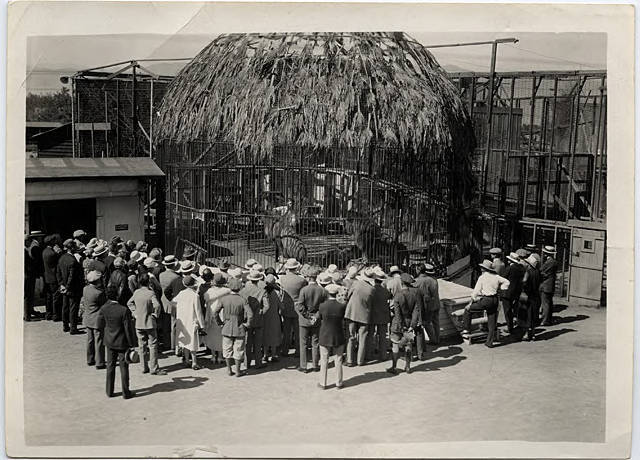
A group of people gather about a cage with a thatched roof. The cage is part of a larger complex of covered cages extending to the back of the image, with a small outbuilding to the left. The main cage is circular, scantily covered with tree branches. Inside the cage, two large lions face a man wearing a white shirt. The people gathered around the cage include men and women. The women wear short skirts and small, close-fitting hats. some of the men wear knicker bockers and watch caps, while most wear suits. Almost all the men wear hats; Panama style and newsboy caps being the most common.
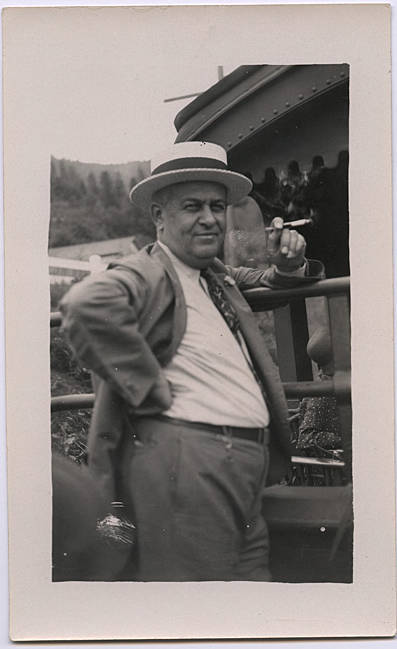
The President of the National Newspaper Association stands on the end of a railroad car, one arm braced on the railing holding a cigar. He wears a light-colored suit over a white shirt and dark tie. He is clean shaven and has a Panama style straw hat on his head. The background is hills and pine trees.
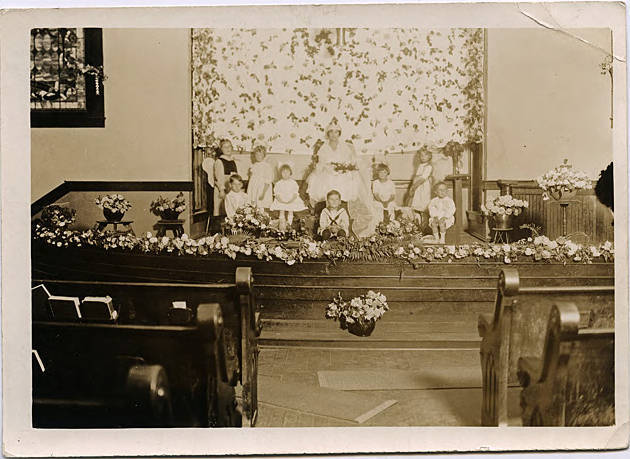
A group of nine children on the stage of a church. The oldest girl is seated in the middle of the group at the back and wears a crown and holds a bouquet. She is wearing a white dress and has bobbed hair. The other children are arranged around her, some seated and some standing; all appear to be under the age of seven. The three boys are in the front row; one wears a sailor suit and the other two have on light-colored shirts and short pants. All have short hair, parted to the side and slicked down. One girl wears a dress with a dark bodice and a peter pan collar; the other girls wear short, full white dresses with empire waistlines and have large white ribbons in their hair. The background behind them is a wallpaper of flowers, and flowers in pots are spaced along the stage in front of the children, and decorate its front edge. A single bouquet in a pot sits on the floor at the front of the stage. The corner of one stained glass window is just visible in the upper left of the image. The floor is wooden and two small runner carpets appear in the front of the stage. There appear to be stairs leading off to the left of the stage.
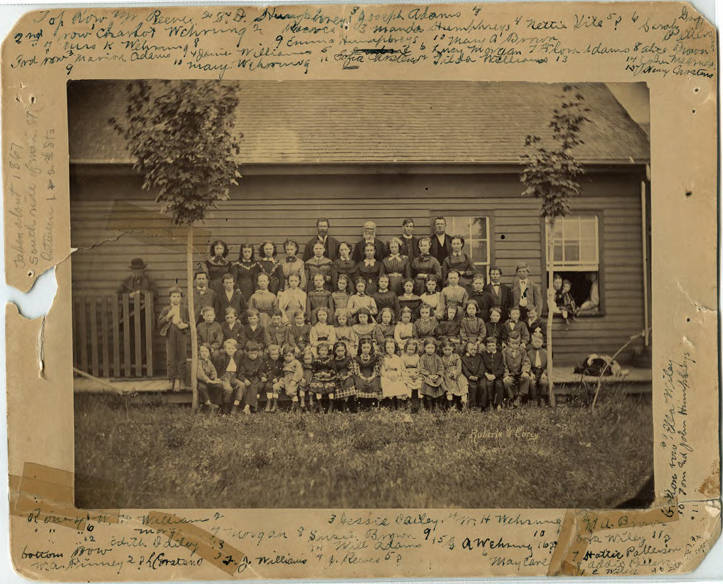
Sepia-toned image of a group of children arrayed on a boardwalk outside a dark wood building. The smallest children sit with their feet dangling over the edge of a boardwalk, with larger children seated and then standing in rows behind them. The girls in the front two rows wear full, short dresses of varying prints and colors, some pinafores and many with shoulder ruffles. The boys wear dark short pants and jackets. The third and fourth rows the girls wear dark dresses with white collars, the boys dark suits with white shirts beneath them. Some of the girls have bonnets, almost all have their hair pulled back in the front and loose down their backs. The girls in the back row wear shirts tucked into skirts, some dark and some light. All the girls war their hair parted in the middle and either pulled back entirely or fastened back above their ears and hanging loose. Two women at the right end of the back row wear dark dresses with full sleeves, and their hair is parted in the middle and pulled back. Four men stand in the back of the group against the building; they wear dark suits and white shirts, and most are bearded. Three children peer through a window next to the group, on holding a small child sitting on the sill with her feet outside. A man to the side of the image wears a dark suit and a bowler hat. and the two small trees on either side of the children are in full leaf. The foreground is a grassy yard.
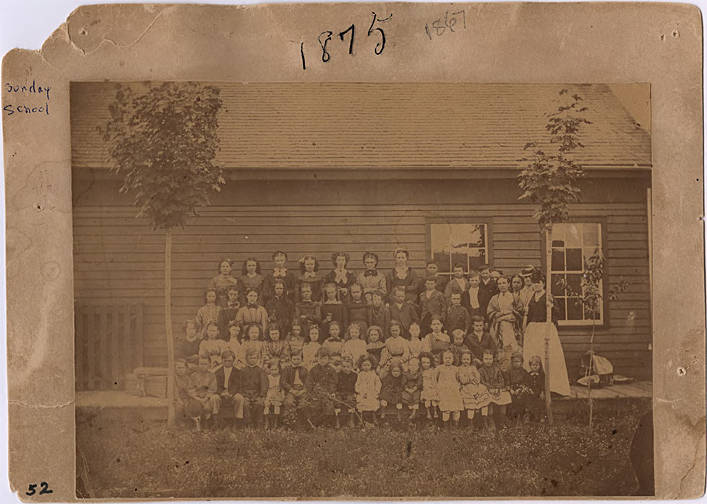
Sepia-toned image of a group of children arrayed on a boardwalk outside a dark wood building. The smallest children sit with their feet dangling over the edge of a boardwalk, with larger children (mostly girls) seated and then standing in rows behind them. The girls in the front two rows wear full, short dresses of varying light prints with pantaloons; the boys wear dark short pants and jackets, most with jackets. The third and fourth rows the girls wear dark dresses with white collars, the boys dark suits with white shirts beneath them. Some of the girls have bonnets, almost all have their hair pulled back in the front and loose down their backs. Two adult women to the right of the image have hats, and one wears a dark jacket over a long white skirt. The building has glass-paned windows and the two small trees on either side of the children are in full leaf. The foreground is a grassy yard.
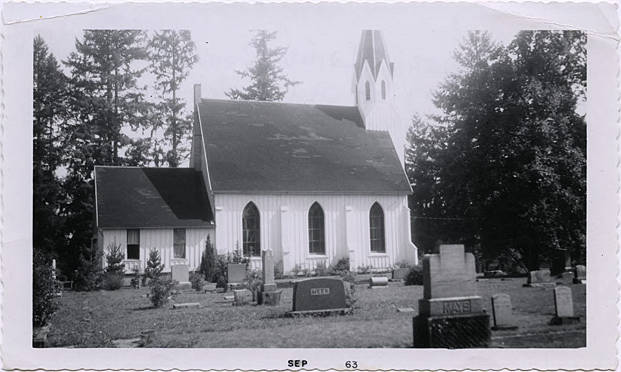
Photograph of a white church in the Carpenter Gothic Style. A graveyard with a number of stone monuments dominates the foreground of the image. Only one side of the church is visible; it features a steep roof sloping down to white walls with three narrow windows with pointed arches between four narrow buttresses. The buttress at the front of the church extends from the building. An octagonal steeple extends up from the front of the building, with steep gables and narrow windows. The roof is cut off at the top of the image. At the rear of the main building is a smaller section, featuring the same steep roofline but shorter in height. Two double-hung paned windows with no ornamentation are visible. The church is bracketed by trees, both pine and deciduous; the latter trees are in full leaf. Visible headstones for the Mays and Meek families.
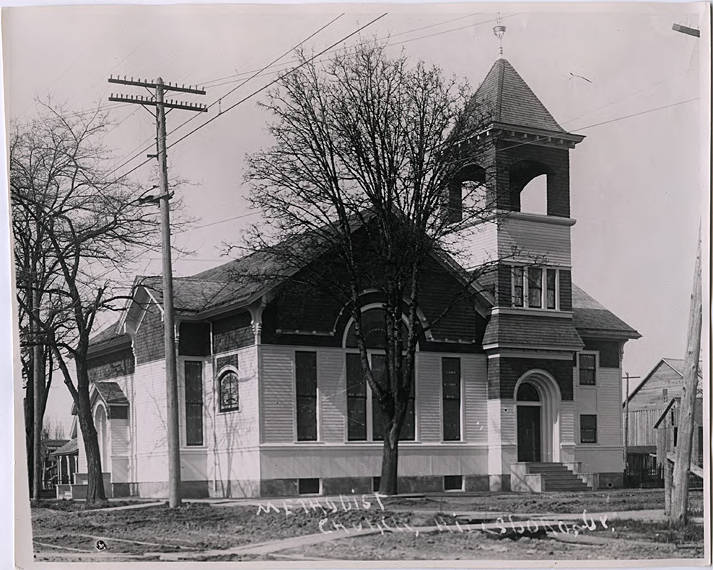
Photograph of a Shingle Style church with a cross-gabled layout, featuring white sides and darker shingle sections on the top of each wall. The bell tower features a balcony with white sides surmounted by shingled arches, and a square pyramid roof topped by an elaborate cup and cross. The church entrance sits away from the street and is a double door in a recessed, graduated archway. Five narrow double-hung windows dominate the facade next to it, two on either side of three in a row. The three are topped by an arched transom window, and the shingled pediment has a matching center arch and extends out over the windows. A smaller, arched window sits around the corner, and another door is visible at the far end of the building sitting inside a smaller arch in the same style as the front door. The building sits on a poured foundation and a sidewalk runs along both sides. A large power poles can be seen in the left of the image, with double cross-ties and a number of power lines running parallel to the church's layout. The empty lot in front of the church appears to be bare dirt. A large, bare tree stands in front of the main window, and others are visible alongside the church, evenly spaced.
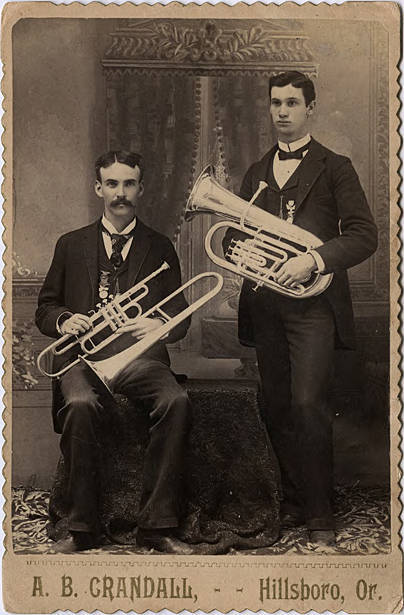
Max Crandall and Charles B. Brown pose in a studio portrait with their instruments. Both wear dark fitted suits with vests over white shirts. One is seated on a cloth covered bench; the other stands next to him. The seated man wears a necktie, and several medals are pinned on his vest. He holds a short model valve trombone in his lap. His hair is short, parted in the middle and slicked down, and he has a mustache. The standing man has a bow tie, no mustache, and short hair. He also has medals pinned to his vest, and he holds a euphonium.
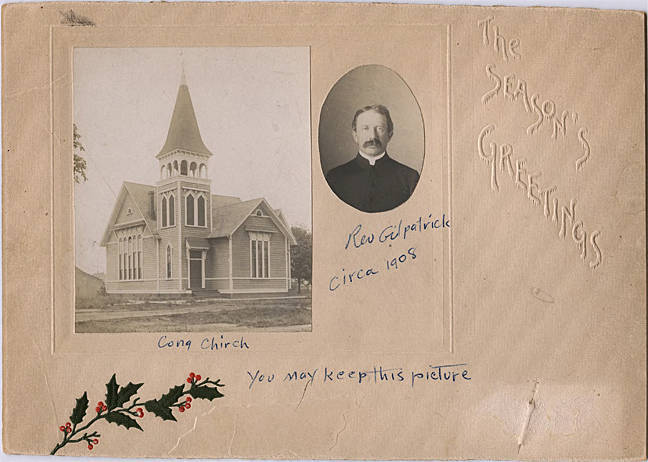
Ivory Christmas card with photos pasted on. A branch of holly with berries extends up from the lower left corner. The larger photo is of a church, cross-gabled and with a large bell tower jutting from the intersection of the two wings. A ribbon of tall, narrow arched windows lines one side of the church, with a matching window in the bell tower. On the other side, double doors beneath a transom window at the base of the tower lead into the church, and three narrow windows are set in the front facade. The Second story of the bell tower has louvered windows, and is topped by a balcony with arched lintels and columns. An elongated pyramidal roof tops this structure, with a cross at the very top. The ground around the building is grassy, and dirt path runs in front of it. Beside this image is an oval image of the head and shoulders of a man. He wears a dark clerical outfit with notched collar backed by white. His hair is light and short and he has a full mustache.
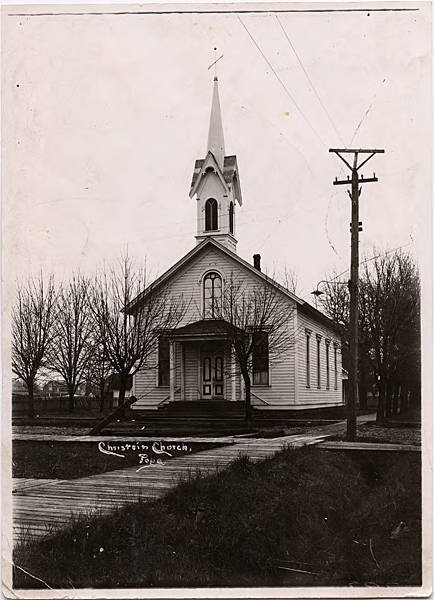
Black and white image of a gabled wooden church. A covered porch is centered in the front faade, bracketed by two double-hung windows with panes. Immediately above the porch is another window, arched and with an arched moldings. Four windows with decorative transoms are spaced down the visible side of the building. The belfry is tall and narrow, with arched, louvered windows and has a cross-gabled roof beneath a four-sided steeple topped with a cross. A power pole stands just to the image right of the building; it has a streetlight and power lines run from the upper edge of the image to the pole and out to the right. At least one line connects the church to the power pole. Small deciduous trees are planted at regular intervals in the churchyard, two to the front the others down the side and also down beside the boardwalk that runs beside and in front of the building. A fence and other buildings are visible in the background of the image.
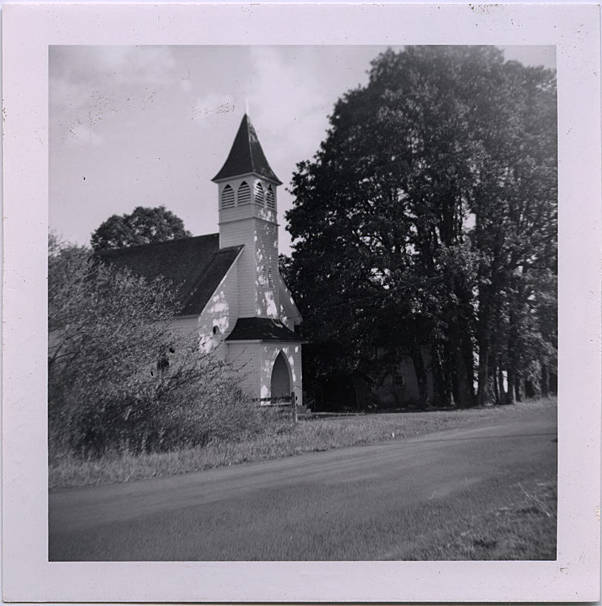
Black and white photo of a church building set off a road and in behind brush with several oak trees to the right front. The building is gabled, with an enclosed porch having an arched entrance. The bell tower is centered in the front and protrudes slightly. The belfry has louvered windows and an elongated pyramidal roof with a cross on top. The rest of the building is obscured by brush. The road in front of the church is paved, and there is a white building just visible behind the oak trees in the right of the image.
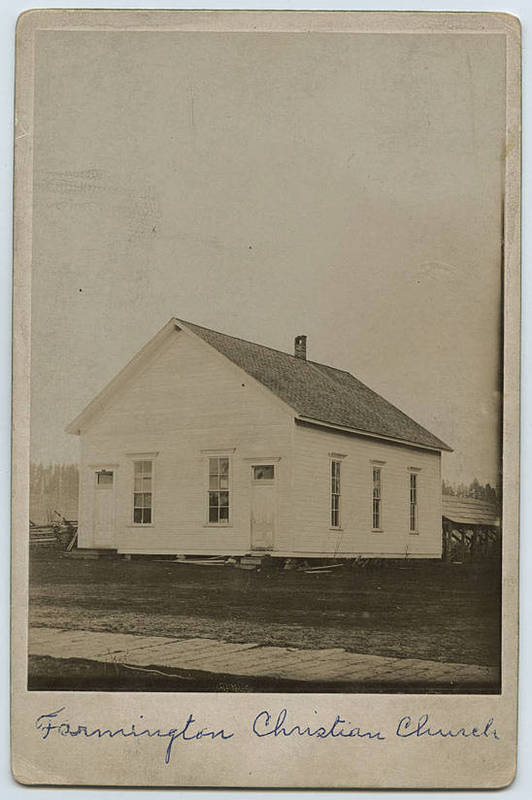
Sepia-toned image of a small gabled church. Church appears to be painted white. Two doors set on either side of the front of the building are separated by two rectangular paned windows. Three single windows with panes are spaced along the visible side. The church appears to sit up on a foundation, and two narrow steps lead up to each door. A split-rail fence can be seen behind the church to the left of the image. To the right of the image and behind the church, a frame building with a roof can be seen. A single narrow chimney protrudes from the back of the building. A wooden boardwalk runs through the foreground of the image, and the ground between it and the church appears largely bare.
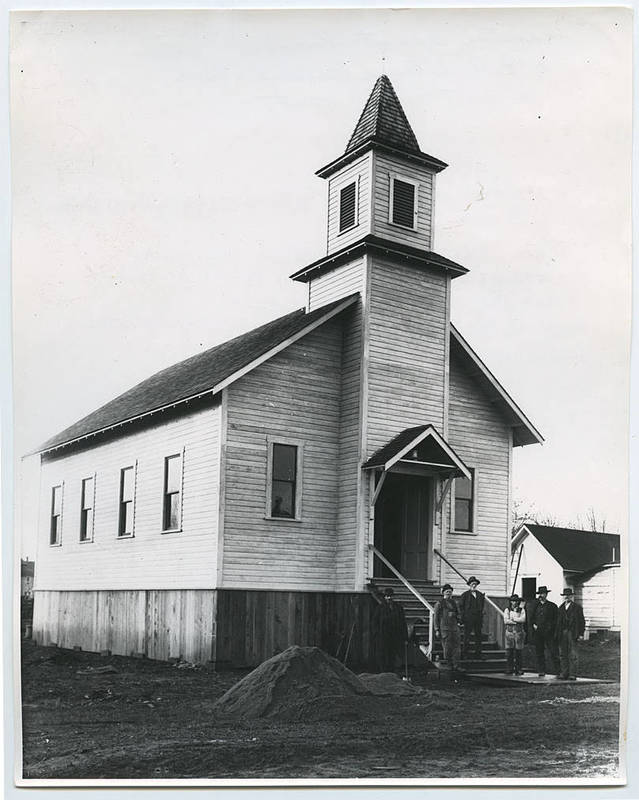
Black and white image from plate negative of a wooden church. Sitting on a wood foundation, the church is gabled, with a bell tower extended to the front and above the roof. Double doors open out of the bell tower, and stairs proceed down to the street level. Single double-hung windows are set on either side of the bell tower in the front, and four more are spaced evenly down the visible side of the building. The belfry has louvered windows and a tall, pyramidal roof with a cross on top. Six men stand about the stairs. Three stand on a walkway in front of the stairs, two on the stairs and one man stands to their right. The men wear dark coats; one man has a long wool coat while the others have suit coats. All wear hats, bowlers and other similar styles. One man stands, arms crossed, in his shirtsleeves and vest with a knee-length apron. To the left of the image there is a large pile of dirt with a shovel thrust upright into it. The road in front of the image is muddy. Another small, cross-gabled white building is visible just beyond the church, and the tips of bare trees is visible just beyond that.
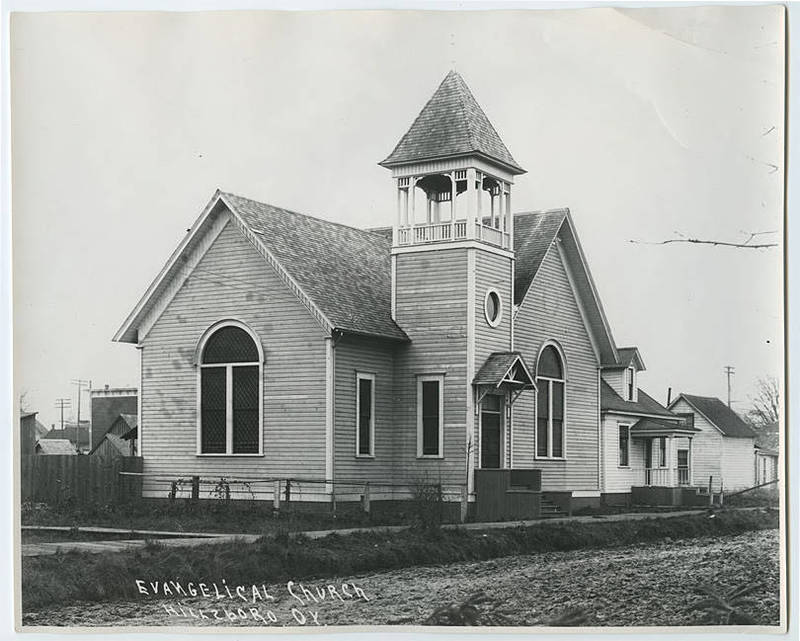
Black and white image of a wooden church. A cross-gabled building faces a muddy street behind a boardwalk. The front entrance is located in a square bell tower that sits next to the front section in the corner between the two sections. Double-hung windows in pairs are set beneath arched transom windows. The bell tower is open, with a hipped roof and a railing around it. Power lines run from the building out of the picture, and power poles are visible in the background. Set immediately against the church to the right of the image is a white gabled house with a single dormer window, set above a small covered porch. A wooden fence runs to the left of the image from the edge of the church. More houses of various sizes and kinds are visible in the background, including one square roofed building to the left of the church. Bare branches are visible on some trees and bushes.
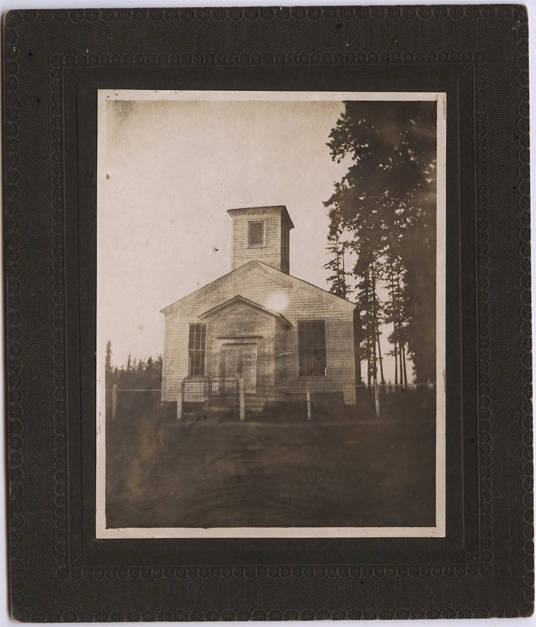
Black and white photo of an old wooden church. The church is single-storied, with large, double-hung, paned windows on either side of an enclosed porch. There is a double door leading into the porch, and a bell tower with louvered windows at the top and a flat roof extends up from the gabled roof. The building sits behind a wire fence, with a metal gate in front of the steps leading from the porch. Large pine trees fill the image to the right, and are also visible in the distance behind the church.
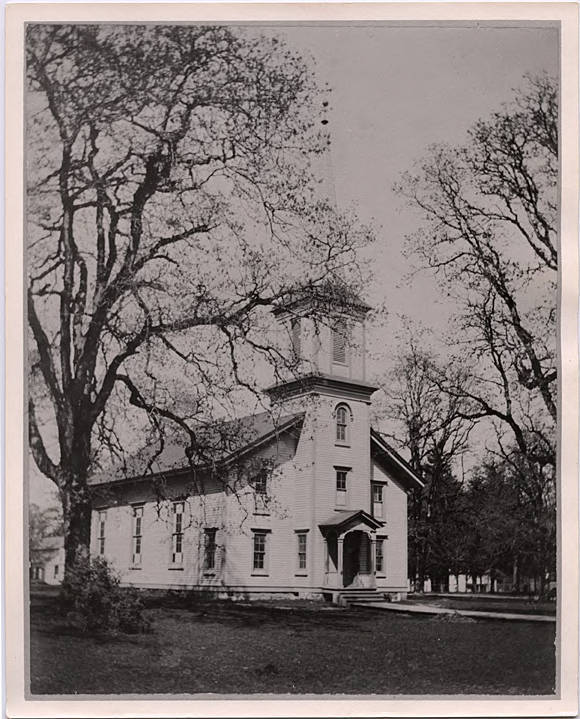
Photo of a wooden church with a bell tower and steeple. The church has a gabled roof with three large windows with colored panes in a row down the visible side. The front has two levels of double-hung, paned windows which bracket a protruding, square bell tower. A covered porch with square carved columns and an arched pediment further extends from the building. Steps lead down to a boardwalk that runs across a grassy field to the church. Bare oak trees bracket the image front and more can be seen in the right of the image. The bell tower has windows in the second and third stories of its front, and is topped by a square belfry with louvered windows a four-sided steeple rises further and is topped by a small cross.
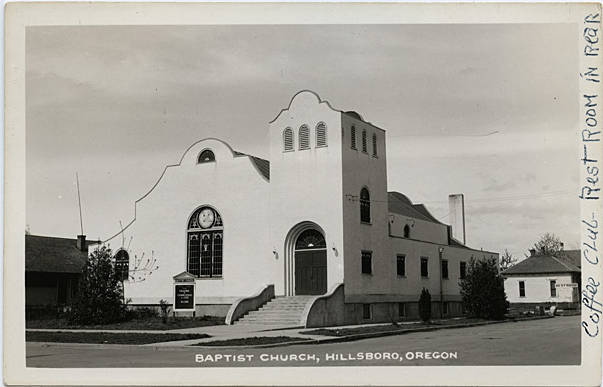
Black and white photographic postcard of a church. The building is Mission Revival style, with a large, square porch and carillon tower on the front corner. Concrete steps lead up to the double doors which sit in a graduated, recessed arched entryway, with a decorative window above it. An arched, stained glass window dominates the front facade of the building, and several small, square windows are visible on the main floor and basement levels of the second side. The church sits on a corner, and has a reader board in front. There is a leafy bush in the front yard, and another on the side, and poured sidewalk and curbs run along both sides of the building's lot. A light colored house with a hipped roof sits on the street just beyond the church, and an illegible sign sits in front of it.
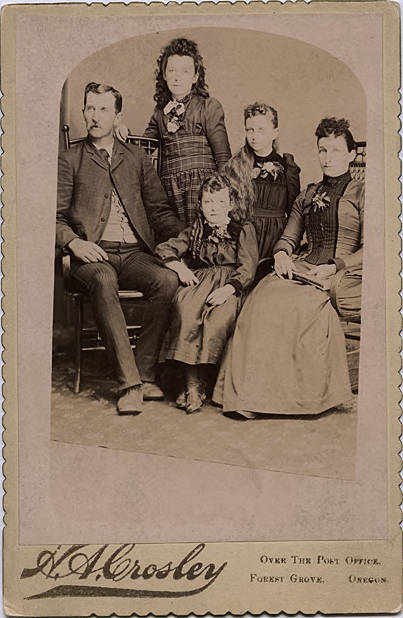
Group portrait of the family of Tom and Emma Caroline Smith Cornelius. Included in the photo are their daughters Frances (Birdie), Minnie, and Bessie. The photo was taken circa 1895.