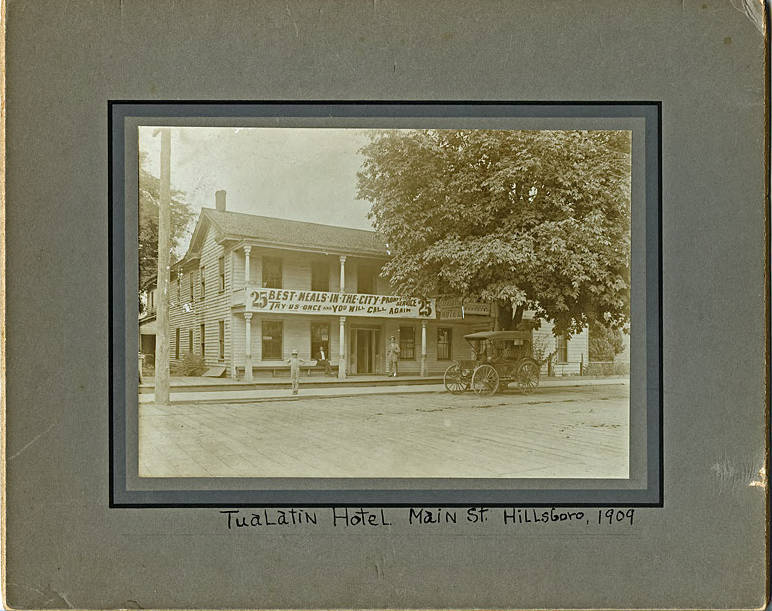
Sepia-toned image of a two-story, cross-gabled building with covered porches along both floors on the front. A man sits on a bench on the porch in front of the hotel, just outside the open door, and another man in a suit and a Panama-style hat stands on the porch. A young boy stands, arms akimbo, on the boardwalk in front of the hotel. A large banner covers most of the second-story porch railing and reads, '25 Best Meals in the City, Prompt Service. Try Us Once and You Will Call Again. 25.' Just beyond that a sign protrudes from the same railing. It reads, 'Tualatin Hotel.' Just beneath that sign is parked a four seater automobile with a cover and large spoked wheels that are larger in the back than the front. It features brass lamps and other fixtures on the front. The road is plank, and a large maple tree in full leaf obscures most of the other half of the building.
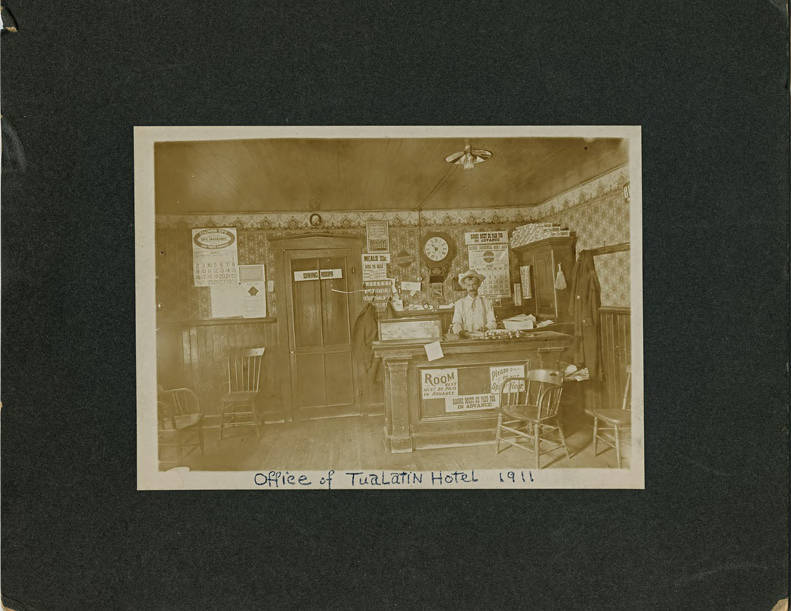
Sepia-toned image on heavy mat showing an interior hotel office with a clerk behind the desk. All three calendars on the wall are turned to July, 1911. The man behind the desk wears a short necktie tucked into his white shirt and suspenders and a light-colored hat. He stands behind a desk in a room with wainscoting; the wallpaper is dark stripes with geometric and foliage patterns, with a light-colored border along the top of the wall. A man's long coat hangs from a hook in the right side of the image. An electric light bulb is set into a fixture on the wooden ceiling, and flypaper hangs on a cabinet door. A door in the center of the wall bears a sign reading 'Dining Room,' and a sign next to the door state 'Meals, 25' and the hours for meals. Several signs state that rooms must be paid for in advance, and another asks patrons 'Please do not spit on the floor.' Three calendars with advertisements hang on the wall, including Illinois Commercial Men's Association, Columbia Life and Trust Company, and Bankers Reserve Life Company. One sign advertises 'Bulletin 5 Cigar,', and a board with numbered hooks, some sporting skeleton keys, hangs beneath that. An inverted horseshoe hangs over the dining room door.
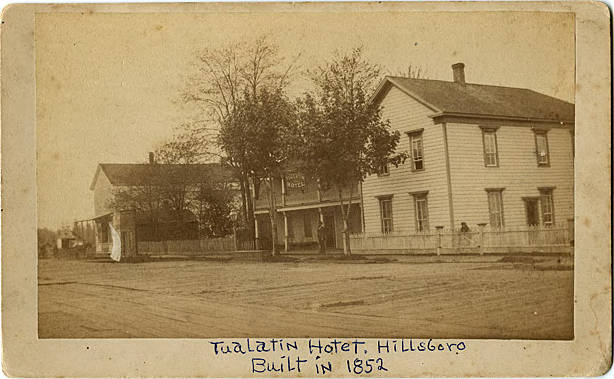
Sepia-toned image of a two-story, cross-gabled building behind a picket fence along a plank road. The building has a covered porch running along both stories on the main section, and double-hung windows along each story in the second section. A man in a suit and hat stands on the step of the front porch, and a young girl in a hat and short dress hangs over the fence beside the building. Two trees in front of the hotel are in full leaf; another, larger tree to one side appears to be just leafing out. Just beyond the building is another, smaller, single-story building with a square front, and then another single-gabled, two-story building with a covered porch and a team tied to the posts. A sign bearing the legend 'Tualatin Hotel' hangs from the second floor porch.
Sepia-toned image mounted on mat of a narrow pyramidal tower with a water tower on top, and a gabled entrance section. Three men stand along the boardwalk in front of the building, and another stands over to the side. A bicycle leans against a fence in the foreground, and another bicycle leans against a block of wood near the men.
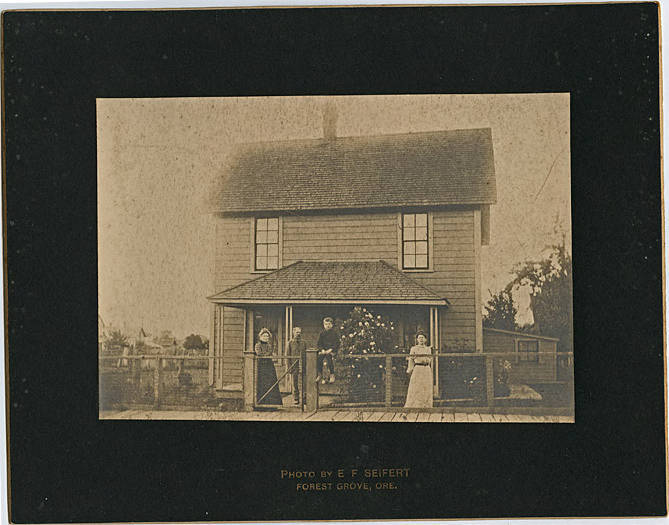
Sepia-toned image mounted on mat of a two-story, gabled home with the family standing in front of it. The house has a covered porch with Stick-style posts. Two women stand inside a wire fence; both wear shirtwaists and their hair up in full buns. A boy wearing long pants and a long-sleeved jacket sits on the fence, facing forward. A man stands on the boardwalk leading from the house to a gate in the wire fence; he wears a suit and has a mustache. A bush in full bloom covers the front entrance to the house, and a similar bush stands to the side of the porch. A boardwalk runs in front of the fence, and a salt-box style extension can be seen in the rear of the house.
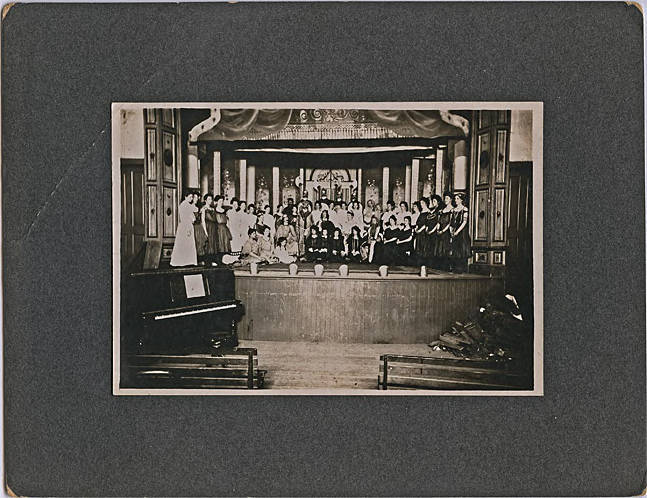
Mat-mounted black and white image of a group of young women in costume on a theater stage. A piano sits in the area right in front of the stage, and two benches with slat back are just visible in the foreground of the image. The women wear pompadour hair styles. Two women on each side of the group are dressed as Tudor style pages, with tunics and boots and lace collars. Several women on the left of the image wear white robes with elaborate designs on the hem and sleeves, while facing them is a group of women in white, knee-length dresses with dark cummerbunds. In the middle of the group six women hold up panels of fabric in a star formation; these women wear filmy dresses with shoulder straps and no sleeves. A number of other women in various costumes stand to the rear of the group, and in the far back of the group are several large axes being held upright.
Mat-mounted black and white image of a group of young women in costume on a theater stage. A piano sits in the area right in front of the stage, and two benches with slat back are just visible in the foreground of the image. The women wear pompadour hair styles, and several smaller girls sit in front of the group. About half a dozen of the girls wear dark, knee-length, sleeveless dresses, while most of the others wear ankle-length, white dresses with long sleeves.
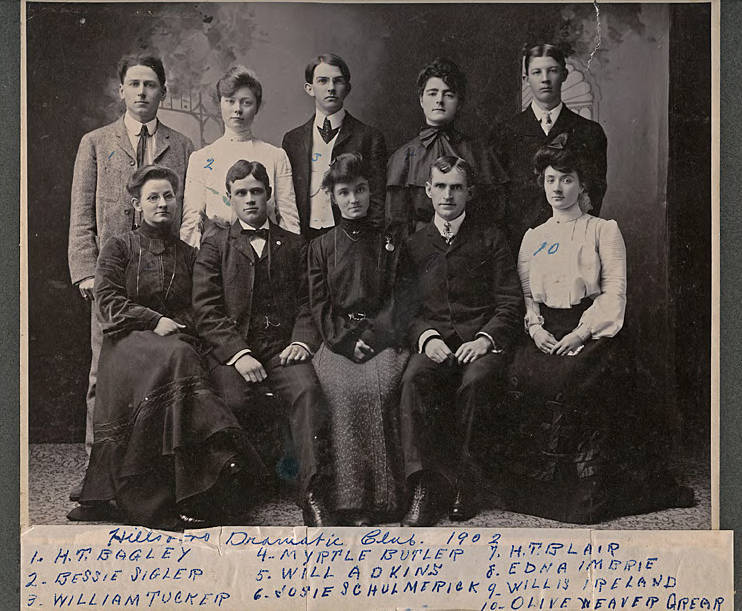
Black and white portrait of a ten young adults, five girls and five boys. The girls wear shirtwaists and skirts with high necks and sleeves gathered into cuffs at the bottom. Their hair is in the pompadour style, and two of the girls skirts have elaborate ribbon designs on the bottom, one in a geometric pattern and the other stripes above a ruffle. the boys wear suits with rounded collars and ties, and one boy wears a bow tie. All the boys have hair parted on one side and combed to the other.
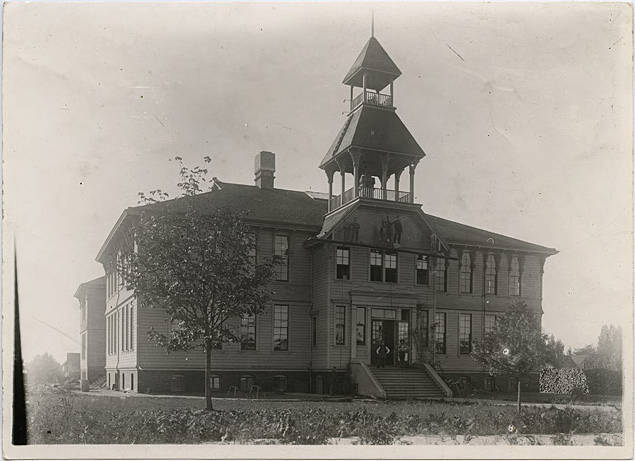
Black and white image of a large, two-story Queen Ann style building set in a grassy yard. There are two small trees in the foreground, and a large stack of wood is visible to the side of the building in the far right of the image. Two men stand on the stairs leading up to the entrance, while three more men stand on a scaffolding raised near the roofline of the central entrance section of the building. There are two chimneys on the roofline.
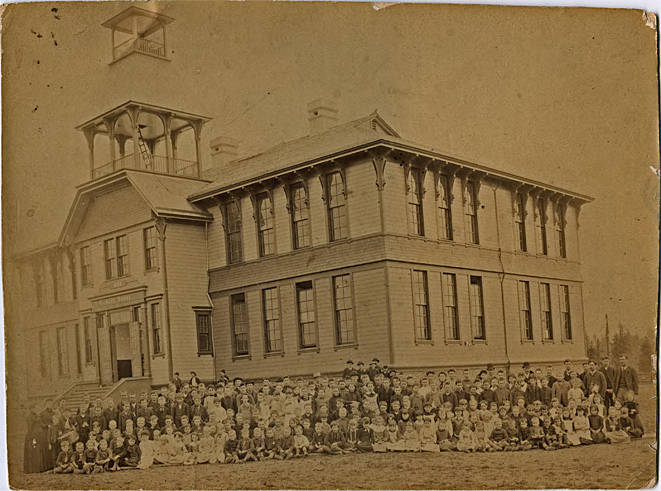
Sepia-toned image of a two-story Queen Anne style building with a large group of children in the foreground. The children are arranged on a grassy yard in rows of younger students seated on boards, then some kneeling, then the oldest students standing in the rear of the group. Several adults stand at the ends of the back rows and amongst the standing students. The gabled building has large steps leading up a cantilevered central entrance section, featuring a double door with a pediment. This section is topped by a large, square, open bell tower with a balustrade and a ladder up to the bell itself. Paned, double-hung windows are closely spaced along each side, and two chimneys are visible on the roof.
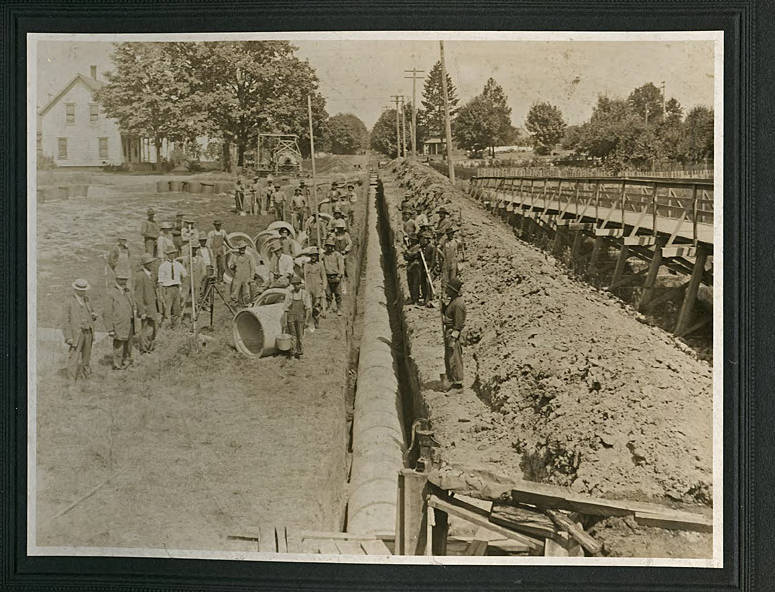
Large, black and white image mounted on a mat of a number of men standing alongside a trench where large sections of pipe are being laid. To the right of the image is a raised walkway. Power poles run along the walkway and the trench. The pipe sections are about 2/3s the height of a man. Most of the men in the fore of the group wear suits, though one has rolled up his sleeves and holds a surveyor's stick next to what appears to be a surveyor's transit mounted on a tripod. Most of the workmen hold shovels, and a young boy in the front middle of the image holds a metal bucket. One house is visible in the background, though other buildings are just visible through the trees in the far background.
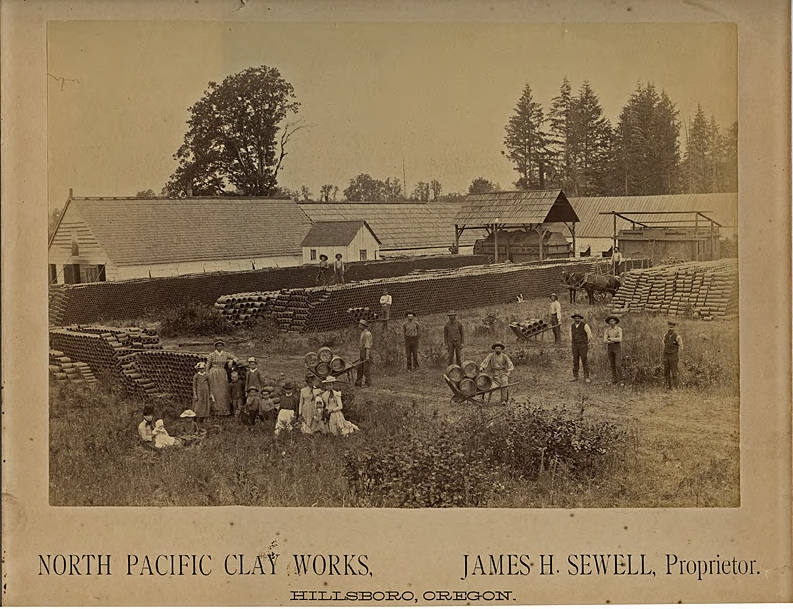
Large, sepia-toned image of a clay works with people standing about the yard. Long stacks of clay pipes with various diameters fill the yard, and two kilns are visible in the back of the image. Several men stand about the yard, one in the back of a wagon holding the reins of a two-horse team. Four stand beside wheelbarrows with large sections of pipe on them. Two boys with large, flat-brimmed hats stand on top of on of the piles of pipe, one sitting on the seat of a tricycle. In the foreground of the image, several women sit and kneel in the grass with a number of children. Two of the women kneeling wear dresses with tightly fitted bodices with small puffs on their upper sleeves, and small-brimmed hats with flowers; a baby in a bonnet and dress stands with them. Beside them another woman wears a dark dress with a man's hat and a white apron. A seated woman wears an elaborate tall, brimless hat; she holds a baby in a white dress and bonnet, and a young girl sits near her. Another woman in a plaid dress with a skirt leans with one arm up on a pile of pipes; two young girls and three small boys stand with her.
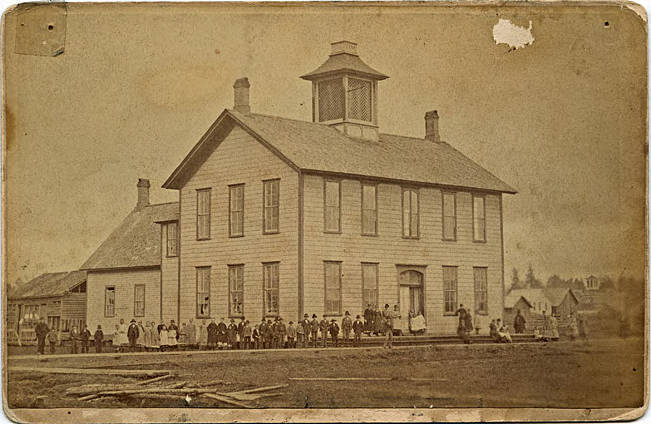
Sepia-toned image of a large group of people standing in a line before a two-story, gabled building with a belfry and an addition in back. Most of the girls wear pinafores over their dresses; the boys are in pants, jackets, and hats. The adult women wear ankle-length dark dresses. The building has double doors with an arched transom above them, flanked by sets of paned, double-hung windows. The windows in the middle of the second floor mimic the arched construction of the first floor. The building sits in a grassy field , and the people are standing on a boardwalk that runs along the front of the building and into the field. Some people sit on the edge of a raised porch. Other houses and trees are visible in the background of the image.
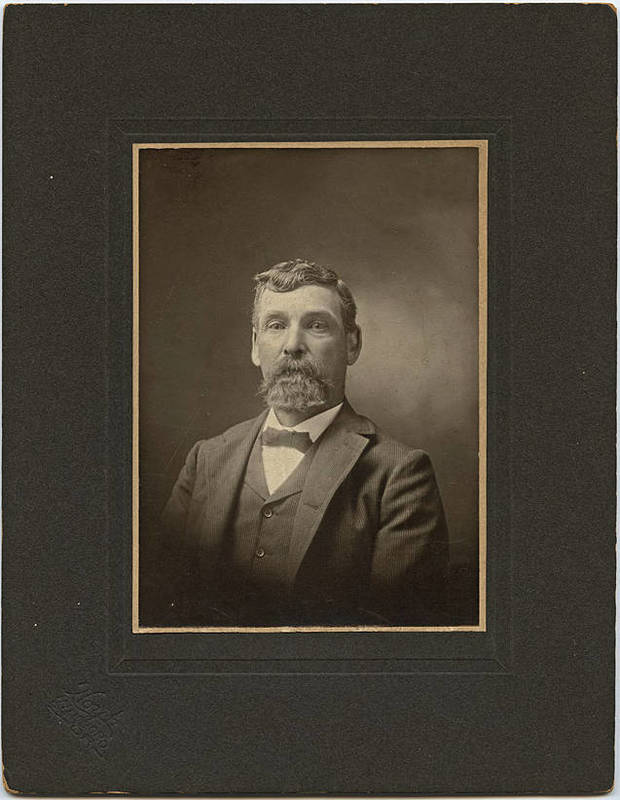
Sepia-toned image of Hillsboro pioneer James Sewell. He wears a suit with a vest and a bow-tie, and a trimmed Vandyke beard. His hair is short and combed to one side.
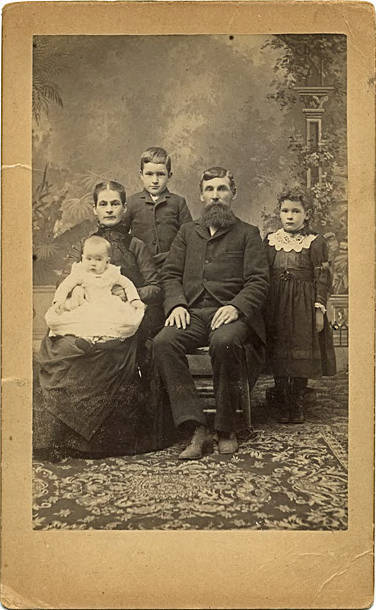
Sepia-toned studio image of a family. The adults are seated, and the man wears a full beard and has his hair combed to the side and back. The woman wears a high-necked, long-sleeved dress with an elaborate lace tie. Her skirt is narrow, but pleated and having an over skirt. She holds a baby in a white dress on her lap. A young boy in a suit almost identical to the man's stands between them; his hair is cut short and combed forward. A young girl stands to the image right of the man; she has a long-sleeved dress with a wide lace collar and ribbons tied around the upper arms. Her bangs are curly, and her hair is pulled back from her face.
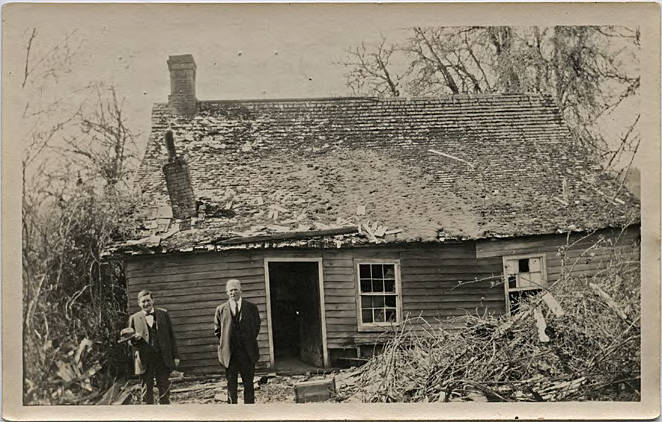
Black and white image of two men in suits standing in front of a ruined home. The house is gabled, and the front door gapes open. Many of the panes in the window next to it are broken out. The roof is mossy and many shingles are loose, and a good portion of the house is hidden behind a pile of debris.
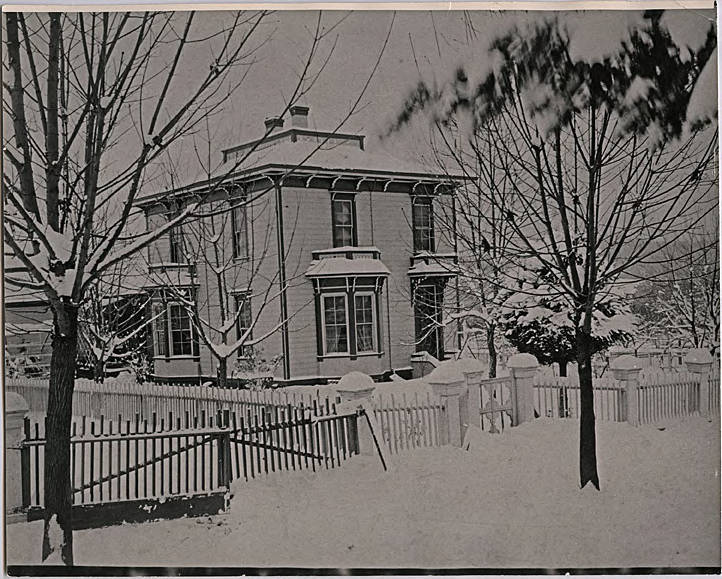
The Smith-Buxton-Caples House at 1938 16th Ave in Forest Grove, Oregon. According to a description in Oregon’s State Historic Sites Database: “The house is said to have been built by Irwin Smith around 1876. Smith was a partner with Mr. Buxton who later lived in the house with his family c. 1900. Buxton’s daughter, Rena Buxton, married a Mr. Caples and continued to live in the house.” This photograph was taken later, possibly in the 1900s-1920s. The house is square, with bay windows and a hipped roofline. Dark trim with light accents set the upper portions of the bay windows apart. Everything is snow-covered, with snow piled at the base of the picket fence that surrounds the yard, and sitting on top of the fence posts and the house.
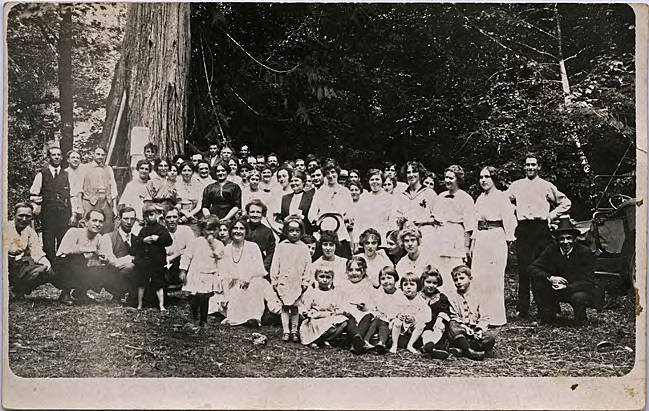
Sepia-toned image of a group of men, women, and children gathered at the base of a large tree. There is a jalopy-style car at the far right of the image. Most of the women wear white blouses with bishop sleeves, tucked into long white skirts and with belts. the men are mostly in shirtsleeves, while a few have vests and at least one man wears a suit.
Portrait of Flora Adams Pio and Charles Pio. Flora Adams' parents settled in Hillsboro in 1852, and Flora was born there in 1859. Flora and Charles were married in Hillsboro in 1879.
Black and white image of a three story mill with a barn. Sacks of product are visible in the open door of the barn behind the loading dock. Train tracks run in front of the mill, and the street is muddy. Six men stand in a row in front of the mill itself. Two men on either end of the line wear suits and hats, as does a man in the middle of the line; one man wears a vest and another overalls. One man appears to be wearing a work outfit with a train conductor's type hat, while the last man wears overalls. A power pole is just visible to the far right edge of the image. White lettering spells out 'Climax Mill' on the front of the main building.