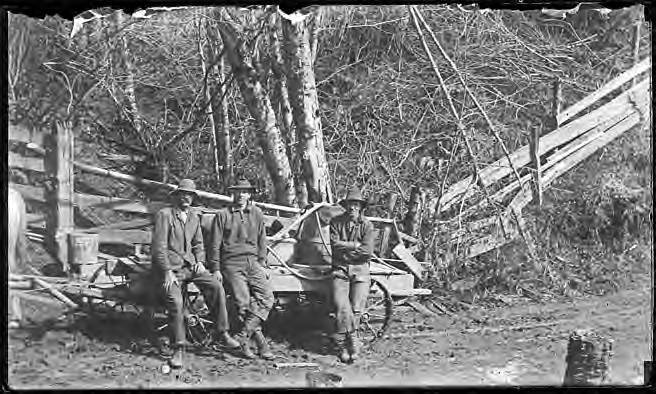
Black and white image of three men sitting on a horse-drawn wagon with orchard spraying equipment on back. The road is muddy and wet. The back of the wagon is a flatbed with no sides, with a barrel and hose sitting on it, with other equipment. Two of the three farmers wear short pants over boots, and all have long sleeved shirts or jackets on. Clapshaw Farm, Clapshaw Hill Rd.
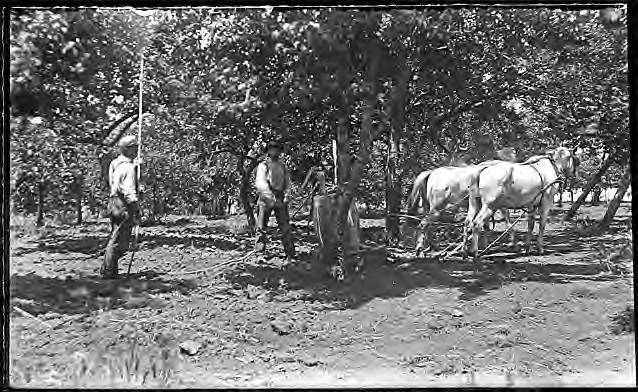
Black and white image of a horse-drawn rig consisting of a barrel on runners with a hose and a pump handle. The device sits in the middle of an orchard, and one man works the pump handle while another directs the hose and sprayer up among the trees. Both men wear long-sleeved work shirts and pants with suspenders. The trees in the orchard are in full leaf. Clapshaw Farm, Clapshaw Hill Rd.
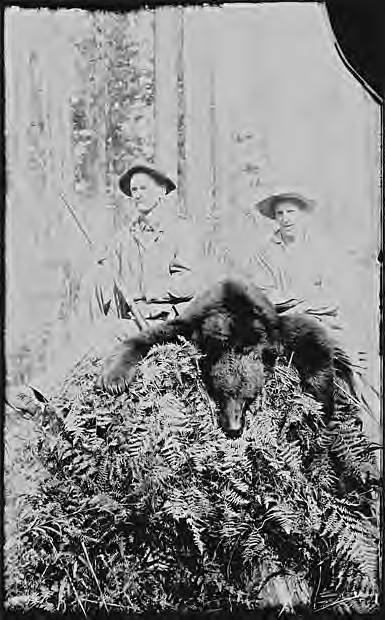
Black and white (overexposed) image of two men on a fern-covered stump with a dead bear. One man holds a rifle, while the other sits beside the bear. The bear itself is laying over the stump with its head and paws hanging down to the front. Both men wear work shirts and hats, and the visible vegetation is lush and thick. Tall pine trees fill the background of the image. The photograph was most likely taken in the Coast Range of Oregon, along the Wilson River. Donated by Thomas Clapshaw.
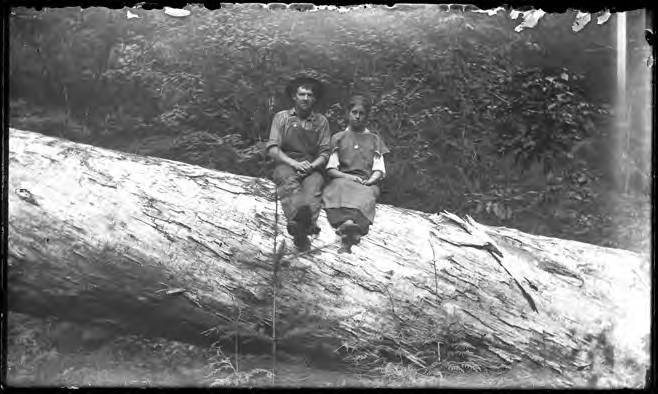
Black and white image of a couple sitting on an old growth log. He wears overalls and a hat; she has on a smock type apron over a dress and skirt and wears a locket. The log appears to rest across a dip in the ground, and the undergrowth behind them is lush and thick. Photo was donated by Thomas Clapshaw.
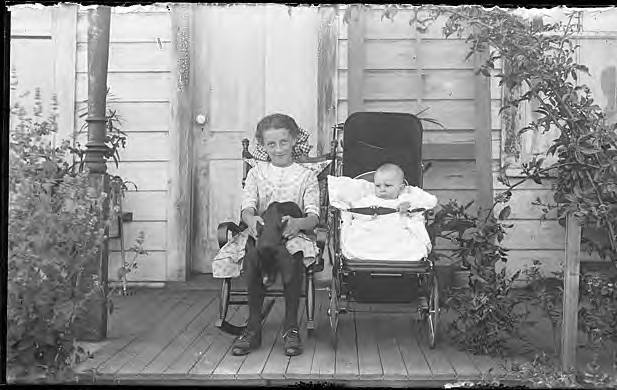
Black and white image of a girl sitting in a child-sized rocker with a puppy on her lap and a baby in a stroller next to her. The girl wears a print dress with dark stockings and flat, lace-up shoes. Her hair is pulled back and tied with a large bow behind her head. She holds a puppy in her lap. The baby next to her sits in a carriage with wire-spoked wheels and is wrapped in several layers of blankets. The building behind them is weathered, with a wooden door and a number of plants growing alongside and on the porch on which the girl and baby sit. Photograph donated by Thomas Clapshaw.
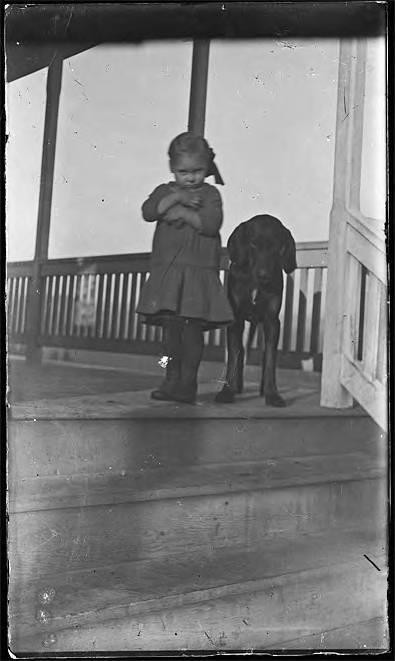
Black and white image of a young girl in a short skirt standing at the top of the porch stairs. A puppy stands next to her, and she appears to be cuddling either another small animal or a toy. Her hair is pulled back and tied with a large bow, and she wears a short dropped waist dress with black stockings and boots. The porch railing behind her blocks any real view of the landscape beyond. The image was donated by Thomas Clapshaw, though no identifying information about the young girl has been found.
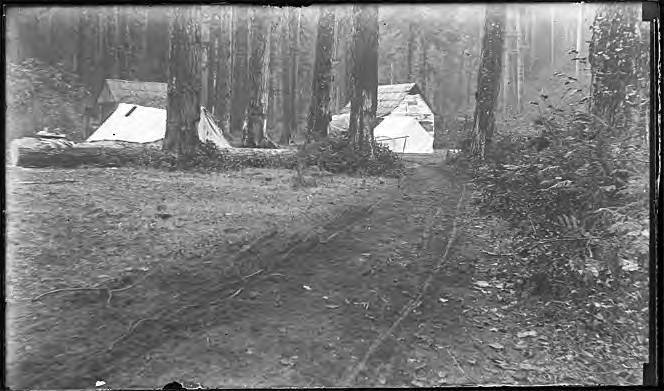
Black and white image showing a camp in the trees and a narrow trail with tire tracks leading up into it. There are two wooden buildings and what appears to be a canvas tent to one side. Camp was located at the confluence of the South Fork and the Devils Lake Fork of the Wilson River in Tillamook County; this particular route later became Highway 6, the Wilson River Highway, after a Works Progress Administration (WPA) project in the late 1930s and early 1940s completed the highway.
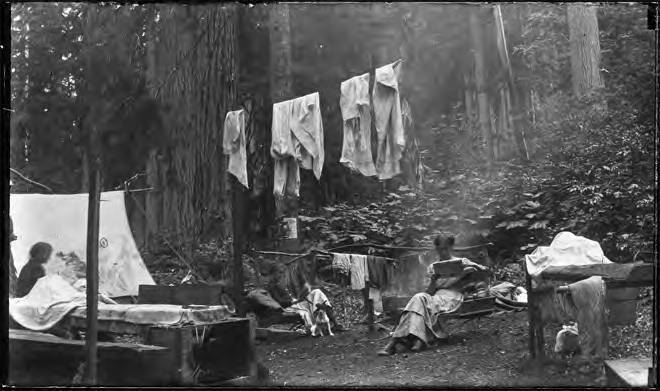
Black and white image of three women in a camp in the woods. A canvas tent is set up on one side, behind a table. Clotheslines with laundry hanging from them cross the center image. Two tables are visible, one appears to be a work table while the other is covered with a cloth and appears to be used for eating. Two of the women are reading, one seated near a fire with a book, and the other sitting on what looks like the seat to a wagon reading a newspaper. The undergrowth is thick and lush, and the fireplace smolders in the background. In many earlier photos of camps, it almost appears that families simply transported their usual living quarters out into the woods. This camp is less elaborate, perhaps because it is a hunting camp. This image was donated by Thomas Clapshaw of Forest Grove, Oregon.
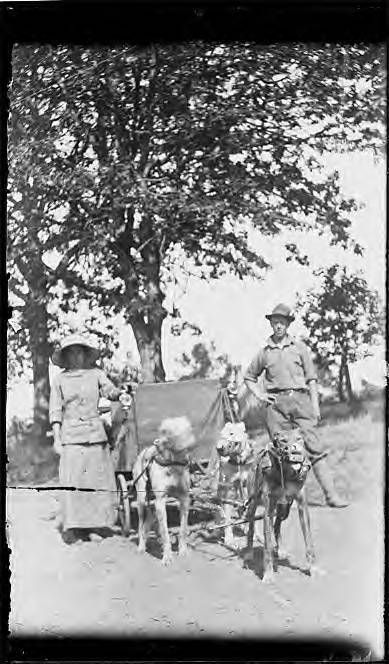
Black and white image of a couple with cart being pulled by three large dogs similar to Great Danes. The cart has side lanterns and appears to be a passenger cart. The woman's outfit is a two-piece suit with an ankle-length skirt, while the man wears baggy pants and a button-up shirt along with a fedora. Behind them is an open hillside with grass and trees. Dogs were often used in the past to pull small carts and haul goods, especially by people who could not afford horses, however, around the turn of the century many animal welfare groups began campaigning to have dog-hauling made illegal, the common feeling being that it was inhumane to use dogs when horses were available and so much better suited to the hard work of hauling cargo.
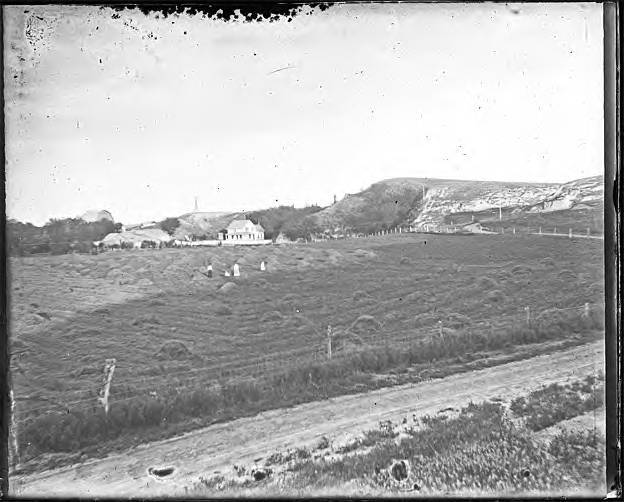
Black and white image taken from the road of a hayfield in front of a farm. Two women and two small children can be seen in the field, walking between the piles of hay. In the background is a two-story farmhouse and a number of outbuildings, including a large barn.
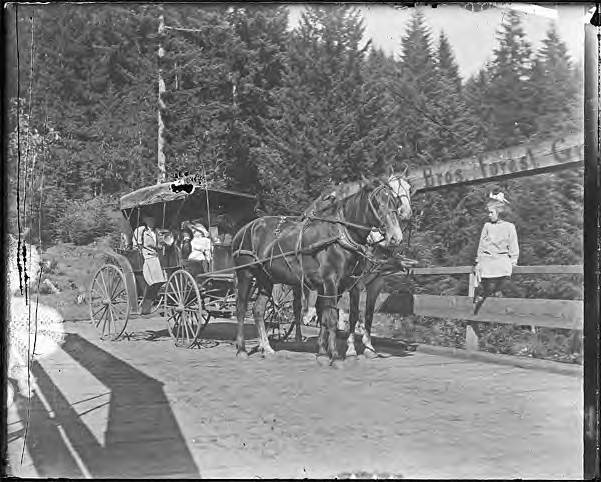
Black and white image of three women, seated inside an elaborate horse-drawn carriage, two in the back and one in the front seat holding the reins and with a small child in a white dress beside her. Another child, a girl, is seated on the railing of the bridge in front of the horses; she wears a short light colored dress and has short hair, some of it pulled to the back top of her head in a bow. The carriage sits on a wooden bridge and the lettering 'Bros. Forest Gr' is just visible on the upper truss. The women wear hats and suits; one hat is large and floppy. The other hats are smaller and sit more to the front of their heads.
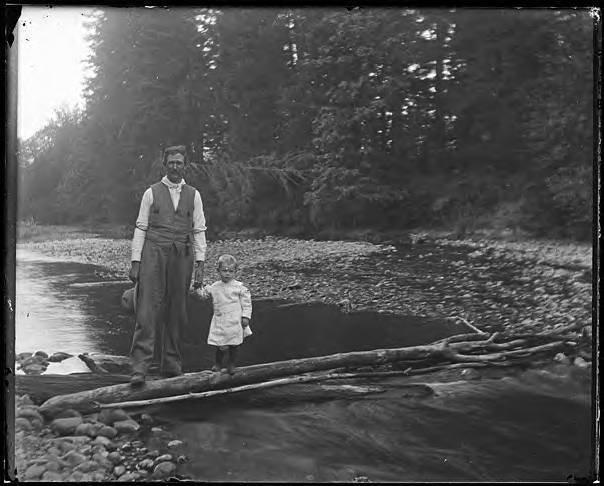
Black and white image of a man standing on a log over a creek, holding the hand of a small boy wearing a light-colored, striped dress. The creek water is low, and a gravel bar fills most of the creek bed behind the pair. The man wears a white shirt with sleeve garters, a kerchief tied around his neck, and loose baggy pants beneath a vest. Loyal Graham was a lawyer from Nebraska who moved to Oregon after 1910 and began practicing law in the Forest Grove area. He was later elected to the state legislature, where in 1919 he authored the nation's first gasoline tax law, making Oregon the first state in the nation to charge drivers for road maintenance and construction. Drivers paid 1 a gallon at the pump. Two of the first projects funded were the Oregon portion of the Pacific Coast Highway (now U.S. 101) and the Columbia River Highway (now Interstate 84).
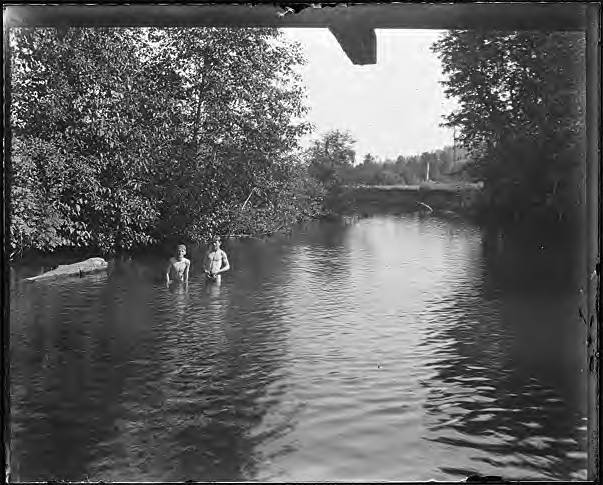
Black and white image of two young men standing hip deep in a creek or river. Neither boy appears to be wearing any clothing. The river is slow moving, and heavy vegetation covers the banks, except for the right rear of the image, where a dirt bank can be seen.
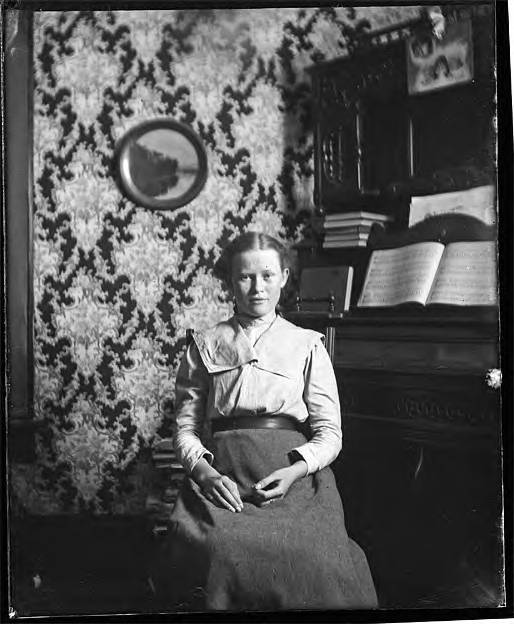
Black and white image of a young woman sitting in front of an upright pump organ. She wears a shirt with a sailor collar tucked into a wool skirt, with a belt. There are a number of books stacked on the floor behind her and on the shelves of the organ. Maud was the daughter of Loyal and Carrie Graham.
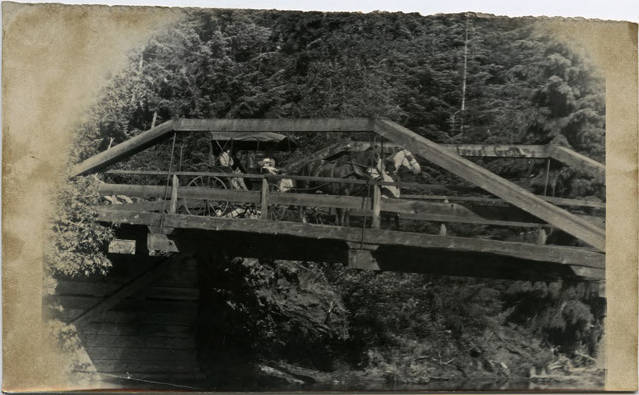
Black and white image of an open carriage sitting on a bridge over a creek. Two horses pull the carriage, and at least two people can be seen sitting inside. The bridge is a queen truss style, with 'Forest Grove' is written on one of the horizontal truss chords.
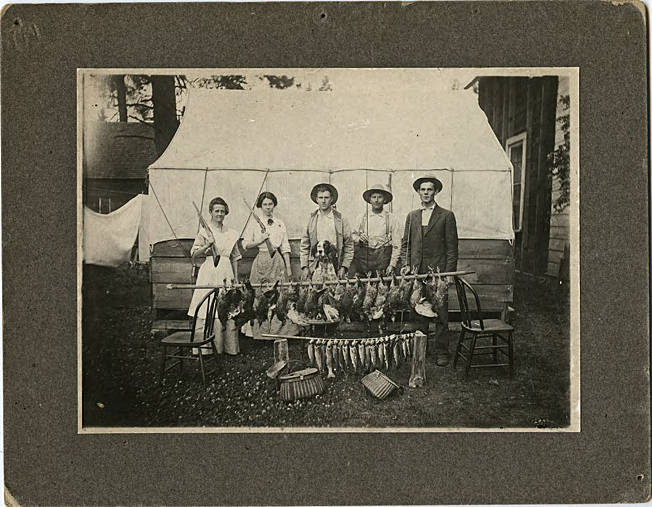
Black and white image mounted on heavy mat of a hunting and fishing camp. Unusually, the two women in the group hold their rifles and appear to have shot the birds hanging on the pole that rests across two chairs in front of the group. There are also three men, two of whom hold fishing poles. A fishing pole is suspended across two upright logs in the foreground of the image, filled with fish, with two creels on the ground in front of that. A hunting dog stands in the center of the image, and behind the group is a wooden camp structure with a canvas top; two other buildings are visible to the right and the rear of the group.
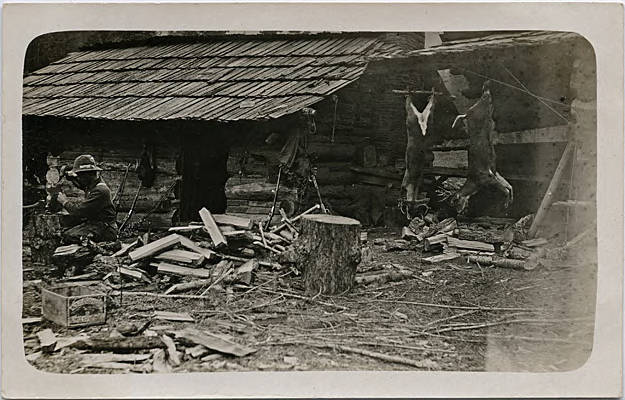
Black and white image of a hunting cabin, with two deer carcasses hanging to one side, and a man working with an awl squatting by a stump on the left side of the image. The cabin appears to have only one room and has a shake roof and a chimney that appears to be made of flat stones. Five rifles lean up against the cabin, and a number of other tools and implements also hang in various places from the cabin. A great deal of cut wood is scattered about the foreground.
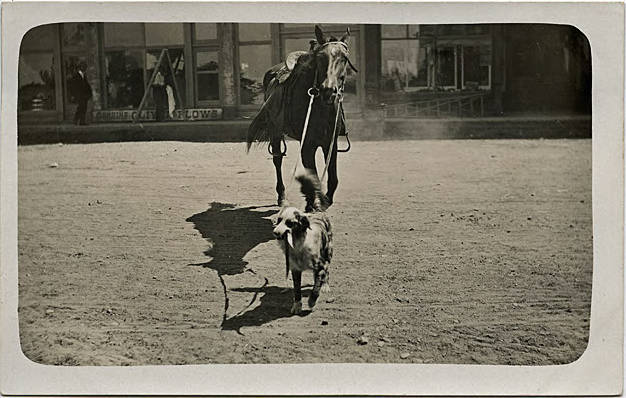
Black and white image of a dog with a saddled horse's reins in its mouth, pulling the horse across a dirt street. Across the streets are buildings fronted with plate glass windows, and several ladders, one on its side and another with a mans standing beneath it. A sign rests against the foot of the building; it reads 'Genuine Oliver Plows.'
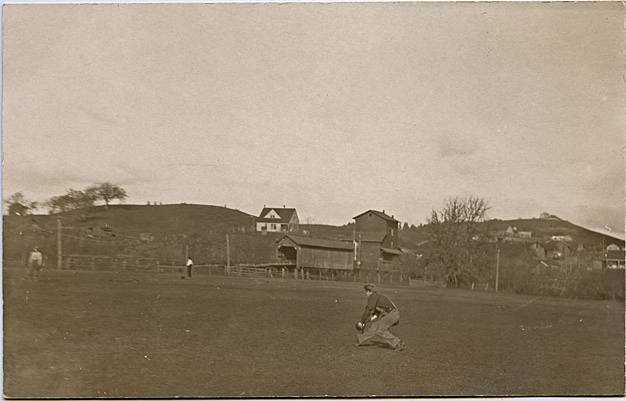
Sepia-toned image of a man with a baseball glove leaning down to catch a ball. The play is in an open field, and two other men are visible in the distance, as are a number of houses and what could be a covered bridge. Bare hills fill the background of the scene. Baseball had been a popular sport in Oregon since the mid-1860s, and professional teams were fielded as early as the 1890s. Baseball was also played casually by many groups, due to the relatively easy rules and the minimal equipment required.
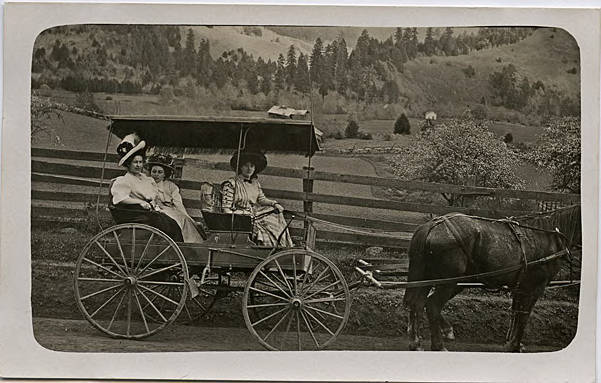
Black and white image of three women in fashionable dresses and hats sitting in a surrey drawn by a pair of horses along an unpaved road. The dress worn by the woman in the front seat features a unique pleated and button pattern on the sleeves. The elbow-length puffed sleeves in the dress worn by the woman in the back seat are unusual for the time period, when most women still routinely covered their entire bodies as a matter of modesty. Note the robe covering the skirt of the young woman driving, to protect her skirt from dust and dirt kicked up by the horses' hooves. The surrey has metal springs and the braking mechanism is visible along the outside of the body. Behind the women is a large pasture, divided by rail fences and having a house in the center, backed by tree-covered hills and another valley.
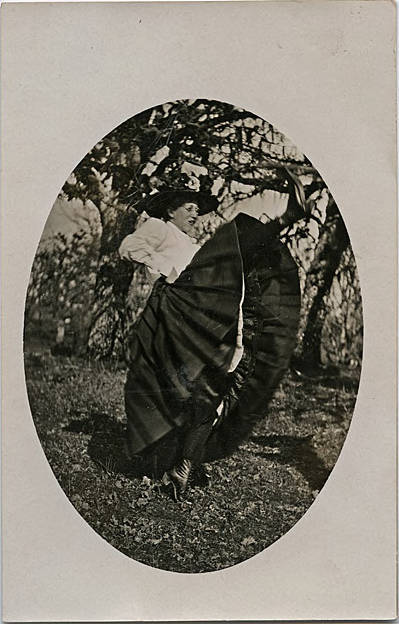
Black and white image of a woman wearing eyeglasses, also in a white shirt and dark skirt doing a high can-can kick. She holds her skirt in either hand and stands on tiptoe with one foot while kicking the other up into the air. She wears dark stockings and buttoned boots, and two layers of petticoats can be seen, one light-colored, and one dark. In an era when showing an ankle in public was taboo, this would have been a highly risqu photograph and, as such, it is very unusual image to have from this time period.
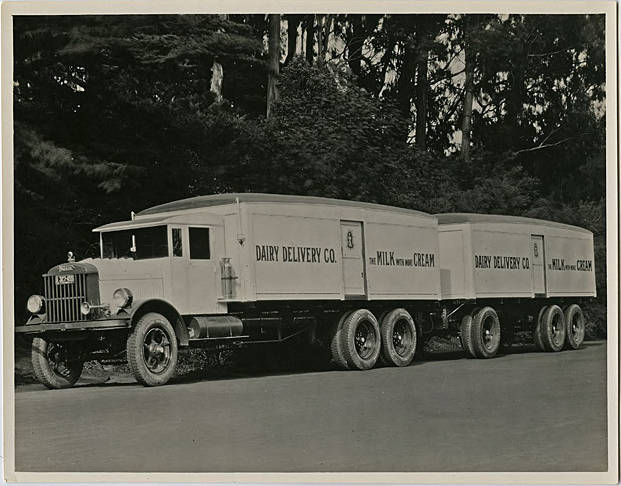
Black and white image of a milk delivery truck with a double trailer parked along the edge of a paved area. There are canisters visible beneath each trailer, presumably for the refrigeration. On the sides of each trailer are the words 'Dairy Delivery Co.' and 'The Milk With your Cream.' A closed door with a logo is visible in the middle of each trailer, and just beside the cab of the truck behind the door is a silver can sitting on a shelf, reminiscent of a milk can.