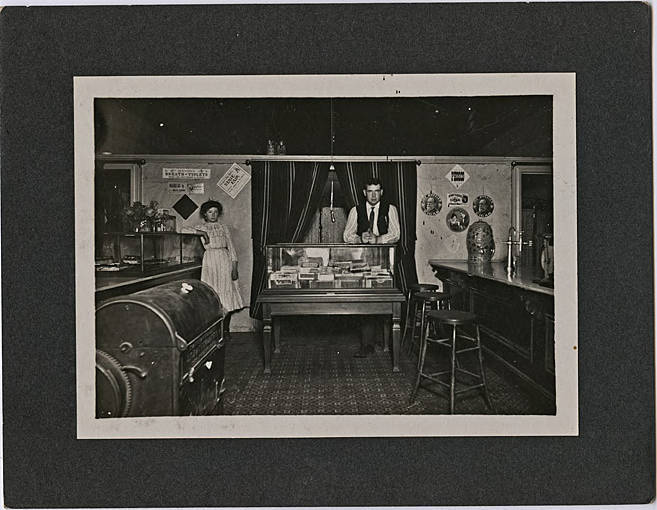
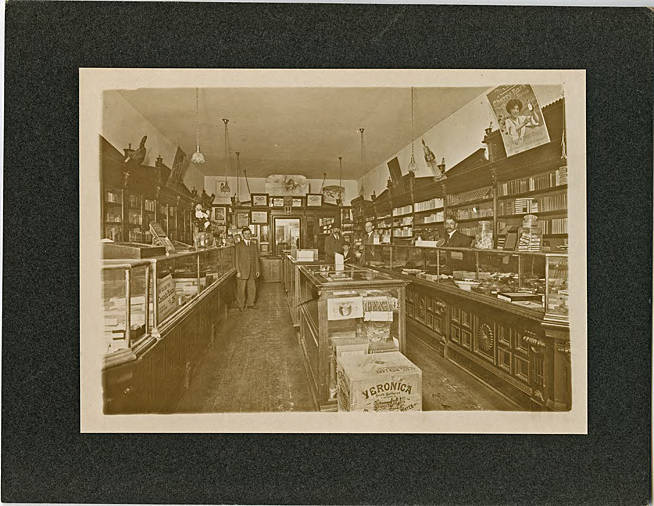
Black and white image of the interior of a confectioner's. The machine in the left foreground is a peanut roaster. There are chocolates in the case behind it and cigars in the center case. The advertisements on the back wall are for breath fresheners and cigars. Note the man helping the woman light up in the Cremo Cigars ad. Cremo was one of the largest cigar manufacturers in the world in the 19th century. The two people in the picture are siblings.
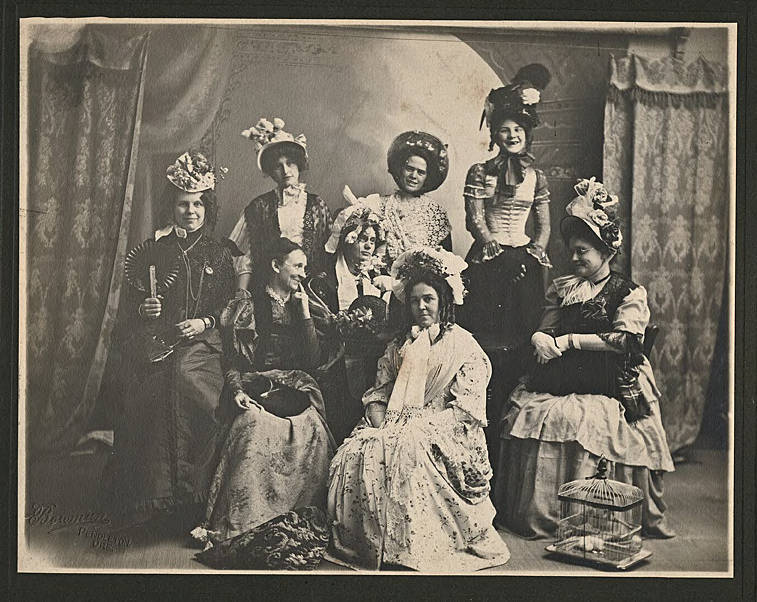
Black and white image of of eight performers. Five are seated and three are standing in the back. All the actors are dressed in period clothing, possibly in character for a performance. One of the performers in the back is possibly dressed as a caricature of a sex worker, with blacked out front teeth and crossed out eyes. In the foreground there is a cage for a small pet, containing a small rodent.
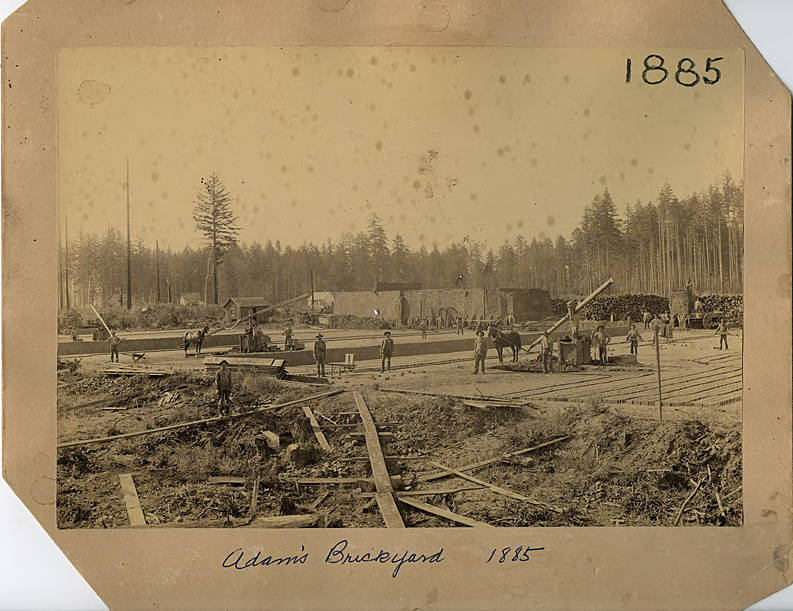
Sepia-toned image of a brickyard. Two horses stand beside pug mills used to process the clay before making bricks, and the large kilns in the background were built of bricks to be fired. Note the businessman in the middle of the photo, dressed in a suit, when all the other men in the photo wear work clothes. This is very likely William C. Adams, the owner of the brickworks. His father, Calvin, came to Oregon in 1852 and took up a Donation Land Claim, and William, the fourth child, was born in Oregon about ten years later. He is listed in the 1880 census at age 15, and in the 1900 census his age given as 37 and his occupation listed as 'Brickmason.'
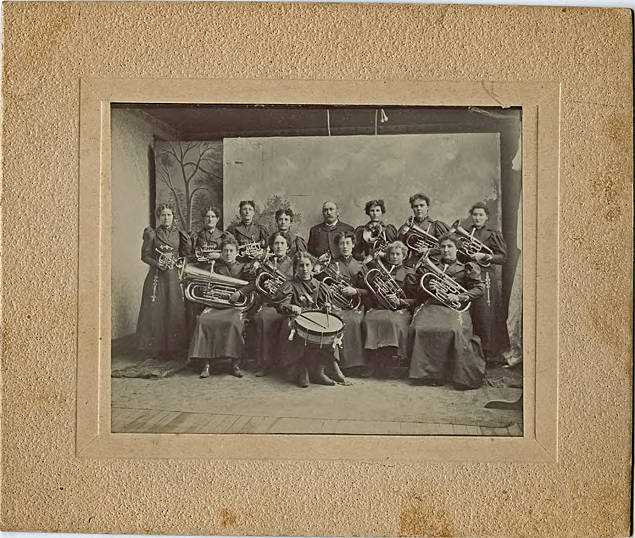
Sepia-toned image of a ladies' brass band. They all appear to wear a long, jacket-style uniform over a shirt and tie, a cost-effective means of providing a standard look for everyone. Instruments played include euphonium, cornet, trumpet, tuba, and possibly baritone, in addition to the snare drum.
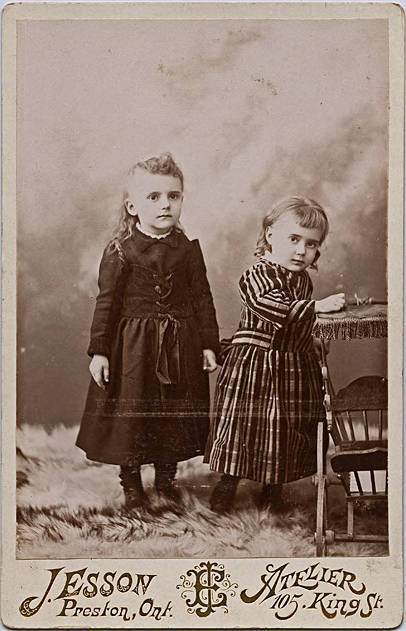
Sepia-toned image of two children, standing on a fur rug. Note the child-sized buggy on which the child in the plaid dress rests one hand. The children are not identified, but the donor's mother was born in Canada.
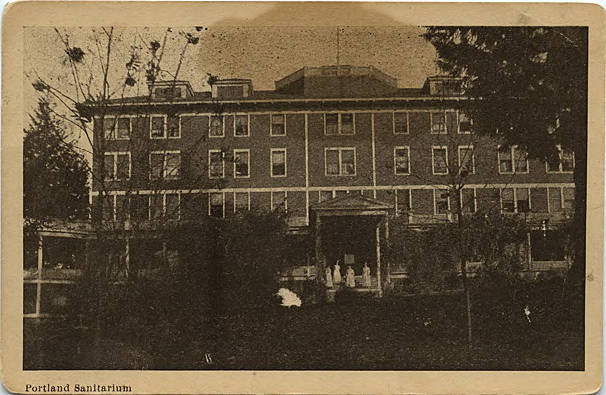
Sepia-toned image of a four-story building with a large, covered front porch and verandah. Four women in nurse's uniforms stand on the main porch. On the back is a 1 cent U.S. postage stamp. The addressee, Mrs. Lowell [Daisy] Markee, was a local woman who had relocated to California with her husband and family. She died in the 1918 influenza epidemic and was buried in Oregon by her husband.
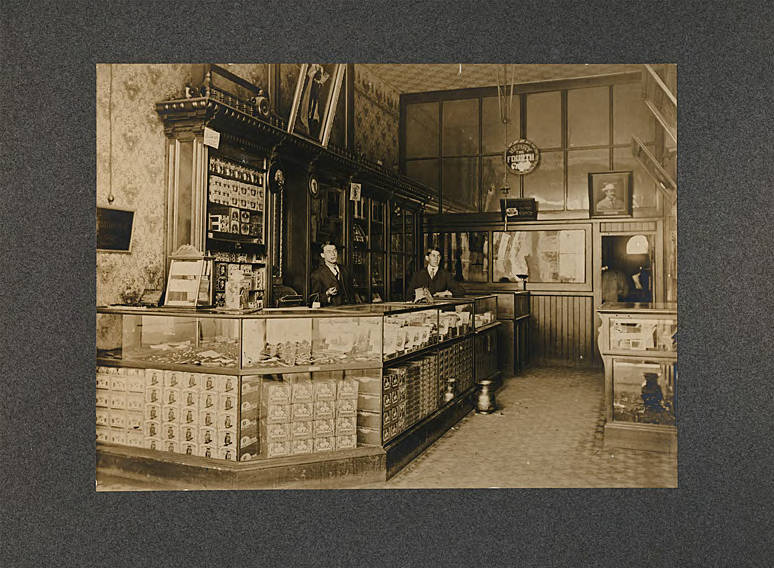
Sepia-toned image of the interior of a drug store. Most of the merchandise seems to be cigars, with advertisements for Havana cigars and Henry the Fourth cigars on the back wall.
Sepia-toned image mounted on heavy matting of the interior of a drug store. Four men in suits are picture, and a small boy stands with one man in the very back of the image. The advertisements on display include one for Cherry Bark cough syrup, still a popular natural remedy, and an advertisement featuring a man in Turkish dress.
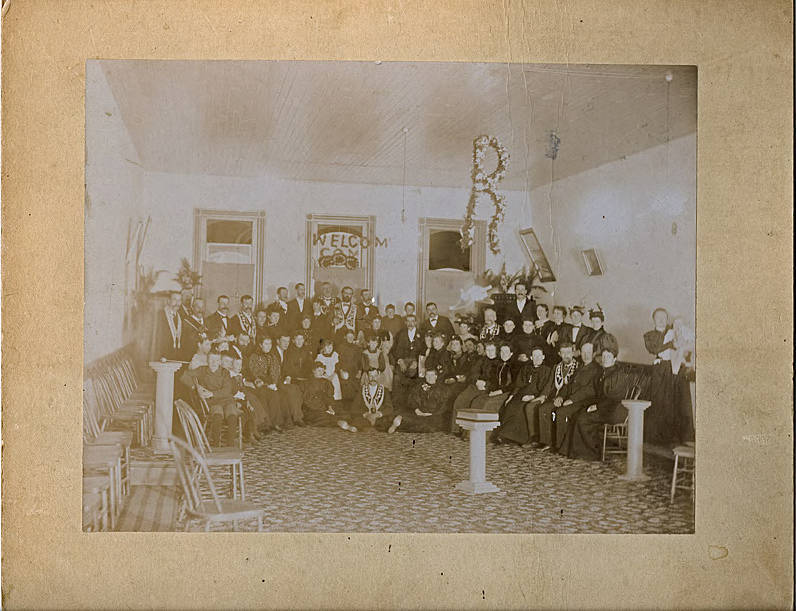
Sepia-toned image of a group of men and women arranged inside a large, carpeted room. Note the large book on the podium in the center of the room. The large 'leg-o'-mutton' sleeves and the small topknots in many of the women's hairstyles are typical of styles worn in the early 1880s. Though it does not identify a specific couple, the 'Mother and Dad' referenced in the transcription are most likely George and Josephine Palmateer, parents of the donor. George was a marine engineer, operating out of Portland for many years.
Sepia-toned image of a man and little girl in a row boat, on a smooth river beneath a covered bridge. The girl has braids and wears a large, floppy hat. She also appears to have on a sailor dress.
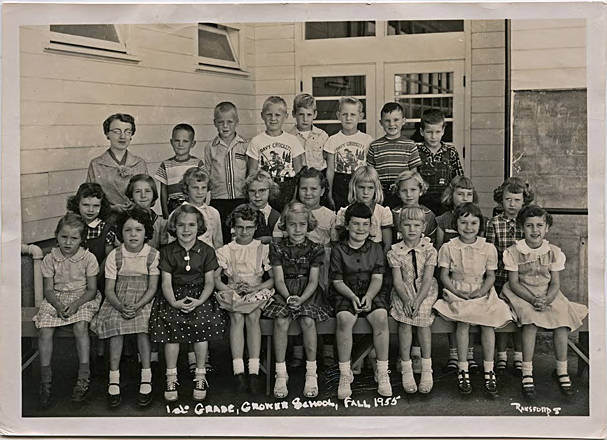
Black and white class portrait of twenty-five first grade students and their teacher. Eighteen of the students are girls, most with short hair and wearing dresses. Seven boys stand in the very back of the group, two wearing Davy Crockett t-shirts. The students are arranged on the porch of a white clapboard building with large windows.
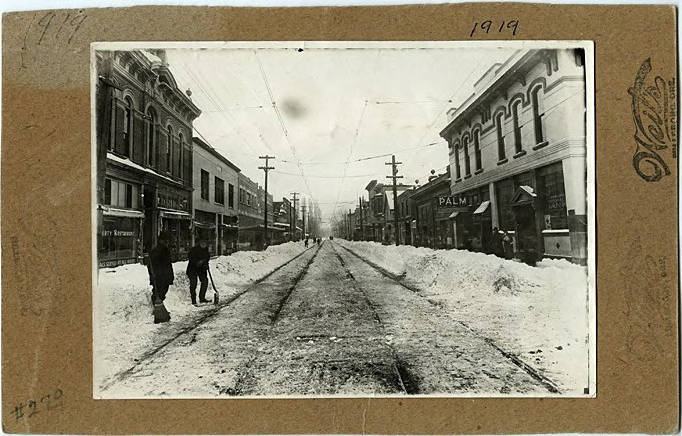
Black and white picture of Main Street with snow. Two men, one with a shovel and one with a broom, stand beside trolley tracks which have just been cleared of snow. A number of other people can be seen down the tracks, apparently also clearing the snow away. Snow appears to be about 3 feet deep where it is piled on either side of the tracks.
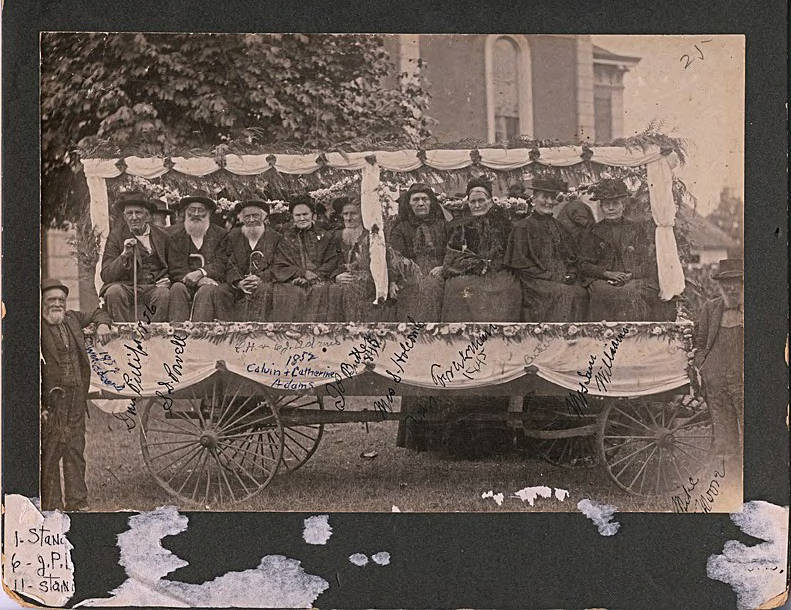
Black and white image of a group of elderly people sitting in the back of a horse-drawn wagon. The wagon is decorated with bunting, drapes, and greenery. The women in the image mostly wear dark dresses with long sleeves and hats or bonnets, and a number wear dark capes. One woman wears a dark prayer veil. the men wear typical suits and hats of the era.
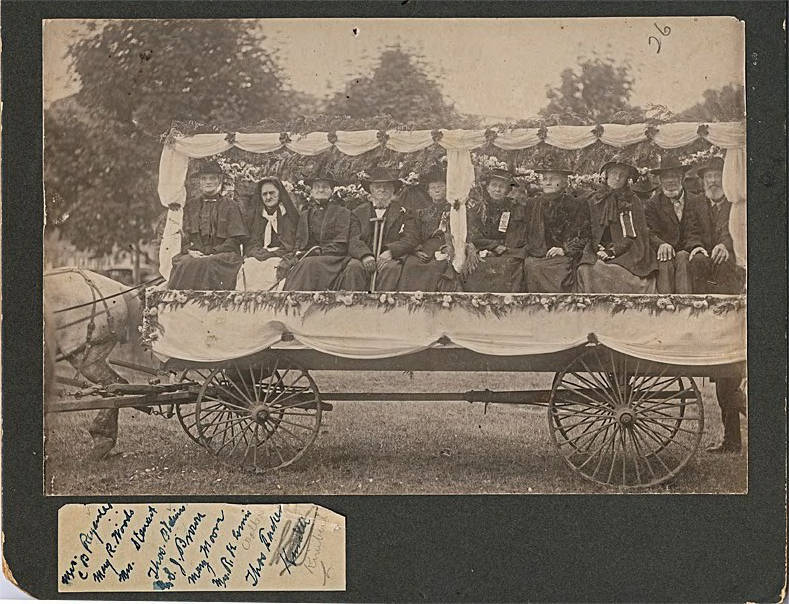
Black and white image of a group of elderly people sitting in the back of a horse-drawn wagon. The wagon is decorated with bunting, drapes, and greenery. The women in the image mostly wear dark dresses with long sleeves and hats or bonnets, and a number wear dark capes. One woman wears a white apron and neck scarf, and her bonnet supports a dark prayer veil. The men wear typical suits and hats of the era. Three of the women have ribbons attached to their capes and dresses.
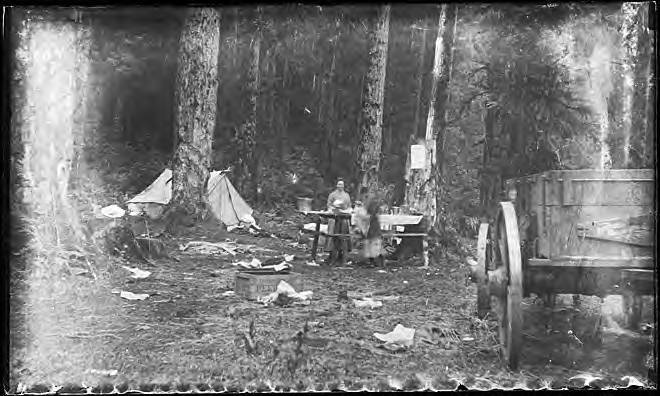
Black and white image of a hunting camp. Two women stand on either side of a table that is attached to a tree at one end for support. A wagon is parked in the foreground, and a canvas tent is behind a tree to the left of the camp. Paper and boxes litter the ground, and a number of large pine trees fill the area, which is backed by thick forest.
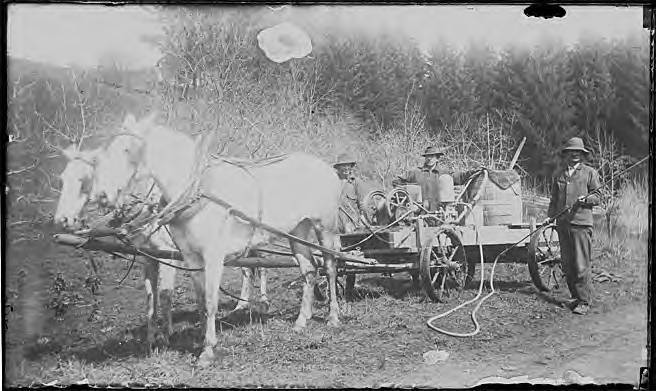
Black and white image of three men with a spraying mechanism set up on the back of a wagon. Gears and an engine are connected to a mixing bottle; a hose extends from that to a spraying arm held by one of the farmers. A large barrel covered with a cloth feeds into the mixer via a pipes and hoses. Two other farmers observe from behind the mechanism, and two horses pull the wagon. In the background is a plowed field and a grove of evergreen trees. Clapshaw Farm, Clapshaw Hill Rd., Hillside area, North of Forest Grove.
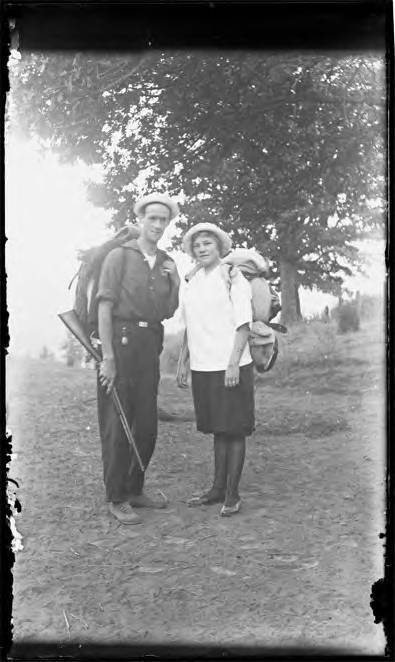
Black and white image of a couple apparently headed out to hunt; both wear backpacks and hats, while the man carries a rifle in one hand. The woman wears an athletic bloomers outfit, consisting of the bloomers, baggy pants fastened at the knee, and a sailor style shirt, with dark stockings. This type of outfit was considered a practical and modest alternative for women involved in activities where the normal attire of full skirts and corsets were impractical. Note, however, that she still wears Mary Jane style shoes, rather than practical boots, like the gentleman in the image.
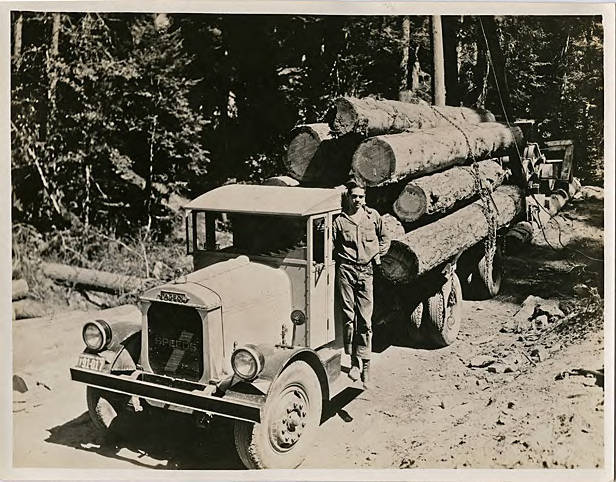
Black and white image of a man standing on the running board of an antique logging truck, loaded with logs. The truck sits on a dirt road, with the engine used to load the logs behind it. The man wears a plain shirt and pants over work boots. There are about eight or nine logs on the back of his truck, held on with chains. The truck has double wheels on the trailer, but not the cab.
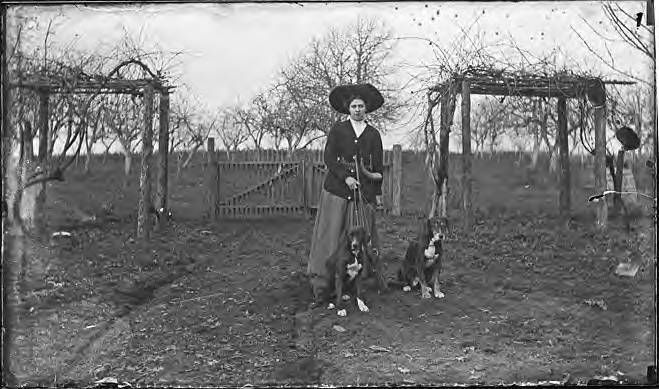
Black and white image of a woman in a skirt, jacket and large floppy hat. She holds a rifle and the leashes for two dogs, and wears a cartridge belt with a knife and a powder horn over one shoulder. Behind her is a largely empty field with a few bare orchard trees.
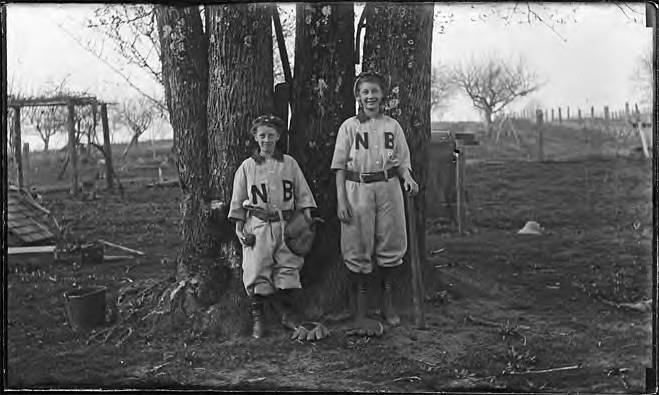
Unusual black and white image of two girls in baseball uniforms. Their uniforms consists of baggy knickers and buttoned shirts with N. B. on the fronts. Each girl wears a cap, and one girl holds a catcher's mitt and ball while the other holds a bat. Two more gloves lie on the ground at their feet. The girls wear button up boots. They stand in front of a tree with several trunks, in a large yard with an empty field in the background.
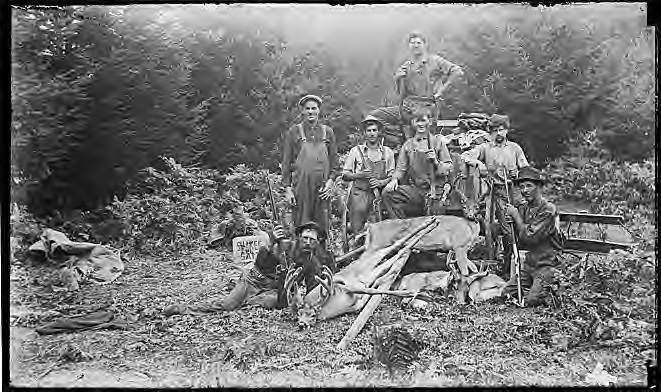
Black and white image of seven men posing with three dead bucks. Two of the men sit on the back of a wagon while a third stands in the wagon. On man leans on the wagon sides, while three others either stand or recline on the ground near the dead deer, which are draped over and about the wagon tongue. All the deer are bucks. The men all have rifles in hand, and a box reading Shaker Salt sits on the ground to the left of the of image. The undergrowth is thick and lush.
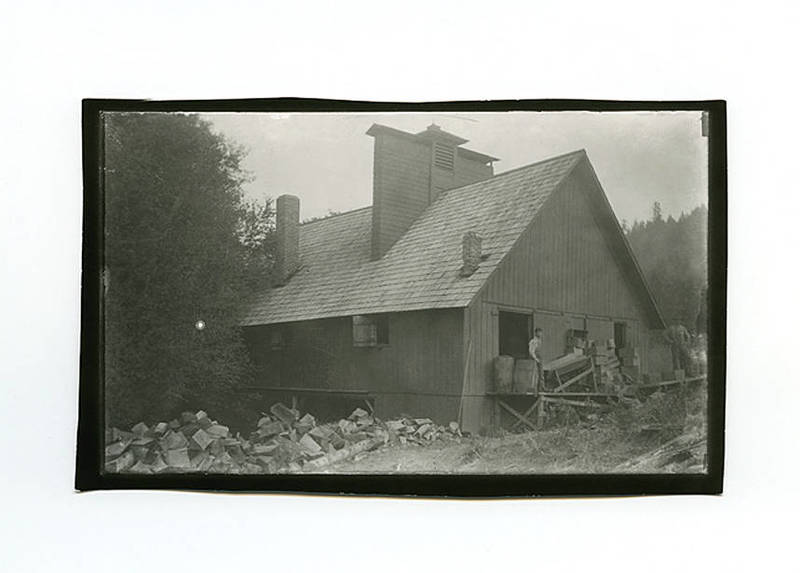
Black and white image of two men outside a barn-like prune dryer. There is a great deal of wood tossed bout on the ground beside the lower level of the building, and several chimneys and a large ventilation shaft. Wooden windows are open underneath the eaves, and a lower floor is just visible. Barrels and crates fill the porch where one of the men stands.
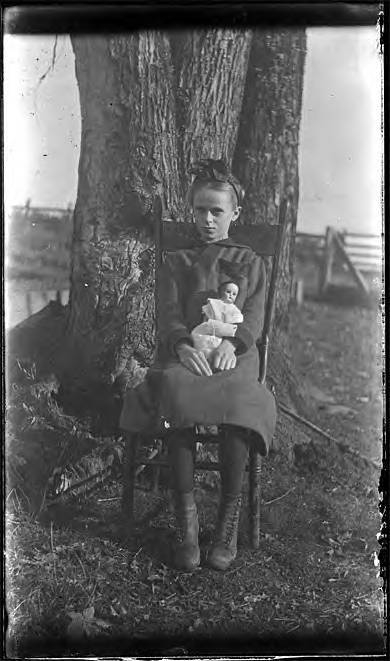
Black and white image of a little girl sitting in a chair in front of a tree with a doll in her lap. She wears a dark coat with an oriental style front that fastens on the side and has a dark decorative band along the edge as well as the cuff. She wears dark stockings and boots, and her hair is pulled back and caught up in a ribbon. The doll appears to be a bisque-faced doll and is wearing a coat with a fleece collar, a muff and a hat.