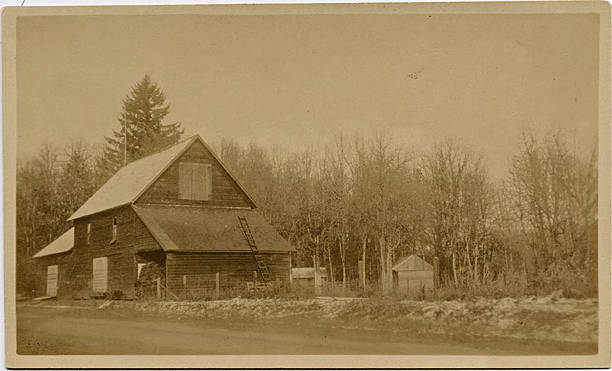
Sepia-toned image a large barn-style building. Advertising decorates both of the large barn doors, and a large pile of wood can be seen stacked next to the outer wall inside a covered porch area.
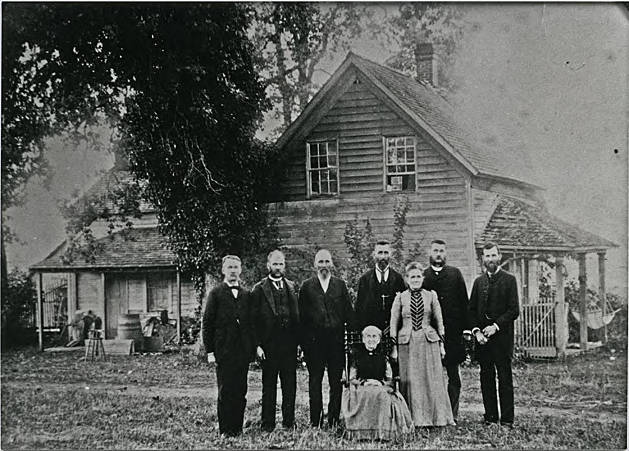
Black and white print of the Walker family standing outside a cross-gabled, two -story home. Note the rain barrel by the eaves of the back porch, and the hammock hanging between posts on the front porch.
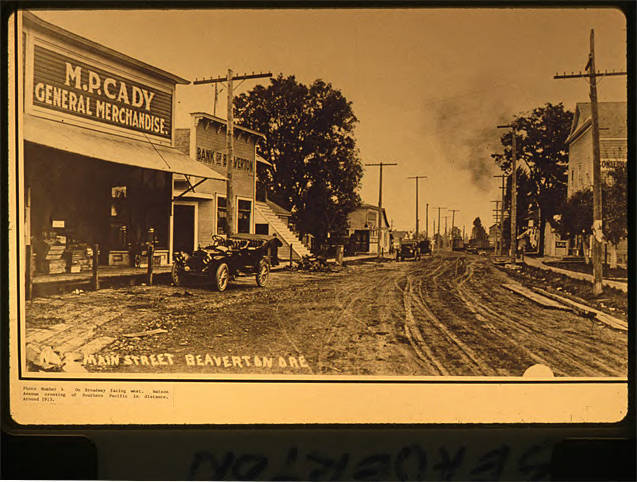
Sepia-toned image of a dirt street in Beaverton. Railroad cars are visible in the distance, and a boardwalk runs along either side of the street. Though hitching posts are still available, only automobiles appear to be using the street.
Sepia-toned image of Gary Shields, an actor, sitting on a horse. Beaverton, Oregon, was home to at least one movie company in the 1920s, Premium Picture Productions also known as J. J. Fleming Productions.
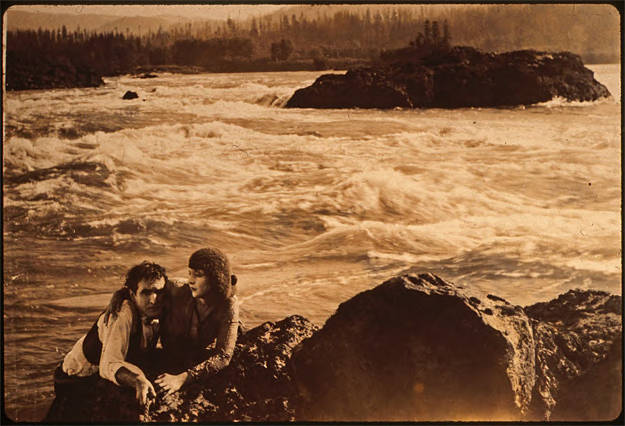
Sepia-toned image of a man and a woman wetly clinging to the rocks beside a rushing river. Bonneville Dam and the resulting Lake Bonneville submerged this location in 1937. Beaverton, Oregon, was home to at least one movie company in the 1920s, Premium Picture Productions also known as J. J. Fleming Productions.
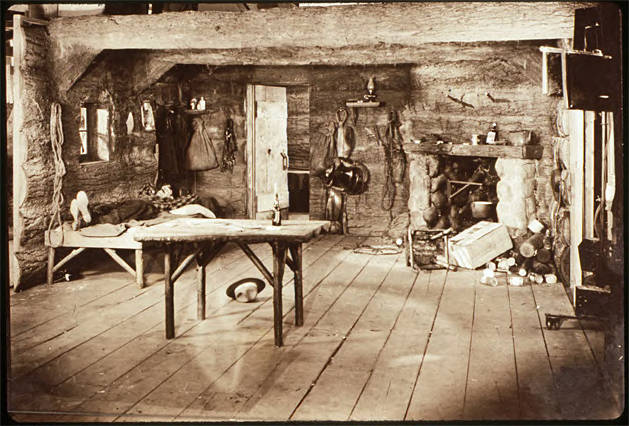
Sepia-toned image of the interior of a movie set. Beaverton, Oregon, was home to at least one movie company in the 1920s, Premium Picture Productions also known as J. J. Fleming Productions.
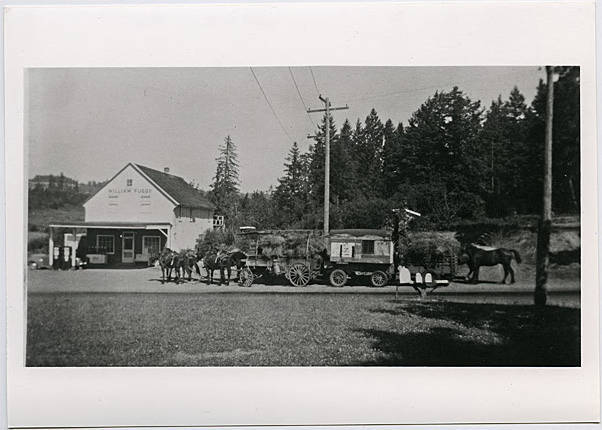
Black and white print of a horse-drawn caravan in front of a local gas station. Four horses draw two wagons, one filled with hay and the other is a covered caravan wagon made of scrap boards and built onto an old car chassis. Behind that is hitched a single-axle trailer that appears to have been made from the back of a truck. This, too, is filled with hay, and two more horses are hitched to that. Note the milk-can on the side of first wagon and the smoke-stack attached to the rear of the covered vardo. A close examination of the structure of the first wagon indicates it could have been a more traditional vardo, with the curved top and covered front seat.
Black and white print of a two-story, gabled building with a covered driveway and two gas pumps at the front. The name 'William Fuegy' is lettered across the building above the second story windows. It sits to the side of a wet and muddy dirt road, and what appears to be a rainbow arches across the sky in front of it. Note the asphalt shingles on the roof.
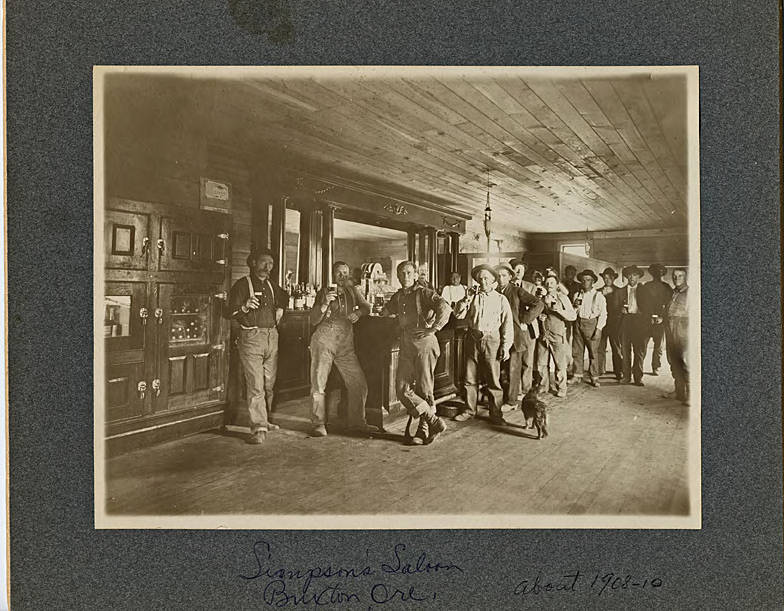
Sepia-toned image mounted on heavy mat of a group of men, all holding a fresh-drawn draft beer, gathered around the bar in a saloon. Note the dog, the spittoons, and the large, three-shelf, double-sided icebox to the side. Most of the men in the image are wearing work clothes.
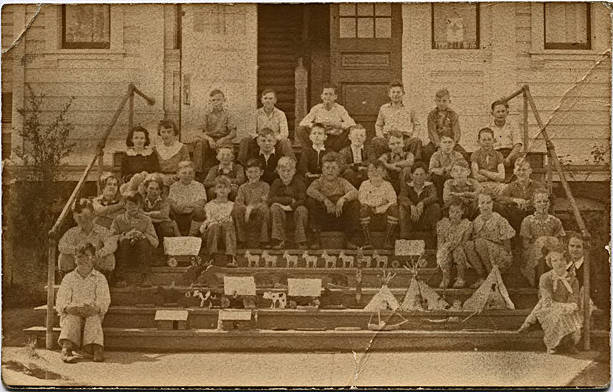
Sepia-tone image of a group of school kids sitting the steps of their school. On the steps between them are a number of toys representing various aspects of the Oregon Trail, including buffalo, teepees, boats, and at least one wagon requiring a number of mules to pull it. They have included a totem pole, even though totem poles were not used by tribes in Oregon or southern Washington. However, popular culture by that time had firmly connected totem poles with the Pacific Northwest in general. Note the boy in the center of the image wearing logging boots.
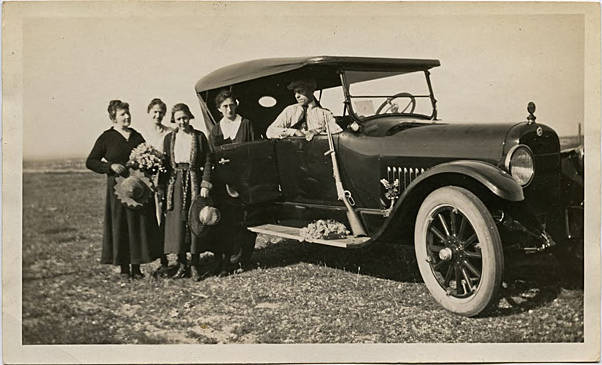
Sepia-toned image of four women standing by a car. A man looks back at them from the front seat, and a rifle leans prominently against the door beside him. Flowers bedeck the running board and dash of the car, and one of the women holds a bouquet. Parked in an open field, the lack of context in the image and documentation of its provenance, there is no way to be certain about the events here, but speculation about a shotgun wedding in the offing is not misplaced.
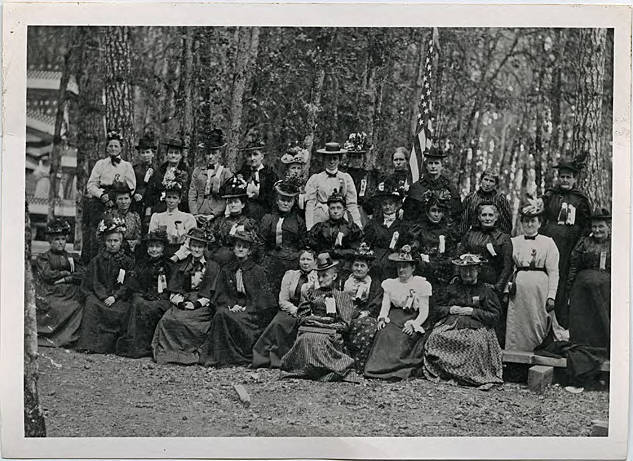
Black and white image of a group of women sitting on bleachers. A continuation of the organizations formed by women to support Union soldiers during the Civil War, the purpose of the G.A.R. Ladies' Auxiliary was to aid veterans and their widows and orphans. Though some early members advocated for it, membership was not limited to wives, widows, and blood kin of Union Veterans, but remained open to all women. Still an active society, today the Auxiliary is focused largely on heritage and descendants of Union soldiers.
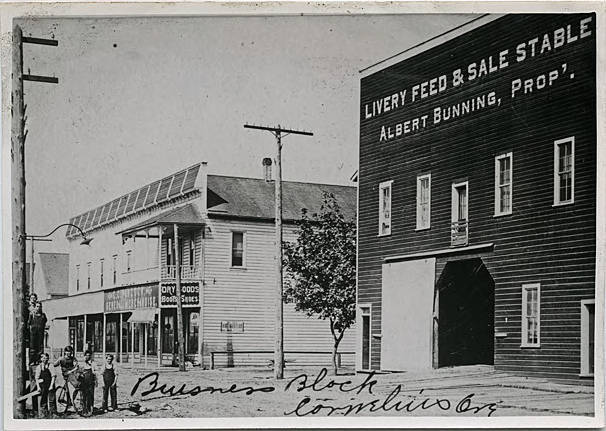
Black and white image of half a dozen boys standing on a dirt street in Cornelius. The boys' hair is combed, and their hats lay on the ground next to them. One boy sits on an a bicycle, and several of the boys appear to be barefoot. An advertisement for 'White River Flour' is on the side of the dry goods store.
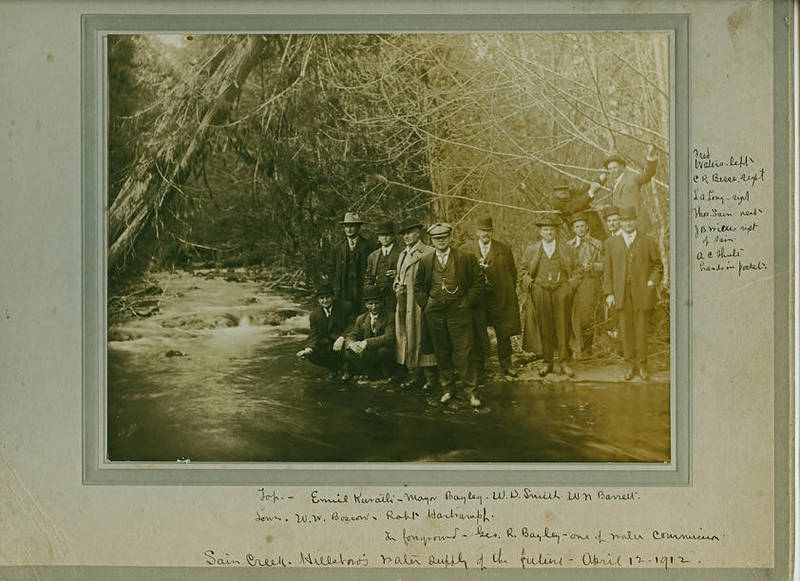
Sepia-toned image mounted on heavy cardstock of a group of men in suits standing beside Sain Creek in the hills behind Cherry Grove. Hillsboro was dealing with an inadequate water supply in the city, and Sain Creek was part of the recommended solution. Eventually, Sain Creek would feed into Henry Hagg Lake, created when the Scoggins Dam was built in 1975.
Black and white image of a large group of mostly men sitting at a dinner table. A number of children and women sit in desks to the sides of the room, and in the rear of the photograph, a woman appears to have just walked into the room with a tray full of cups.
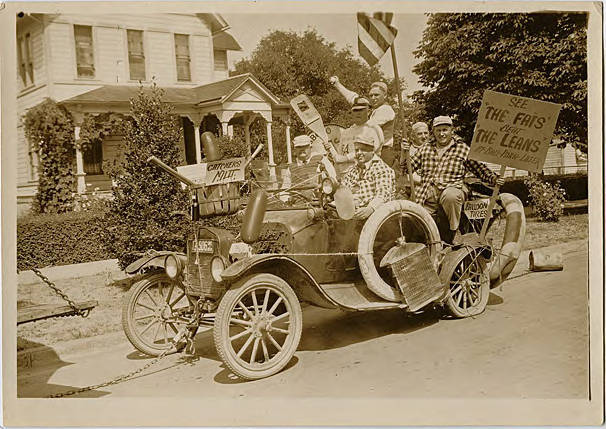
Black and white image of six men in an old car, with one flat back wheel. One man brandishes a cricket bat, while baseball bats and balloons adorn the rest of the car. A spare radiator hangs from a large spare tire by the drivers' door, and the car is being towed by a chain. The license plate on the car states 'Oregon 1924' while a sign at the back says, 'See 'the FATS' beat 'the LEANS' at ball park later.' The car is parked in front of a house, and it appears to be summer, from the lush vegetation. A canister is being dragged behind the car, too.
Sepia-toned image of two women and a man, standing on a beach in front of a wharf. The women wear tops that go down over their hips, shorts, and at least one woman wears tights beneath that. They wear swim caps, as well.
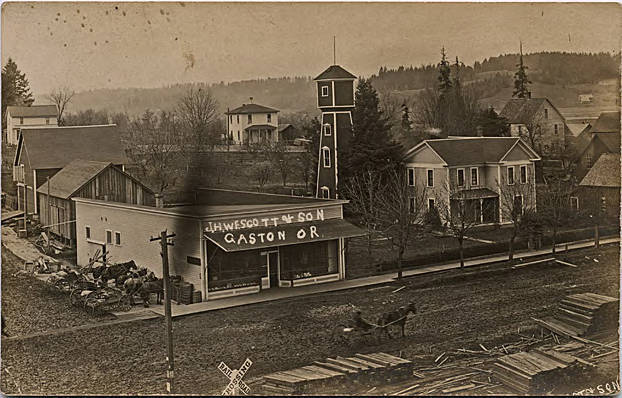
Black and white image of a store in the middle of town. Note the muddy street in front of the store, and the loading area provided for customers where they can park the team on the boardwalk and also have most of their wagon out the mud. Mr. Wescott is listed in the 1900 census of Washington County as a merchant, and two of his sons, Frank (age 17) and Charles (16), are listed as 'clerks.'
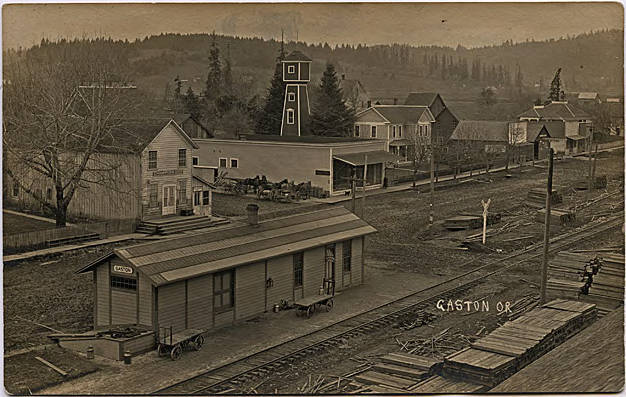
Black and white image of Gaston, Oregon. The train station is central to the page, and power poles line both sides of the street. Notice the four hitched wagons at the store, all of the wagons have bags of the supplies in the back. Two dogs are walking on boardwalk. Two stores advertise farming equipment, one John Deere and the other Champion Harvest Machines, reflecting the rich agricultural heritage of this area.
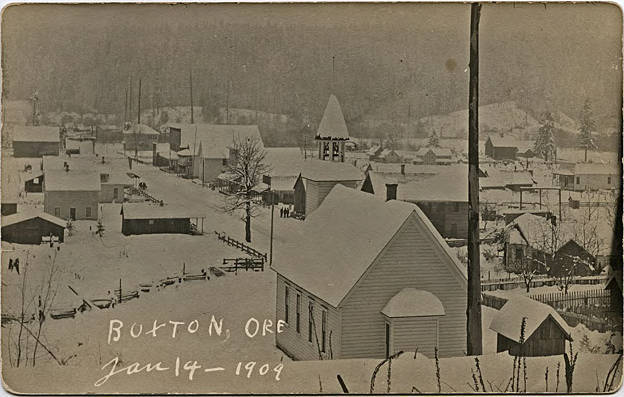
Black and white image of a snow-covered town. Note how deeply the snow is piled on the porch extending from the back of the church, and how it's piled on the zigzag rail fence in the lower left of the image.