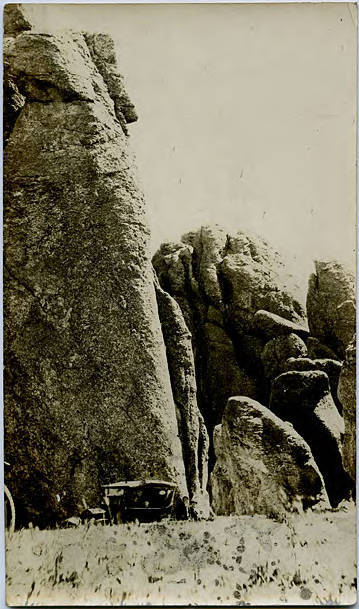
Sepia-toned image of a car and two women standing in front of 'The Needles,' large granite rock formations in South Dakota. The dedication on the back of the photo identifies one of the women as Alice Sewell, a student and sometime art instructor at Pacific University, and an artist who was part of the Portland art scene for much of the first half of the twentieth century.
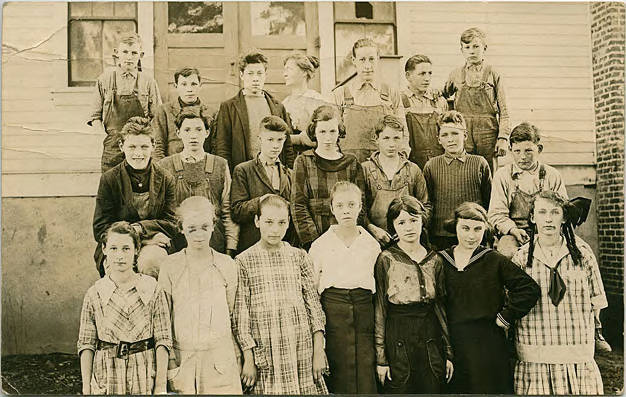
Seventh and eighth grade students from Sherwood, Oregon gathered on the front steps of a school around 1920. Most of the boys wear overalls and all have short hair, while the girls wear a variety of styles of dress, reflecting the more fitted styles of the previous decades. All the children are dressed in more adult fashion rather then the shorter skirts and less-adult styles that became popular in the 1910s for children, girls especially.
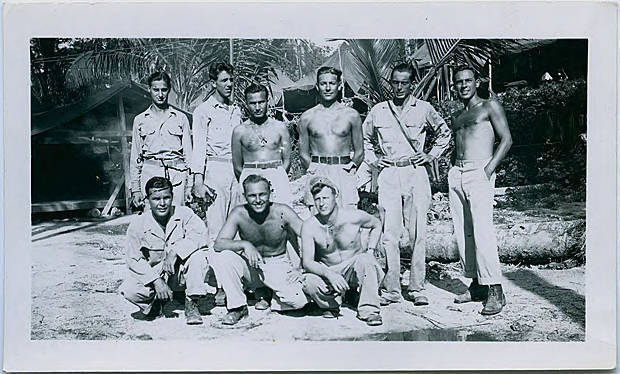
Black and white image of a group of men in New Guinea. the men wear khaki uniforms (some without shirts). Palm trees and open tents are visible in the background. Most of these men were members of the 41st Infantry Division Band, a Division consisting of men almost entirely from the Pacific Northwest. The band members saw service in New Guinea, Luzon, and the Philippines during World War II. Elroy Gravelle, on the image right end of the front row, spent most of his life in the Portland area. As a small child, he lived in Lone Fir, near Timber,, with his family, including his twin brother, Edmund. Both brothers enlisted in the National Guard in the fall of 1940, Elroy listing his civilian occupation as a musician and teacher of music.
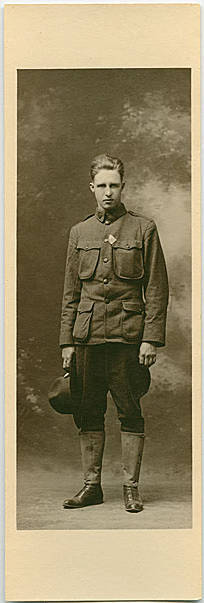
Sepia-toned image of Verne McKinney in his World War I military uniform, including a belted tunic with large patch pockets, jodhpur-style trousers, gaiters or leggings, and a campaign hat. McKinney was born in Hillsboro, and after the war he returned to help his mother run the family newspaper, the Hillsboro Argus, eventually becoming editor.
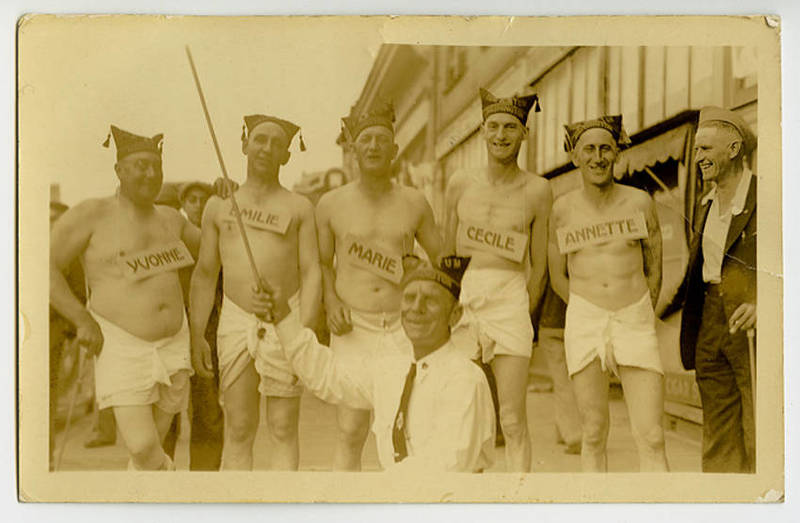
Men in a fraternal organization dressed as Dionne quintuplets who were the first known quintuplets to survive their infancy. The men are wearing only diapers and a hat in a public setting near Tumtum, Washington. The picture is printed on a post card with room for correspondence, address and stamp on the back.
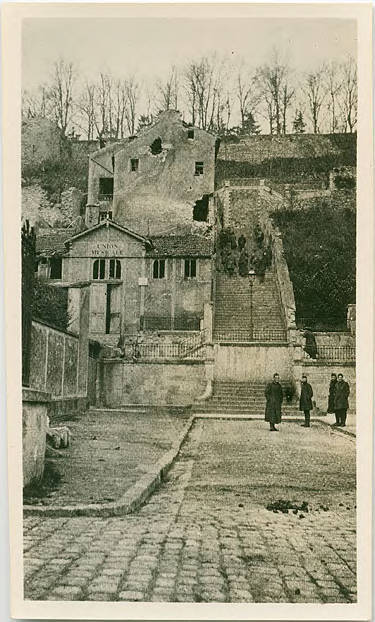
Sepia-toned image of a shelled out building in Chateau Thierry, France. The building is set up against a steep hill, with a wide staircase running up the hill beside it. A wall can be seen at the top of the hill, and a group of soldiers appear to be ascending the stairs. The four soldiers in the foreground are United States soldiers, one of whom is Verne McKinney, from Hillsboro, Oregon. The term 'Yanks' referenced in the transcription on the back is a colloquial term used mostly by British and other Commonwealth nations to refer to residents of the United States. The Battle of Chateau-Thierry was one of the first battles fought by the American Expeditionary Forces (AEF) after joining France and Britain in declaring war against Imperial Germany. There is an American Battle Monument near the town commemorating the cooperative effort between the French and United States armies. McKinney was born and raised in Hillsboro and spent many years as editor of the Hillsboro Argus.
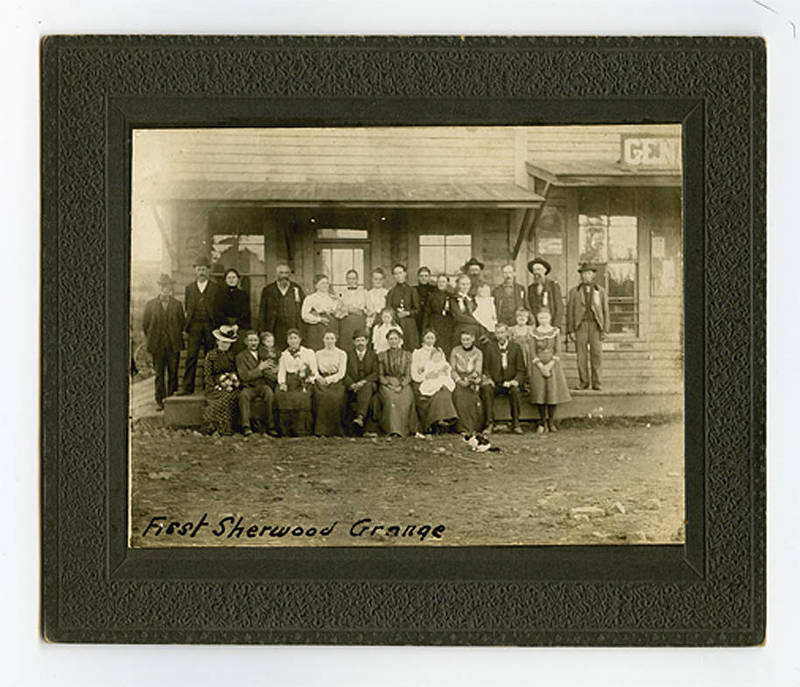
The members of the first Sherwood Grange pose to take a picture during a meeting. The Sherwood Grange was farmers who formed a political alliance in Sherwood, Oregon.
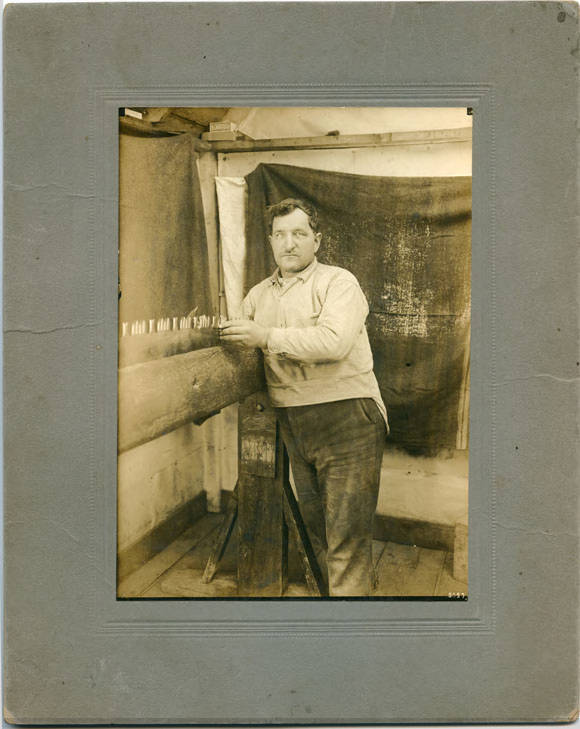
Sepia-toned image of a man with light-colored eyes in work clothes standing next to a crosscut saw which he appears to have been sharpening. The floor he stands on is wood, but the walls behind him are canvas.
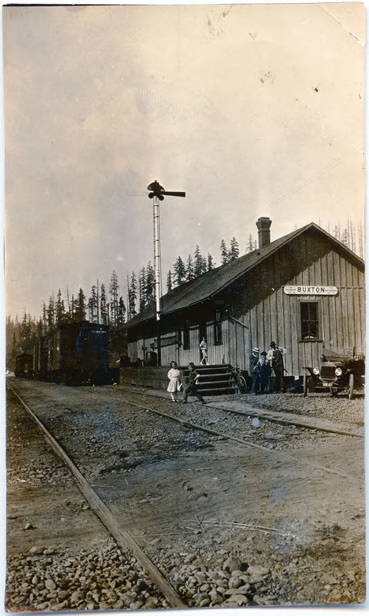
Sepia-toned image of a railroad station. Two children, a boy and a girl, stand on the tracks, while another child is visible in the doorway of the station. Three other people stand at the end of the station, beside a Model-T type car. A sign reading 'Buxton' hangs on the end of the building.
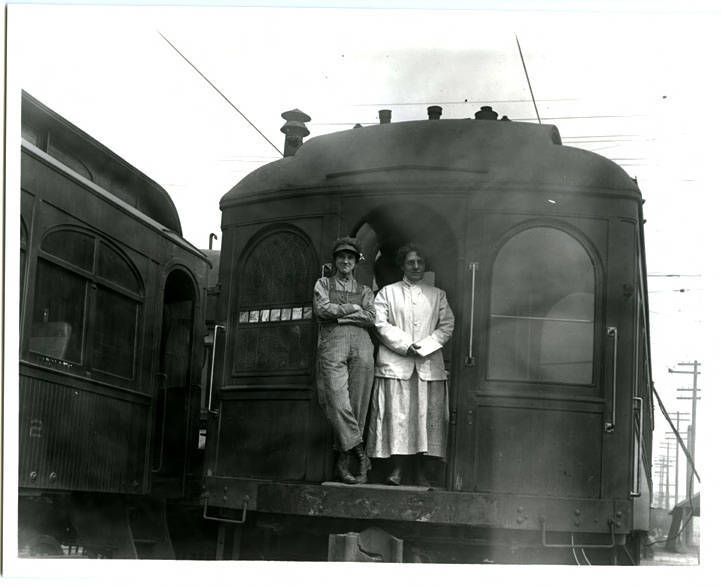
Black and white image of two women standing in the open door of a passenger railroad car. One wears an engineer's uniform with a small white flower in her cap, while the other wears a skirt and white coat more typical of a conductor or other help.
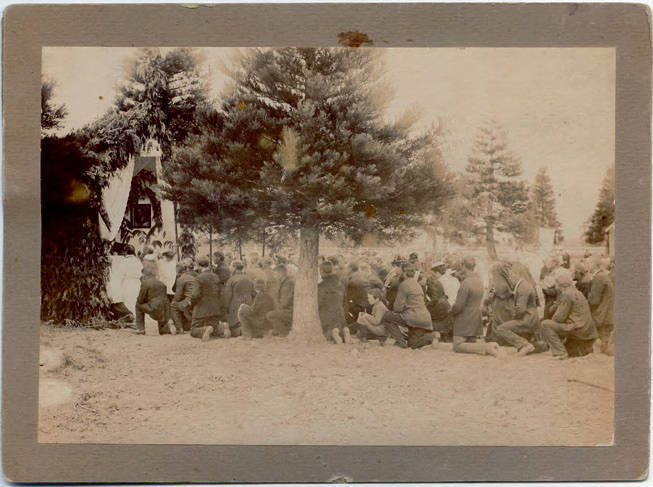
Sepia-toned image of a group of men and women kneeling in a field before a tent containing religious iconography. According to museum records, this is a Corpus Christi parade, a traditional Catholic feast day celebrated in late May or June.
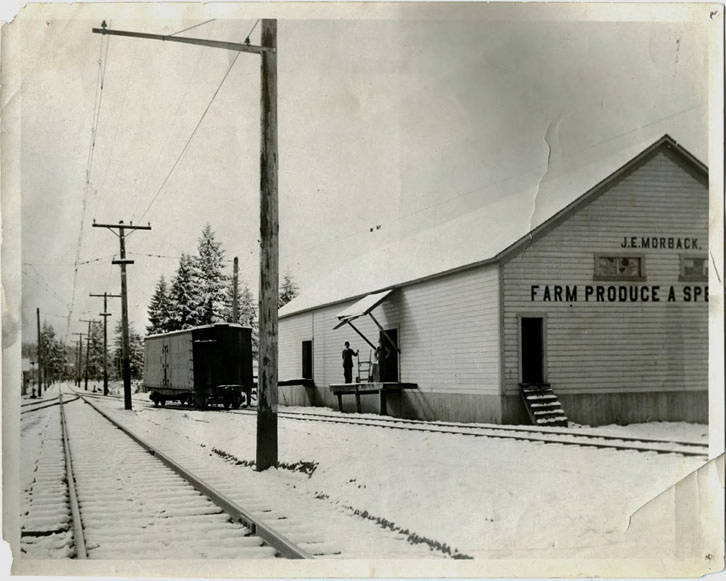
Black and white image of a warehouse next to a rail line, with covering the ground. Lettered on the front of the warehouse is 'J. E. Morback. Farm Produce a Spe[cialty].' Two men stand on the loading dock, and a power line follows the railroad line into the distance.
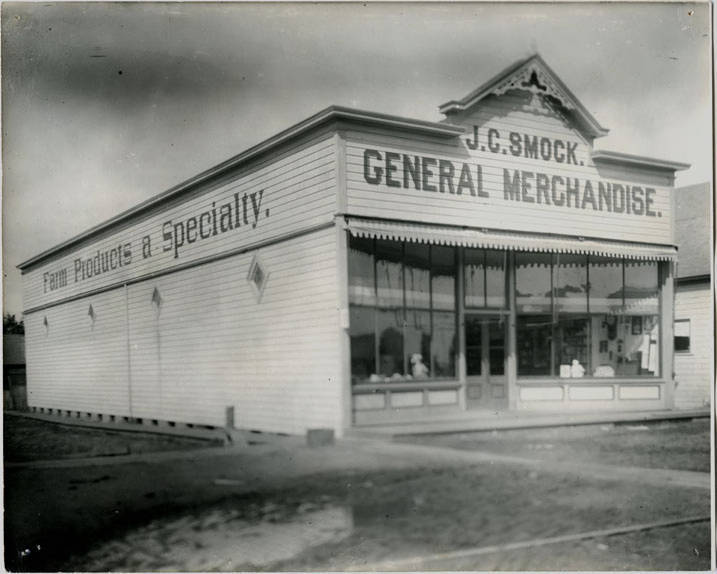
Black and white image of a single-story building with a glass front and gingerbread trim on the front gable. 'J. C. Smock. General Merchandise' is lettered on the front facade, while along the side is written 'Farm Products a Specialty.' A boardwalk and a dirt road front the store. Because his store held the first post office in the area, the community was originally known as 'Smockville,' and later changed to Sherwood. This is the second building he built for his store.
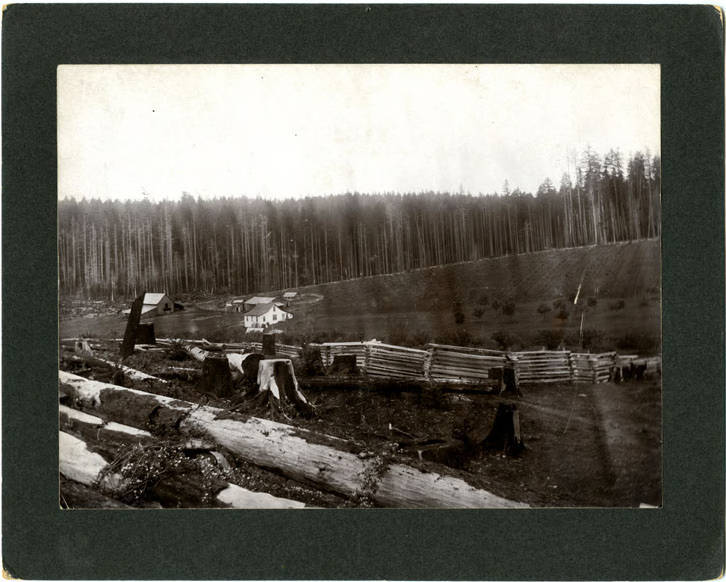
Black and white image of a farm at the base of a hill. Stumps and a zigzag rail fence cross the front of the image, and a plowed and planted field fills the middle of the image. A large, salt-box style house is in the left middle, along with a barn and several other outbuildings.