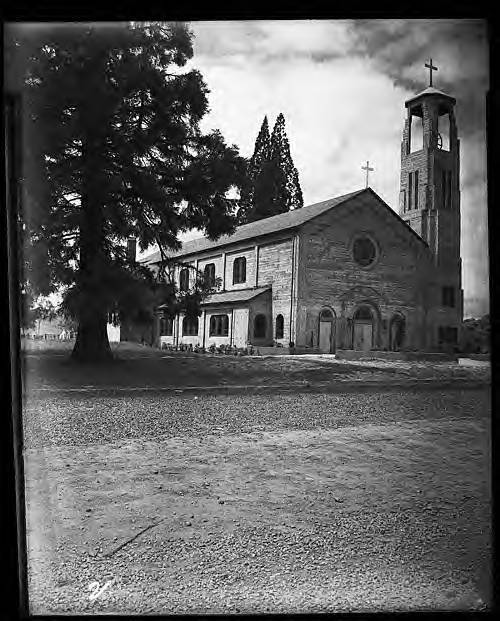
Black and white image of a Romanesque revival church, Visitation Church in Verboort, Oregon. The Verboort community was founded in 1875 when the Verboort family with three other Dutch families settled in the area, calling themselves The Catholic Colony of Forest Grove. Many of the other Catholic churches in the area were founded by groups from this original church. The current building was erected in 1959; the sequoias on either side date from 1888.
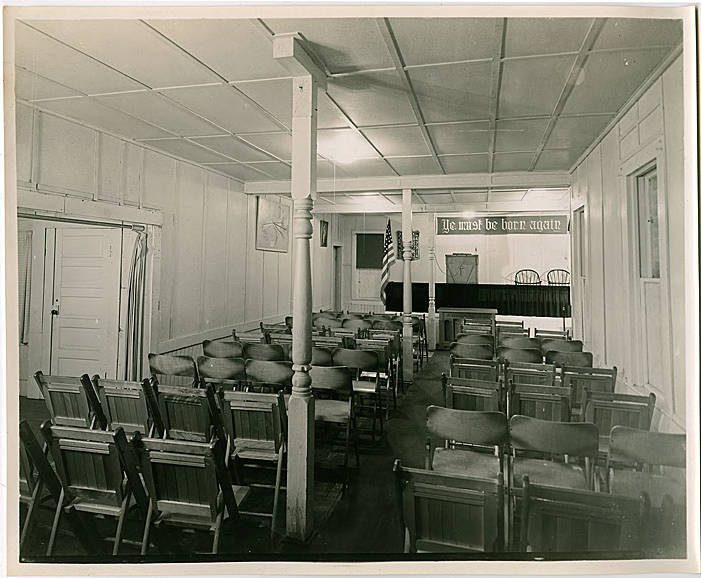
Interior of a small chapel, whitewashed with chairs in rows. The only decorations are a Bible verse and a United States flag on the rear wall behind the pulpit, a missions map and a picture of Jesus on one wall. The attendance board lists 84 members, of which 61 were in attendance last week and 57 this week.
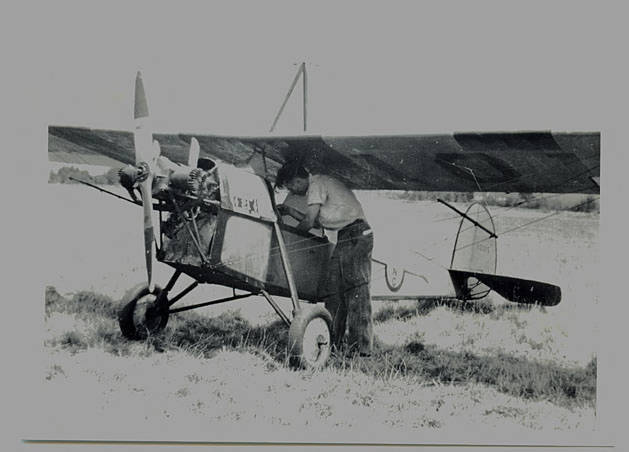
Black and white photograph of a man working beneath the wing of his hand-built aircraft. The airfield is most likely the Bernard Airport in Beaverton, Oregon, once considered the busiest non-commercial airport in the United States and famous for its hand built, amateur aircraft. Built on the site of a failed movie studio, the airport itself was replaced in 1969 by Beaverton Mall.
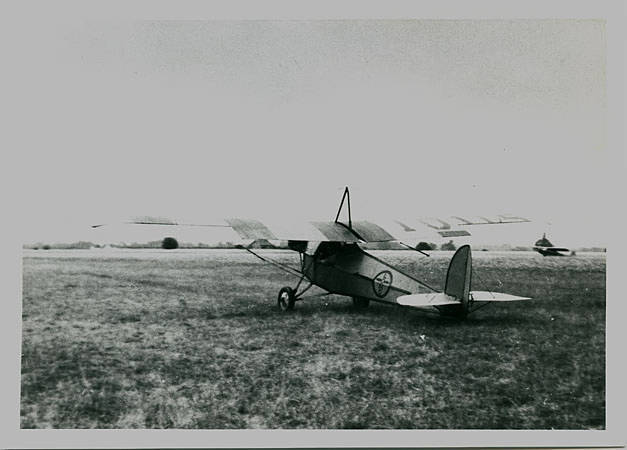
Black and white photograph (overexposed) of a handmade, single-engine airplane built by Les Long. The airfield is most likely the Bernard Airport in Beaverton, Oregon, once considered the busiest non-commercial airport in the United States and famous for its hand built, amateur aircraft. Built on the site of a failed movie studio, the airport itself was replaced in 1969 by Beaverton Mall.
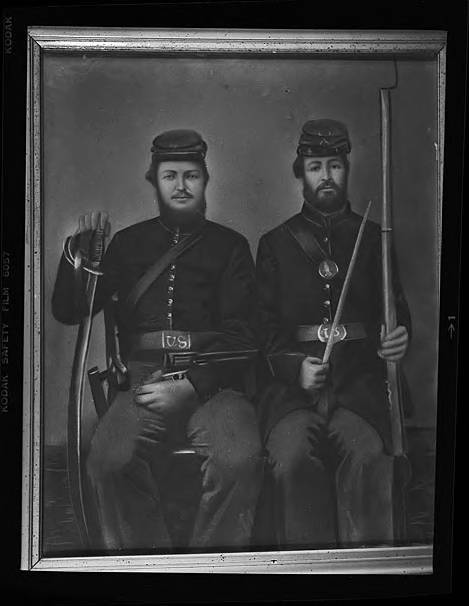
Pencil drawing of two Civil War soldiers, William and Samuel Clapshaw. The Clapshaw brothers settled in Hillside, northwest of Forest Grove after the war. In the 1880 census, both brothers and their father are listed as farmers. All three were born in England.
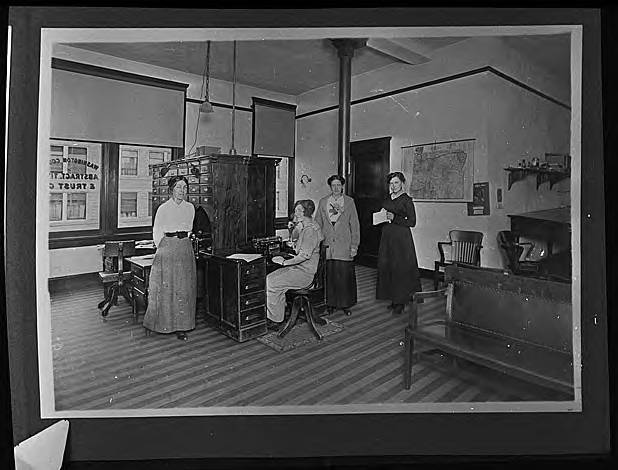
Black and white image of four women in a title office. One woman wears a thick sweater and has two roses attached to her chest. Two others wear stylish, ankle-length dresses, and another has a white shirtwaist. The fourth woman sits before an old typewriter. They appear to be in a second story office, and the legend 'Washington Cou[nty] Abstract. Ti[tle] & Trust C[o.] can be made out in reverse on the window.
Black and white image of a sculpted clay bust of a woman. The artist Alice Sewell was born in 1888 and studied at Pacific University in 1907 and 1908. In 1911, after studying art in New York, she returned to teach art at Pacific for a few years. Ms. Sewell was a sculptor and painter. She later taught at Linfield College and remained an integral part of the Portland area art scene for much of the first half of the twentieth century.
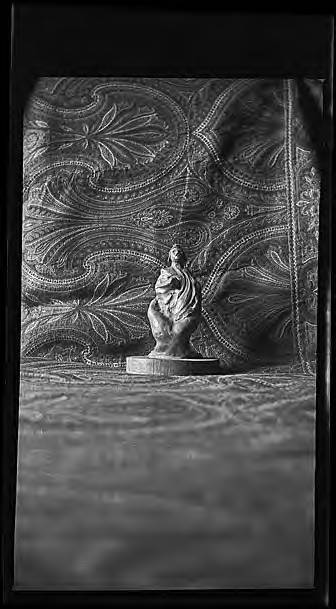
Black and white image of a hand with a figure rising out of it. The artist Alice Sewell was born in 1888 and studied at Pacific University in 1907 and 1908. In 1911, after studying art in New York, she returned to teach art at Pacific for a few years. Ms. Sewell was a sculptor and painter. She later taught at Linfield College and remained an integral part of the Portland area art scene for much of the first half of the twentieth century.
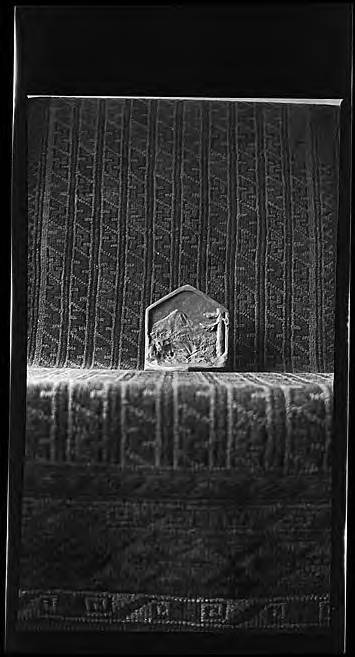
Black and white image of Mt. Hood with a pine tree in the foreground, with an elaborate, hand-woven rug as a backdrop. The artist Alice Sewell was born in 1888 and studied at Pacific University in 1907 and 1908. In 1911, after studying art in New York, she returned to teach art at Pacific for a few years. Ms. Sewell was a sculptor and painter. She later taught at Linfield College and remained an integral part of the Portland area art scene for much of the first half of the twentieth century.
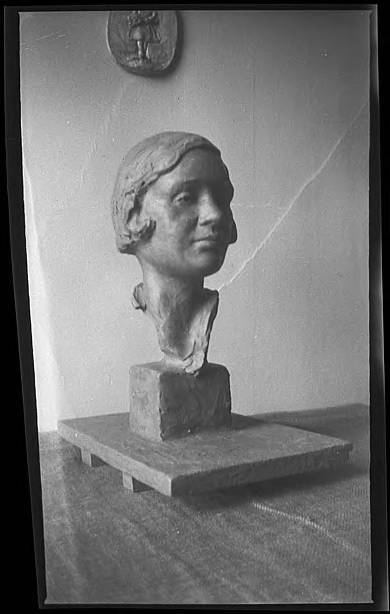
Black and white image of a sculpted clay bust of a woman with a twenties-era hair style. The artist Alice Sewell was born in 1888 and studied at Pacific University in 1907 and 1908. In 1911, after studying art in New York, she returned to teach art at Pacific for a few years. Ms. Sewell was a sculptor and painter. She later taught at Linfield College and remained an integral part of the Portland area art scene for much of the first half of the twentieth century.
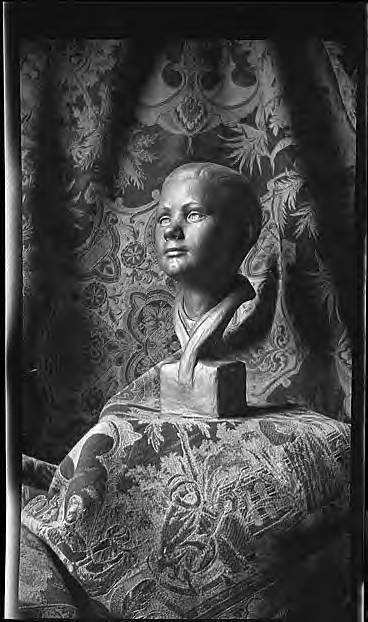
Black and white image of a sculpted clay bust of a young boy, posed with an elaborate carpet in the background. The artist Alice Sewell was born in 1888 and studied at Pacific University in 1907 and 1908. In 1911, after studying art in New York, she returned to teach art at Pacific for a few years. Ms. Sewell was a sculptor and painter. She later taught at Linfield College and remained an integral part of the Portland area art scene for much of the first half of the twentieth century.
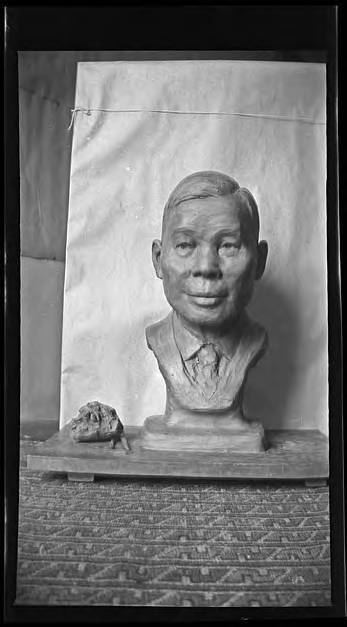
Black and white image of a sculpted clay bust of an Asian man. The artist Alice Sewell was born in 1888 and studied at Pacific University in 1907 and 1908. In 1911, after studying art in New York, she returned to teach art at Pacific for a few years. Ms. Sewell was a sculptor and painter. She later taught at Linfield College and remained an integral part of the Portland area art scene for much of the first half of the twentieth century. (See also WCMpic_012180 and WCMpic_012176.)
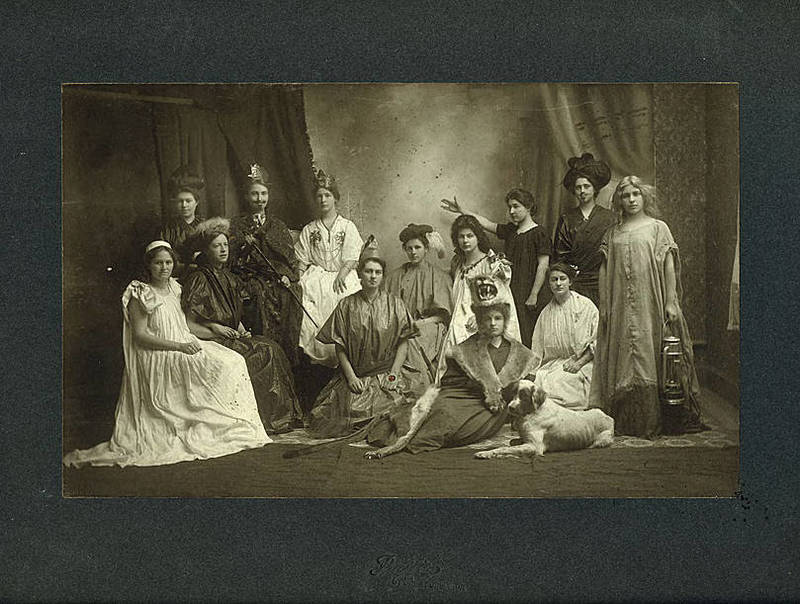
Black and white portrait of an all female drama production. Note the very real lion skin complete with head, teeth, and claws that the young woman in the front row wears. Pacific studio, the imprint on the front mat, was operated in Forest Grove by two sisters, Nettie and Emma Hoffman, from 1898 until 1906.
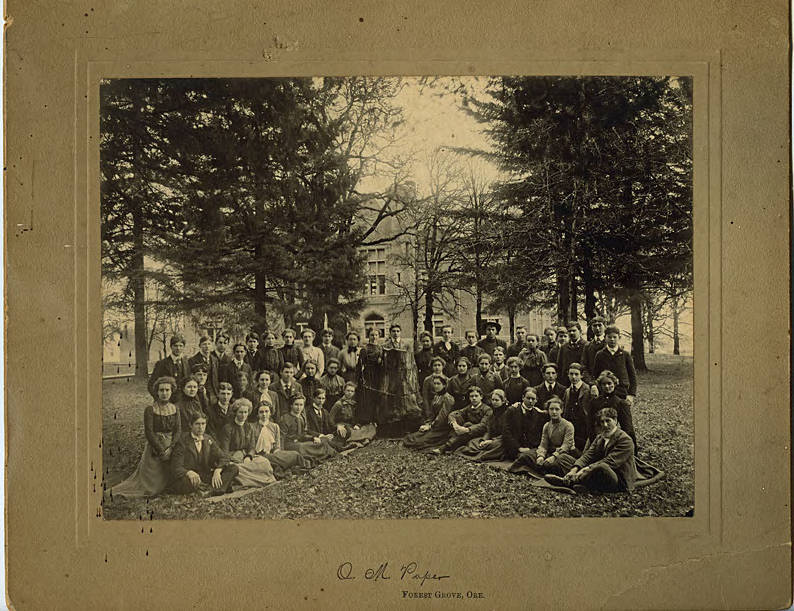
Sepia-toned image of a group of students on the grounds of Pacific University, grouped around a large stump. The petrified wood stump was put in place by the class of 1897 and marked the location of the first building at Pacific University, a log cabin. Most likely this photograph was taken of the class of 1897 at the stump's dedication ceremony. Pacific University was founded in 1849 as Tualatin Academy and is one of the oldest educational institutions in the western United States. The stump is still in place on the University campus in Forest Grove.
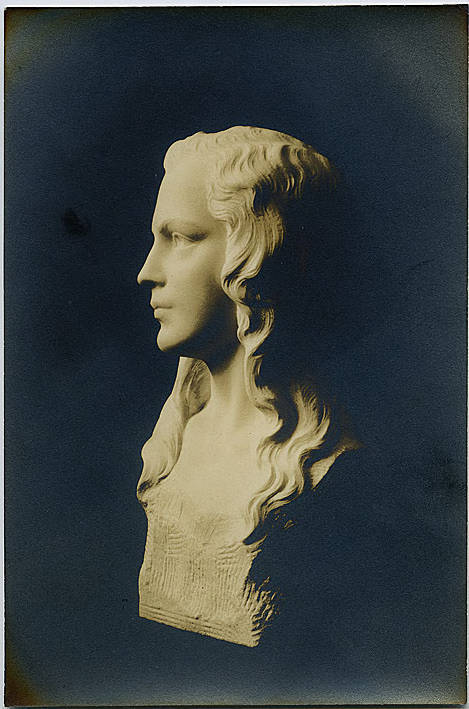
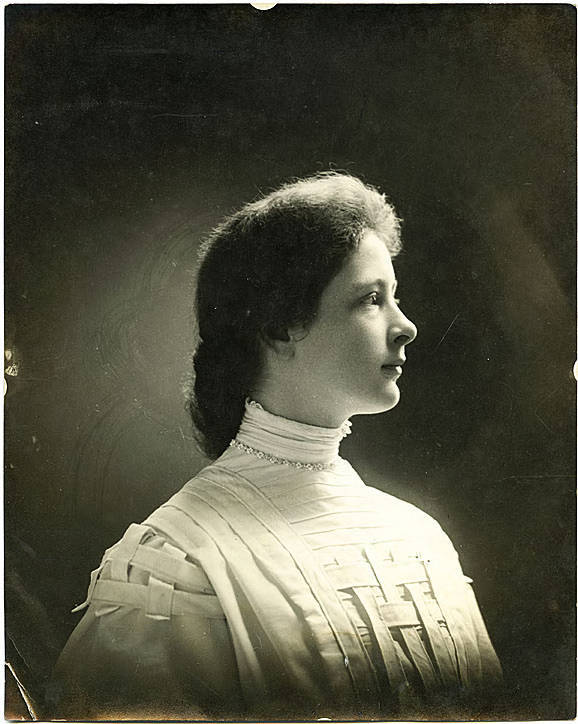
Black and white portrait of a young woman in profile. Her top has an elaborate lattice-work motif on the front and upper sleeves. Alice Sewell was born in 1888 and studied at Pacific University in 1907 and 1908. In 1911, after studying art in New York, she returned to teach art at Pacific for a few years. Ms. Sewell was a sculptor and painter. She later taught at Linfield College and remained an integral part of the Portland area art scene for much of the first half of the twentieth century.
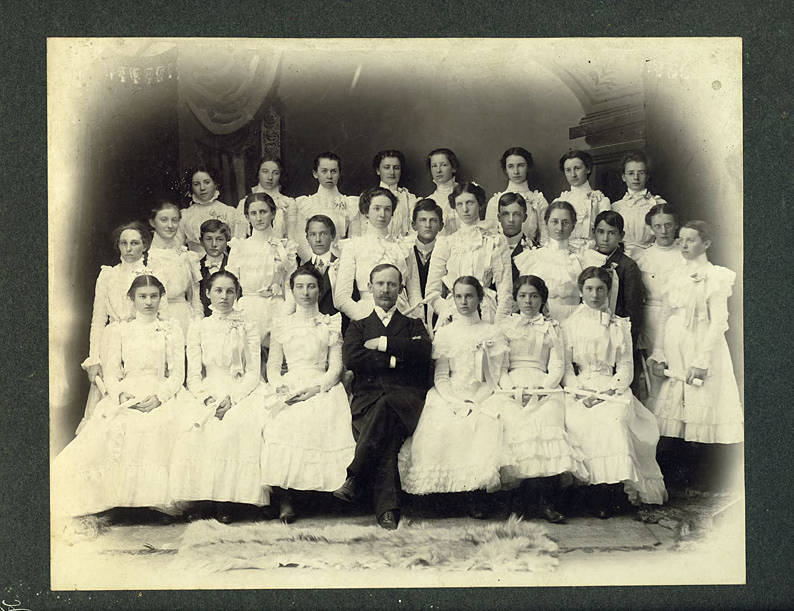
Black and white portrait of a group of young men and women, all holding rolled certificates in their hands. The girls wear white dresses of varying styles and the boys wear suits with white ties. An older man sits in the middle of the front row.
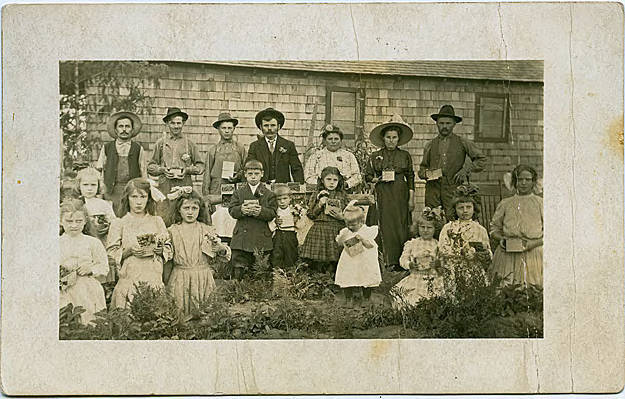
Sepia-toned image of a group of adults and children gathered around a table covered with quarts of strawberries, with almost everyone in the family holding strawberries. John Holmason and his wife, Rosa, are the couple in the center of the picture. Since the clothing worn in this picture is the same as that worn in WCMpic_12008 and WMCpic_012009, it is very likely that this picture was taken at the same time and also at the Holmasons' new, stick-built home. It is not known whether Holmason also acquired the fields which produced the strawberries with the house or the picture was taken because it was working at Oregon Nursery Company which enabled Holmason to afford this home for his family. The Holmason family immigrated from Hungary in 1905 with their two oldest children, part of a large work force recruited by the Oregon Nursery Company. In addition to Magyar (Hungarian) listed as the Holmasons' native tongue, the same page in the census lists neighbors who spoke Japanese, Romanian, and Canadian French. (See WCMpic_012008 and WCMpic_012009 for other images of this family.)
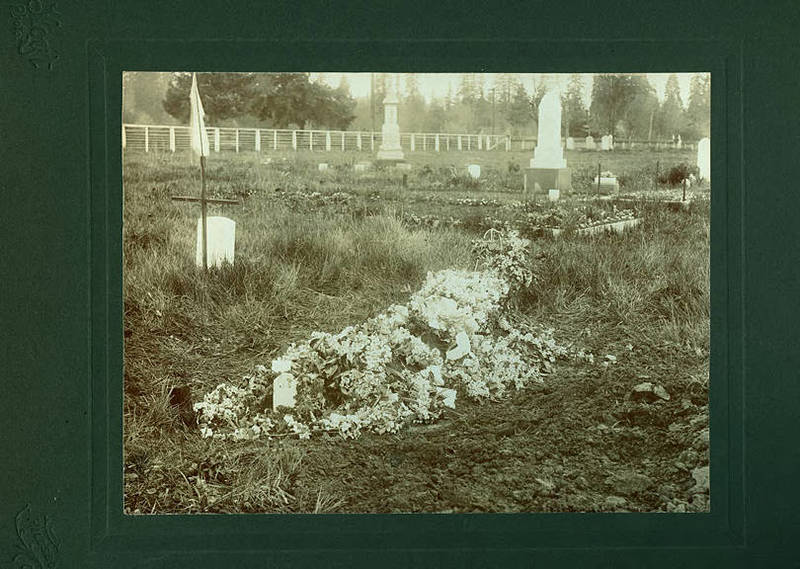
Sepia-toned image of a grave mound covered with flowers. While this grave is waiting for a headstone to be installed and others have stone tablets or elaborate monuments, a number of the graves have simple crosses, appearing to be made out of iron, as markers. According to his obituary in the local paper, William McKinney was only twenty-seven when he died of what was then called consumption, or tuberculosis. His widow, Emma McKinney, was part owner and editor of the Hillsboro Argus for many years.
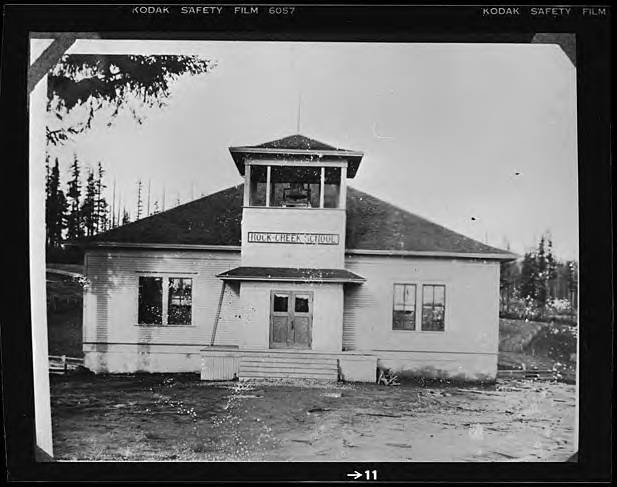
Sepia-toned image of a group of school students gathered on the front steps of the Sherwood school. While there appear to be slightly more boys than girls in the younger students, almost all of the older students are female. Four of the boys in the front row are barefoot. Sherwood School District was organized in 1892.
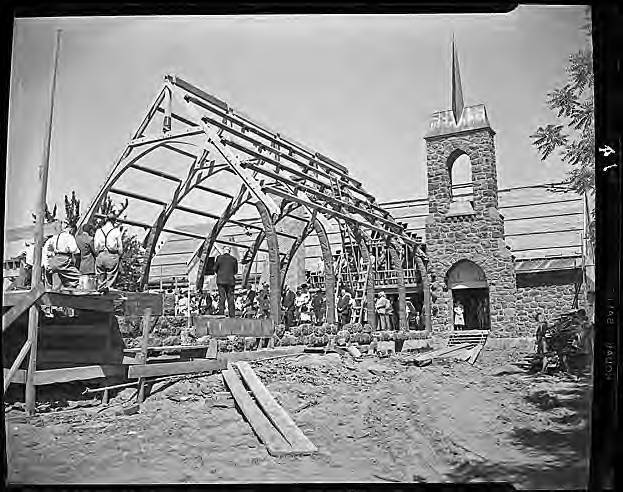
Black and white image of the framework for a small Gothic revival style sanctuary. Trinity Lutheran was built largely with donated labor from the congregation from 1947 to 1948. The building opened for dedication on May 9, 1949, likely when this photo was taken. The congregation remained here until the late 1990s, when they relocated to a larger facility elsewhere in Hillsboro. A donation enabled the city to purchase the property and renovate it for its current use, the Glen and Viola Walters Cultural Arts Center. (See also WCMpic_012430, WCMpic_012424, and WCMpic_012427 for other pictures of this building in the same time period.)
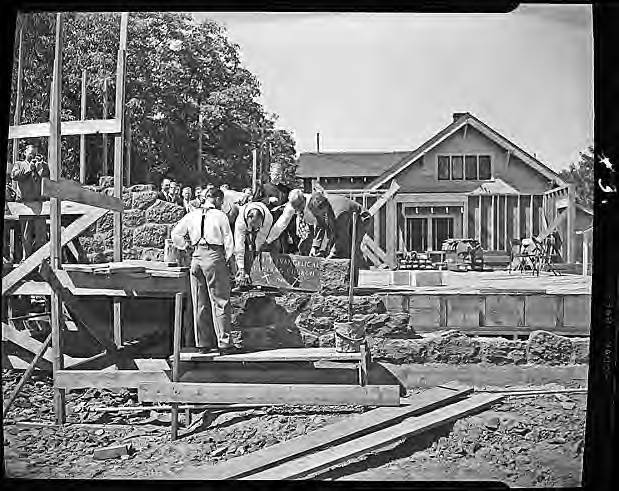
Black and white image of a number of men installing a church sign. The rocks were hand-quarried by the congregation from the quarry in Camas, Washington, where they used dynamite to loosen the rocks and then hauled them in personal vehicles to the building site. (See also WCMpic_012431, WCMpic_012424, and WCMpic_012427 for other pictures of this building in the same time period.)
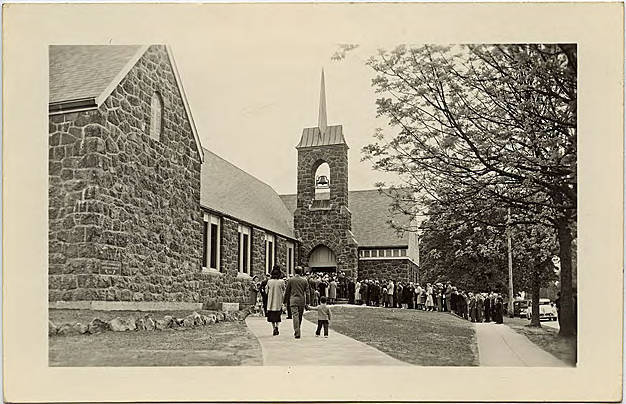
Black and white image of a congregation gathered outside of a church. Trinity Lutheran was built largely with donated labor from the congregation from 1947 to 1948. The building opened for dedication on May 9, 1949, likely when this photo was taken. The congregation remained here until the late 1990s, when they relocated to a larger facility elsewhere in Hillsboro. A donation enabled the city to purchase the property and renovate it for its current use, the Glen and Viola Walters Cultural Arts Center. (See also WCMpic_012431, WCMpic_012430,and WCMpic_012427 for other pictures of this building in the same time period.)
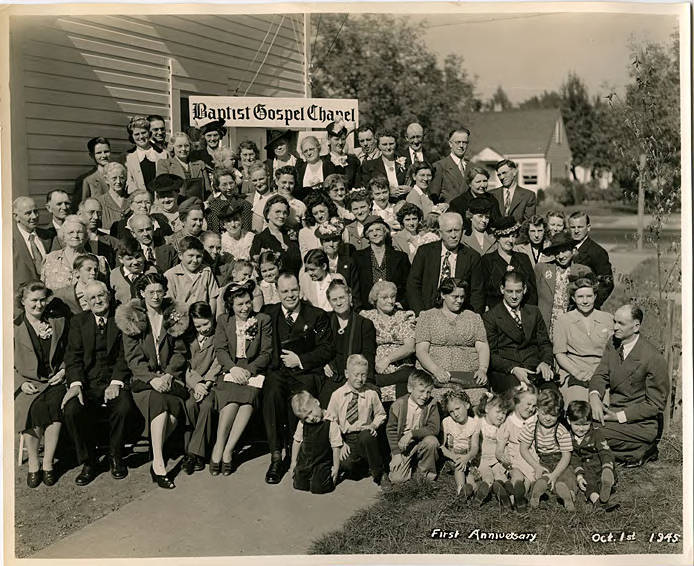
Black and white photograph of a group of people on the sidewalk in front of a building. The sign behind the group reads 'Baptist Gospel Chapel.' The church was founded in 1944 by Rev. W. T. Mugford, formerly pastor of Hillsboro First Baptist Church and about thirty members of the congregation who left with him.