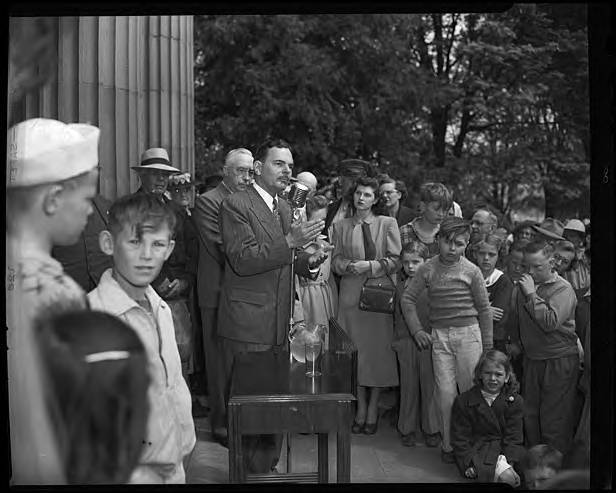
Black and white image of Thomas E. Dewey, campaigning for the Republican nomination for President in Hillsboro in 1948. Dewey speaks from the front entrance of the Washington County Courthouse. Eventually winning the Republican nomination against a field of 5 other candidates and highly favored to win, Dewey lost in the general election that fall, leading to the famous picture of President Harry Truman holding up the newspaper with the headline 'Dewey Defeats Truman' on the morning after the election.
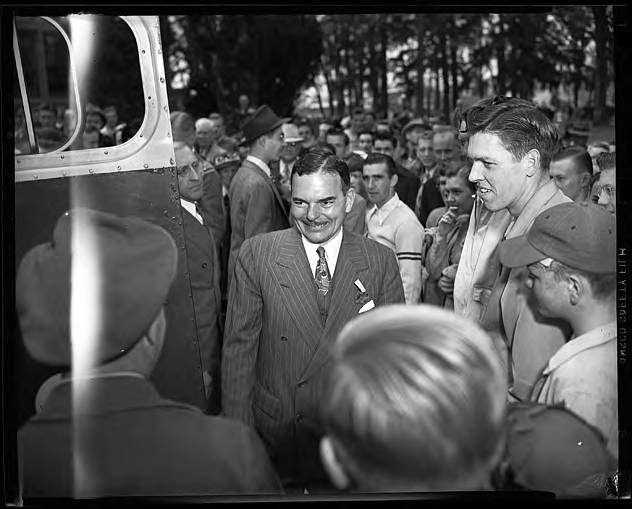
Black and white image of Thomas E. Dewey, campaigning for the Republican nomination for President at Pacific University in 1948. Dewey defeated, among others, Harold Stassens for the nomination that year, only to lose to Truman in the general election in November. Though perhaps most familiar to most as the loser of the 1948 election to Truman, Dewey came to prominence in his home state of New York in the mid 1930s, where as Special Prosecutor he mounted an ambitious campaign to bring down mob bosses and corrupt politicians.
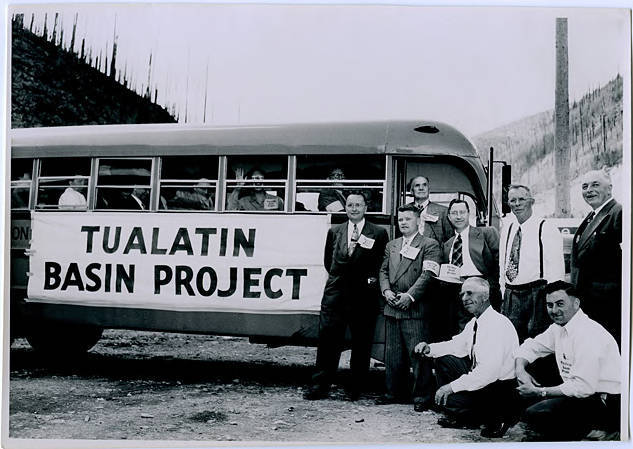
Black and white image of a bus with a sign reading 'Tualatin Basin Project'. A number of men in suits squat or stand before the bus, while others wave from inside the vehicle. Burned out hillsides with standing tree trunks provide a backdrop for the image. The Tualatin Basin Project was an effort by local businessmen and farmers to control seasonal flooding, increase arable acreage with more water for irrigation, and advance the area economically by providing a stable water source for increased population in the valley. While the idea for the project began in the 1930s, it was not until the 1950s that funds were allocated from Congress and the planning began in earnest, as evidenced by this group, most likely touring the headwaters of the Tualatin river drainage in the Coast Range.
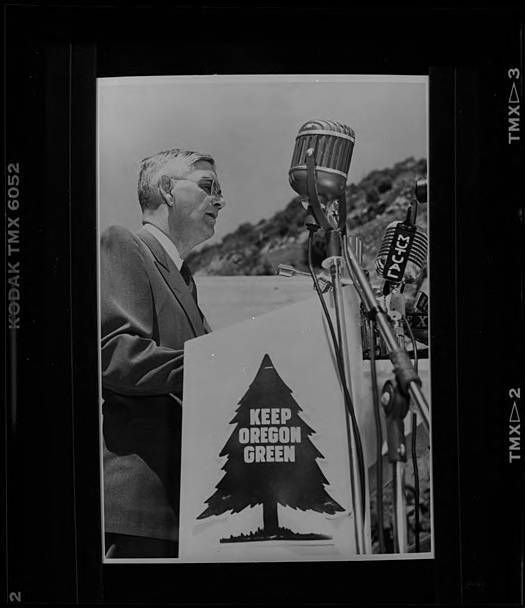
Black and white image of Paul Patterson, giving a speech, standing at a podium with a 'Keep Oregon Green' sign. The 'Keep Oregon Green' program was begun in 1940, part of an effort by Oregon's State Forester and others to combat forest fire danger in the state and remains an integral part of the State Forestry office's outreach to the public regarding wildfire prevention.
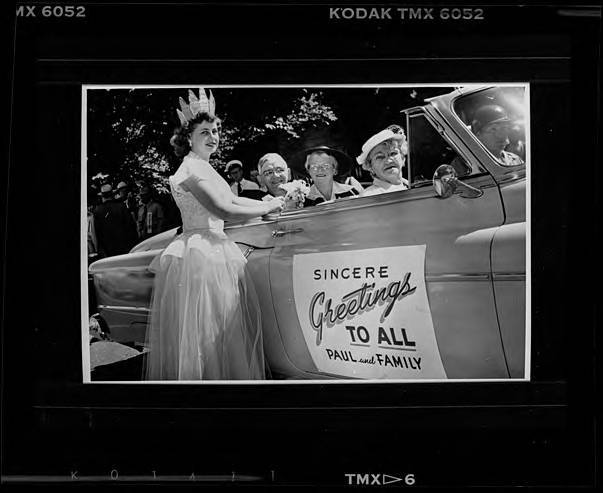
Black and white image of Oregon Governor Paul Patterson riding in a parade. The sign on the car door reads Sincere Greetings to all, Paul and family. Georgia Patterson, the governor's wife, sits next to him in the back seat, and a young woman in a ball gown and crown stands beside the car. Patterson was appointed to serve out the term of his predecessor, Douglas McKay, in 1952, then ran and was elected in his own right in 1954. He died suddenly in 1956.
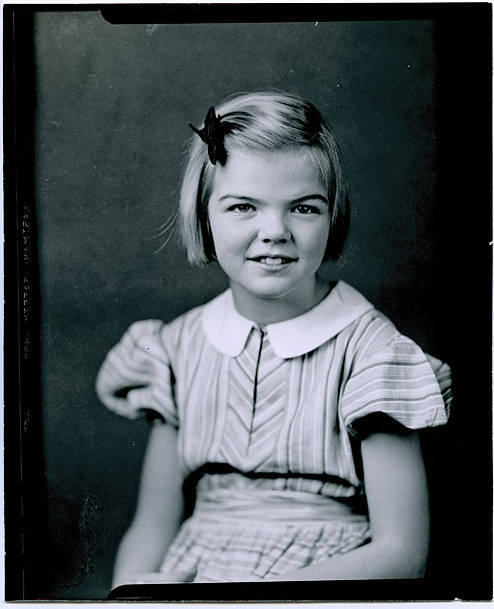
Black and white image of a young girl in a dress. Virginia Patterson was one of the three children of Governor Paul Patterson. The governor died in office on January 31, 1956, just as he announced his candidacy for the U.S. Senate.
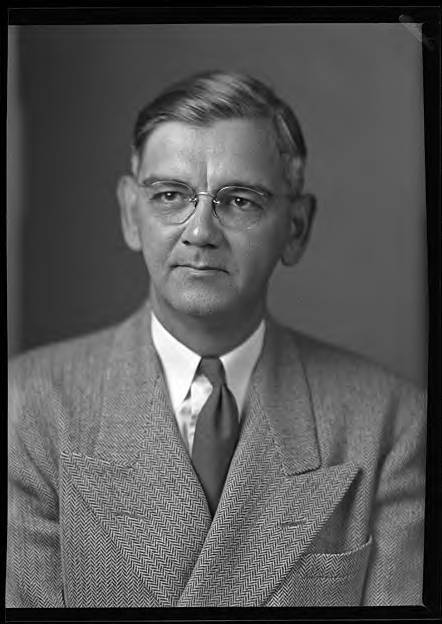
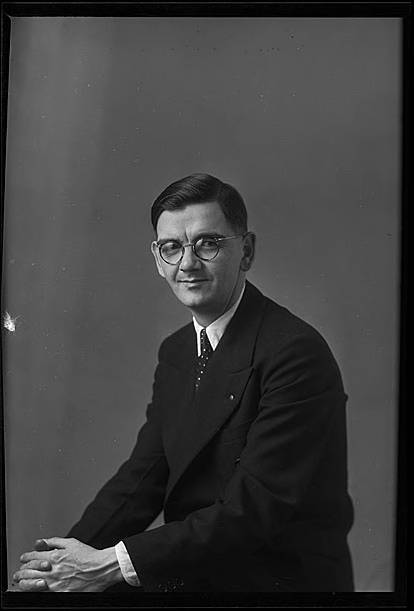
Black and white image of a man in a suit. Patterson was a lawyer in Washington County, who became active in local politics and, in 1944, was elected to the Oregon State Senate. Eight years later, he was sworn in as Governor of Oregon, finishing the term of his predecessor, Douglas McKay. This photo dates to his tenure as president of the Washington County Republican Party, which lasted until 1944.
Black and white image of a man in a suit. Patterson practiced law in Hillsboro for a number of years, before entering politics. He served as city attorney for various cities in Washington County before being elected to serve in the Oregon State Senate. As president of the Senate, Patterson was sworn in as Oregon's 26th governor in 1952, replacing Governor McKay who had resigned to become United States Secretary of the Interior. This image likely dates to his years as a city attorney.
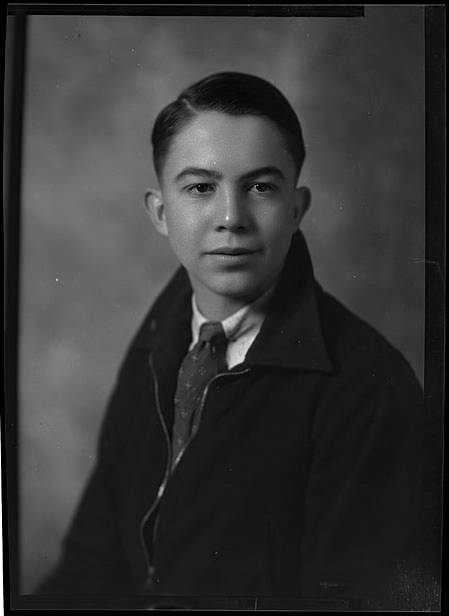
Black and white image of a young man in an informal jacket with a shirt and tie. James Meek was the grandson of Joseph L. Meek, a fur trapper who was one of the first European settlers in Washington County.
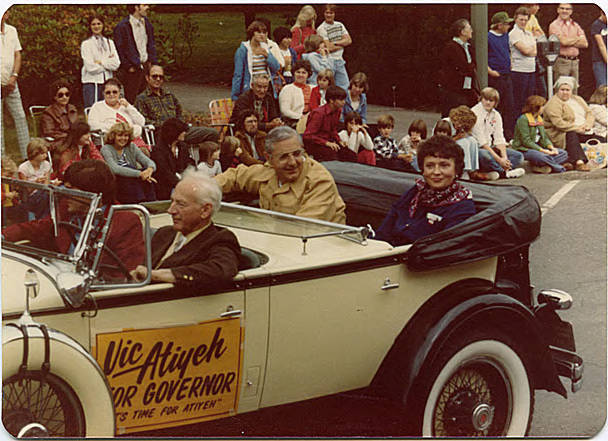
Color photograph of Vic Atiyeh riding in an antique car during a parade, with people watching along the sidewalks. A sign on the car door reads, 'Vic Atiyeh for Governor. It's time for Atiyeh.' Atiyeh was governor of Oregon from 1979 - 1987, after having served as both a state representative and a state senator. Atiyeh was the first elected governor of Arab descent in the United States. His father had immigrated from Syria in 1903 and established himself as an importer of rugs and carpets woven in the Middle East.
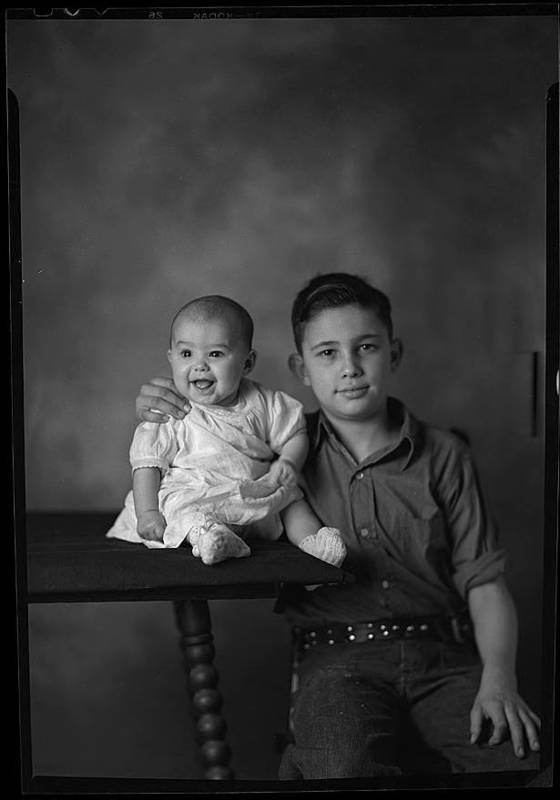
Black and white image of a young boy with his arm around an infant. Wes and Judy are the great-grandchildren of Joseph Meek, mountain man and one of the first European settlers in Washington County.
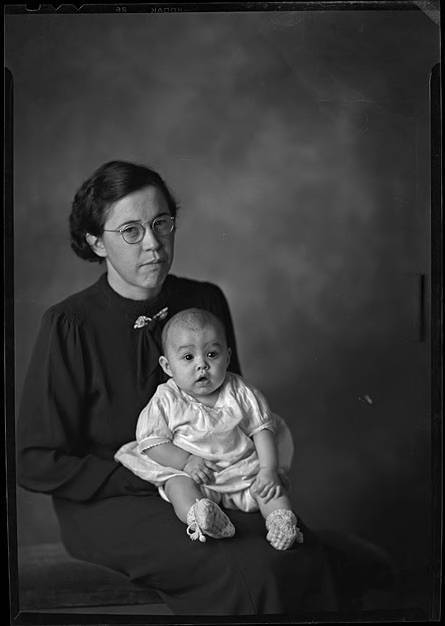
Black and white image of a woman in a dark dress holding a baby on her lap. The woman, Ruth Gates, was the granddaughter of Joseph Meek, mountain man and one of the first European settlers in Washington County.
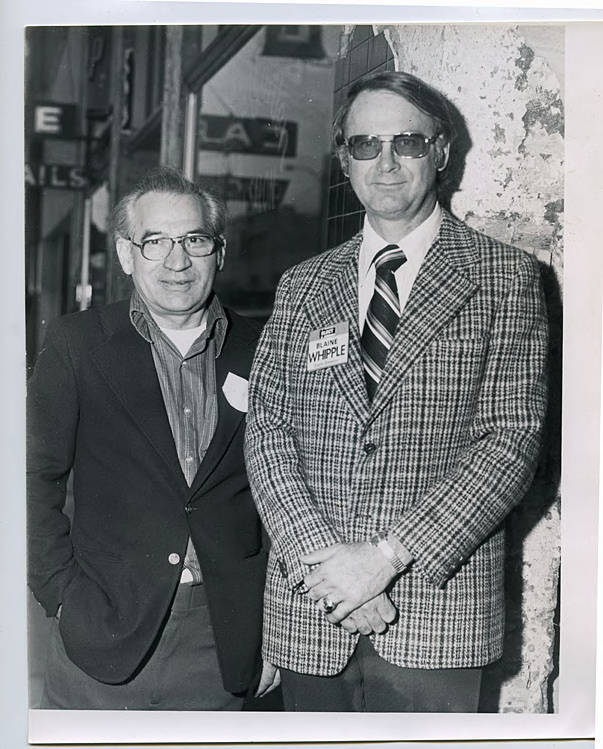
Black and white image of two men standing in front of a tree in a sidewalk. The man in the plaid suit is identified as Blaine Whipple, a local realtor who also served as an Oregon State Senator and in other local and national political offices.
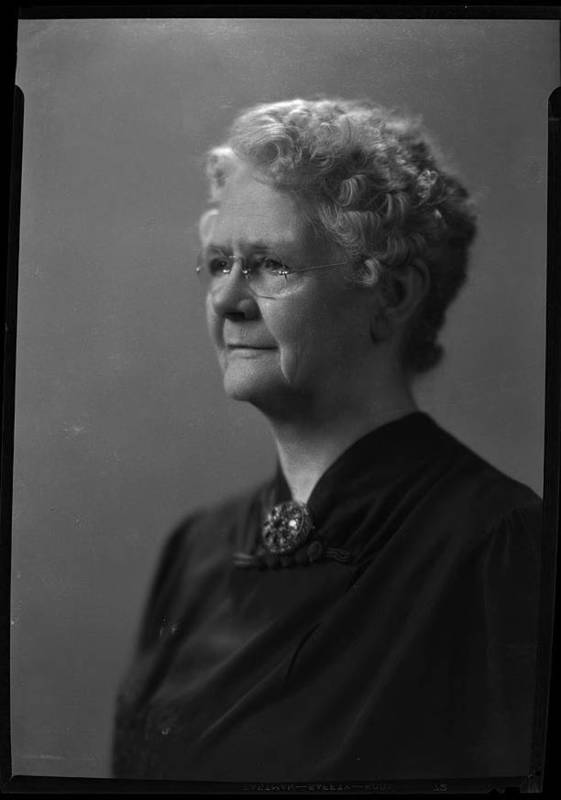
Black and white image of a woman in 3/4 profile. Emma McKinney was widowed at a young age. Born Emma Carstens near where what is now the Hawthorne Farms Intel Campus in 1871, she began working as a typesetter at the Hillsboro Independent newspaper in 1888, when she was seventeen. Married to William Walter McKinney in 1896, three years later she found herself a widow with a toddler and a young sister-in-law to support. Returning to the newspaper business, her brothers helped her purchase a half-interest in the Argus in 1904, and by 1909 she owned the newspaper in its entirety. Working with her son, Verne, after his return from college, Ms. McKinney produced a newspaper that was nationally recognized for its excellence. The National Newspaper Association annually awards the Emma C. McKinney award for service and leadership to communities and their local presses and advancement of the profession of journalism.
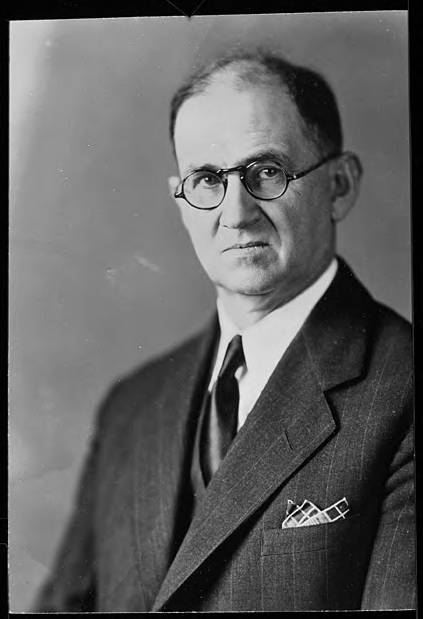
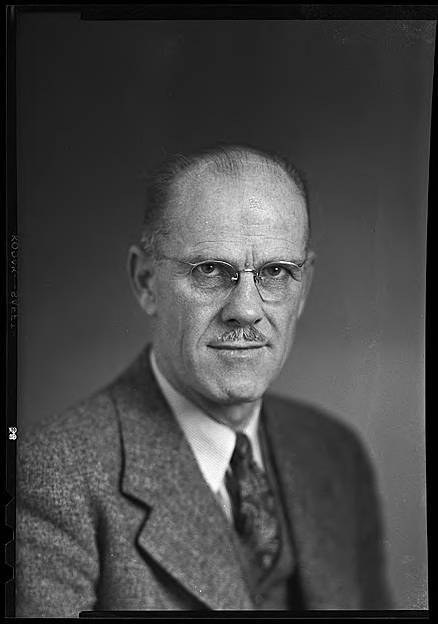
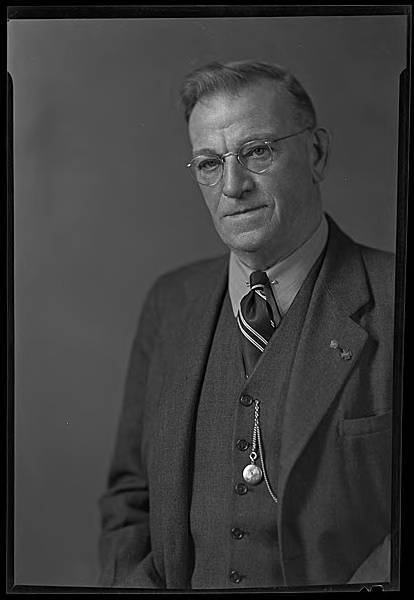
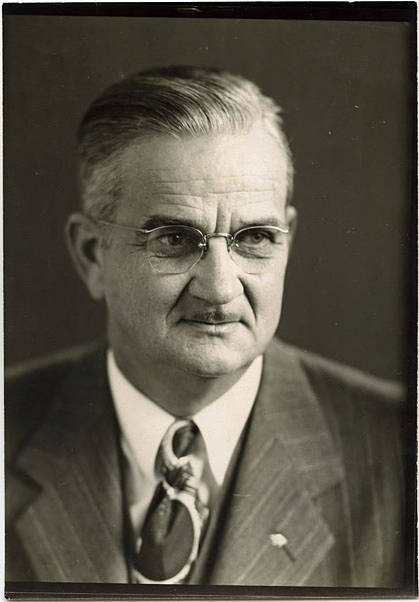
Black and white image of a man, shoulders up, wearing a pin-striped suit and wire framed glasses. The man is identified in museum records as J. W. Barney, City Manager of Hillsboro from 1939 - 1972.
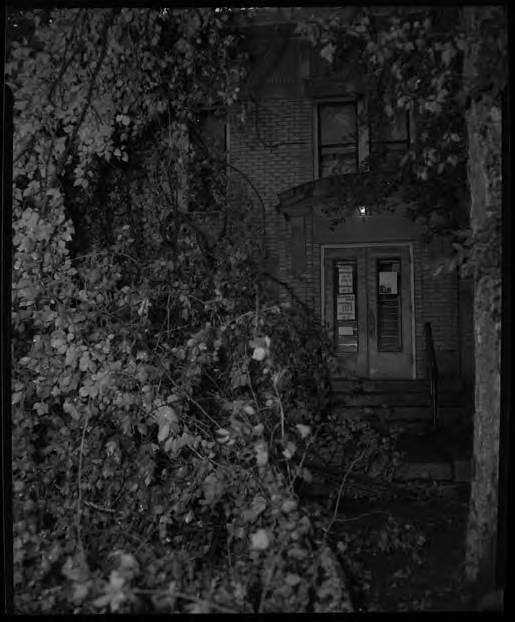
Black and white image of tree limbs and other debris on the sidewalk in front of the Washington County Library building. Most likely this was after the Columbus Day Storm, a massive windstorm that ravaged northern California, Oregon, and Washington on October 12, 1962. Forty seven people died, hundreds were injured, and in Oregon alone the cost of damages was estimated at close to $200,000,000 in current value (equivalent to anywhere between $3 billion and $5 billion in today's dollars.)
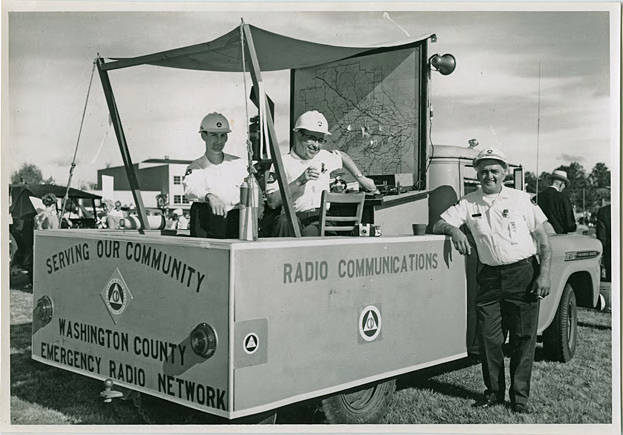
Black and white image of a truck most likely used for public relations. Two men sit in the truck, with radio equipment and a map of Washington County behind them. The stylized 'C D' in the triangle means this program was part of the national Civil Defense network plan in the 1950s, when a nuclear missile strike from Russia was considered the biggest threat to local safety. In the recent past, the Civil Defense network has been supplanted by emergency management plans which focus on natural and health disasters, and by Homeland Security.