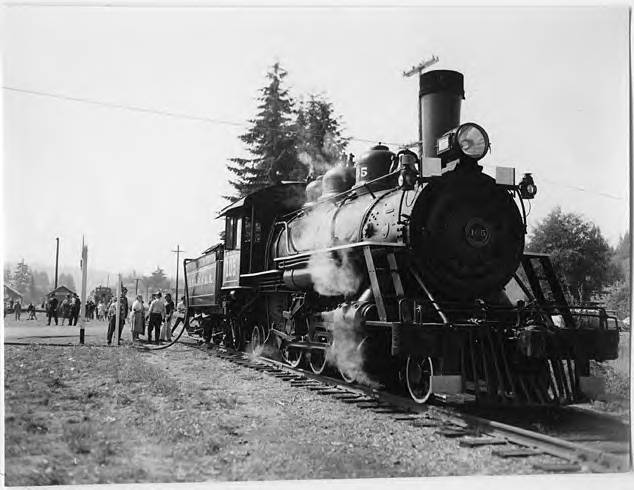
Black and white image of the crew refilling engine #105 of the V. S. P. and S. railroad while passengers wait in the background. The Vernonia, South Park and Sunset Steam Railroad was a nonprofit venture that ran a tourist and excursion train from Banks to Vernonia in the last half of the 1960s. Supposedly named for its first engineer, Chet Alexander, this engine, #105, was built in 1925 and originally pulled trains that transported lumber from mills in Vernonia and Manning. Salvaged and restored for use by the V. S. P. and S. Steam Railroad, the train was In operation from 1965 to 1969, when the V. S. P. and S. folded. The engine was last known to be in storage in Merrill, Oregon. See WCM_012932, WCMpic_012939, and WCMpic_012936 for more images of this train.
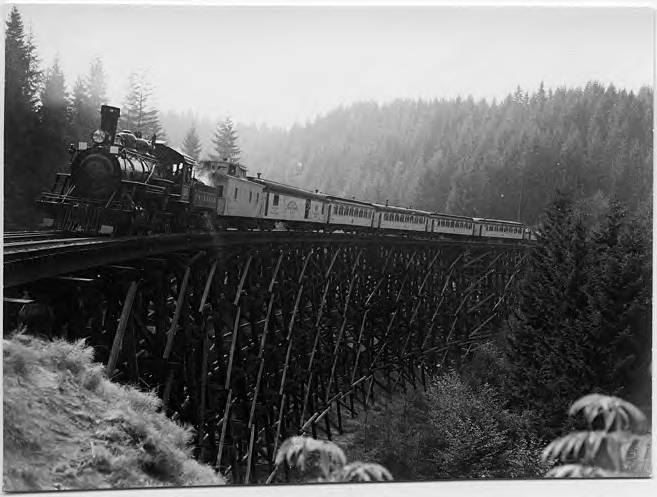
Black and white image of a steam train going across a trestle, most likely the Tophill or Horseshoe trestle near Vernonia. The Vernonia, South Park and Sunset Steam Railroad was a nonprofit venture that ran a tourist and excursion train from Banks to Vernonia in the last half of the 1960s. The engine, #105, was originally used to move lumber from mills in Vernonia and Manning in the early 1900s. The cars, purchased by donation and refurbished by volunteer labor, were from the original Oregon Electric Railway that ran from Forest Grove into Portland and then down to Eugene. In operation from 1965 to 1969, the V. S. P. and folded and the railcars were sold to South Dakota where they still operate as part of an 1880s tourist train. The rail line itself was the first of Oregon's 'Rails to Trails' parks to be completed, and is now the Banks-Vernonia State Trail. See WCM_012936, WCMpic_012939, and WCMpic_012940 for more images of this train.
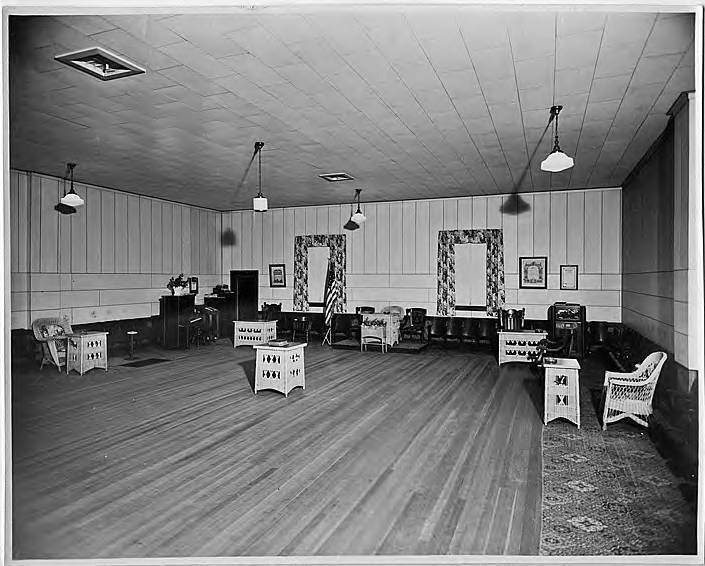
Black and white image of the interior of a large meeting space. Fold down chairs line each wall, while a piano sits in the left corner of the image and an old console radio sits in the other corner.
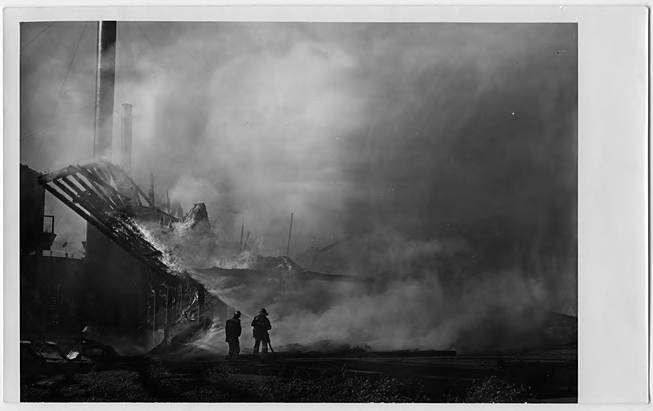
Black and white image of two firefighters fighting a fire Carnation Lumber Mill in Forest Grove, Oregon in August of 1952. The building is largely consumed, but flames can still be seen running along the building's framing. The fire began in the sawdust bin, and the lumber mill itself was saved, though a great deal of equipment was destroyed.
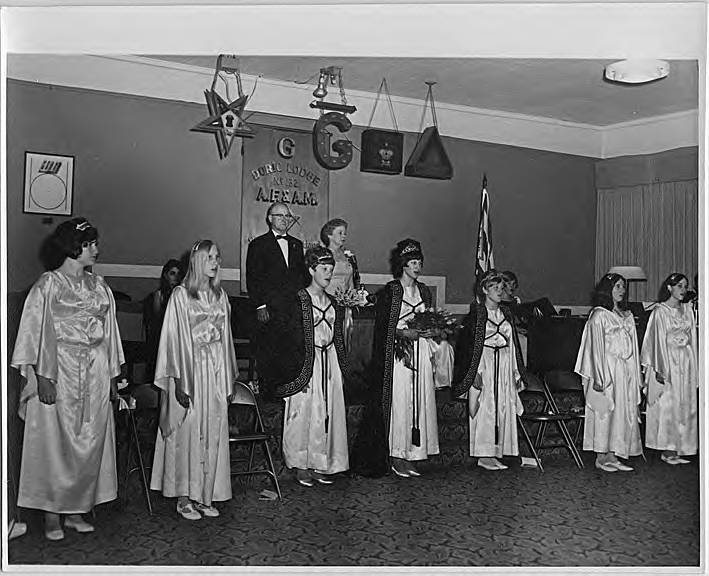
Black and white image of a group of young girls standing at the front of an auditorium. They wear the white silk gowns and robes typical of a group of Job's Daughters, the Masonic-sponsored organization typically consisting of young women. On the wall behind the group is a banner from their organization, the symbols of both the Masons and the Eastern Star hang from the ceiling above them. Members of Job's Daughters must be related to a Mason and profess belief in a supreme being.
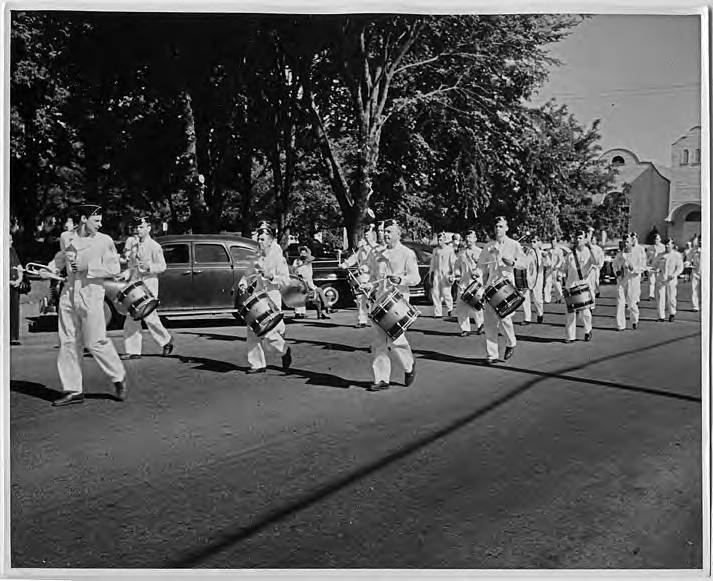
Black and white image of the American Legion Drum and Bugle Corps, marching down Second Street in Hillsboro. Museum records do not give a date or an event for the parade.
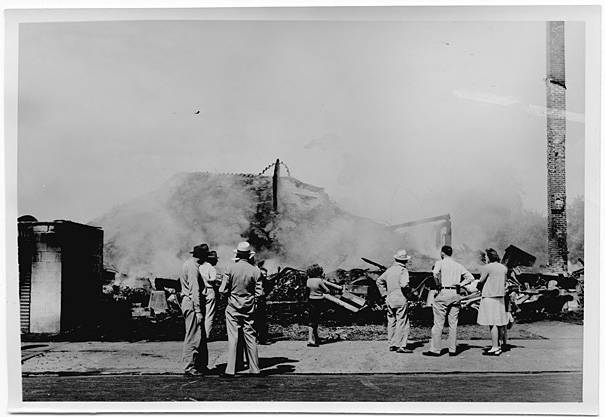
Black and white image of a burned-out building. a large brick chimney can be seen to the left of the smoldering remains of the fire, while a few passersby look on. Museum records do not identify the location or the date, simply indicate that it was a 'local' building that burned.
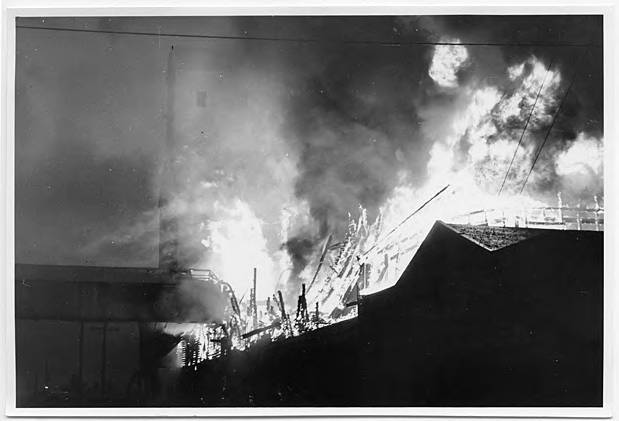
Black and white image of a fully involved structure fire, near Hillsboro. A grain elevator can just be seen in the background. Local museum records identify this simply as 'a local co-op.' See WCMpic_012738 and WCMpic_012737 for other views of this same event.
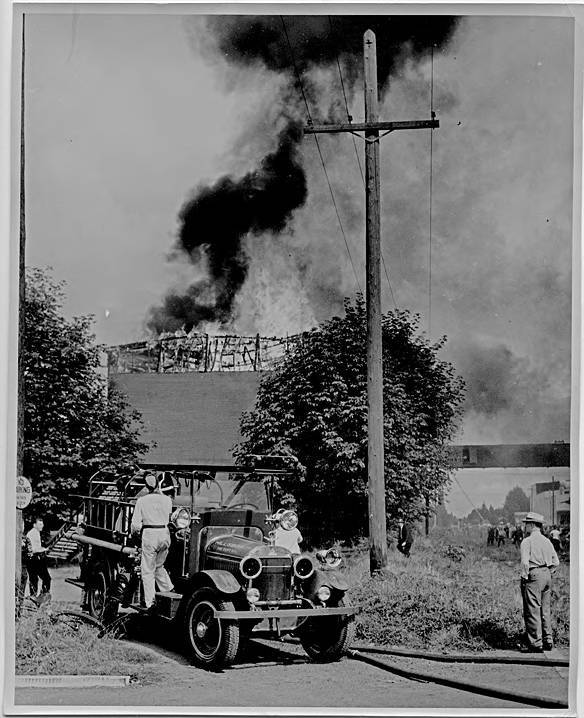
Black and white image of a group of firefighters that have just arrived at a fire. One firefighter stands on the running board of the fire truck, while another can be seen pulling the ladder from the back. The fire itself appears to be fully involved, with the frame of the building visible among the flames. Museum records identify the building simply as 'a local co-op.' See WCMpic_012737 and WCMpic_012742 for other views of this same event.
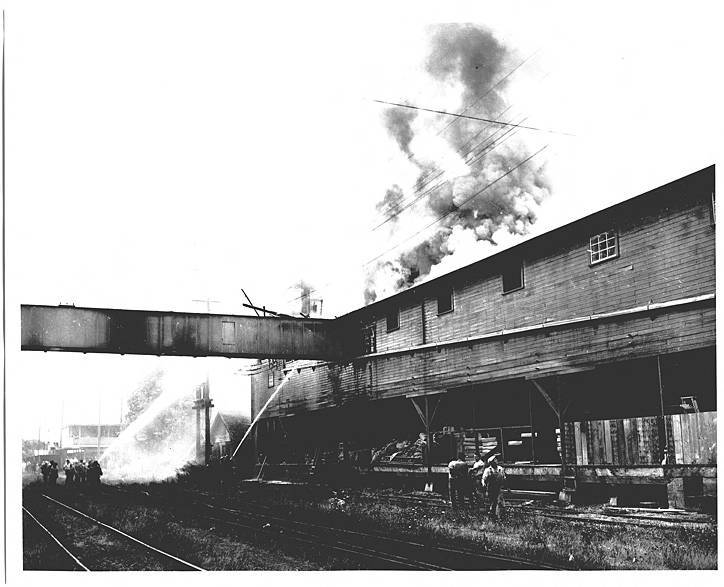
Black and white image of a group of firefighters directing their hoses at the upper story of a large warehouse. Museum records identify the building simply as 'a local co-op.' See WCMpic_012738 and WCMpic_012742 for other views of this same event.
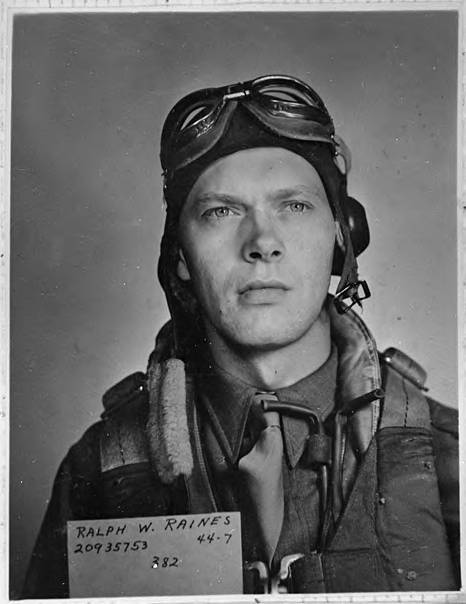
Black and white image of a young man standing near some greenery. Museum records identify the individual as Ralph Raines, newly home from fighting in Italy during World War II. Raines, a long time area resident, was the ball gunner in his crew, manning the turret underneath the plane, until near the end of the war when a shortage of navigators led to him being pressed into service at that post. Raines, who had not quite completed navigational school, flew nine missions as navigator. He was later awarded a Distinguished Flying Cross for a mission where he navigated their damaged bomber back to base after a bombing run left them with only one engine and dangerously low fuel levels. The course he plotted to get them back needed no corrections, enabling the plane to land safely in Italy. The pilot submitted Raines' name for the medal, but the medal itself was not awarded until 1982, the paperwork having been lost in the shuffle after the war. (Original photo remains with the family of the donor; image is a photograph of original.)
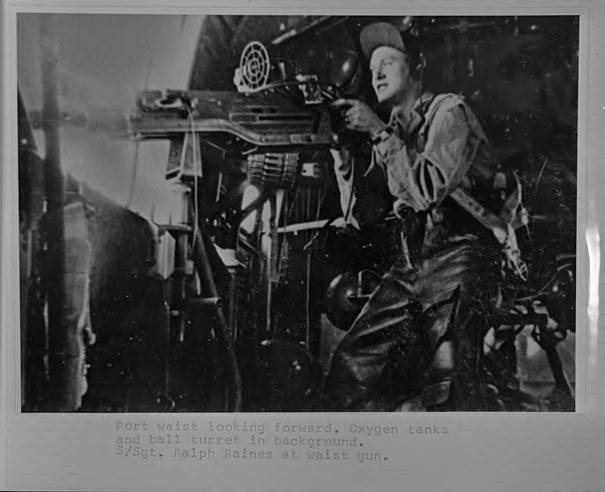
Black and white image of a young man, Ralph Raines, manning a gun inside of a B-24 bomber during World War II. Raines, a long time area resident, was usually the ball gunner in his crew, manning the turret underneath the plane, until near the end of the war when a shortage of navigators led to him being pressed into service at that post. Raines, who had not quite completed navigational school, flew nine missions as navigator. He was later awarded a Distinguished Flying Cross for a mission where he navigated their damaged bomber back to base after a bombing run left them with only one engine and dangerously low fuel levels. The course he plotted to get them back needed no corrections, enabling the plane to land safely in Italy. The pilot submitted Raines' name for the medal, but the medal itself was not awarded until 1982, the paperwork having been lost in the shuffle after the war. (Original photo remains with the family of the donor; image is a photograph of original.)
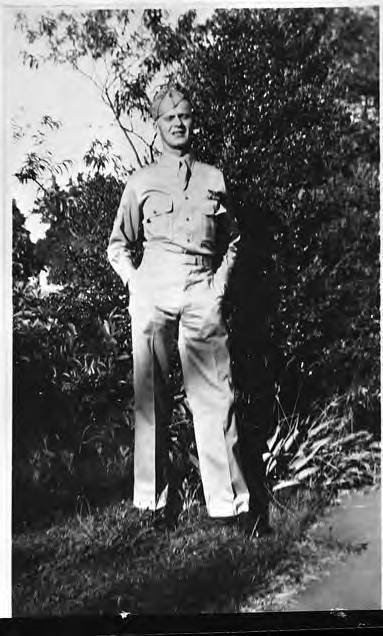
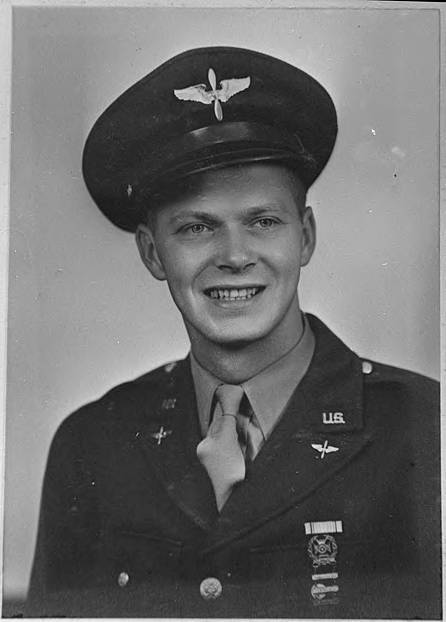
Black and white image of a young man, Ralph Raines, in his airman's uniform from World War II. Raines, a long time area resident, was the ball gunner in his crew, manning the turret underneath the plane, until near the end of the war when a shortage of navigators led to him being pressed into service at that post. Raines, who had not quite completed navigational school, flew nine missions as navigator. He was later awarded a Distinguished Flying Cross for a mission where he navigated their damaged bomber back to base after a bombing run left them with only one engine and dangerously low fuel levels. The course he plotted to get them back needed no corrections, enabling the plane to land safely in Italy. The pilot submitted Raines' name for the medal, but the medal itself was not awarded until 1982, the paperwork having been lost in the shuffle after the war. (Original photo remains with the family of the donor; image is a photograph of original.)
Black and white image of a young man, Ralph Raines, in his World War II Aviation Cadet dress uniform. Raines, a long time area resident, was the ball gunner in his crew, manning the turret underneath the plane, until near the end of the war when a shortage of navigators led to him being pressed into service at that post. Raines, who had not quite completed navigational school, flew nine missions as navigator. He was later awarded a Distinguished Flying Cross for a mission where he navigated their damaged bomber back to base after a bombing run left them with only one engine and dangerously low fuel levels. The course he plotted to get them back needed no corrections, enabling the plane to land safely in Italy. The pilot submitted Raines' name for the medal, but the medal itself was not awarded until 1982, the paperwork having been lost in the shuffle after the war. (Original photo remains with the family of the donor; image is a photograph of original.)
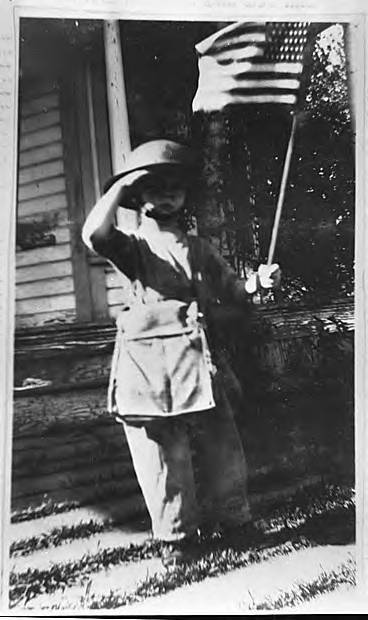
Black and white image of a young boy, Ralph Raines, age 5, playing in his Dad's World War I uniform. He holds aloft a flag with 48 stars. A lifelong resident of Washington County, Ralph served in World War II as a gunnery sergeant and navigator on a B-24 Bomber. (Original photo remains with the family of the donor; image is a photograph of original.)
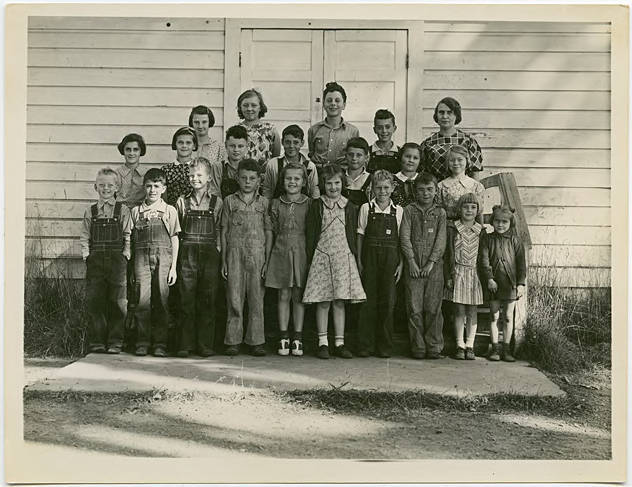
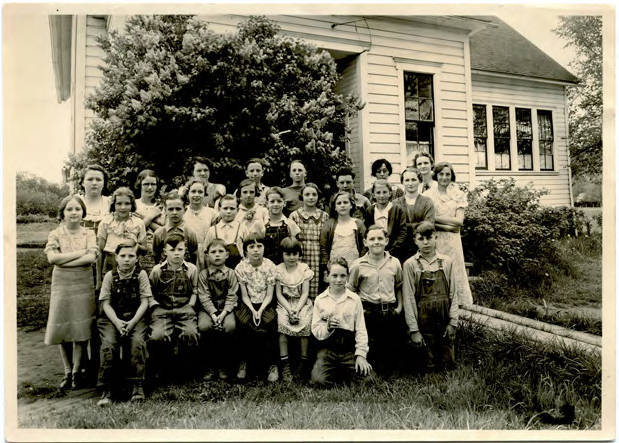
Black and white image of a group of students gathered outside a small wooden school. West Union School was the first school district in Washington County, classes beginning in 1852.
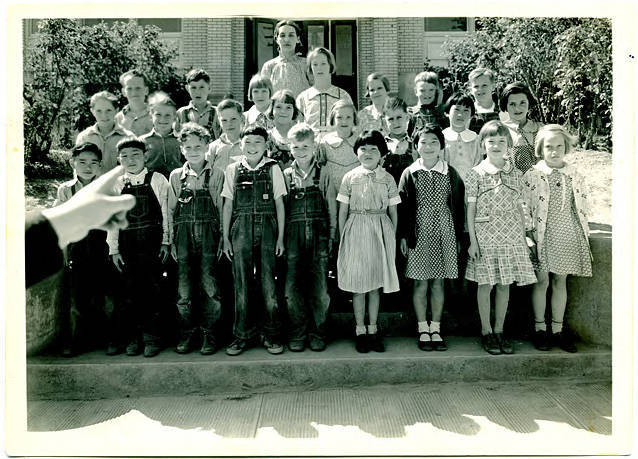
Black and white image of a group of students gathered in front of Gaston school. These students all lived in Yamhill County according to school district records, but their school was in Washington County. Of the forty-four students listed on the school record, twenty have Japanese names.
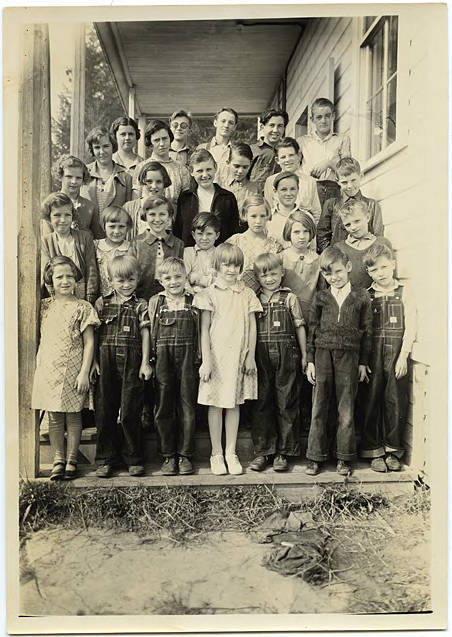
Black and white image of a group of approximately 50 school children gathered in front of their school building. The students are arranged on the stairs leading up to the front door; their ages ranged from two students who were only four up to several nineteen-year-olds who were still in school. Their teacher, Gustus Scrofford, stands at the back right of the image. Washington County records list 93 total students at Orenco School #38 for the school year of 1936-1937, though it is unlikely all were in attendance at any one time. At its peak in the 1910s, this school had over 150 students, however by the mid-1930s, when this picture was taken, the Nursery company had been shut down for a number of years and the population in the area was also declining.
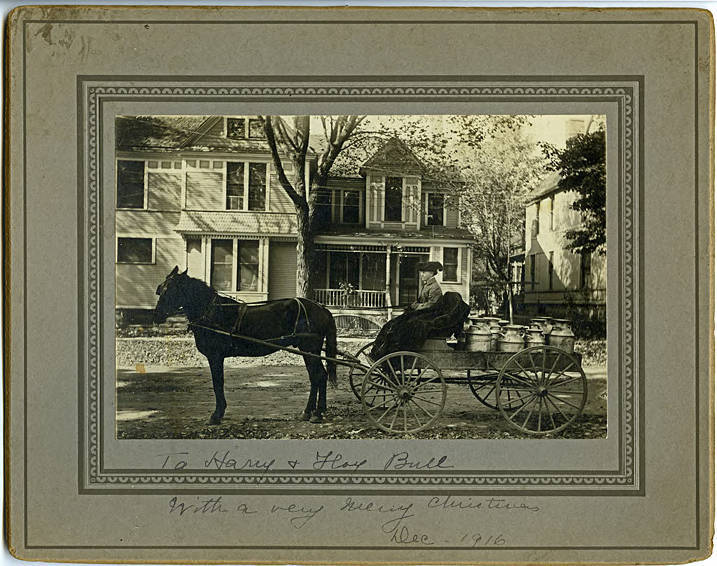
Sepia-toned image of a woman holding the reins as she sits in an open horse-drawn wagon in front of a large house. The back of the wagon is filled with milk cans. Museum records give no indication of who the woman is or where the photo was taken.
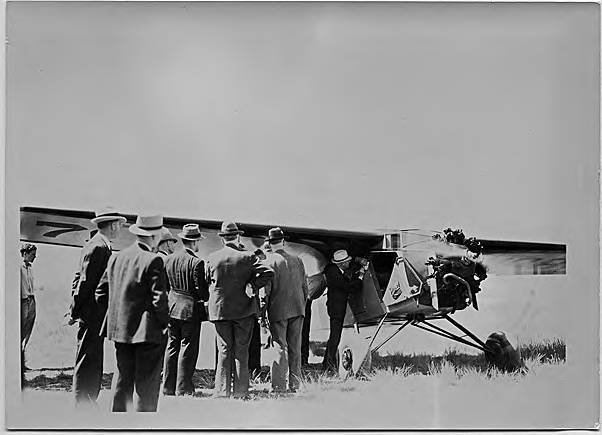
Black and white image of a group of men waiting for mail to be disbursed from an airplane. Museum records do not identify where the airplane has landed, or who the men are who are waiting to receive the mail.
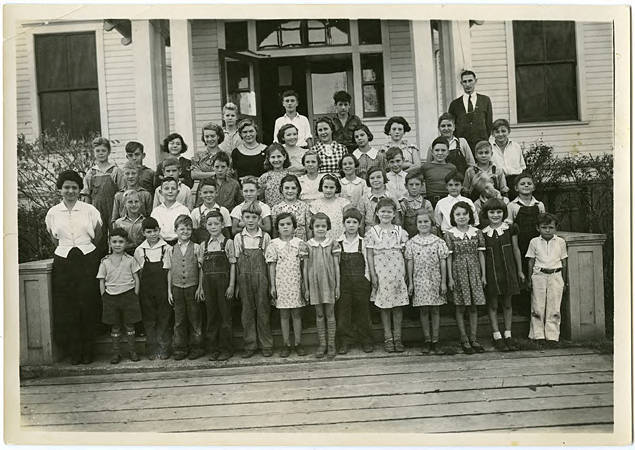
Black and white image of a group of school children of varying ages gathered on the front porch of a school. Glenwood School was located out on Highway 6, north of Forest Grove, and at one time had a railroad station, a post office, and a school.
Black and white image of a group of students gathered on the steps of Harrison School #63. School census records for this year record a total of 46 students who attended at some point during the year, most of whom lived northeast of the community on Rural Route #1, now the Wilson River Highway or Oregon State Highway 6.
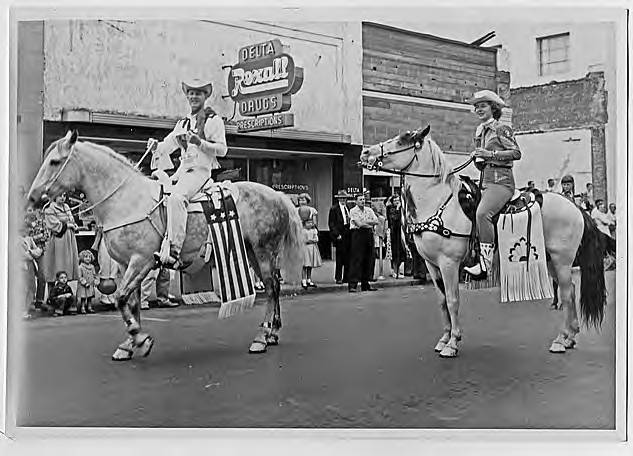
Black and white image of a man and a woman in western wear riding horses in a parade. People sit or stand along the sidewalk and watch. Note the patriotic banner with stripes and stars on the horse to the left of the image, and the feathers approximating a Native American symbol on the horse at the right side of the image.
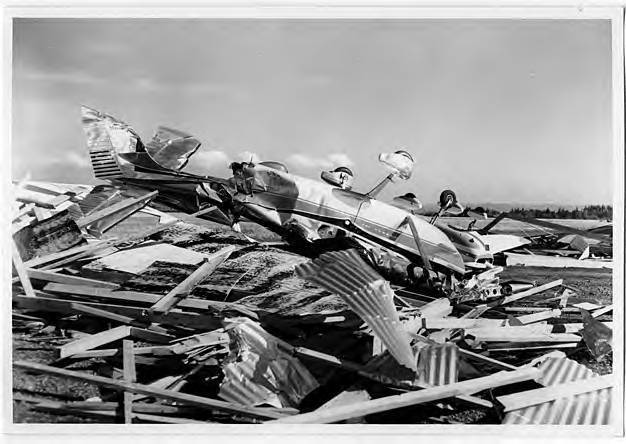
Black and white image of a pile of debris, including a small airplane resting upside down on the top of the pile. Airplanes, hangars, and even navigational beacons were blown away at local airports during the storm. The highest winds recorded in the Portland area reached 116 mph, but many local anemometers (wind gauges) were destroyed by the storm after reaching their measurement capacity. Oregon airports reported a total of 226 airplanes damaged and 56 completely wrecked, along with twenty-four hangars destroyed by the Columbus Day Storm.