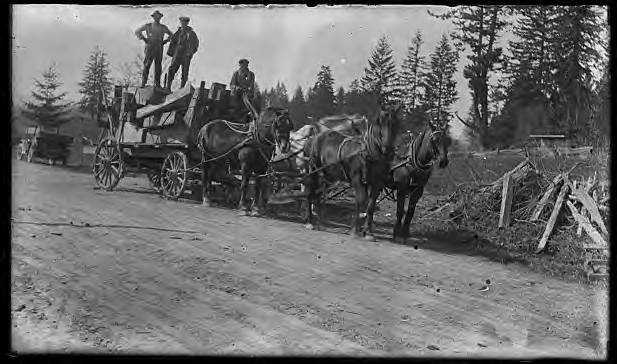
Black and white image of three men in a four-horse wagon parked along a dirt road. Two men stand atop a load of lumber in the wagon, while another sits at the front of the lumber holding the reins. An automobile with its top down is parked behind the wagon. Behind the group is a large field with a pile debris in the foreground and large pine trees visible in the back. Museum records do not identify the men in the wagon, but this image is one of a number of glass negative plates donated by Thomas Clapshaw.
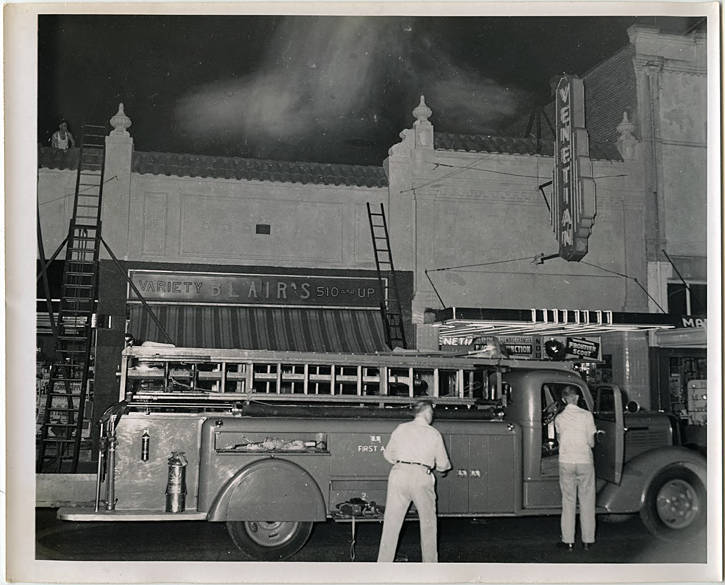
Black and white image of two men beside a hook and ladder fire engine parked on a city street at night. One man is standing at the cab while another waits. Ladders can be seen leaning against the buildings behind the fire truck, and a man at the far left of the appears to be waiting for something as he stands next to a ladder. Smoke billows from the top of the building.
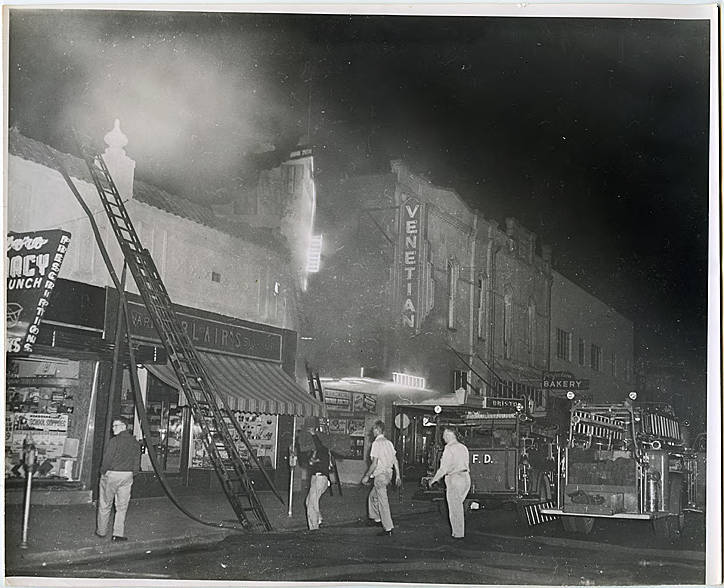
Black and white image of two fire trucks parked on the street in front of the Venetian Theater at night. Smoke billows from the theater as several men appear to be heading to the ladders. Two ladders are resting against the buildings that front the street next to the theater, and a fire hose ascends beside one.
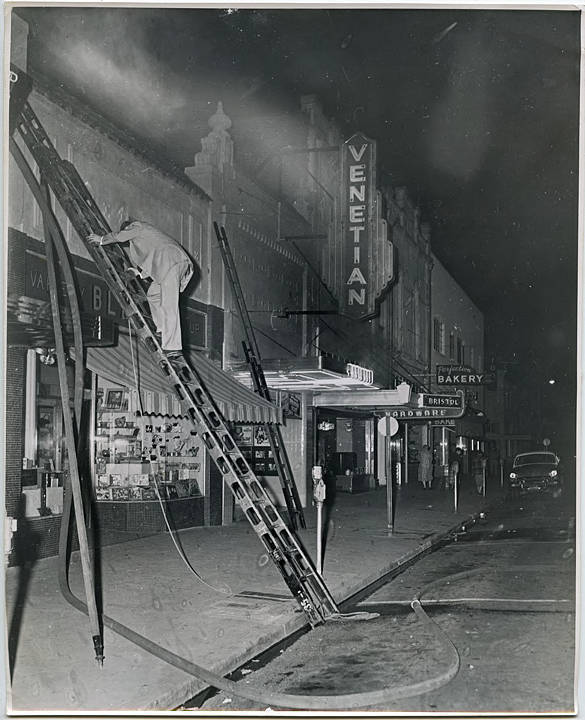
Black and white image of man climbing up a metal ladder set against the front of a row of commercial buildings at night. Fire hoses dangle beside the ladder and snake along the street. Another, smaller ladder is visible on the other side of an awning, also leaning against the building. The Venetian Theater sign is visible, and a pall of smoke is visible above the buildings. The street is empty but for one car, and parking meters line the curb.
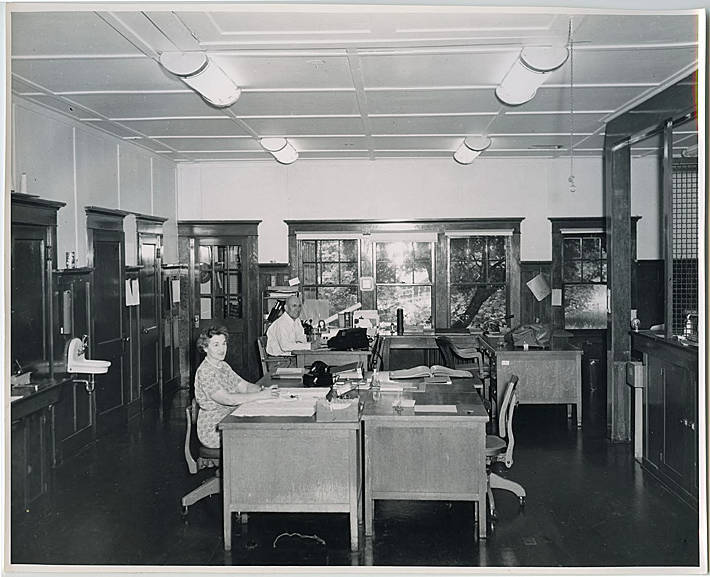
Black and white image of an office interior. Four desks are visible; a woman sits at one while a man sits at a desk near the window. She has a telephone on her desk, he has a typewriter as well as a telephone. A water fountain extends from the wall at the left of the image.
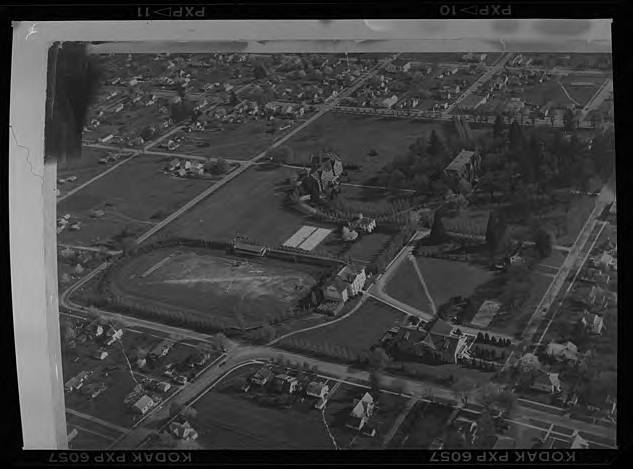
Black and white image of Pacific University showing Old College Hall at the center. Most notably, there are only four other main buildings and one house situated throughout a rather large grassy area with a few trees planted in rows. A large oval track dominates the lower left of the image.
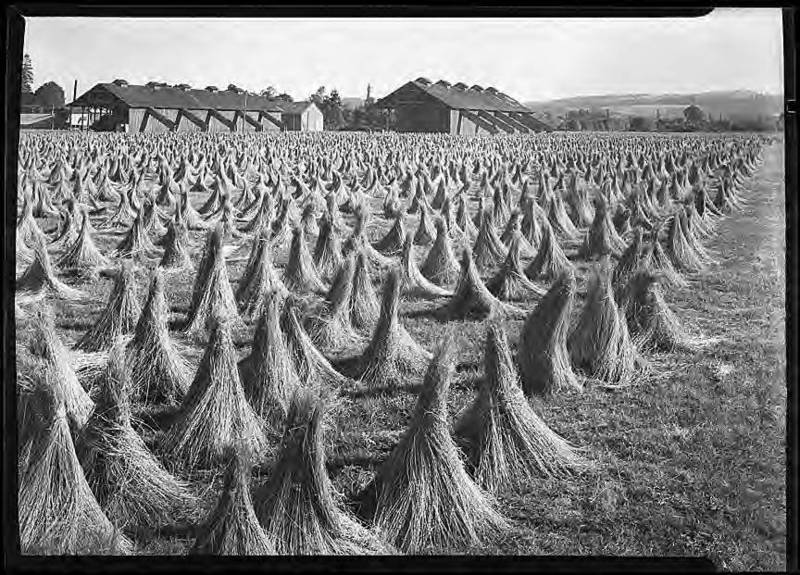
Black and white image of hand-harvested flax stacked in a field outside Cornelius, Oregon. These traditional stacks or 'little chapels' preserved the fibers at their longest and most supple, ideal for the manufacture of cloth. One of the oldest fibers known to mankind, flax produces both linen and linseed oil. A major crop in the Cornelius and North Plains area from the late 1800s, a large processing plant was built near Cornelius in the twentieth century. Cheaper cotton and synthetic fibers collapsed the flax market in the late 1950s. Currently, flax is on the upswing again as a crop, though today it is valued more for its seeds, which are rich in Omega-3 fatty acids and highly prized for both human consumption and animal feed.
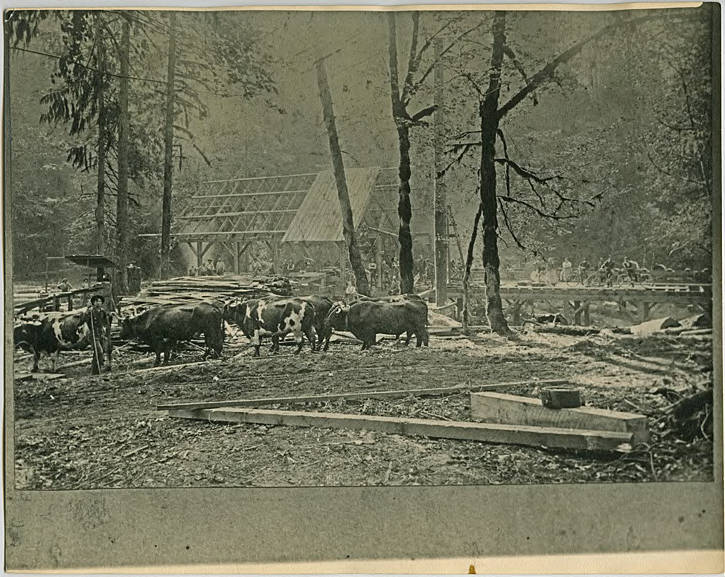
Sepia-toned image of a man with four teams of oxen standing near a partially constructed building in a heavily wooded area. A number of people stand watching on a raised platform or bridge in the background, including several with bicycles. More people stand inside the unfinished building, all looking toward the camera. A large wheel and some unidentified machinery sits at the right end of the building, while a large pile of lumber fills the space between the yoked oxen and the building. The man in the foreground wears workpants, suspenders, a dark shirt and a dark hat and has dark hair. Museum records identify the image as 'Gypsy [Roma] loggers, with oxen,' but do not give a specific location. This photo was part of the Herbert McMullen bequest. McMullen was a local photographer who, in addition to taking his own photographs, collected images that depicted daily life in the area.
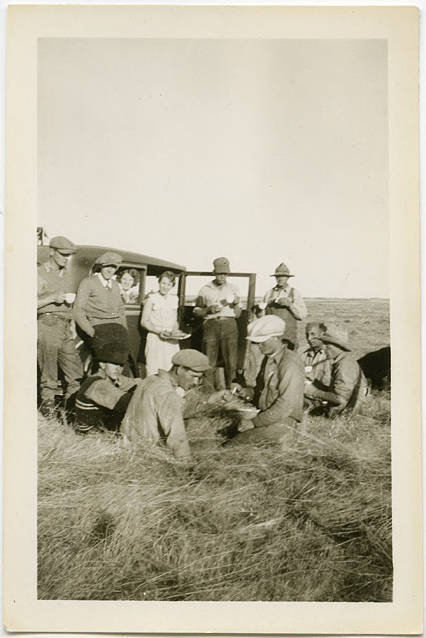
Sepia-toned image of a group of men sitting in a field. A woman holding a dish of food stands in the open door of the car, and several of the men gathered about the car appear to be eating and three or four hold coffee cups in their hands. The field behind them is full of rows of harvested grain. In the early 1900s machinery was expensive, and most farmers did not own their own harvesting machinery. Instead paid crews such as this one for the few days it would take to harvest their crops. The crew would then move on to the next farm in the area ready for harvest, or on to another area entirely. Museum records do not identify either the people in the picture or their location, but the photo was part of the Herbert McMullen bequest. McMullen was a local photographer who, in addition to taking his own photographs, collected images that depicted daily life in the area.
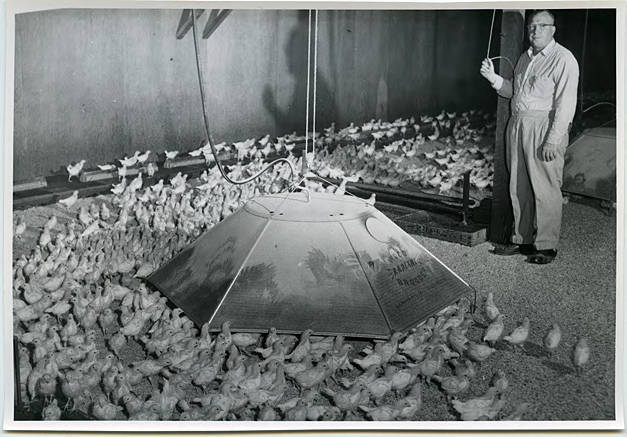
Black and white image of a man standing inside a hatchery filled with young hens. He appears ready to lift a large light in a reflective frame up from the floor. See WCMpic_013650 for another image of the farm. This photo was part of the Herbert McMullen bequest. McMullen was a local photographer who, in addition to taking his own photographs, collected images that depicted daily life in the area.
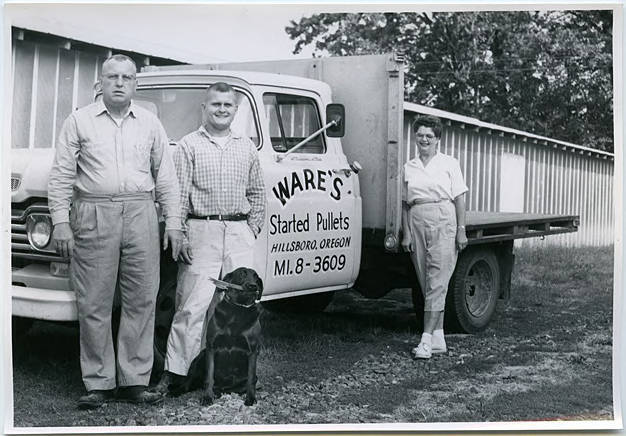
Black and white image of a man, a woman, and a boy standing beside a flatbed truck. Lettering on the truck reads 'Ware's Started Pullets, Hillsboro, Oregon. Mi. 8-3609.' A black Labrador retriever sits at the boy's feet, holding a stick in its mouth. In the background is a long metal barn. See WCMpic_013652 for another image of the farm. This photo was part of the Herbert McMullen bequest. McMullen was a local photographer who, in addition to taking his own photographs, collected images that depicted daily life in the area.
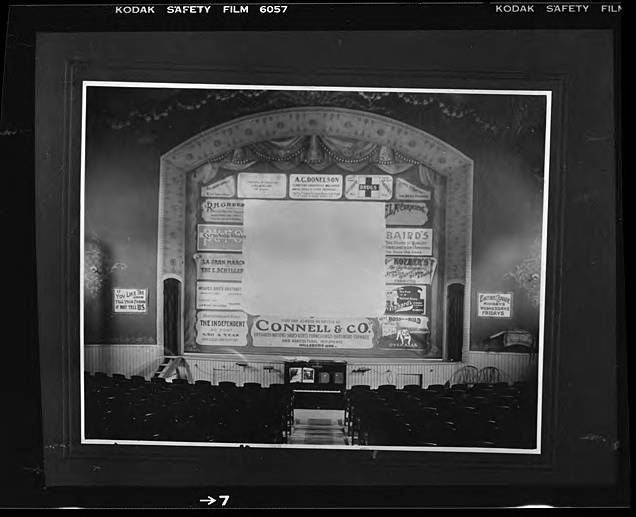
Black and white image of a back lit movie theater stage. A number of products and local businesses have their advertisements displayed around the edges of the screen, including the Independent Newspaper, which was purchased by the Hillsboro Argus in 1932. One ad is for 'Boss of the Road' overalls.
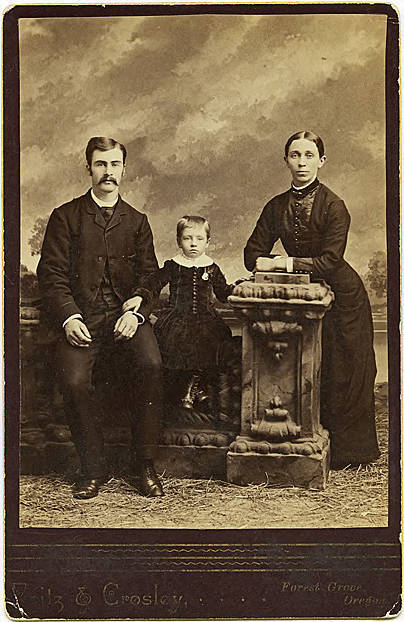
Sepia-toned studio portrait of an unidentified family, taken in Forest Grove. The man and a small child in a dress sit upon a carved wall, while the woman leans on a pediment at the end of the wall. The floor is covered with straw and the background behind them is a pastoral scene. The man has a large walrus mustache, typical 1880s fashion for men.
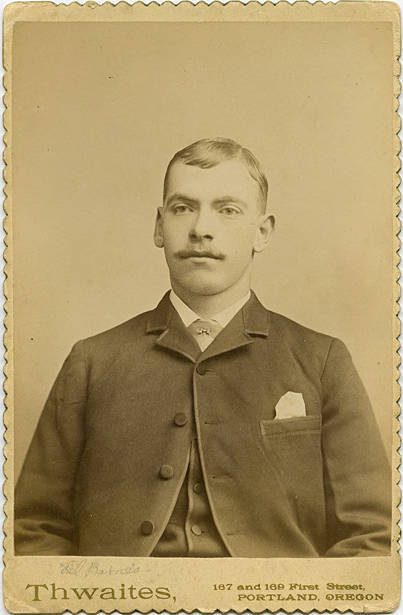
Sepia-toned portrait of a man in a suit. He has light-colored hair and a full mustache, and wears a cravat with a stick-pin with his cutaway suit. First name is written on the front, but is not legible.
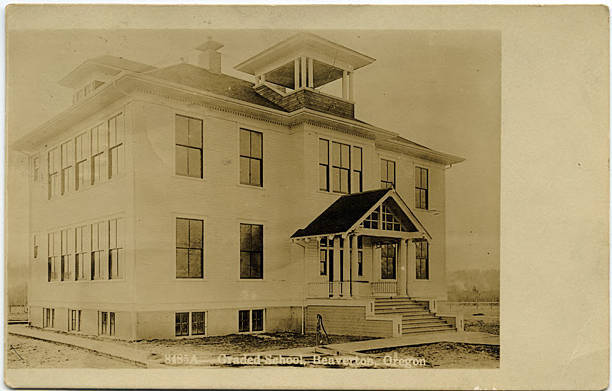
Sepia-toned image of a two-story school building with a basement, front porch, bell tower, and dormer windows in the roof. A 'graded' school separated children into grades by age, rather than a one-room school where students were grouped according to where they were working in any particular curriculum.
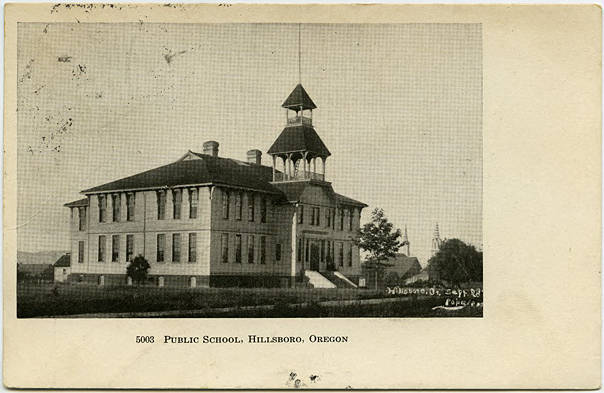
Black and white image of Hillsboro Public School on the front of a postcard. The building is two-story, Queen Anne style, with a front entrance and bell tower and sits in a large open yard. Two church steeples rise in the distance. Printed postcards such as this were a common way to share photographs in the late nineteenth and early twentieth century. A one cent postage stamp is affixed to the back.
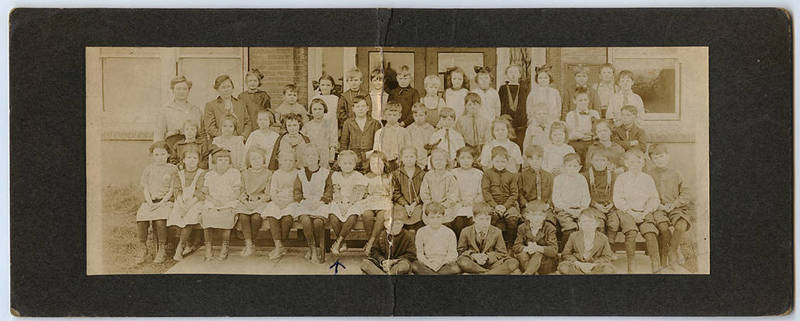
Sepia-toned image mounted on heavy cardstock of a group of students gathered on benches outside of their school. The children wear dark stockings and button-up boots, and the girls have skirts and pinafores. Most of the boys wear short pants. An arrow points up from the lower left of the image, pointing out Inez Ward Warren as a child. Hillsboro had a population of about 2,000 at this time, and was the largest school district in the area. Most of these children would have lived in town.
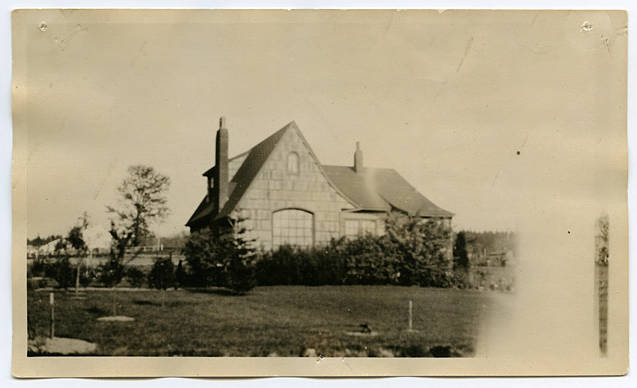
Sepia-toned image of a cross-gabled, two-story house with steeply pitched, flared roofs and shingle siding. The house sits in a large yard and is surrounded by shrubbery. Museum records identify this as the 'Ward family home.'
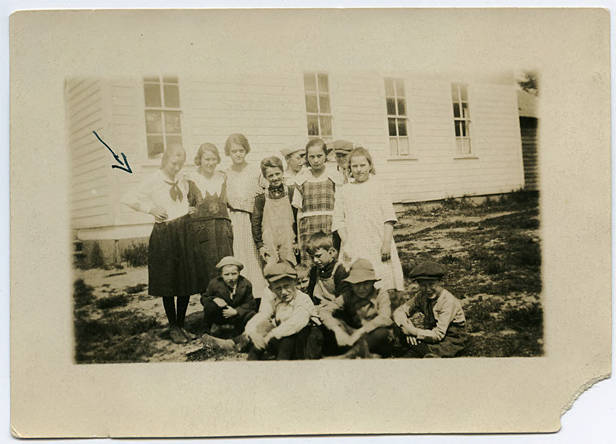
A dozen or so boys and girls assembled outside of the Firdale School south of Hillsboro, Oregon in 1922. The girls wear"middy" blouses tucked into knee-length skirts, while the boys wear overalls or knee-length pants, and caps or hats. Their teacher stands in the middle of the group toward the back. An arrow points to the young girl on the end of the back row, most likely Inez Ward Warren.
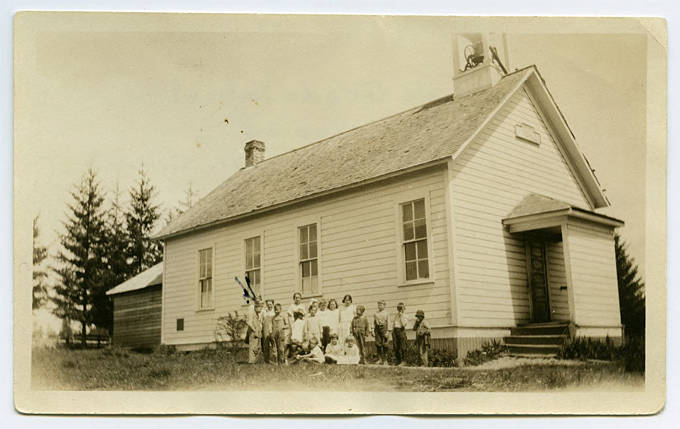
Sepia-toned image of a small group of students gathered outside a one-room school house. An arrow drawn in pen points to a young girl at the end of the back row, most likely identifying Inez Ward Warren, the donor of the photo. Firdale was one of many 'walking' schools in Washington County, small, rural schools situated where their students could walk to class.
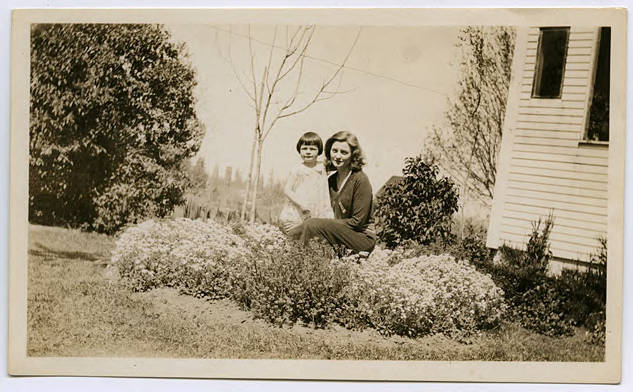
Sepia-toned image of a young woman crouched down next to a young girl in a white dress. Museum records identify the image as that of ' Inez Warren and a neighbor girl;' Inez is most likely the older girl in the image.
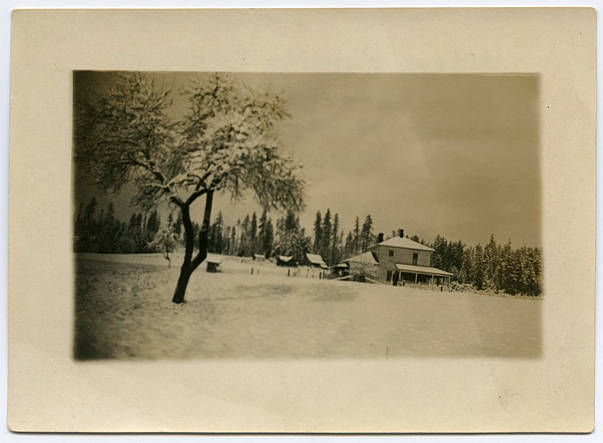
Sepia-toned image of a two-story 'American Foursquare' home with a hipped roof, a side addition, and a screen-in porch attached. Snow covers the house, the fields, and the evergreen trees behind the home. Barns and outbuildings are also covered with snow. Museum records identify this as the 'Ward family farm in the Tualatin Valley, south of Hillsboro, ca. 1918.
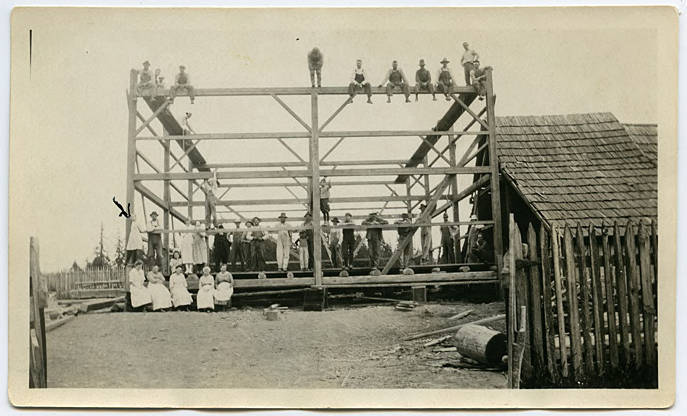
Sepia-toned image of people gathered for a barn raising. The barn is framed, but not roofed or sided. A number of men sit along the top of the front cross-beam, while the rest of the group is gathered along the bottom of the framing on the floor of the barn. Several children, mostly girls, stand with the men, and a group of women is seated on a board in front of the floor. Museum records identify the location as 'near Firdale Gr. School.' Firdale school was in the hills north of Cornelius, Oregon.
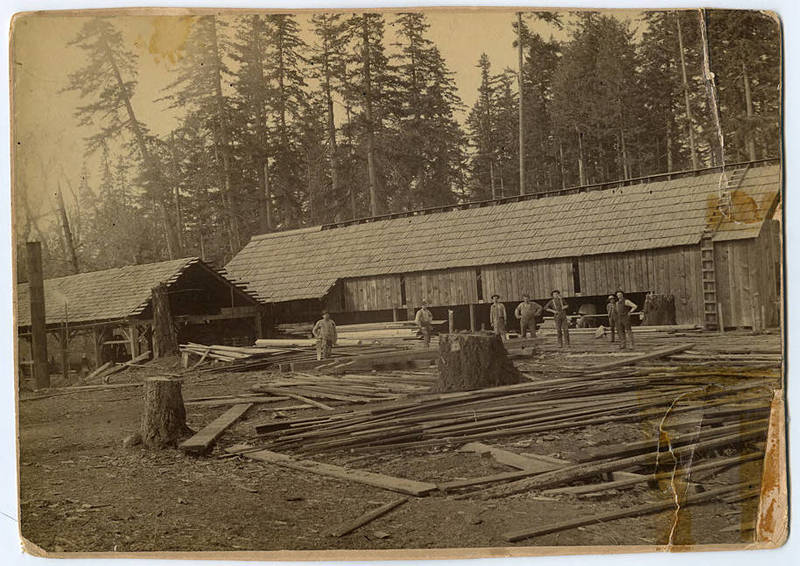
Sepia-toned image of several men standing in the yard in front of a long, wooden building. Stumps and lumber are scattered about the yard, and trees fill the background. The smaller building is open-sided, and some machinery and pallets can be seen in the interior. The larger building has half-sides. There were several sawmills located in the Scholls area in the early 1900s, though museum records do not identify this mill, specifically. Two of the men in the picture, the second from the left and fourth from the left, are identified as Verne Briggs and A. E. Briggs.