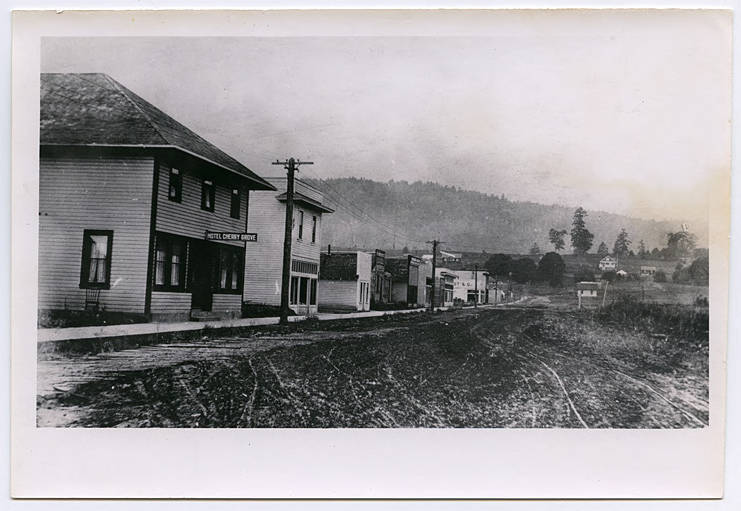
Black and white image of a dirt street with buildings along one side. The first building, a two-story with a hipped roof, bears a sign identifying it as the Cherry Grove Hotel. A power line runs down the street in front of the other businesses, most of which after the hotel and its neighbor appear to be single story wooden constructions. A portion of the road directly beside the sidewalk has been planked. Two or three houses dot the hills which rise in the background.
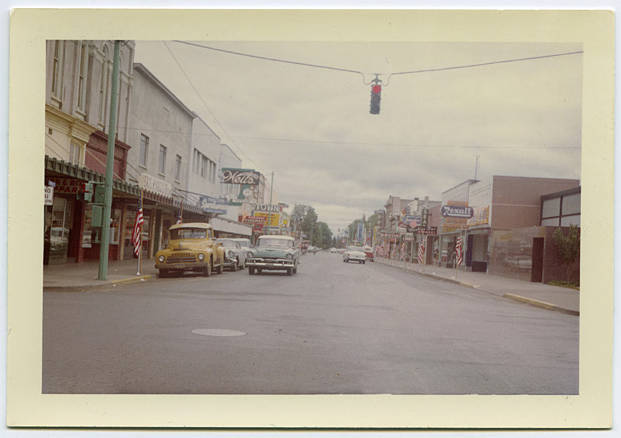
Color image of a street with cars along it. A stop light hangs from wires near the middle of the image. Various store and business signs line the buildings along the road. According to museum records, this image dates from 1956 and looks down Main Street from its intersection with Second Street.
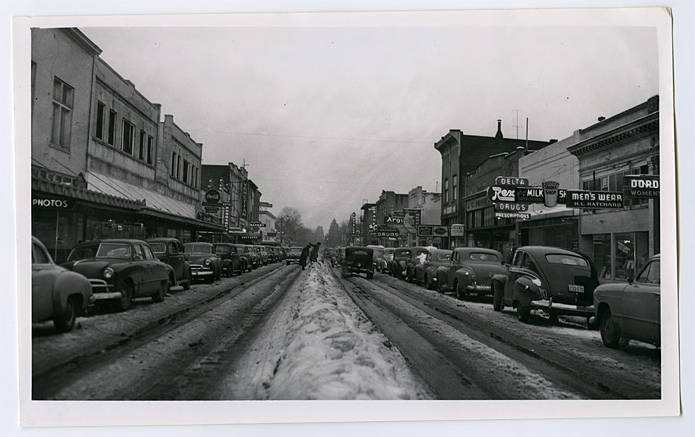
Black and white image of a slushy street with cars parked along either side and a large hump of snow down the middle. Museum records identify this as Main Street in Hillsboro during the winter of 1950-1951, when there was a great deal of snow.
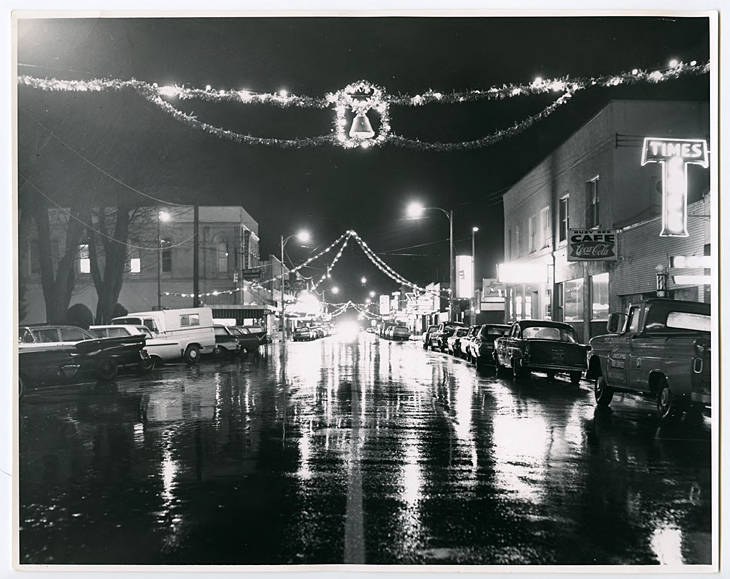
Black and white image of a street at night, with neon signs aglow and holiday decorations hanging above the street. Museum records identify this as Hillsboro, Christmas, circa 1967.
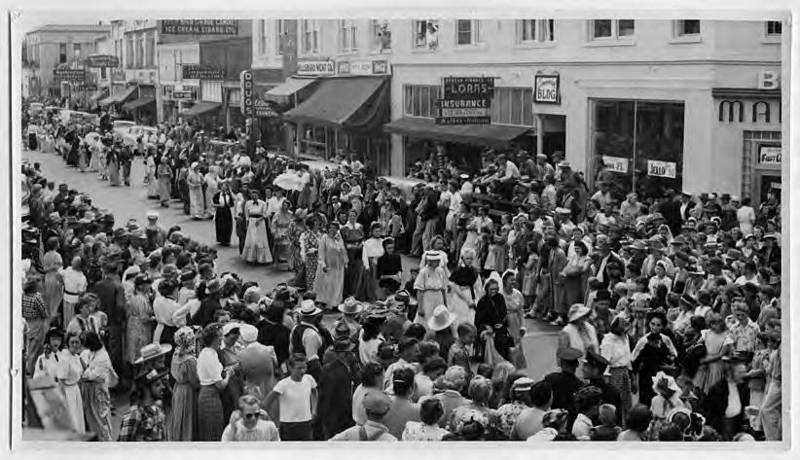
Black and white image of a group of people dressed in clothing typical of the 19th century walking down a paved street in Hillsboro, while crowds in 20th century clothing watch. Museum records date this image to the 1940s, possibly a celebration of the centennial of the Oregon Trail.
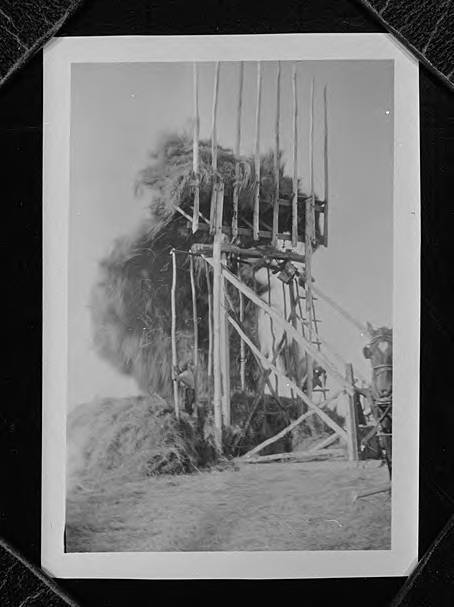
Black and white image of showing hay being stacked with a beaverslide stacker. Hay was loaded on the large forked tines, then pulled up the slide and dumped over to form a large, loaf-shaped stack. Museum records do not identify a location for this image, which is part of the Herbert McMullen bequest. McMullen was a local photographer who also collected photographs and images from around the area.
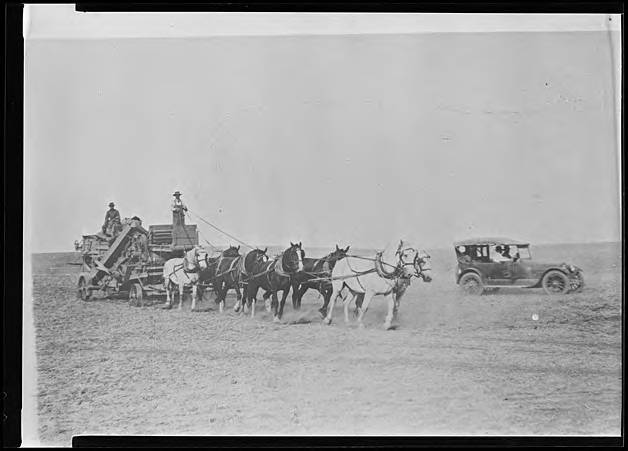
Black and white image of a team of eight horses pulling a threshing machine through an empty field. One man sits on top of the thresher, while another holds the reins at the front of the machine. On the other side of the team of horses, an automobile with two men inside also drives through the field. Farmers rarely owned their own machinery; instead, large crews of itinerant laborers travelled up and down the Columbia River Basin during harvest season, following a machine owner to the various farms and working for several days to harvest and thresh the farmers' crops. Museum records do not identify a location for this image, which is part of the Herbert McMullen bequest. McMullen was a local photographer who also collected photographs and images from around the area.
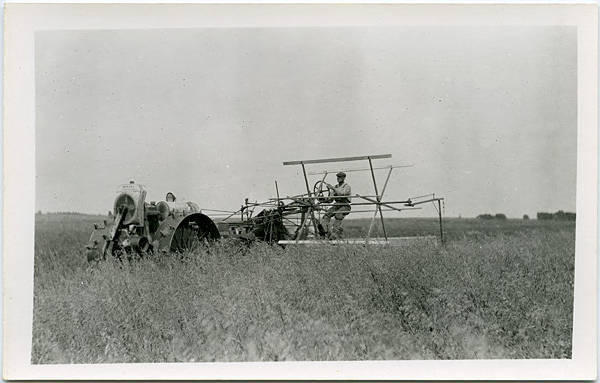
Sepia-toned image of a two-wheeled tractor pulling a grain binder through a field of wheat. The binder cut the grain near the base, then the large paddle wheel swept the stalks into the binder where they were gathered and bound with twine by a mechanical knotter. The bundled grain was then dumped off to the side to be placed into a shock for further ripening before being loaded on a wagon and taken to the thresher. Museum records do not identify a location for this image, which is part of the Herbert McMullen bequest. McMullen was a local photographer who also collected photographs and images from around the area.
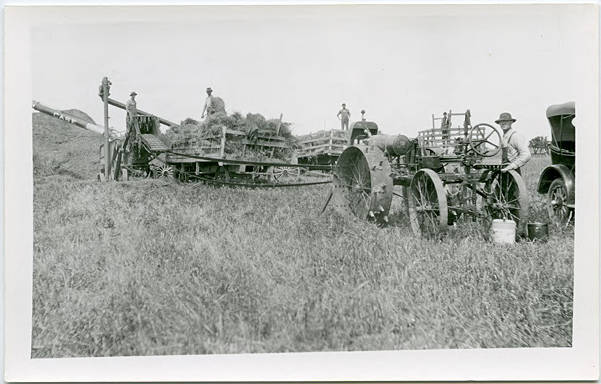
Sepia-toned image of men loading grain into a belt-driven threshing machine. One man at the right of the image monitors the tractor whose engine is running the machine; the other of the long belt a man stands on top of a rick full of wheat, ready to toss it into the separator. Another man stands on a cart of wheat, waiting to be separated as well. The name 'Case' can be seen on pipe leading away from the thresher. J. I. Case invented the first successful threshers, which were originally horse-powered. Farmers rarely owned their own machinery; instead, large crews of itinerant laborers travelled up and down the Columbia River Basin during harvest season, following a machine owner to the various farms and working for several days to harvest and thresh the farmers' crops. Museum records do not identify a location for this image, which is part of the Herbert McMullen bequest. McMullen was a local photographer who also collected photographs and images from around the area.
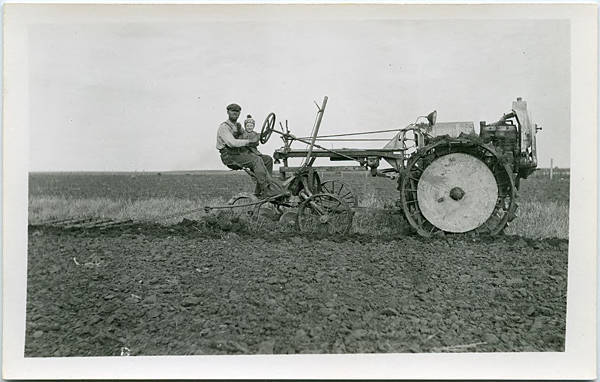
Sepia-toned image of man driving a two-wheeled tractor across a field. A young child in a knitted hat with a pom-pom on top waves from his lap. He appears to be plowing under the field; most of the field is turned earth, but for a small strip of dried straw just to the other side of where his plow is turning the earth. A harrow is chained behind the plow. Museum records do not identify a location for this image, which is part of the Herbert McMullen bequest. McMullen was a local photographer who also collected photographs and images from around the area.
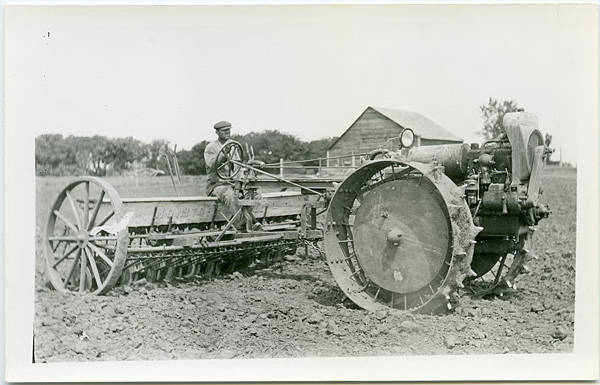
Sepia-toned image of mechanical farm equipment from early twentieth century. A tractor with two large metal wheels pulls what appears to be a planter across a plowed field. Museum records do not identify a location for this image, which is part of the Herbert McMullen bequest. McMullen was a local photographer who also collected photographs and images from around the area.
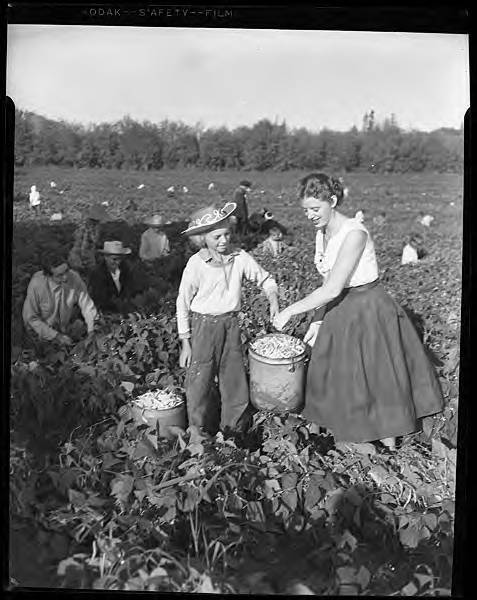
Black and white image of a child and a young woman holding a bucket of beans. The child wears pants and a shirt and a cowboy hat. People of all ages can be seen picking beans throughout the field behind the pair at the center of the image. Museum records identify this location as the Carothers & Son farm, near Cornelius, Oregon.
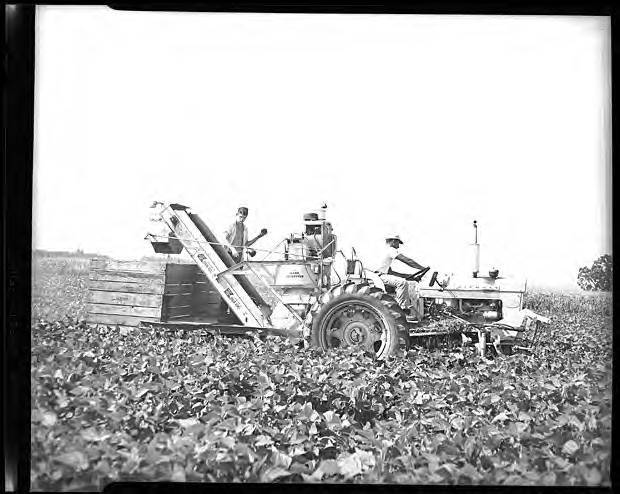
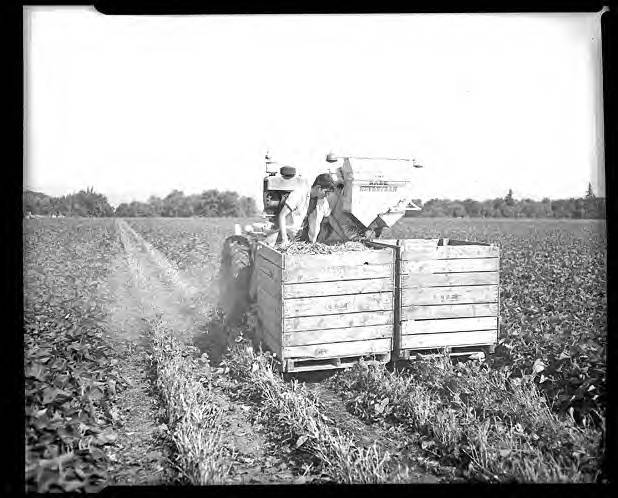
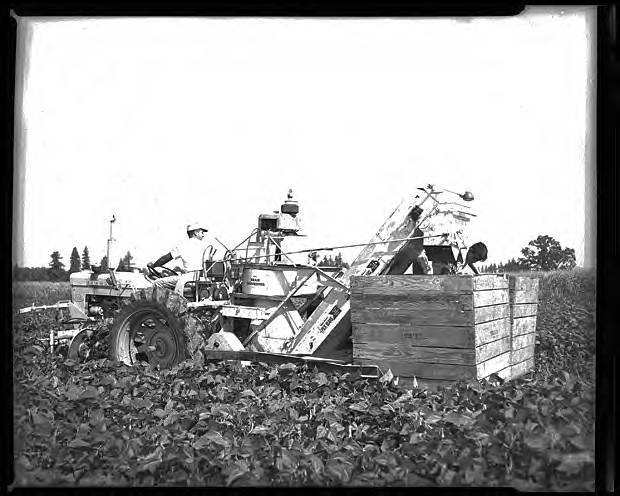
Black and white (overexposed) image of a tractor pulling a mechanical bean picker through a field of beans. The harvested beans are dropping from a hopper into wooden crates behind the picker, overseen by a young man. Museum records identify this location as the Carothers & Son farm, near Cornelius, Oregon.
Black and white(overexposed) image of a mechanical bean picker being pulled through a field of beans. The harvested beans are dropping from a hopper into wooden crates behind the picker, supervised by a young man making certain the crates do not overflow. Museum records identify this location as the Carothers & Son farm, near Cornelius, Oregon.
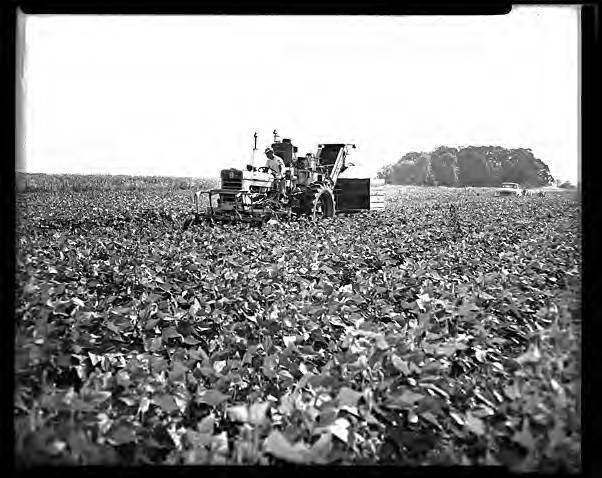
Black and white (overexposed) image of a tractor pulling a mechanical bean picker through a field of bush beans. A pick-up truck follows in the background. Museum records identify this location as the Carothers & Son farm, near Cornelius, Oregon.
Black and white (overexposed) image of a tractor pulling harvesting equipment through a field of beans. The harvested beans are lifted up a conveyor belt and then dropped into wooden crates behind the picker. A young man rides on the trailer, supervising the fall of the harvested beans. Museum records identify this location as the Carothers & Son farm, near Cornelius, Oregon.
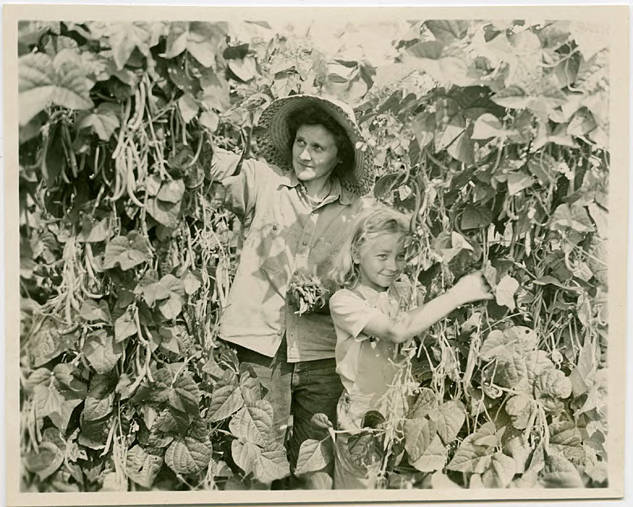
Black and white image of a young girl, identified in museum records as Eileen Carothers, and a woman wearing a hat. They stand in between two rows of pole beans, and the woman holds a handful of beans while Eileen is picking some. Museum records identify this image as from the Carothers & Son farm, near Cornelius.
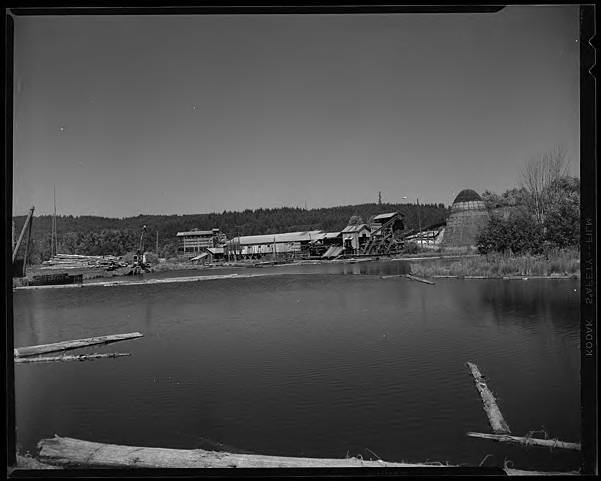
Black and white image looking across a small body of water at a sawmill. Though the location is unknown, this image is from the Herbert McMullen bequest. McMullen was a local photographer who also collected photographs and images from around the area.
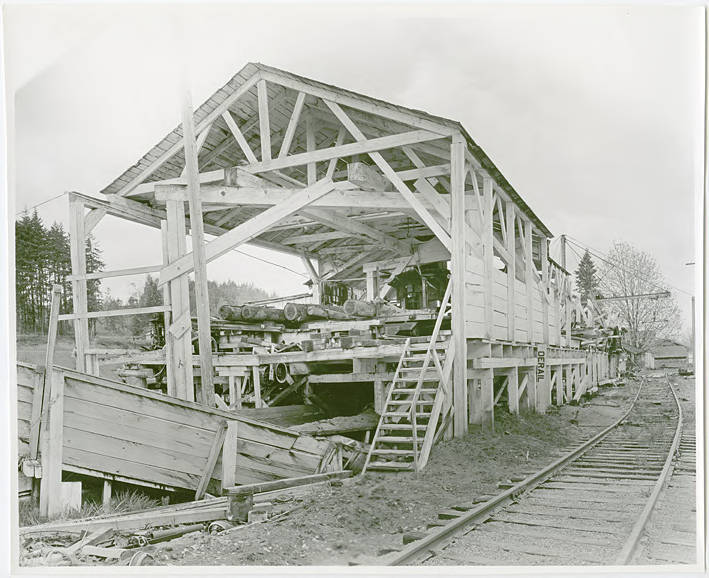
Black and white image of a partially destroyed sawmill. Railroad tracks run to one side of the mill. The image is from the Herbert McMullen bequest. McMullen was a local photographer who also collected photographs and images from around the area.
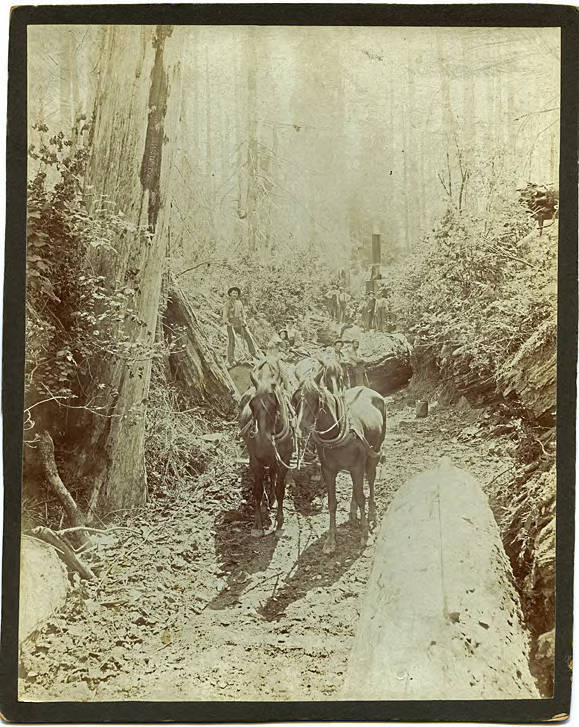
Sepia-toned image of peeled logs along a narrow track in dense undergrowth of woods. A man stands on a log in the background, holding the reins of a horse-team that is pulling the log along the track, while several other men are scattered about the background of the image. A woman and a child are seated on the trunk beside the man holding the reins. Though the specific location of this group is unknown, a team hauling logs would have been a familiar sight in the forests of Washington County and the Coast Range during the early 1900s. The image is from the Herbert McMullen bequest. McMullen was a local photographer who also collected photographs and images from around the area.
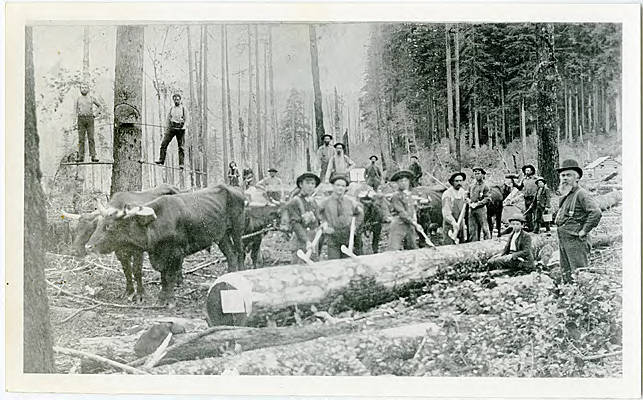
Black and white image of a number of men working in the forest. Half a dozen or more men are peeling the bark from a large log at the right of the image, while another man with a full beard and a derby hat appears to supervise. Several teams of oxen and their drivers stand behind the group, ready to haul a log away from the forest. To the left of the image, two men stand several feet up on either side of a tree, balancing on a cross-cut saw that is embedded in the tree trunk. Though the specific location of these men is unknown, this would have been a familiar sight in the forests of Washington County and the Coast Range during the early 1900s. The image is from the Herbert McMullen bequest. McMullen was a local photographer who also collected photographs and images from around the area.
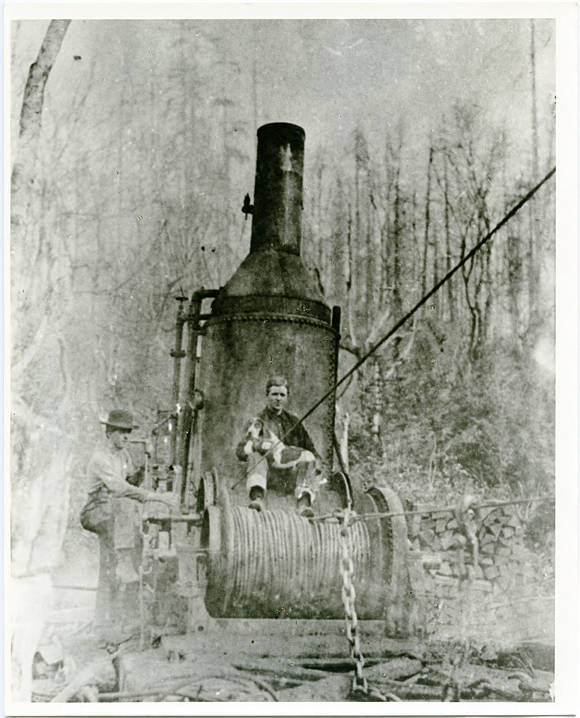
Black and white image of two men with a steam donkey. One man stands to the side and appears to be running the engine. Another man sits on one of the cable drums that winds the cable used to pull the logs from the forest. He holds a dog in his lap. One of the large chains used to secure the engine extends down from the cables at the lower center of the image. Leafless trees fill the background of the image, and a large stack of wood sits to the right of the donkey engine. Though the specific location of these men is unknown, this would have been a familiar sight in the forests of Washington County and the Coast Range during the early 1900s. The image is from the Herbert McMullen bequest. McMullen was a local photographer who also collected photographs and images from around the area.
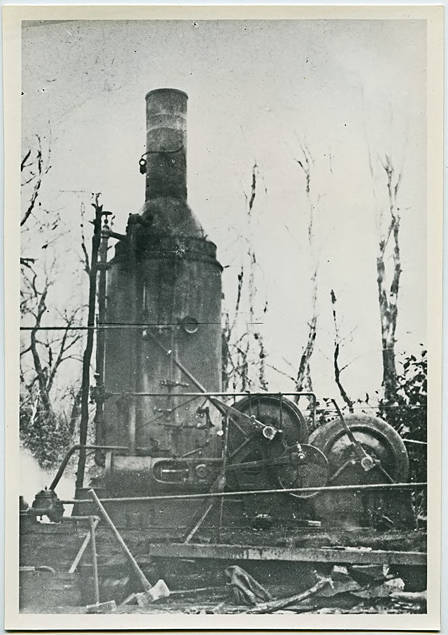
Black and white image of a steam donkey, with a large ax leaning up against the side near the boiler. Though the specific location of this particular machine is unknown, this would have been a familiar sight in the forests of Washington County and the Coast Range during the early 1900s. The image is from the Herbert McMullen bequest. McMullen was a local photographer who also collected photographs and images from around the area.