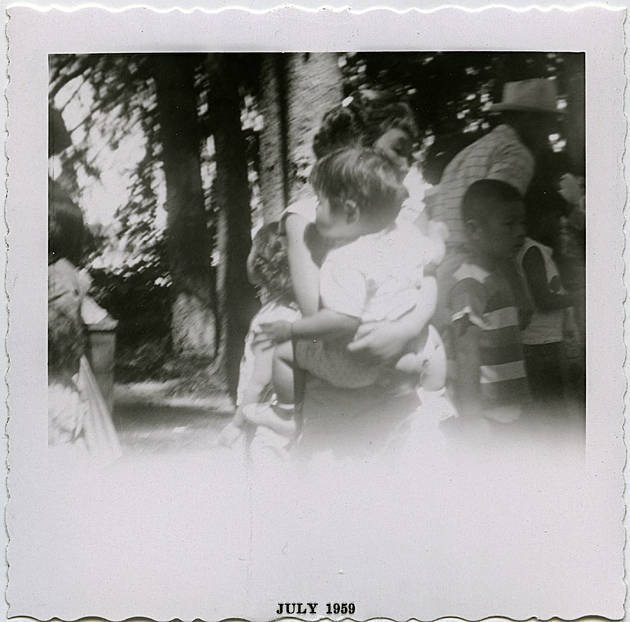
Black and white (overexposed) image of a woman holding a young child in her arms. Another boy can be seen clearly in the background in front of a man and more children. The picture bears a stamp reading 'July 1959' on the border. Though the event being recorded in this image is unknown, museum records identify the people in the image as members of a group of 'potato pickers,' most likely migrant workers. Migrant farm labor has been an important part of agriculture in Washington County since the early 1900s, though the cultural groups which provide the majority of the laborers have changed over time.
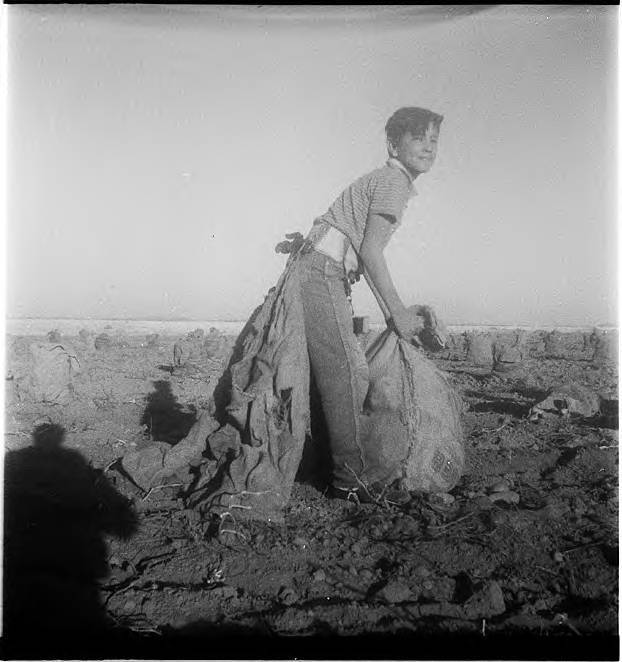
A boy holding a burlap bag full of potatoes, working the harvest in a field in Washington County, Oregon. Empty bags hang from his belt behind him, and the wooden frame which holds the bag open as the worker fills it hangs from his belt in front. He wears jeans, shoes, and a striped, short-sleeve shirt. Filled bags of potatoes dot the bare field behind him. These bags were traditionally suspended between the workers legs, with the worker bending over at the waist to fill the bag as it drags along the ground with each step. Museum records identify the boy in the image as a 'potato picker,' and he is most likely a migrant worker. Migrant farm labor has been an important part of agriculture in Washington County since the early 1900s, though the cultural groups which provide the majority of the laborers have changed over time.
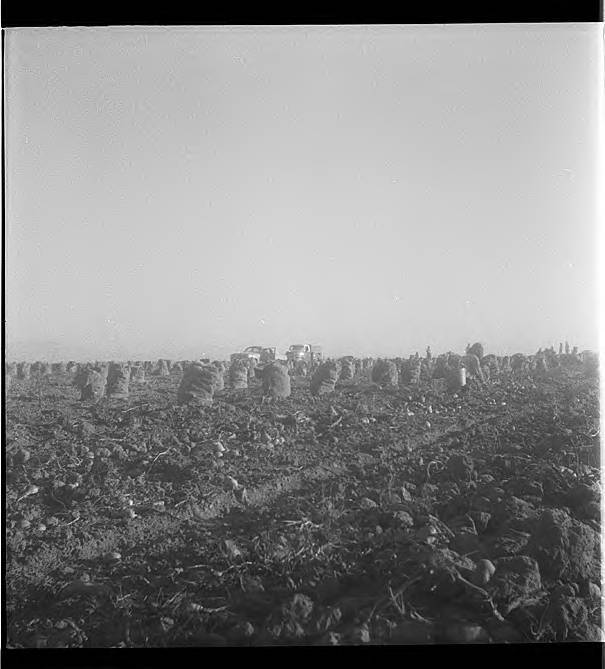
A bare field in which has been recently harvested with bags of potatoes standing throughout. This was somewhere in rural Washington County, Oregon. Workers can be seen in the background, with a car and a side panel pick-up truck parked nearby. Museum records identify the people in the image as members of a group of 'potato pickers,' most likely migrant workers. Migrant farm labor has been an important part of agriculture in Washington County since the early 1900s, though the cultural groups which provide the majority of the laborers have changed over time.
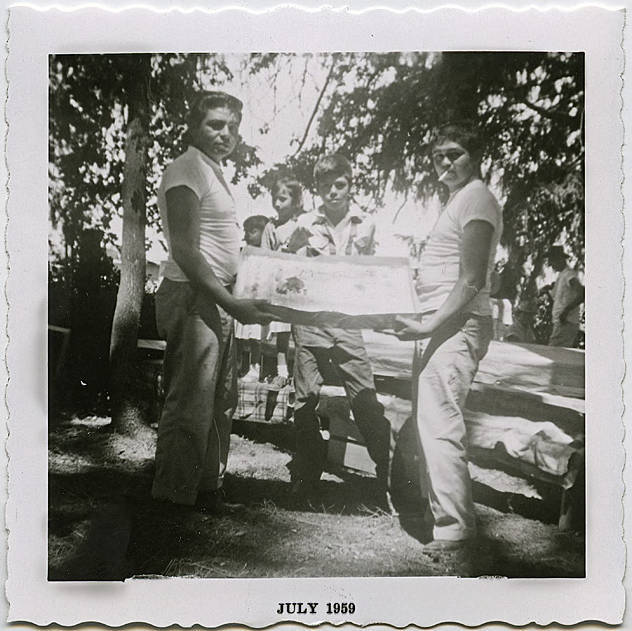
Black and white image of two men holding a decorated sheet cake in a shaded picnic area, while a young boy stands behind watching. Two other children stand on the bench beside a covered picnic table. the men wear jeans and white t-shirts. The image is overexposed and the details of the cake's inscription are not legible, but the picture bears a stamp reading 'July 1959' on the border. Though the event being recorded in this image is unknown, museum records identify the people in the image as members of a group of 'potato pickers,' most likely migrant workers. Migrant farm labor has been an important part of agriculture in Washington County since the early 1900s, though the cultural groups which provide the majority of the laborers have changed over time.
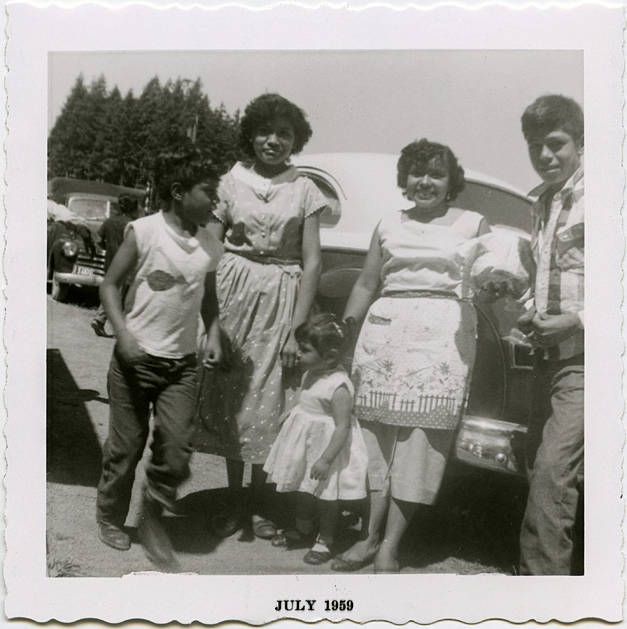
Two women and three children at a migrant labor camp in Washington County, Oregon in 1959. One of the women leans against an older model car, while the other stands next to her. Both wear dresses. A little girl in a dress stands between them, while two older boys stand on either side of the group. Printed on the bottom of the photograph are the words 'July 1959.' Museum records identify the people in the image as members of a group of 'potato pickers,' most likely migrant workers. Migrant farm labor has been an important part of agriculture in Washington County since the early 1900s, though the cultural groups which provide the majority of the laborers have changed over time.
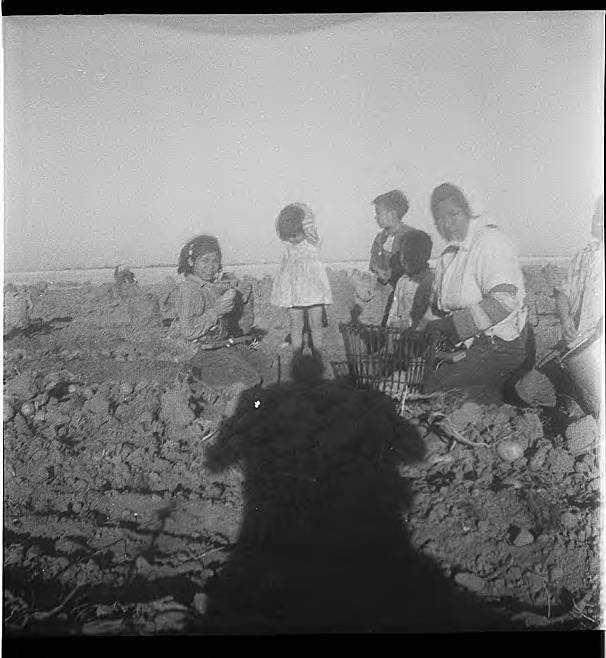
Black and white (overexposed) image of a woman with several small children sitting in a bare field. She kneels beside a wire basket and wears gloves and arm guards as she picks potatoes up from the ground. Small children stand with her, while one slightly older child kneels nearby, holding a potato ready to place in the bag behind her.
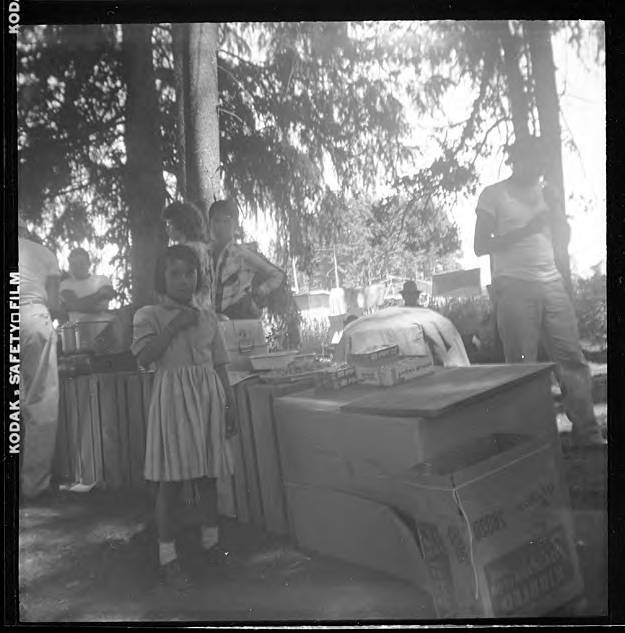
Black and white image of a young girl standing on front of a makeshift table made of crates and boxes. She wears a short dress, white socks and shoes. The table is piled with utensils and dishes of various kinds, and a people are gathered about it behind her. Tall pine trees shade the group. Museum records identify the people in the image as members of a group of 'potato pickers,' most likely migrant workers. Migrant farm labor has been an important part of agriculture in Washington County since the early 1900s, though the cultural groups which provide the majority of the laborers have changed over time.
Black and white (overexposed) image of a man harvesting potatoes in a field. He stands with a burlap bag between his legs, the mouth of the sack attached at either end to a bar suspended from his belt loops, keeping it open. He carries empty bags attached to his belt at the back. While the field is bare and any visible plants are dried and apparently dead, unharvested potatoes can be seen laying on the ground in front of the worker. Behind him, another worker is bent over his own sack, and several filled sacks sit in the field behind them. Museum records identify the people in the image as 'potato pickers,' and they are most likely migrant workers. Migrant farm labor has been an important part of agriculture in Washington County since the early 1900s, though the cultural groups which provide the majority of the laborers have changed over time.
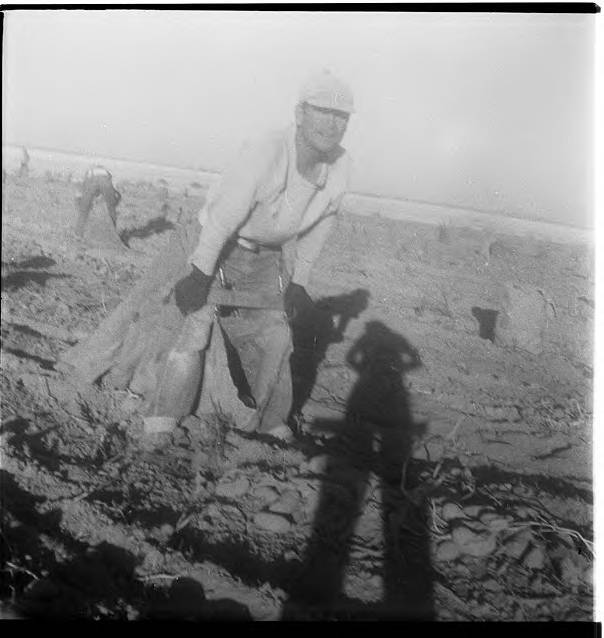
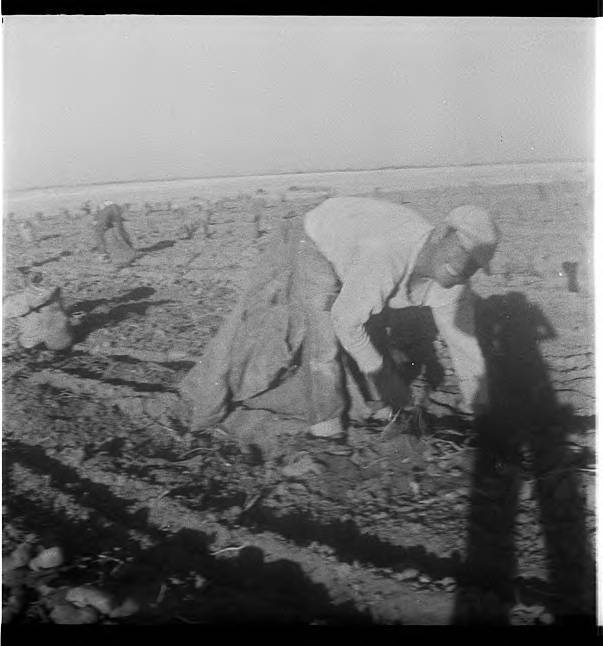
Black and white (overexposed) image of a man bent over as he pulls potatoes from the ground in a bare field. He wears pants, gloves, a long-sleeved shirt, and a hat. A burlap bag is suspended between his legs, held open by a wooden bar so that it can be filled with potatoes as he works his way down the row. Another worker can be seen in the left of the image, bent over as they also pick up potatoes. Filled sacks of potatoes are scattered throughout the field, and what appear to be a few potatoes are piled in the left foreground of the image. Museum records identify the man in the image as members of a group of 'potato pickers,' most likely migrant workers. Migrant farm labor has been an important part of agriculture in Washington County since the early 1900s, though the cultural groups which provide the majority of the laborers have changed over time.
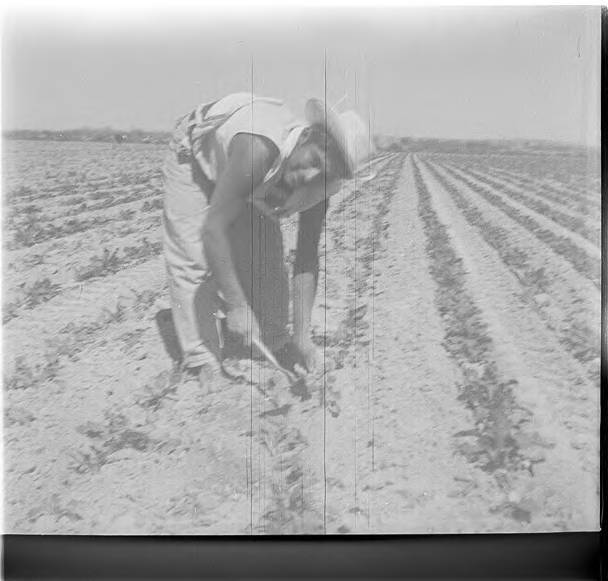
Black and white (overexposed) image of a man bent over as he uses a small Warren hoe in a planted field. He wears pants, a sleeveless shirt, and a straw hat, and holds the hoe in one hand while he lifts a plant leaf with the other. The planted rows extend into the distance, and the plants themselves are small. Museum records identify the man as a 'potato picker.'
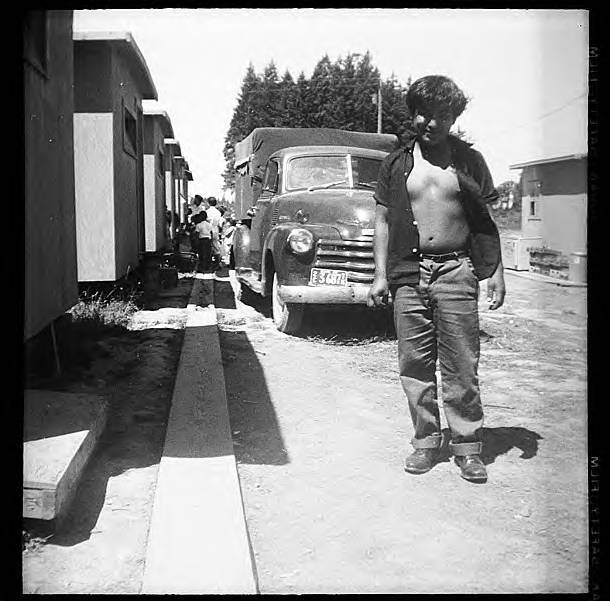
Black and white image of a young boy standing next to a row of small houses. A board runs along the ground in front of the houses as a sidewalk, and a truck with a covered panel back is parked behind him. The young man wears jeans, shoes, and a dark shirt and smiles toward the photographer. In the background a group of adults and children are gathered in front of one the small houses. Museum records identify the people in the image as members of a group of 'potato pickers.' Migrant farm labor has been an important part of agriculture in Washington County since the early 1900s, though the cultural groups which provide the majority of the laborers have changed over time.
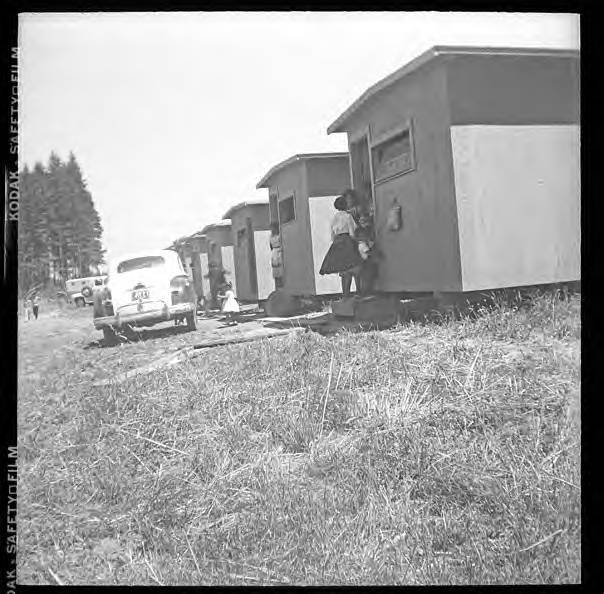
Black and white image of a row of narrow houses set up on blocks along the edge of a field. Several women and a young child stand in the doorway of the near home, while another woman in the next doorway watches young children play in the dirt in front of the houses. An empty washtub lays on the ground in front of her house. A car and a pickup are parked in front of the houses, and a stand of trees fills the upper left of the image. Museum records identify the people in the image as members of a group of 'potato pickers.' Migrant farm labor has been an important part of agriculture in Washington County since the early 1900s, though the cultural groups which provide the majority of the laborers have changed over time.
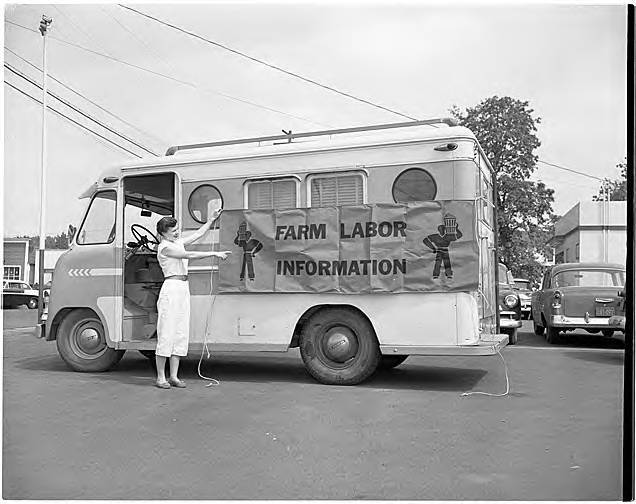
Black and white image of a woman holding up one end of a sign that has been tied to the sides of a van. She points to the sign, which bears a drawing of two men, each holding a basket on one shoulder, on either side of the legend 'Farm Labor Information.' The woman has short hair and wears Capri pants and a short top. The van is parked in a parking lot, with a number of cars and buildings visible beyond it. Migrant farm labor has been an important part of agriculture in the area since the early 1900s, though the cultural groups which provide the majority of the laborers have changed over time.
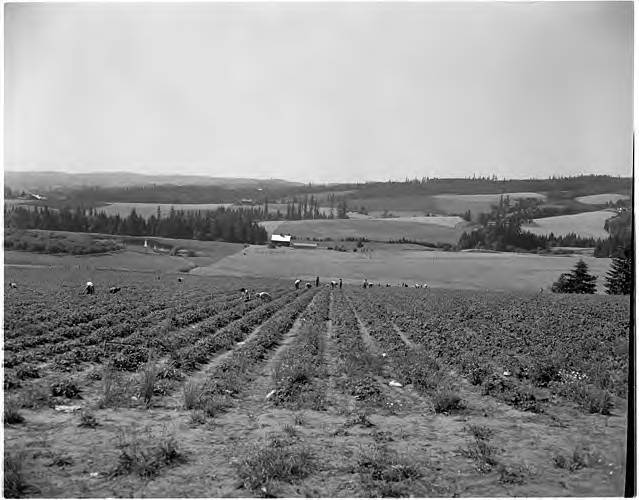
Black and white image of a strawberry field with workers. Fields and patches of forest stretch away in the background of the image. Museum records do not identify a specific location for this image, but the negative was part of the Herbert McMullen bequest. McMullen was an area photographer who also collected images of the area.
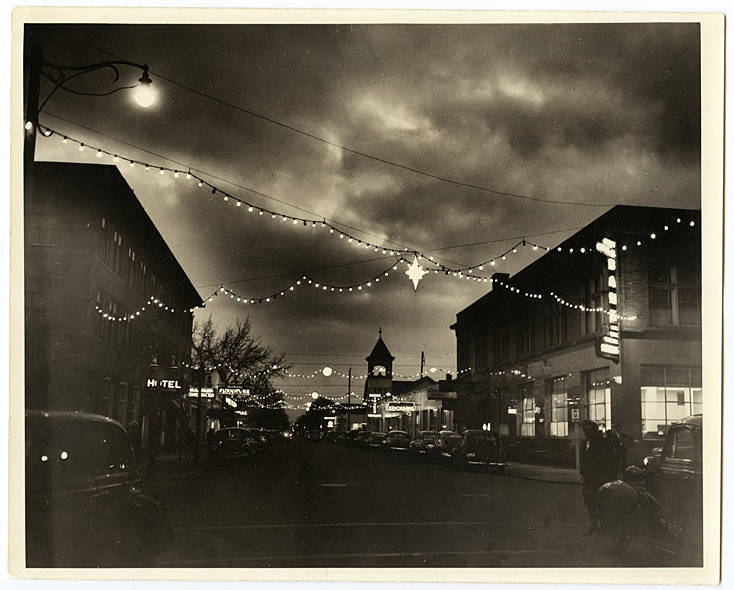
Black and white image of a city intersection at night. Neon signs are lit up above many of the buildings, advertising banks, hotels, a chiropractor and at least two car dealerships. According to museum records, this is the intersection of Main and Second Streets in Hillsboro, looking south, during the Christmas season of 1948.
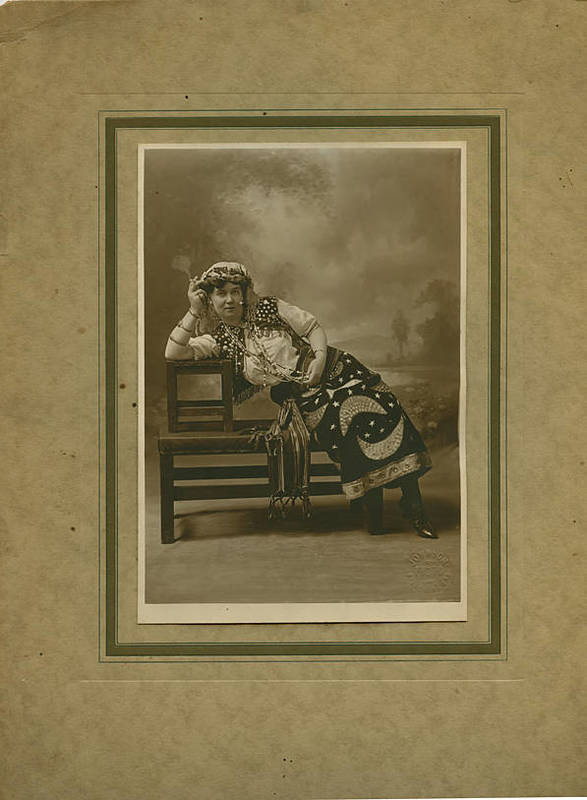
A woman in costume leans on a bench while smoking a cigarette. She is posing in a photo studio. Her costume may be in imitation of a Roma person, or is imitating a Southwest Asian and/or North African style of dress.