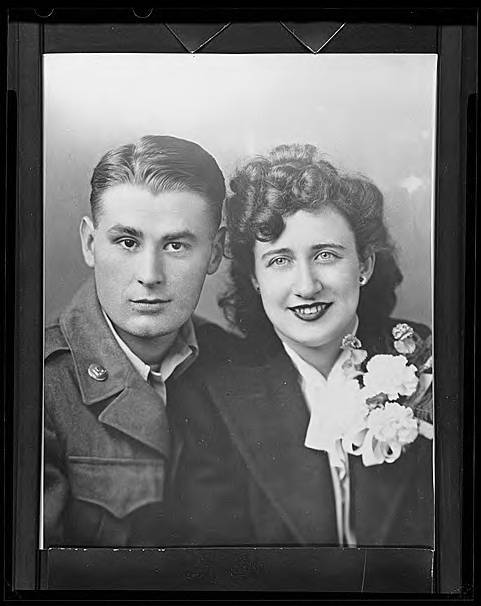
Black and white reproduction of an image of a man and a woman, possibly a wedding portrait taken during World War II. The man wears what appears to be a uniform, while the woman has on a jacket and light colored blouse. A large corsage is fastened to one lapel of her coat. The woman's shoulder-length hair is softly curled and pulled back from her face, except for her bangs. She wears earrings and dark lipstick. The young man's hair is parted on one side and slicked back. Museum records do not identify the couple, but the image is part of the Herbert E. McMullen bequest. Mr. McMullen, a local photographer, also collected images of daily life in the area from other sources and photographers.
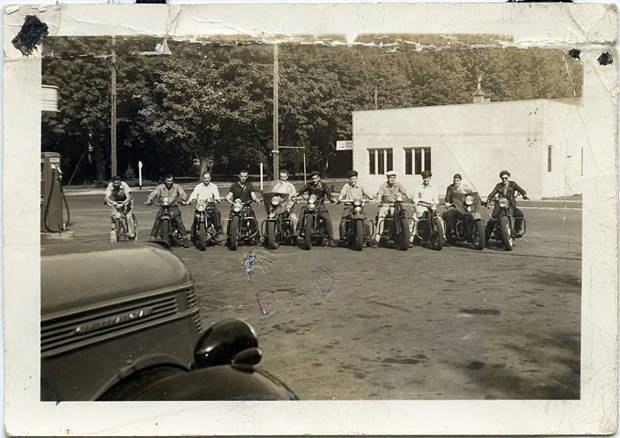
Black and white image of a group of ten men arranged in a row, all on motorcycles. At least one of the motorcycles appears to have the deeply valanced fender indicating it was made by the Indian Motocompany. Several of the men wear Gatsby or newsboy hats of various colors, and two have on leather jackets. The rest of the men wear casual shirts and pants. A younger man sits on his bicycle at the image left end of the row. Those who are not wearing hats wear their hair greased back, a style popular in the 1940s. The men have arranged their motorcycles on what appears to be the parking lot of a gas station, with an unidentifiable building in the background and what appears to be a filbert orchard across the street from their location. Someone has tried to write in pen on the front of the picture, drawing an arrow pointing at the man third from the left end of the row of motorcycles and writing 'Dad' beneath the arrow. This image is part of the Herbert E. McMullen bequest. Mr. McMullen, a local photographer, also collected images of daily life in the area from other sources and photographers.
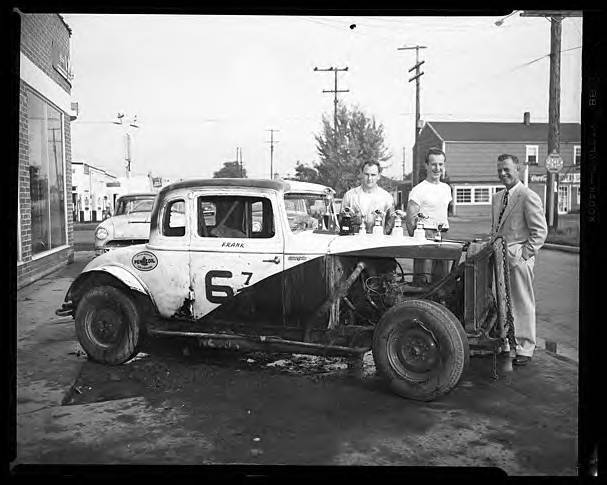
Black and white image of what appears to be a 1932 Ford Deuce that has been modified as a 'hot rod' or race car. Sitting on the hood of car are a number of trophies related to racing, and three men stand behind the car, one in mechanic's overalls, one in a t-shirt and pants, and one in a suit. The number '6 7/8' is painted on the door, and beneath the door window is the name 'Frank.' A 'Penz Oil' sticker is on the body of the car near the back fender. The side panels and fenders have been removed from the front of the car, revealing the enhanced engine, and the front windshield has been replaced with mesh. Rolls bars can be seen inside the car, and the doors are hinged at the back so they open at the front, a style commonly known as 'suicide doors.' The car is parked along a city street in what appears to be an industrial area, with gas stations and garages on either side of the street behind the car and its people. This image is part of the Herbert E. McMullen bequest. Mr. McMullen, a local photographer, also collected images of daily life in the area from other sources and photographers.
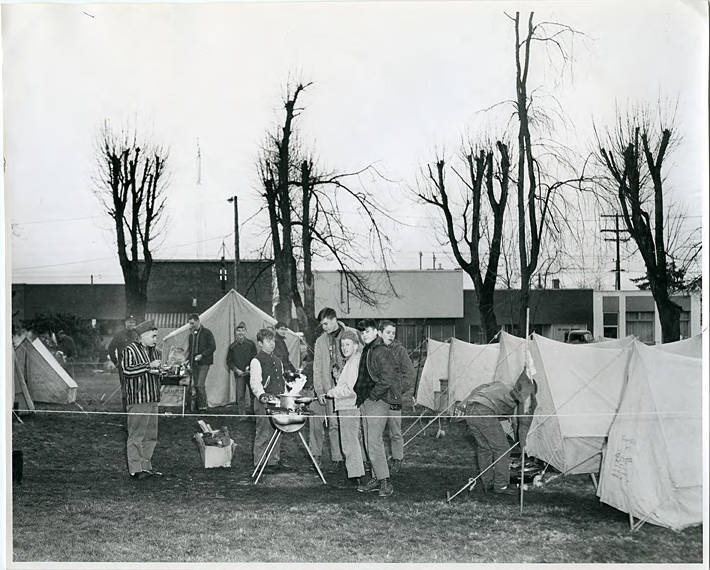
Black and white image of a group of boys gathered around a small grill set up on three legs. Two of the boys appear to be cooking while the others observe. Six small tents and one larger one are pitched in rows around the area where the boys stand, and other men and boys can be seen in the background. Houses and buildings are visible just beyond the tents, and a row of severely pruned trees dominates the skyline above them. Museum records suggest this could be Hillsboro Boy Scout Troop 216, camping out at the Washington County Courthouse shortly after the Columbus Day Storm.
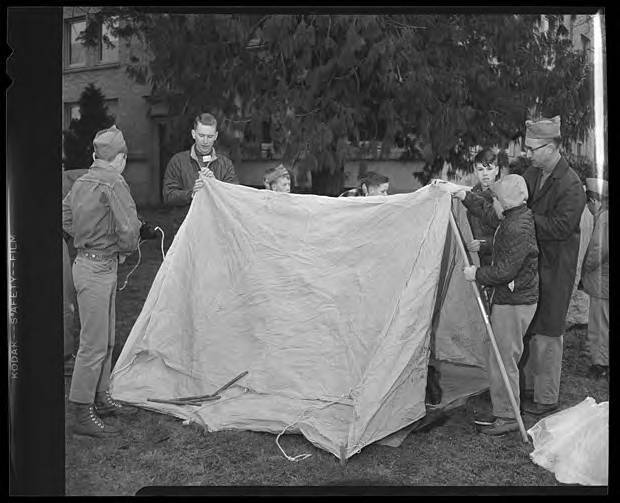
Black and white image of a man showing a young boy how to place the center pole at the front entrance of a tent while other boys watch. Another man secures the pole in the rear of the tent. Washington County Courthouse is just visible in the background. Museum records indicate that this group was very likely part of Hillsboro Boy Scout Troop 216. This image is part of the Herbert E. McMullen bequest. Mr. McMullen, a local photographer, also collected images of daily life in the area from other sources and photographers.
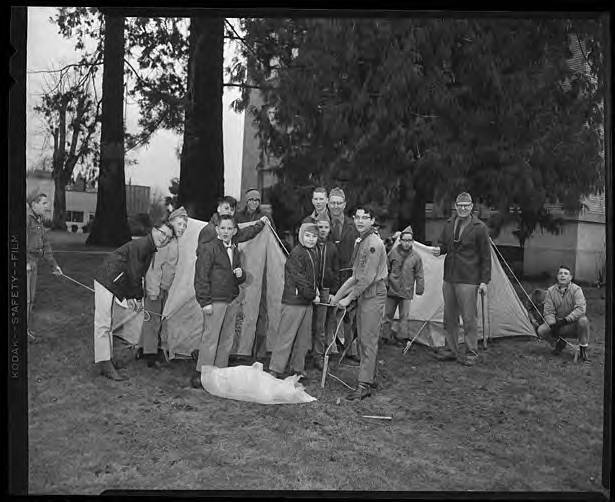
Black and white image of a group of boys and men putting tents up on the Courthouse lawn. Several of the boys wear Boy Scout uniforms, as do two of the men. Museum records identify this group as most likely to be Hillsboro Troop 216. This image is part of the Herbert E. McMullen bequest. Mr. McMullen, a local photographer, also collected images of daily life in the area from other sources and photographers.
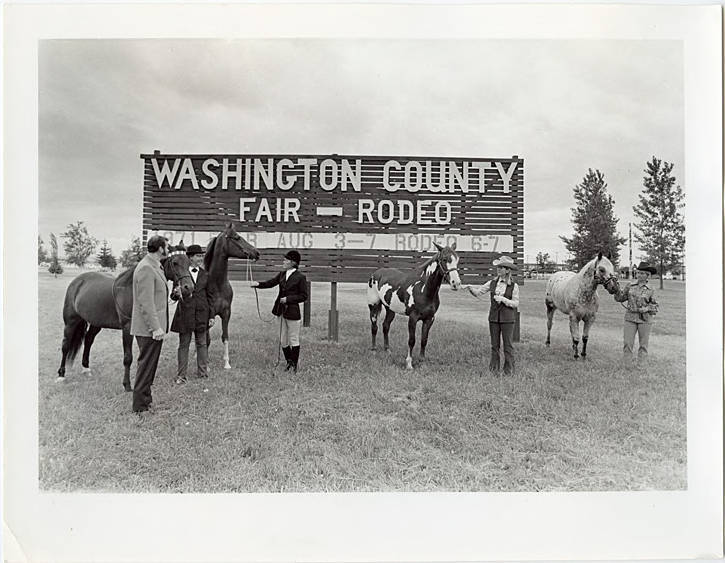
Black and white image of a sign for the Washington County Fair and Rodeo at the Fairgrounds. In front of the sign stand four women with their horses, two dressed as English riders or hunters, and two in Western wear. The horses range from solid color to paint and Appaloosa.
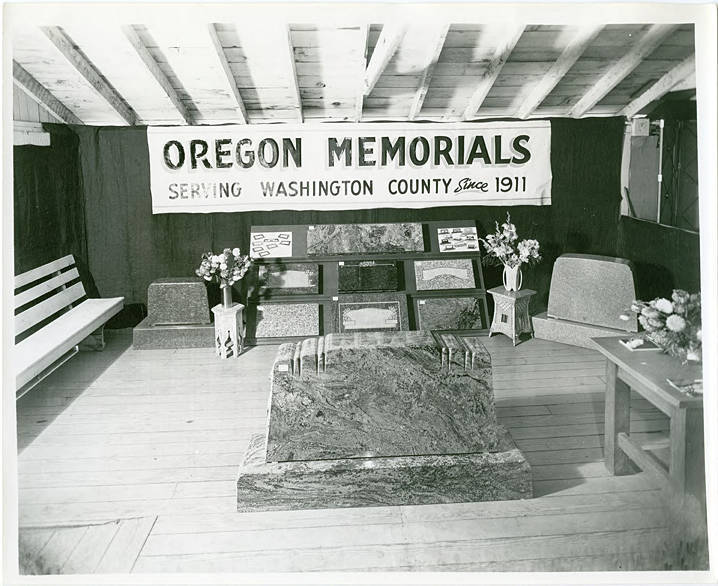
Black and white image of a booth at a fair showing various tombstones for purchase. The sign on the back wall reads 'Oregon Memorials, serving Washington County since 1911.' The tombstones are all either flat, perpetual care styles or the plain monument style common in the 20th century.
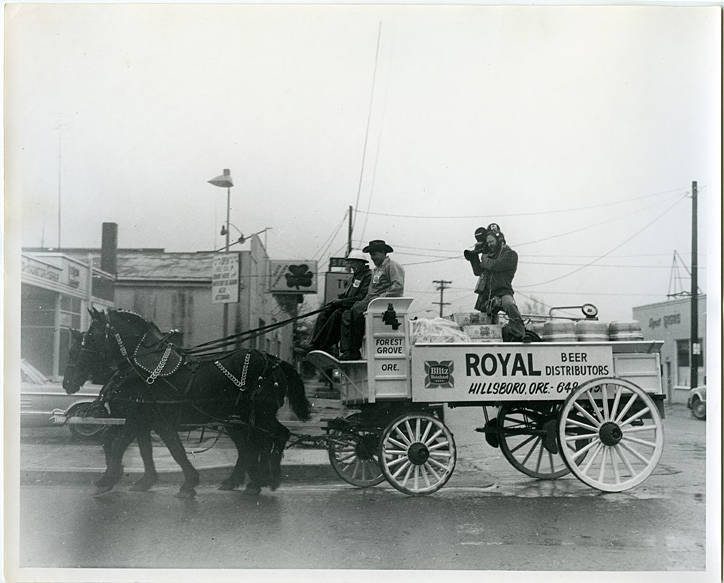
Black and white image of two men with cowboy hats driving a white wagon hitched to a dark pair of horses. The sign on the wagon reads 'Royal Beer Distributors, Hillsboro, Ore. 649-[illegible]. Blitz Weinhard Beer.' The wagon has several kegs and some cases of beer. A man with a camera over his shoulder stands in the middle of the wagon, filming over the shoulders of the drivers.
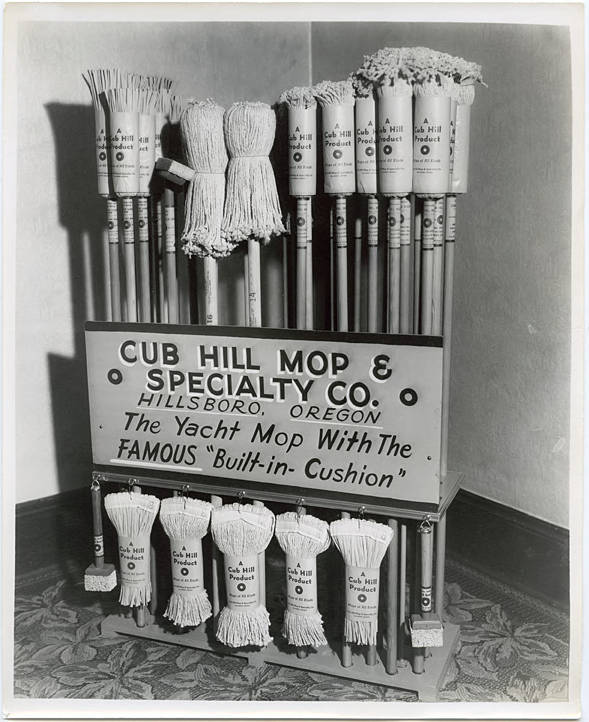
Black and white image of a stand displaying mops and mop head replacements made by the Cub Hill Mop & Specialty Company. The mops were made in a house in Hillsboro.
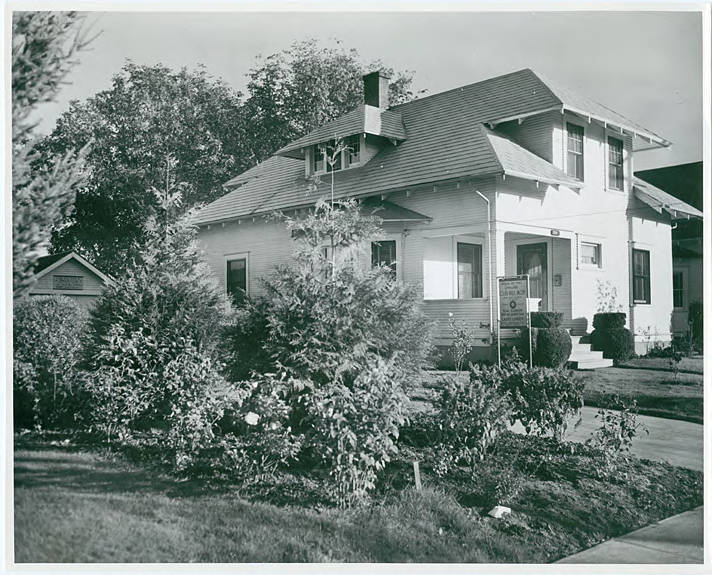
Black and white image of a two-story bungalow style house. The sign in front of the house indicates that it is the home of 'Cub Hill Mop and Specialty Co.' The house served as the 'factory' for the products, mostly mops and other cleaning tools, sold by the company.
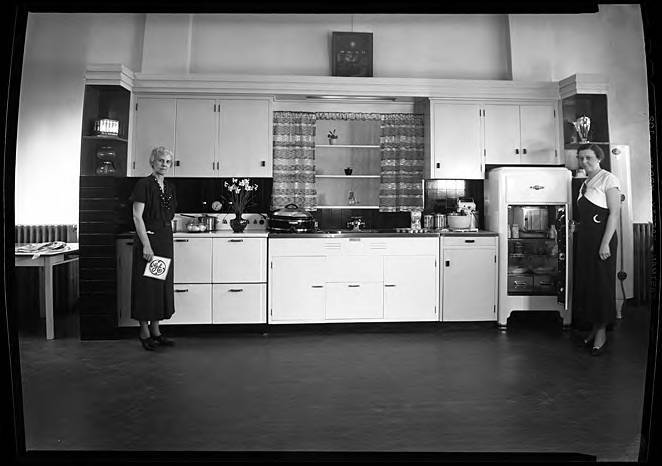
Black and white image of a model kitchen, built by Portland General Electric to advertise the advantages of electrical appliances such as refrigerators, stand mixers, and electric ranges.
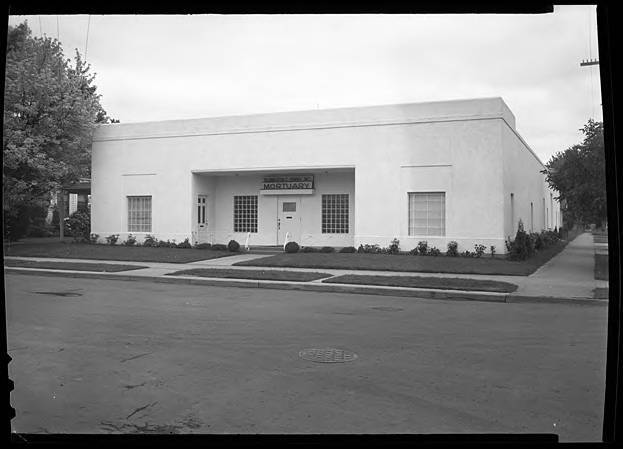
Black and white image showing the exterior of a modern style building with a recessed entryway. A sign above the door identifies the building as the Donelson and Sewell Mortuary. The Donelson, Sewell, and Matthews Mortuary merged with the Bronleewe Bass home in 2008, and no longer uses this building on NW Third Avenue.
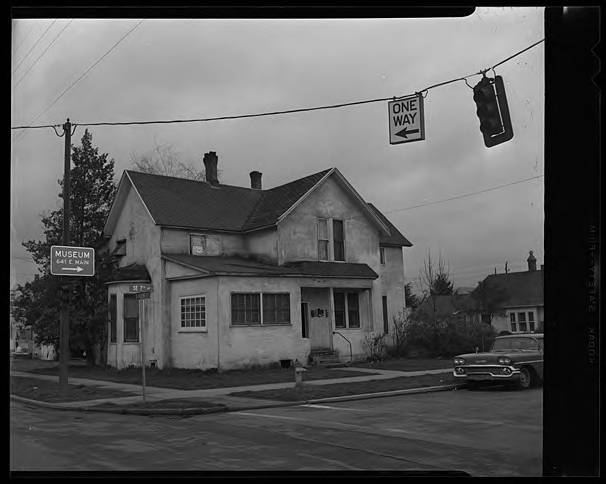
Black and white image of a house on the corner with a street light hanging across the intersection. A large sign on the power pole indicates that the museum is down the street, address 641 E. Main. The house is two story, cross-gabled, with a stucco exterior.
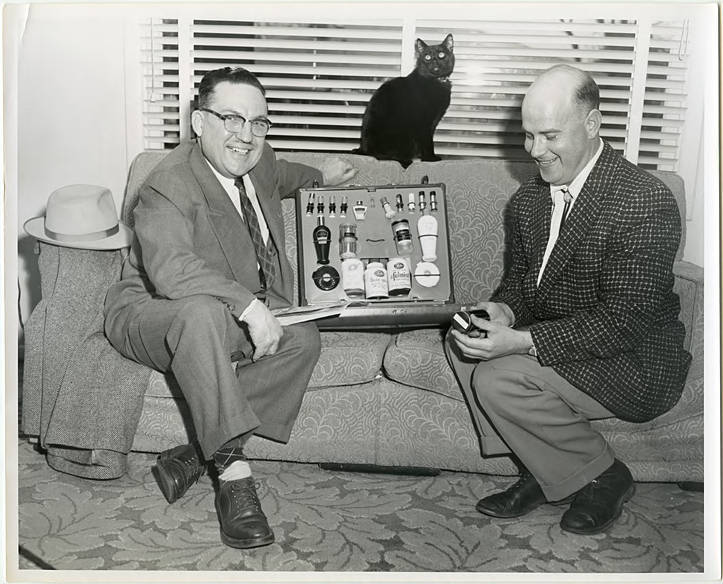
Black and white image of two men seated on a couch with an open display case between them. One man looks at an item from the case while the other smiles at the camera. The second man's coat and hat lay on the arm of the couch behind him. A black cat observes from the back of the couch.
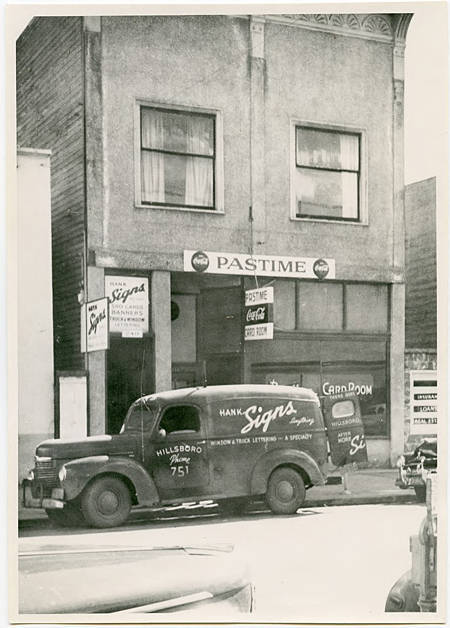
Black and white image of a two story building advertising a card room inside. A truck for 'Hank Signs Anything' is parked in front of the building and signs indicate that Hank signs his signs somewhere on the premises.
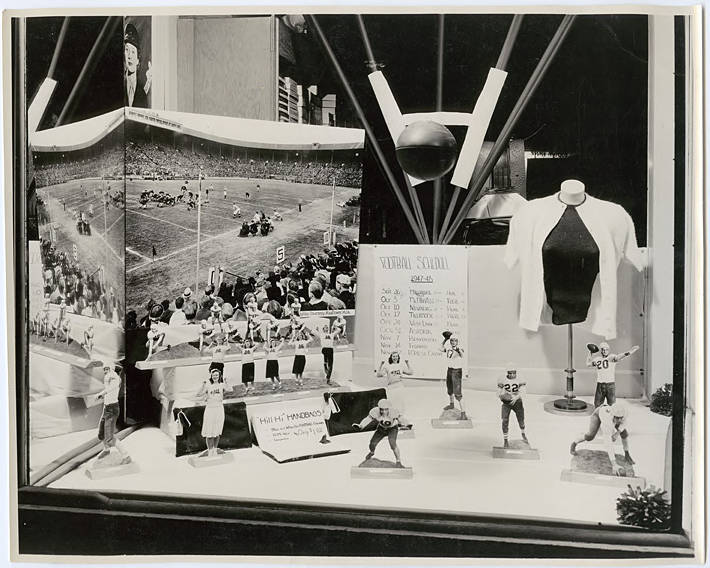
Black and white image of a store's display window featuring Hillsboro High School Football, 1947-1948. Small figures of the football players and cheerleaders are featured in the display in front of a large picture of a football game, and a manikin wearing a dark shirt and a white sweater sits in the corner. A sign gives the schedule on the back wall of the display.
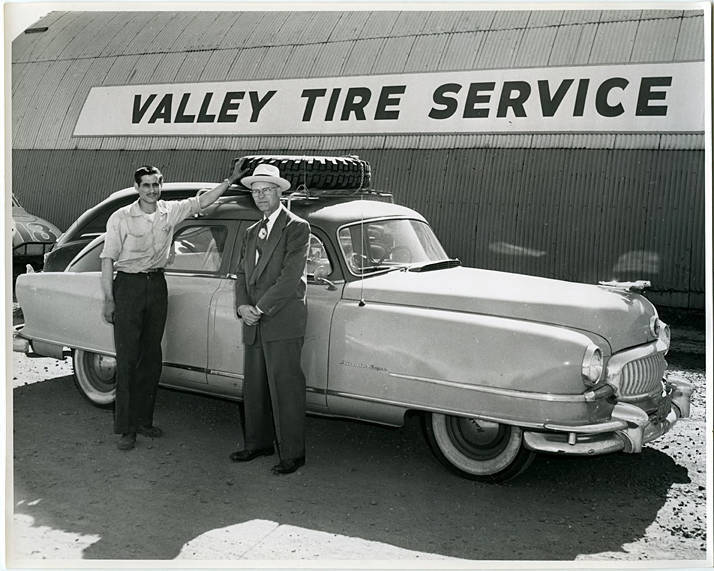
Black and white image of two men standing beside a car. One man wears work clothes and has one hand on a tire fastened to the roof of the car, while another man wears a suit and has a hat. In the background is a Quonset Hut style building with a sign stating that it is the 'Valley Tire Service.'
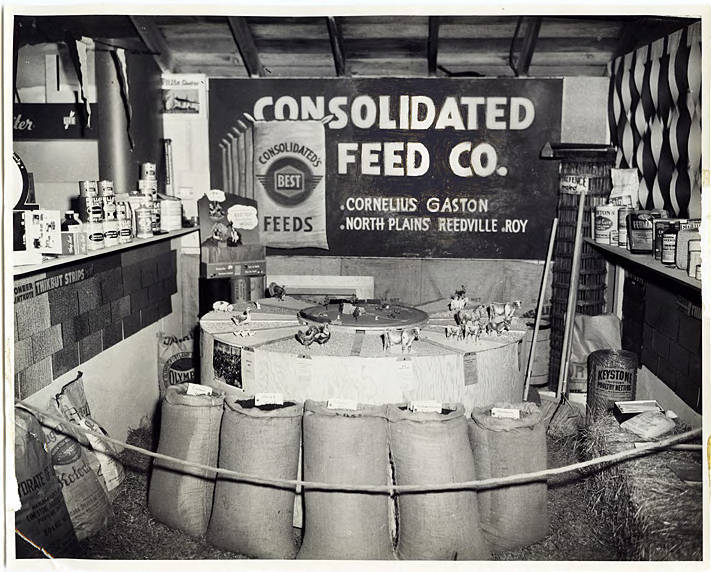
Black and white image of the interior of a feed store. A wheeled container with small model animals on top indicates what kinds of feeds are available for which animals. Chemicals, paints, and other goods line shelves along the edges of the room, and samples of fencing and 'poultry netting' are stacked in one corner. Locations for the Consolidated Feed Co. included Cornelius, Gaston, North Plains, Reedville, and Roy, though museum records do not identify which location is pictured here.
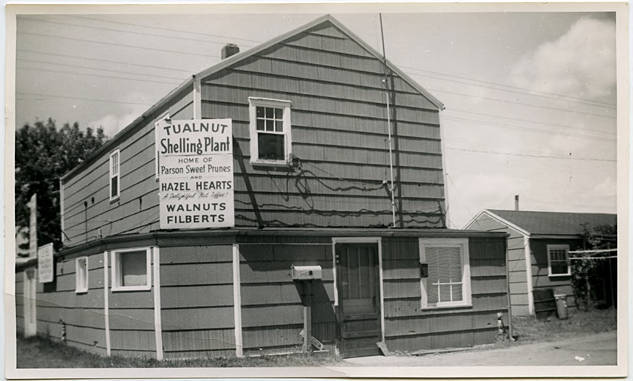
Black and white image of a two story building. A sign on the second floor indicates this is the 'Tualnut Shelling Plant,' home of 'Parson Sweet Prunes' and 'Hazel Hearts' nut toffee. Prunes and hazelnuts (or filberts) have been one of the most important cash crops in Washington County for generations.
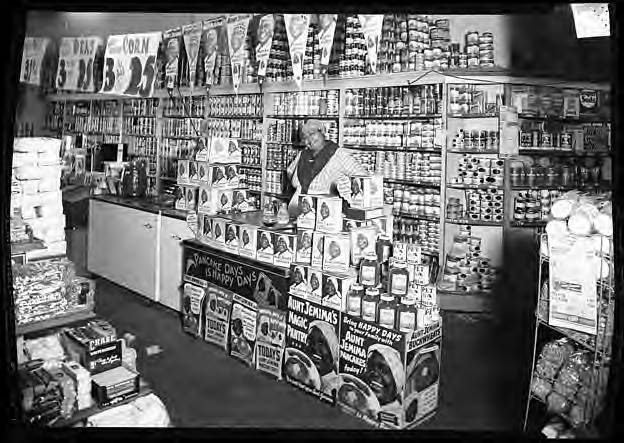
Black and white image of the interior of a grocery store. Cans fill the shelves, but the focus of the picture is a woman dressed as 'Aunt Jemima' to promote her ready-made pancake and buckwheat corn and wheat flour mixes. Jars of coffee grounds and pet milk fill in the end of the display. Museum records identify the location as the Fairway Grocery Store in Hillsboro.
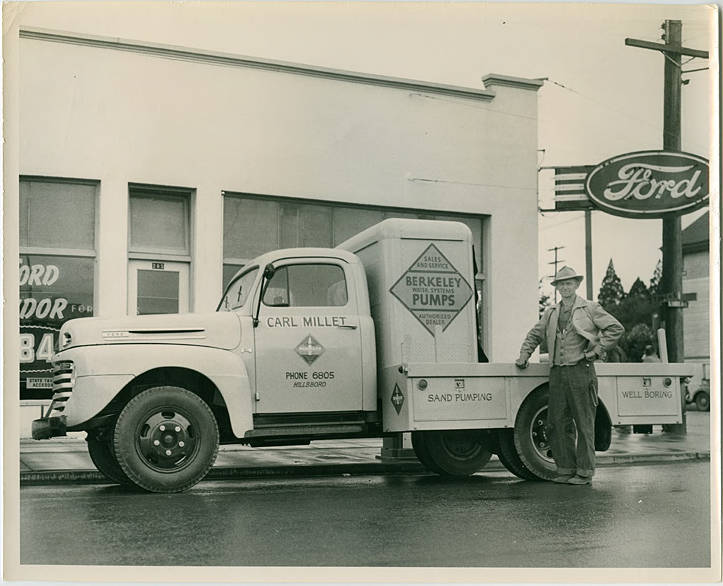
Black and white image of a man standing beside a truck in front of a Ford dealership. He stands with one hand on the bed of the truck and wears a jacket over work clothing of a sweater, shirt, and pants. The truck advertises 'Sales and Service' for 'Berkeley water systems Pumps,' 'Sand pumping,' and 'Well boring.' The name on the door of the truck is Carl Millet, of Hillsboro.
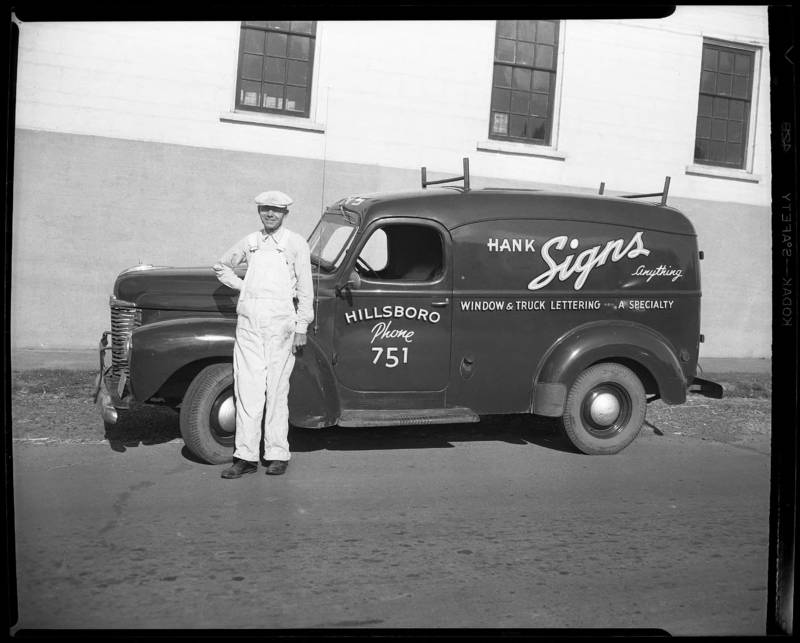
Black and white image of a man standing beside a company van. Painted on the side of the van is 'Hank Signs Anything. Window & Truck Lettering A Specialty. Hillsboro, Phone 751.'
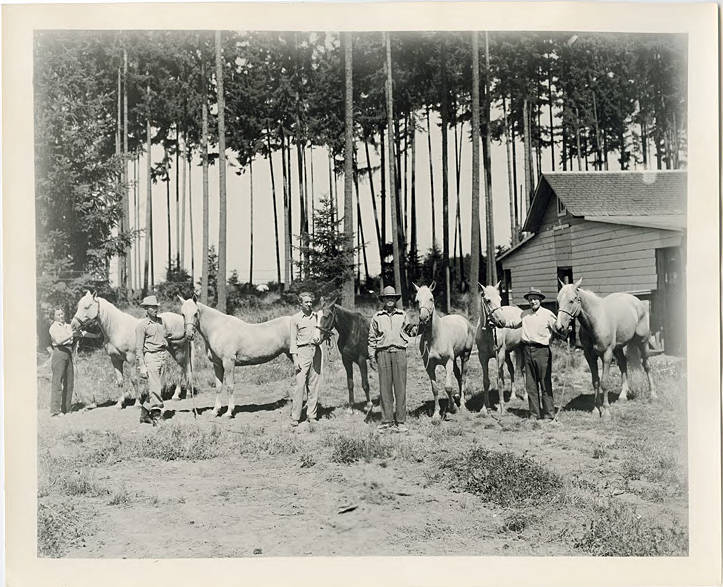
Black and white image of five people holding the bridles of half a dozen horses, all standing in a row in front of a banner with a number of tall pine trees in the background. Museum records identify this as the Washington County Fair, sometime during the 1940s when it was being held at Shute Park in Hillsboro.