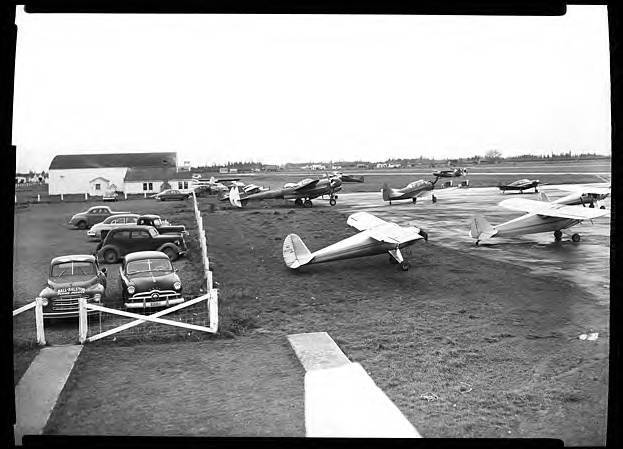
Black and white image of a number of airplanes sitting on an airfield, next to a parking lot with cars. In the background are a hangar and other buildings. One of the airplanes is a Lockheed P-38, with twin booms, a design which saw extensive use in the Pacific during World War II. One of the trucks in the left image foreground belongs to the Ball-Ralston Flying Service, owned by Norman Ralston and Ed Ball, one of the first businesses opened at the airport.
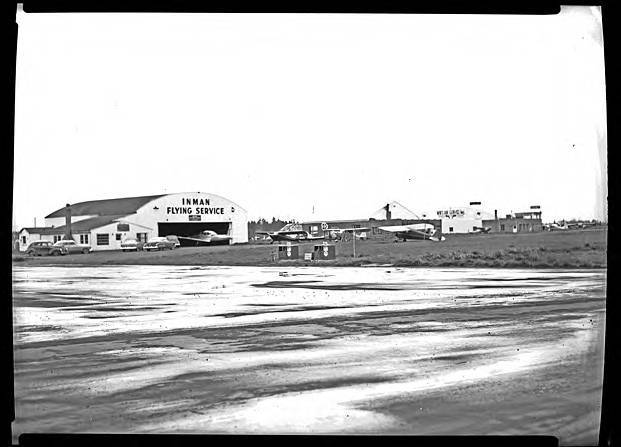
Black and white image of Quonset hut style hangar, with a number of airplanes and cars parked in and around it. Several other buildings and another Quonset hut dominate the background, and trees can be seen in the far distance. An empty runway dominates the front of the image, with two small gasoline pumps at its edge.
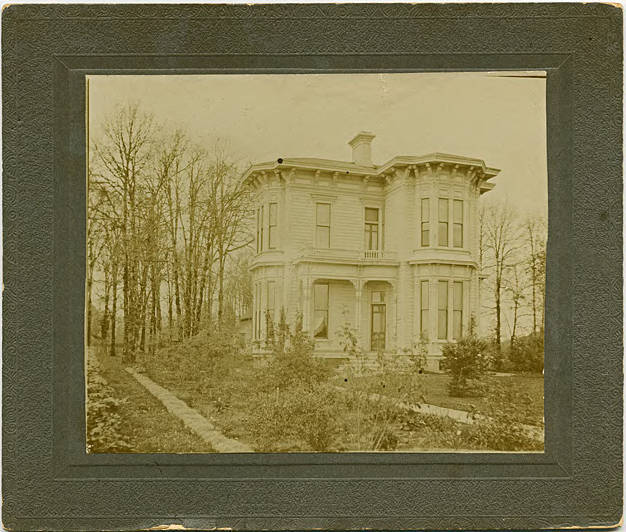
Sepia-toned image of a two-story, Italianate house set in a yard surrounded by gardens and trees. Set in a four-acre block near the center of town, the house was built by a local dentist and his wife, George and Adeline Rogers, and was dismantled in the 1930s by new owners, who used materials from the house to build a new home nearby. The property is now a city park, Rogers Park.
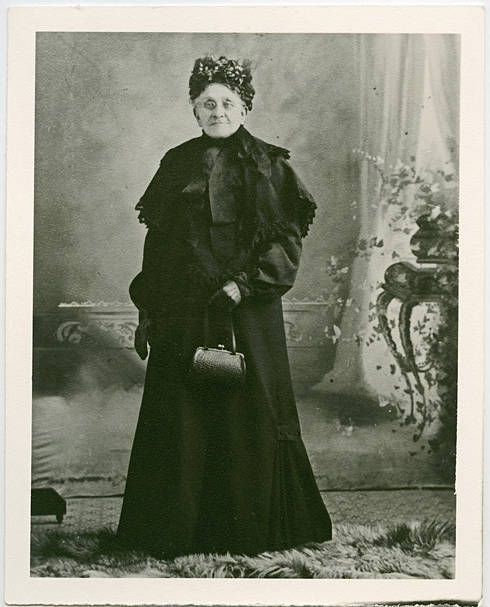
A full-length studio portrait of Sarah Turner Crowther (1832-1915). Sarah immigrated from England to the United States at the age of 17. She moved to Washington County, Oregon in the late 1880s with her husband Israel Crowther, a weaver, and several of their children. They lived in Forest Grove for 25 years. In this photograph, she is pictured wearing a dark dress, a hat, shawl, purse and eyeglasses. She is standing on a fur rug, and behind her is a painted studio backdrop of a parlor scene. This photograph was likely taken in Forest Grove around 1900-1909.
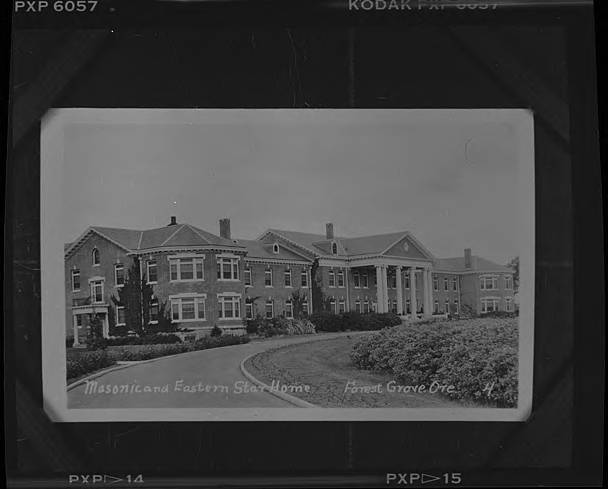
A photograph of the Masonic and Eastern Star Home in Forest Grove, Oregon, as seen from the driveway on its southwest side. This facility opened as a retirement home funded by the Masonic Lodge of Oregon in 1922, housing sick and elderly Masons. In 1999, the retirement home moved to new premises on the north side of the property. The original buildings shown here were sold to the McMenamins hotel chain, which renovated and reopened the property as the Grand Lodge hotel in 2000.
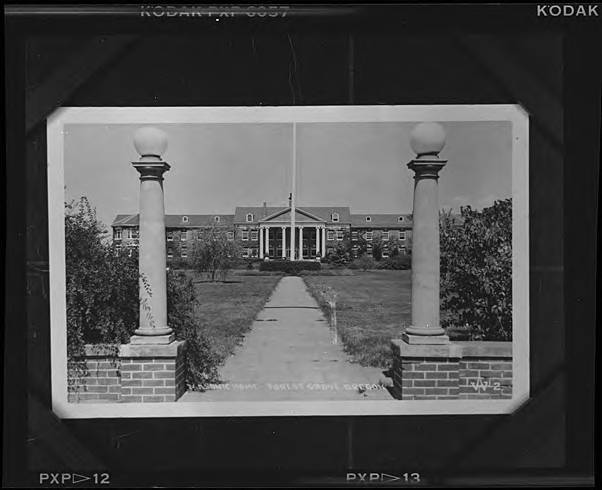
A photograph of the Masonic and Eastern Star Home in Forest Grove, Oregon, as seen from Pacific Avenue on its south side. This facility opened as a retirement home funded by the Masonic Lodge of Oregon in 1922, housing sick and elderly Masons. In 1999, the retirement home moved to new premises on the north side of the property. The original buildings shown here were sold to the McMenamins hotel chain, which renovated and reopened the property as the Grand Lodge hotel in 2000. In this photograph, the entrance gate appears in the foreground; a flagpole is in the middle-ground; and the retirement home is in the background.
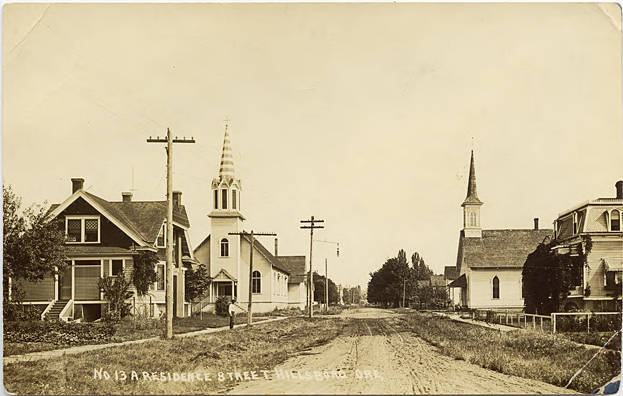
Looking north through the intersection of SE 3rd and Walnut Streets in Hillboro, Oregon. A dirt road runs north, between two grassy verges. Sidewalks run along each verge, and houses and two church buildings are visible, as well as power lines. A man stands on the sidewalk beside the house at the left. The church on the image left of the intersection is St. Matthew's Catholic Church, though the rectory now sits where this building is located, with the church on the northeast corner of the block. The house on the right is the Rice-Gates House at 308 SE Walnut Street, which was built in 1890. It is on the National Register of Historic Places. The house on the left is 272 SE Walnut Street, which was built in 1910.
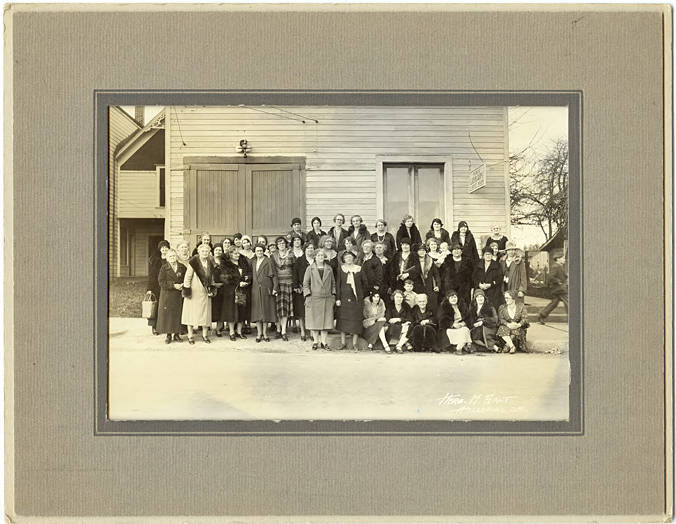
Black and white image of a group of women gathered in front of a wooden building. The sign hanging above them indicates the building is the Public Library and it has a rest room in side. Some of the women wear fur coats; most wear somewhat shapeless dresses of the style in the 1930s. Cloche hats and round, dark framed glasses further set the photo in the late 1930s.
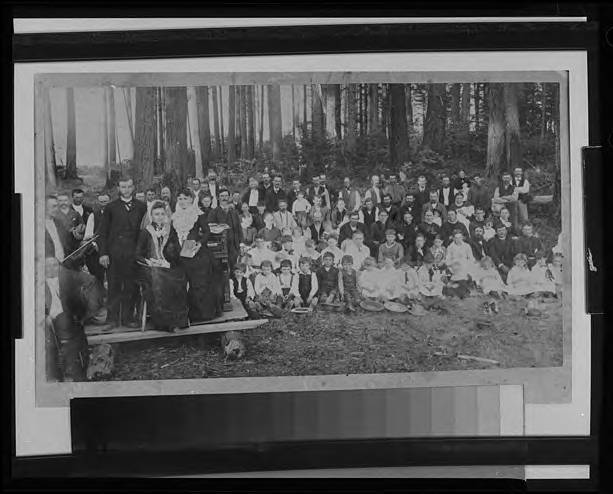
Black and white image of a group of people gathered behind a bride and groom. The bride, wearing a dark, fitted dress that buttons down the front and a lace veil, sits on a chair set up on a temporary platform. Her groom stands behind her, and next to her is a woman wearing a large white lace collar and holding a book. An organ is just visible behind her. A man holding a fiddle and bow sits next to the groom, who wears a three-piece 'sack' style suit. The rest of the crows is seated in orderly rows with the children in front and then couples and then men standing in the very back.
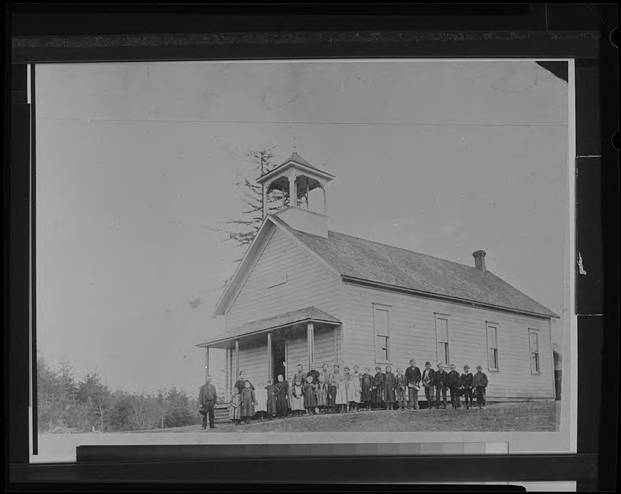
Black and white image of a group of children gathered outside a one-room schoolhouse. The wooden building features a high, gabled roof and a square bell tower on the front apex. The children are grouped according to gender, and the girls wear skirts and pinafores while the boys mostly wear jackets and pants. One boy appears to wear a 'Little Lord Fauntleroy' outfit with a large lace collar and knee-length pants. Helvetia was predominantly settled by German-speaking Swiss immigrants in the 1870s.
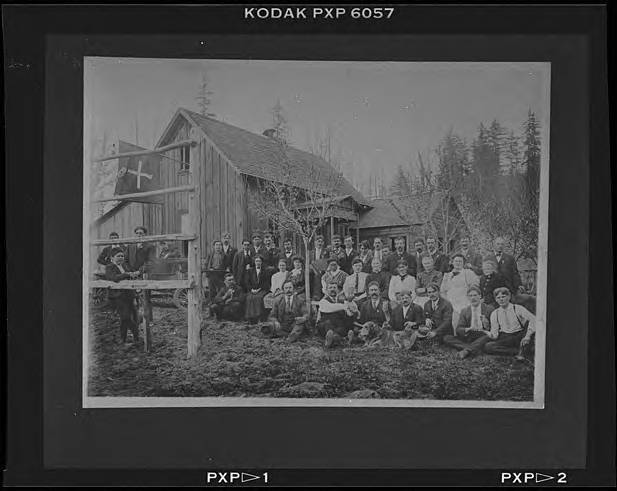
Black and white image of a group of men and women seated on the ground in front of a large wooden church. The national flag of Switzerland, red with a white cross in the center, flies from the upper window of the church. In the background an antique car can just be seen, and the trees appear to be just budding out. Many of the farmers who settled in Washington County in the late 1800s were from Switzerland. Heritage clubs such as this and the various singing and yodeling groups in the area helped to keep the culture of their homeland alive.
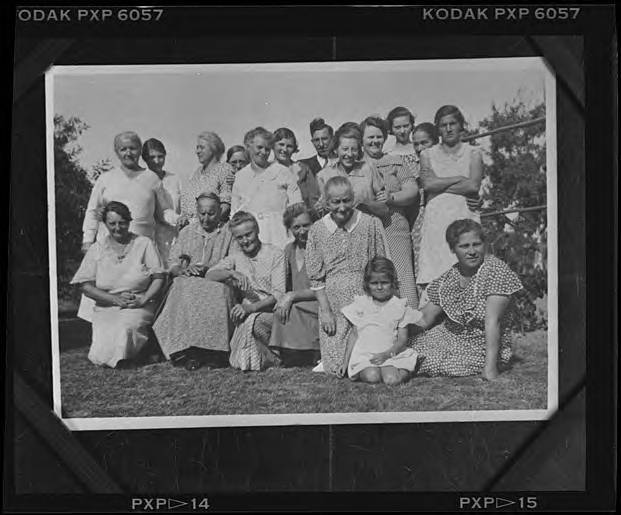
A group portrait of women from the Ladies Guild of the Reformed Church of Helvetia, Oregon in 1937. Many of the members of this church were from Swiss or German immigrant families. Its original language for church services was German, although by the time this photograph was taken, most services were in English. The women wear comfortable dresses, most with shorter sleeves and buttons up the front. A man in a suit (possibly the church pastor?) stands at the very back of the group.
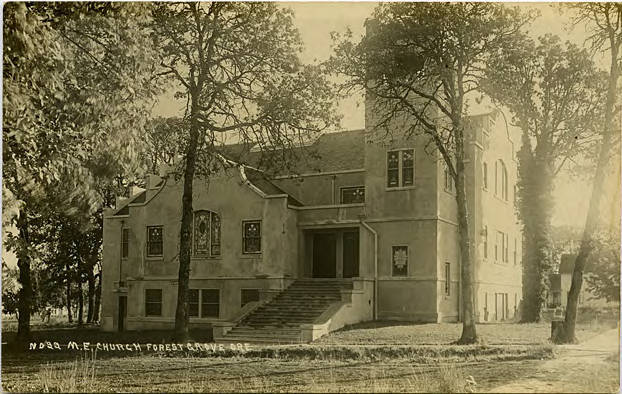
Sepia-toned image of a large, two-story Mission revival style church with a large, square bell tower. Elaborate stained glass windows fill the visible facades, and a long flight of stairs leads up to a recessed entrance. The church sits in a grassy yard, and a sidewalk runs beside it. Several tall, slender oak trees are set about the edge of the lawn.
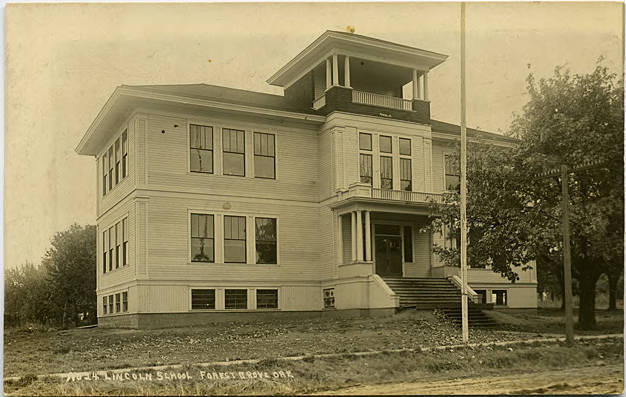
Black and white image of a two-story school with a daylight basement and a large, protruding front entrance with a bell tower and balcony on the top. The school sits in a large yard, with a flagpole and a power pole directly in front of it. A sidewalk runs in front of the school, and the road just visible in the lower right corner is dirt.
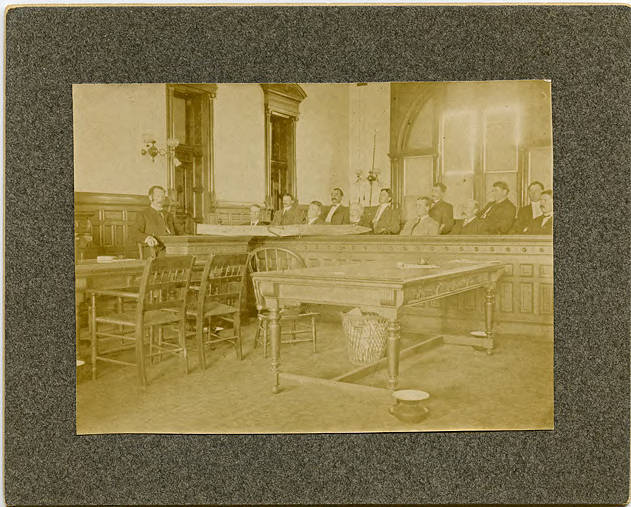
Sepia-toned image of a group of twelve men seated in what is most likely a jury box, with another man seated in a witness box to their right. Two empty tables fill the foreground of the image, and a large, arched window with a number of panes dominates the wall behind the box. Most of the men wear suits and ties, and several have large, full mustaches. All of the men appear to be interested in a large piece of wood with a point on one end and that extends from the top of the witness stand to the divider in front of the jury.
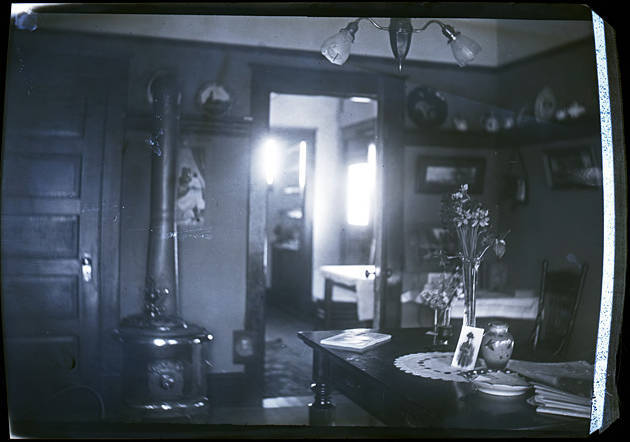
Black and white image depicting an interior room of a house. A woodstove stands against one wall, while a table fills the lower right foreground. A newspaper, book, doily, and several vases holding flowers are scattered about the table, and a picture of a woman in a Victorian dress leans against an urn. In the background is another small table, covered in a cloth with several books sitting on it. A shelf runs along the upper wall below the wainscoting; it holds plates and teapots. Through an open door two windows let in bright daylight, and another table with a cloth can be seen. The floors are wooden and a rug runs along the floor immediately in front of the door to the other room. A light fixture with decorate glass shades hangs from the high ceiling.
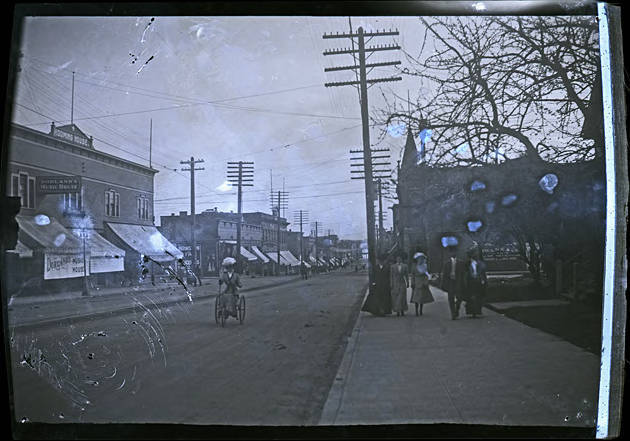
Black and white image of a three adult women, a girl, and a man walking down a poured sidewalk in a business district. The women wear fitted suits with long, bustled skirts and large, flat hats with ornamentation. The girl wears a knee length skirt and a similar hat. In the street nearby, a woman rides a tricycle with the smaller, single wheel in the front and two sticks for steering control. Women of this era often rode tricycles because of their relative ease of handling, given the restrictive clothing custom required. The closest building across the street is identified by signs and advertising as 'Dorland's Music House,' which was located in Vancouver, Washington. Most of the businesses along the street have awnings over their main windows, and power poles with numerous arms dominate the visible skyline.
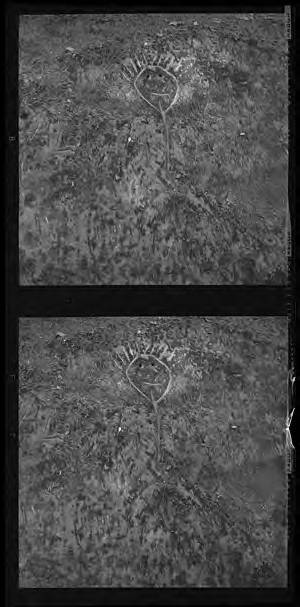
Black and white image showing duplicate views of a petroglyph figure carved into a rock wall, possibly located near Cherry Grove in Washington County. The figure clearly has a head, eyes, a mouth and hair, with a neck/spine descending from the bottom of the head. The legs appear to be indicated by an arch that crosses perpendicular to the line of the body about one-third of the way up from the bottom of the line.
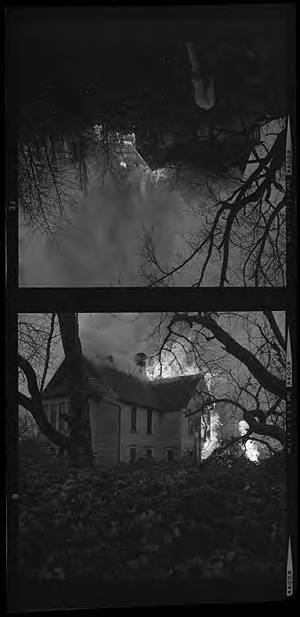
Black and white images of a house being burned down. The house appears weathered and is in the midst of an overgrown yard. In the upper image, smoke pours from the home, which appears mostly as a dark blob. In the lower image, the house is clearly seen, backlit by flames at the front and with smoke pouring from the roofline. See WCMpic_015330 for an image of this house intact.
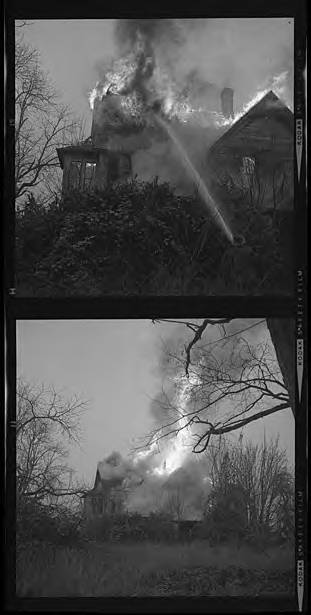
Black and white images of a house being burned down. The house appears weathered and is in the midst of an overgrown yard. In the upper image, a fireman directs a spray of water directly against flames on the roof of the house. See WCMpic_015330 for an image of this house intact.
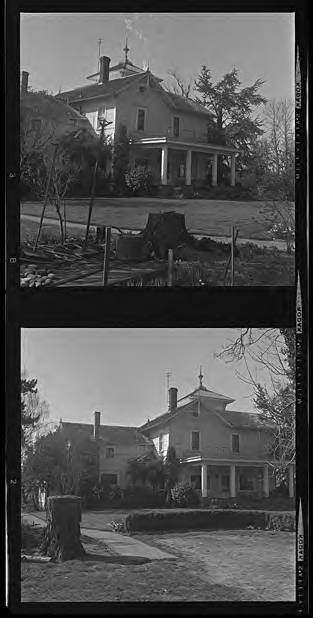
Black and white images of a large, cross-gabled house from two different angles. the house is two story and features a cupola in the middle of the main section. A front porch with columns runs along the front of the home, and a large, well-kept lawn stretches out in front of the house. Museum records are not specific as to who owned the home or where it was located.
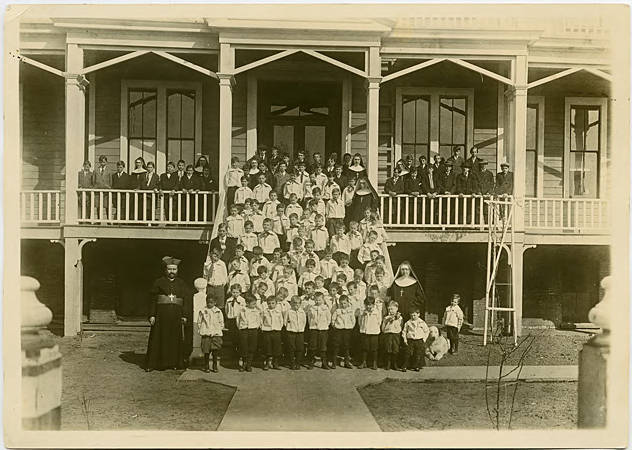
Sepia-toned image of a large group of young boys and adolescents gathered on the steps of a large wooden buildings. A priest stands to the image left at the bottom of the stairs, and several nuns can be seen standing with the boys up the stairs and along the porch. Most of the boys wear loose white smocks with large collars over dark knickers, stockings, and boots. The older boys standing on the porch are dressed in suits and ties, and some have fashionable hats. The building is wooden, with a brick foundation. St. Mary's Orphanage was founded about 1890 in Beaverton. This photo was likely taken after 1902, after girls and infants had been sent to other religious orders in the area for care.
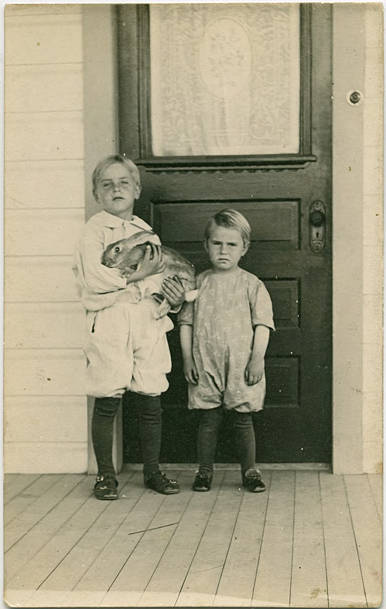
Black and white image of two children standing on the porch of a house in front of a door. Both wear knickers; the smaller child wears a single-piece, romper style in a print fabric. The taller child holds the rabbit and wears a light-colored pair of knickers with a matching sailor style shirt tucked into the pants. Both children have hair that is longer and bleached lighter on top and parted to one side. The rabbit is not overly large and appears to have a light underbelly, lighter fur around its eyes, and dark tips on its upright ears.
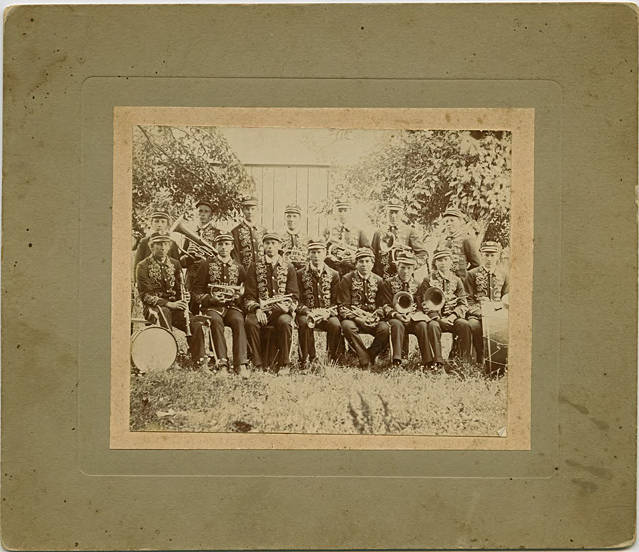
Sepia-toned image of a band in uniform, seated in a garden in front of a fence. Most of the band members hold instruments: drums, trumpets, flugelhorns, etc. One holds a bass drum, and another has a snare drum on the ground beside his feet. The fronts of their uniforms are decorated on both sides with elaborate curvilinear designs that are repeated on the collars. Each man wears a captain's hat that matches his uniform.