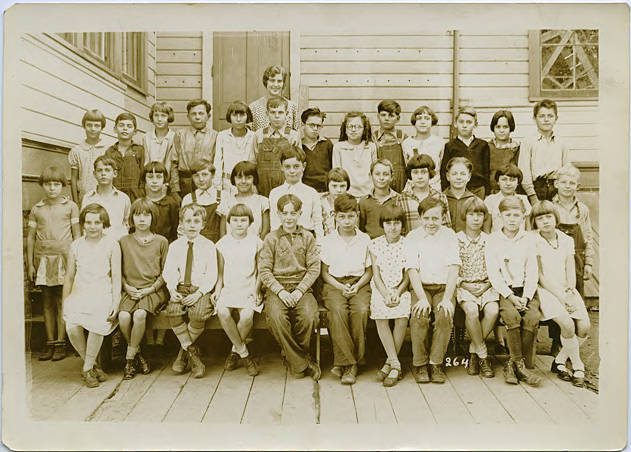
Sepia-toned image of a group of students arranged in front of their school. The girls almost exclusively wear their hair in short bobs, and their skirts and dresses are also short. Their teacher stands at the back of the group. Dilley School was one of the first schools in the area, founded in 1860.
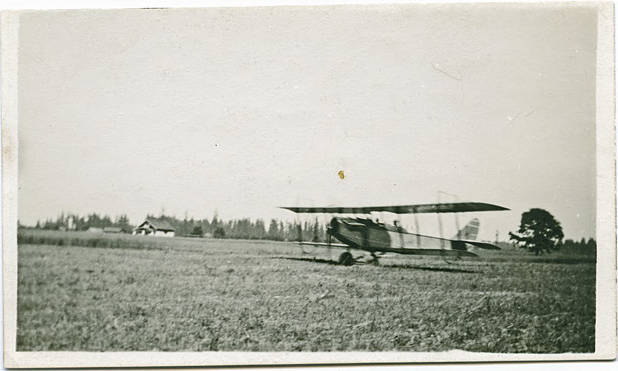
Black and white image of a biplane landing in a field. The pilot is just visible in the back seat, and the tail does not appear to be touching the ground. Trees and a small, gabled house appear in the background. This image was included in a group of images featuring Myrtle and August Blassing, long-time Washington County residents.
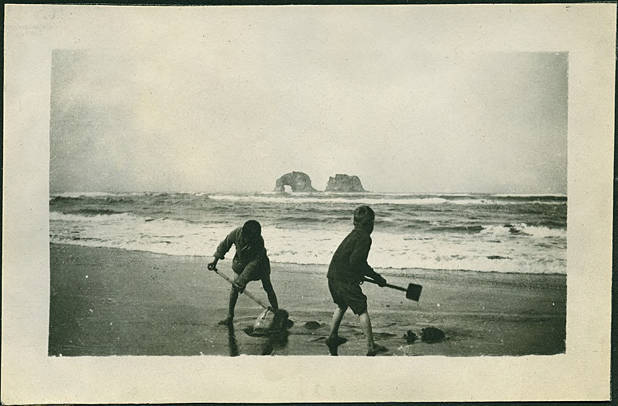
Black and white image of two children digging on the beach. Arch Rock is visible in the background. One boy wears knickers and a jacket; the other appears to wear a heavy coat over bare legs. Both are wielding shovels as they dig holes, racing what appears to be an incoming tide. This image was included in a group of images featuring Myrtle and August Blassing, long-time Washington County residents. Many of the photos include two young boys; most likely these are the same two children, enjoying a moment on the beach.
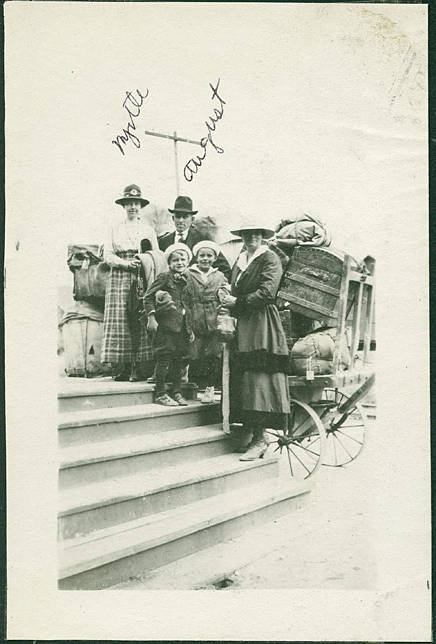
A photograph of August and Myrtle Blassing Family with two children and another woman, next to a loaded cart. This photograph probably dates to around 1910.
August Blassing was born in Baden, Germany in 1876, and came to the Unites States in 1891. Myrtle Brown Blassing was born in Iowa. They came to Oregon sometime in the early 1900s, and settled in Hillsboro, Washington County, Oregon before World War I.
The Blassings are standing on steps leading up to what appears to be a loading platform, next to a cart piled high with baggage, chests, and rolled bundles. 'Myrtle' and 'August' stand in back. A power pole stands upright in the background.
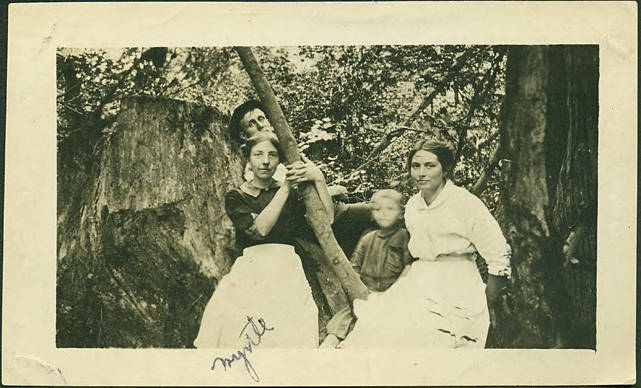
Black and white image of two women, a child, and a man, seated on a stump in the forest. The women wear blouses and skirts, and at least one wears an apron. The child's face is blurred, and the man sits behind the women, leaning and looking over one woman's head. 'Myrtle' is written on the picture, indicating the woman on the left of the image.
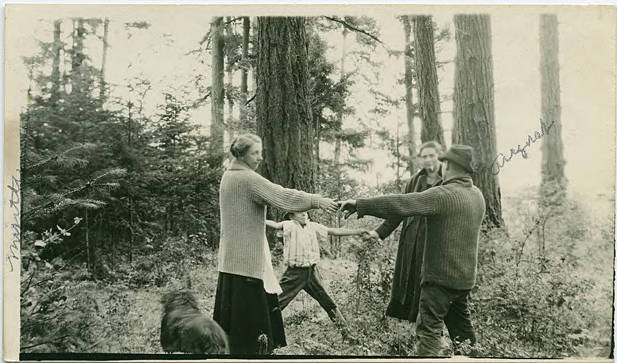
Black and white image of two women, one man, and a child forming a circle with their arms outstretched and holding hands. The women wear skirts and one wears a dark coat. The couple identified as August and Myrtle both wear thick, shawl-necked sweaters. The child wears a light-colored, short-sleeved shirt and pants, and a hat. A dog watches at the feet of Myrtle Blassing. Behind the group, thick undergrowth and tall trees can be seen, with an open area to the right rear of the image. 'August' is written on the picture near the man.
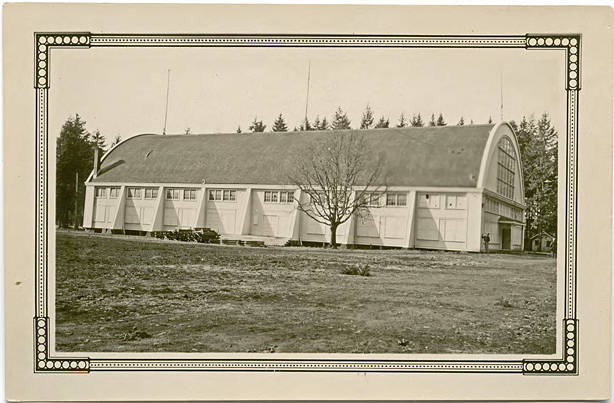
Black and white image of a large, Quonset hut-styled building, showing the round barreled roof on top of a wall with external buttresses. A row of pine trees is visible beyond the building, and an empty yard fills the foreground of the image.
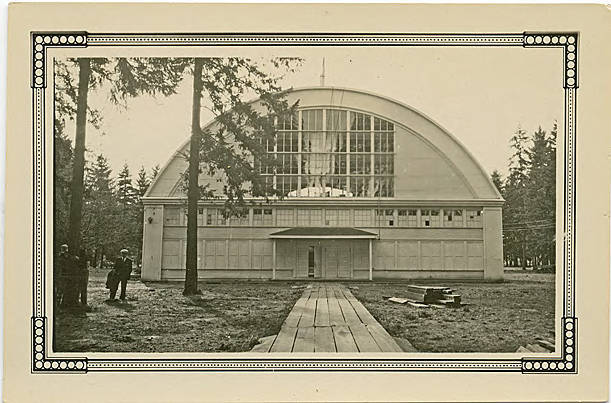
Black and white image of a large, Quonset-hut styled building with a wide bank of windows above the entrance. A boardwalk leads up to the main entrance, and a number of window panes appear to be broken out above the first floor. Three men, including one in a uniform, stand in the lower left corner of the image.
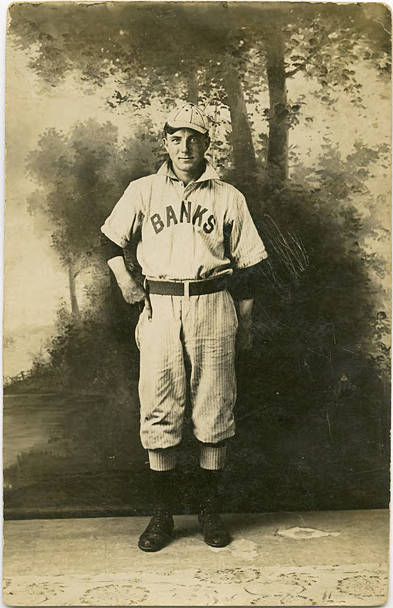
A member of the local baseball team of Banks, Oregon circa 1900. The man is wearing a traditional striped baseball uniform of knickers and loose fitting, short-sleeved buttoned shirt, with a baseball cap. He wears a dark, long-sleeved shirt beneath the light-colored uniform shirt, and his knickers are tucked into thick, two-colored socks that disappear into lace-up boots. 'Banks' is lettered across the front of his shirt. He stands in front of a misty, romantic studio backdrop.
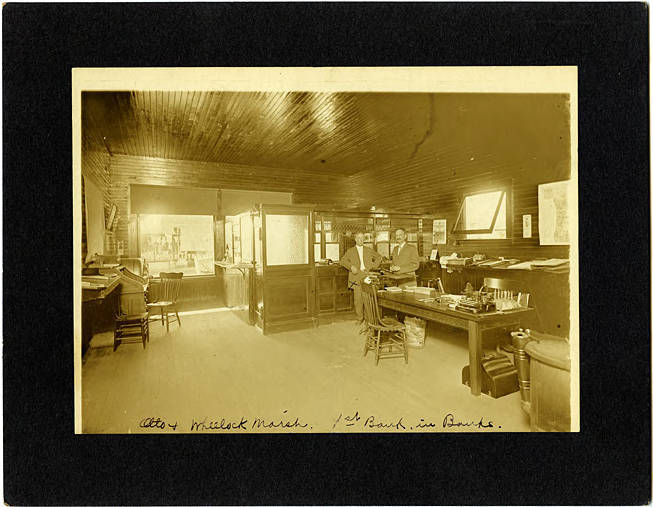
Sepia-toned image of two men standing inside a building with a number of desks and tables. A teller's cage fills the area directly behind the men, separating the entrance from the interior of the bank. Both men wear suit coats and ties. Otto Galaway, bank teller, stands to the image left of Wheelock Marsh, the vice-president. The Washington County Bank opened in 1909; Galaway left in 1921 to open a bank in Vernonia.
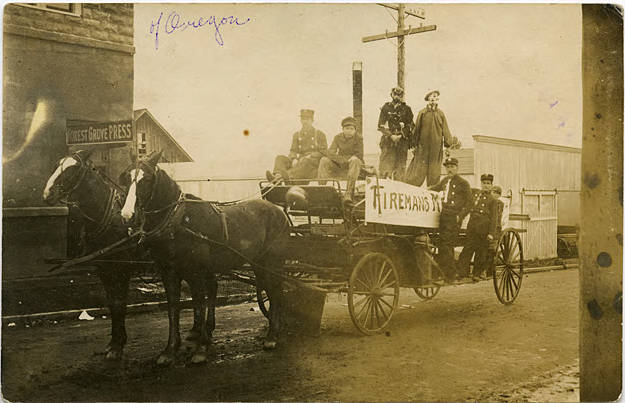
Black and white image of a two horse team hitched to a fire wagon. Mud flaps hang just behind the horses' hind feet. A large bell is attached to the footrest of the wagon, and there are side rails where men can stand. A tank with a hose can be seen on the footboard, too. A man in uniform and a boy sit on the wagon seat, and two men, also in uniform, and another boy stand on the side of the wagon, which bears a sign reading 'Fireman's M [illegible].' Two men dressed as clowns stand in the wagon bed, one wears a sack type garment gathered at the neck and sleeves and ankles. The second wears what appears to be a partially rotted Union soldier's uniform, and his makeup could indicate that the Zombie Apocalypse has deep roots in western Washington County. A sign advertising the office of the 'Forest Grove Press' hangs from the building directly behind the team, while the next building on the street appears to be a livery or possibly the fire station. A power pole with crossbars stands behind the far corner of the wagon.
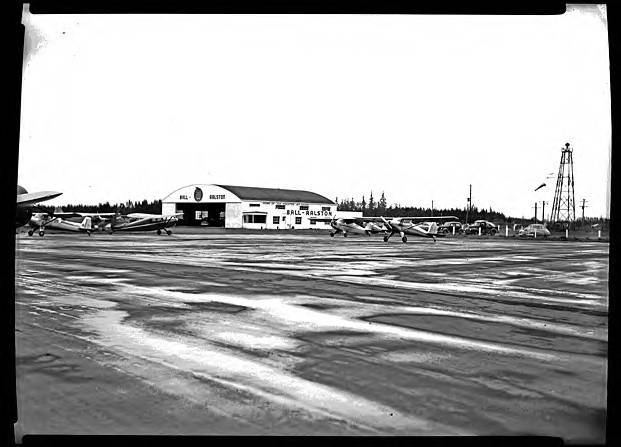
Black and white image of a large airplane hangar with a number of airplanes parked on the tarmac in front of it. Ball-Ralston Flying Service was one of the first charter flight services opened at Hillsboro Airport, and was run by Ed Ball and Norman 'Swede' Ralston. They offered air tours of Washington County for $2.50.
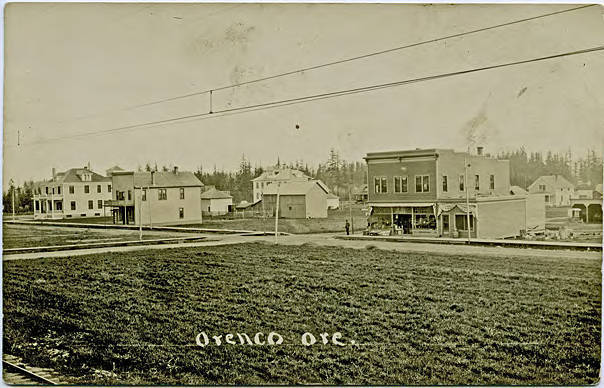
Black and white image of a community. Two, two-story buildings sit across a street from a large field, one is gabled with a false front while the other is a large, square, two-story construction next to smaller, single block building. Several residences can be seen in the background, two of those are large, two-story homes with dormer windows protruding from their rooflines. Orenco was a 'company town,' built for workers in the short-lived Oregon Nursery Company.
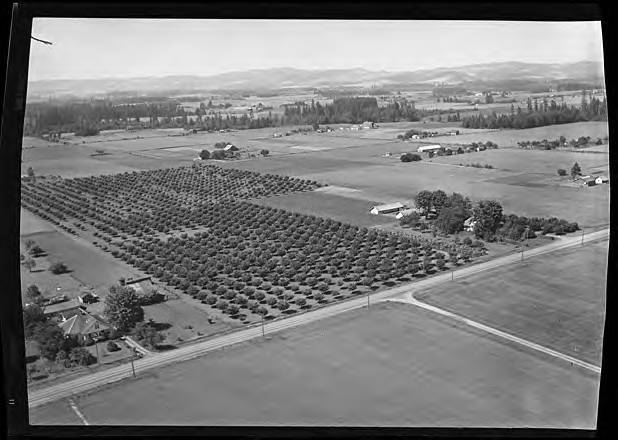
Black and white aerial view of a farmhouse and an orchard, with hills in the background. A number of other farms and farmhouse can be see in the background. William G. Ide was a farmer south of Hillsboro; the 1930 Federal census lists his property as being on Grabel Road, off of Highway 219.
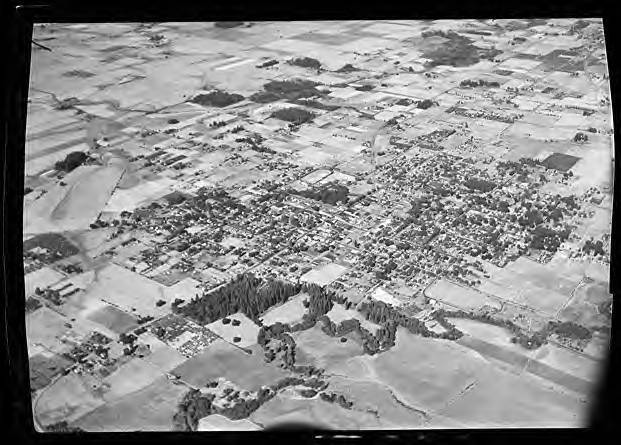
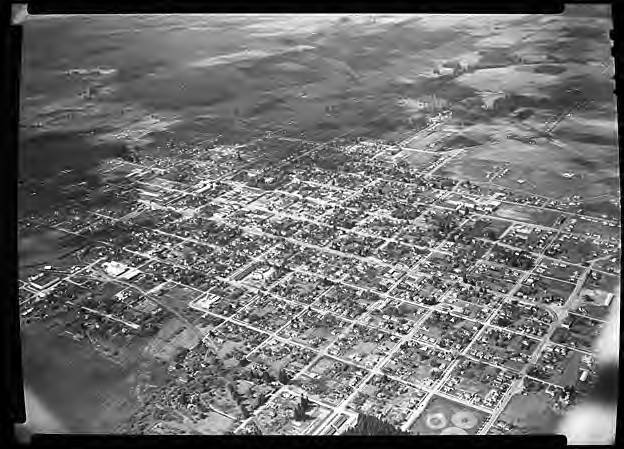
Black and white aerial image of Forest Grove, looking northeast. The track at Pacific University can be seen in the upper center left of the urban area.
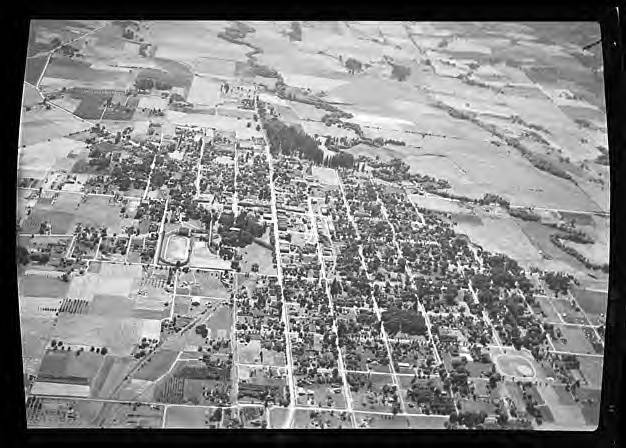
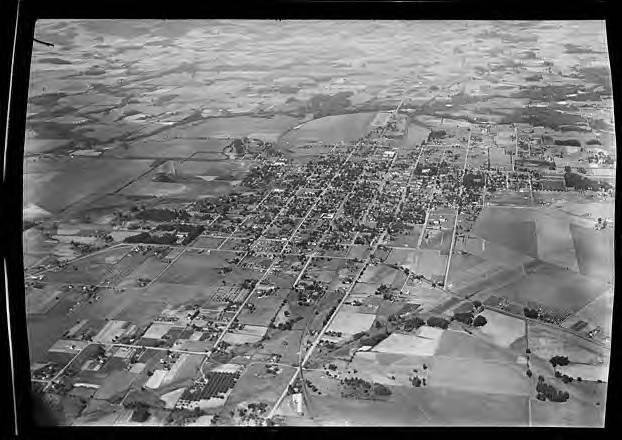
Black and white aerial image of Forest Grove, looking south. Pacific University's track and gymnasium can be seen in the center left of the photo. The road running through the center of the image is Main Street, in Forest Grove.
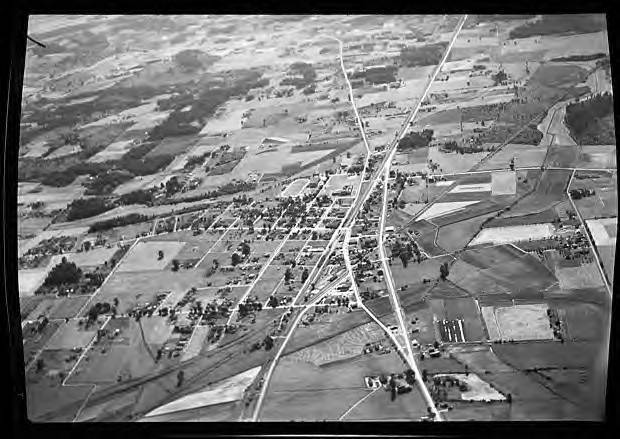
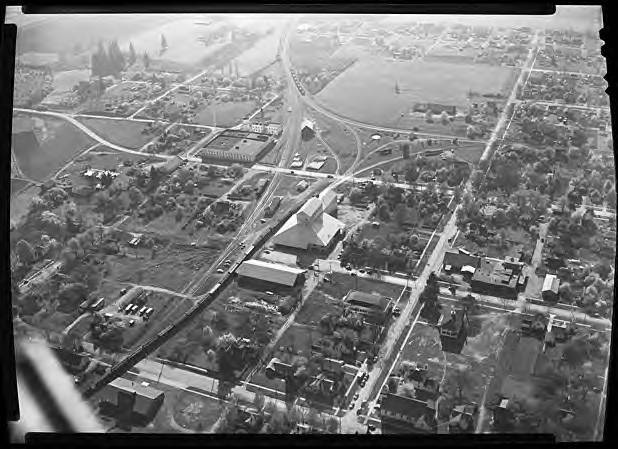
Black and white aerial image of Cornelius, Oregon. The main road running from the lower center left to the upper center right is Tualatin Valley Highway or Baseline Street, and the railroad runs along the south side of the road.
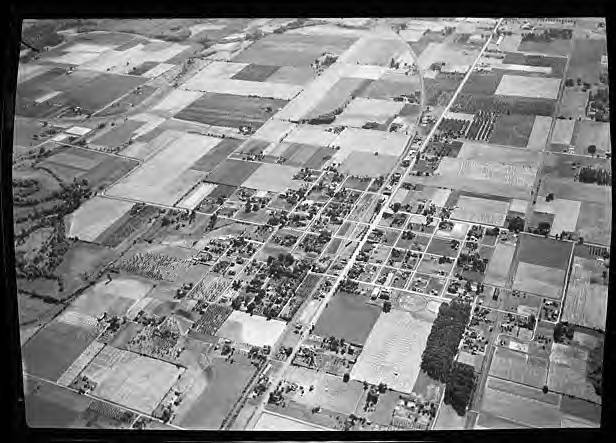
Black and white aerial image of Beaverton, looking east. This appears to be downtown Beaverton, showing Farmington Road and Canyon Road or Tualatin Valley Highway.
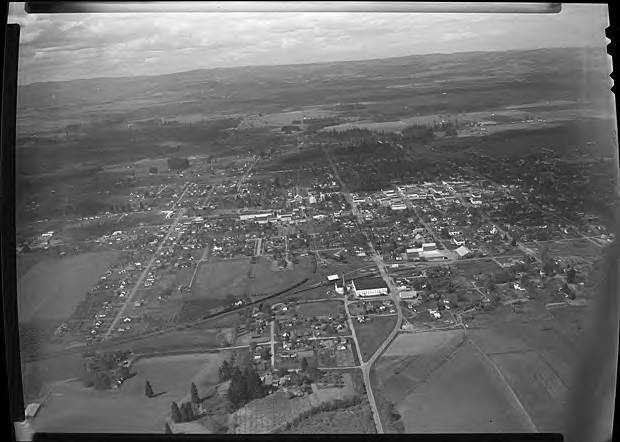
Black and white aerial view of Hillsboro, looking north. The large square building in the lower center of the image is the Carnation factory at the south edge of town, and the Washington County courthouse can be seen a few blocks north on First Avenue. See WCMpic_015495 for a similar view, taken ten years previous.
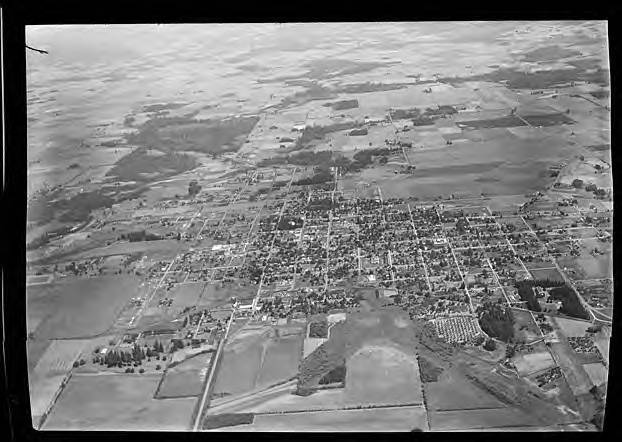
Black and white view of Hillsboro, looking north. The Washington County Courthouse can be seen in the dark square of trees at the northwest corner of the city; identifiable by the Sequoias at the south entrance and the flagpole on the east side. The other darker square to the right and up one block is Bagley Park. See WCMpic_015500 for a similar view, ten years later.
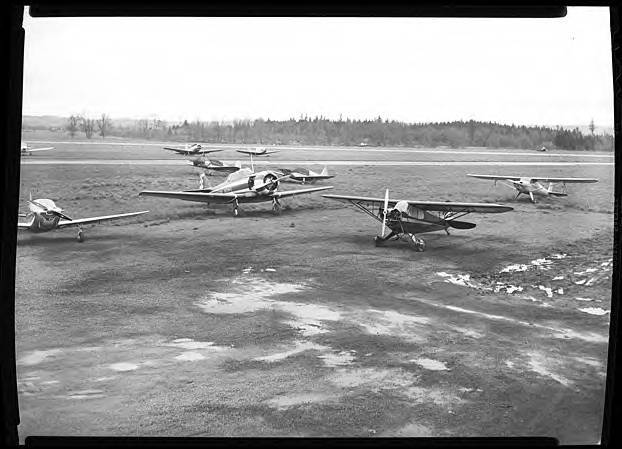
Black and white image of a number of airplanes parked in an airfield. At least two runways can be seen in the background. Hillsboro Airport was founded in 1928.