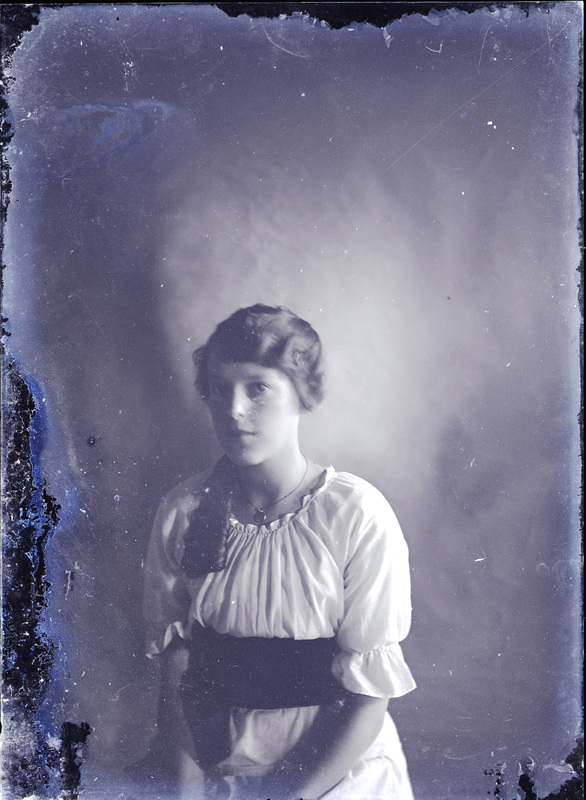
A portrait of a young woman wearing a loose, white blouse with a dark sash around her waist, and a locket on her neck. Her hair is in a ponytail that has been curled to hang down in a coil over her shoulder. This photograph was taken by amateur photographer William Alonso Clapshaw, probably in a home studio circa 1910-1914. Several other photographs exist that were taken in the same setting. The woman may have been a friend or relative of the photographer. Flaws in the image are due to deterioration of the emulsion layer on the negative. For two similar portraits that may portray the same woman, see Images PUA_MS154_032 and PUA_MS154_042.
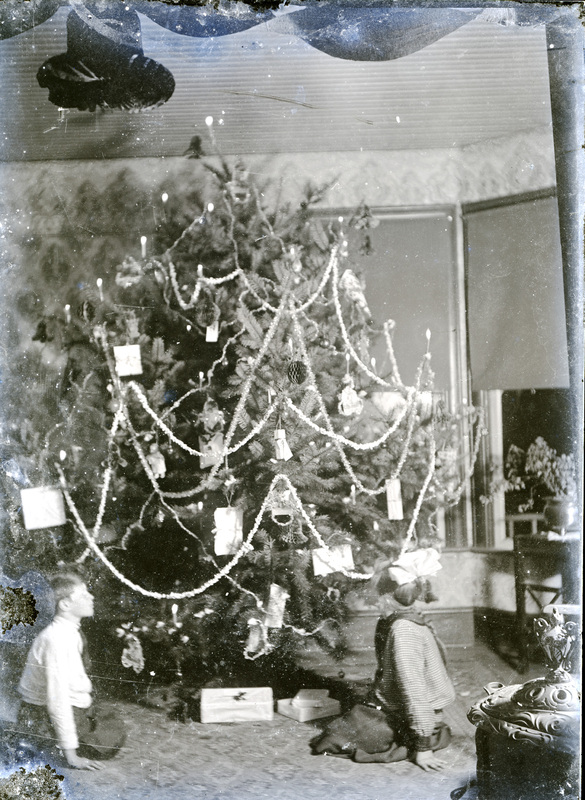
Two children, a boy and a girl, sit looking up at a Christmas Tree. They are most likely Dorothy and Harold Clapshaw, the daughter and son of the photographer, William Alonso Clapshaw. They would have been around 6-9 years old in 1914. The setting is the Clapshaw Home, which was probably in the Hillside neighborhood northwest of Forest Grove, although they may have been living in another location when this photograph was taken.
The children are dressed in nice clothing, with the boy wearing a tie and the girl wearing a large bow on her head. The tree is trimmed with ornaments and a garland made of popcorn; crepe paper decorations hang from the ceiling in the foreground. Envelopes and small presents also hang from the tree, while several larger presents are on the floor beneath it. The edge of a stove appears on the right. The same oilcloth rug on the floor also appears in many of the studio-style portraits that Clapshaw created.
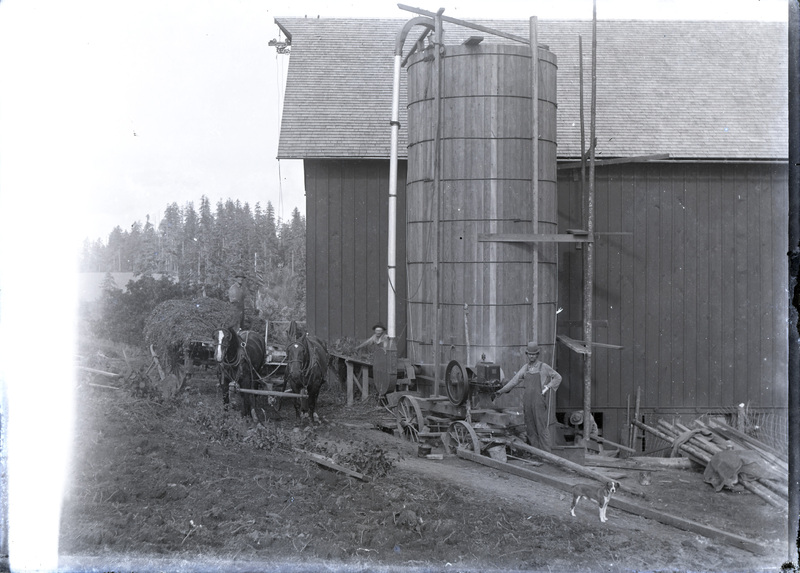
Men on a farm near Forest Grove, Oregon, fill a silo attached to a barn. The man in the bowler hat (right) is tending an engine that is driving a belt. The belt turns a wheel which is attached to a silo-filling machine (center, with tall white pipe extending vertically). The man by the silo-filling machine is feeding hay into its hopper, which the machine chops and then blows through the pipe into the silo. A third man, standing on the wagon drawn by two horses, is delivering the hay -- possibly alfalfa. This was likely to be used as livestock feed. A farm dog stands on the right, and one more man stands almost behind the silo, facing away from the camera. A pulley system is attached to the side of the barn. This photograph was probably taken in the Hillside, Gales Creek or Banks neighborhoods between 1910-1914.
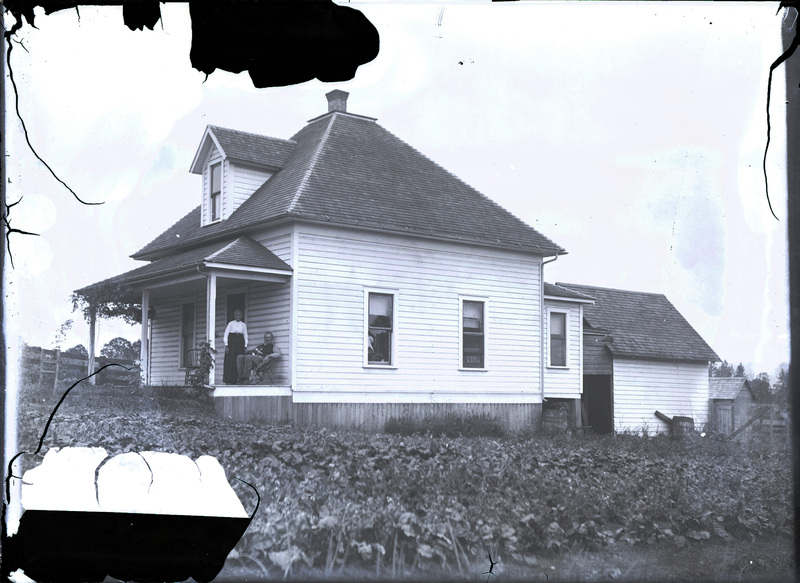
A farmhouse in the countryside near Forest Grove, Oregon, circa 1910-1914; possibly around Hillside or the town of Banks. An older couple are on the porch, with the man sitting in a rocking chair and holding a cat. The house is relatively small with a pyramidal hip roof, a single dormer window, a small addition (probably a kitchen) on the back, and several sheds or outbuildings in the rear. A low-lying, leafy vegetable crop (possibly rhubarb?) is growing directly next to their house. Flaws in the image are due to deterioration of the emulsion layer on the negative.
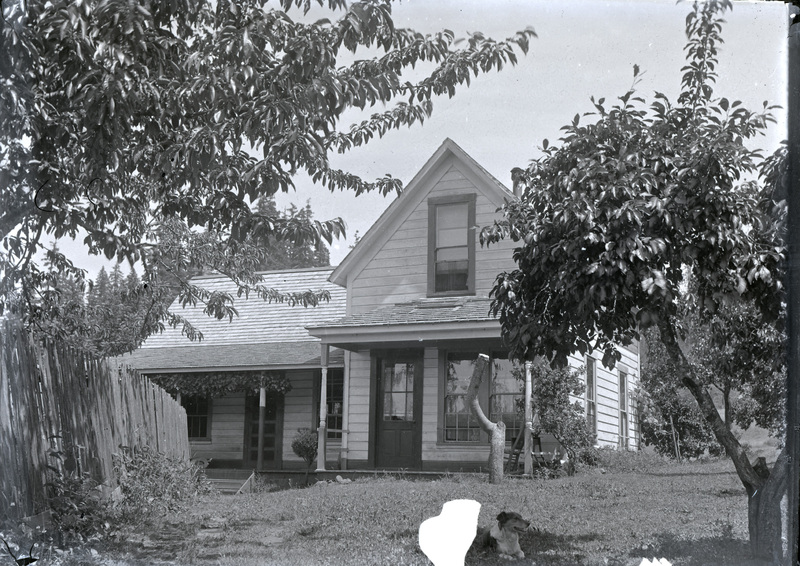
An house with a side gable near Forest Grove, Oregon circa 1910-1914; possibly located around Hillside, Gales Creek or Banks. The house appears to be already several decades old in this photograph, perhaps dating from the 1870s-80s. A dog, possibly a collie mix, sits on the grass in the foreground near several fruit trees. Flaws in the image are due to deterioration of the emulsion layer on the negative.
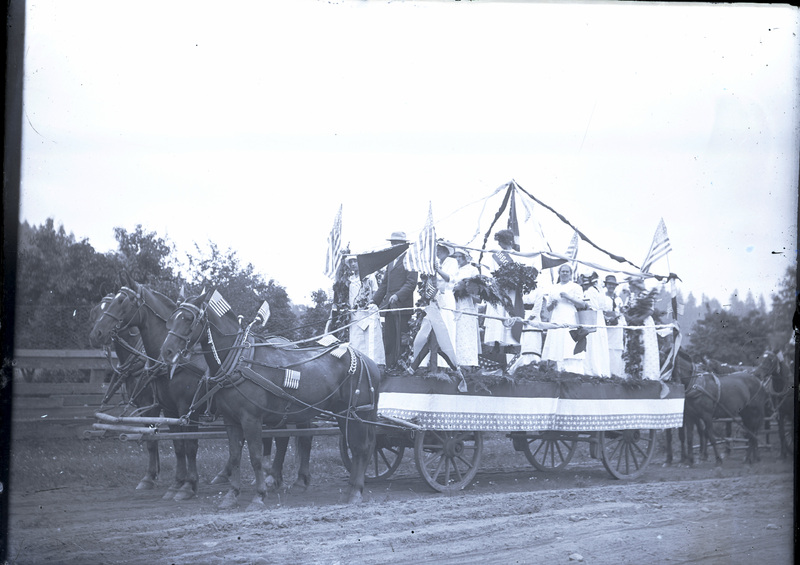
A Fourth of July parade float near Forest Grove, Oregon circa 1910-1914. A note found with the original describes this as "Hillside Girls Float," indicating that the girls were from the Hillside neighborhood northwest of Forest Grove. A pennant on the front of the float that is faintly visible says, "Hillside." One girl standing on a platform at the center of the float wears a sash that reads "Oregon." American flags and stars-and-stripes fabric decorate the float, which is built on a wagon drawn by a team of horses. Swags of greenery are draped over the wagon and the girls hold large bouquets of ferns and leaves, with crowns of flowers on their heads. For another view of the same float, see image PUA_MS154_017.
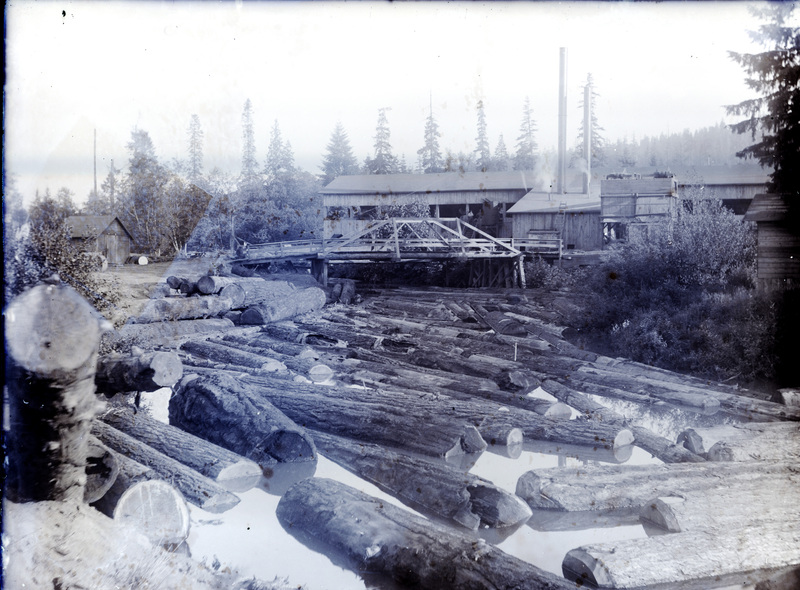
A pond filled with floating logs waiting to be cut for lumber at the sawmill in the background. A small bridge, a shed, and workers standing inside the mill are also visible. This photograph was taken in the vicinity of Forest Grove, Oregon circa 1910-1914. It may show the mill that was formerly located near the intersection of String Town Road and Highway 8 between Forest Grove and Gales Creek; the ridgeline in the background appears to match the one seen from that location. At this time, logging companies would cut trees in the Tillamook Forest and then float them down Gales Creek for milling.
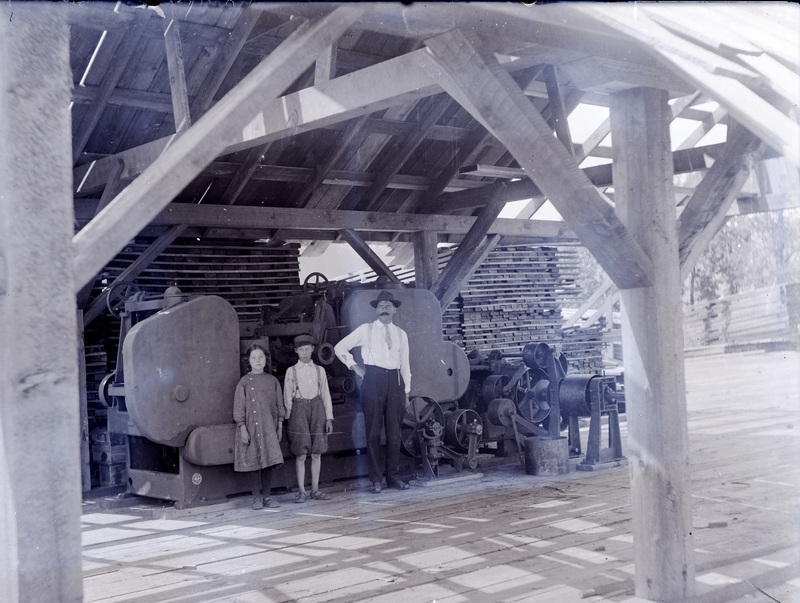
A man and two children stand next to brick-making machinery inside a brickyard in Wilkesboro, near the town of Banks, Oregon circa 1910-1914. They may be the brickyard owner and his son and daughter. The man is wearing business clothes, a hat, tie and a pocketwatch chain, while the children are wearing sandals and clothes that would be suitable for play. Other photographs of the same brickyard show workers wearing much rougher and dirtier clothing; see photographs PUA_MS154_036a and PUA_MS154_036b. They are standing inside a shed which sheltered the brick-making machines. Stacks of bricks are drying in the background.
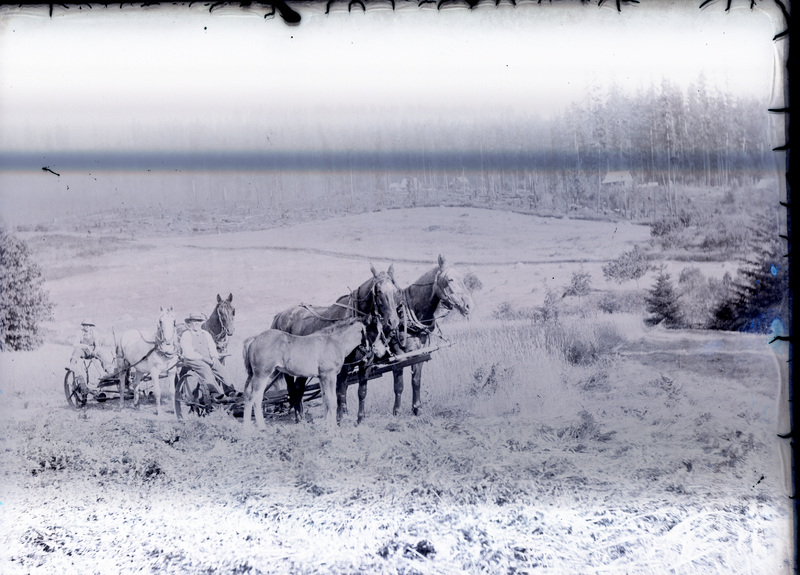
Two farmers wearing overalls and straw hats sit on a pair of plows, each of which is drawn by a team of two horses. A young horse (or possibly a mule?) stands near one of the horse teams. This photograph was taken in the vicinity of Forest Grove, Oregon circa 1910-1914, possibly in the Hillside or Hayward communities northwest of town. A field stands behind them, with a partially cleared forest and several houses on the hill in the background. This photograph appears to have been overexposed, and also has some damage due to deterioration of the emulsion layer on the negative.
A man sits on a horse on Main Street in Banks, Oregon circa 1910-1914. He is dressed like a cowboy, wearing sheepskin chaps, overalls, and a hat, with ropes coiled in front of him on the saddle. Signs for many small businesses in the town of Banks are visible. From left to right, they read: Michelet, Lawyer; W. C. Young's Real Estate, Insurance, and Feed Store ("Town Lots & Homes, Farms & Acreage"); Billiards; Odd Fellows Hall ("IOOF"); and the Willis Hardware & Imp. Co. The latter store has product signs posted including ones for: Carriages; Sharples Tubular Cream Separators; Phoenix Paint; and John Deere. Main Street is an unpaved dirt road, with wood plank sidewalks. A horse-drawn buggy is in the background behind the cowboy, while a boy holding a bicycle and a car with a cloth top stand on the right.
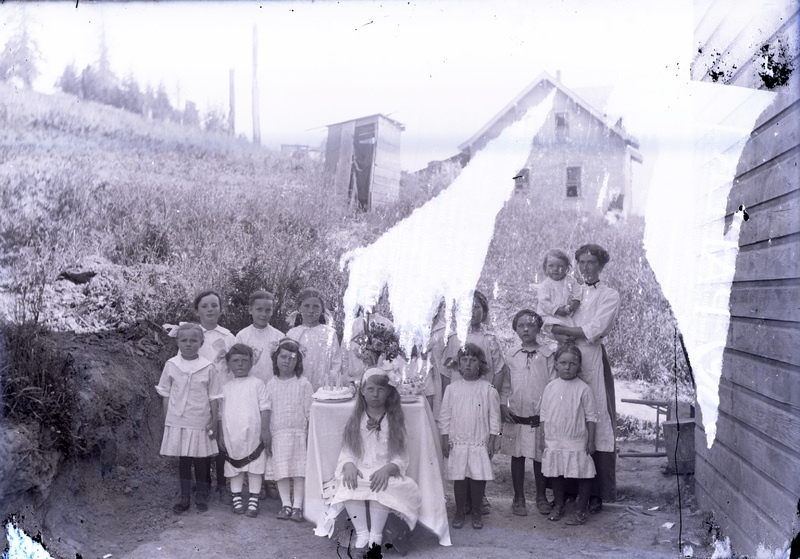
A group of girls mostly aged around 4-8 years old, at a party in the vicinity of Forest Grove, Oregon circa 1910-1914, likely in the Hillside neighborhood northwest of town near Gales Creek. This was probably the birthday party of the girl who is sitting on a chair in the center. She is wearing a large bow on her head and a pinned flower or ribbon on her chest. The same girl appears in at least one other image by the same photographer (see image PUA_MS154_005); she may have been the photographer's daughter or niece. The small table behind her appears to hold a birthday cake with candles, a vase of flowers and several other desserts. A woman holding a younger child aged around 2 stands on the right. The house they are standing next to has unpainted siding; an outhouse and another house appear on the hill in behind them.
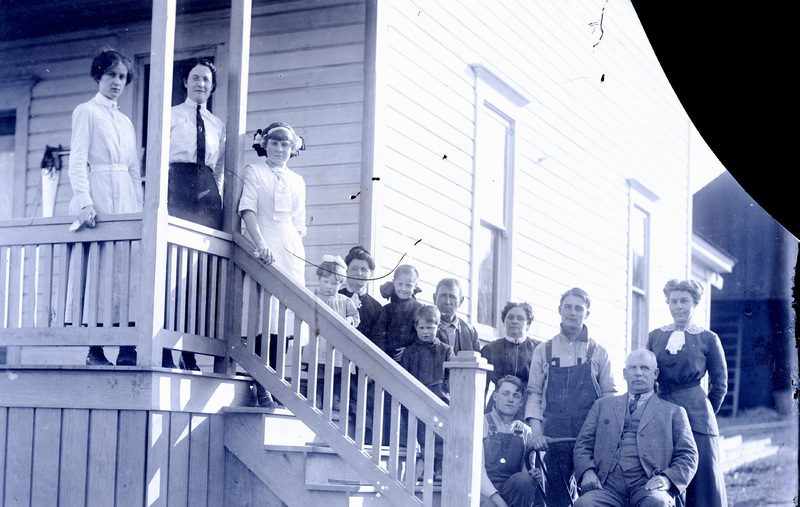
A group portrait of children and adults on a porch in the vicinity of Forest Grove, Oregon circa 1910-1914, possibly in the Hillside neighborhood northwest of town. Based on the range of ages of those present, this may be a portrait of an extended family. Most are formally dressed in what were likely some of their best clothes. These are likely relatives and/or friends of the photographer, William Alonso Clapshaw.
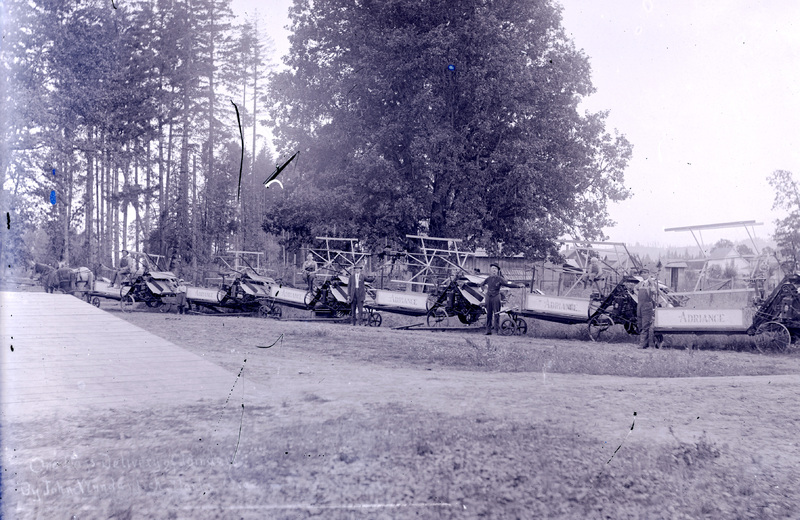
Several men and boys stand with a set of Adriance brand reaper-binders in Banks, Oregon, circa 1910-1914. A faint caption reads: "One Day's Delivery of Binders By John Wunderlich, Banks, Ore." John Wunderlich was a merchant in Banks at the time. The binder machines were used to cut grain and bind it into bundles or sheaves, which would then be pushed into cone-shaped stacks that would be left to dry in the fields. This photograph may have been taken at or near the train depot in Banks. For another version of the same scene, see Image PUA_MS154_022
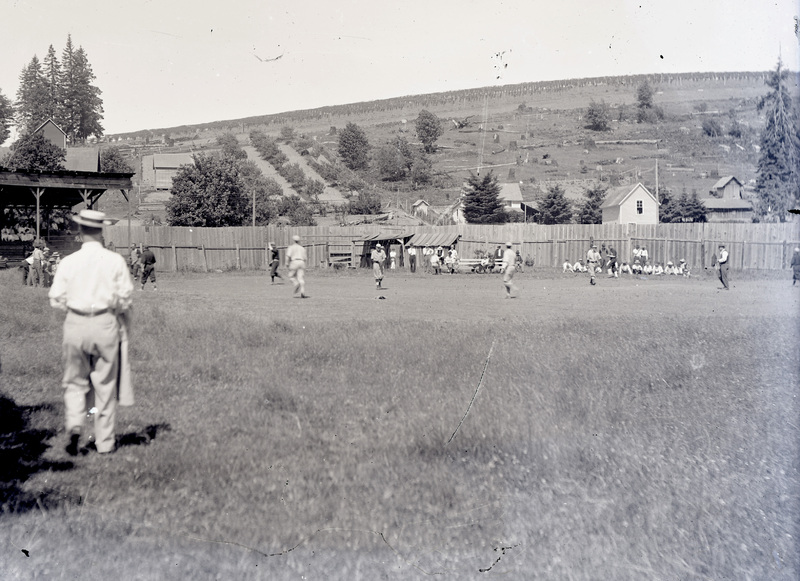
A baseball game in the vicinity of Forest Grove, Oregon circa 1910-1914. The teams appear to be changing sides, with people walking to and from the infield. A covered stand in the background seats women spectators. Men and boys sit on the sidelines watching the game. A makeshift dugout for one of the teams is along the fence. On the hill behind the baseball field, there is a small orchard (center-left), a logged field (right), a hops field (top of hill along the ridge), and several small houses (lower right). Based on other images by Clapshaw, this likely depicts the team from Hillside, Oregon. There is another photograph that depicts the same field and possibly the same game; see image PUA_MS154_019.
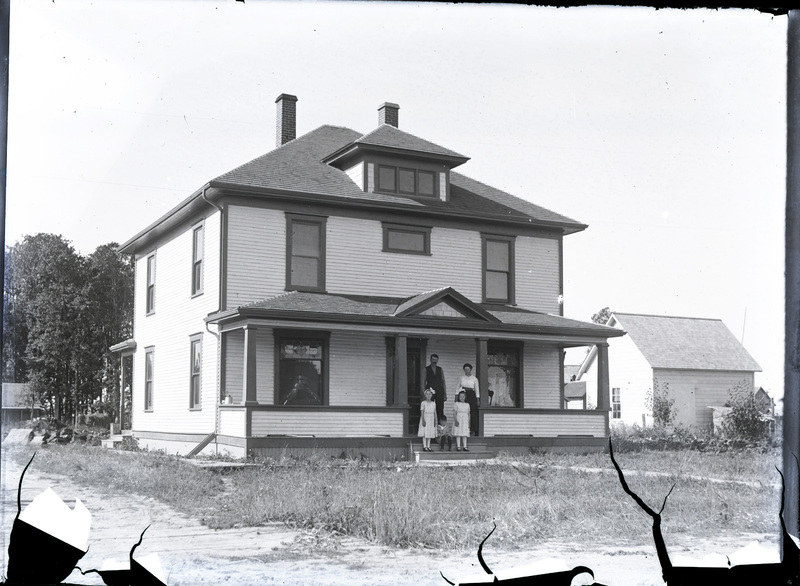
A family stands on the porch of a large house in the vicinity of Forest Grove, Oregon circa 1910-1914, possibly near Banks or Hillside. The family appears to include a mother, father, their two daughters and a son, all dressed up in nice clothes. The girls wear matching dresses and large bows on their heads, while the boy wears a sailor-style outfit. The house appears to have been recently constructed at the time this photograph was taken. It is two-and-a-half stories tall with two chimneys and some elements of Craftsman style, including a large porch, one dormer, stained glass over the front windows, tapered columns, and a front door with a window and sill. Wood plank sidewalks lead around the house. Several sheds or outbuildings appear in the background.
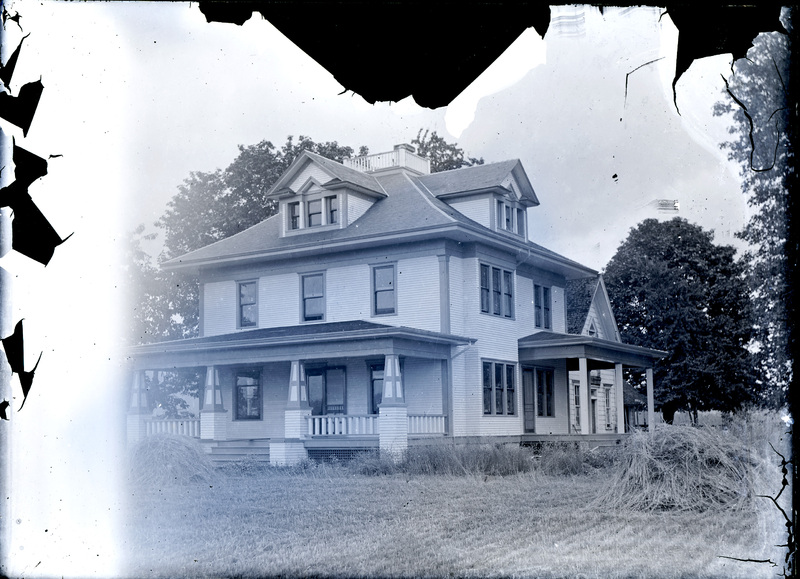
A large, two-and-a-half story house in the countryside near Forest Grove, Oregon circa 1910-1914. The house appears to have been relatively new when the photograph was taken. It displays some Craftsman-style elements including wide porches, tapered wood columns and dormers. It is standing in front of an older, smaller house. The yard has been mown recently, with loose stacks of hay on the ground. Several outbuildings and trees appear in the background. The photograph suffers from damage to the emulsion layer on the negative, with part of the image cracked off; the left side is also overexposed. For another less damaged view of the same house, see image PUA_MS154_015.
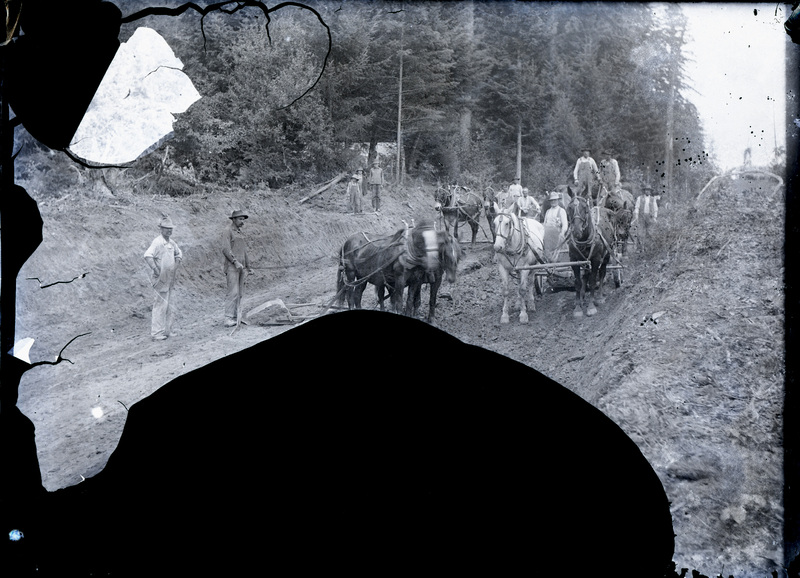
Road construction by men with horses near Forest Grove, Oregon probably circa 1910-1914. This may have been in the vicinity of Gales Creek or Hillside. Several men are driving teams of horses that are pulling road-grading equipment, which are digging out and leveling the ground on a hill to make a road. Several boys watch from the side, and a thick forest of fir trees appears in the background. The damage to this photograph is due to the emulsion layer on the negative deteriorating and cracking off. For several other images by the same photographer that appear to depict the same road construction event, see PUA_MS154_024 and PUA_MS154_012b.
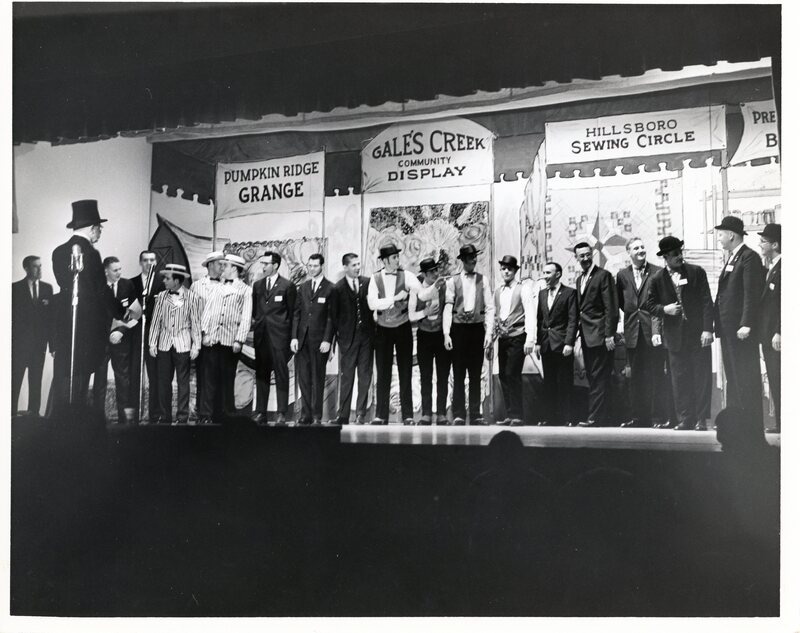
A black and white photograph featuring the finalists of the Original All-Northwest Barbershop Ballad Contest in 1961. A handwritten note on the back states: "Top 8 Quartets - 1961." The photographer is unknown, but it may have been Allan J. de Lay, a staff photographer for The Oregonian who took numerous photographs of the event over the years.
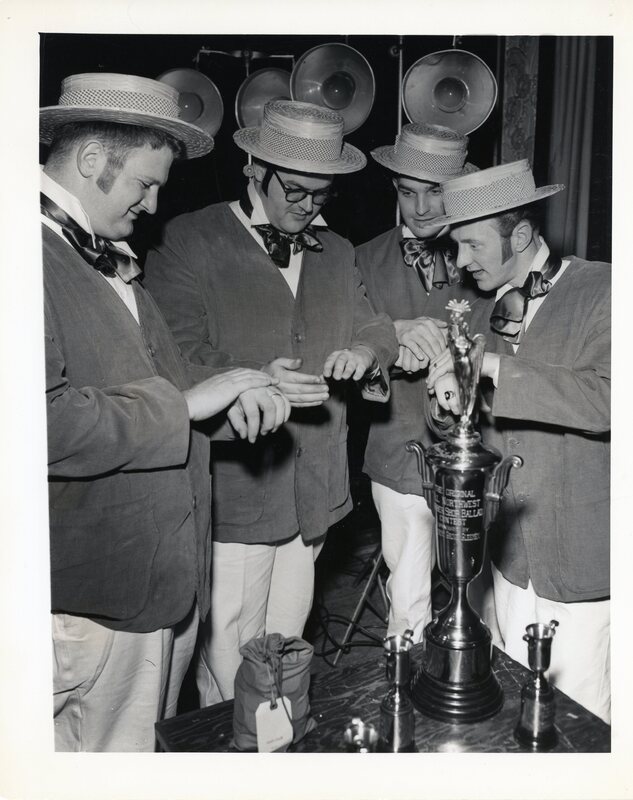
A black and white photograph featuring the Agony Four with their 1952 Original All-Northwest Barbershop Ballad Contest trophy. The Agony Four were the contest's champions in 1950, 1951, and 1952. The photographer is unknown, but it may have been Allan J. de Lay, a staff photographer for The Oregonian who took numerous photographs of the event over the years.
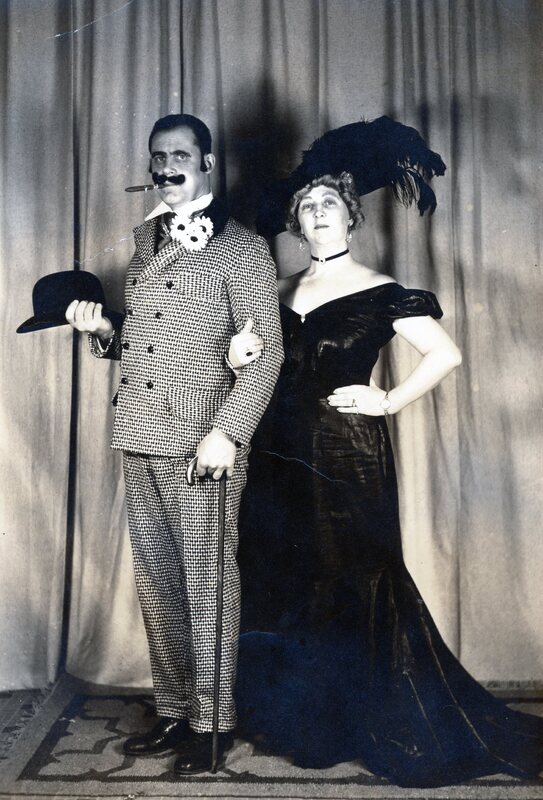
A black and white photograph featuring an unknown couple posing in elaborate Gay Nineties attire sometime within the first few years of the Gay Nineties festival. The photographer is unknown, but it may have been Allan J. de Lay, a staff photographer for The Oregonian who took numerous photographs of the event over the years.
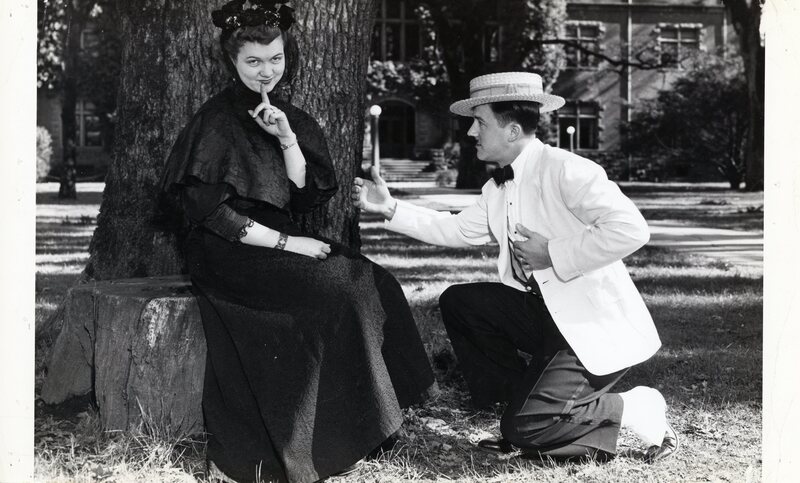
A black and white photograph taken in the first couple of decades of the Gay Nineties festival featuring Dave and Shirley Jones in costume and posed in front of Marsh Hall. A handwritten note on the back identifies the couple. The photographer is unknown, but it may have been Allan J. de Lay, a staff photographer for The Oregonian who took numerous photographs of the event over the years.
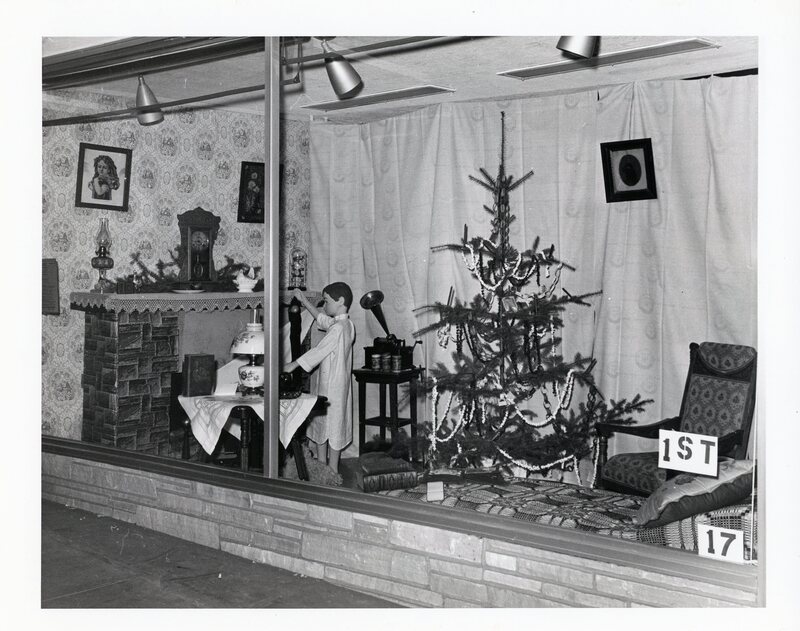
A black and white photograph by Allan J. de Lay featuring the Gay Nineties window display of Paterson's Furniture Store during the Gay Nineties festival in 1961. A handwritten inscription on the back reads: "Another Pattersons' furniture [sic] window 1960."
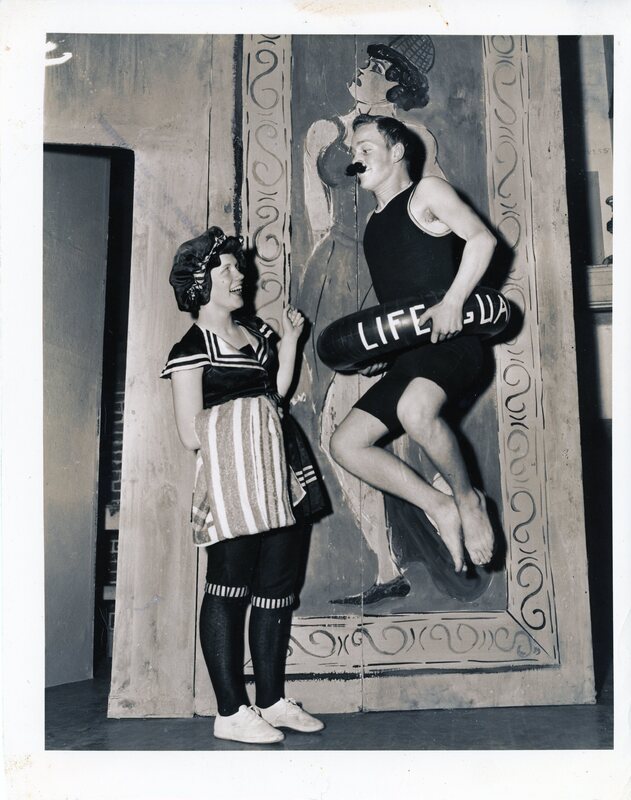
A black and white photograph featuring two teenagers in Gay Nineties swimming attire in the late 1940s or 1950s. The photographer is unknown, but it may have been Allan J. de Lay, a staff photographer for The Oregonian who took numerous photographs of the event over the years.
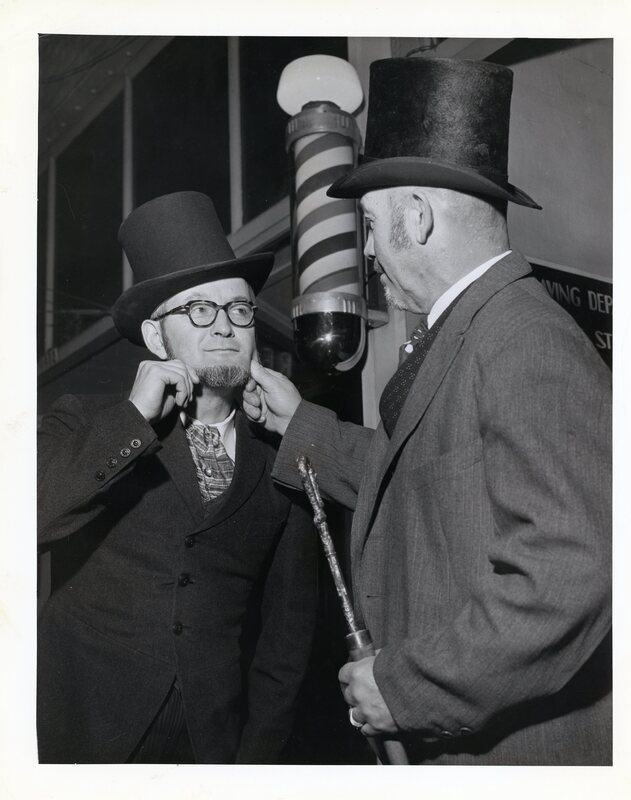
A black and white photograph featuring Forest Grove Mayor Lester Hughes inspecting Marvin Emerson's muttonchops during the Gay Nineties festival in the 1950s or early 1960s. A typewritten inscription on the back reads: "Lester Hughes, former mayor, admires Marvin Emerson's neatly trimmed beard before barbershop. Muttonchops and handlebar soupstrainers." An additional handwritten inscription on the back titles the photograph "a hair-raising sight." The photographer is unknown, but it may have been Allan J. de Lay, a staff photographer for The Oregonian who took numerous photographs of the event over the years.