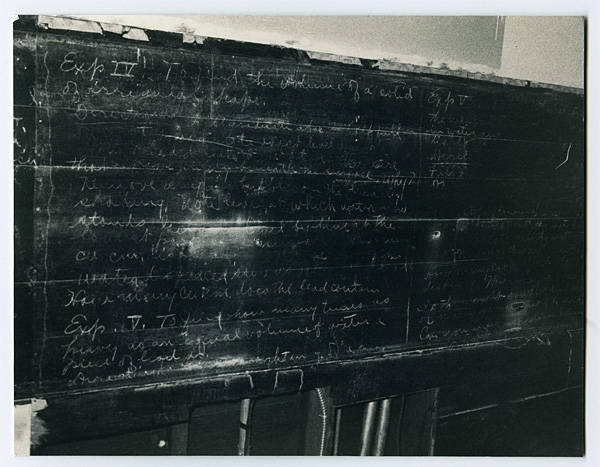
A blackboard from a classroom in Old College Hall. Notes from a geometry or physics class are written out. Some of the words are legible but most are unclear.
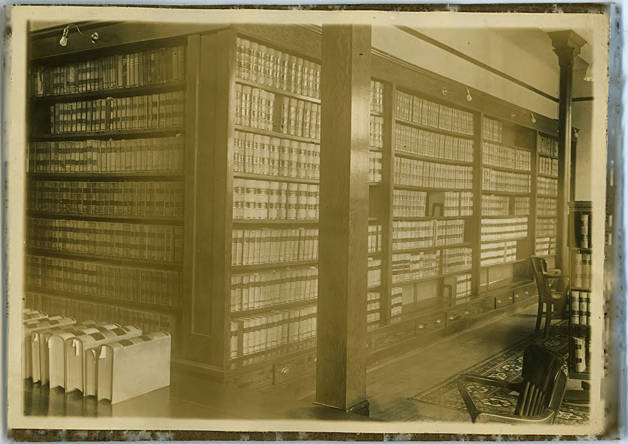
Folder containing two sepia-toned images of a room whose walls are lined with bookshelves filled with books. Tables and chairs and smaller bookshelves are located throughout the room, and more books lay out on the tables. Glass lighting fixtures hang from the ceiling and are set above each section of the bookshelf, while oriental style carpets cover much of the floor. Some chairs have wooden backs, while others are of leather. Local attorneys George R. Bagley and William G. Hare practiced law together in downtown Hillsboro. Hare also served in the state legislature, and Bagley was a local judge.
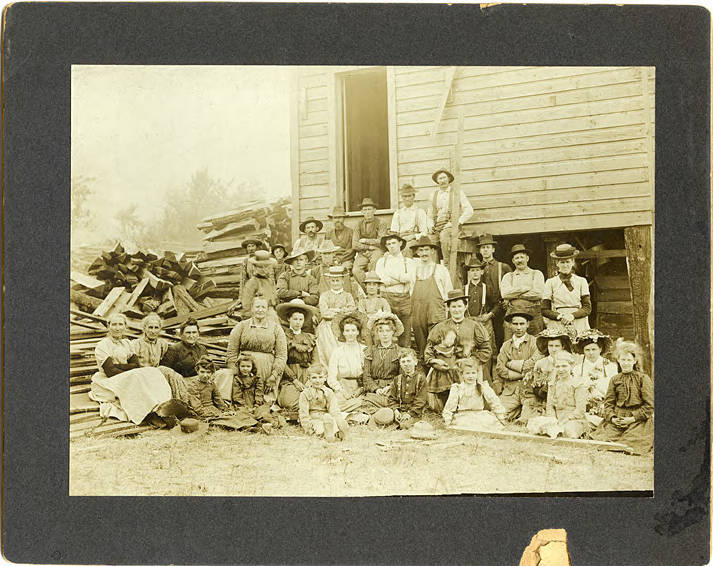
Sepia-toned image of a group of people gathered in front of a building. Piles of lumber and wood fill the background. The women are seated or kneel in the front of the group with a number of children of various ages, while the men are lined up behind them and seated on stairs leading up to the open door of the building above them. The men wear work clothes, most with suspenders, while some wear overalls. Several of the men's shirts are striped or checked. Two gentlemen seated on the steps wear vests over their striped shirts.
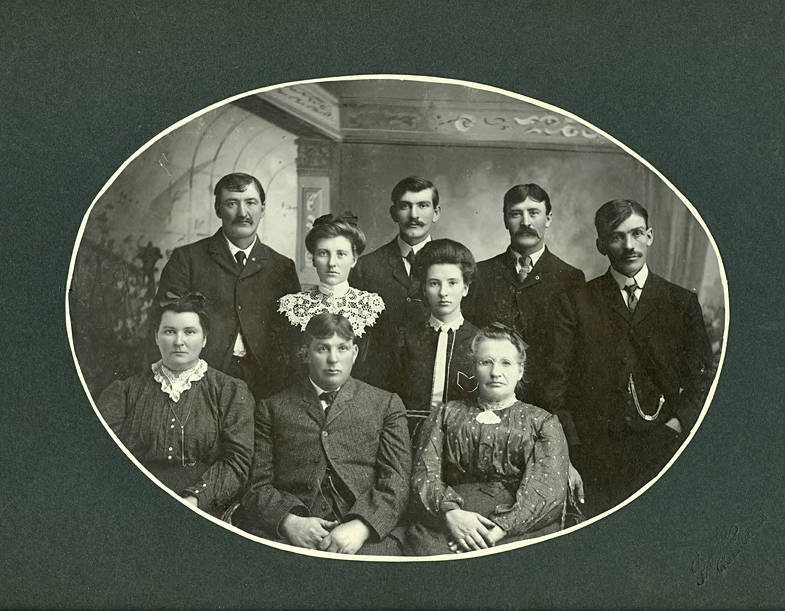
Black and white portrait of a family group gathered in front of an interior background. Four women and five men sit or stand in the image. The men wear suits and vests, and four of the five have heavy mustaches. The women wear their hair up in loose buns, and two have lace collars, one a large lace yoke, and the other wears a narrow tie. Their dresses are gathered at the waist, and have long, full sleeves. Mrs. Fanny Friday was born in Switzerland, but emigrated to the United States with her family and settled in Wisconsin. She married Nicolas Friday there, and in the early 1880s they moved with their children to the Dairy Creek area near Banks.
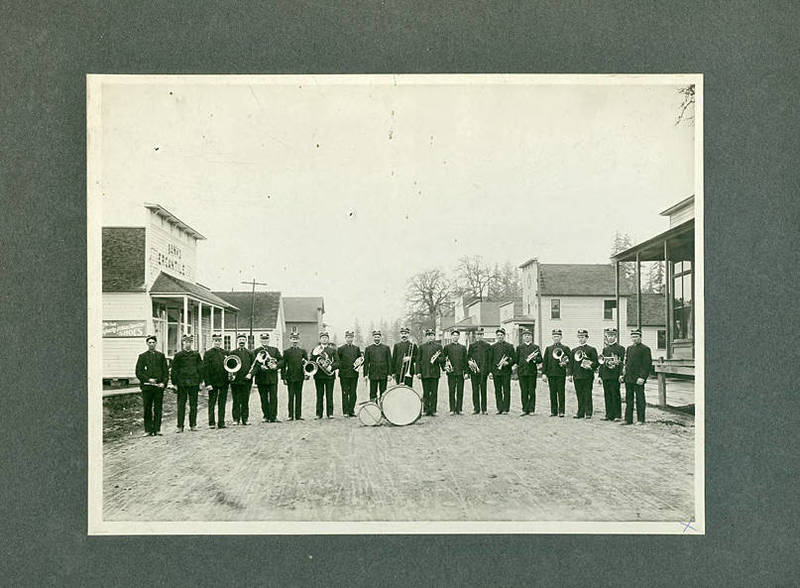
Black and white image of a band standing in a row across an unpaved street. On a building behind them the words 'Banks Mercantile' can be read. Most of the men hold brass instruments, baritones, French horns, and trumpets. In the center of the image is a large bass drum.
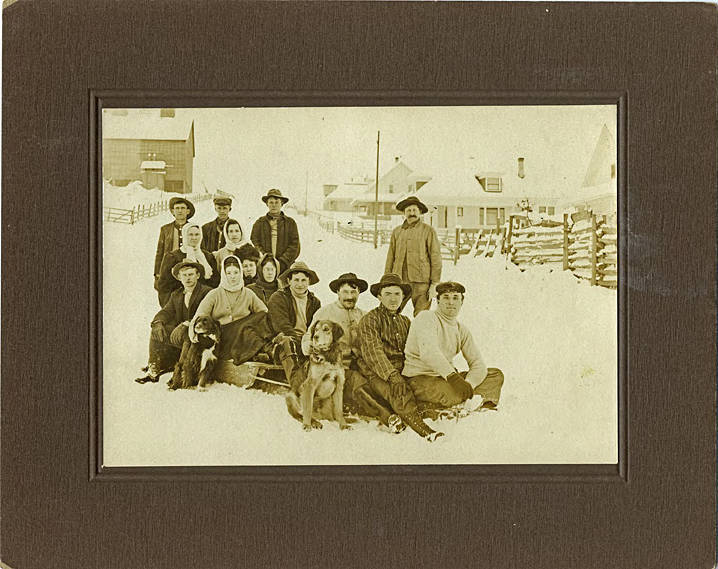
Black and white image of a group of adults and two dogs in a snowy street. Most of the group is seated on a large bobsled. Houses line one side of the street behind them, set behind split-rail fences. A large barn sits in the background on the opposite side of the street. Most of the sledders wear only sweaters, hats and gloves; the women wear scarves wrapped around their heads.
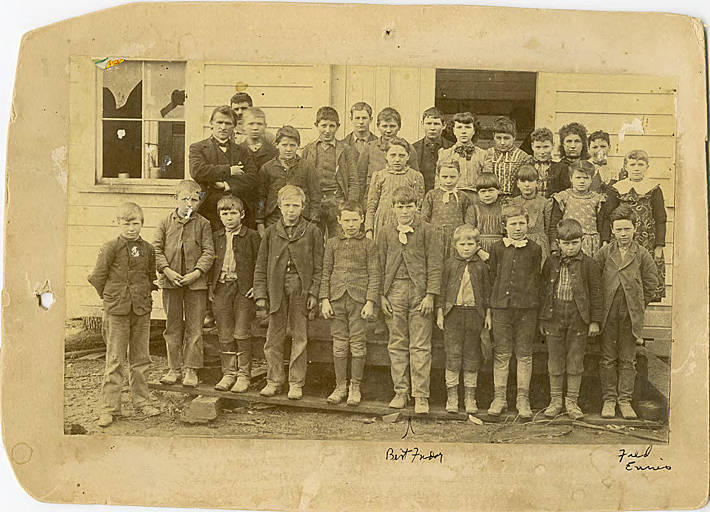
Sepia-toned image of a group of school students standing on the porch and a temporary step outside of their building. Most of the boys wear coats and pants, some wear short pants and one boy has a ruffled collar. The girls wear print and patterned dresses of varying fabrics, and most wear their hair pulled back from their faces. Two men stand at the left of the group, one just visible behind the other. The school has broken out windows and an open door.
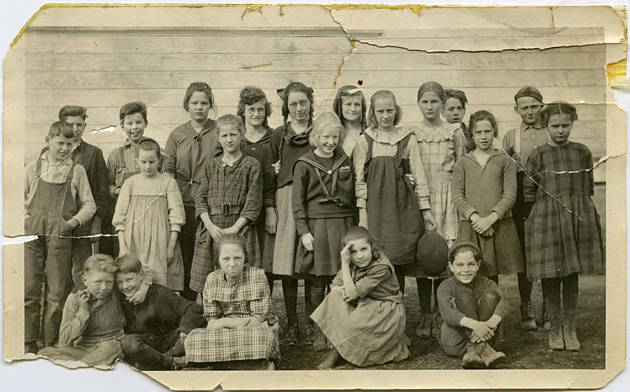
Black and white image of a number of children standing outside of a building. Some students are seated in front of the group, including two boys who appear to be almost wrestling. The girls wear knee-length skirts, many made of plaid material, while some wear pinafores or sailor style shirts. The boys wear overalls or pants with suspenders.
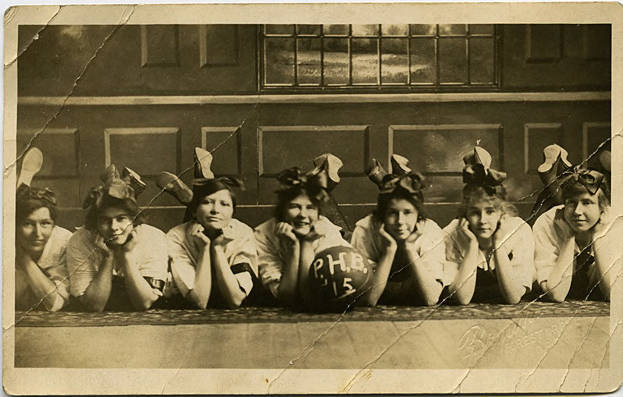
Sepia-toned portrait of a group of girls, all wearing short-sleeved shirts, lying on their stomachs on a carpet. They rest their chins on their hands, and their feet are up in the air. All wear large bows in their hair. A basketball sits on the rug in the middle of the group, with 'P. H. B. '15' lettered on it in white paint. The young women in the image were residents of the Banks area, which had no high school at this time, so it is unclear which school this team is affiliated with.
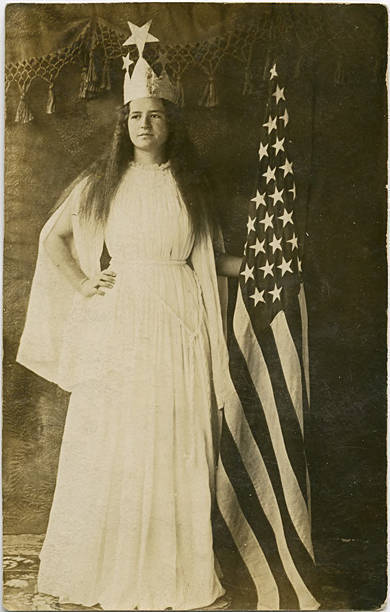
Sepia-toned image of a young woman dressed in a full, long white gown, gathered at the neck and belted at the waist, and with long, full, split sleeves. She holds a United States flag in one hand, and wears a crown with stars on each point.
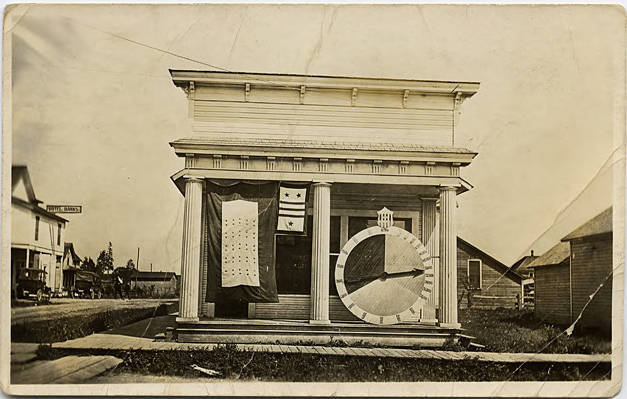
The Washington County Bank building on Main Street in the small town of Banks, Oregon, decorated in support of the military during World War I. The front of the building is decorated with two service flags and a wheel showing progress towards a war bond fundraising goal. This photograph, which was issued as a postcard, was probably taken in late 1917 or early 1918.
The large service flag (left) is similar to other ones produced in this region during World War I. Each of the small stars on such flags typically represented one man from the community who had entered military service. Blue stars signified men who had joined the war and were still alive, while gold stars signified those who had died in service. The smaller flag (center) with three stars may have belonged to the family who operated the bank, signifying that they had three sons in service. These flags symbolized the town's commitment to the war and the seriousness of the need for raising funds.
The wheel on the right demonstrated progress towards a community-wide goal for purchasing Liberty Bonds. These war bonds were issued by the U.S. Department of the Treasury as a way to finance the war effort. People who bought bonds would gain a return of around 3-4%, but they were promoted more as a means of demonstrating patriotic sentiment, rather than as an investment. This wheel shows that the town of Banks was about 1/4 of the way towards their goal for purchases.
The Washington County Bank was the first bank in the town of Banks, having opened in 1909. It was a postal savings bank, which was a part of a limited service banking system backed by the federal government. Outlets often served rural communities. The building had a false front with a neoclassical facade, featuring three Doric columns, holding up a rectangular pediment with false columns etched along beneath its top. A wooden sidewalk surrounded the building. An unpaved road and several Model T -like cars are visible on the left.
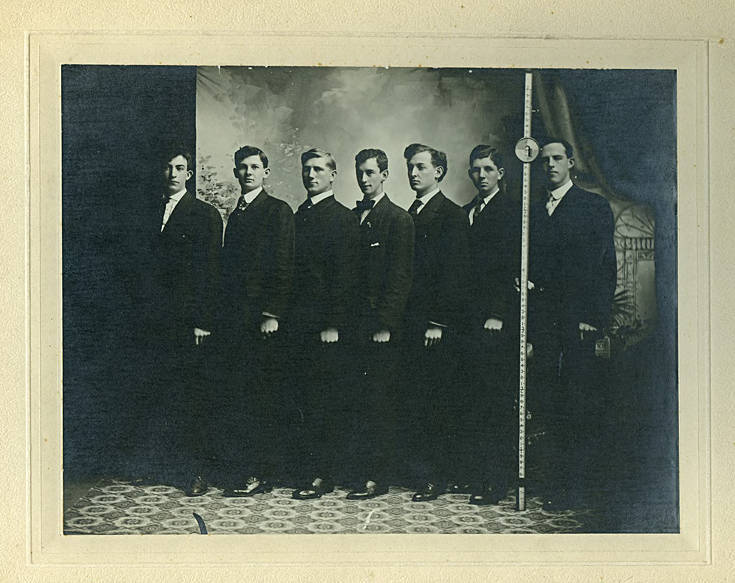
Black and white portrait of seven men wearing suits and ties, standing in a row. All wear their hair parted on one side and combed over. The man at the end of the line on the right holds what appears to be a surveyors measuring rod, most likely marking a six foot measurement.
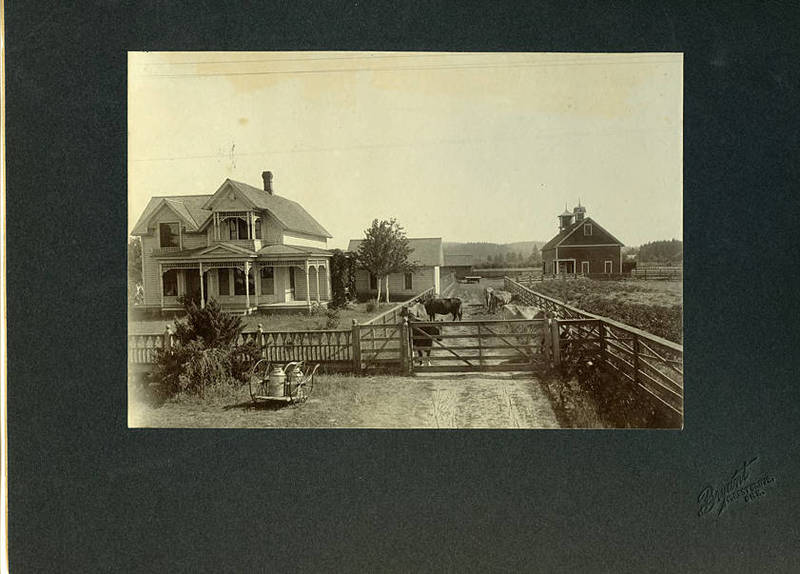
Sepia-toned image of a cross-gabled, Queen Anne-style house with two outbuildings and a large barn. The house has two dormer windows, one of which extends into a balcony over a large front window. A porch wraps around the front of the house. A decorative fence runs along the front edge of the yard, next to a fenced lane leading back to the barn and outbuildings. Several cows stand in the lane, and a small cart with two milk cans on it stands in front of the fence.
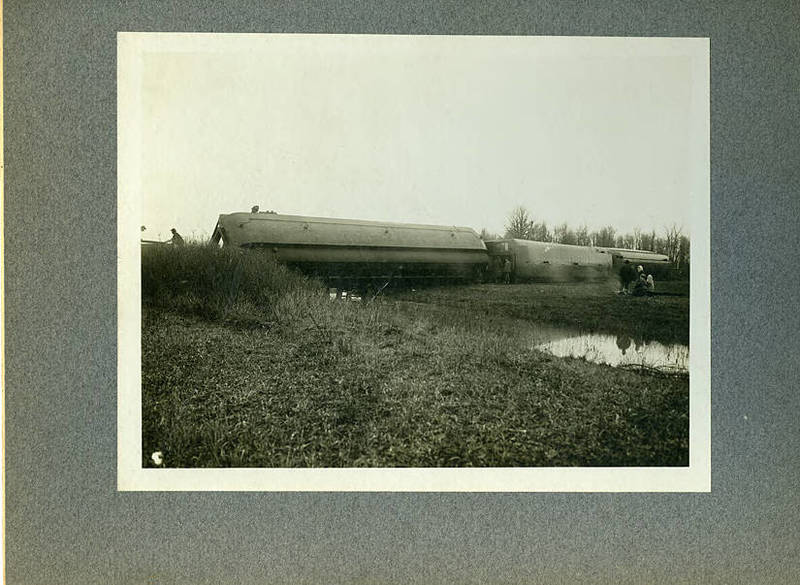
Black and white image of several train cars lying on their sides. Several men are seen looking into one car, and three women, one who holds a baby, are gathered around a small fire on the ground in the right of the image, observing the wreck. The ground appears to be muddy and overgrown, and a small creek or slough runs through the center of the image. The accident took place just west of Forest Grove, and was a result of a broken rail, which splintered after the engine and baggage cars had passed, derailing the smoking car and two coaches. Three people were killed in the accident, a man from McMinnville, and a woman and her infant child from Portland.
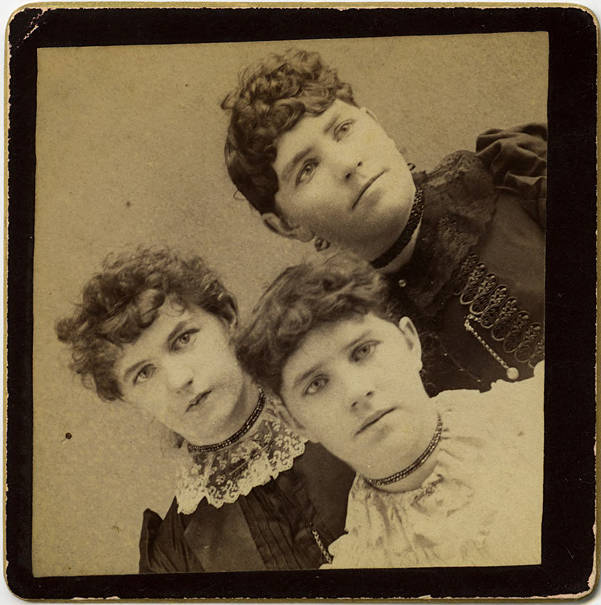
Sepia-toned image of three young women, apparently sisters. All three wear their hair pulled back and have curly bangs hanging over their foreheads. Their simple, beaded choker necklaces also match. Two wear dark dresses with puffed sleeves; one has a white lace collar while the other has a black lace collar and an elaborate braided and buttoned trim down the front of her dress. The girl in front wears a white blouse with an elaborate lace ruffle gathered about her neck. The photographer, Harry Crosley, was the son of the local Forest Grove postmaster and had his studio above the post office. It is possible at least two of the young women pictured are the McLin sisters, Martha (Emerick), and Mary Ellen (Rowen), but the style of clothing worn by the subjects and the known information about the photographer indicates the pictures was taken sometime in the 1890s, when both women would have been in their thirties.