
Items
-
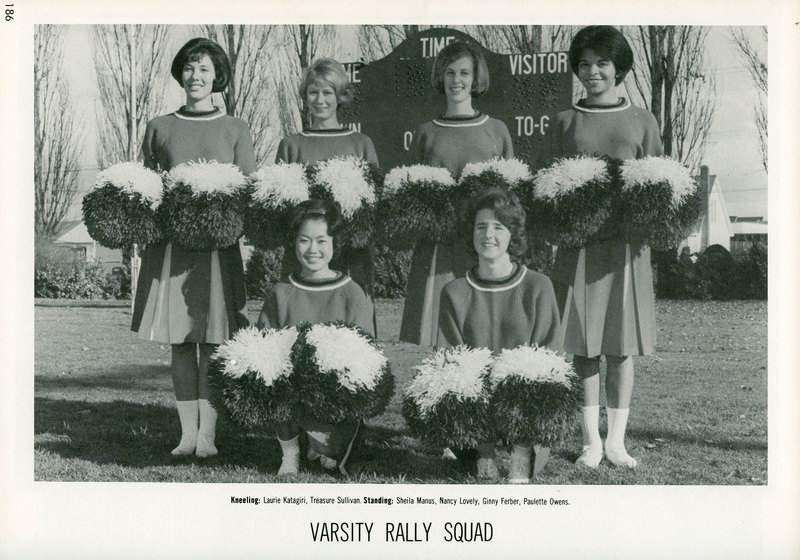 Varsity Rally Squad PhotographA photograph taken of the Varsity Rally Squad at Pacific University in Forest Grove, Oregon. This photo was located at the Heart of Oak '65 yearbook of Pacific University. This yearbook was created by Pacific students and faculty. The Varsity Rally Squad members included: Laurie Katagiri, Treasure Sullivan, Sheila Manus, Nancy Lovely, Ginny Ferber, and Paulette Owens. These student athletes were very involved with not only sports, but also extra curricular activities such as clubs. These women participated in the athletic program when they supported the men's basketball and football games during competitions. There was not just a varsity group, but a junior varsity rally squad as well. This recognizes the fact that women's sports were now becoming more active and more women were becoming involved with athletics. This shows the progress of girls trying out to be part of the rally squad. There were two teams to potentially make. The rally squad during 1965 are equivalent to what a cheerleader is. They support, rally, and cheer on Pacific University. These women had practices like every other sport did, and performed. The rally squad was not always at Pacific University for athletics unlike sports like basketball, tennis, and volleyball. It slowly grew into an activity that women wanted to try out for and be a part of. This photo is significant because it shows the support in women's athletics and including various forms of athletics to include at the collegiate level such as the rally squad.
 -
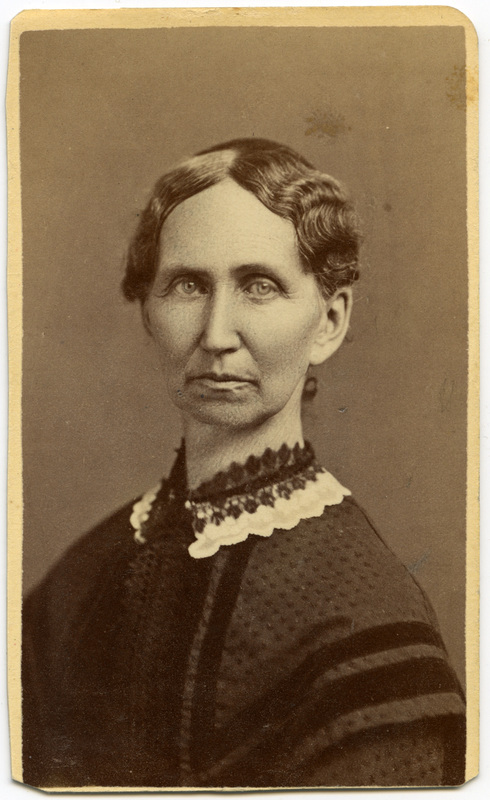 Photograph of Mary Richardson WalkerMary Richardson Walker was born April 1st, 1811. She grew up in Massachusetts as the oldest of eleven. In 1837, she meets Elkanah Walker. After only knowing each for 48 hours, they became engaged and were married a year later. Both being strong of faith and having a dream of being a missionary, they jumped at the chances to travel to Oregon Country as missionaries. They left on March 7th, 1838 with three other couples. They reached the Whitman Mission in August 29th, 1838. The Richardson’s then proceed to make a new mission called Tshimakain. The lived there for ten years. Shortly after the Whitman Massacre in 1847, then the Walker family decided to move to Oregon. Before long, the family became an eminent part of the Forest Grove community. The important thing to note about the Walker family was they were the ones who donated the land and a building in which Pacific University is established on. Elkanah also served on the board of trustees. Now the importance of Mary Richardson Walker cannot be easily overlooked. Not much is known of her true accomplishments, partly due to her gender. She wrote a diary of her entire journey through life. This journal is used today as an honest representation of life on the trail and once reaching Oregon. She is a true woman of the Oregon trail
 -
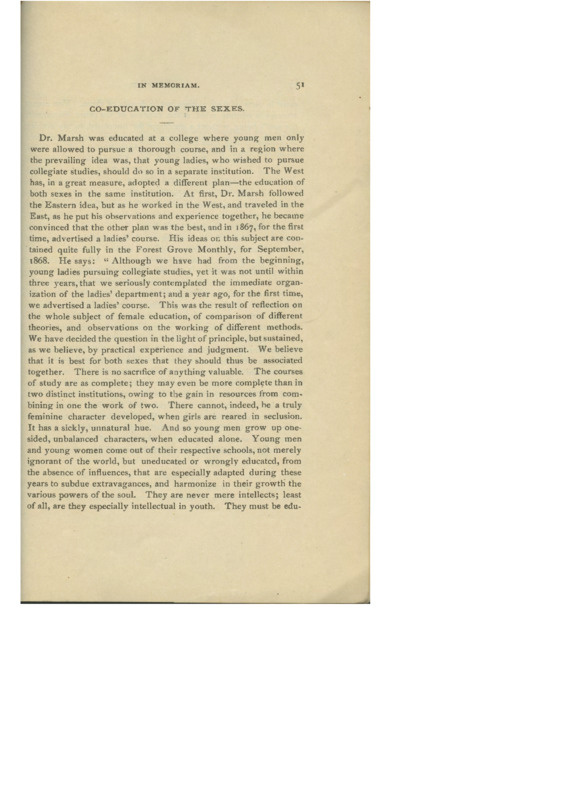 In Memoriam. C0-Education of the SexesThis is the section of a Memoriam book for Dr. Marsh, whom died two years before the publishing date in 1879. The book describes how he changed the school's education system from not teaching female students, to teaching female students. While observing different teaching methods from different regions, he found that the society seemed to function better when both men and women were being taught in a similar environment, rather than separate from each other. The trustees, agreed that it was important to keep the humanity with the males sane and that having women in the school environment would be beneficial in general. Young Women were still considered to be famine rather than noble still within the eyes of the University trustees. For they did not consider the approval or thoughts of women when it came to this decision or even consult with women on the educational synopsis developed for women.
 -
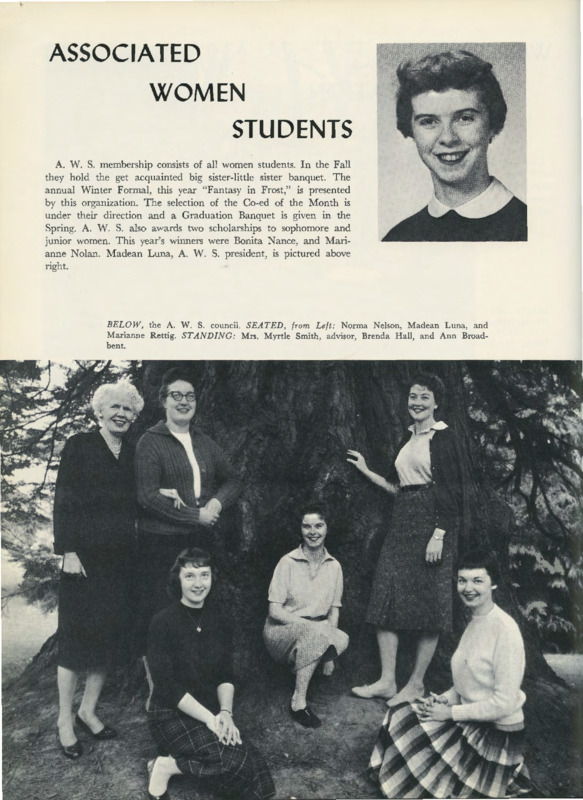 Associated Women Students 1959 Yearbook PageThe Associated Women Students 1959 yearbook page shows their Spring 1959 President, Madean Luna, as well as the A.W.S council, which included their adviser Mrs. Myrtle Smith. A.W.S. also selected a co-ed of the month as well as a co-ed of the year. The selection was based on achievement and involvement on campus. This page was taken from the 1959 Yearbook from Pacific University, Heart of Oak.
 -
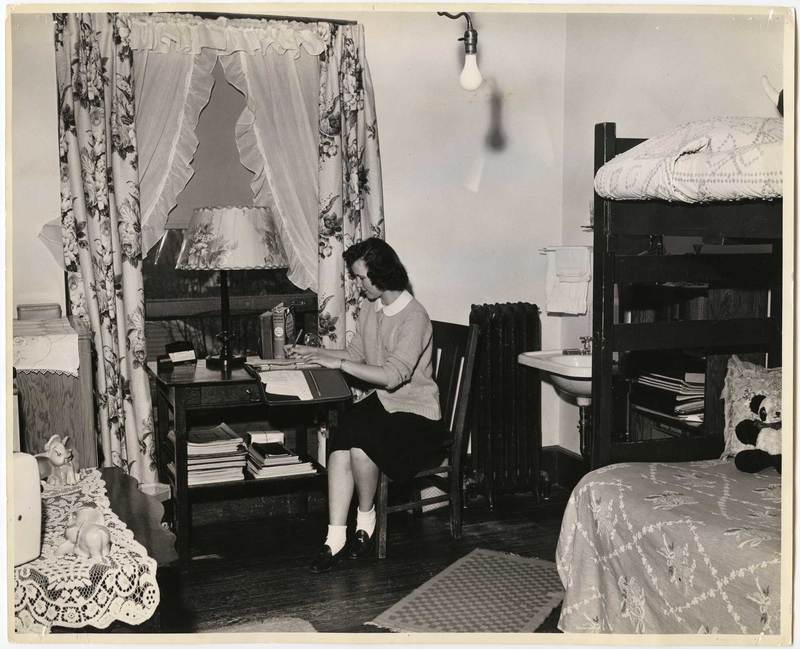 Dorm room in second Herrick Hall at Pacific UniversityThis is a photograph of a young woman named Jean Stephenson studying in her dorm room in Herrick Hall at Pacific University in February, 1947. Jean is from Metzger, Oregon, and was a sophomore at the time of this photo. Jean graduated from Pacific University in 1949 as valedictorian with a Bachelor of Arts in History. She later became a teacher, living first in southern Oregon and later moving to northern Oregon where she lived for the rest of her life until April 3, 2016. Herrick Hall was three stories tall with bathrooms on each floor with single and double-bedrooms lining the halls. Every dorm room in Herrick Hall was supplied with a sink, a heater, and furniture such as a bed, mattress, and a desk for each student. All women who did not have already have a home in Forest Grove were required to live in Herrick Hall. The original all-female dormitory was first built in 1883 and was called Ladies Hall. During the second university president Reverend John Russell Herrick's tenure, he spent much of his four years as president away from the university, but in that time, he was able to accomplish many things including raising $16,000 to build Ladies Hall. The first year the building was put to use was in 1884. It was renamed after President Herrick in 1887. The first Herrick Hall completely burned down on Sunday, March 11, 1906, from chimney sparks on the roof. A combination of women's fundraising and the Carnegie Foundation donation of $10,000 allowed the second Herrick Hall to be built in 1907. Until 1958, it was still an all-female residence hall. Herrick Hall burned down a second time in 1973.
 -
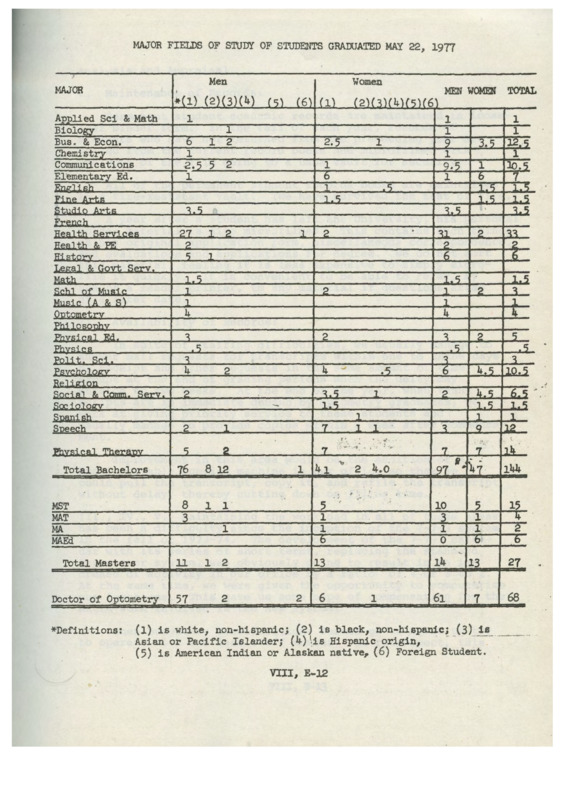 1977 Pacific University Self-Study Reports ExcerptsThe Pacific University Self-Study Reports are a series of decennial reports that lay out University goals, collect and interpret data related to student admissions, graduations, faculty size increases, university finances and more. The reports can act as a valuable measure of race and gender related issues both in what they directly say and what is left out. The 1977 reports expresses racial and gender diversity as a main goal for the University. Specifically, this is expressed a 'maintain[ing]' an 'ethnic and social and coed mix of [the] student body.' On the twelfth page of the introduction attention is drawn to Black Culture Week and the Hawaiian Luau which are considered 'grand celebrations' of minority culture. Having an excess of 20% of students as minorities is considered an indication of achieving University goals. Rather than expressing a goal to diversify the mix of students, or increase acceptance of minorities, the goal is explicitly to 'maintain the mix'. Section VIII, E-12 shows the number of graduating students in May '77 broken down by major field of study, gender and racial background. This was the first time race and ethnicity was reported in these self-studies, but this practice would not be followed in the '87 and '97 reports. The documents featured show important statistics about the portion of women undergraduate and graduate students who were minorities.
 -
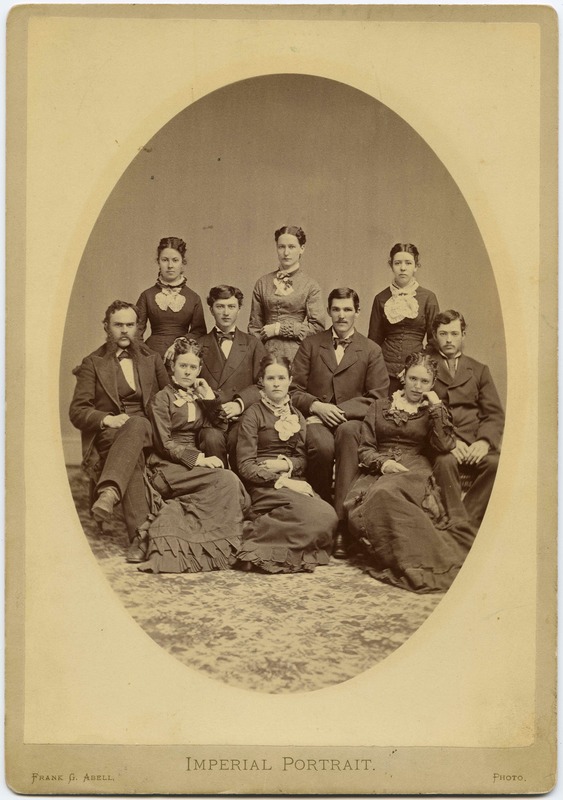 Pacific University Graduating Class of 1878, PortraitThis is the portrait of the graduating class of 1878 at Pacific University. The majority of students graduating are female and they are arranged in the portrait as follows.First Row; Mary A. (Creswell) Eagan later Simard, Elvira H. Fearnside, Laura M. (Haxter) Wholley: Second Row; DeWitt Clinton LaTourette, Milton W. Smith, Samuel R. Stott, Horace Sumner Lyman: Third Row; Mary F. (Lyman) McCoy, Ellen (Scott) Latourette - Mrs. D.C., Mary Stacey Eaton.
 -
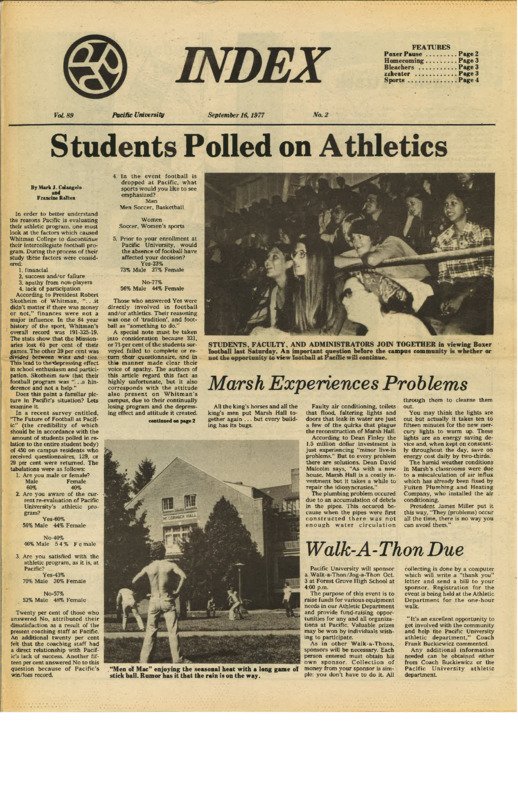 'Students Polled on Athletics' IndexThis item is a newspaper article that came out of the Index of Pacific University about the students polling on athletics. The writers of the article was Mark J. Colangelo and Francine Raften. The article was written in 1977. The article subject is about the issues that students saw in the athletic program. In the polling process it is very evident that women were very unsatisfied with sports at this time. Interesting enough this is 5 years after Title IX was passed, so it would seem that not much has changed in response, even though women were participating in sports during 1977. Women were involved in competition, participating in sports, and were part of a team. Women were involved in gymnastics, soccer, tennis, track, volleyball, and even basketball. There were equal to men, but even after the passing of Title IX women were still unsatisfied at Pacific University. The polling article greatly stressed the percentages of the polls and how 70% men were satisfied with the program whereas women were 30% satisfied. This article is significant because even after the pass of Title IX where women are suppose to equal to men in athletics, there were still issues for women. This entails how long the process was for women to be recognized fairly in the same light as men and gaining the respect of being a female athlete. This article is very significant because it shows retrogression in Title IX instead of progress at Pacific University based on the polling results of the athletic program.
 -
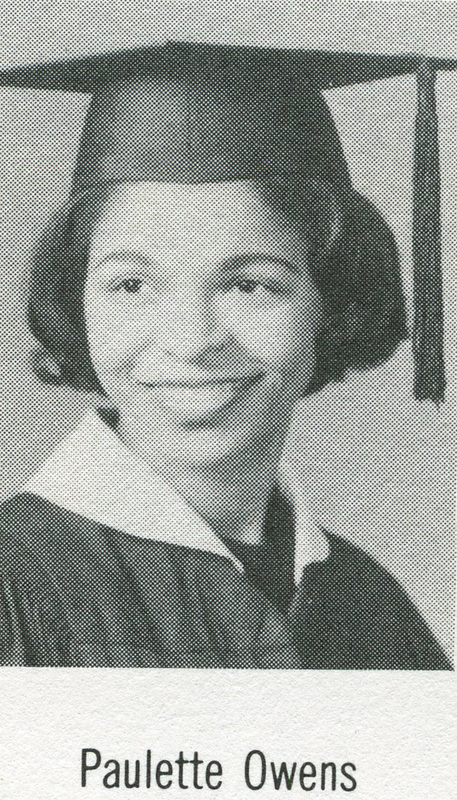 Paulette Owens Portrait 1965 Yearbook PhotoGraduated in 1965 in Psychology. member of phi lambda omicron sorority, the Pan-Hellenic Council, Pacific University Singers, the Student Anti-Discrimination League, and the Varsity Rally Squad. Paulette would go on to study and practice law in New York City and would return to Pacific during the 1983 Homecoming-Inauguration Convocation and received an Honorary Degree at Pacific with her twin Paul Owens. She may have been the first black woman to graduate Pacific's undergraduate program.
 -
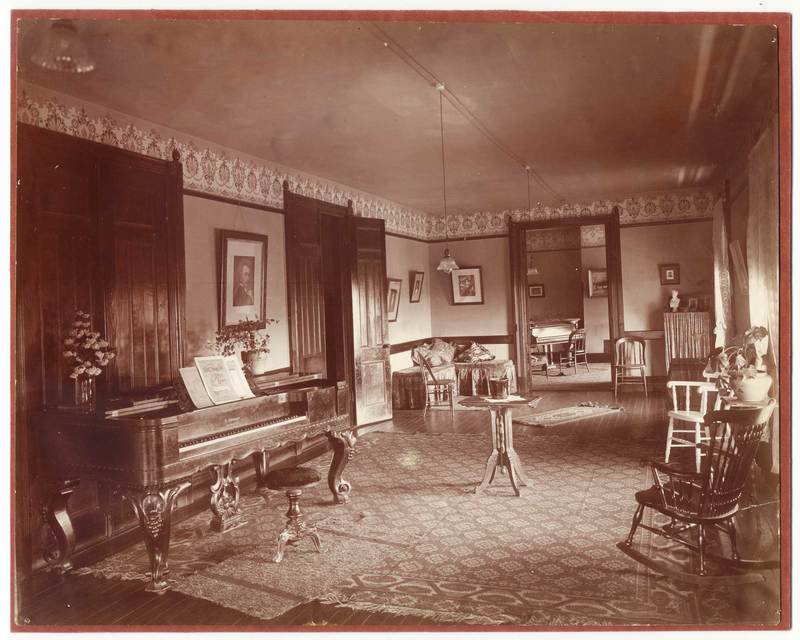 Parlor in Second Herrick Hall at Pacific UniversityThis is a photograph of the parlor in the second Herrick Hall. This was a gathering place on the first floor of the building for women while living in this residence hall. Women were required to live in this building while attending Pacific University if they did not already own a home off campus. The original all-female dormitory was first built in 1883 and was called Ladies Hall. During the second university president Reverend John Russell Herrick's tenure, he spent much of his four years as president away from the university, but in that time, he was able to accomplish many things including raising $16,000 to build Ladies Hall. The first year the building was put to use was in 1884. It was renamed after President Herrick in 1887. The first Herrick Hall completely burned down on Sunday, March 11, 1906, from chimney sparks on the roof. A combination of women's fundraising and the Carnegie Foundation donation of $10,000 allowed the second Herrick Hall to be built in 1907. Until 1958, it was still an all-female residence hall. Herrick Hall burned down a second time in 1973.
 -
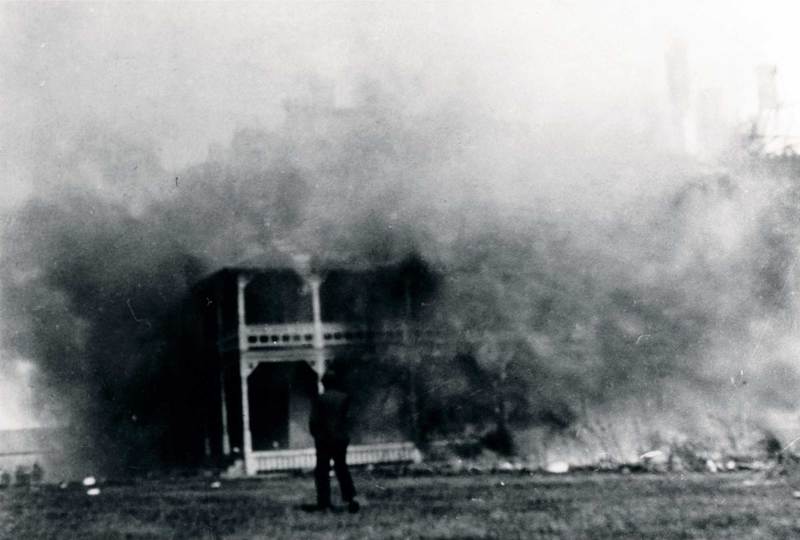 Burning of first Herrick Hall at Pacific UniversityThis is a photograph of the first Herrick Hall burning on Sunday, March 11, 1906. An unidentified man watches the building burn in the center of the photograph. Herrick Hall was the all-female residence hall on campus that all women were required to live in unless they had special accommodations to live in a house in the surrounding area in Forest Grove. The fire started at 11:oo am while everyone was attending church and was discovered by Professor F. T. Chapman. It was later discovered that sparks from the chimney fell on the roof and an east wind started the flames. Because the fire started at the top of the building, much of the contents of the building was able to be saved, though the building was not. It took three hours for the entire building to burn down. The fire could have easily spread to other buildings on and off-campus if it weren't for the efforts of the citizens, students, and fire department. Herrick Hall was built in 1883 and was originally named Ladies Hall for its residents. In 1887, it was renamed Herrick Hall after the University's second president who raised money for the building. By May, 1906, a $10,000 donation from the Carnegie Foundation and women's fundraising had raised enough money so that building plans were already in affect for a second Herrick Hall. The second Herrick Hall stood as an all-female residence hall until 1958 and burned down in 1973. This photograph might have come out of a L. J. Corl photo album.
 -
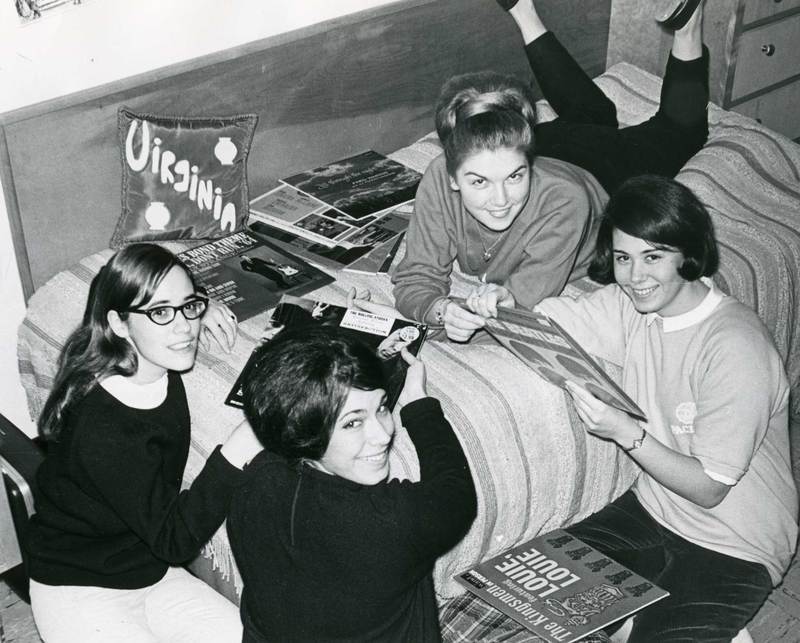 Women in Walter Hall at Pacific UniversityThis is a photograph taken most likely in the first few months of 1966 of four women: (left to right) Zelda Wissman, Judith Engdahl, Carolyn Brown, and Virginia Stretcher. They are in a dorm room in Walter Hall at Pacific University looking at vinyl records which include The Kingsmen's 'Louie Louie', The Beatles' 'A Hard Day's Night', and The Rolling Stones' 'Satisfaction'. Mary Eliece (Zelda) Wissman graduated from Pacific University in 1969 with a B.A. in English. She was from Belvedere, California, and later married, changing her last name to Weeks and relocated to Indianapolis, Indiana. During the time of this photograph, she was a freshman living in Walter Hall. Judith Ann Engdahl graduated from Pacific University in 1968 with a B.A. in Sociology. She originated from Edina, Minnesota. When she married in August, 1968, she changed her last name to Bishop and relocated to Portland, Oregon. Engdahl has since donated money back to Pacific University, During the time of this photograph, she was a sophomore living in Walter Hall. Carolyn Marian Brown graduated from Pacific University in 1968 with a B.A. in Speech. She was from Orinda, California. She changed her last name to Moore when she married and then moved to Chico, California to become a teacher. During the time of this photograph, she was sophomore living in Walter Hall. Virginia Ann Stretcher was a student into her senior year at Pacific University, but there were records found stating that she graduated from the university. She was a history major, originating from Bakersfield, California. There are a few other photographs of her from the same time period in the Pacific University archives. During the time of this photograph, she was a sophomore living in Walter Hall. When looking at this photograph in comparison to others near its location in the Pacific University archives, this photo is one of many staged photos for publicity. Walter Hall was built in 1958 and named after Judith Scott Walter, the daughter of the first graduate from Pacific University. Walter had allotted the largest single grant to Pacific University that the school had received thus far in her will and upon her death, it was put towards building a new all-female residence hall. The hall was opened up to students in September, 1958, and is still standing today. It is three-stories tall and has a basement used for laundry and storage. It has double and single-bedrooms and currently houses about 250 students.
 -
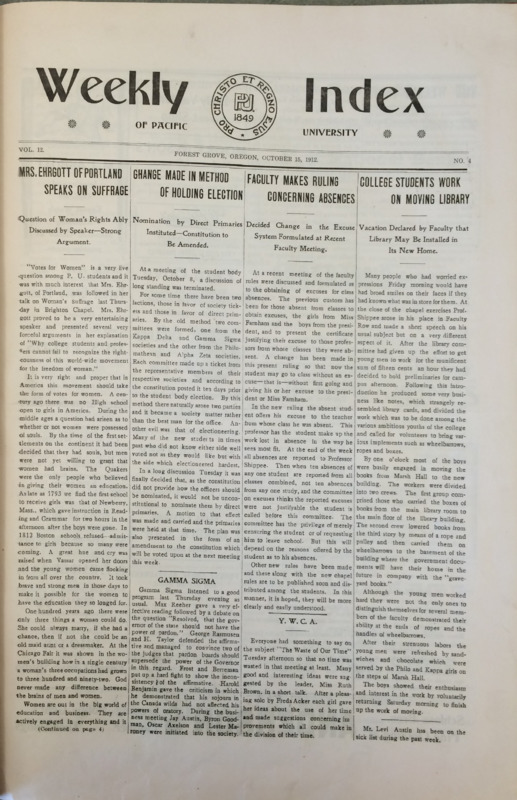 Weekly Index of Pacific University: Mrs. Ehrgott of Portland Speaks On SuffrageThis is a 1912, Pacific University Index Article. It talks about the speech of the leader Mrs. Erhgott, whom speaks upon the subject of women's suffrage. She describes the rights of women as something that was gained over time. Mrs. Ergott used the arguments of Medieval scholars debates of women having souls, talks about the Quakers being the only religious group in the early United States giving women the right to vote, and then goes into the subject of the Boston school system shutting its doors to women in 1812, and how by this point women finally argued against their separation from education. In 1912, Mrs. Erhgott compelled a crowd to consider also giving women the right to vote. As she argues, many women were already starting to go into the public business world and 17 percent of high school graduates come from high school. She further argued, that it would only be fair to let women have the right to vote, because women who are educated do make society better, and excluding them would exclude an significant portion of the population from having a say in society. At the time, there existed a anti-womens suffrage movement to counter her. They believed that when women received the right to vote, that they would not use the right to vote. Her speech countered their objections by attracting a large crowd interested in her speech.
 -
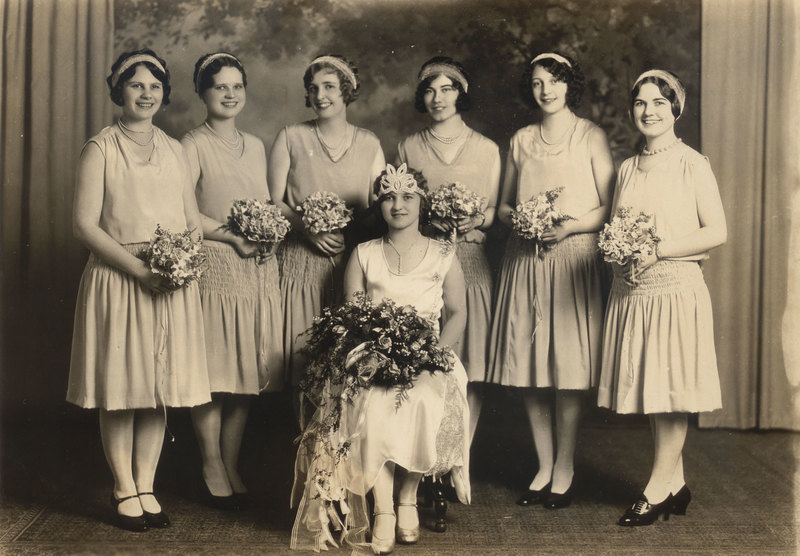 May Day Queen and Court 19281928 May Day Queen Florence Bennett (seated), and her ladies-in-waiting Dorothy Wood, Lillian Thouvenel, Florence Riffle, Shellie Slyter, Alice Montgomery, and Jacqueline Honeyworth, pictured in Herrick Hall. The subjects of this photograph exemplify the importance placed on the May Day court, all having been heavily involved in both academic and extracurricular activities.
 -
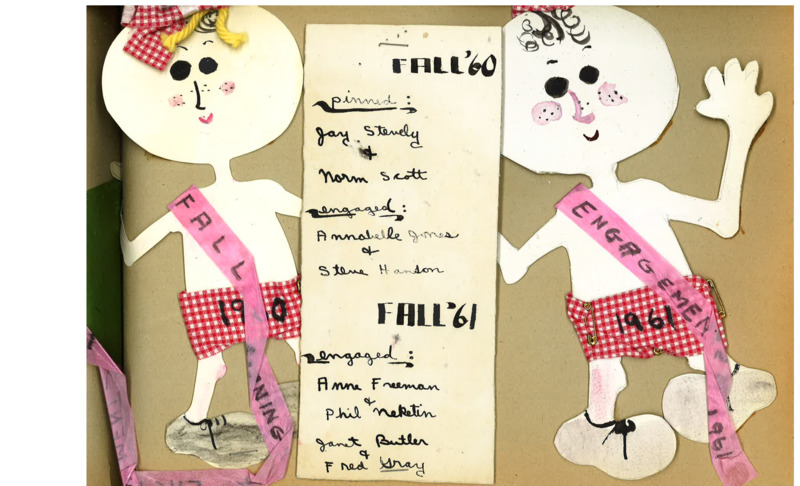 Delta Chi Delta 'Pinned & Engaged' Scrapbook PageA page from the 1960-1961 scrapbook from the Delta Chi Delta sorority at Pacific University. Delta Chi Delta was founded in 1959 and was active on campus at Pacific into the 1980's when it was disbanded. The sorority renewed it's charter in 2001. This scrapbook page has a list of sorority women had either become 'pinned or engaged.' Pinning was a sort of pre-engagement ceremony where a fraternity brother would give his fraternity pin to his girlfriend in a sorority. the page has lists for both Fall semester of 1960 and Fall semester of 1961.
 -
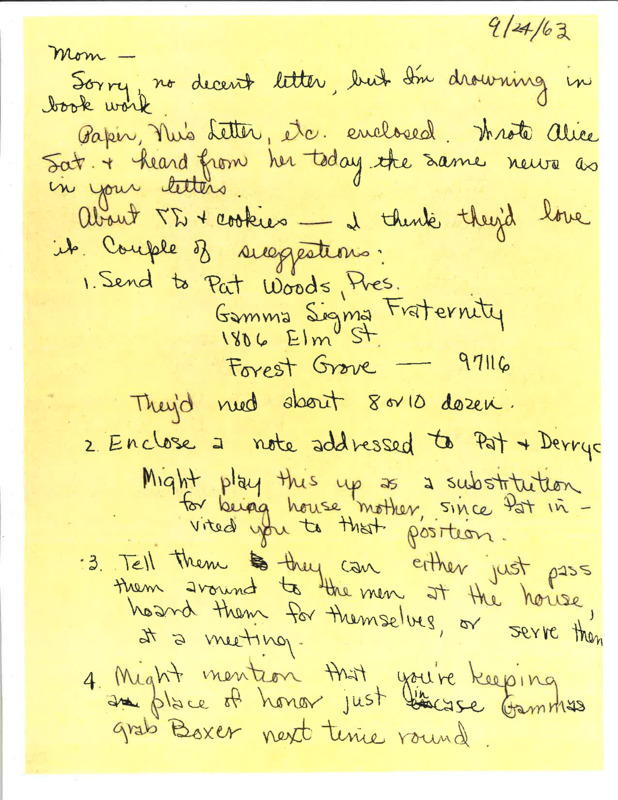 Cheron Mayhall Letter To Mother Asking for Cookies for Gamma Sigma FraternityA letter written by Cheron Mayhall on September 24, 1963 to her mother concerning the making of cookies for the Gamma Sigma fraternity. Cheron was part of the Theta Nu Alpha Sorority at Pacific in the 60's and they were affiliated with the Gamma Sigma Fraternity. At Pacific it was common place for Fraternities and Sororities to be affiliated with each other as brother-sister and these connections still exist today at Pacific. Cheron is asking her mother to make cookies for the Gammas as a gesture of good faith as it seems she had declined the opportunity to become the Gamma Sigma House Mother. Cheron even instructs her mother to keep a 'place of honor just incase Gammas grab boxer next time around.' Cheron here is referring to the 'Boxer toss' which was a brawl that took place between fraternities and other campus groups to seize the Boxer Statue that is now the mascot of Pacific. This letter shows how the fraternities were viewed and treated by the sororities who seemingly just did things like bake cookies and supported them in the Boxer Toss from the sidelines. This document is from a collection of photocopies of Cheron Mayhall's letters from her time at pacific.
 -
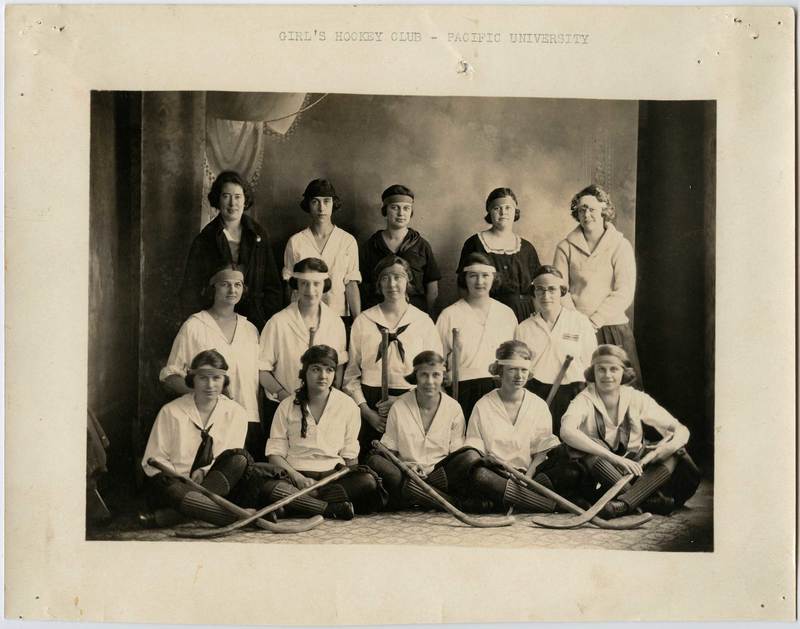 Women's Hockey Club PhotographThe photograph of the Women's Hockey Club is of several women that participated in athletics at Pacific University. There is lack of information about the individual women because the picture did not include a list of their names. Based off of other sources about when women were part of field hockey would be approximately between 1918-1925. There are field hockey team pictures throughout 'The Heart of Oak' yearbooks during the years of 1922 and 1923. There is even articles in 1920 that mentions of women's hockey teams throughout the Index newspaper. Women throughout each of the pictures have the same type of uniform. All the women are wearing some sort of white shirt with a black sash tied around their neck in the same way. The uniform throughout the different years have very many similarities, so based on that contextual evidence this picture seems to possibly have been taken between 1918-1925. Field hockey was apart of a larger schedule for women's athletics. Field hockey was part of a list of sports that women could play based on the implementations of the Women's Athletic Association of Pacific University. These sports including field hockey provided opportunities for women to earn points in order to earn an official white sweater. An official white sweater signifies a lettermens jacket to show women what they have accomplished in sports. Field hockey was played during the fall season and outside out on a field when the weather permitted. The field hockey group did not play competitively against other teams. The early implementations of women's sports at Pacific University included competitions between their classes. There was a variation of teams with the classes. In 1922 it was Senior-Sophomore girls versus the Junior-Freshman class. While in 1923, the teams were composed of Senior-Freshman girls and the other team was the Junior-Sophomore team. Based on the variations of the teams it might have changed every year to make the competition different and interesting. It was one of the oldest sports in the United States and also a very popular game as well. Many girls participated in these events and many of them came back to play this sport. Some articles within the Pacific University Index Newspaper mentioned the popularity and amount of girls that improved and came back to play field hockey during the 1920's. It shows the amount of support these women got from the Women's Athletic Association based on the push for women's athletics to be able to earn points for their participation.
 -
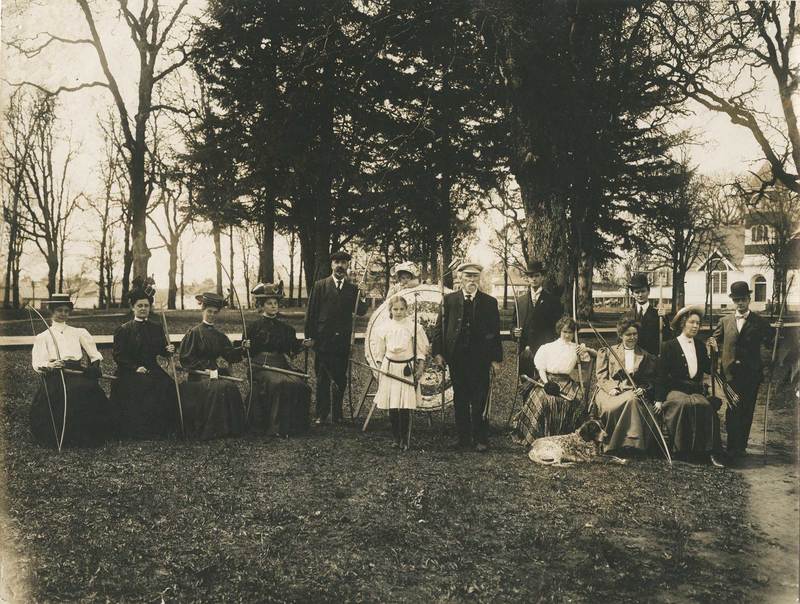 Women's Archery Club PhotographA photograph taken of the Maurice Thompson Archery Club approximately in 1895. The archery club’s members pictured here are: Margaret Hinman, Mary MacKenzie, Anna Penfield, W.U. Marsh, Henry Liberty Bates, Arlye Marsh (behind target), Margaret Marsh, Barnes, Professor Orr-Lela Micklin, Lillian Bain, Professor Bin Kori, Manche Langley, and a Mr. Cook from left to right. The Archery Club was associated with Tualatin Academy as it worked alongside Pacific University. The Tualatin Academy was a secondary private school and it provided many clubs for Pacific University students that could participate in. It was a co-ed club with women and men that were able to participate. A major contributor to this club was Henry Liberty Bates as he was the assistant coach alongside head coach Barnes. Both are pictured within the archery club photo. Archery was seen as a feminist sport because it was not seen as a very active sport and was not physically difficult. Archery was perceived as elegant and graceful based on how the women held the bow and arrow. Pacific University has had archery for many years since it began in late 1890's, but it also has evolved into a sport at Pacific University instead of just in a club. The Women's Athletic Association during 1940 counted archery as a sport to earn points in the fall season. There was a transition period between when archery became a sport, but it was not long lasting. Archery has not been much of a popular competitive sport in college activities for quite some time. It is not as big of competition in college athletics, but it still was one of the major and earliest activities that women were able to participate in. It had a major impact on women's sports because of the openness for women to participate in a sport such as archery.
 -
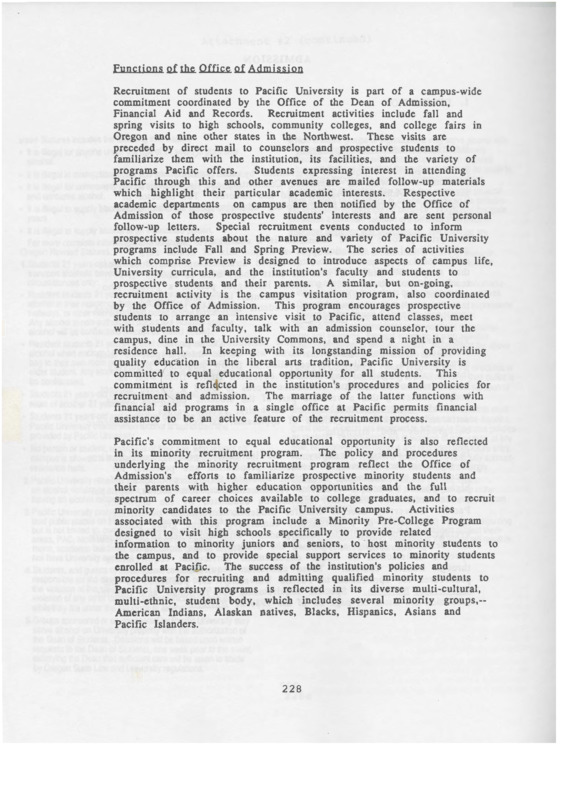 1987 Pacific University Self-Study Reports ExcerptsThe Pacific University Self-Study Reports are a series of decennial reports that lay out University goals, collect and interpret data related to student admissions, graduations, faculty size increases, university finances and more. The reports can act as a valuable measure of race and gender related issues both in what they directly say and what is left out. In the 1987, there were no mentions of racial and ethnic diversity as an explicit University goal as there was in the '77 reports. It is also missing a racial/ethnic breakdown of admitted or graduating students. This selection shows a brief description of Pacific's minority recruitment program and its efforts to 'familiarize minority students and their parents with higher education opportunities' and which includes a Minority Pre-College Program that visited high schools to entice minority students.
 -
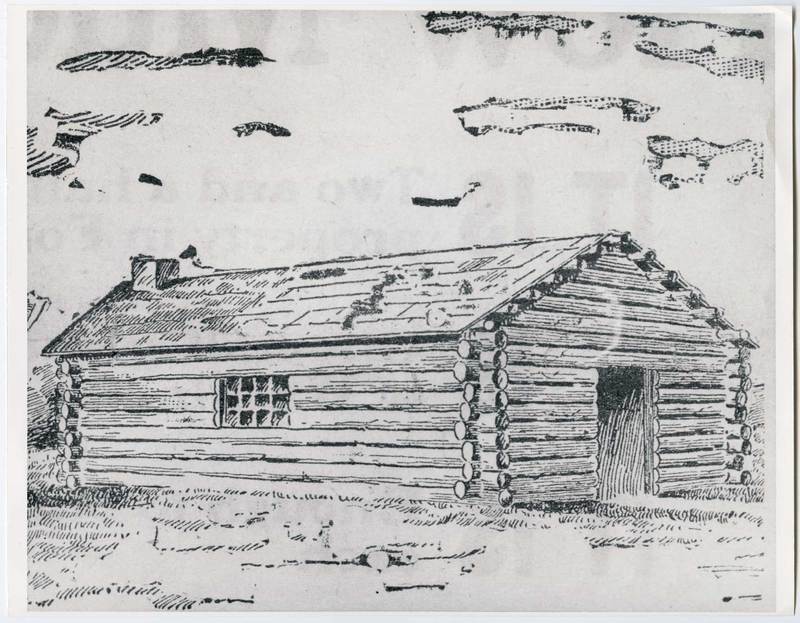 Earliest building on Pacific University's campus SketchThis sketch was an interpretation of the original log cabin that was built around1847. There is a question as to which cabin this sketch is showing. There were two cabins built between the time of 1846 and 1847. One was the church, and this is where classes were taught. The other is the boarding house where Tabitha Brown looked after the orphan children. In regards to the sketch, there is no real documentation on who made it or when it was made. However, the important thing to note is that this is one of the few remaining images of the original birthplace of Pacific University.
 -
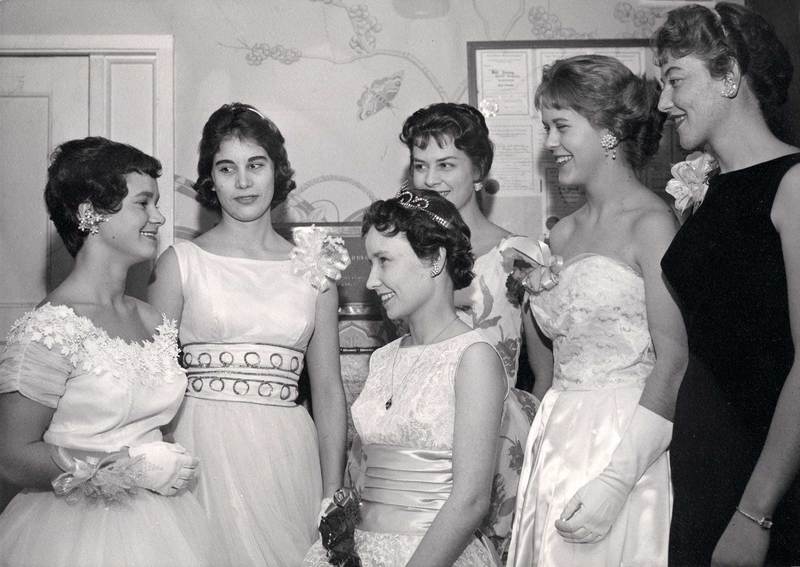 Intercollegiate Knights Queens 1959Taken at the Intercollegiate Knights Queen's Ball on February 6th, 1959, this photograph shows (in order from left to right): Blythe Lynch (1959 I.K. Queen; Theta Nu Alpha), Ruth Long (unaffiliated), Suzanne Richards (1958 I.K. Queen; Phi Lambda Omicron), Linda Bumgarner (Delta Chi Delta), Kay Kienstra (Kappa Delta), Ann Broadbent (Phi Lambda Omicron). The Intercollegiate Knights were a national honor-service society for male university students. One of the annual service functions of the Pacific University's chapter was to host the I.K. Queen's Ball, where a Knight's Queen was elected. The selection process for the 1959 Knight's Queen began on January 29th, when two representatives from each sorority as well as two unaffiliated female students all attended a banquet put on by the Intercollegiate Knights where each I.K. voted on his favorite candidate for Queen. Whichever five women got the most votes became the I.K. Queen's Ball Court. The Knight's Queen is elected from among those five women and crowned during the Intercollegiate Knights Queens Ball by the past year's Queen.
 -
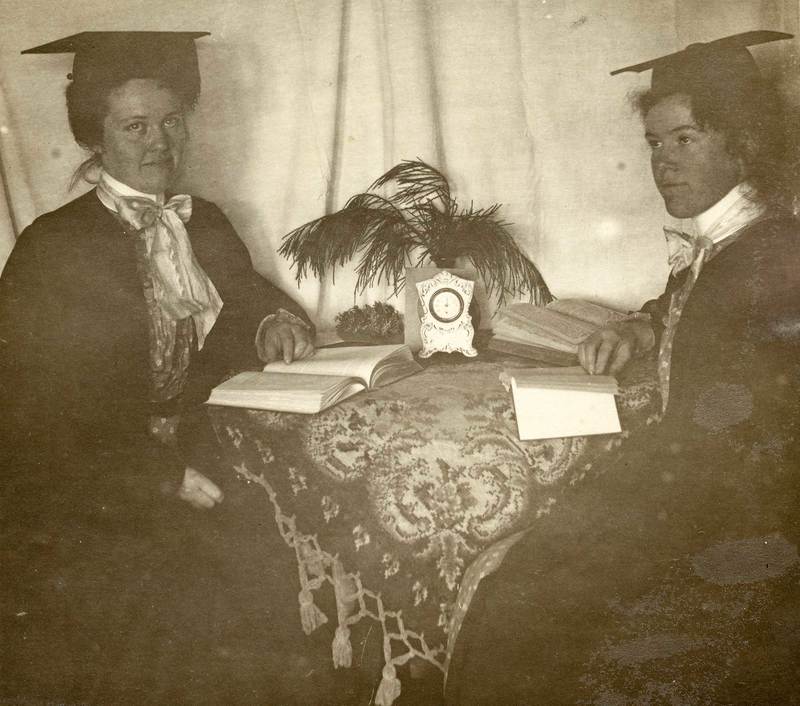 Elda and Leva Walker PortraitThis is a portrait of Leva (left) and Elda (right) Walker. They are wearing their graduation robes at Pacific University in the year 1900. Born in 1877 and 1878, they were most likely the first women from Forest Grove to earn a doctoral degree, Elda from the University of Nebraska and Leva from Cornell University. Both Doctorates were in Biology. The sisters taught together at the University of Nebraska and lived together until their deaths in 1970 and 1971.
 -
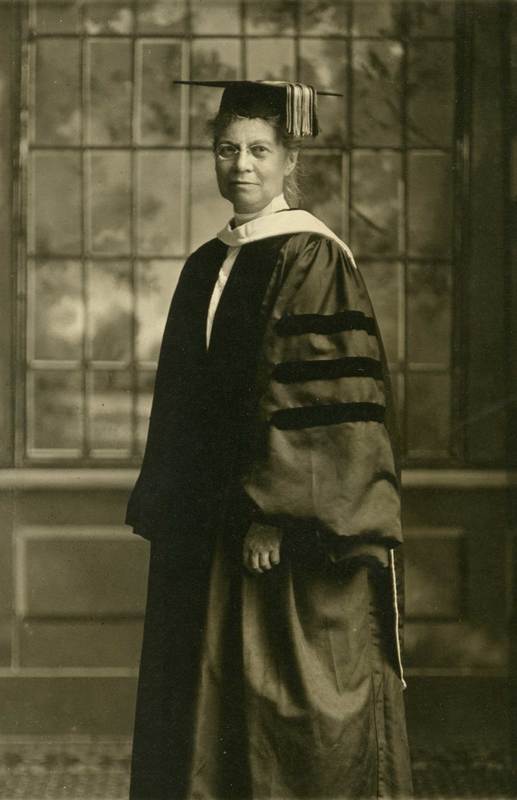 Mary Frances Farnham PortraitThis is a portrait of Mary Frances Farnham wearing graduation robes. Born in Maine in 1847, she graduated from Mount Holyoke college in 1868. She taught at various schools in the U.S. and South Africa until 1895 when she returned to school to study history at Radcliffe college. In 1896, Farnham became the principal of Tualatin Academy, Pacific University's preparatory school. In 1912 she was awarded a doctorate degree in English literature from Mount Holyoke college. By 1915 the preparatory school had closed and Farnham became Dean of women at Pacific University. She held the position until she retired in 1924.
 -
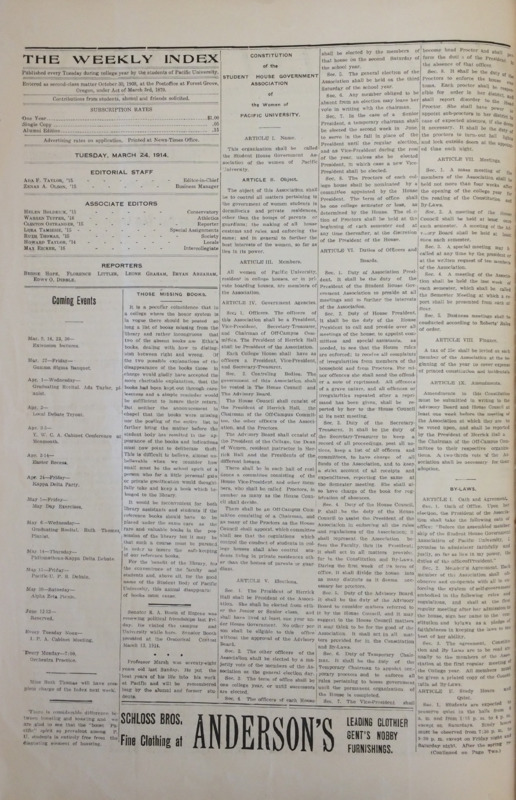 Constitution and By-Laws of Herrick Hall, Student House Government Association of the Women of Pacific UniversityThis is a copy of the Constitution and By-Laws of Herrick Hall printed in The Weekly Index at Pacific University on March 24, 1914. It is stated that the purpose of the constitution was to control all matters pertaining to women living on and off-campus (excluding those who lived with parents or guardians), making and enforcing rules, and to further the interests of the women. All women who attended Pacific University were required to live in a residence hall on-campus unless given special permission with other living situations regarding parental or marriage supervision. The constitution describes the different roles and their respective duties that were made each year by each of the halls: a President of the Hall (who would also reside as the President of the Association), a Vice-President of the Association, a Vice-President of the Hall, a Secretary-Treasurer of the Association, a Secretary-Treasurer of the Hall, a Chairman of the Off-Campus committee, many different Proctors for each section of the hall, and a Head Proctor. There was sometimes also a Temporary Chairman who served when the previous year's chairman graduated. The committees that were put together were the House Council, Advisory Board, and an Off-Campus Committee. The By-Laws describes the oaths and agreements each woman followed. The articles include things like: quiet and study hours during the week and relaxed hours during the weekend; no running or walking noisily in the halls, with soft slippers used after 7:30 pm; no slamming of doors; the scheduled time of reception and when guests were allowed to be in the building; men were not allowed at all into the residence hall, with the exception of fathers and sometimes, under rare permission, brothers; women, unless given special permission by the Dean of Women, were not allowed to visit the men's residence hall; the women had to get permission to leave the hall, spend the night outside of their room, and when leaving the school; attendance at social evening events needed permission, while those that were associated with school or school-related clubs and societies were approved without permission; three nights of having a guest were free of charge; women could not ride horseback or drive without an approved accompanist; doctor visits or summons could not be made without permission; each morning, rooms had be cleaned promptly, with the exception of Saturday until 10:30 am; attendance at meal times was expected and on time; lights had to be off between 10 pm and 5:30 am, with Friday and Saturday extended to 10:30 pm; any light on after the designated time had to be reported to their Proctor; evening social events ending after 9:30 pm allowed the women to have lights on for the following half hour; fines were made for any meeting unattended; the House Council had control of any and all disciplinary actions. Any permission that was granted was given by the Dean of Women. Each woman was automatically a member of the Association and was required to attend the regular and special meetings. The Constitution and By-Laws were read at the beginning of the first meeting of each school year and each woman received a personal copy. Amendments could be made to both the Constitution and By-Laws if submitted in writing to the Advisory Board and House Council and then voted on a two-thirds majority at the following Association meeting.