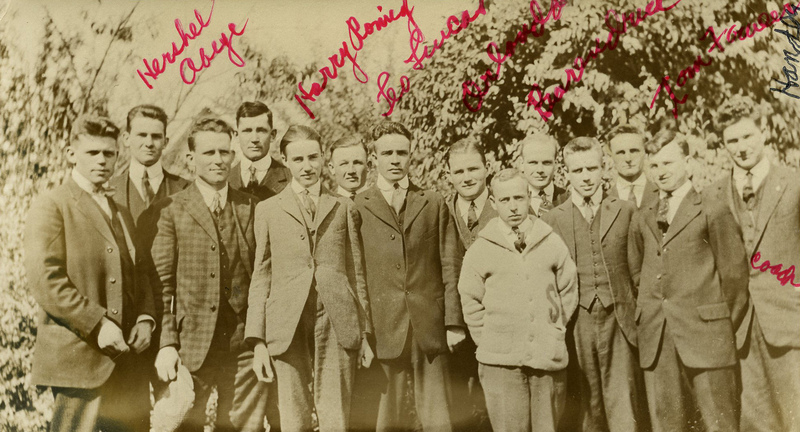
A group photograph of male students at Pacific University in 1917. The caption with the photograph identifies the students as Hershel Obye, Harry Romig, Noah Jones, Leo Lucas, Thomas Fowler, Orlando Romig, Samuel Stanley and Ralph Jones. It was probably taken around the time the United States entered World War I in April, 1917. Most male students of Pacific University enlisted in the military during World War I. This picture appears in an album that was compiled by Greta McIntyre Sheeley, a 1920 Pacific University graduate.
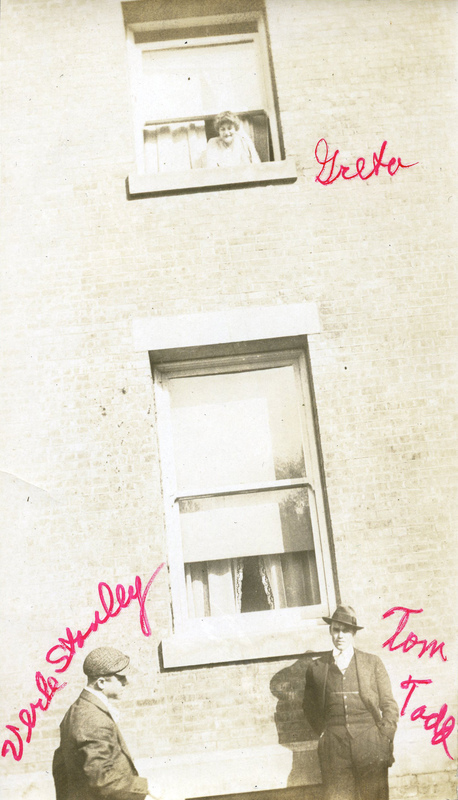
A photograph two male students standing outside second Herrick Hall windows, while a female student looks out at them from a second story window. The caption with the photograph identifies the males students as Verle Stanley and Tom Todd. The female student is Greta McIntyre Sheeley. Herrick Hall was the second women's dormitory on the Pacific University campus. It was built in 1907 after it's predecessor burned down. Weekly room and board was listed at $5.50 for the 1918-1919 school year. This picture appears in an album that was compiled by Greta McIntyre Sheeley, a 1920 Pacific University graduate.
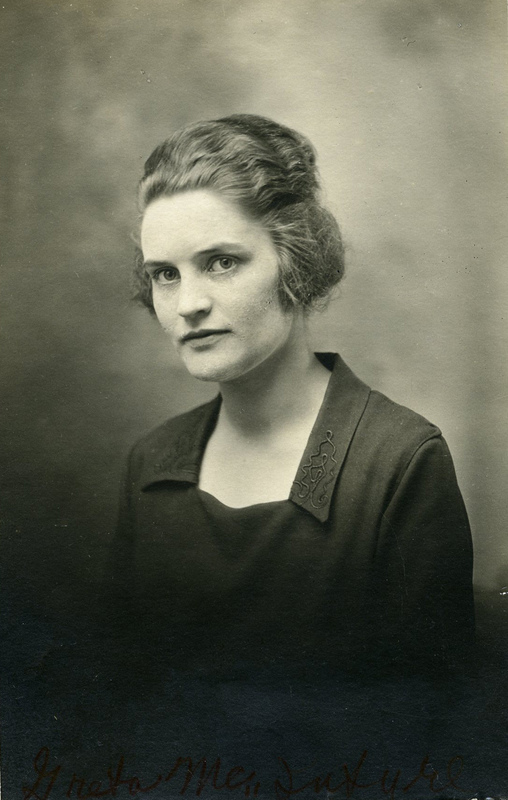
A portrait of Pacific University student, Greta McIntyre Sheeley. She was a student at Pacific University from 1916-1920, during which time the United States entered World War I. This picture appears in an album that she compiled.
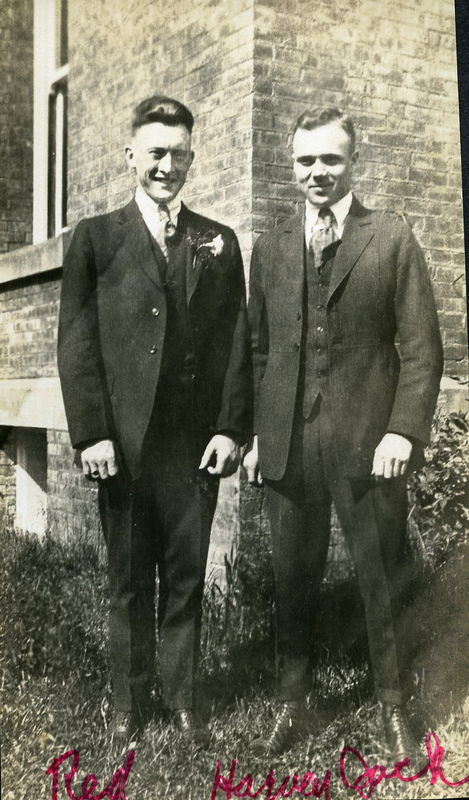
A photograph of two male Pacific University students in 1919. According to the caption on the photograph, the students were Glenn 'Red' Sheeley and Harvey Jack. The photograph was taken shortly after the end of World War I, during which time almost all male Pacific University students had entered the military. This picture appears in an album that was compiled by Greta McIntyre Sheeley, a 1920 Pacific University graduate.
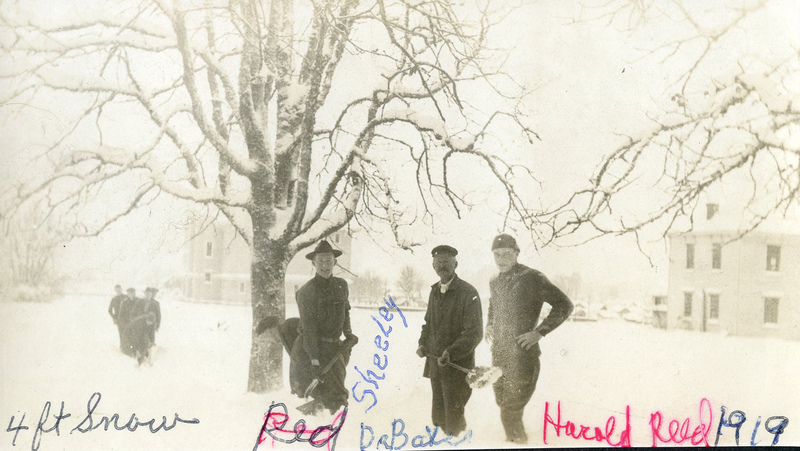
A photograph of Professor Henry Liberty Bates along with several students shoveling snow on the Pacific University campus after a snowstorm in 1919. According to the caption on the photograph, four feet of snow fell in the storm preceding this image. Professor Bates was a beloved professor at Pacific University. He taught Philosophy and Education in 1919. Prior to his time as a professor, he served as the last principal of the Tualatin Academy before it closed in 1915. This picture appears in an album that was compiled by Greta McIntyre Sheeley, a 1920 Pacific University graduate.
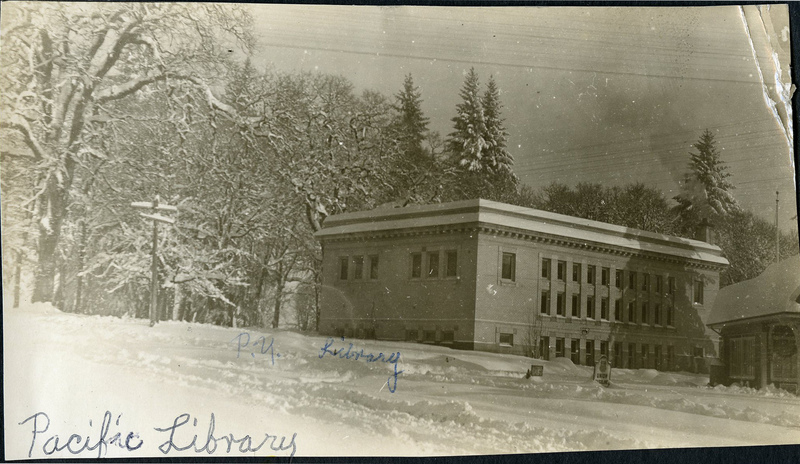
A photograph of the Carnegie Hall Library on the Pacific University campus after a snowstorm in 1919. According to a caption on the photograph, four feet of snow fell in the storm preceding this image. Carnegie Hall was called the Library Building in 1919. Construction on Carnegie Hall was completed in 1912. It was funded by Andrew Carnegie and designed by Portland architectural firm, Whidden and Lewis. This picture appears in an album that was compiled by Greta McIntyre Sheeley, a 1920 Pacific University graduate.
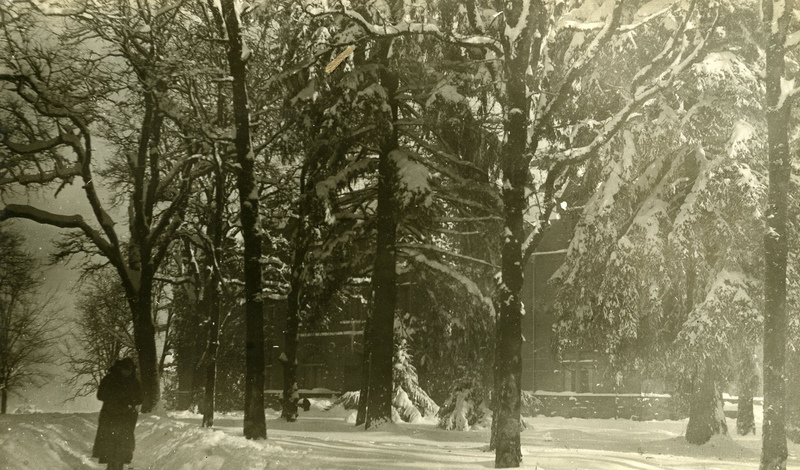
A photograph of Marsh Hall on the Pacific University campus after a snowstorm in 1919. According to the caption on the photograph, four feet of snow fell in the storm preceding the image. In 1919 Marsh Hall housed the university's chapel, recitation rooms, office and rooms for the literary societies and the Christian Associations. This picture appears in an album that was compiled by Greta McIntyre Sheeley, a 1920 Pacific University graduate.
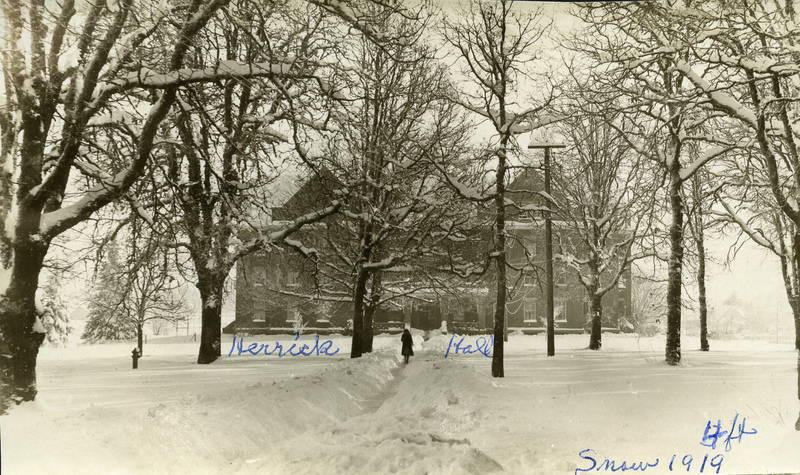
A photograph of the second Herrick Hall on the Pacific University campus after a snowstorm in 1919. According to a caption on the photograph, four feet of snow fell in the storm preceding this image. Herrick Hall was the second women's dormitory on the Pacific University campus. This picture appears in an album that was compiled by Greta McIntyre Sheeley, a 1920 Pacific University graduate.
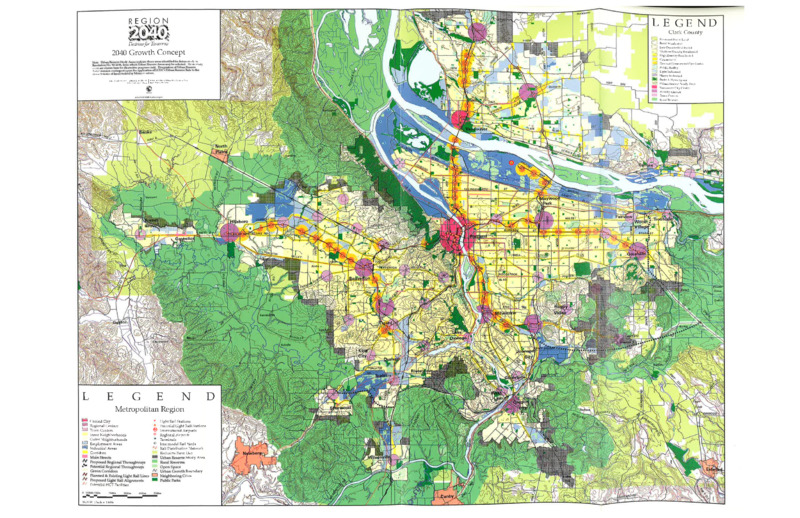
Map of the 2040 Growth Concept plan for the greater Portland metropolitan area. This is taken from the Regional Urban Growth Goals and Objectives ordinance, which was adopted by Metro in 1995.
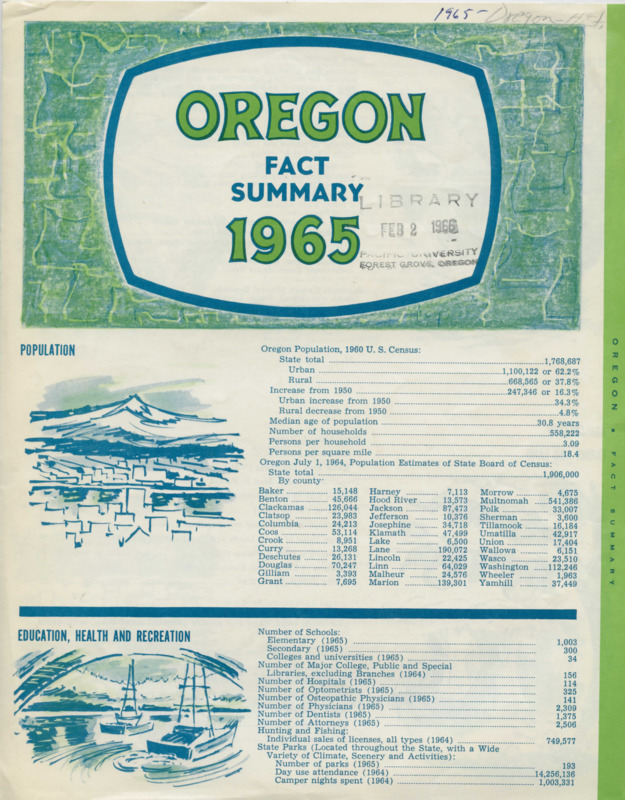
Pamphlet released by the Oregon Department of Commerce (Division of Planning and Development). It gives a basic account for Oregon's population and economy for the year 1965.
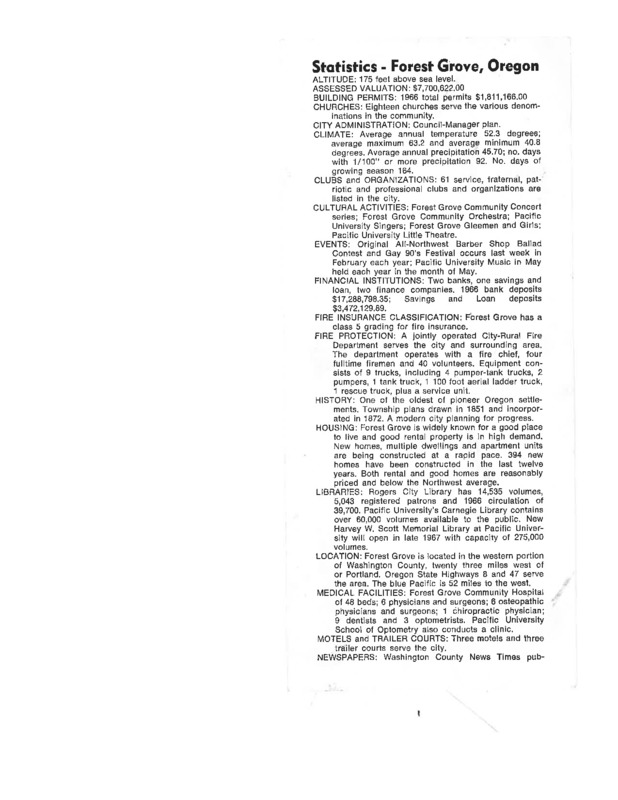
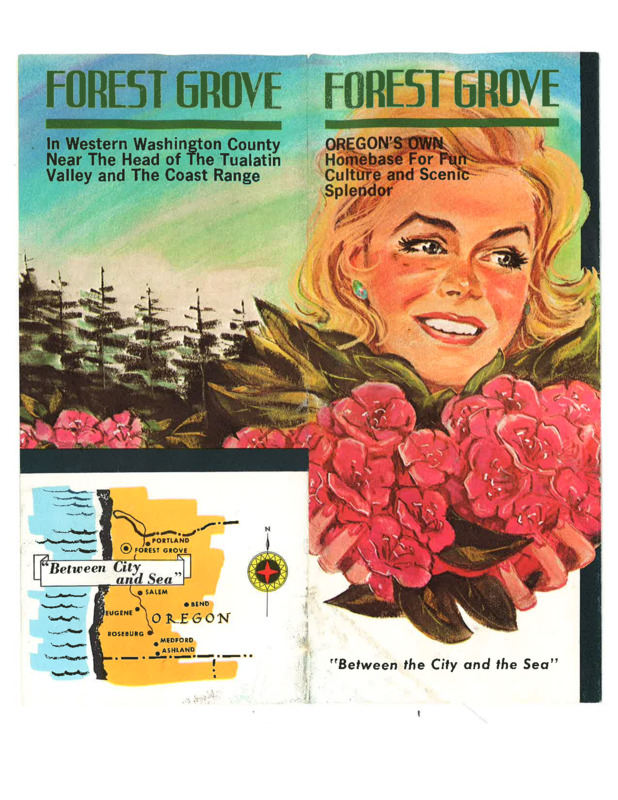
Two-sided insert in the Chamber of Commerce brochure. These items were found together, but it is not clear if they were originally intended to go together. This piece gives a wide variety of facts and statistics about Forest Grove.
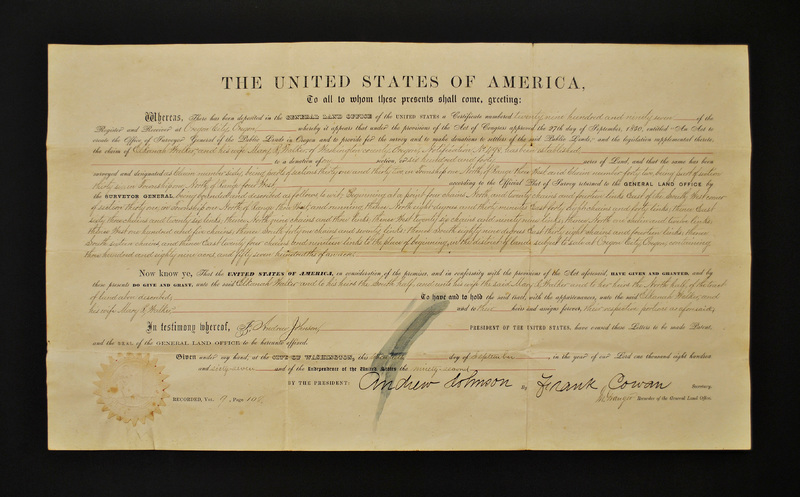
The certificate for Elkanah and Mary Richardson Walker's donation land claim in Forest Grove, Oregon. The Walkers were among the earliest immigrants from the United States to the Oregon Territory. After living as missionaries on Spokane lands, they arrived in the area that would later become Forest Grove in 1848. There, the family helped to found Pacific University. They gave some of the land that is described in this claim to Pacific University, forming a large part of its original campus.
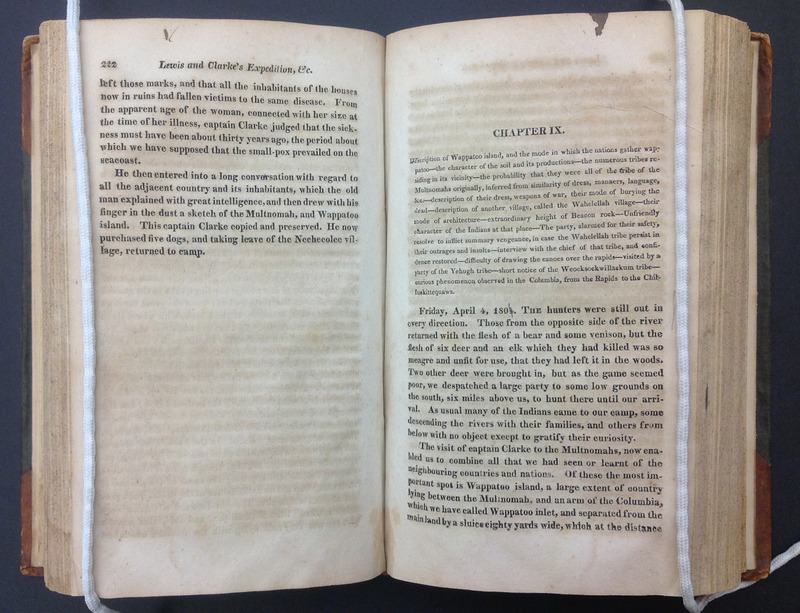
The first three pages (Vol. 2, pp. 223-225) of a chapter describing 'Wappatoo Island,' in the first edition of Lewis and Clark's account of their journey to Oregon. Wappatoo Island is now known as Sauvie Island and is located in a channel of the Columbia River, near the junction with the Willamette River. This passage describes the abundant plant life of the island and the fertile Willamette Valley.
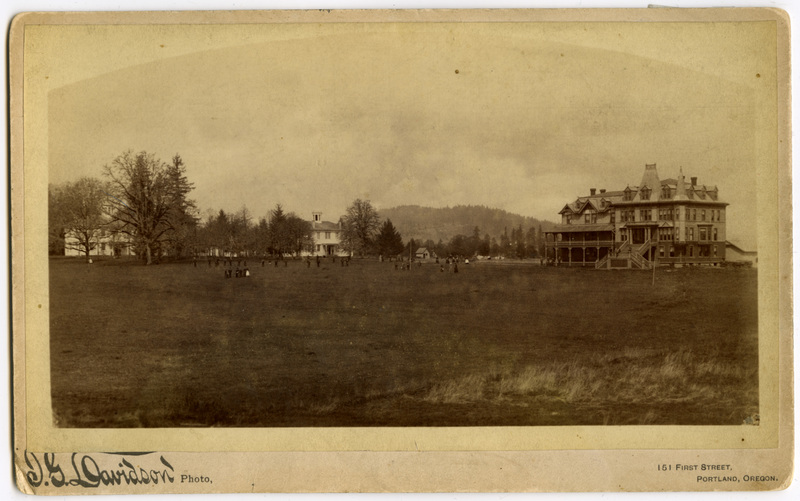
Panoramic photograph of the Pacific University campus, showing the principal buildings as they stood in 1887 before Marsh Hall was built. From left to right, the large buildings are: Old College Hall (which is now in a different location); Academy Hall (burned in 1910); Herrick Hall (the first girls' dormitory, burned in 1906). Students or faculty stand in the field between the buildings, and David Hill appears in the background. This photograph was taken by a travelling photographer from the I.G. Davidson Studio, based in Portland.
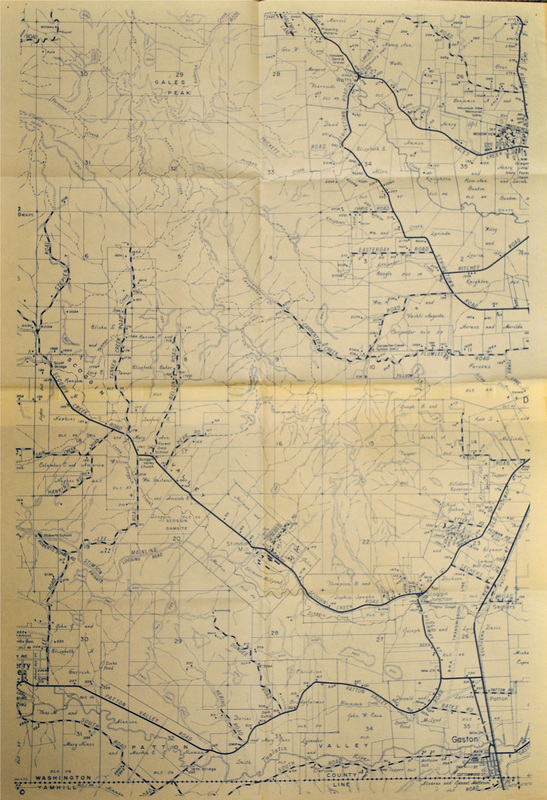
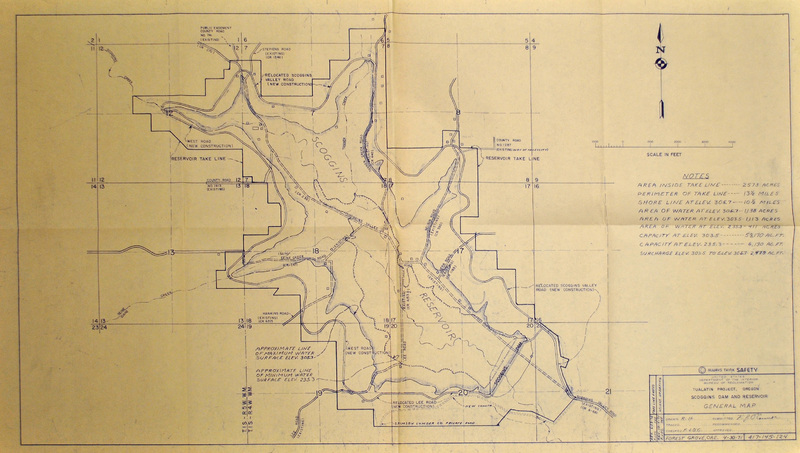
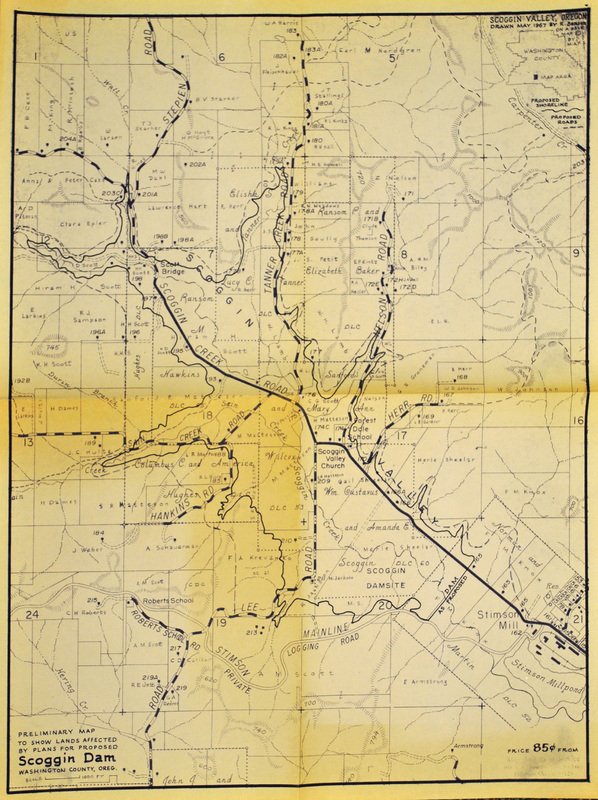
Map of the area due to be effected by the Scoggins Valley Dam project. The map shows the surrounding towns, the Stimson Mill, and the land owners at the time. The map also shows the original Donation Land Claim plots. Donation Land Claims were taken by early settlers in Oregon as part of a government program that began in 1850 and sought to bring settlers to the western territories. Single men were granted 320 acres of land, while married couples could claim 640 (the later, arguably more famous, Homestead Act of 1862, granted claimants 160 acres of land).