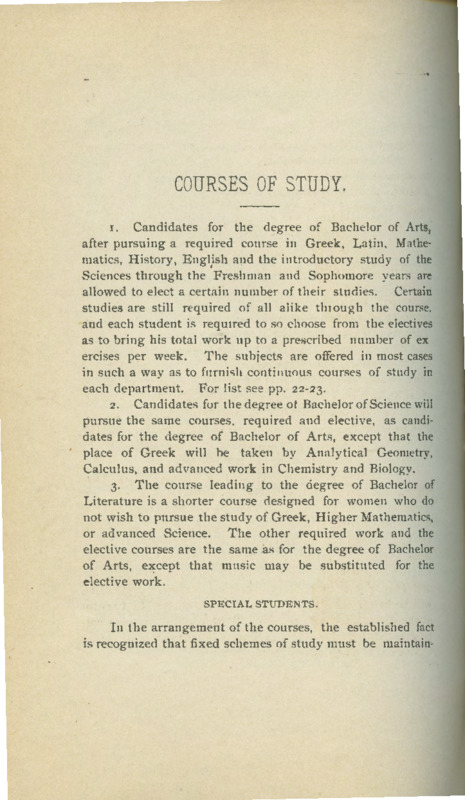
This is a Courses of Study introduction to a Study Catalog of Pacific University from the 19th century. It includes brief information on obtaining a degree in the bachelor of arts, sciences, and literature, as well as information on how to recieve a degree, students taking classes but not going for a degree, and in formation on teacher certificates.
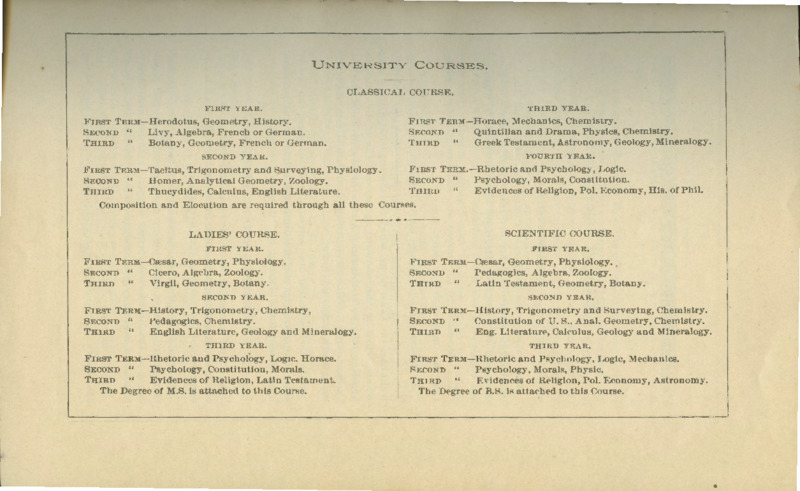
This resource is a descriptor of university classes from the 19th century with courses for the sciences schedule, the 'classical' schedule and women courses. The science and classic schedules are for male students, whereas as the females have their own ciricullum for studying education. The classic courses consist of four years of courses with an early focus upon the humanities and courses later on focusing on the general sciences. The scientific section was only three years, but they received education more sciences than the persons studying in the classical courses. The ladies courses is a hybrid of both the classical agenda and the scientific agenda, with the exception that they study Cicero and Virgil whereas as the male students don't touch on these figures. Only the sciences and the women section study Caesar for a class.
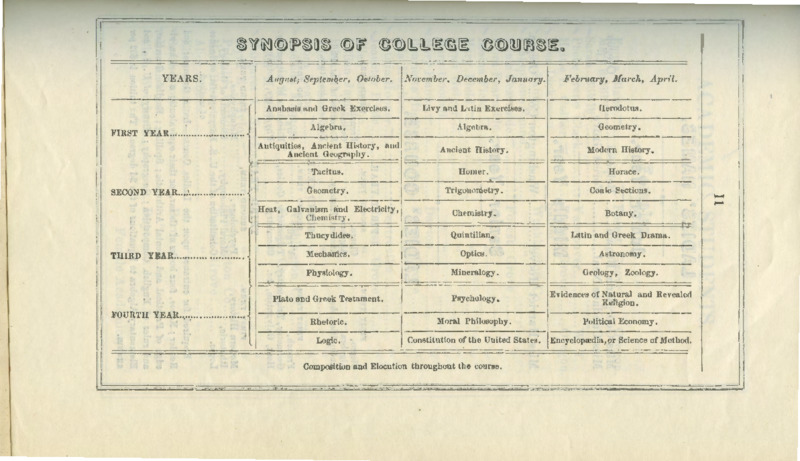
This is a course catalog of Pacific University courses for 1867. The courses have separate course objectives for male and female students at Pacific University, with small differences, such as the four year college curriculum for males and three years for females. Other differences include the difference in varsity of philosophers and sciences taught to the male and female students. The female students are taught about about Cicero and Virgil as specific philosophers courses, were as the men look at Herodotus, Theodotus, but not Cicero or Virgil. Women only study basic chemistry and biology, whereas males study these as well as zoology, geology and higher levels of science.
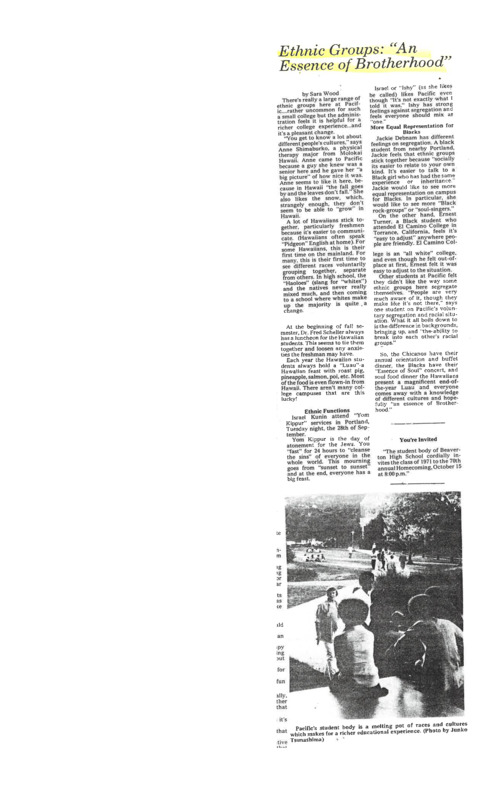
This news article written by Sara Wood offers a brief description of the main nonwhite ethnic groups present at Pacific in 1971. Wood mainly offers perspectives on group activities of the Hawaiians, especially the annual Lu'au which Pacific University is known for, and also discusses the topic of greater representation for the black student population. Also mentioned are Chicanos, and one Jewish student. On the topic of black students at Pacific, it references the opinions of two black students and shares a final thought of hope wishing for the emergence of 'an essence of Brotherhood' from sharing in these cultural events. Written in the backdrop of increased visibility and size of ethnic groups at Pacific that raised tensions especially about their ability to organize into campus groups.
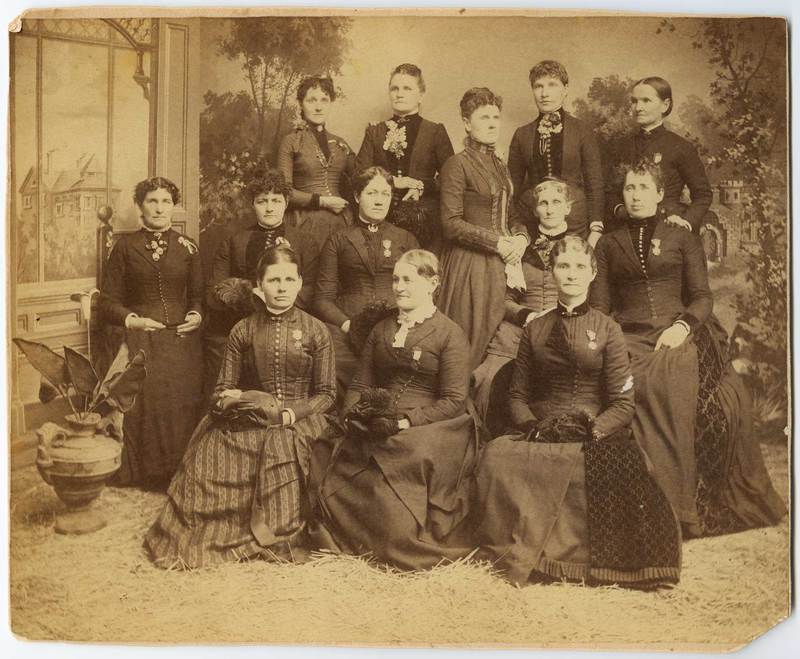
This photo shows thirteen women posing for the camera. Some of the have medals, while others don't. It is believed that the one's wearing medals were married to men who had been killed during the Civil War. The Women's Relief Corps at Pacific University consisted of women who were or widows of men who had fought in the Civil War. These women would help run activities and different events for Memorial Day, which included teaching patriotism and nationalism to all ages. Members of the Women's Relief Corps would also petition the Federal Government for nurses pensions.
The debate team was a big deal on campus, especially in the early 1900's. The importance of this is that the women were able to have a separated team from the men and make it their own. Many of the debates and speeches took place in the spring, and the women's team was even on the front cover of the Weekly Index multiple times. The debates were a huge thing on campus, where many students and residences of Forest Grove would come and attend.
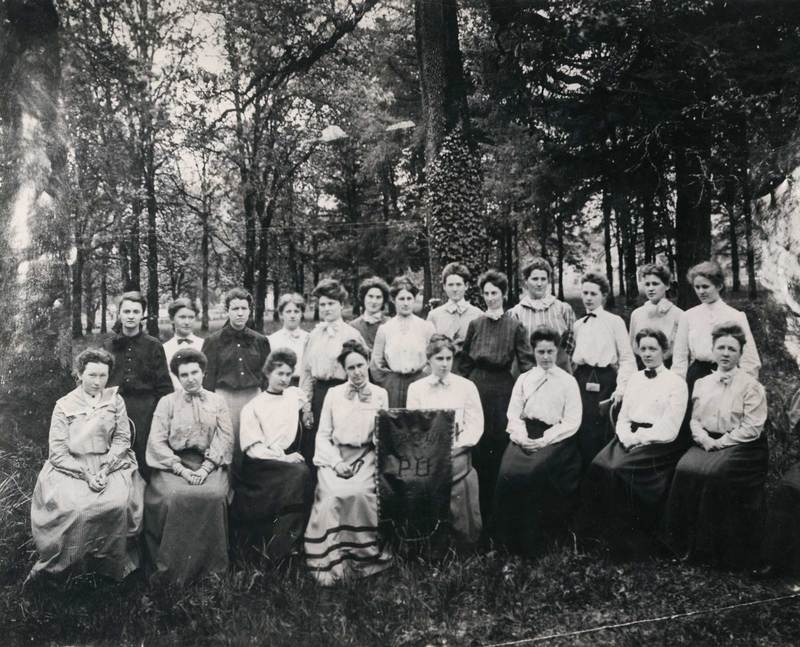
Little is known about this photograph other than the professor, who was Albert Raddin Sweetser. Professor Sweetser worked in the Chemistry and Biology Department, and is believed that he would sometimes take his class into the forest to have lunch. Also, two students are recorded in this picture, Louis P. Myers and Charles Bradley, but it is undefined as which ones they are
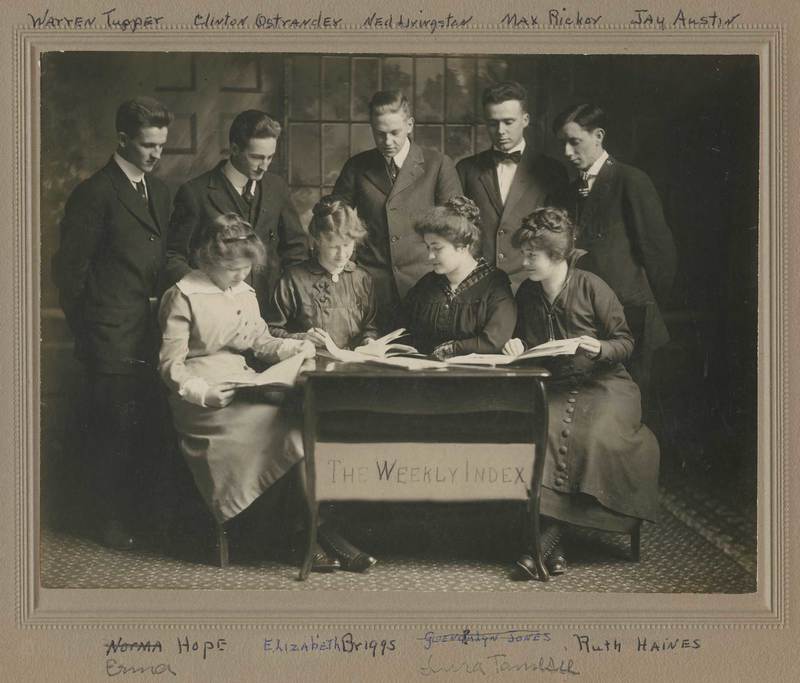
The Weekly Index was the name of the newspaper that Pacific University had and still is the name of the newspaper to this day. This photograph is staged and shows the different writers for the Weekly Index. It is important to notice that there are women who were part of the staff for writing the newspaper. Back in the early 1900's women were suppose to be limited to what they could do, and this photograph shows that Pacific University was working to treat women more equally.
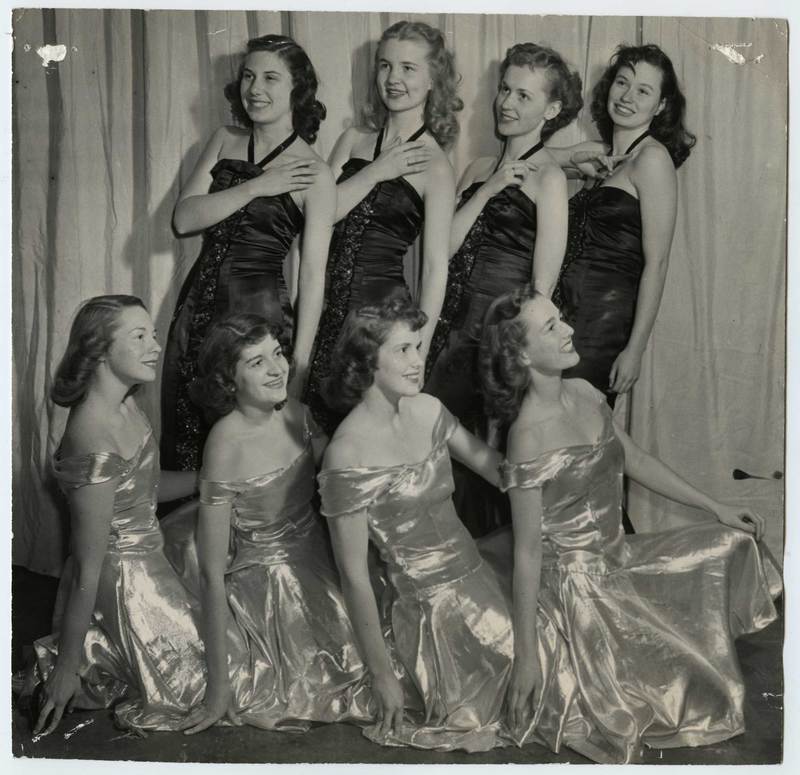
The photograph features, from the left: front row, Marjorie Jackson, Leona Blackmun, Ruth Casteel, Lael Peters; back row, Pat Dozier, Lorraine Mortensen, Nancy Sinclair, and Jane Babcock. These eight girls comprised the Belles of the Nineties - a female song and dance group who, in conjunction with the Folly Dollies and the Golden Gayeties, participated in the All-Northwest Barbershop Ballad Contest. The Belles of the Nineties were not part of the actual competition, their presence being requested for pure entertainment value instead. The contest took place on February 18th and 19th, 1949 in the Forest Grove High School's auditorium.
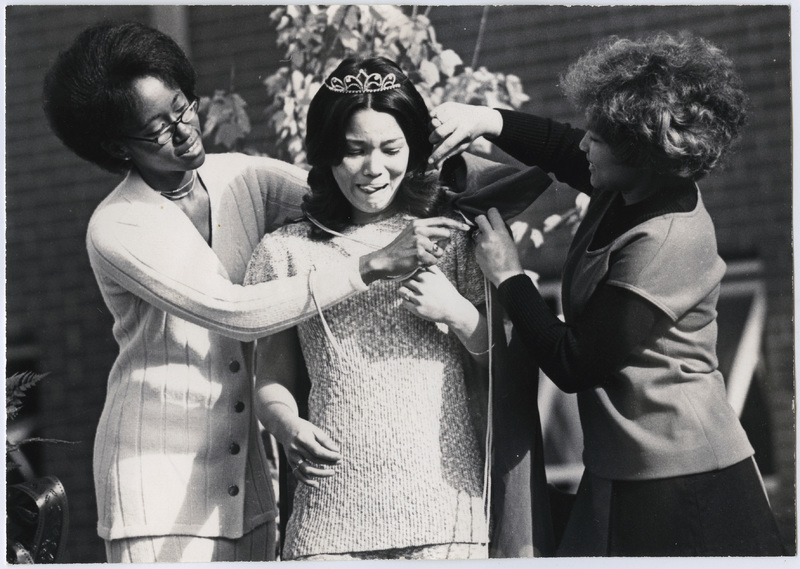
Taken on Friday, October 30th at the coronation of the 1970 Homecoming Queen, Jill Matsui, this photograph features, left to right: Willie Deckard, Jill Matsui, and an unidentified female student. The Coronation was part of the Victory Dance, sponsored by the Hawaiian Club (of which Jill Matsui was the Secretary) and organized by the Intercollegiate Knights, who were responsible for all the Homecoming weekend activities. Though not shown in this photograph, the 1970 Homecoming Court consisted of: Jill Matsui (Queen, Junior, Hawaiian Club representative); Marcia Englund (Princess, Junior, Gamma Sigma representative); Linda Jenkins (Princess, Junior, Black Student Union representative); Mary Ann Lazelle (Princess, Junior, Alpha Zeta representative); and Lynnette Siles (Princess, Junior, Sinfonia representative). Sinfonia, otherwise known as Phi Mu Alpha, is a professional music fraternity which at the time had a chapter at Pacific university. The girls all represented either one of the fraternities or one of the ethnic clubs on campus.
This photograph features Cheron Mayhall née Messmer (left) and Jim Carlson (right) standing in a Walter Hall dorm room. Carlson was Mayhall's date to the annual Wassail Party and following McCormick Hall Christmas Ball held on December 8th, 1961. Found in a donated scrapbook among other mementos from Cheron Mayhall's sophomore year at Pacific University, this photograph is one of many that detail Mayhall's extremely active social life. A member of both the Theta Nu Alpha sorority and the Boxerette service and honor society, there was rarely a weekend when Mayhall was not involved in a social activity.
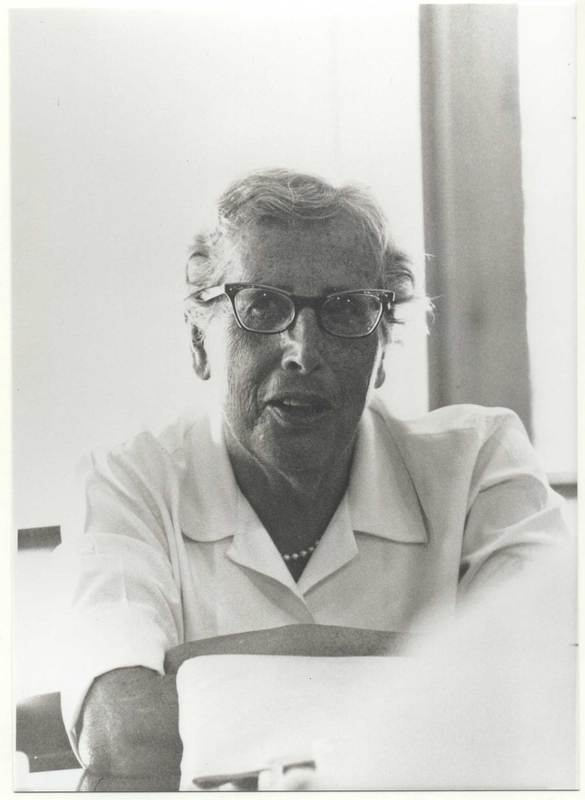
Cecile Froehlich was born in Germany and came to the United States after World War Two. She was a professor of electrical engineering at City college for 21 years from 1945-66. Some of Froehlichs accomplishments as an educator are that she was City colleges first female faculty member, first female department chair, and the first woman to head any engineering department anywhere in the United States.
There is little to be known about the Ivy Club. All we know is that it was another form of a musical club. The significance of this is that women were participating in an activity alongside men in the same club.
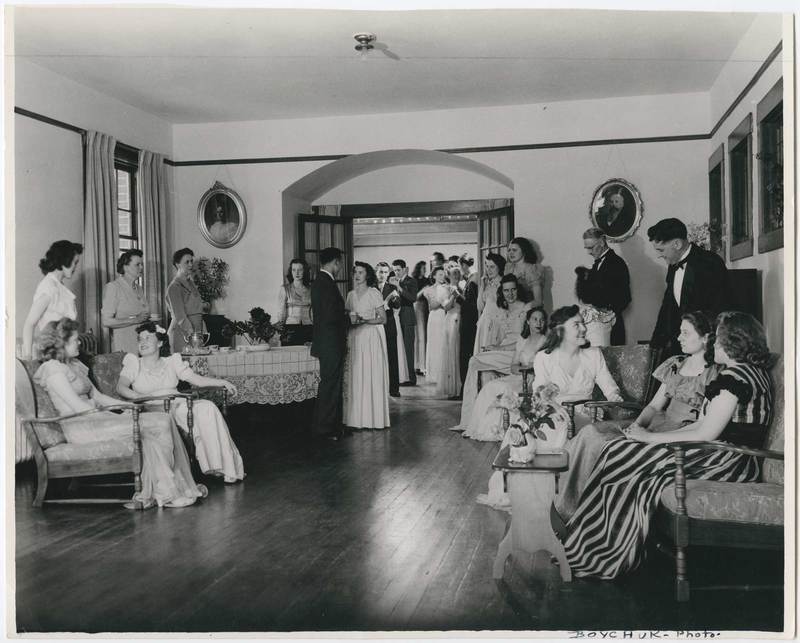
This photograph depicts part of a formal dance/social that took place in McCormick Hall between 1930-1945. No couple was allowed to sneak off on their own; this rule was enforced by the watchful chaperones stationed in each room whose duty it was to protect the female students' virtue.
Madeleine Yamane was likely Pacific's first Asian-American graduate, who graduated in May 1941.
Madeleine Yamane attended Pacific at the same time as several other students of Japanese descent including Yukie Katayama Sumoge, Lillian Hirasawa Kurahara, and Saka Yoneyama Noma. Of the four, Madeleine Yamane was the only one who graduated before the Japanese attack on Pearl Harbor and she also was the only one of the four who was not interned during the war.
Yamane was a member of Kappa Delta sorority and served as its Vice President in the school year 1939-40 and was also a member of the Young Women's Christian Association. She graduated with a BA in Literature.
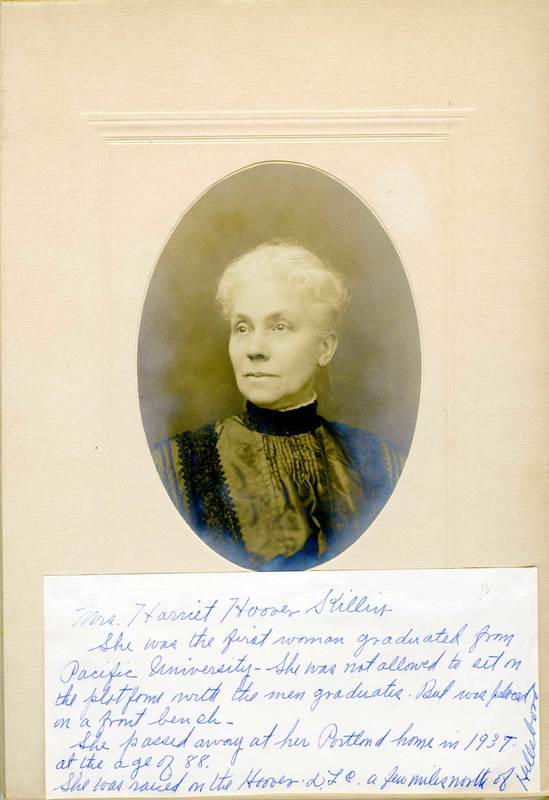
Harriet Hoover Killin was the first woman to graduate from Pacific University in 1869. The photo in this exhibit is one that was taken in 1937 when she was 88. It is believed that she is some how related to Herbert Hoover, because they both have family ties in Oregon.
Something important to note, is during graduation, classes were so small, every person was expected to give a speech. She was not allowed because she was a woman. Harriet Hoover Killin brought in a new wave to Pacific, and started the trend for all the rest of the woman after her.
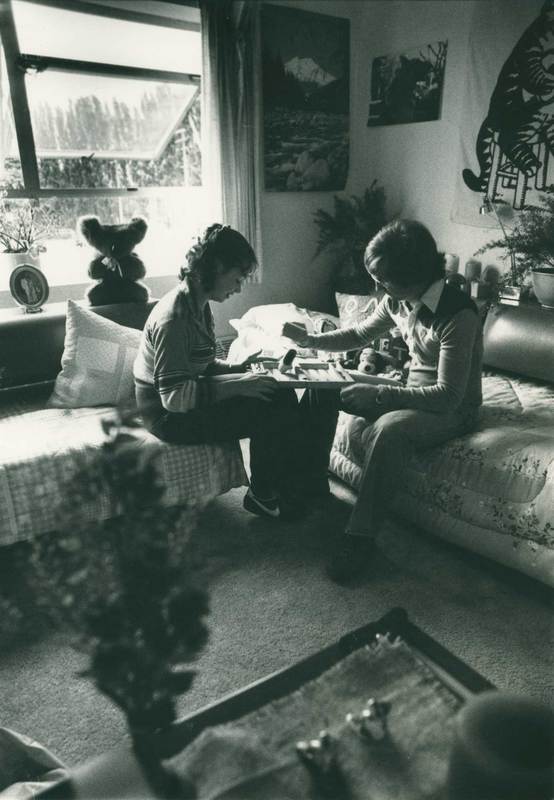
Bill Berk ’83 and Peggy (Donkle) Thompson PT '85, playing backgammon in a dorm room Clark Hall in 1980. Clark Hall was the first residence hall at Pacific University to offer co-educational residence to students. At the time of this photograph, all unmarried, undergraduate women and all freshman men were required to live on campus in a residence hall and have a meal plan unless excused by the Office of the Dean of Students. At the time of construction, the three-stories of rooms were planned to hold about 70% female students and 30% male students.
The cost to build Clark Hall at the time was $890,000. It was built in 1966 during President Ritchie's development program which included $10 million worth of buildings. It was originally named Harvey Clarke Hall after one of Pacific University's founders, Harvey Clarke. In using the newest design plans for the building, the dorm rooms were divided into separate study and sleeping areas.
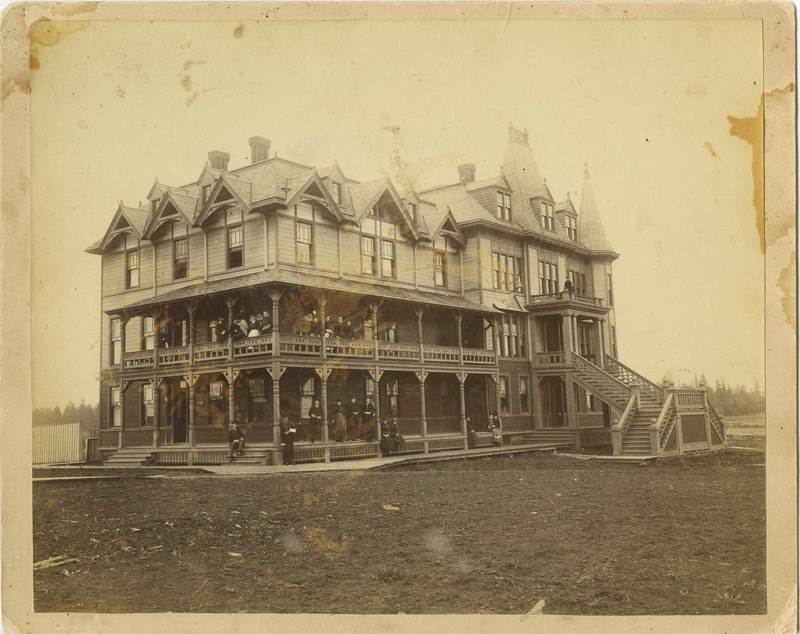
This is a picture of the first Herrick Hall with students gathered along the balconies. Herrick Hall was the all-female residence hall on campus that all women were required to live in unless they had special accommodations to live in a house in the surrounding area in Forest Grove. It was first built in 1883 and was called Ladies Hall. During the second university president Reverend John Russell Herrick's tenure, he spent much of his four years as president away from the university, but in that time, he was able to accomplish many things including raising $16,000 to build Ladies Hall. The first year the building was put to use was in 1884. It was renamed after President Herrick in 1887. The first Herrick Hall completely burned down on Sunday, March 11, 1906, from chimney sparks on the roof. A combination of women's fundraising and the Carnegie Foundation donation of $10,000 allowed the second Herrick Hall to be built in 1907. Until 1958, it was still an all-female residence hall. Herrick Hall burned down a second time in 1973.
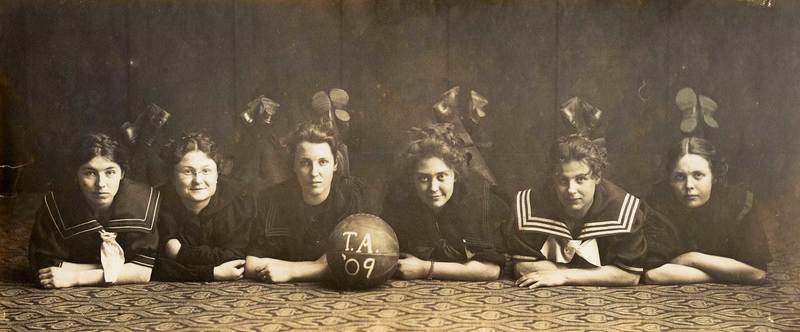
The photograph includes the Tualatin Academy women's basketball team of 1909. The girls pictured from left to right include: Lila McDonald, Ada Wiest, Beulah Ireland, Grace Thomas, Helen Allworth, and Florence Avery. These girls were a combination of students from the Tualatin Academy and Pacific University. The team combined both high school and college women because of the lack of enrollment of women in the school during that time.
The women's basketball team only could compete inter-class games instead of teams from other schools. Women would compete against one another based on their year they were in school such as 2nd year team versus a 3rd year team. There were at least 2 women's basketball teams during 1909, but that was because they did not travel to compete against other team. There was not much support of women's athletics yet to compete competitively against other schools and teams unlike the men. Men had much more opportunities even in 1909 to compete not just their own class, but other teams from other cities such as McMinnville.
The photograph is significant because women's basketball became popular in the United States around 1892, and was offered here at Pacific University as early as the 1900's. Even though women did not have the same opportunities as men in basketball, they were still able to participate. Women were at least given an opportunity to play sports at Pacific University. There are many inequalities about how women were treated unfairly in athletics, but it shows the progress of women being recognized in documents of their participation in sports.
This is a portrait of Margaret 'Dolly' Hinman taken around the year 1900. Granddaughter of pioneer Alanson Hinman, Margaret graduated Pacific University in 1891, and had a pioneering spirit like her grandfather. Her college experience taught her about education and business, both of which she used during her missions trips. She was commissioned for life service in Smyrna, Turkey, during a time of crisis in the country. Over a twelve year period, 1919-1932, Turkeys government changed four times, demonstrating Hinmans courage and commitment to what she was doing. Margaret often thought about Pacific while teaching English in Smyrna and had a cartoon map of Oregon hanging over her desk.
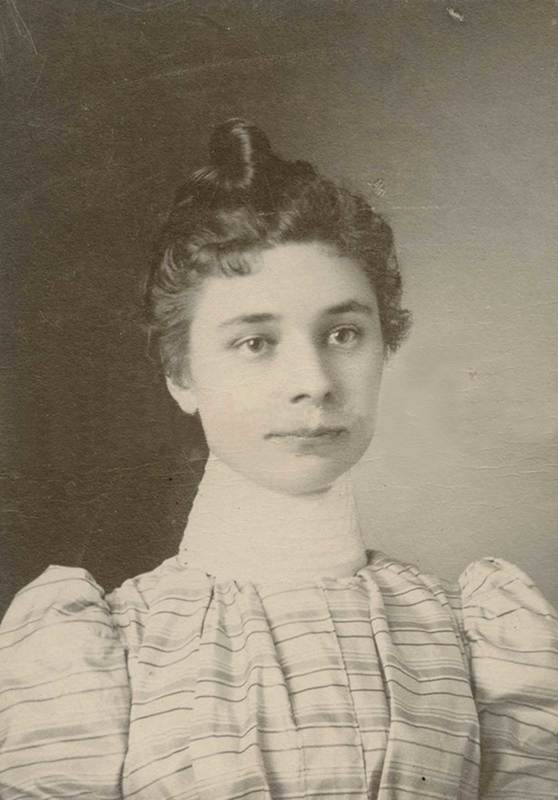
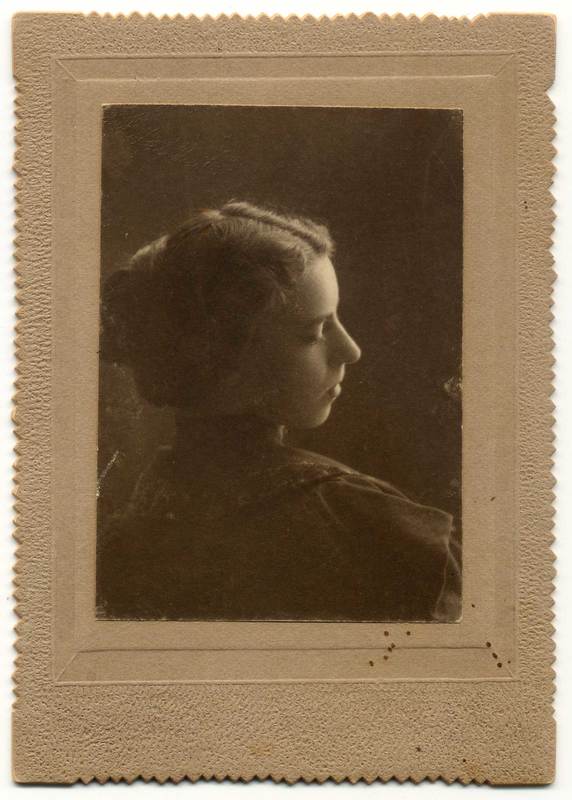
This is a portrait of Liberta Brown, later Liberta Schoch, from the year 1899. Liberta graduated from Tualatin Academy, Pacific University's preparatory school, in 1899. She then went on to graduate from Columbia University in 1903 and then graduate school at the University of California. Liberta was the firs descendant of Tabitha Moffet Brown to receive a college degree. Liberta played a significant role in preserving the early history of Forest Grove, as she wrote many letters asking older people questions about what things were like when they were young and how it had changed.
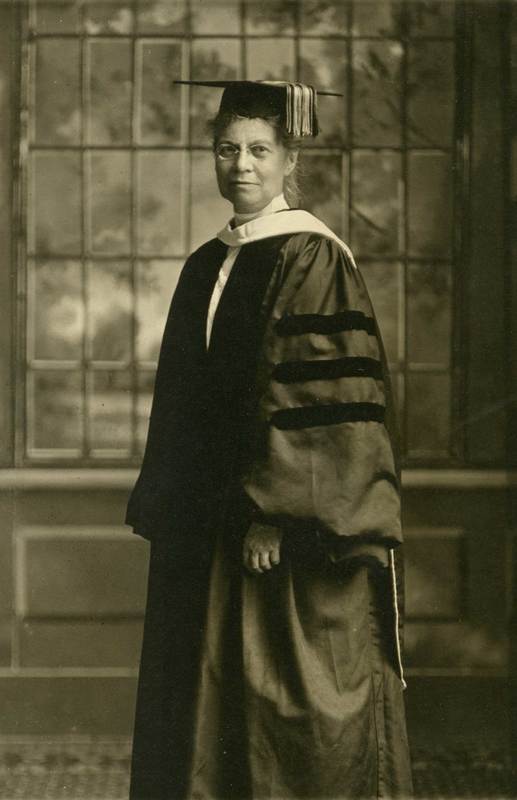
This is a portrait of Mary Frances Farnham wearing graduation robes. Born in Maine in 1847, she graduated from Mount Holyoke college in 1868. She taught at various schools in the U.S. and South Africa until 1895 when she returned to school to study history at Radcliffe college. In 1896, Farnham became the principal of Tualatin Academy, Pacific University's preparatory school. In 1912 she was awarded a doctorate degree in English literature from Mount Holyoke college. By 1915 the preparatory school had closed and Farnham became Dean of women at Pacific University. She held the position until she retired in 1924.
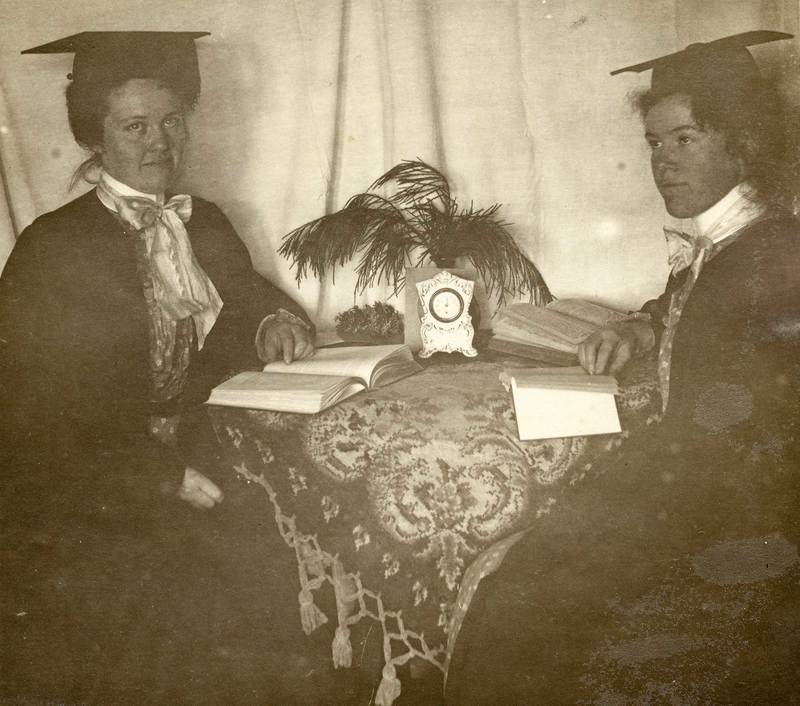
This is a portrait of Leva (left) and Elda (right) Walker. They are wearing their graduation robes at Pacific University in the year 1900. Born in 1877 and 1878, they were most likely the first women from Forest Grove to earn a doctoral degree, Elda from the University of Nebraska and Leva from Cornell University. Both Doctorates were in Biology. The sisters taught together at the University of Nebraska and lived together until their deaths in 1970 and 1971.
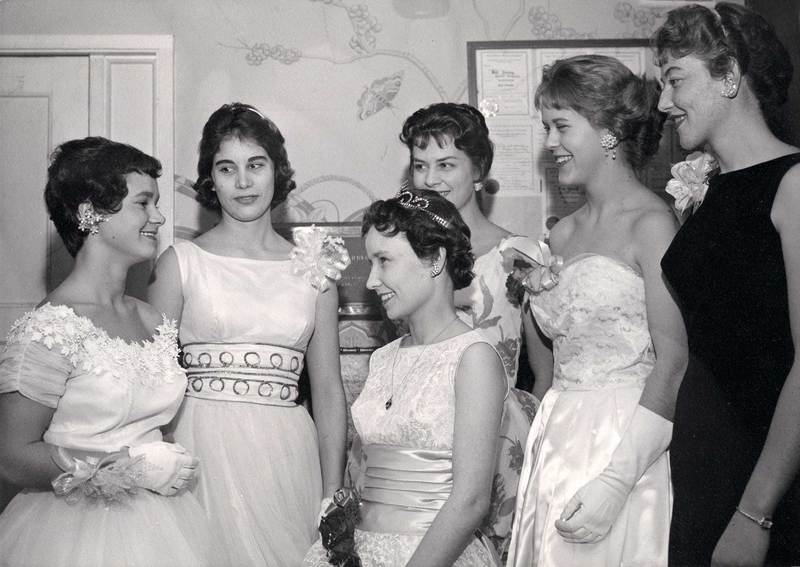
Taken at the Intercollegiate Knights Queen's Ball on February 6th, 1959, this photograph shows (in order from left to right): Blythe Lynch (1959 I.K. Queen; Theta Nu Alpha), Ruth Long (unaffiliated), Suzanne Richards (1958 I.K. Queen; Phi Lambda Omicron), Linda Bumgarner (Delta Chi Delta), Kay Kienstra (Kappa Delta), Ann Broadbent (Phi Lambda Omicron). The Intercollegiate Knights were a national honor-service society for male university students. One of the annual service functions of the Pacific University's chapter was to host the I.K. Queen's Ball, where a Knight's Queen was elected. The selection process for the 1959 Knight's Queen began on January 29th, when two representatives from each sorority as well as two unaffiliated female students all attended a banquet put on by the Intercollegiate Knights where each I.K. voted on his favorite candidate for Queen. Whichever five women got the most votes became the I.K. Queen's Ball Court. The Knight's Queen is elected from among those five women and crowned during the Intercollegiate Knights Queens Ball by the past year's Queen.