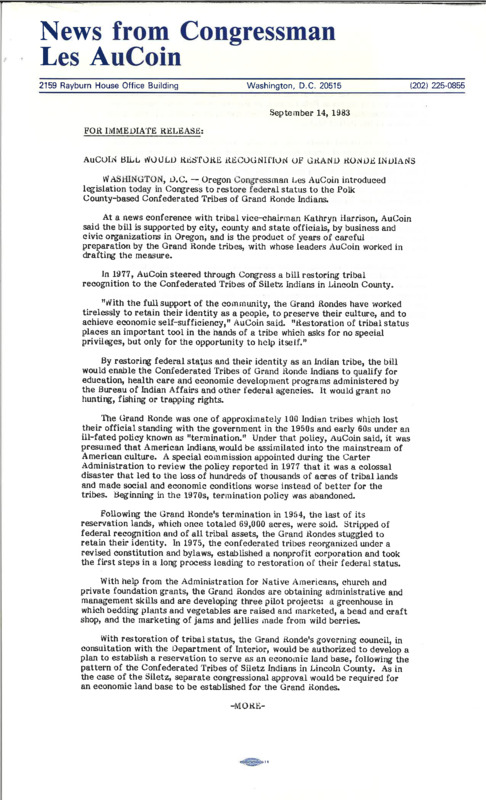
Press release from the office of Representative Les AuCoin announcing the introduction of legislation to restore federal status to the Confederated Tribes of Grand Ronde. The Confederated Tribes of Grand Ronde includes over 30 tribes from Oregon, California, and Washington. In the early 1850s, the United States forced these tribes off their lands, eventually establishing the Grand Ronde Reservation in Oregon in 1857. In 1954, Congress passed the Western Oregon Indian Termination Act, which ended federal recognition of the Confederated Tribes of Grand Ronde. Beginning in the 1970s, tribal leaders began working to restore the tribe's federal status, lobbying Congress to first pass the Grand Ronde Restoration Act in 1983, which restored federal recognition, then the Grand Ronde Reservation Act in 1988, which restored a small part of the reservation. This document is one of a collection of digitized objects from the Les AuCoin Papers (MS.147) at the Pacific University Archives. See also PUA_MS147_73 through PUA_MS147_84 and PUA_MS147_128 through PUA_MS147_129 for further information about the Grand Ronde bills.
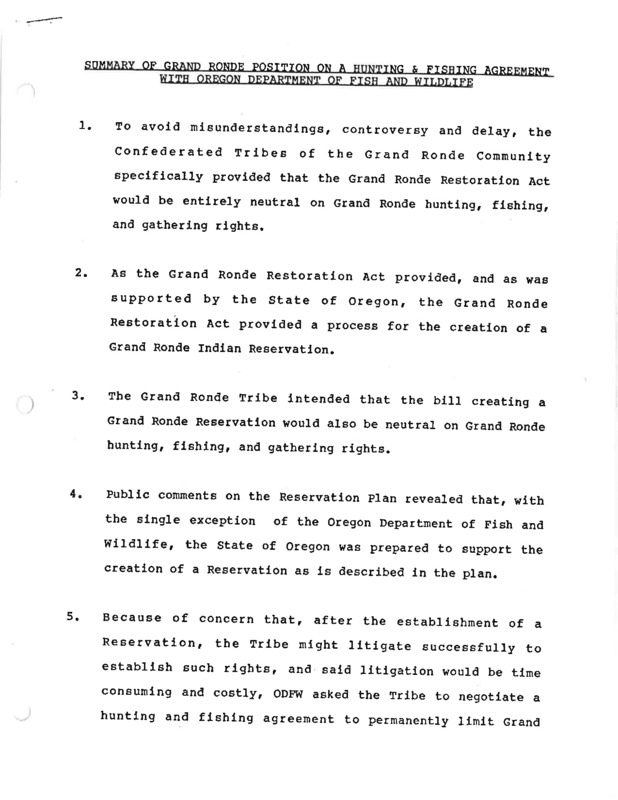
Summary of the negotiation of hunting and fishing rights between the Confederated Tribes of Grand Ronde and the Oregon Department of Fish and Wildlife. The Confederated Tribes of Grand Ronde includes over 30 tribes from Oregon, California, and Washington. In the early 1850s, the United States forced these tribes off their lands, eventually establishing the Grand Ronde Reservation in Oregon in 1857. In 1954, Congress passed the Western Oregon Indian Termination Act, which ended federal recognition of the Confederated Tribes of Grand Ronde. Beginning in the 1970s, tribal leaders began working to restore the tribe's federal status, lobbying Congress to first pass the Grand Ronde Restoration Act in 1983, which restored federal recognition, then the Grand Ronde Reservation Act in 1988, which restored a small part of the reservation. This summary outlines the concerns of the tribe, beginning with the passage of the Grand Ronde Restoration Act. It was probably prepared in 1987, as part of the negotiations to reestablish a reservation. This document is one of a collection of digitized objects from the Les AuCoin Papers (MS.147) at the Pacific University Archives. See also digital objects PUA_MS147_73 through PUA_MS147_84 and PUA_MS147_128 through PUA_MS147_129 for further information about the Grand Ronde bills.
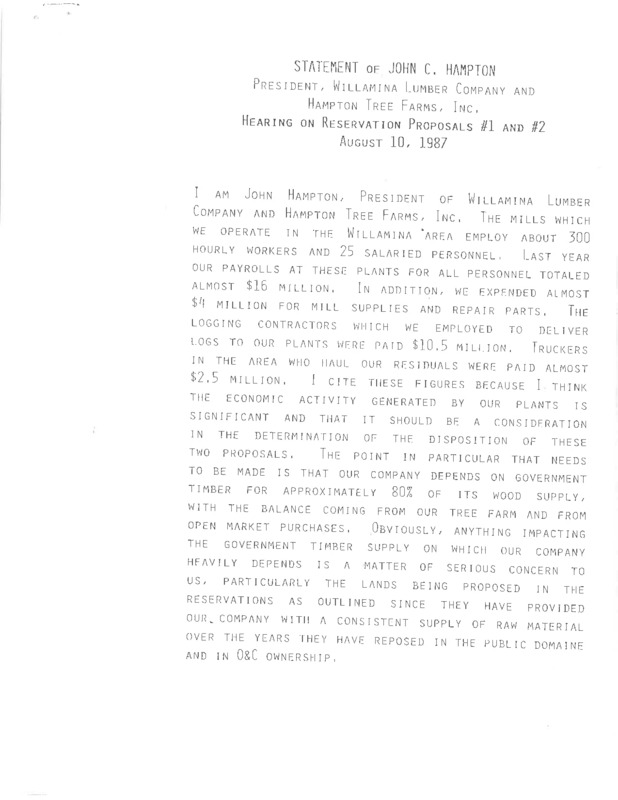
Statement of John Hampton, President of the Willamina Lumber Company and Hampton Tree Farms, opposing the reestablishment of a reservation for the Confederated Tribes of Grand Ronde. The Confederated Tribes of Grand Ronde includes over 30 tribes from Oregon, California, and Washington. In the early 1850s, the United States forced these tribes off their lands, eventually establishing the Grand Ronde Reservation in Oregon in 1857. In 1954, Congress passed the Western Oregon Indian Termination Act, which ended federal recognition of the Confederated Tribes of Grand Ronde. Beginning in the 1970s, tribal leaders began working to restore the tribe's federal status, lobbying Congress to first pass the Grand Ronde Restoration Act in 1983, which restored federal recognition, then the Grand Ronde Reservation Act in 1988, which restored a small part of the reservation. On August 10th, 1987, Representative Les AuCoin scheduled a local hearing to discuss the plan to reestablish a reservation. The hearing included a pro-reservation panel of tribal leaders and an anti-reservation panel led by local lumber mills. Representative AuCoin also invited members of several federal agencies, including the Forest Service, the Bureau of Land Management, the Fish and Wildlife Service, and the Bureau of Indian Affairs, to answer legal questions about the process. John Hampton led the anti-reservation panel, and his testimony outlines their major complaints. First, that reestablishing a reservation would give "special dispensation of government lands for Indian purposes" and second, that the reservation would impact "our potential wood supply and the cost of that wood supply". This document is one of a collection of digitized objects from the Les AuCoin Papers (MS.147) at the Pacific University Archives. Digital objects PUA_MS147_73 through PUA_MS147_77 and PUA_MS147_128 through PUA_MS147_129 represent a selection of opinions offered at the August 10th hearing.
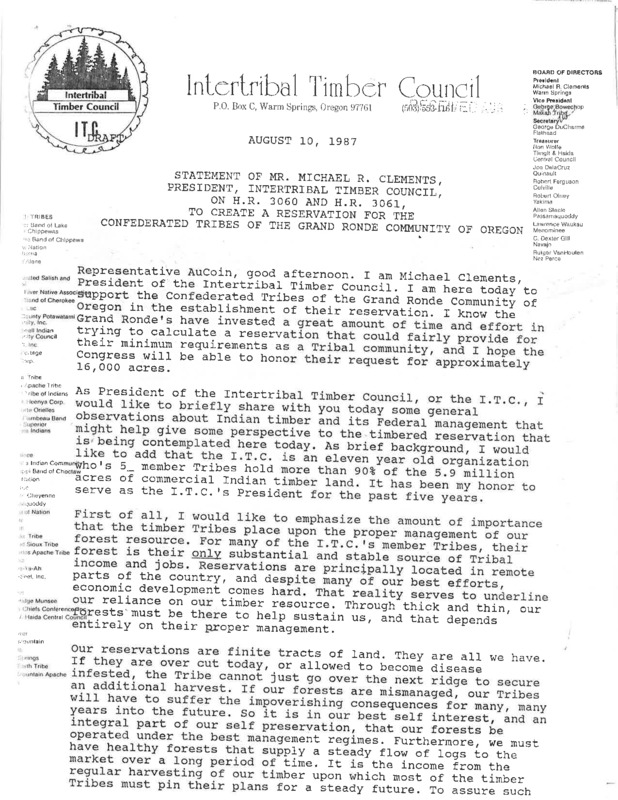
Statement of Michael Clements, President of the Intertribal Timber Council, in support of reestablishing a reservation for the Confederated Tribes of Grand Ronde. The Confederated Tribes of Grand Ronde includes over 30 tribes from Oregon, California, and Washington. In the early 1850s, the United States forced these tribes off their lands, eventually establishing the Grand Ronde Reservation in Oregon in 1857. In 1954, Congress passed the Western Oregon Indian Termination Act, which ended federal recognition of the Confederated Tribes of Grand Ronde. Beginning in the 1970s, tribal leaders began working to restore the tribe's federal status, lobbying Congress to first pass the Grand Ronde Restoration Act in 1983, which restored federal recognition, then the Grand Ronde Reservation Act in 1988, which restored a small part of the reservation. On August 10th, 1987, Representative Les AuCoin scheduled a local hearing to discuss the plan to reestablish a reservation. The hearing included a pro-reservation panel of tribal leaders and an anti-reservation panel led by local lumber mills. Representative AuCoin also invited members of several federal agencies, including the Forest Service, the Bureau of Land Management, the Fish and Wildlife Service, and the Bureau of Indian Affairs, to answer legal questions about the process. This statement outlines the work of the Intertribal Timber Council to manage forest resources on tribal land. This document is one of a collection of digitized objects from the Les AuCoin Papers (MS.147) at the Pacific University Archives. Digital objects PUA_MS147_73 through PUA_MS147_77 and PUA_MS147_128 through PUA_MS147_129 represent a selection of opinions offered at the August 10th hearing.
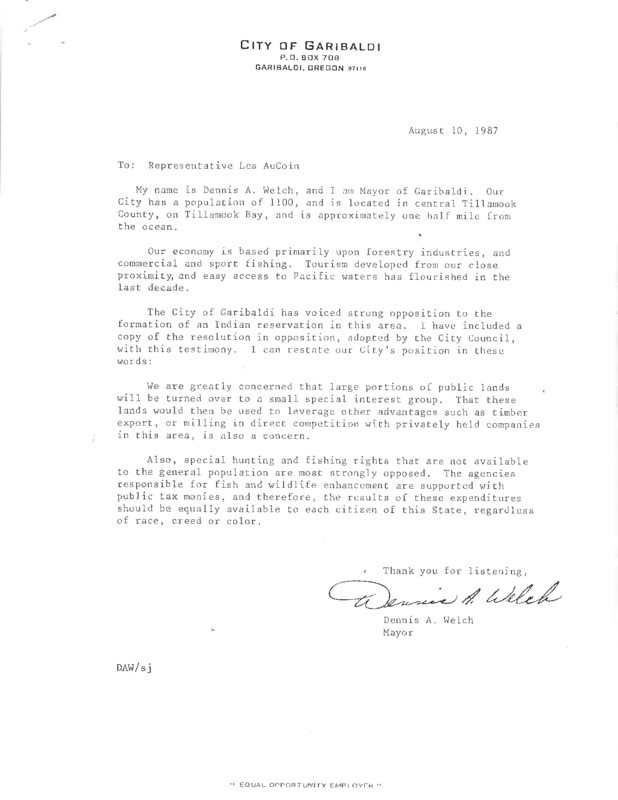
Letter from Dennis Welch, Mayor of Garibaldi, to Representative Les AuCoin, voicing opposition to the reestablishment of a reservation for the Confederated Tribes of Grand Ronde. The Confederated Tribes of Grand Ronde includes over 30 tribes from Oregon, California, and Washington. In the early 1850s, the United States forced these tribes off their lands, eventually establishing the Grand Ronde Reservation in Oregon in 1857. In 1954, Congress passed the Western Oregon Indian Termination Act, which ended federal recognition of the Confederated Tribes of Grand Ronde. Beginning in the 1970s, tribal leaders began working to restore the tribe's federal status, lobbying Congress to first pass the Grand Ronde Restoration Act in 1983, which restored federal recognition, then the Grand Ronde Reservation Act in 1988, which restored a small part of the reservation. On August 10th, 1987, Representative Les AuCoin scheduled a local hearing to discuss the plan to reestablish a reservation. The hearing included a pro-reservation panel of tribal leaders and an anti-reservation panel led by local lumber mills. Representative AuCoin also invited members of several federal agencies, including the Forest Service, the Bureau of Land Management, the Fish and Wildlife Service, and the Bureau of Indian Affairs, to answer legal questions about the process. This letter from the Mayor of Garibaldi exemplifies local opposition to reestablishing a reservation, arguing without clear evidence that the reservation would grant "a small special interest group" timber, hunting, and fishing rights that would damage the local economy. This document is one of a collection of digitized objects from the Les AuCoin Papers (MS.147) at the Pacific University Archives. Digital objects PUA_MS147_73 through PUA_MS147_77 and PUA_MS147_128 through PUA_MS147_129 represent a selection of opinions offered at the August 10th hearing.
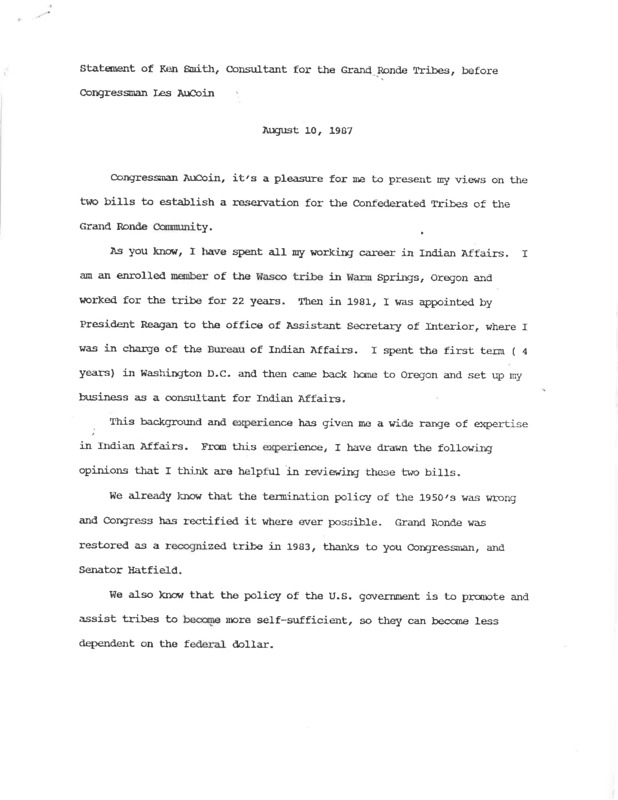
Testimony of Kevin Smith, Consultant for the Grand Ronde Tribes, in support of reestablishing a reservation for the Confederated Tribes of Grand Ronde. The Confederated Tribes of Grand Ronde includes over 30 tribes from Oregon, California, and Washington. In the early 1850s, the United States forced these tribes off their lands, eventually establishing the Grand Ronde Reservation in Oregon in 1857. In 1954, Congress passed the Western Oregon Indian Termination Act, which ended federal recognition of the Confederated Tribes of Grand Ronde. Beginning the 1970s, tribal leaders began working to restore the tribe's federal status, lobbying Congress to first pass the Grand Ronde Restoration Act in 1983, which restored federal recognition, then the Grand Ronde Reservation Act in 1988, which restored a small part of the reservation. On August 10th, 1987, Representative Les AuCoin scheduled a local hearing to discuss the plan to reestablish a reservation. The hearing included a pro-reservation panel of tribal leaders and an anti-reservation panel of local lumber mills. Representative AuCoin also invited members of several federal agencies, including the Forest Service, the Bureau of Land Management, the Fish and Wildlife Service, and the Bureau of Indian Affairs, to answer legal questions about the process. This document is one of a collection of digitized objects from the Les AuCoin Papers (MS.147) at the Pacific University Archives. Digital objects PUA_MS147_73 through PUA_MS147_77 and PUA_MS147_128 through PUA_MS147_129 represent a selection of opinions offered at the August 10th hearing.
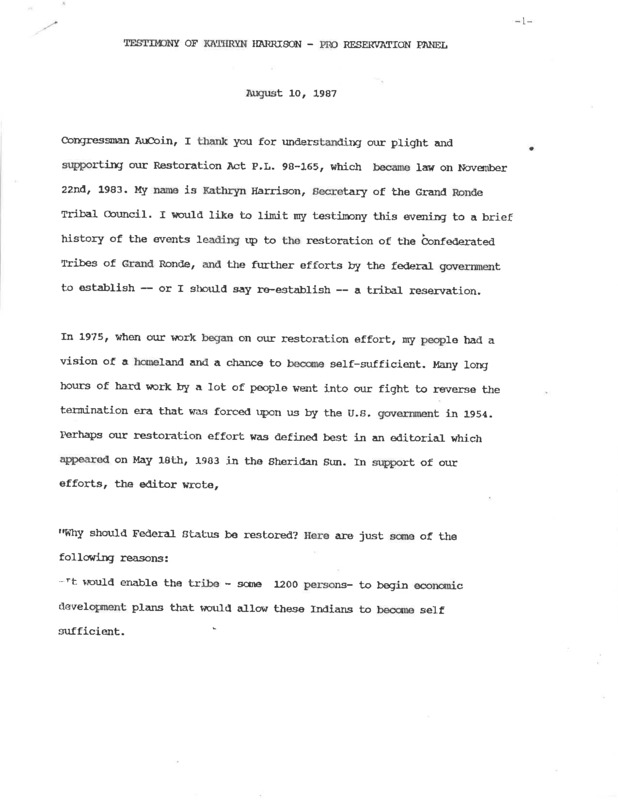
Testimony of Kathryn Harrison, Secretary of the Grand Ronde Tribal Council, in support of reestablishing a reservation for the Confederated Tribes of Grand Ronde. The Confederated Tribes of Grand Ronde includes over 30 tribes from Oregon, California, and Washington. In the early 1850s, the United States forced these tribes off their lands, eventually establishing the Grand Ronde Reservation in Oregon in 1857. In 1954, Congress passed the Western Oregon Indian Termination Act, which ended federal recognition of the Confederated Tribes of Grand Ronde. Beginning in the 1970s, tribal leaders began working to restore the tribe's federal status, lobbying Congress to first pass the Grand Ronde Restoration Act in 1983, which restored federal recognition, then the Grand Ronde Reservation Act in 1988, which restored a small part of the reservation. On August 10th, 1987, Representative Les AuCoin scheduled a local hearing to discuss the plan to reestablish a reservation. The hearing included a pro-reservation panel of tribal leaders and an anti-reservation panel of local lumber mills. Representative AuCoin also invited members of several federal agencies, including the Forest Service, the Bureau of Land Management, the Fish and Wildlife Service, and the Bureau of Indian Affairs, to answer legal questions about the process. This document is one of a collection of digitized objects from the Les AuCoin Papers (MS.147) at the Pacific University Archives. Digital objects PUA_MS147_73 through PUA_MS147_77 and PUA_MS147_128 through PUA_MS147_129 represent a selection of opinions offered at the August 10th hearing.
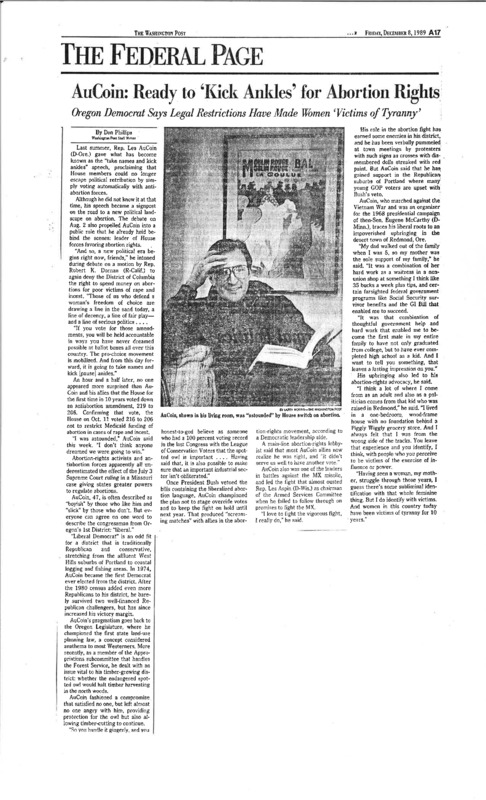
Photocopy of an article in the Washington Post on December 8th, 1989. The article, written by Don Phillips, discusses the role that Representative Les AuCoin played in the congressional fight for abortion rights. This is one of a collection of digitized objects from the Les AuCoin Papers (MS.147) at the Pacific University Archives.
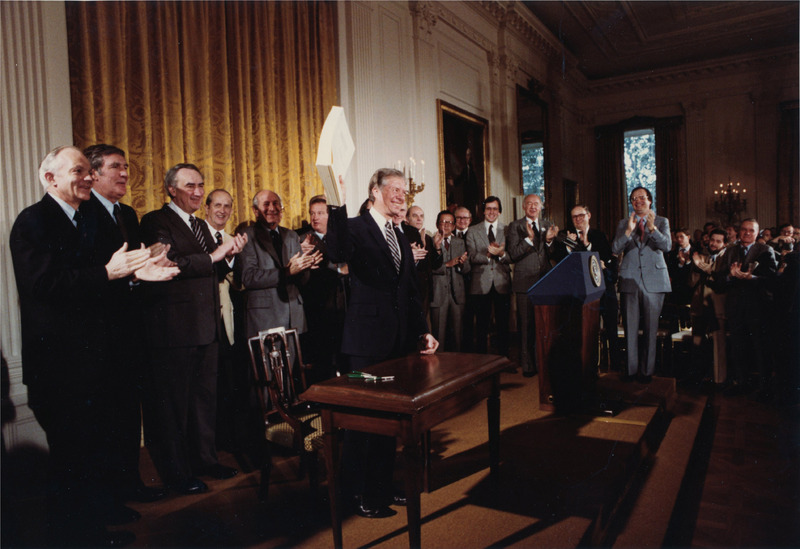
President Jimmy Carter celebrates signing a bill into law, surrounded by clapping legislators. The photo was probably taken in 1980, based on the people in the photo. This is one of a collection of digitized objects from the Les AuCoin Papers (MS.147) at the Pacific University Archives. See also PUA_MS147_65.
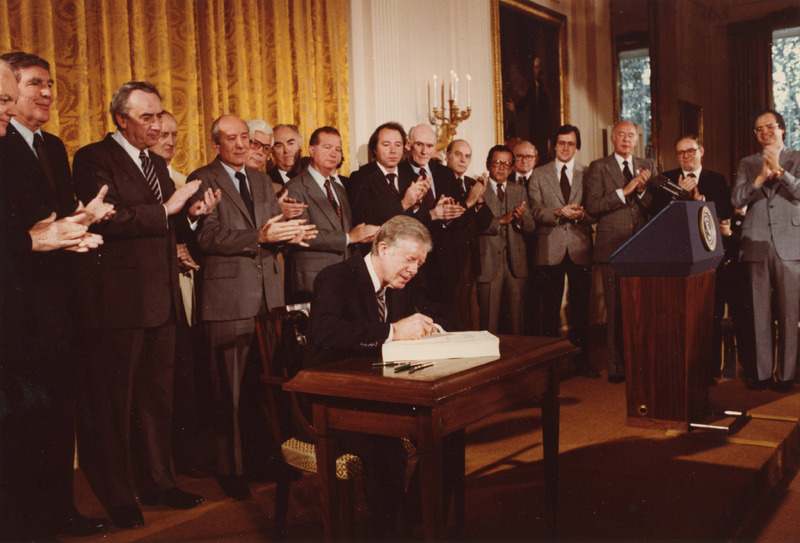
President Jimmy Carter signs a bill into law, surrounded by clapping legislators. Representative Les AuCoin is the fourth person from the right. The photo was probably taken in 1980, based on the people in the photo. This is one of a collection of digitized objects from the Les AuCoin Papers (MS.147) at the Pacific University Archives. See also PUA_MS147_66.
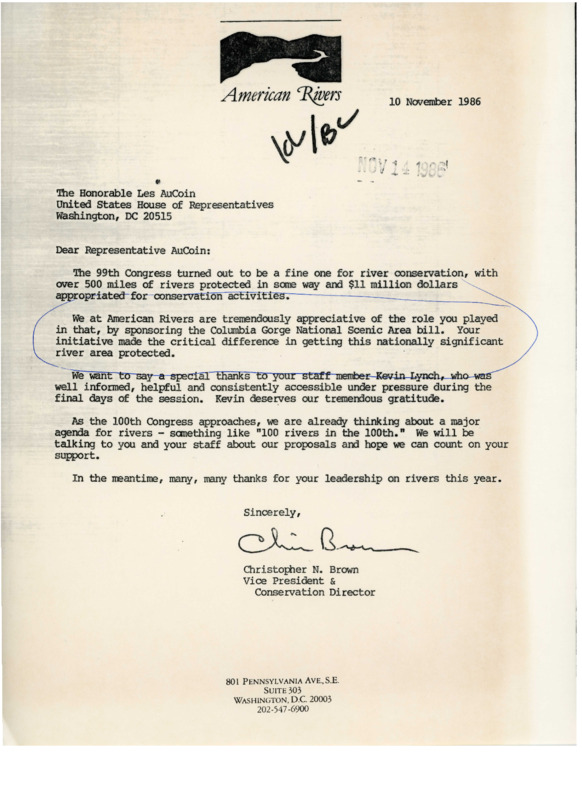
Letter to Representative Les AuCoin from Christopher Brown, Conservation Director at American Rivers. The letter thanks Representative AuCoin and his staff member Kevin Lynch for their work supporting the Columbia Gorge National Scenic Area Bill. This is one of a collection of digitized objects from the Les AuCoin Papers (MS.147) at the Pacific University Archives and can be found in Box 25, Folder 7.
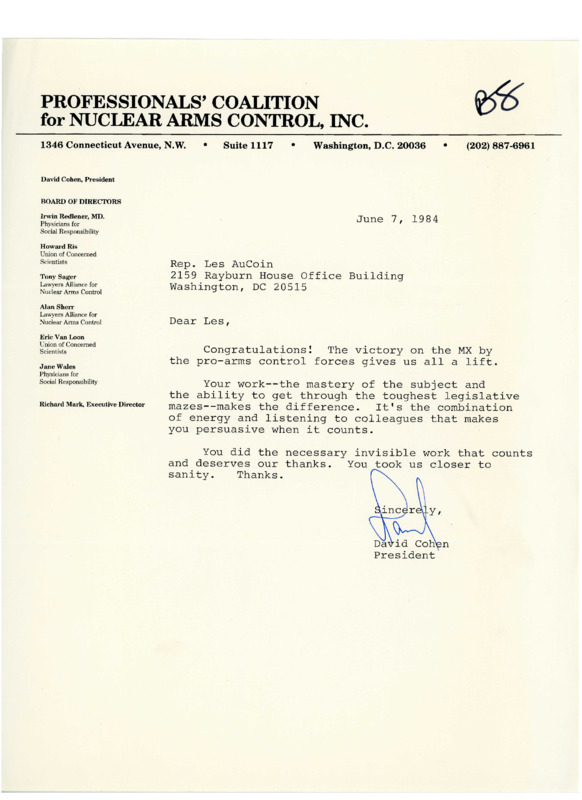
Letter to Representative Les AuCoin from David Cohen, President of the Professionals' Coalition for Nuclear Arms Control. In the letter, Cohen thanks Representative AuCoin for his opposition of MX missiles and contributions to arms control. This is one of a collection of digitized objects from the Les AuCoin Papers (MS.147) at the Pacific University Archives and can be found in Box 25, Folder 7.
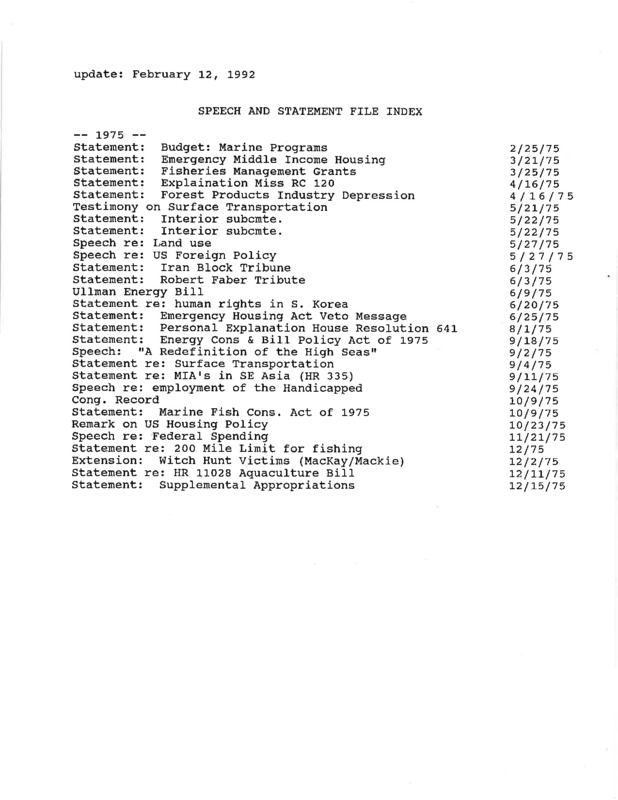
Typed index of speeches and statements given by Representative Les AuCoin between 1975 and 1992. The index reflects the speeches present in the Les AuCoin Papers (MS 147) at the Pacific University Archives.
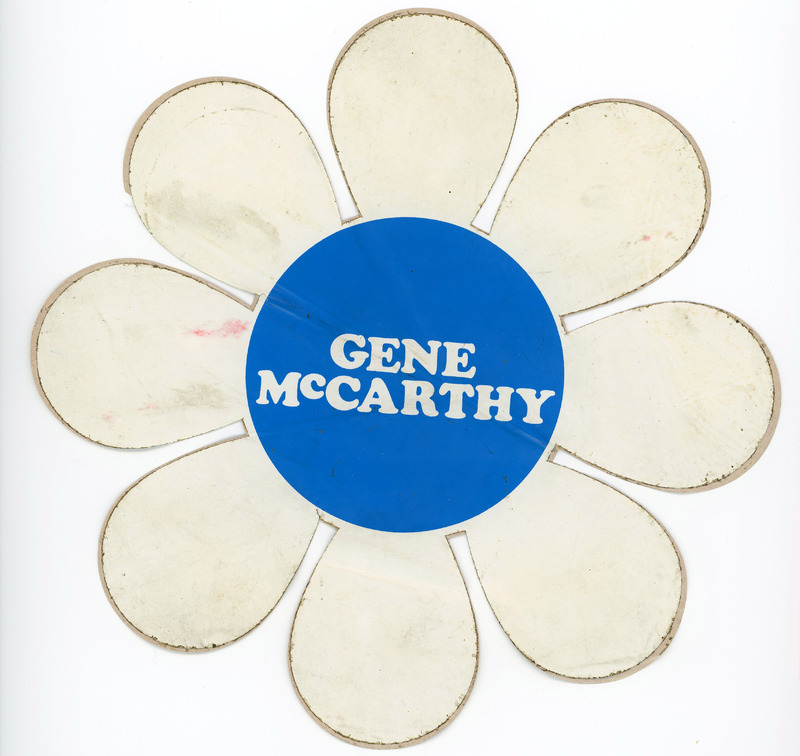
Sticker advertising Eugene McCarthy's 1968 campaign for president. Representative Les AuCoin campaigned for Eugene McCarthy in Oregon, and the experience inspired him to run for state representative two years later. This is one of a collection of digitized objects from the Les AuCoin Papers (MS.147) at the Pacific University Archives.
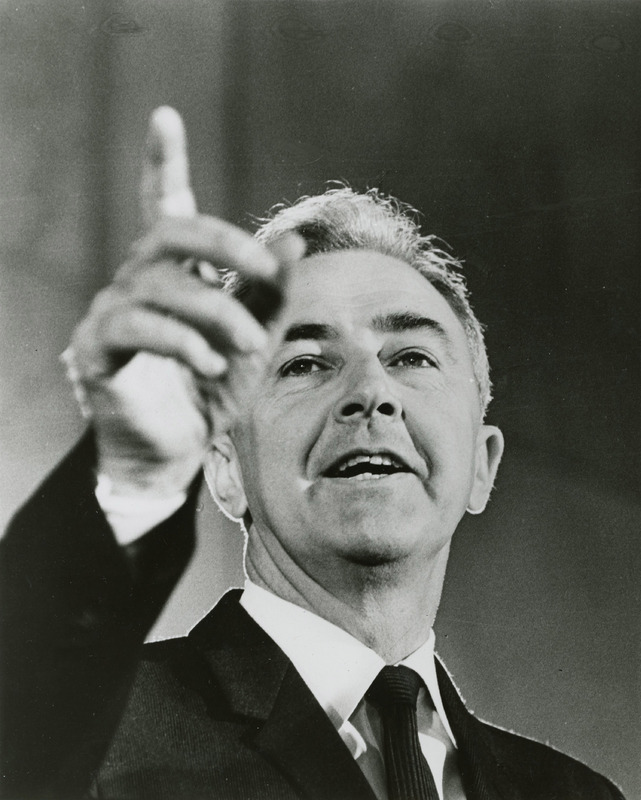
Portrait of Eugene McCarthy, Democratic candidate for the 1968 presidential election. Representative Les AuCoin campaigned for Eugene McCarthy in Oregon, and the experience inspired him to run for state representative two years later. This is one of a collection of digitized objects from the Les AuCoin Papers (MS.147) at the Pacific University Archives and can be found in Box 49, Folder 13.
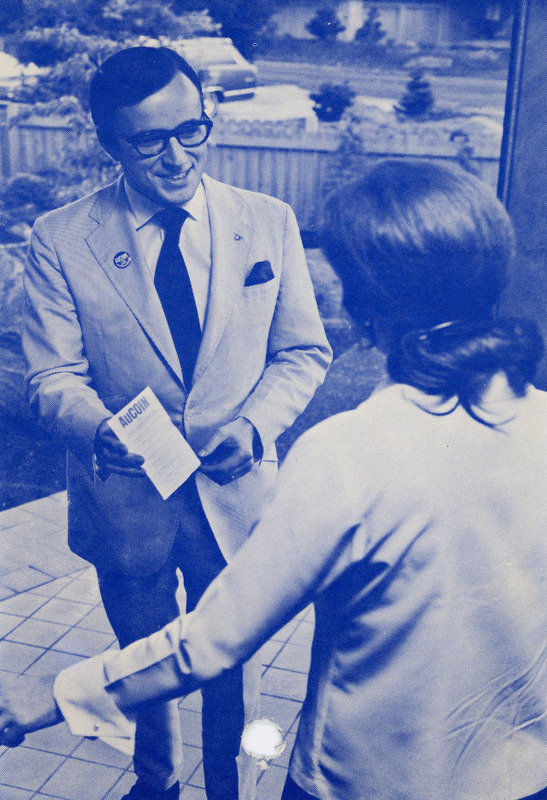
Postcard advertising Representative Les AuCoin's first campaign for Oregon state representative. On the front, a smiling Representative AuCoin hands out campaign literature. On the back, the text reads "Dear, I am supporting LES AUCOIN for State Representative (Washington County Position No. 2). I hope you will strongly consider doing the same. By visiting 5,000 homes in Washington County Les has demonstrated that he is a real worker for responsive government, and a sensible, new voice for Washington County! (Bipartisan Citizens Committee for Les AuCoin, P.O. Box 5190, Aloha, Oregon 97005)". This is one of a collection of digitized objects from the Les AuCoin Papers (MS.147) at the Pacific University Archives and can be found in Box 11, Folder 26.
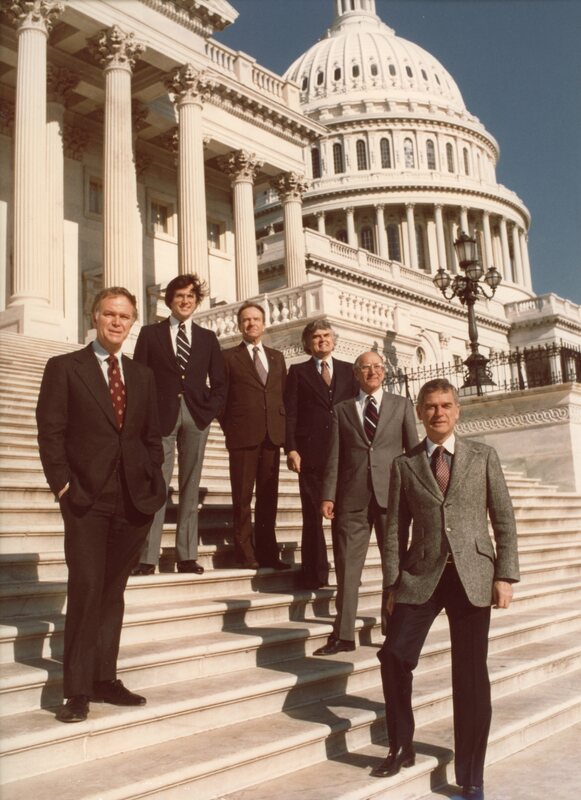
The 1979 Oregon delegation stands for a group portrait in front of the U.S. Capitol. In typed notes about the image, Les AuCoin writes: "The only picture I believe ever taken of the Oregon delegation. Bob Packwood and Mark Hatfield, Republican senators, are on the lower steps on each side. I'm on the top step. From the left moving downward: Congressmen Bob Duncan, Al Ullman, and Jim Weaver. Duncan had run against Hatfield in a very oddly contested 1966 Senate race, but they became good friends. Ullman and Duncan would lose reelection in 1980. I ran and lost a race against Packwood in 1992." This is one of a collection of digitized objects from the Les AuCoin Papers (MS.147) at the Pacific University Archives. The original photo remains with the AuCoin family.
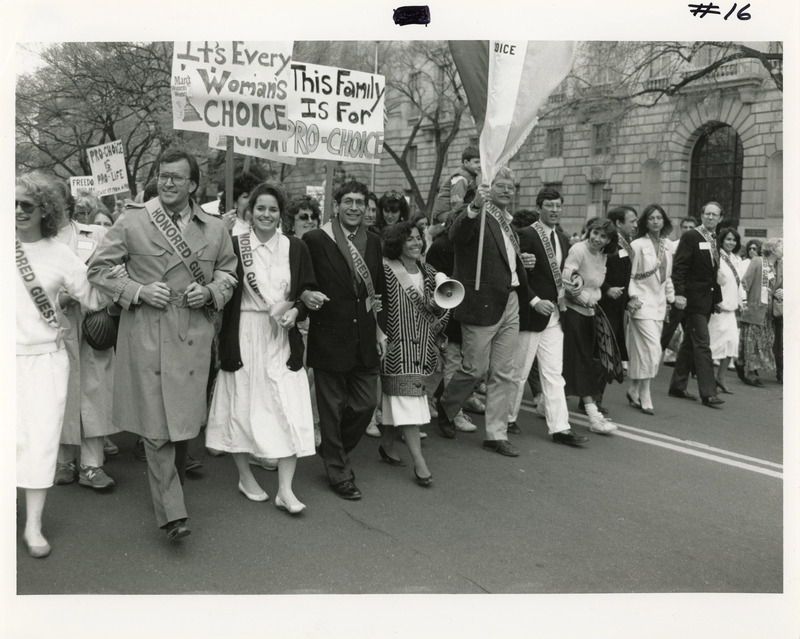
Representative Les AuCoin leads an abortion rights march with his wife, Sue, and daughter, Stacy, along with other U.S. Representatives. In typed notes about the image, AuCoin writes: "In the late eighties, I fought for Medicaid funding for abortion in cases of rape or incest. In this photo, Sue, Stacy, and I, along with several congressional colleagues, helped lead a pro-choice march. Left to right: Sue, Les, Stacy, Ted Weiss (D-NY), Barbara Boxer (D-CA), George Miller (D-CA), Tom Downey (D-NY), Howard Wolpe (D-MI), Anthony Beilenson (D-CA)." Based on this note, the photo was probably taken between 1985 and 1989. This is one of a collection of digitized objects from the Les AuCoin Papers (MS.147) at the Pacific University Archives. The original photo remains with the AuCoin family.
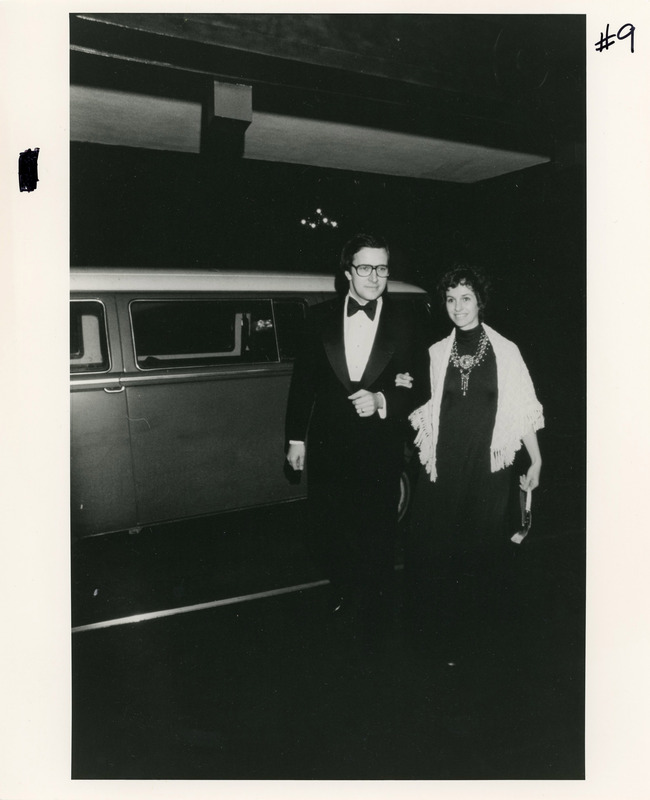
Representative Les AuCoin and his wife Sue arrive at the White House for the Christmas Ball. In typed notes about the image, AuCoin writes: "Sue and I arrive at the White House for the 1975 Christmas Ball. Entering the compound, our old VW bus sounded like a sputtering lawn mower. We had bought the rig ten years earlier and couldn't afford something new." This is one of a collection of digitized objects from the Les AuCoin Papers (MS.147) at the Pacific University Archives. The original photo remains with the AuCoin family.
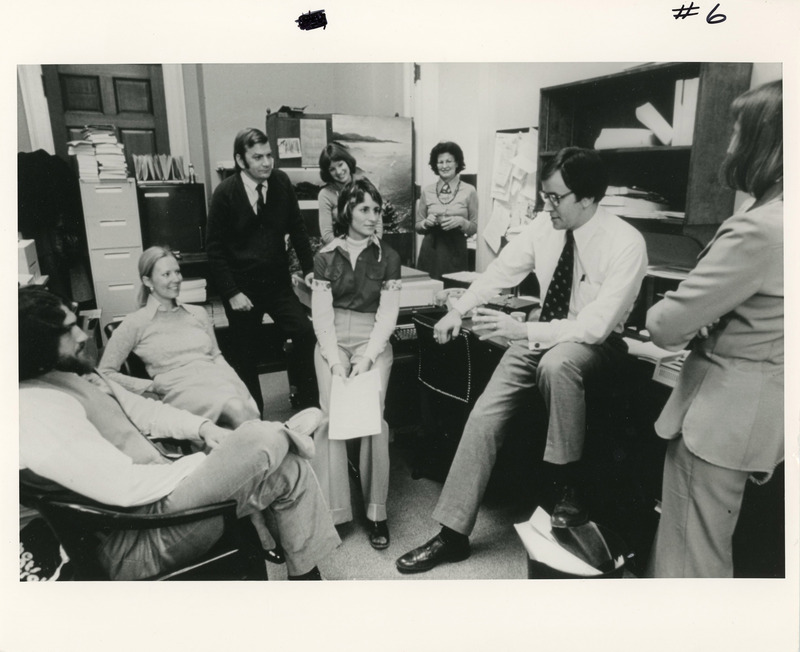
Representative Les AuCoin sits in his congressional office, surrounded by his staff. In typed notes about the image, AuCoin writes: "An impromptu staff meeting in 1975, my freshman year. In the last 10 to 12 years of my career, my office had one of the lowest turnover rates in the House." This is one of a collection of digitized objects from the Les AuCoin Papers (MS.147) at the Pacific University Archives. The original photo remains with the AuCoin family.
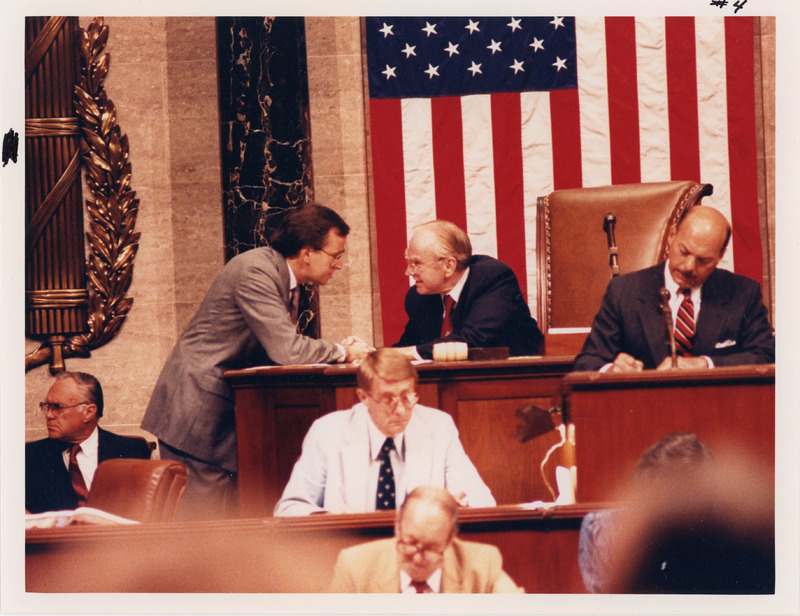
Representative Les AuCoin speaks with House Speaker Jim Wright on the House Floor. In typed notes about the image, AuCoin writes: "Conferring with House Speaker Jim Wright. I was 47, Dean of the Oregon House delegation, 84th in house seniority, a member of the Democratic whip organization, a veteran of the Appropriations Committee, and an official congressional observer to the US-USSR arms control talks in Geneva." Based on these notes, the photo was probably taken in 1989. This is one of a collection of digitized objects from the Les AuCoin Papers (MS.147) at the Pacific University Archives. The original photo remains with the AuCoin family.
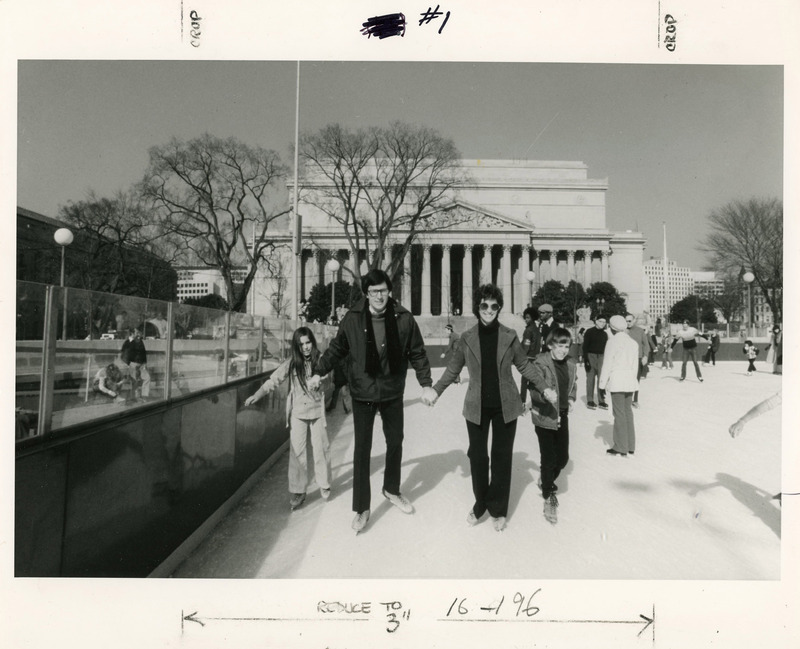
The AuCoin family ice skates on the Capitol Mall in Washington D.C. In typed notes about the image, Representative Les AuCoin writes: "With Congress adjourned, Sue and I took Stacy (left) and Kelly (right) skating on the Capitol Mall. Interregnums between congresses offered a two-month breather every two years to focus on being a family." The photo was taken in the late 1970s. This is one of a collection of digitized objects from the Les AuCoin Papers (MS.147) at the Pacific University Archives. The original photo remains with the AuCoin family.
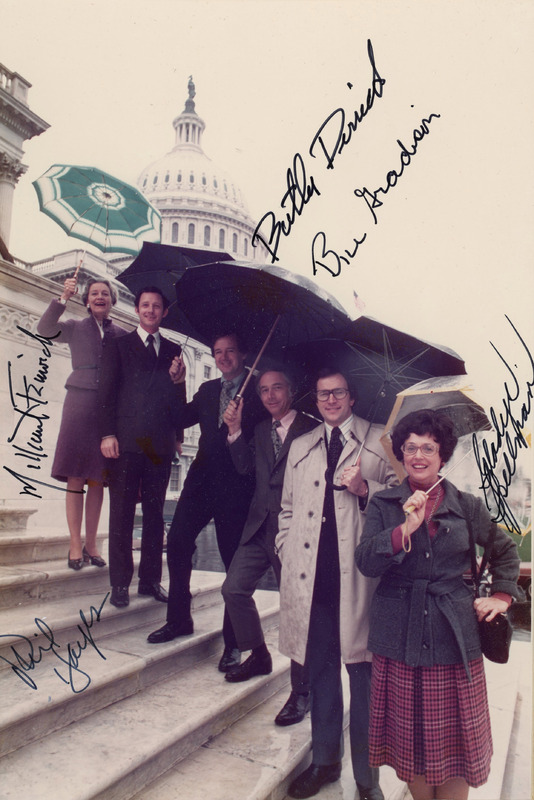
The six freshman of the 1975 House Banking Committee pose together for a group portrait. In typed notes about the image, Representative Les AuCoin writes: "Photo of me and my fellow freshman on the Banking Committee in 1975. This was on the cover of the American Banker magazine, illustrating the independent thinking of these bipartisan newcomers. Top to bottom: Millicent Fenwick (R-NJ), Phil Hayes (D-IN), Butler Derrick (D-SC), Bill Gradison (R-OH), me, Gladys Spellman (D-MD)" Each representative, save for AuCoin, has signed their name above their picture. This is one of a collection of digitized objects from the Les AuCoin Papers (MS.147) at the Pacific University Archives. The original photo remains with the AuCoin family.
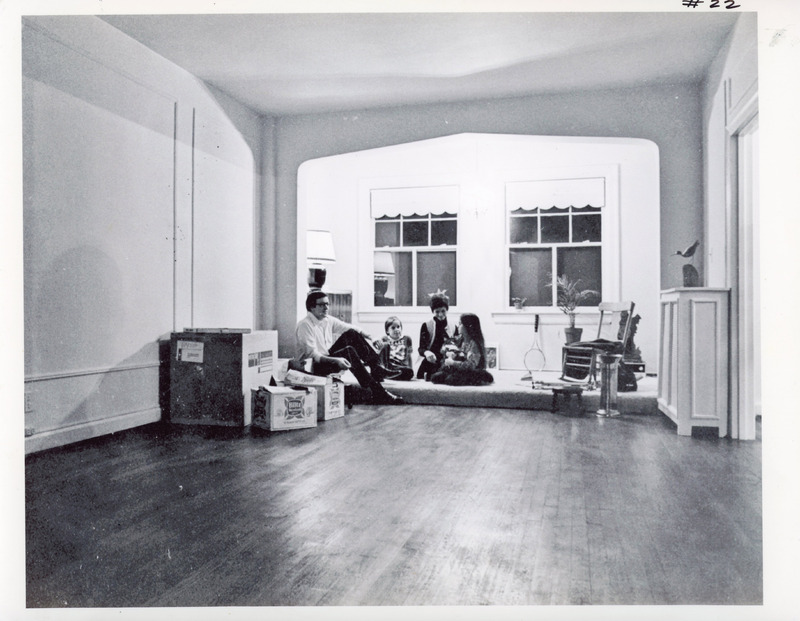
The AuCoin family sits in an unfurnished apartment in Washington D.C. In typed notes about the image, Representative Les AuCoin writes: "My family's first night in our condo apartment in Washington D.C. We got into our apartment before the movers arrived. The first two nights were a bit lonely, but we came to love our home on NW Connecticut Avenue in the Cleveland Park neighborhood. A friend of Sue's mother recommended the condo to us because it was in the city and offered a quicker trip to and from the capital. It was one of the best homes we had." This is one of a collection of digitized objects from the Les AuCoin Papers (MS.147) at the Pacific University Archives. The original photo remains with the AuCoin family.