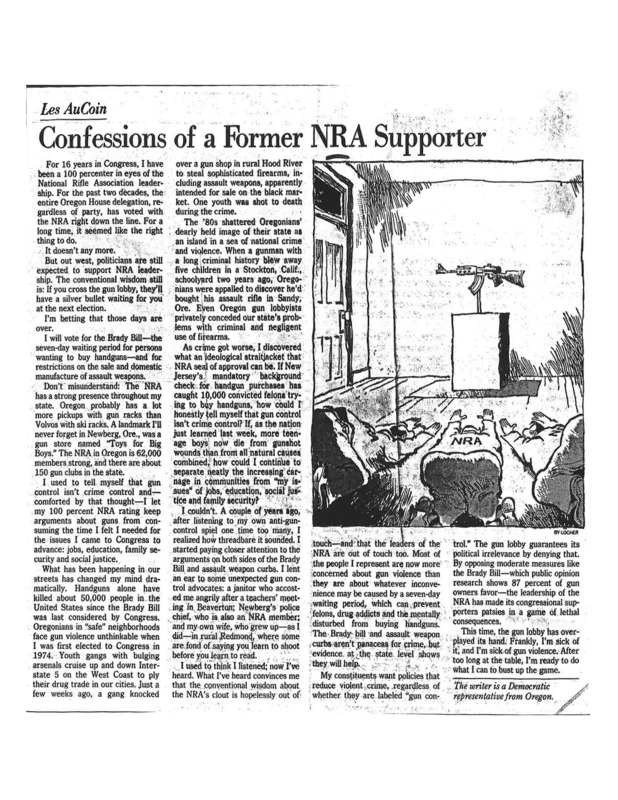
Article written by Representative Les AuCoin discussing his changing perspective on the National Rifle Association and his support for the Brady Bill. The Brady Bill, a short name for the Brady Handgun Violence Prevention Act, mandated background checks and a waiting period for firearm purchases. Representative AuCoin had previously argued against gun control, but this 1991 article in the Washington Post marked a significant change in his position. This document is one of a collection of digitized objects from the Les AuCoin Papers (MS.147) at the Pacific University Archives.
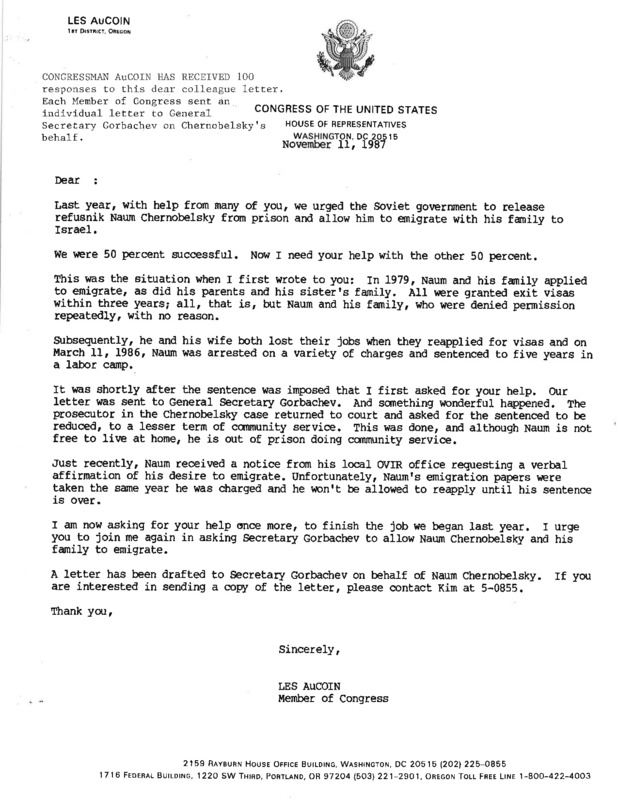
Two form letters addressing the case of Naum Chernobelsky. The first letter is a "dear colleague" letter from November 1987, requesting that members of congress sign the second letter, which asks Mikhail Gorbachev, General Secretary of the Soviet Union, to begin the emigration process for Naum Chernobelsky. The Chernobelskys were a Ukrainian Jewish family of "refuseniks," an unofficial term for individuals, most commonly Soviet Jews, whose requests to emigrate from the Soviet Union were denied by officials. In the case of the Chernobelsky family, Naum's parents and sister were able to emigrate to Portland, Oregon in 1979, but he, his wife, and his children were not permitted to leave the Soviet Union. In February 1986, Naum's sister Raisa requested help from Representative AuCoin, who spent the next 2 years lobbying the Soviet Union for Naum Chernobelsky's release. Naum and his family were eventually allowed to emigrate from the Soviet Union to the United States in late 1988. This is one of a collection of digitized objects from the Les AuCoin Papers (MS.147) at the Pacific University Archives. See also PUA_MS147_111 through PUA_MS147_113 for other materials related to the Chernobelsky family.
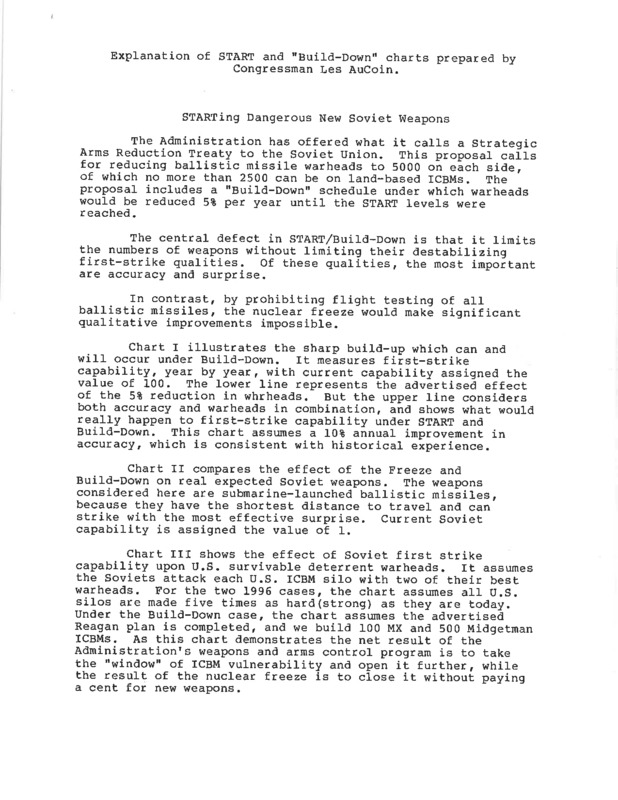
Document titled "STARTing Dangerous New Soviet Weapons" prepared by Representative Les AuCoin. The document includes an explanation of START, the Strategic Arms Reduction Treaty between the United States and the Soviet Union, and charts outlining the impacts of the treaty. Chart one compares the advertised and actual impact on counterforce capability. Chart two compares the impact of nuclear freeze and nuclear build-down on Soviet weapons. Chart three illustrates the effect of Soviet first strike capability on U.S. ICBM warheads. Using these charts, Representative AuCoin argues that START's Build-Down schedule would not sufficiently reduced the threat of nuclear war. Based on the charts, this document was prepared in 1983, shortly after START negotiations with the Soviet Union began. This is one of a collection of digitized objects from the Les AuCoin Papers (MS.147) at the Pacific University Archives. See also PUA_MS147_93 through PUA_MS147_110 for other materials related to nuclear arms control.
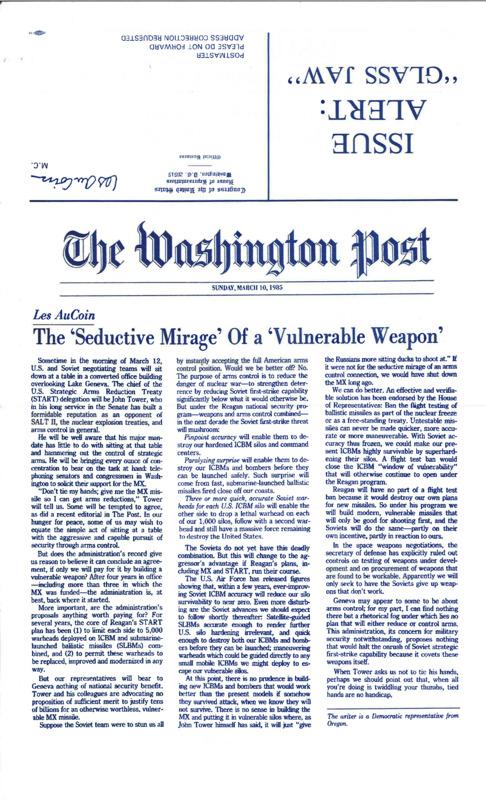
Issue Report mailing produced by the office of Representative Les AuCoin on March 20th, 1985. The mailing includes a letter from Representative AuCoin updating voters on upcoming votes on funding MX missiles. The mailing also includes a copy of a recent article in the Washington Post written by Representative AuCoin titled "The Seductive Mirage of a Vulnerable Weapon". This is one of a collection of digitized objects from the Les AuCoin Papers (MS.147) at the Pacific University Archives. See also PUA_MS147_93 through PUA_MS147_110 for other materials related to nuclear arms control.
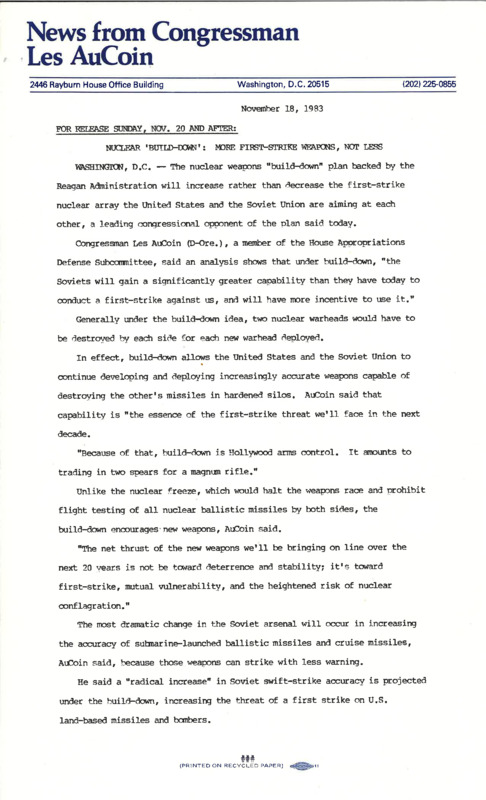
Press release from the office of Representative Les AuCoin on November 18th, 1983. The release argues that the Reagan Administration's "build-down" plan would actually increase the number of first-strike nuclear weapons in the United States. This is one of a collection of digitized objects from the Les AuCoin Papers (MS.147) at the Pacific University Archives. See also PUA_MS147_93 through PUA_MS147_110 for other materials related to nuclear arms control.
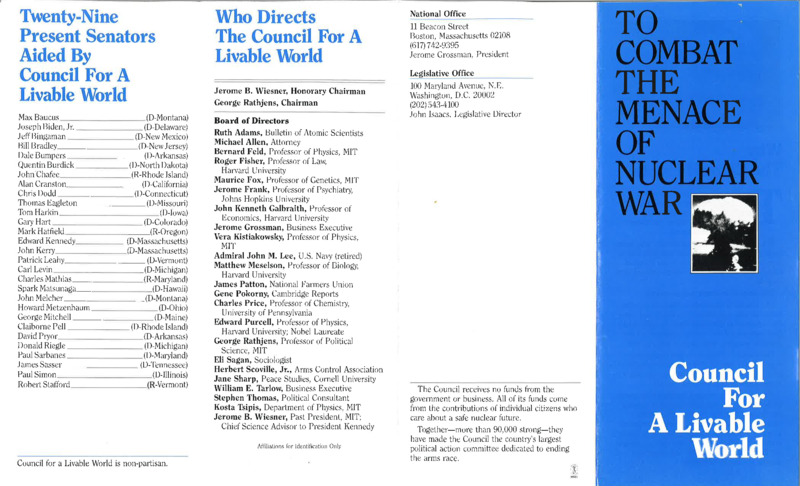
Pamphlet titled "To Combat the Menace of Nuclear War" produced by the Council for a Livable World. Founded in 1962, the Council for a Livable World is a non-profit organization dedicated to nuclear disarmament. This pamphlet outlines recent work of the organization with congressional elections, and it was likely published in 1986. This is one of a collection of digitized objects from the Les AuCoin Papers (MS.147) at the Pacific University Archives. See also PUA_MS147_93 through PUA_MS147_110 for other materials related to nuclear arms control.
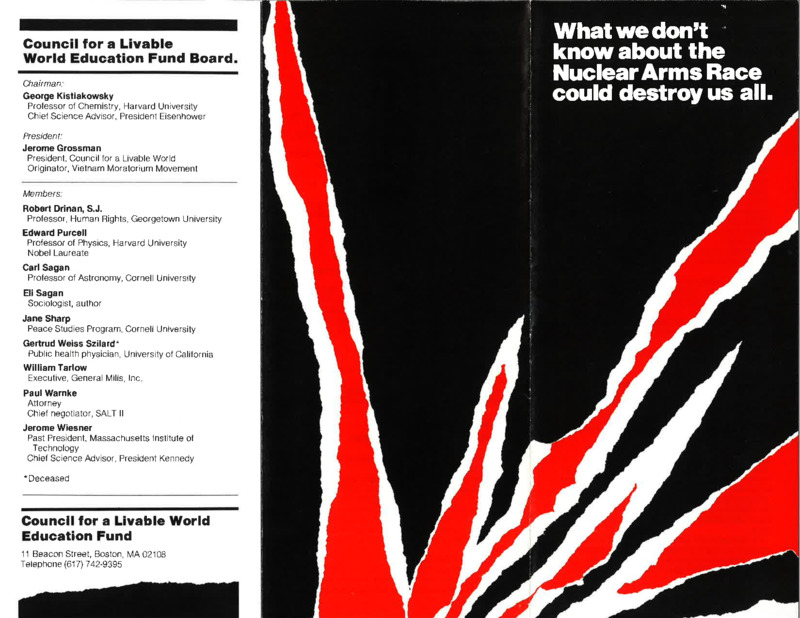
Pamphlet titled "What we don't know about the Nuclear Arms Race could destroy us all" produced by the Council for a Livable World Education Fund. Founded in 1962, the Council for a Livable World is a non-profit organization dedicated to nuclear disarmament. The Education Fund focused on educating the American public through pamphlets, books, symposiums, and public talks. This pamphlet outlines recent work of the organization, and it was likely published in the early 1980s. This is one of a collection of digitized objects from the Les AuCoin Papers (MS.147) at the Pacific University Archives. See also PUA_MS147_93 through PUA_MS147_110 for other materials related to nuclear arms control.
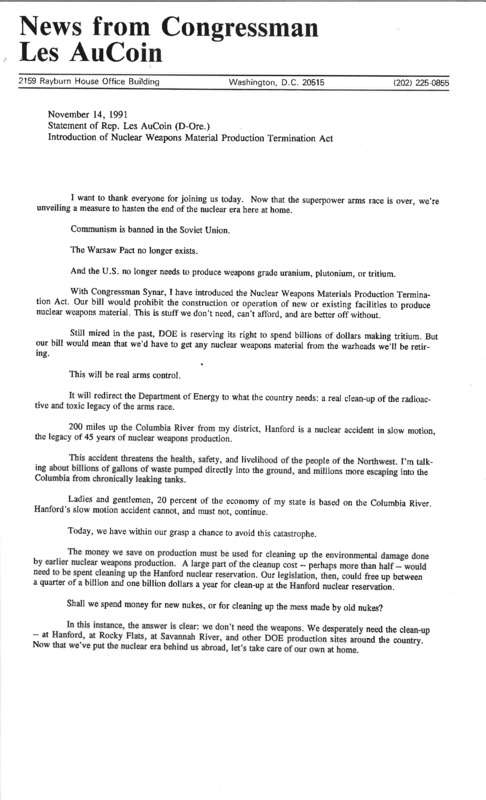
Statement by Representative Les AuCoin on November 14th, 1991 about the introduction of the Nuclear Weapons Production Termination Act. The act would have prohibited further production of tritium, plutonium, and highly enriched uranium for weapons and allocated the money saved to cleaning up environmental damaged caused by earlier production of nuclear weapons. This is one of a collection of digitized objects from the Les AuCoin Papers (MS.147) at the Pacific University Archives. See also PUA_MS147_104 for an overview of the bill. See also PUA_MS147_93 through PUA_MS147_110 for other materials related to nuclear arms control.
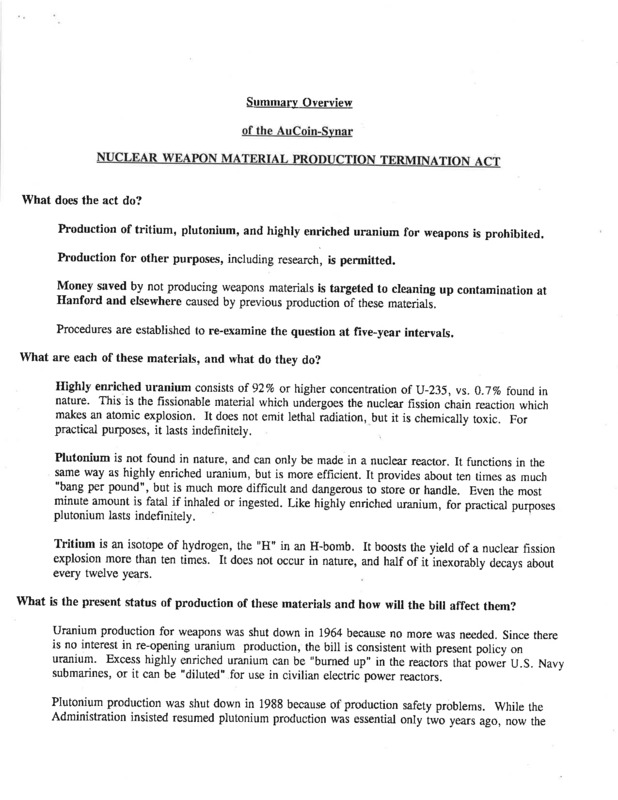
A summary of the Nuclear Weapon Material Production Termination Act, which was introduced by Representative Les AuCoin on November 18th, 1991. The act would have prohibited further production of tritium, plutonium, and highly enriched uranium for weapons and allocated the money saved to cleaning up environmental damaged caused by earlier production of nuclear weapons. This document discusses details of the bills, including descriptions of the nuclear materials, budget, and impact of the bill. This is one of a collection of digitized objects from the Les AuCoin Papers (MS.147) at the Pacific University Archives. See also PUA_MS147_105 for statement by Representative AuCoin on the Nuclear Weapon Material Production Termination Act. See also PUA_MS147_93 through PUA_MS147_110 for other materials related to nuclear arms control.
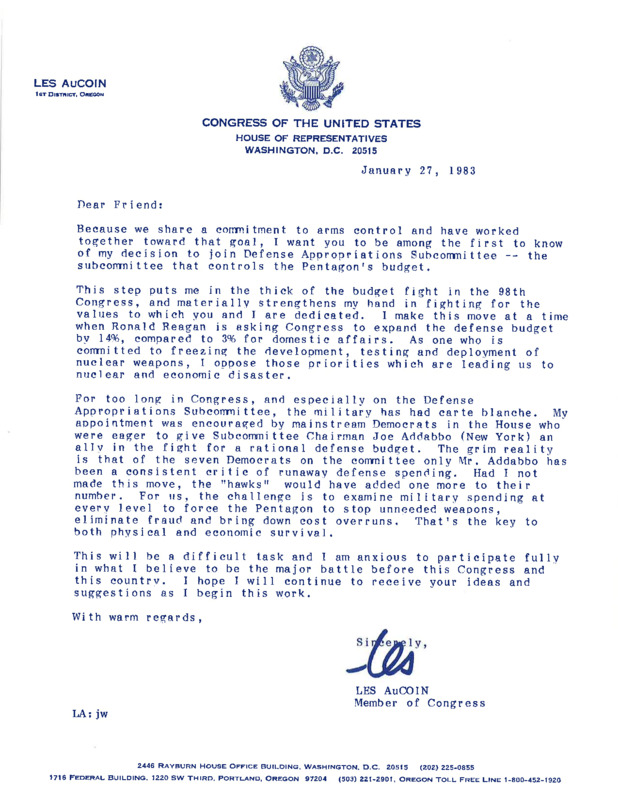
Form letter from Representative Les AuCoin discussing his decision to join the Defense Appropriations Subcommittee. The letter, written on January 27th, 1983, expresses Representative AuCoin's reasons for joining the committee and his commitment to a nuclear freeze. This is one of a collection of digitized objects from the Les AuCoin Papers (MS.147) at the Pacific University Archives. See also PUA_MS147_93 through PUA_MS147_110 for other materials related to nuclear arms control.
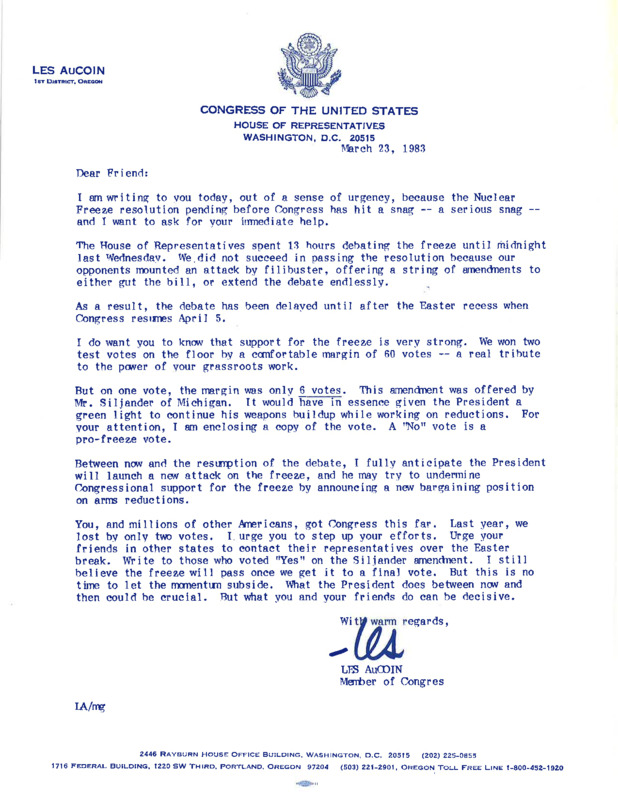
Form letter from Representative Les AuCoin to voters, asking for their support for the Nuclear Freeze resolution. The letter, written March 23rd, 1983, discusses recent the debate in the House on the resolution, which ended in a filibuster. This is one of a collection of digitized objects from the Les AuCoin Papers (MS.147) at the Pacific University Archives. See also PUA_MS147_93 through PUA_MS147_110 for other materials related to nuclear arms control.
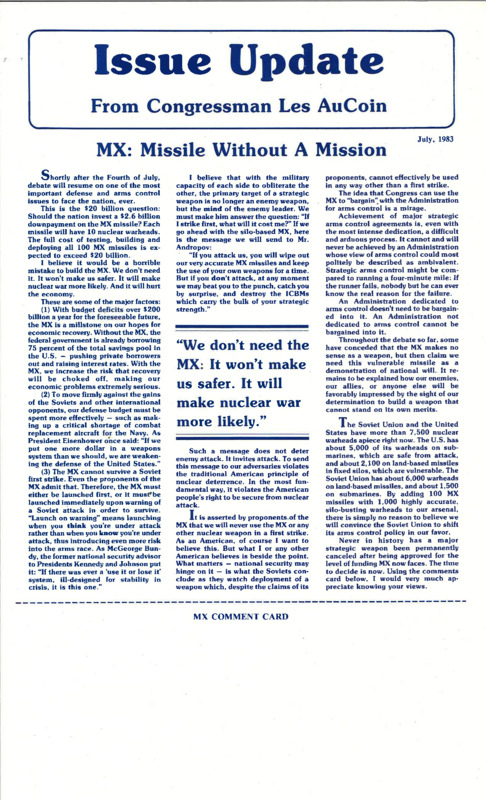
A copy of The AuCoin Report titled "MX: Missile Without A Mission". The AuCoin Report was a newsletter produced by the office of Representative Les AuCoin to update Oregon voters about his work in Congress. This newsletter, from July 1983, discusses Representative AuCoin's opposition to the MX missile. This is one of a collection of digitized objects from the Les AuCoin Papers (MS.147) at the Pacific University Archives. See also PUA_MS147_93 through PUA_MS147_110 for other materials related to nuclear arms control.
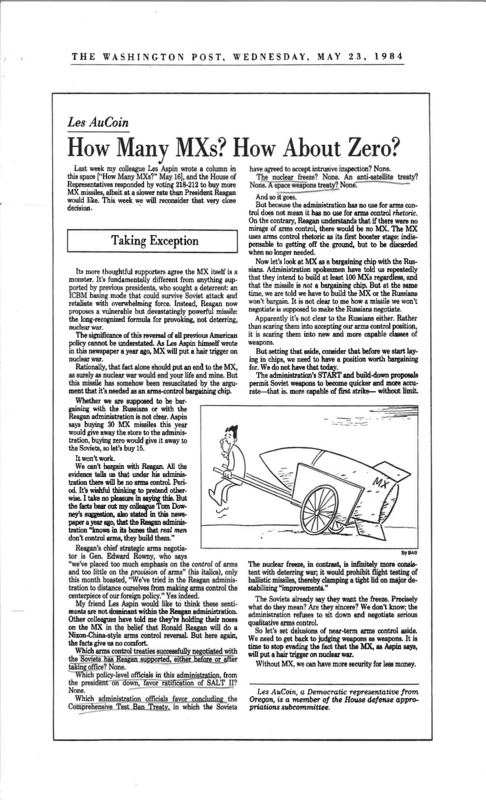
Article by Representative Les AuCoin published on May 23rd, 1984 in the Washington Post. The article responds to a May 16th column by Representative Les Aspin which asked "How Many MXs?". In the article, Representative AuCoin disagrees with Representative Aspin and argues that the MX missile would provoke nuclear war, rather than deterring it. This is one of a collection of digitized objects from the Les AuCoin Papers (MS.147) at the Pacific University Archives. See also PUA_MS147_93 through PUA_MS147_110 for other materials related to nuclear arms control.
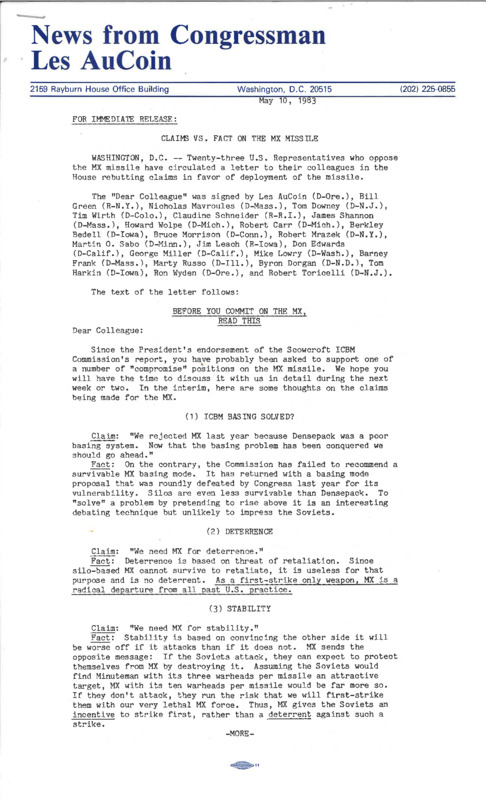
Press release from the office of Representative Les AuCoin on May 10th, 1983, discussing "Claims vs. Fact on the MX Missile". The press release publishes a "dear colleague" letter signed by twenty-three U.S. Representatives. A "dear colleague" letter is a piece of official correspondence written by a member of Congress and distributed in bulk to other congressional offices. This particular letter, titled "Before You Commit on the MX, Read This" addresses claims and facts around the MX missile discussed in Congress. This is one of a collection of digitized objects from the Les AuCoin Papers (MS.147) at the Pacific University Archives. See also PUA_MS147_93 through PUA_MS147_110 for other materials related to nuclear arms control.
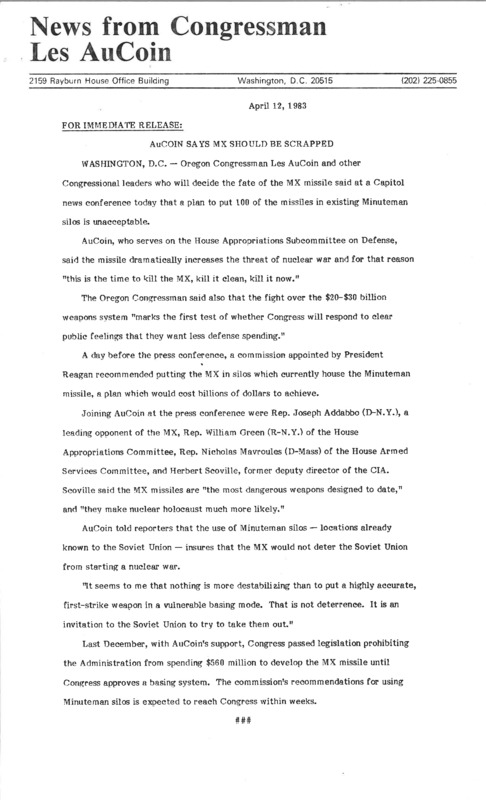
Press release from April 12th, 1983 from the office of Representative Les AuCoin arguing against a plan to put MX missiles in existing Minuteman silos. The press release was responding to a commission appointed by President Reagan that recommended the plan, which would cost billions of dollars. This is one of a collection of digitized objects from the Les AuCoin Papers (MS.147) at the Pacific University Archives. See also PUA_MS147_93 through PUA_MS147_110 for other materials related to nuclear arms control.
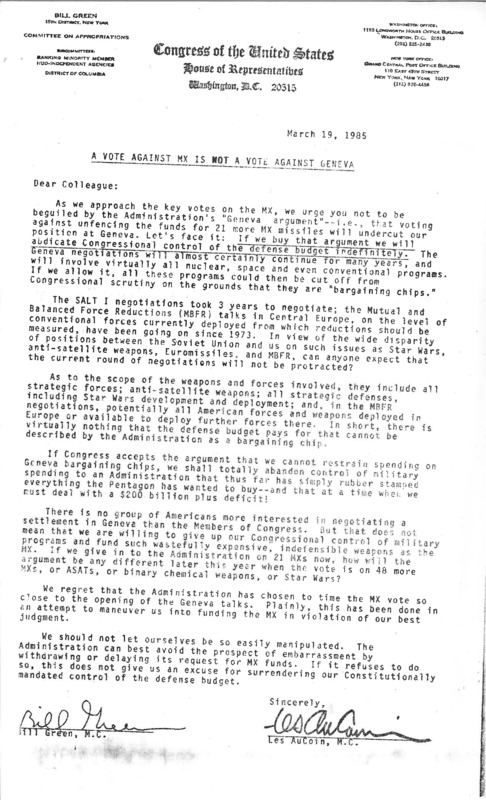
A "dear colleague" letter from Representative Les AuCoin regarding the MX missile on March 19th, 1985. A "dear colleague" letter is a piece of official correspondence written by a member of Congress and distributed in bulk to other congressional offices. In this particular letter, Representative AuCoin argues against tying the funding of MX missiles to the upcoming Geneva negotiations. This is one of a collection of digitized objects from the Les AuCoin Papers (MS.147) at the Pacific University Archives. See also PUA_MS147_93 through PUA_MS147_110 for other materials related to nuclear arms control.
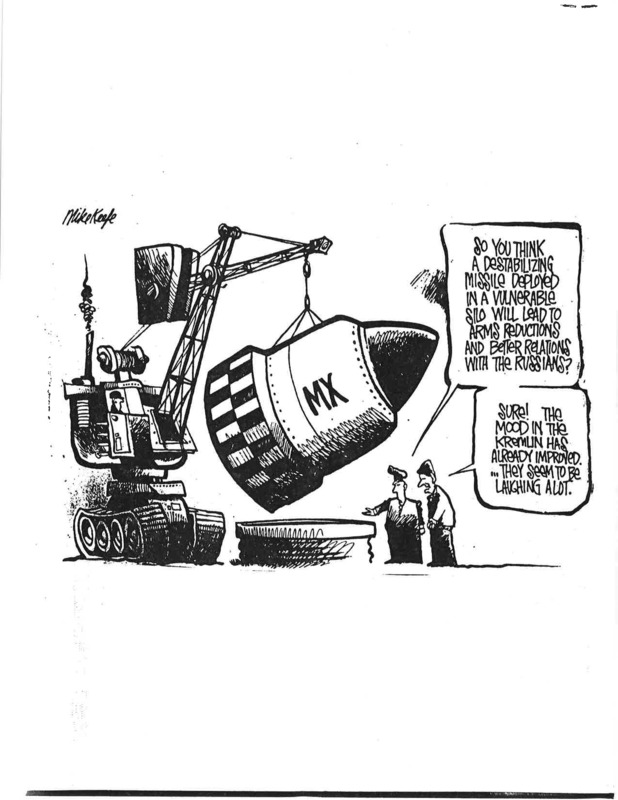
Political cartoon by Mike Keefe about the MX missiles. The text reads, "So you think a destabilizing missile deployed in a vulnerable silo will lead to arms reductions and better relations with the Russians?". The response say, "Sure! The mood in the Kremlin has already improved. They seem to be laughing a lot." Based on the reference to the MX missile, the cartoon was probably created between 1983 and 1988. This is one of a collection of digitized objects from the Les AuCoin Papers (MS.147) at the Pacific University Archives. See also PUA_MS147_93 through PUA_MS147_110 for other materials related to nuclear arms control.
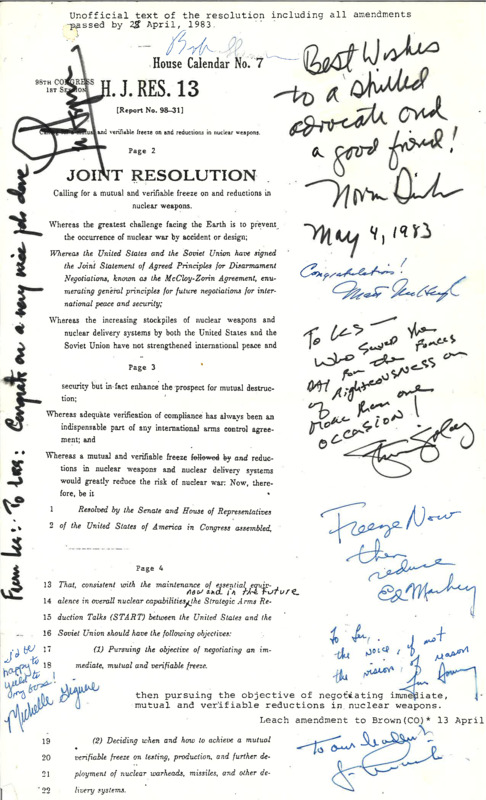
Unofficial copy of House Joint Resolution 13, "Calling for a mutual and verifiable freeze on and reductions in nuclear weapons". The first page of the bill is covered in signatures and notes of congratulations addressed to Representative Les AuCoin, who worked hard to pass the bill in the House. This is one of a collection of digitized objects from the Les AuCoin Papers (MS.147) at the Pacific University Archives.
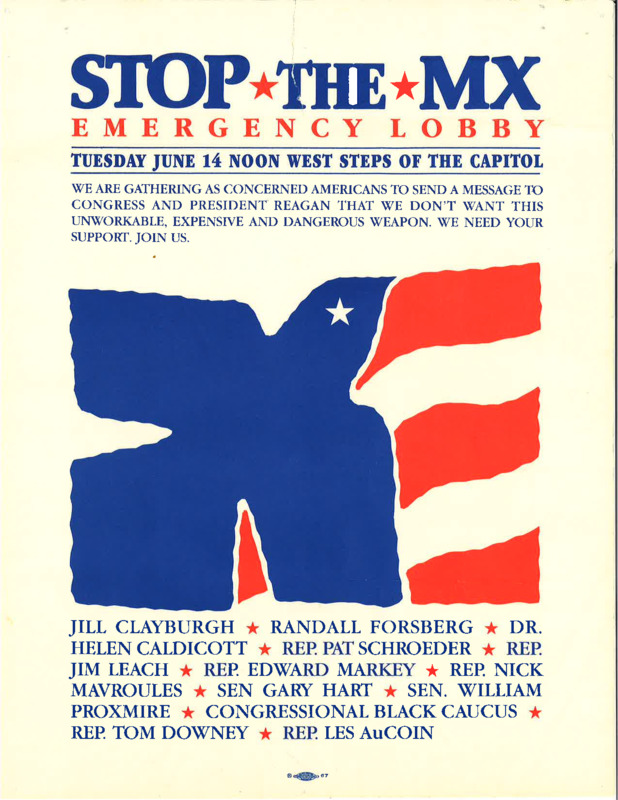
Flyer for the "Stop the MX Emergency Lobby" on June 14th, 1988. The flyer states, " We are gathering as concerned Americans to send a message to Congress and President Reagan that we don't want this unworkable, expensive and dangerous weapon. We need your support. Join us." A list of representatives and senators attending the event appears at the bottom of the flyer. This is one of a collection of digitized objects from the Les AuCoin Papers (MS.147) at the Pacific University Archives.
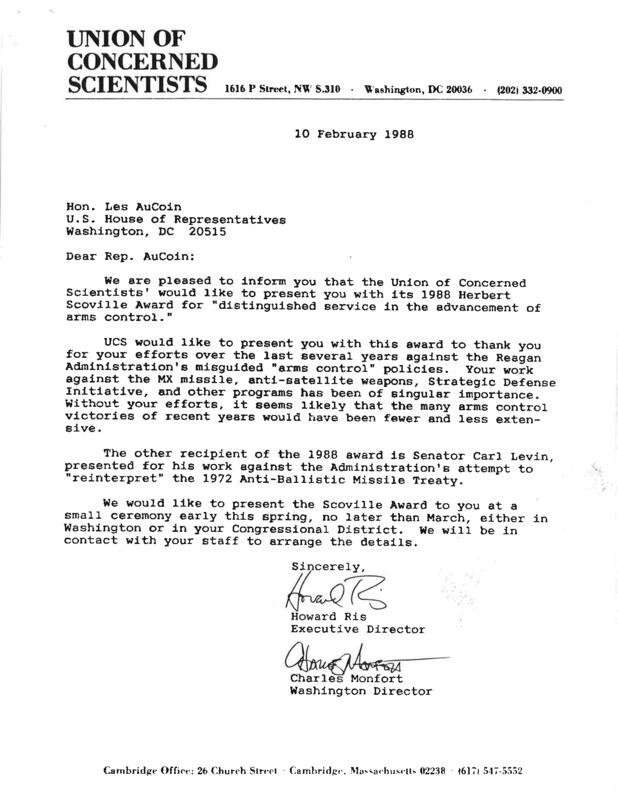
Letter from Union of Concerned Scientists to Representative Les AuCoin, signed by Howard Ris, Executive Director and Charles Monfort, Washington Director. The letter, dated February 10th, 1988, awards Representative AuCoin the 1988 Herbert Scoville Award for "distinguished service in the advancement of arms control", noting his work against the MX missile and the Strategic Defense Initiative in particular. Senator Carl Levin shared the award in 1988. This is one of a collection of digitized objects from the Les AuCoin Papers (MS.147) at the Pacific University Archives. See also PUA_MS147_19 for image of Representative AuCoin and Senator Levin receiving their awards.
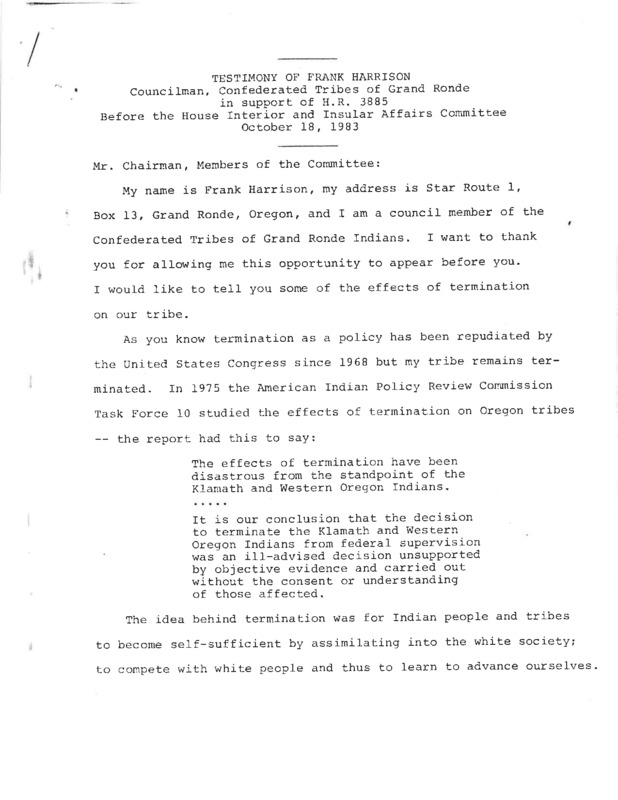
Testimony of Frank Harrison, Councilman of the Confederated Tribes of Grand Ronde, on October 18th, 1983 before the House Interior and Insular Affairs Committee in support of H.R. 3885, the Grand Ronde Restoration bill. The Confederated Tribes of Grand Ronde includes over 30 tribes from Oregon, California, and Washington. In the early 1850s, the United States forced these tribes off their lands, eventually establishing the Grand Ronde Reservation in Oregon in 1857. In 1954, Congress passed the Western Oregon Indian Termination Act, which ended federal recognition of the Confederated Tribes of Grand Ronde. Beginning in the 1970s, tribal leaders began working to restore the tribe's federal status, lobbying Congress to first pass the Grand Ronde Restoration Act in 1983, which restored federal recognition, then the Grand Ronde Reservation Act in 1988, which restored a small part of the reservation. Frank Harrison's testimony discusses the impact that termination had on the tribe and advocates for restoration of federal status. This document is one of a collection of digitized objects from the Les AuCoin Papers (MS.147) at the Pacific University Archives. See also PUA_MS147_73 through PUA_MS147_84 and PUA_MS147_128 through PUA_MS147_129 for further information about the Grand Ronde bills.
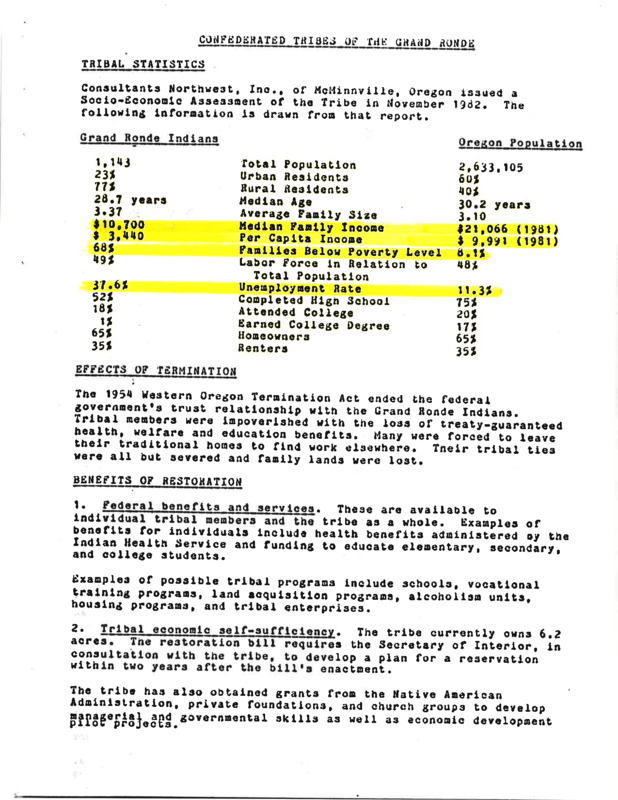
Fact sheet based on a socio-economic study of the Confederated Tribes of Grand Ronde performed by the Consultants Northwest, Inc. of McMinnville, Oregon in 1982. The Confederated Tribes of Grand Ronde includes over 30 tribes from Oregon, California, and Washington. In the early 1850s, the United States forced these tribes off their lands, eventually establishing the Grand Ronde Reservation in Oregon in 1857. In 1954, Congress passed the Western Oregon Indian Termination Act, which ended federal recognition of the Confederated Tribes of Grand Ronde. Beginning in the 1970s, tribal leaders began working to restore the tribe's federal status, lobbying Congress to first pass the Grand Ronde Restoration Act in 1983, which restored federal recognition, then the Grand Ronde Reservation Act in 1988, which restored a small part of the reservation. This fact sheet was probably prepared in 1983, as part of the tribe's work to lobby Congress for federal recognition. This document is one of a collection of digitized objects from the Les AuCoin Papers (MS.147) at the Pacific University Archives. See also PUA_MS147_73 through PUA_MS147_84 and PUA_MS147_128 through PUA_MS147_129 for further information about the Grand Ronde bills.
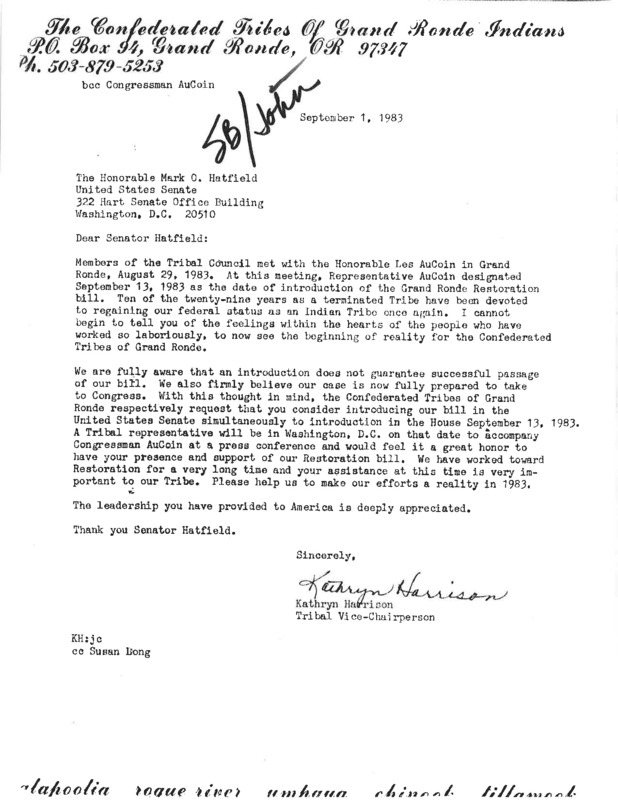
Letter written from Kathryn Harrison, Vice-Chairperson of the Confederated Tribes of Grand Ronde to Senator Mark Hatfield on September 1st, 1983. The letter discusses Representative Les AuCoin's intention to introduce the Grand Ronde Restoration bill and asks for Senator Hatfield's support. The Confederated Tribes of Grand Ronde includes over 30 tribes from Oregon, California, and Washington. In the early 1850s, the United States forced these tribes off their lands, eventually establishing the Grand Ronde Reservation in Oregon in 1857. In 1954, Congress passed the Western Oregon Indian Termination Act, which ended federal recognition of the Confederated Tribes of Grand Ronde. Beginning in the 1970s, tribal leaders began working to restore the tribe's federal status, lobbying Congress to first pass the Grand Ronde Restoration Act in 1983, which restored federal recognition, then the Grand Ronde Reservation Act in 1988, which restored a small part of the reservation. This document is one of a collection of digitized objects from the Les AuCoin Papers (MS.147) at the Pacific University Archives. See also PUA_MS147_73 through PUA_MS147_84 and PUA_MS147_128 through PUA_MS147_129 for further information about the Grand Ronde bills.
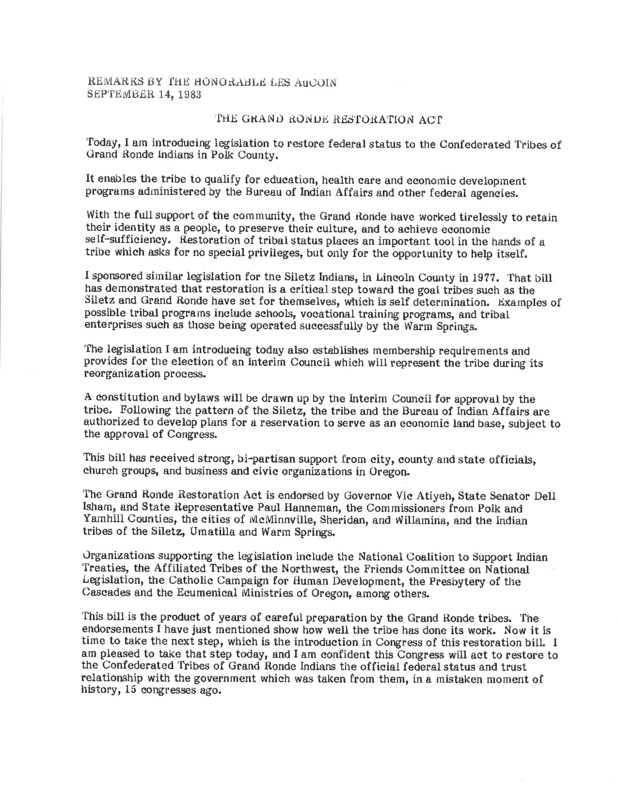
Statement by Representative Les AuCoin on September 14th, 1983 announcing the introduction of legislation to restore federal status to the Confederated Tribes of Grand Ronde. The Confederated Tribes of Grand Ronde includes over 30 tribes from Oregon, California, and Washington. In the early 1850s, the United States forced these tribes off their lands, eventually establishing the Grand Ronde Reservation in Oregon in 1857. In 1954, Congress passed the Western Oregon Indian Termination Act, which ended federal recognition of the Confederated Tribes of Grand Ronde. Beginning in the 1970s, tribal leaders began working to restore the tribe's federal status, lobbying Congress to first pass the Grand Ronde Restoration Act in 1983, which restored federal recognition, then the Grand Ronde Reservation Act in 1988, which restored a small part of the reservation. This document is one of a collection of digitized objects from the Les AuCoin Papers (MS.147) at the Pacific University Archives. See also PUA_MS147_73 through PUA_MS147_84 and PUA_MS147_128 through PUA_MS147_129 for further information about the Grand Ronde bills.