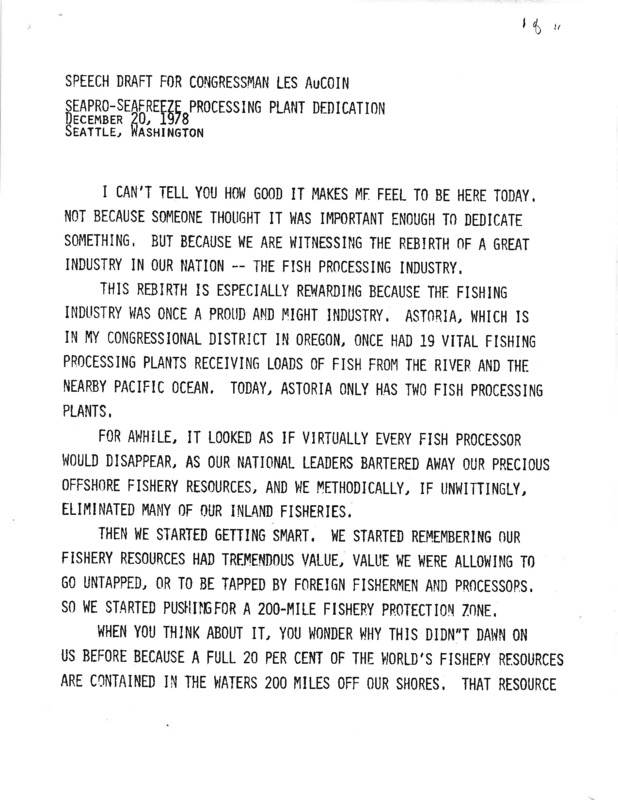
A draft of a speech by U.S. Congressman Les AuCoin at the Seapro-Seafreeze Processing Plant Dedication on December 20, 1978, in Seattle, Washington. In his speech, Congressman AuCoin declared the new processing plant a win for the U.S. fish processing industry. He explained how the fishing industry had previously been on the decline in the U.S., giving the example of Astoria going from 19 fishing processing plants to only two. This is one of a collection of digitized objects from the Les AuCoin Papers (MS.147) at the Pacific University Archives. AuCoin served in the Oregon House of Representatives (1971-1975) and in the United States House of Representatives from Oregon's 1st District (1975-1993).
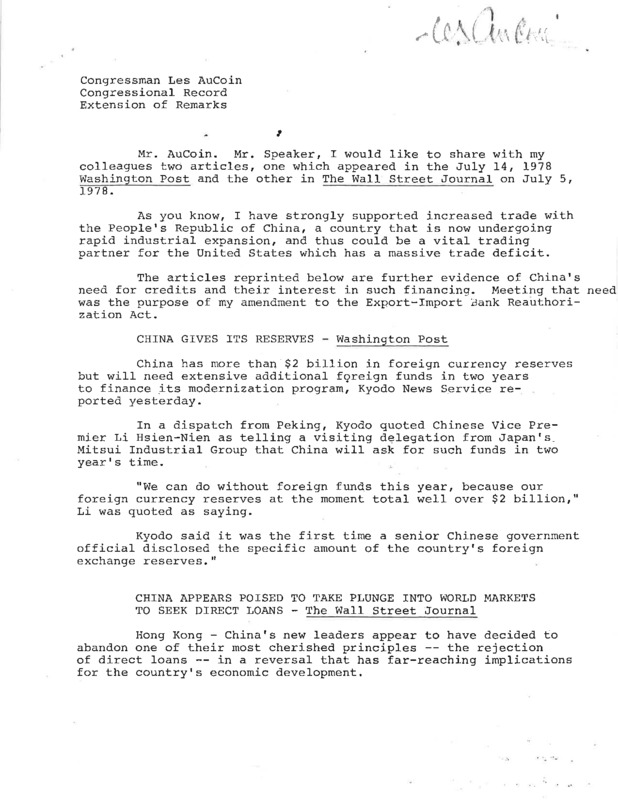
As part of the Congressional Record, U.S. Congressman Les AuCoin briefly expressed his support for improved trading relations between the U.S. and the People's Republic of China. As part of the congressional Extension of Remarks, Congressman AuCoin shared two articles by the Wall Street Journal and the Washington Post regarding the benefits of trading with China. This is one of a collection of digitized objects from the Les AuCoin Papers (MS.147) at the Pacific University Archives. AuCoin served in the Oregon House of Representatives (1971-1975) and in the United States House of Representatives from Oregon's 1st District (1975-1993).
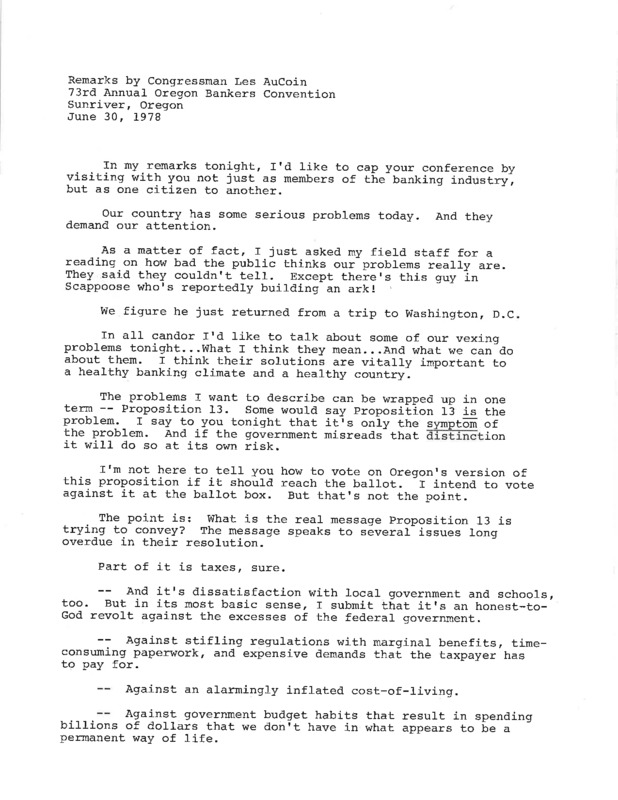
Speech by U.S. Congressman Les AuCoin at the 73rd Annual Oregon Bankers Convention in Sunriver, Oregon, on June 30, 1978. In his speech, Congressman AuCoin expressed his disapproval of Proposition 13. Proposition 13, which aimed to cut taxes, was among a political trend of similar propositions in multiple states in 1978, dubbed "13 Fever" by the Washington Post at the time. This is one of a collection of digitized objects from the Les AuCoin Papers (MS.147) at the Pacific University Archives. AuCoin served in the Oregon House of Representatives (1971-1975) and in the United States House of Representatives from Oregon's 1st District (1975-1993).
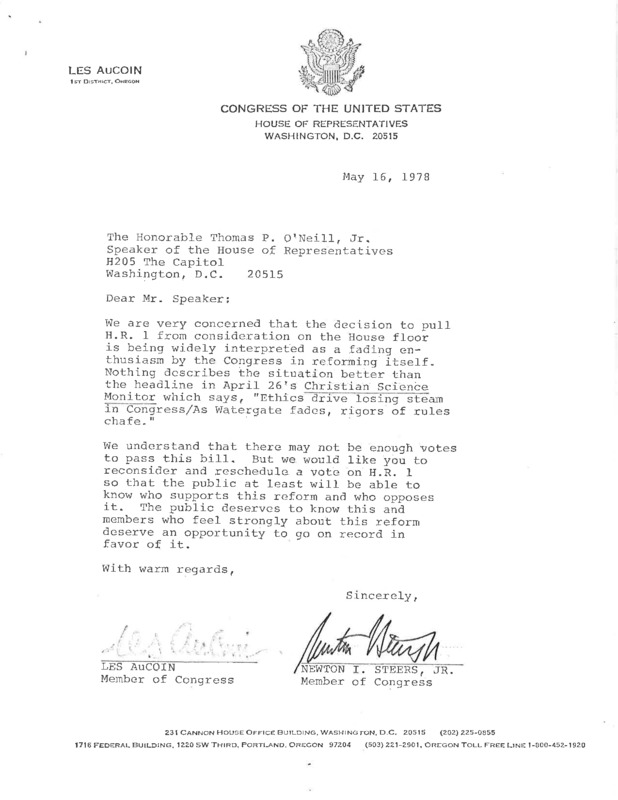
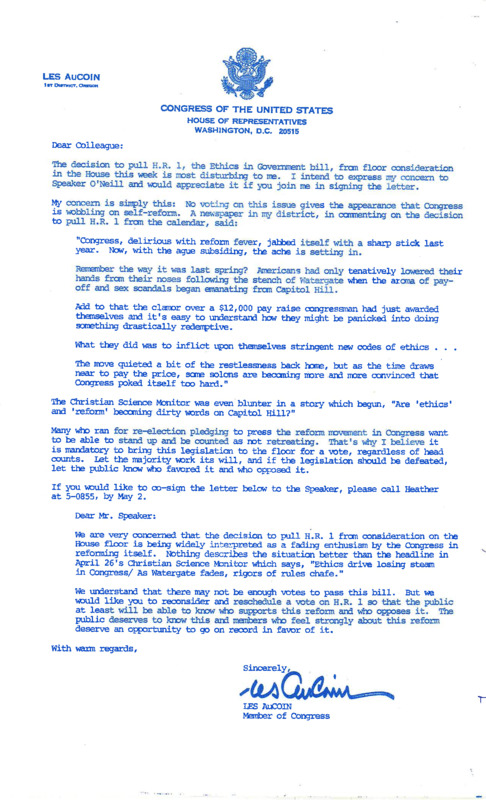
A letter to U.S. Speaker of the House Thomas P. O'Neill, Jr. signed by several members of Congress, including U.S. Congressman Les AuCoin, meant to express concerns regarding the pulling of the Ethics in Government Bill, H.R. 1. The Ethics in Government bill was created during the 95th Congress in the years following the Watergate scandal. The representatives advocated for the rescheduling of a vote for the bill. This is one of a collection of digitized objects from the Les AuCoin Papers (MS.147) at the Pacific University Archives. AuCoin served in the Oregon House of Representatives (1971-1975) and in the United States House of Representatives from Oregon's 1st District (1975-1993).
A letter to a congressional colleague from U.S. Congressman Les AuCoin on co-signing a letter to Speaker of the House Thomas P. O'Neill, Jr. to express concern on the pulling of the Ethics in Government Bill, H.R.1. The Ethics in Government bill was created during the 95th Congress in the years following the Watergate scandal. This is one of a collection of digitized objects from the Les AuCoin Papers (MS.147) at the Pacific University Archives. AuCoin served in the Oregon House of Representatives (1971-1975) and in the United States House of Representatives from Oregon's 1st District (1975-1993).
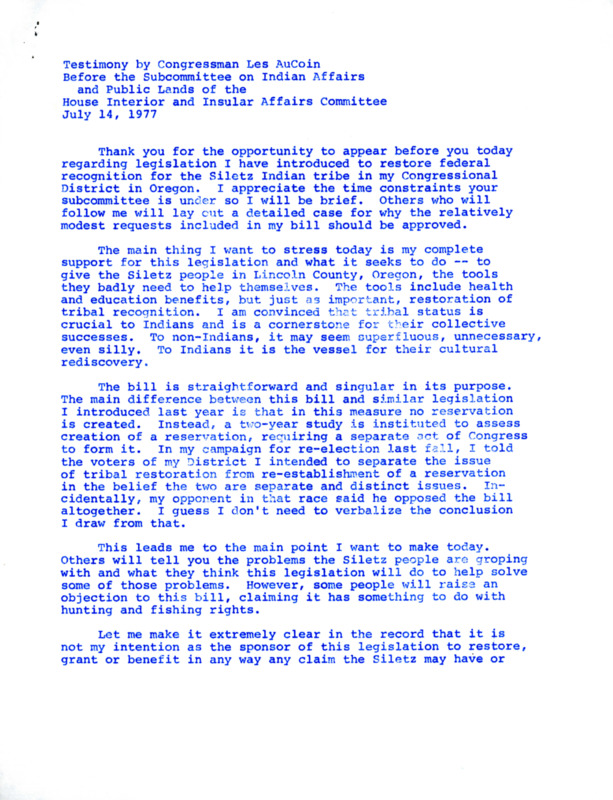
In a speech before the Subcommittee on Indian Affairs and Public Lands of the House Interior and Insular Affairs Committee, Congressman Les AuCoin advocates for his proposed bill, House Resolution 7259 of the 95th Congress (1977-1978), the Siletz Indian Tribe Restoration Act, which re-established federal tribal status to the Siletz Indians. AuCoin explained how the bill would not affect fishing and hunting rights, but would instead grant humanitarian aid eligibility and federally recognize the Siletz Indians as an entity. This is one of a collection of digitized objects from the Les AuCoin Papers (MS.147) at the Pacific University Archives. AuCoin served in the Oregon House of Representatives (1971-1975) and in the United States House of Representatives from Oregon's 1st District (1975-1993).
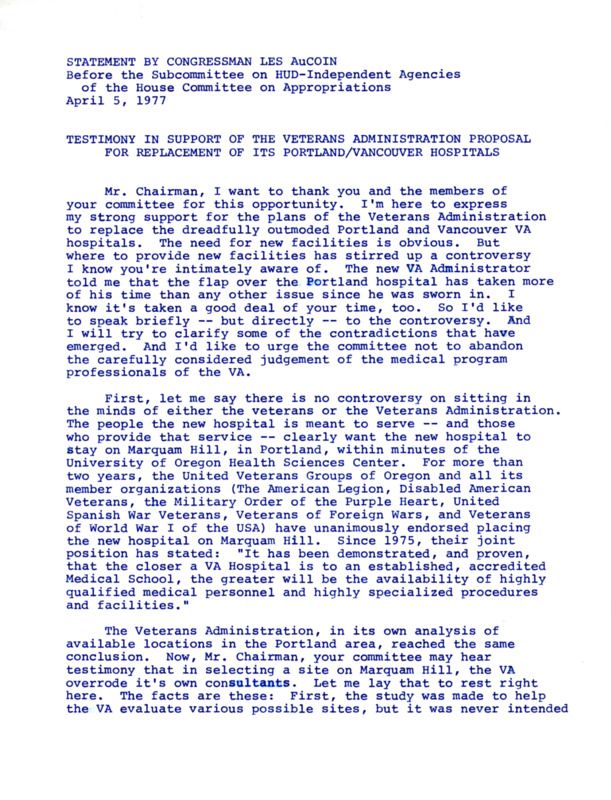
In a statement before the Subcommittee on HUD-Independent Agencies of the House Committee on Appropriations, Congressman Les AuCoin advocates for the proposed replacement of V.A. hospital facilities in Portland and Vancouver. This is one of a collection of digitized objects from the Les AuCoin Papers (MS.147) at the Pacific University Archives. AuCoin served in the Oregon House of Representatives (1971-1975) and in the United States House of Representatives from Oregon's 1st District (1975-1993).
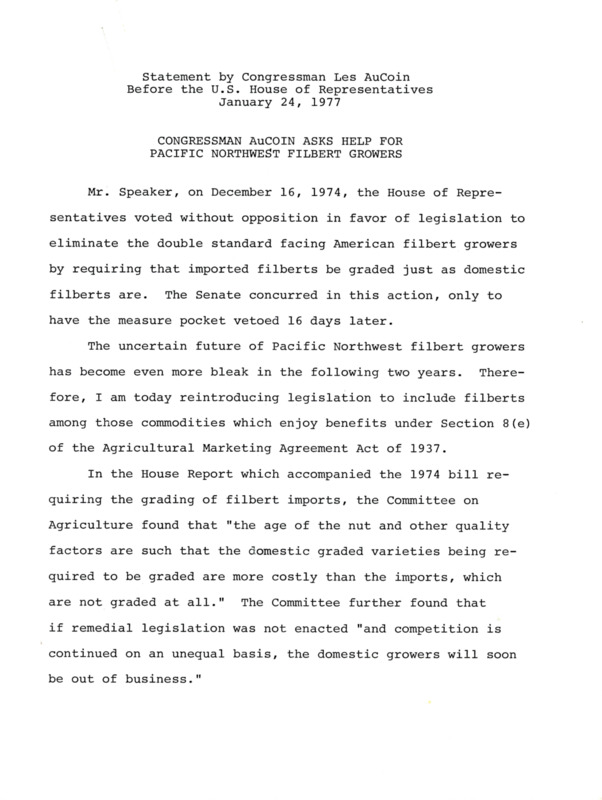
Les AuCoin's statement before the United States House of Representatives asking for congressional support for filbert (i.e. hazelnut) growers of the Pacific Northwest. AuCoin calls for the inclusion of filberts under the the Agricultural Marketing Agreement Act of 1937. This is one of a collection of digitized objects from the Les AuCoin Papers (MS.147) at the Pacific University Archives. AuCoin served in the Oregon House of Representatives (1971-1975) and in the United States House of Representatives from Oregon's 1st District (1975-1993).
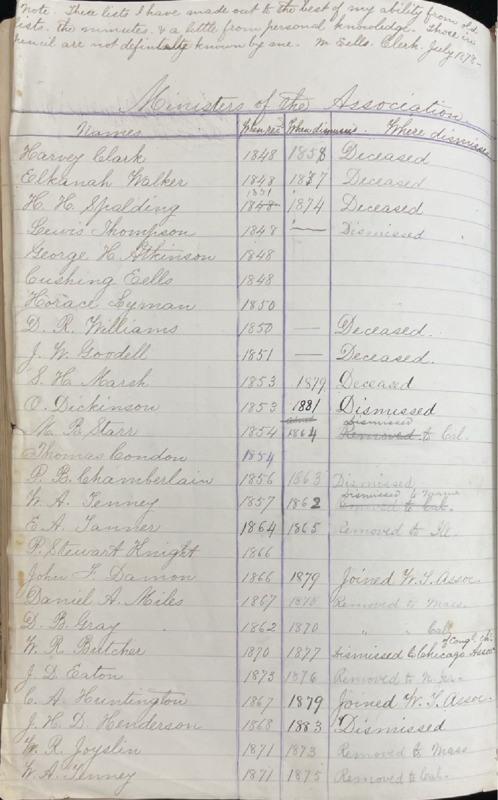
One part of a record book compiled by the Congregational Association of Oregon, with this part containing the lists and charts related to members between 1848-1886 (but written down between 1878-1886). The Association's members were church ministers and other delegates from Oregon and bordering areas. They met annually to share reports, promote Christian education, support special projects and address internal disputes. The components of this section of the record book include: -- : 1. List of Ministers who were members of the Congregational Association of Oregon, and the dates of their service; -- 2. List of member Congregational churches in Oregon, Washington and Idaho and the dates of their inclusion in the association; -- 3. List of the meetings of the Congregational Association of Oregon, including dates, locations and names of preachers.
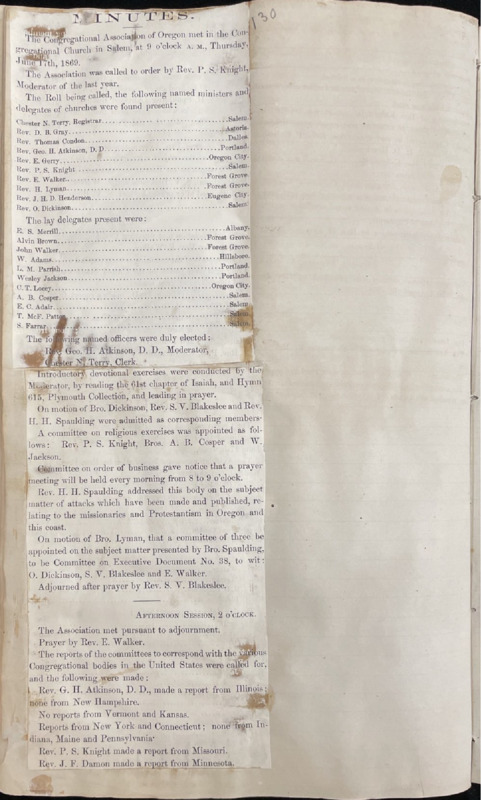
One part of a record book compiled by the Congregational Association of Oregon, with this part containing the minutes of the annual meeting held in 1869. The Association's members were church ministers and other delegates from Oregon and bordering areas. They met annually to share reports, promote Christian education, support special projects and address internal disputes. Some of the topics covered in this part of the record book include: -- Report by Henry Spalding, a missionary who had been teaching at the Nez Perce Reservation, complaining of attacks against the church in the press; -- Creation of a committee to address these attacks; -- Acceptance of routine reports; -- "Report on the Religious Condition of the Country" by D.B. Gray, celebrating gains by the church; -- Report on Executive Document No. 38 [an account of the "Whitman Massacre"], criticizing it as being tainted by Catholic testimony, and stating that the Jesuit priests who contributed to the report "did themselves instigate violence to the mission, resulting in the massacre" [note: Henry Spalding had long argued this viewpoint, but it is not credited by recent historians]; -- Resolutions in support of the Protestant missionaries connected to the Whitmans, especially Henry Spalding; -- "Report of the Committee on Home Missions," reporting that the American Home Missionary Society rejected the Association's request for support of an Agent for the Pacific Northwest, and recommending alternatives; -- Report on Indian Affairs, recommending against a educational plan that would have separated Native children from their parents permanently like "foundling orphans"; -- Recommendation that all member churches join more closely with Temperance groups; -- "Narrative of Churches" describing growth and challenges of member churches over the past year; -- Resolution in favor of the American Home Missionary Society sending a minister to Puget Sound; -- Statistical table of church membership.
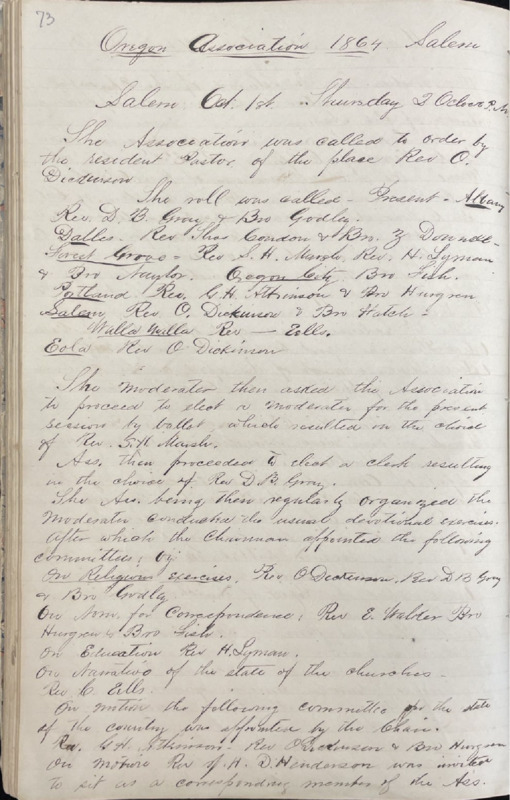
One part of a record book compiled by the Congregational Association of Oregon, with this part containing the minutes of the annual meeting held in 1864. The Association's members were church ministers and other delegates from Oregon and bordering areas. They met annually to share reports, promote Christian education, support special projects and address internal disputes. Some of the topics covered in this part of the record book include: -- Creation of a Committee for the State of the Country [i.e. on matters relating to the Civil War and national politics]; -- Acceptance of routine reports; -- Resolutions by George H. Atkinson asking the American Home Missionary Society to send three more missionaries to work in Oregon and Idaho; -- Discussion of a resolution that the AHMS also appoint an Agent to serve Oregon, Washington and Idaho; -- A man namedTanner granted a license to preach; -- Resolutions in support of the Union Army and raising funds for the soldiers' Sanitary Fund; -- Resolutions recognizing that "God is freeing the slaves of our country," and that donations should be raised for the Freedman's Aid Association; the latter resolutions were adopted with amendments affirming the hope that "slavery will be entirely destroyed," but omitting fundraising for freed slaves; -- Resolution in favor of raising salaries for ministers; -- Resolution in support of inter-denominational harmony.
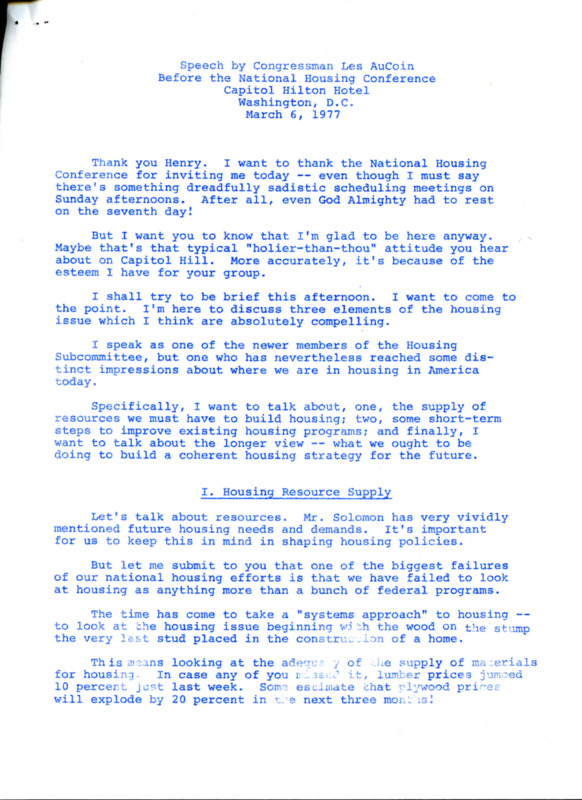
A speech given by Les AuCoin at the National Housing Conference in Washington, D.C. on March 6, 1977. The speech addresses issues with the 1970s housing crisis. AuCoin promotes both long-term and short-term solutions for housing policy, including Urban Development Action Grants.
This is one of a collection of digitized objects from the Les AuCoin Papers (MS.147) at the Pacific University Archives. AuCoin served in the Oregon House of Representatives (1971-1975) and in the United States House of Representatives from Oregon's 1st District (1975-1993).
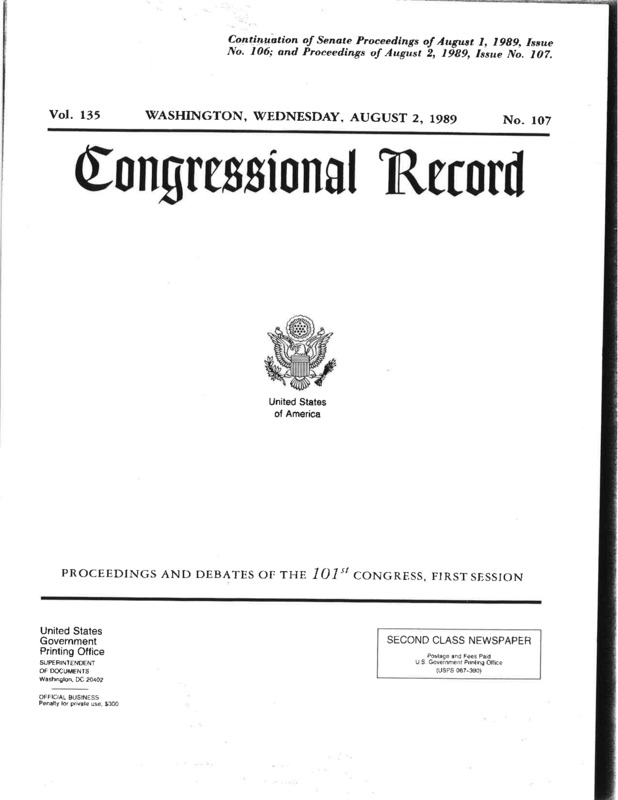
On August 2nd, 1989, AuCoin gave what became known as his “Take Names and Kick Ankles” speech. The statement was in response to an amendment proposed by Representative Robert Dornan, Republican from California, to prevent the use of public funds for abortion in the District of Columbia. From his seat on the House Appropriations Committee, AuCoin led the debate, declaring that Congress could no longer pass anti-abortion policy without political backlash. This is one of a collection of digitized objects from the Les AuCoin Papers (MS.147) at the Pacific University Archives, and it can be found in Box 10, Folder 8.
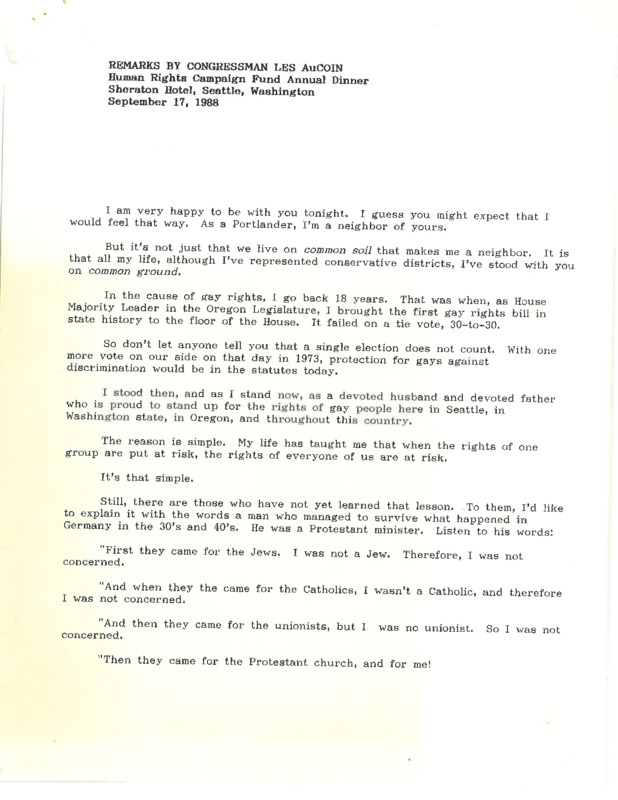
Remarks by Representative Les AuCoin at the Human Rights Campaign Fund Annual Dinner, held on September 17th, 1988. In the speech, AuCoin discusses his support of gay rights and advocates for greater legal protections. AuCoin frequently spoke at fundraisers for the Human Rights Fund, a major organization for the promotion of LGBT rights. In 1992, AuCoin was honored for his contributions to the fund. This is one of a collection of digitized objects from the Les AuCoin Papers (MS.147) at the Pacific University Archives.
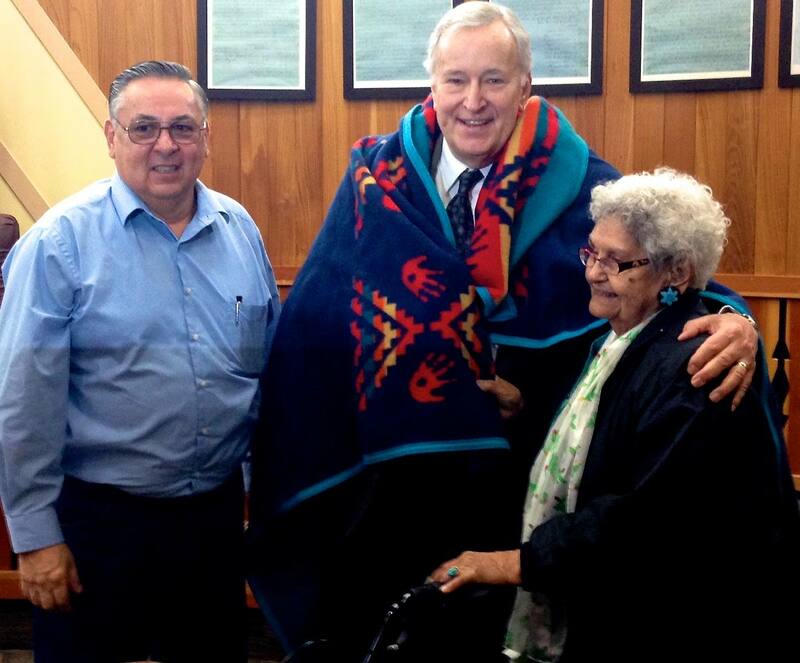
Representative Les AuCoin poses with Reyn Leo and Kathryn Harrison, both former chairs of the Confederated Tribes of Grand Ronde Tribal Council. The Confederated Tribes of Grand Ronde includes over 30 tribes and bands from Oregon, California, and Washington. In the early 1850s, the United States forced these tribes off their lands, eventually establishing the Grand Ronde Reservation in Oregon in 1857. In 1954, Congress passed the Western Oregon Indian Termination Act, which ended federal recognition of the Confederated Tribes of Grand Ronde. Beginning in the 1970s, tribal leaders began working to restore the tribe's federal status, lobbying Congress to first pass the Grand Ronde Restoration Act in 1983, which restored federal recognition, then the Grand Ronde Reservation Act in 1988, which reestablished a small reservation. Representative AuCoin worked with the tribe on both bills. This photo was taken in 2018, at a celebration of the 35th anniversary of the tribe's restoration. This is one of a collection of digitized objects from the Les AuCoin Papers (MS.147) at the Pacific University Archives. The original photo remains with the AuCoin family.
Article originally published in the New York Times Magazine on August 31st, 1975. The article, written by James Naughton, discusses the batch of new representatives elected to the House in 1974, focusing on Representative Les AuCoin in particular. For the article, Representative AuCoin kept a journal for his first 8 months in office, reflecting on his experiences in and perspective on Congress. AuCoin was reelected another 8 times, serving in the House for 18 years. This is one of a collection of digitized objects from the Les AuCoin Papers (MS.147) at the Pacific University Archives.
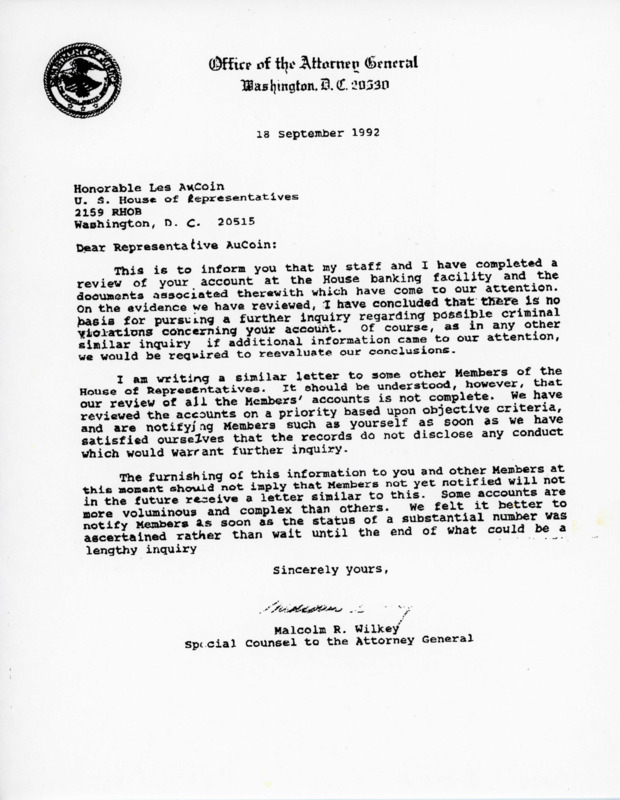
Letter from Malcolm Wilkey, Special Counsel to the Attorney General, clearing Representative Les AuCoin of any criminal violations regarding the House Bank. In 1991 a government audit of the bank, where House members could deposit paychecks, showed hundreds of members with overdrafts on their accounts. Further investigation eventually revealed that, while a few members intentionally abused the bank, many of these overdrafts were caused by the bank’s delay in processing deposits. In this letter from September 18th, 1992, the US Department of Justice cleared AuCoin of any wrongdoing with the bank. The House Bank was a major issue in the 1992 election, and AuCoin's involvement was frequently attacked by political opponents.This is one of a collection of digitized objects from the Les AuCoin Papers (MS.147) at the Pacific University Archives. See also PUA_MS147_137 for a statement by AuCoin addressing the House Bank audit.
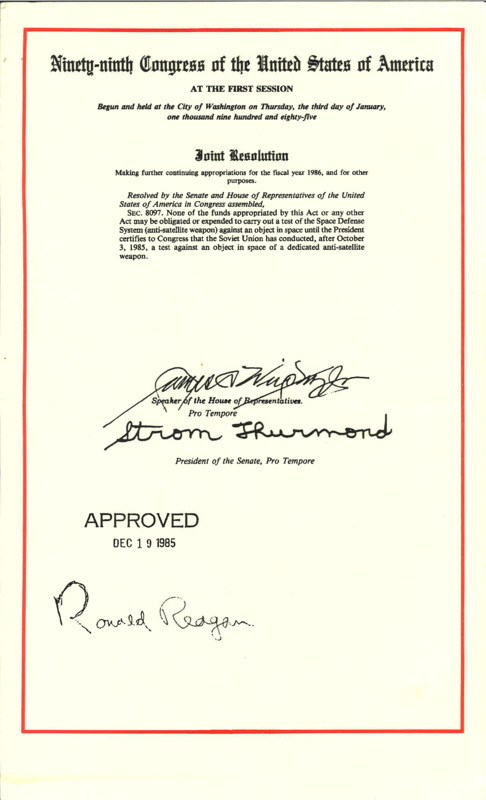
Copy of the Joint Resolution preventing funding for tests of the anti-satellite weapons in space until the Soviet Union performs a similar test in space. The resolution is signed by President Ronald Reagan and approved on December 19th, 1985. This is one of a collection of digitized objects from the Les AuCoin Papers (MS.147) at the Pacific University Archives.
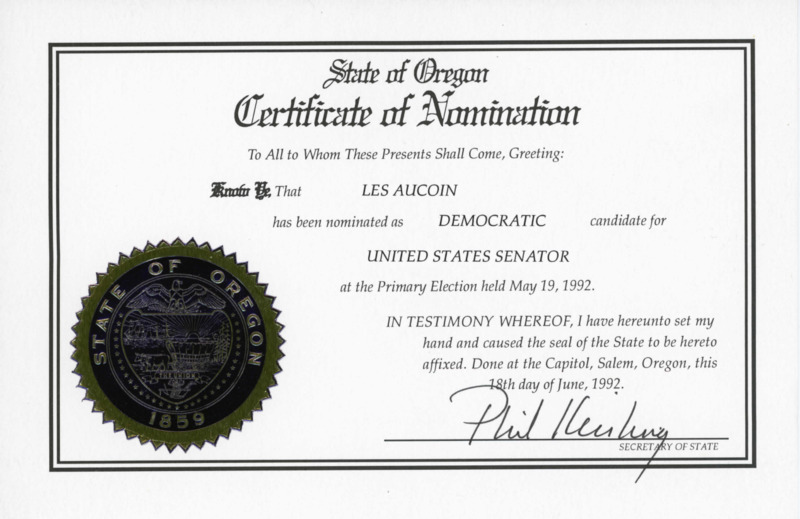
Certificate of Nomination declaring "Les AuCoin has been nominated as Democratic candidate for United States Senator at the Primary Election held May 19, 1992". Signed by Secretary of State Phil Keisling on June 18th, 1992. In the Democratic primary, AuCoin’s biggest opponent was Harry Lonsdale, a multi millionaire businessman who ran as an outsider to Washington politics. The primary results were close enough to trigger an automatic recount, and AuCoin was eventually certified as the winner by 330 votes. AuCoin went on to face Senator Bob Packwood in the general election, and Packwood was ultimately elected to the Senate. This is one of a collection of digitized objects from the Les AuCoin Papers (MS.147) at the Pacific University Archives.
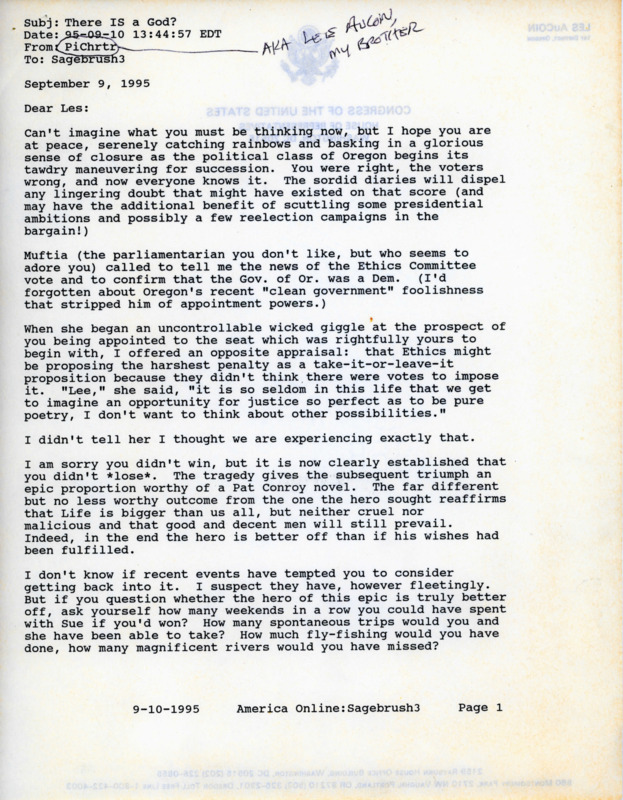
Letter from Lee AuCoin to his brother, Representative Les AuCoin, discussing the outcome of the 1995 Senate Ethics Committee vote on Senator Bob Packwood. Three years earlier, shortly after the 1992 election in which Packwood defeated AuCoin for a Senate seat, the Washington Post published a year-long investigation about sexual assault allegations against Packwood. Further investigation revealed that the allegations were true, and in on September 7th, 1995, the Senate Ethics Committee recommended that the Senate expel Packwood. The next day, Packwood resigned. In this letter, which was written on September 9th, 1995, Lee AuCoin discusses the outcome of the investigation and Packwood's subsequent resignation from the Senate. This document is one of a collection of digitized objects from the Les AuCoin Papers (MS.147) at the Pacific University Archives.
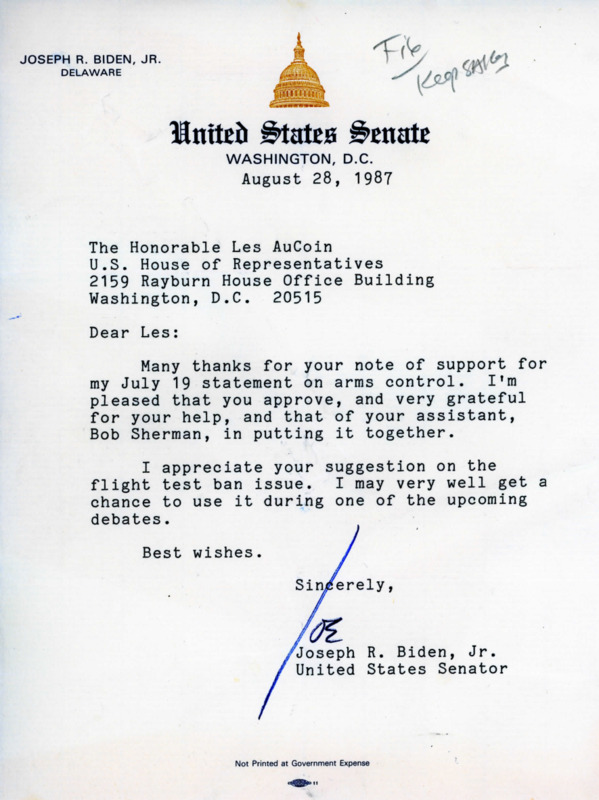
Letter from then-Senator Joe Biden to Representative Les AuCoin, thanking AuCoin for his support of a arms control statement. In the letter, Biden also thanks AuCoin's aide Bob Sherman for his help in drafting the statement.This is one of a collection of digitized objects from the Les AuCoin Papers (MS.147) at the Pacific University Archives.
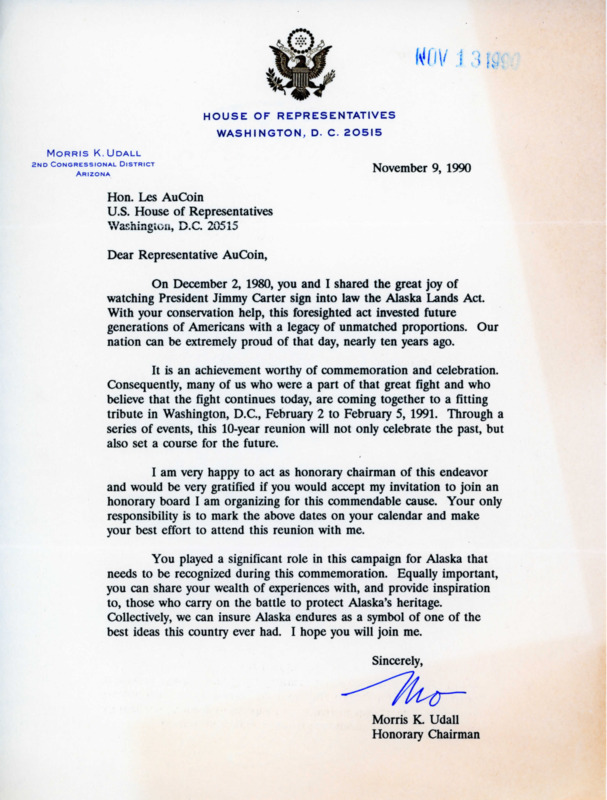
Letter from Representative Morris Udall of Arizona to Representative Les AuCoin celebrating the 10th anniversary of the Alaska National Interest Lands Conservation Act, which was signed into law by President Jimmy Carter on December 2nd, 1980. The act, which AuCoin supported and helped draft, provided environmental protection for over 157 million acres of land. The act was introduced by Representative Udall and signed into law by President Jimmy Carter on December 2nd, 1980. This is one of a collection of digitized objects from the Les AuCoin Papers (MS.147) at the Pacific University Archives.
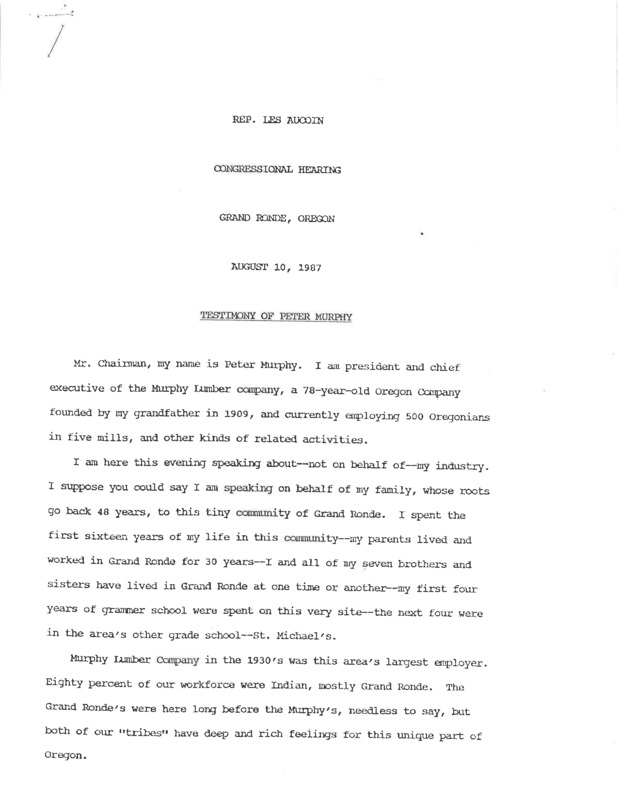
Testimony of Peter Murphy, President and Chief Executive of the Murphy Lumber Company, in support of reestablishing a reservation for the Confederated Tribes of Grand Ronde. The Confederated Tribes of Grand Ronde includes over 30 tribes from Oregon, California, and Washington. In the early 1850s, the United States forced these tribes off their lands, eventually establishing the Grand Ronde Reservation in Oregon in 1857. In 1954, Congress passed the Western Oregon Indian Termination Act, which ended federal recognition of the Confederated Tribes of Grand Ronde. Beginning in the 1970s, tribal leaders began working to restore the tribe's federal status, lobbying Congress to first pass the Grand Ronde Restoration Act in 1983, which restored federal recognition, then the Grand Ronde Reservation Act in 1988, which restored a small part of the reservation. On August 10th, 1987, Representative Les AuCoin scheduled a local hearing to discuss the plan to reestablish a reservation. The hearing included a pro-reservation panel of tribal leaders and an anti-reservation panel of local lumber mills. Representative AuCoin also invited members of several federal agencies, including the Forest Service, the Bureau of Land Management, the Fish and Wildlife Service, and the Bureau of Indian Affairs, to answer legal questions about the process. Peter Murphy is significant as the only member of the timber industry to testify in support of the reservation. This document is one of a collection of digitized objects from the Les AuCoin Papers (MS.147) at the Pacific University Archives. Digital objects PUA_MS147_73 through PUA_MS147_77 and PUA_MS147_128 through PUA_MS147_129 represent a selection of opinions offered at the August 10th hearing.
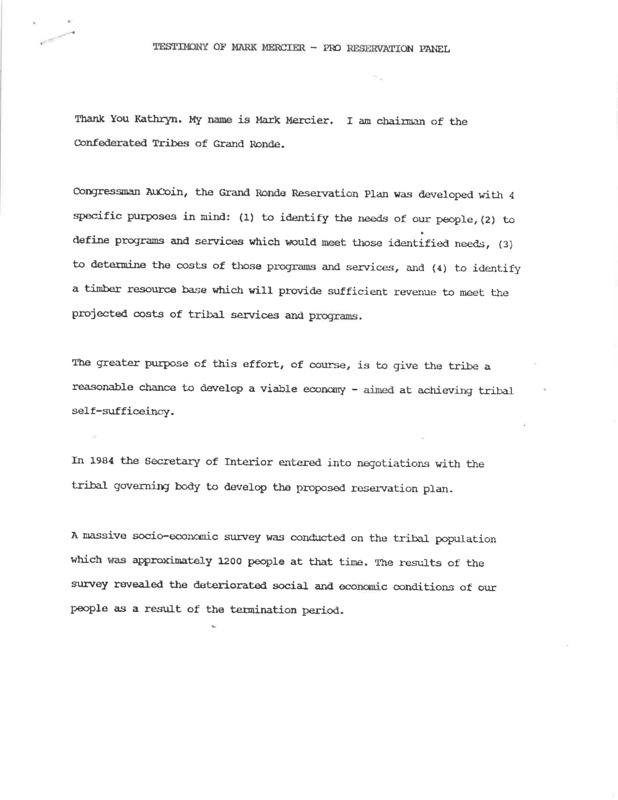
Testimony of Mark Mercier, Chairman of the Confederated Tribes of Grand Ronde, in support of reestablishing a reservation for the Confederated Tribes of Grand Ronde. The Confederated Tribes of Grand Ronde includes over 30 tribes from Oregon, California, and Washington. In the early 1850s, the United States forced these tribes off their lands, eventually establishing the Grand Ronde Reservation in Oregon in 1857. In 1954, Congress passed the Western Oregon Indian Termination Act, which ended federal recognition of the Confederated Tribes of Grand Ronde. Beginning in the 1970s, tribal leaders began working to restore the tribe's federal status, lobbying Congress to first pass the Grand Ronde Restoration Act in 1983, which restored federal recognition, then the Grand Ronde Reservation Act in 1988, which restored a small part of the reservation. On August 10th, 1987, Representative Les AuCoin scheduled a local hearing to discuss the plan to reestablish a reservation. The hearing included a pro-reservation panel of tribal leaders and an anti-reservation panel of local lumber mills. Representative AuCoin also invited members of several federal agencies, including the Forest Service, the Bureau of Land Management, the Fish and Wildlife Service, and the Bureau of Indian Affairs, to answer legal questions about the process. Mark Merceir's testimony focuses on the results of a socio-economic survey of the tribal population. This document is one of a collection of digitized objects from the Les AuCoin Papers (MS.147) at the Pacific University Archives. Digital objects PUA_MS147_73 through PUA_MS147_77 and PUA_MS147_128 through PUA_MS147_129 represent a selection of opinions offered at the August 10th hearing.