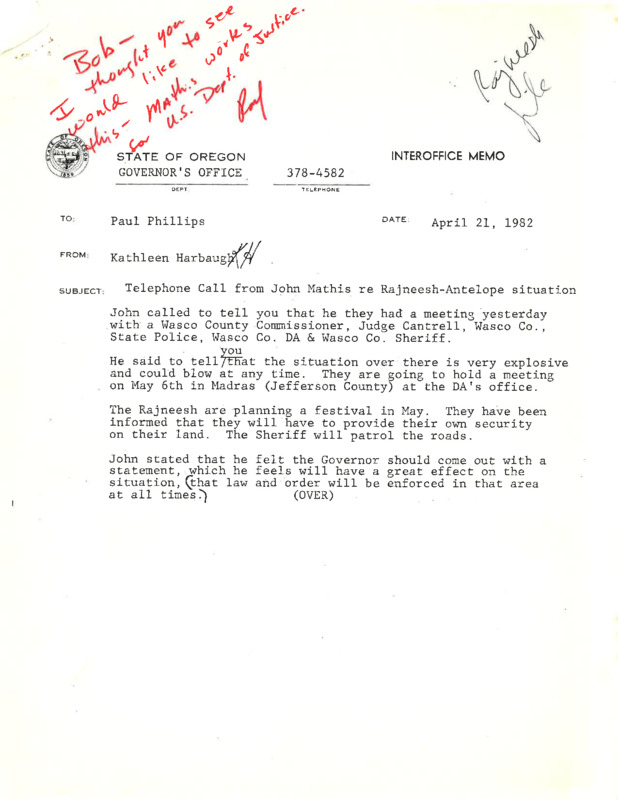
An inter-office memo from administrative assistant Kathleen Harbaugh to Paul Phillips, an advisor to Governor Atiyeh. A note from Phillips is included, passing the memo to Atiyeh's legal counsel, Bob Oliver. The memo covers a telephone call from John Mathis regarding the situation at the Rajneeshpuram and Antelope. The memo states the county will be holding a meeting on May 6 before the festival in Rajneeshpuram. The contents of the message further recommend that Governor Atiyeh make a statement regarding the rising tensions in Wasco County to ease the minds of the citizens of Oregon. This item was a part of the papers of Bob Oliver, Governor Atiyeh's legal counsel.
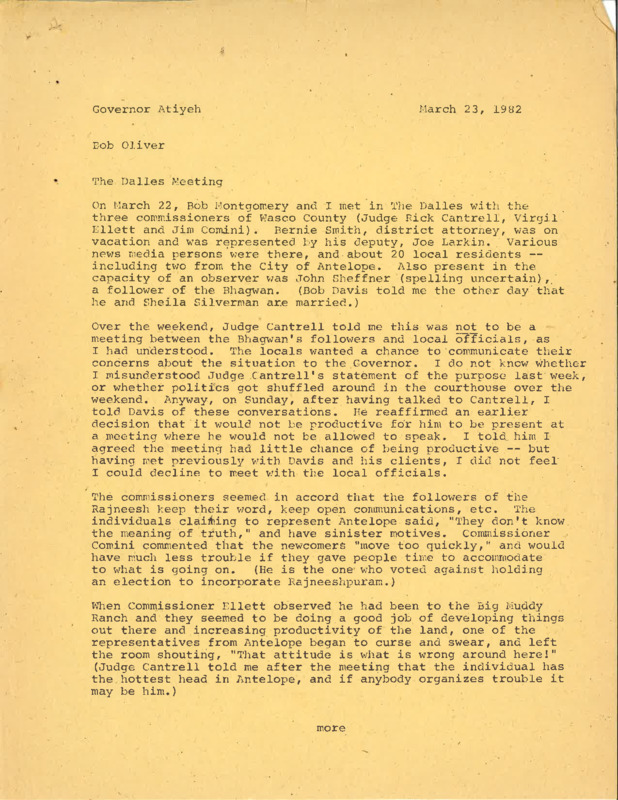
Memo to Governor Atiyeh from his legal counsel, Bob Oliver, regarding a meeting at The Dalles relating to the Rajneesh. Oliver attended the meeting with Bob Montgomery, Community Relations Representative. The letter describes the meeting between County Commissioners: Judge Richard Cantrell, Virgil Ellett and Jim Comini. Also present were Jim Larkin, Deputy to the District Attorney, about 20 local residents, including two representatives from the city of Antelope, and John Sheffner, a follower of Rajneesh. The purpose of the meeting was to discuss local concerns regarding the Rajneeshpuram situation. Also stated in the letter is a scheduled public hearing for a permit for the Rajneesh July festival. This item was a part of the papers of Bob Oliver, Governor Atiyeh's legal counsel.
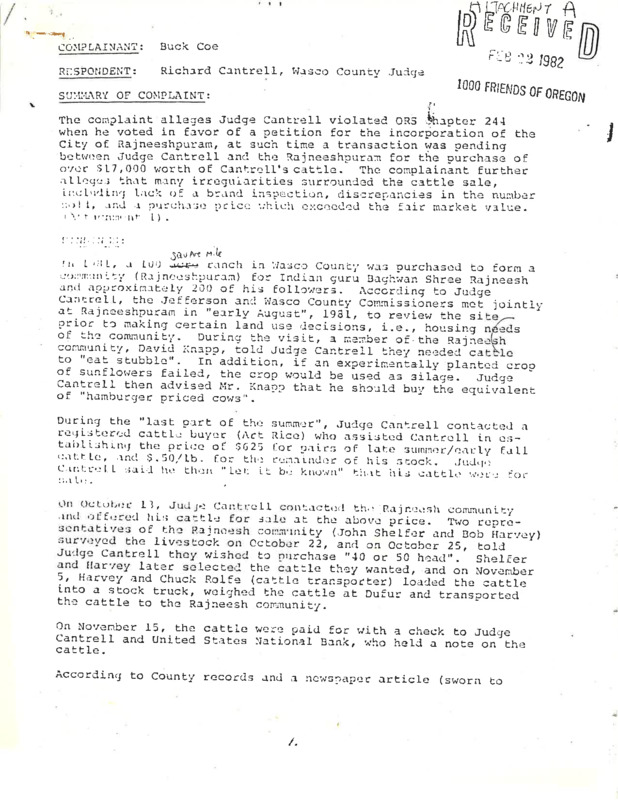
A formal complaint charge between Buck Coe and Judge Richard Cantrell, related to a cattle sale between Cantrell and the Rajneesh Foundation. The complaint is based on violation of ORS Chapter 244. A timeline of events brought into question is outlined. County records, a newspaper article written by Austin Abrams for the Dalles Chronicle covering the investigation, cattle transportation certificates and personal notes exchanged between Judge Cantrell and Coe are all included in the formal complaint as evidence. Also attached is D.D. Hodge's Department of Agriculture Officer report, and formal affidavits from Buck Coe, Austin Abrams, D.D. Hodges and Madras Auction Yard worker Lauren Corwin. This item was a part of the papers of Bob Oliver, Governor Atiyeh's legal counsel.
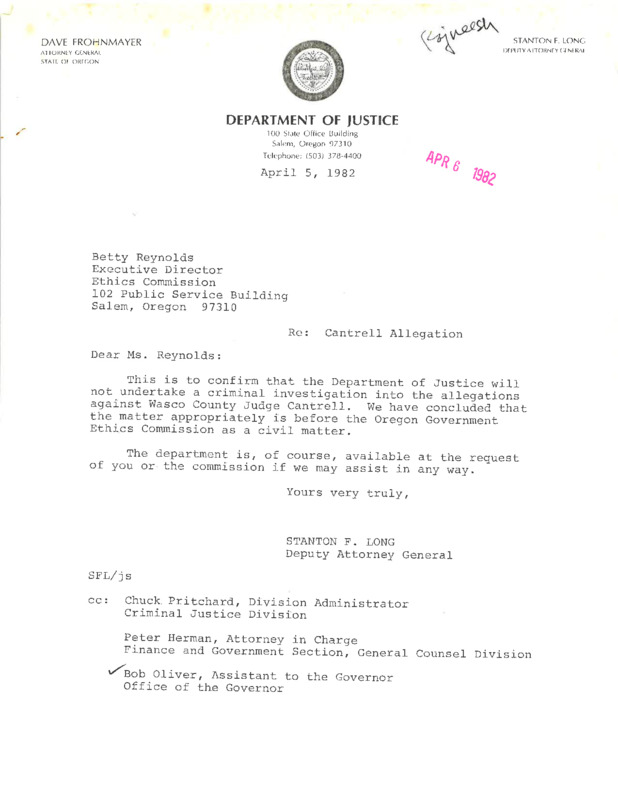
Letter from Stanton F. Long, a Deputy Attorney General of for the state of Oregon, to Betty Reynolds, the Executive Director of the Oregon Ethics Commission. Stanton confirms with Reynolds that the Department of Justice will not be undertaking a criminal investigation into the accusations made against Wasco County Judge Richard Cantrell, which related to a cattle sale between him and the Rajneesh Foundation. The anti-Rajneesh group 1000 Friends of Oregon had alleged that the sale constituted a bribe. Governor Atiyeh's legal counsel, Bob Oliver, is courtesy-copied on the letter. This item was a part of the papers of Bob Oliver.
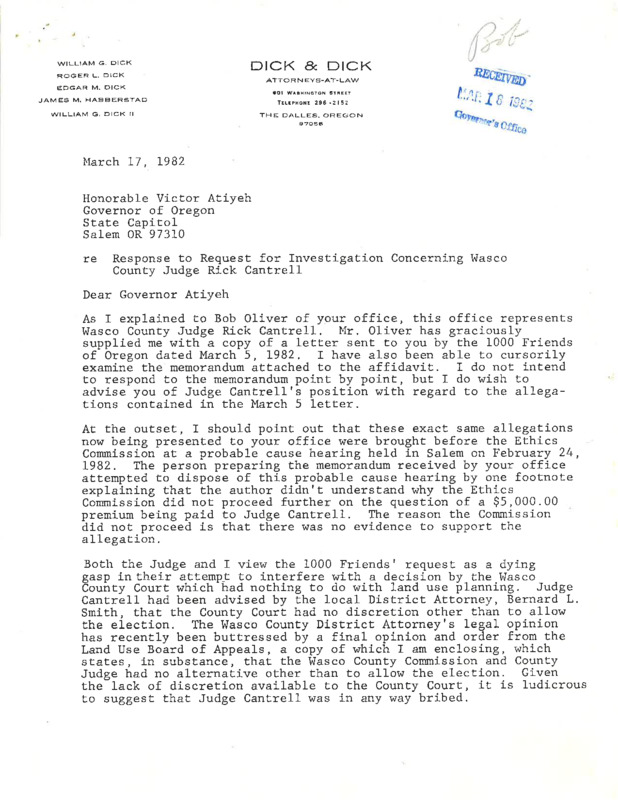
A letter from James M. Habberstad, the attorney for Oregon's Wasco County Judge Richard Cantrell, to Governor Atiyeh. Habberstad writes regarding a memorandum compiled by an anti-Rajneesh group, the 1000 Friends of Oregon. The group alleged that Cantrell's sale of cattle to the Rajneesh at an elevated price constituted a bribe in exchange for assistance in incorporating the city of Rajneeshpuram. Habberstad responds to the allegations, refuting the possibility of any ill-intent behind the cattle transaction. He writes that Judge Cantrell will be running for office, and accusations of this sort are an attempt by the 1000 Friends of Oregon to influence the election. This item was a part of the papers of Bob Oliver, Governor Atiyeh's legal counsel.
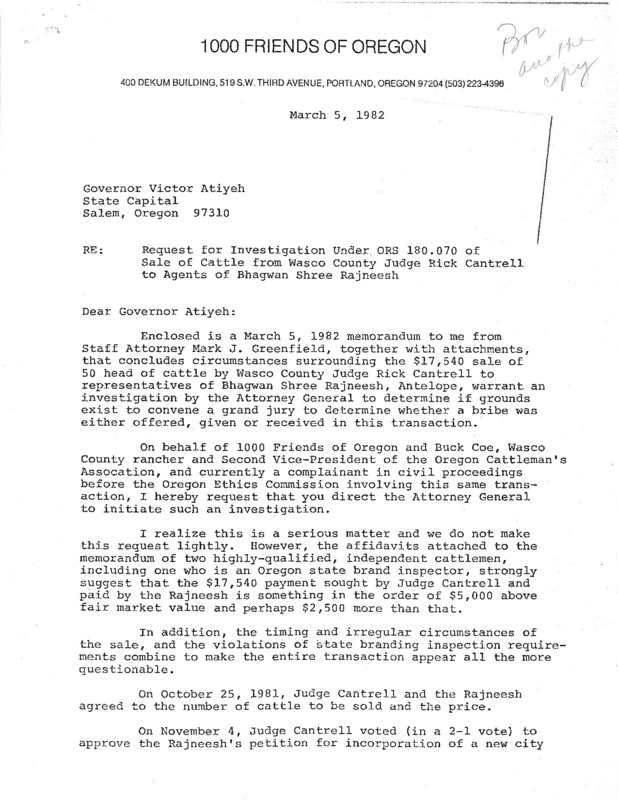
A letter to Governor Atiyeh from Henry R. Richmond, Executive Director of 1000 Friends of Oregon, which was an anti-Rajneesh group. Richmond requests a full-scale investigation of a cattle transaction between Wasco County Judge Richard Cantrell and the Agents of Bhagwan Shree Rajneesh. The 1000 Friends of Oregon believed that the sale may have constituted a bribe. Richmond discusses the evidence presented in the affidavits by attorney Mark J. Greenfield's memorandum as grounds for an investigation. The letter urges Governor Atiyeh to exercise his power to involve the Attorney General, and launch the investigation. This item was a part of the papers of Bob Oliver, Governor Atiyeh's legal counsel.
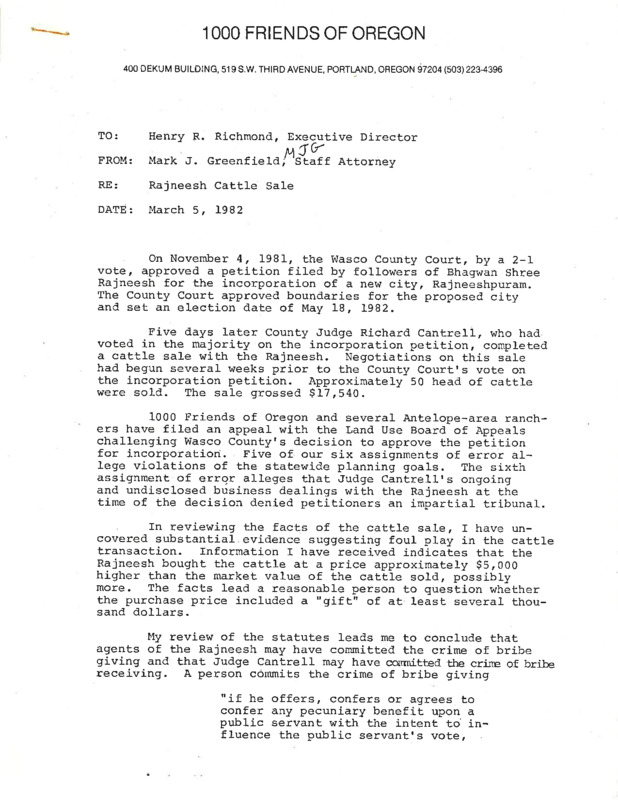
Memorandum from Mark J. Greenfield, the staff attorney for the anti-Rajneesh group 1000 Friends of Oregon, to Henry R. Richmond, director of the same group. Greenfield provides information on the Wasco County Court's ruling approving the petition that would incorporate the city of Rajneeshpuram. He writes about a cattle sale between County Judge Richard Cantrell and the Rajneesh. The 1000 Friends of Oregon thought that the sale could constitute a bribe. Evidence in the memorandum shows the transaction began prior to the court date. Other affidavits suggest the 1000 Friends of Oregon would have grounds to argue 'bribe receiving' and general misconduct had been committed by Judge Cantrell. Also included are sources, various testimonies, and a recommendation that Governor Atiyeh be contacted for a full-scale investigation. This item was a part of the papers of Bob Oliver, Governor Atiyeh's legal counsel.
Legal papers for the Rajneeshpuram community's lands in Wasco County, Oregon. Included is the mortgage, promissory note, loan agreement and maps of purchased lots all executed by the Rajneesh Investment Corporation. The mortgage agreement outlines the present property and excepted property. Also included is a loan agreement containing conditions the Rajneesh had to comply with in order to receive the mortgage. A map and listing of lots within the collection of documents displays the location of land allocated to the Rajneesh within Wasco-Jefferson County and the general layout of that land. This item was a part of the papers of Bob Oliver, Governor Atiyeh's legal counsel.
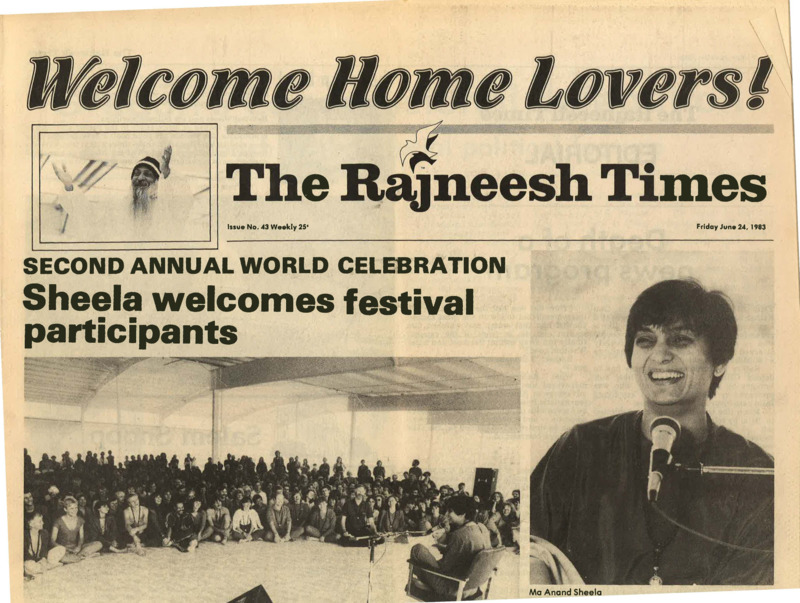
News article from the Rajneesh Times, a newspaper developed for the community of Rajneeshpuram in rural Wasco county, Oregon. A note from Atiyeh is included with the article stating the Governor, contrary to what the paper reported, never visited the ranch or negotiated with community leaders.
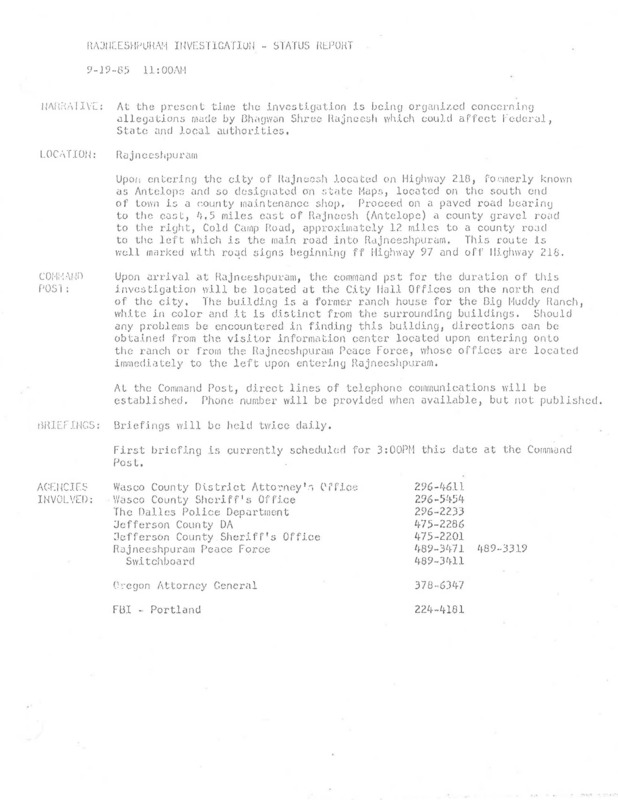
Part of a binder that was compiled for Governor Atiyeh with reports and memoranda on the Rajneeshpuram community. The several thousand residents of this community followed a charismatic leader named Bhagwan Shree Rajneesh and attempted to form their own utopian city in rural Wasco county, Oregon. This section includes status reports, police log, and miscellaneous documents that relate to the community from September to October, 1985. During this period, their guru had left the commune under pressure from the government, and several other leaders had either been arrested or were under investigation. Notably, several leaders were suspected of having poisoned hundreds of people in The Dalles by spraying salmonella at a salad bar. Followers were leaving the Rajneeshpuram ranch.
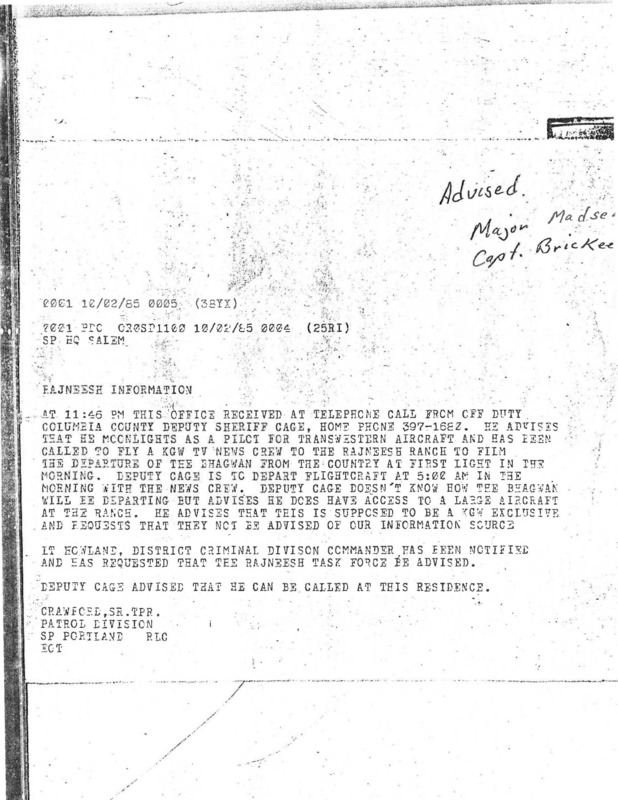
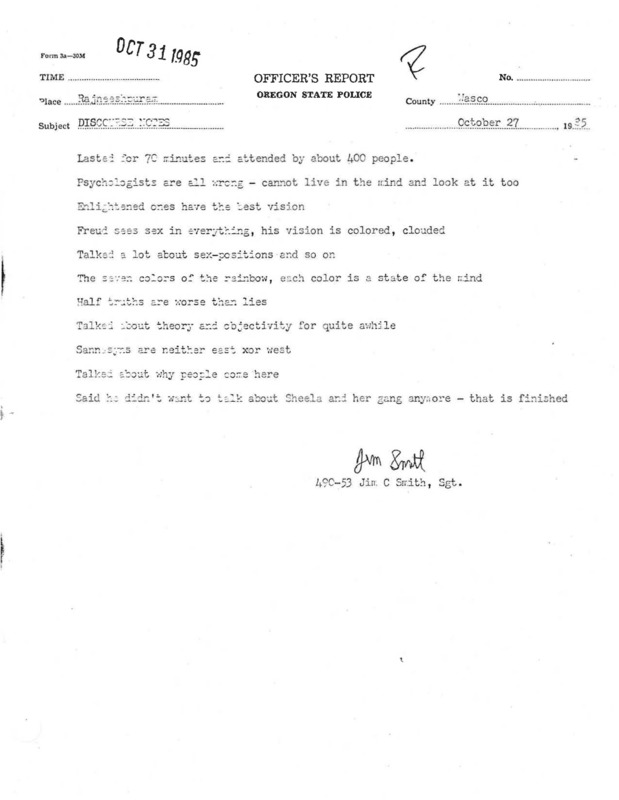
Part of a binder that was compiled for Governer Atiyeh with reports and memoranda on the Rajneeshpuram community. The several thousand residents of this community followed a charismatic leader named Bhagwan Shree Rajneesh and attempted to form their own utopian city in rural Wasco county, Oregon. This section includes police reports from August to September, 1985. During this time, the guru leaves Oregon under pressure from government investigations, and the commune begins to dissolve.
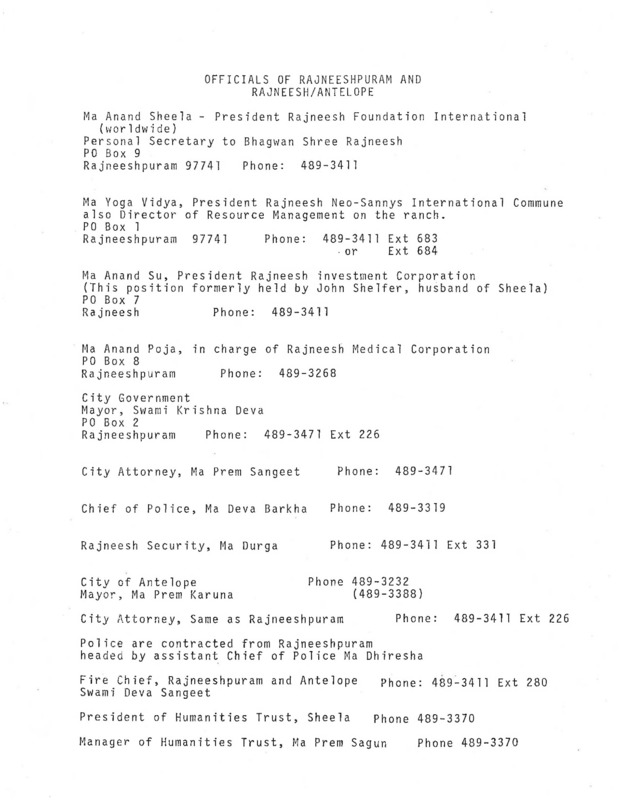
Part a binder that was compiled for Governor Atiyeh with reports and memoranda on the Rajneeshpuram community. The several thousand residents of this community followed a charismatic leader named Bhagwan Shree Rajneesh and attempted to form a utopian city in rural Wasco county, Oregon. This section includes background information on officials of Rajneeshpuram; a 'Rumor Control' center; the Rajneesh's bussing in of homeless people in order to register them as voters in the November 1984 election; and other events of 1984.
Part a binder that was compiled for Governor Atiyeh with reports and memoranda on the Rajneeshpuram community. The several thousand residents of this community followed a charismatic leader named Bhagwan Shree Rajneesh and attempted to form their own utopian city in rural Wasco county, Oregon. This section coverrs events inside the commune from 1983-1984. It includes a brief history the of Rajneesh in Oregon; Oregon State Police surveillance reports from inside the commune; documents related to alleged environmental and land use violations; reports on the Rajneesh's recruitment of homeless people to register to vote in Wasco County and subsequent 'dumping' of these people in other communities after the election was over; and other material.
Part of a binder that was compiled for Atiyeh with reports and memoranda on the Rajneeshpuram community. The several thousand residents of this community followed a charismatic leader named Bhagwan Shree Rajneesh and attempted to form their own utopian city in rural Wasco county, Oregon. This section includes investigative reports on the community by the Oregon State Police and others during November to December, 1985. During this time period, the guru had left Oregon under pressure from the government, and other leaders had been arrested or discredited. Several members of the community were being investigated for having poisoned hundreds of people in The Dalles by spraying salmonella at a salad bar. Many followers of the Rajneesh had already left the commune, and the community was quietly dissolving under the eyes of the State Police. A statement from a former mayor of Rajneeshpuram, Swami Krishna Deva, also known as David Berry Knapp, is included.
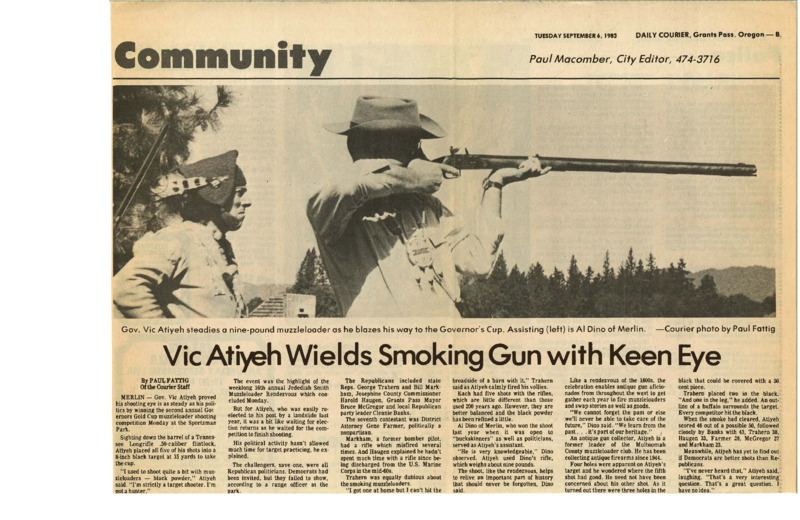
News article on Atiyeh's attendance and win at the second annual Governor's Gold Cup muzzleloader shooting competition held at the Sportsman Park in Josephine County.
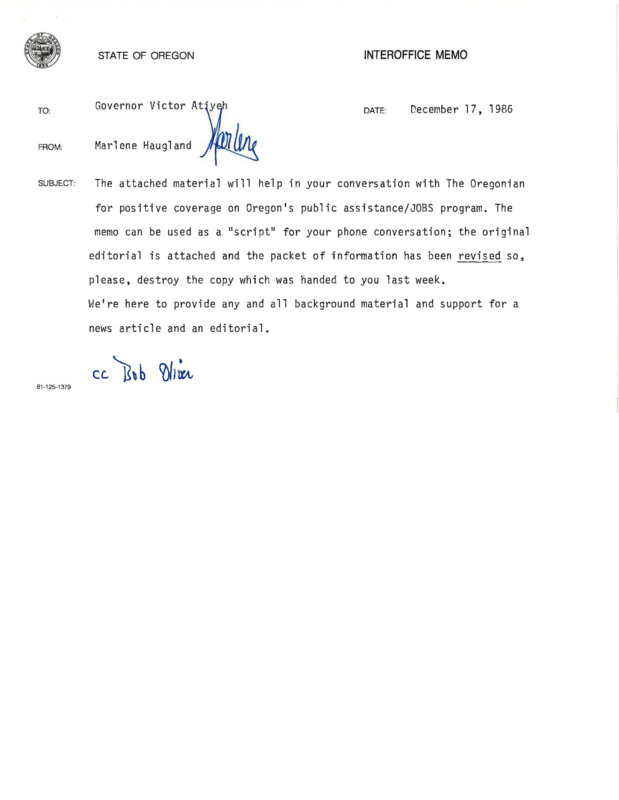
Background information on Oregon's response to Washington state's Family Independence Program sent to Atiyeh in order to prepare for his conversation with the Oregonian newspaper on Oregon's public assistance programs.
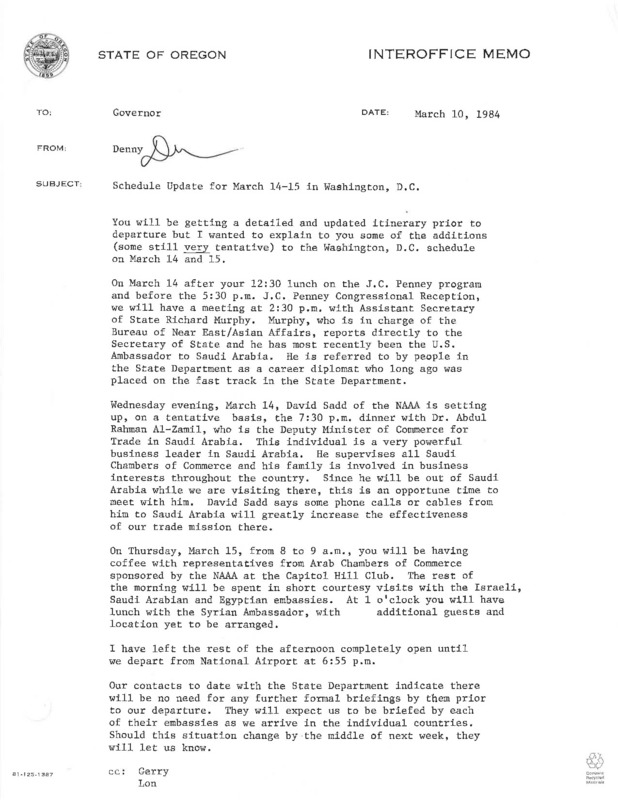
Letter from Denny Miles to Atiyeh regarding a schedule update for the Governor's visit to Washington D.C. to be briefed on trade mission to Middle East
Victor Atiyeh served as governor of Oregon from 1979-1987. This is one part of an oral history interview that was originally recorded on over 60 cassette tapes by the Oregon Historical Society. It is accompanied by a typed transcript. This portion covers: Status of his children Tom and Suzanne Atiyeh, 1998; travels in post-governor era, 1990s; George Atiyeh and Opal Creek, 1998; assessment of Barbara Roberts and John Kitzhaber as governors, 1998; gun control in Oregon, 1998; debate on Thurston High School shooting, 1998; advice to aspiring politicians and public servants, 1998; final conclusions, 1998.
Victor Atiyeh served as governor of Oregon from 1979-1987. This is one part of an oral history interview that was originally recorded on over 60 cassette tapes by the Oregon Historical Society. It is accompanied by a typed transcript. This portion covers: Outcome of the Northwest Power Planning and Conservation Act, 1980s; the Northwest Power Planning Council and the “three sovereigns”; dams and fisheries on the Columbia River, late 1990s; Atiyeh’s view of the legislature, 1998; feelings on the last day of being Governor, 1987; Atiyeh’s political activities since leaving office, 1990s; state of the Republican party, 1998; thoughts on Barry Goldwater, 1998; business and other activities since leaving office, 1998.
Victor Atiyeh served as governor of Oregon from 1979-1987. This is one part of an oral history interview that was originally recorded on over 60 cassette tapes by the Oregon Historical Society. It is accompanied by a typed transcript. This portion covers: Employment opportunities in Oregon, 1980s; link between the repeal of the unitary tax and the diversification of Oregon’s economy, 1980s; lack of school finance reform in Oregon, 1980s-1990s; Atiyeh vetoing tax relief packages, 1979-1980; effect of state-run rainy day funds; structure of the legislature, 1980s-1990s; 1982 election victory, effort to introduce sales tax, 1980s-1990s.
Victor Atiyeh served as governor of Oregon from 1979-1987. This is one part of an oral history interview that was originally recorded on over 60 cassette tapes by the Oregon Historical Society. It is accompanied by a typed transcript. This portion covers: Court reform while Governor, 1980s; Atiyeh’s administrative style as Governor, 1980s; diversification of Oregon’s economy, 1980s; tourism as an economic sector in Oregon, 1980s; repeal of the unitary tax, mid-1980s; timber relief program, early 1980s.
Victor Atiyeh served as governor of Oregon from 1979-1987. This is one part of an oral history interview that was originally recorded on over 60 cassette tapes by the Oregon Historical Society. It is accompanied by a typed transcript. This portion covers: Review of political career; thoughts on Neil Goldschmidt; successes as Governor: avoiding gas shortage, dealings with the Rajneesh, relieving Oregon of the recession; reflections on Governorship: Oregon Food Bank, preservation of the Columbia River Gorge, Northwest Power Planning Council, rebalancing of budgets, Deschutes River, racial and religious harassment.