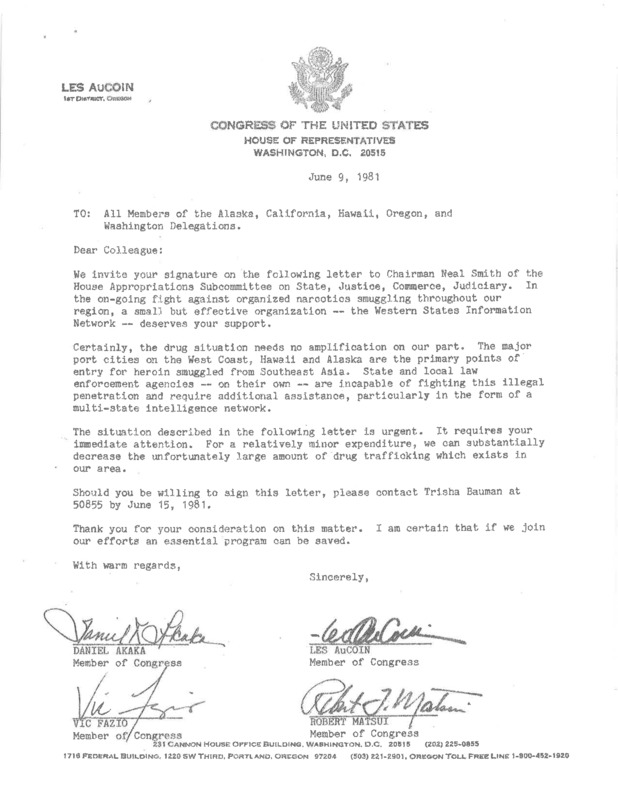
A letter from representatives Les AuCoin, Daniel Akaka, Vic Fazio, and Robert Matsui to the members of the Western states delegations advocating for the Western States Information Network following the news that the Reagan Administration planned to eliminate monetary support for the organization. The letter was dated June 9, 1981. The WSIN was designated by the letter's authors as crucial in supporting "local law enforcement narcotic investigations in the states of Alaska, California, Hawaii, Oregon, and Washington by providing analytical, financial, and equipment services."
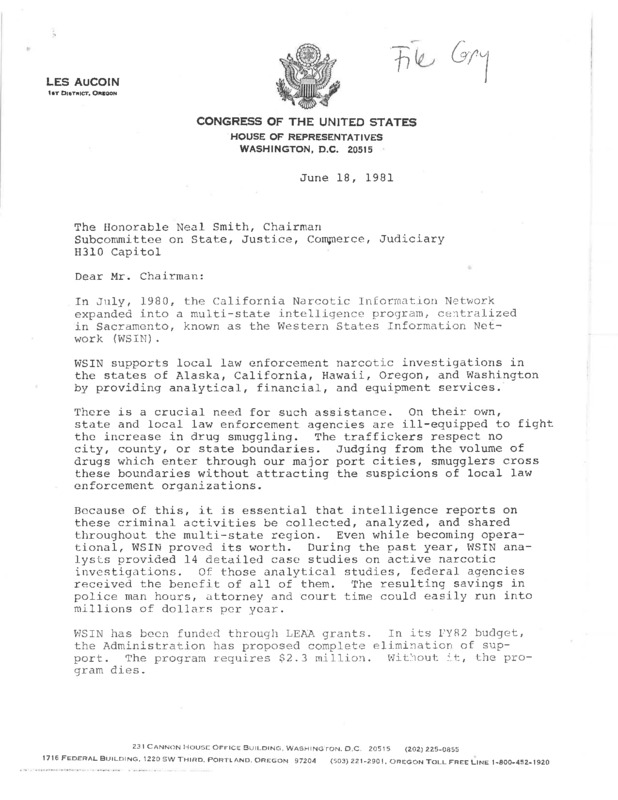
A letter to Chairman Neal Smith of the Subcommittee on State, Justice, Commerce, and Judiciary, from several US representatives advocating for the Western States Information Network (WSIN) to be included in the fiscal year 1982 federal budget following the news that the Reagan Administration planned to eliminate monetary support for the organization. The letter was dated June 18, 1981, and was signed by Norman Mineta, Les AuCoin, Ronald V. Dellums, Augustus F. Hawkins, Jerry M. Patterson, Robert T. Matsui, Daniel K. Akaka, Bobbi Fiedler, Vic Fazio, Tom Lantos, Mervyn M. Dymally, Cec Heftel, Pete Starke, Julian C. Dixon, Robert J. Lagomarsino, Ron Wyden, Glenn M. Anderson, Pete McCloskey, Edward R. Roybal, Joel Pritchard, and Tony Coelho. The WSIN was designated by the letter's authors as crucial in supporting "local law enforcement narcotic investigations in the states of Alaska, California, Hawaii, Oregon, and Washington by providing analytical, financial, and equipment services."
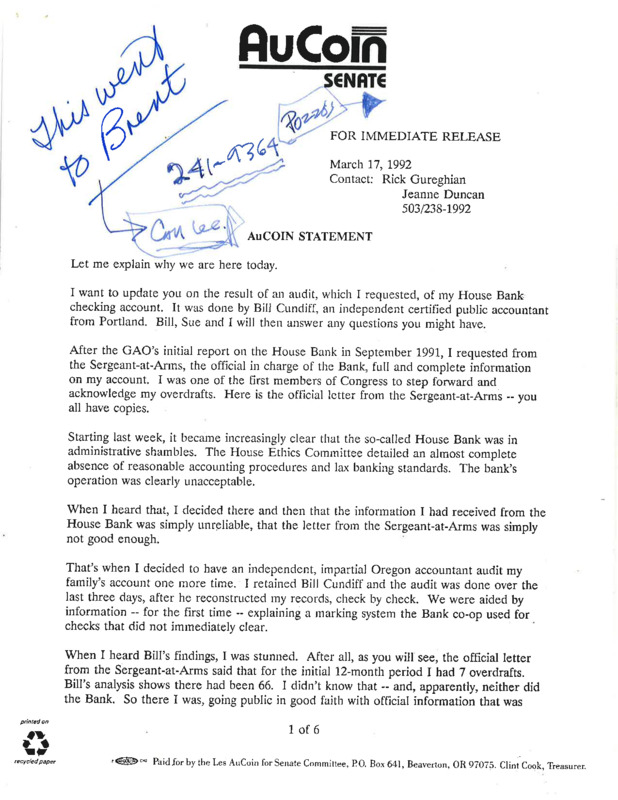
A statement and accompanying receipts provided by US Congressman Les AuCoin and his office in response to the 1992 House banking scandal. In 1992, an investigation discovered that hundreds of members of Congress had overdrafted their House bank accounts numerous times, although it was found that the vast majority did so unintentionally -- as the House bank system did not properly alert members of their overdrafts and delayed processing deposits -- and did not break any laws. AuCoin himself was later cleared of any wrongdoing by the US Department of Justice. The receipts provided by Congressman AuCoin in this document include an official account statement from the Sergeant at Arms, a sample check, a list of checks identified as "overdraft" by the House bank, a list of ending balances from monthly statements received from the Sergeant at Arms, a letter from Merrill Lynch Consumer Markets, a Washington Post article titled "House Bank Records Hampered Probe" by Guy Gugliotta, a letter regarding information on withdrawals from the Congressional Federal Credit Union, and a letter from the Bank of Astoria.
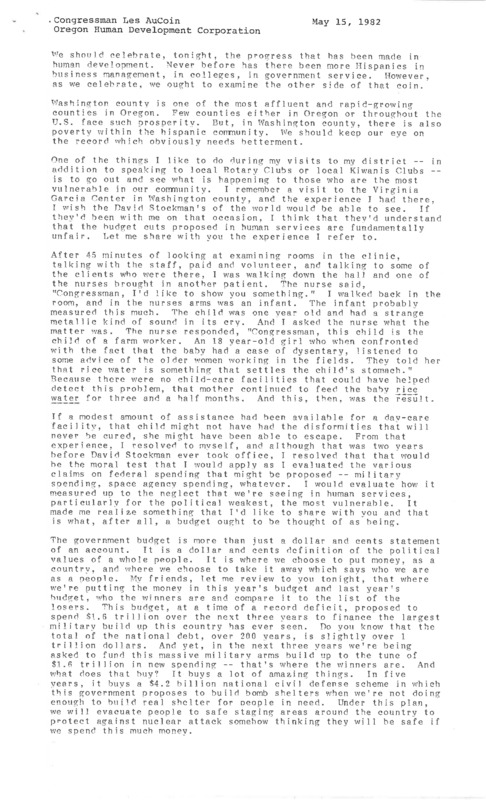
A speech by US Congressman Les AuCoin delivered at the Oregon Human Development Corporation, a farmworker-serving non-profit organization, on May 15, 1982. In his speech, Congressman AuCoin discussed the Hispanic community in Washington County; the increase in Hispanics in business management, colleges, and government service; his past visit to the Virginia Garcia Center; and the federal budget, arms control, the B-1 bomber, and describing how "The $4.2 billion going into bomb shelters could be better spent on the Virginia Garcia Centers and in the farm workers housing and in all the housing for all Americans then in that category."
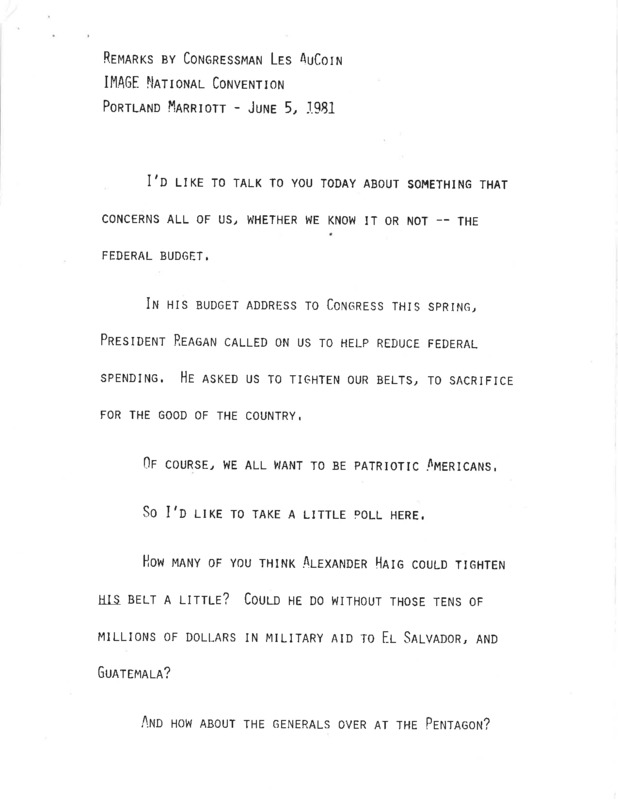
A speech by US Congressman Les AuCoin given at the national convention of IMAGE, an organization of Hispanic federal, state, and local government employees, on June 5, 1981. In his speech, Congressman AuCoin discussed the issue of the Reagan Administration proposing to cut several programs that benefited Hispanic Americans from the 1982 federal budget -- such as portions of the Occupational Safety and Health Adinistration (OSHA), bilingual education and migrant health, housing and social services -- all while increasing military spending. During his time in Congress, AuCoin had been a part of the Congressional Hispanic Caucus.
A video of U.S. Congressman Les AuCoin hosting a small, televised press conference from Washington, D.C. addressing how legislation that extended unemployment benefits was likely initially defeated by President H. W. Bush for not declaring the unemployment crisis an emergency. He also discussed the Bureau of Land Management's Cy Jamison's decision to petition the Secretary of Interior to convene the "God Squad" (environmentalist members of the ESA Committee) during the early 1990s logging crisis. AuCoin took questions from Oregon reporters who called in over the phone.
A video featuring footage of U.S. Congressman Les AuCoin hosting a televised press conference from Washington, D.C. reacting to U.S. District Judge Helen Frye's decision to impose a temporary injunction on the entirety of the BLM's timber sales program. AuCoin expresses his disappointment in the decision, its impact on the timber industry, and the recent activities of the BLM, including the BLM's failure to provide an environmental impact statement on its sales program. He took questions from reporters who called in over the phone. The early 1990s in Oregon was marked by a declining timber industry, including a large-scale debate between environmentalists (including members of the ESA Committee, the "God Squad") concerned about protecting the habitat of the endangered northern spotted owl and the members of the logging industry who argued that the Endangered Species Act and its regulations reduced the number of jobs for timber workers.
A video of U.S. Congressman Les AuCoin hosting a televised press conference from Washington, D.C. reacting to President George H. W. Bush's proposed healthcare program during his 1992 reelection campaign. AuCoin condemns Bush's "nonplan," which he describes as "robbing" funds from Medicare and Medicaid and failing to provide plans for prescription drugs or long term, affordable healthcare programs for the elderly or working class families. For most of the program, AuCoin took questions from reporters who called in over the phone.
A video recording of an episode of America's Defense Monitor titled "Can America Be Defended?" hosted by the WHMM television station in Washington, D.C. The program interviews experts on the Strategic Defense Initiative (SDI) "Star Wars" and Global Protection Against Limited Strikes (GPALS) programs. U.S. Congressman Les AuCoin, an advocate for arms control, appears at the 1:20, 7:35, 11:18, 16:12, 22:47, minute marks.
A video featuring footage of Les AuCoin hosting a small, televised press conference in Washington D.C. to discuss the 1993 federal budget, "America's first post-Cold War budget for our nation and for our people," that was to be debated the next day. AuCoin advocates for a federal budget that invests in the economy, infrastructure, and education. AuCoin is joined by Ginny Markell of the Oregon Parent Teacher Association and Cindy Weeldreyer of Lane Community College's Board of Education. For a portion of the, AuCoin took questions from Oregonians (likely reporters) who called in over the phone.
An audio recording by Oregon Congressman Les AuCoin on 2004 Democratic presidential candidate John Kerry's August visit to Medford, Oregon. Kerry visited the Republican Jackson county in order to persuade undecided voters. This is one episode from AuCoin's biweekly radio show on Jefferson Public Radio (JPR), which ran after he had retired from office. The majority of episodes feature his commentary on current political events, often focusing on issues important to southern Oregon where JPR is based. This episode aired in August 2004.
An audio recording by Oregon Congressman Les AuCoin on the Healthy Forest Restoration Act of 2003, which claimed to improve forests and reduce wildfires by thinning out trees. AuCoin says the act instead allows logging companies to profit. Doctor Jerry Franklin of the Univeristy of Washington gave Congress data on how intact forests in fact increase wildlife diversity. This is one episode from AuCoin's biweekly radio show on Jefferson Public Radio (JPR), which ran after he had retired from office. The majority of episodes feature his commentary on current political events, often focusing on issues important to southern Oregon where JPR is based. This episode aired in 2003 or 2004.
An audio recording by Oregon Congressman Les AuCoin on toxic nuclear waste management at Hanford Site, Washington; Aiken, South Carolina; and Idaho Falls, Idaho. He describes how Senator Lindsey Graham proposed the idea of allowing the Energy Department to reclassify radioactive waste, despite the known risk of contamination in the environment. Oregon Senators Ron Wyden and Gordon Smith supported Washington Senator Maria Cantwell's attempt to remove the revision, but the vote was tied. This is one episode from AuCoin's biweekly radio show on Jefferson Public Radio (JPR), which ran after he had retired from office. The majority of episodes feature his commentary on current political events, often focusing on issues important to southern Oregon where JPR is based. This episode aired in 2004.
An audio recording by Oregon Congressman Les AuCoin clarifying and apologizing for factual errors on his part in a former radio episode on Columbia River dredging. AuCoin states that he still stands by his original comment on how sometimes even good people have negatively impacted the climate for reasons of monetary gain. However, he apologizes for using out of date information, including details about the motives of the Port of Portland and a comment on how dredge spoils were to be placed in sensitive aquatic locations, as this was the original proposal of the Army Corps of Engineers, though it was vetoed by the Oregon Department of Fish and Wildlife and the Washington State of Ecology. This is one episode from AuCoin's biweekly radio show on Jefferson Public Radio (JPR), which ran after he had retired from office. The majority of episodes feature his commentary on current political events, often focusing on issues important to southern Oregon where JPR is based. This episode likely aired in 2002.
An audio recording by Oregon Congressman Les AuCoin on a then recent Oregon forest report. Douglas County requested and paid for the report, led by researcher of Oregon State University School of Forestry, John Sessions. AuCoin points out how Sessions is a civil and forest engineer, not a wildfire scientist, and was seemingly unqualified to author the report. AuCoin states that the best approach to generating healthy forests is by natural recovery. This is one episode from AuCoin's biweekly radio show on Jefferson Public Radio (JPR), which ran after he had retired from office. The majority of episodes feature his commentary on current political events, often focusing on issues important to southern Oregon where JPR is based. This episode aired in 2003.
An audio recording by Oregon Congressman Les AuCoin on Washington DC-based group called the “Citizens for a Sound Economy,'' an anti-tax organization dedicated to defeating a temporary tax surcharge in Oregon. Three likely Oregon businessmen involved with the organization include Aaron Jones, Wes Lematta, and Dick Wendt. This is one episode from AuCoin's biweekly radio show on Jefferson Public Radio (JPR), which ran after he had retired from office. The majority of episodes feature his commentary on current political events, often focusing on issues important to southern Oregon where JPR is based. This episode aired between 2002-2003.
An audio recording by Oregon Congressman Les AuCoin condemning a proposal to ship large amounts of nuclear waste to the Hanford Nuclear Site. Weeks prior to the proposal, the U.S. Department of Energy won the right to designate Nevada's Yucca Mountain as the national nuclear repository. AuCoin states the Hanford Site is amongst one the most polluted sites in the world, and while some radioactive materials had already seeped through into the ground and the Columbia River, the Department of Energy was planning to expand the site. This is one episode from AuCoin's biweekly radio show on Jefferson Public Radio (JPR), which ran after he had retired from office. The majority of episodes feature his commentary on current political events or personal life updates, often focusing on issues important to southern Oregon where JPR is based. This episode aired in 2002.
An audio recording by Oregon Congressman Les AuCoin on a new addition to his family, a year-old dog named Rascal from the Jackson County Animal Shelter. AuCoin recalls taking Rascal, his new fishing companion, to Dailey (or Daley) Creek with him. This is one episode from AuCoin's biweekly radio show on Jefferson Public Radio (JPR), which ran after he had retired from office. The majority of episodes feature his commentary on current political events, often focusing on issues important to southern Oregon where JPR is based. This episode aired between 2001-2003.
An audio recording by Oregon Congressman Les AuCoin on a conservative bill that plans to stimulate the economy through tax breaks for wealthy corporations and individuals. AuCoin asserts that this bill would do nothing to increase demand in the economy, and would only enrich Americans at the top economic tier at expense of middle class and unemployed Americans, who he argues should be the ones to receive potential tax cuts. This is one episode from AuCoin's biweekly radio show on Jefferson Public Radio (JPR), which ran after he had retired from office. The majority of episodes feature his commentary on current political events, often focusing on issues important to southern Oregon where JPR is based. This episode aired from December 2001-2003.
An audio recording by Oregon Congressman Les AuCoin on the dangers of water transfers. He describes a scheme by an Alaskan company named World Water SA, which was planning to collect water from rivers in Mendocino County, California in giant "water bladders." The bladders would be towed south down to the coast to San Diego, where taxpayers would be charged for the water. AuCoin says that this scheme likely will not happen, but that ideas like this in the past have occured and caused great environmetal harm, benefitting only a few people. AuCoin says that taxpayers should not subsidize these sorts of projects, but that the free market cost of natural water should be passed on to consumers. This is one episode from AuCoin's biweekly radio show on Jefferson Public Radio (JPR), which ran after he had retired from office. The majority of episodes feature his commentary on current political events, often focusing on issues important to southern Oregon where JPR is based. This episode aired in 2002.
An audio recording by Oregon Congressman Les AuCoin on water rights policy in the Klamath Basin. In his recording, AuCoin describes how President George W. Bush's Secretary of the Interior Gale Norton and Agriculture Secretary Ann Veneman were "opening the water tap" in Klamath Falls, an action AuCoin dubs as "political theater trumping substance." AuCoin argues that while the opening of irrigation is beneficial to farmers, it is often harmful to the endangered fish that reside in the water. This is one episode from AuCoin's biweekly radio show on Jefferson Public Radio (JPR), which ran after he had retired from office. The majority of episodes feature his commentary on current political events, often focusing on issues important to southern Oregon where JPR is based. This episode aired in 2002.
An audio recording by Oregon Congressman Les AuCoin on spending the day in Washington, D.C. with his actor son, Kelly AuCoin. In the recording, AuCoin discusses the difficulties of seeing his son while living on different sides of the country, reflects on watching his son getting older, and shares how he and his son always find the time to crack jokes with one another. This is one episode from AuCoin's biweekly radio show on Jefferson Public Radio (JPR), which ran after he had retired from office. The majority of episodes feature his commentary on current political events, often focusing on issues important to southern Oregon where JPR is based. This episode aired in 2002.
An audio recording by Oregon Congressman Les AuCoin regarding Multnomah County Ballot Measure 26-48 of 2003. AuCoin shares how Multnomah County voters voted to increase taxes on the county-level to alleviate the school funding crisis. Moreover, he criticizes the hypocrisy of the conservatives in the Oregon legislature who condemn Ballot Measure 26-48 for keeping tax revenue within Multnomah County schools and out of rural Oregon counties, while simultaneously arguing against raising taxes in general. AuCoin specifically calls out Republican Oregon State Senator Ted Ferrioli. This is one episode from AuCoin's biweekly radio show on Jefferson Public Radio (JPR), which ran after he had retired from office. The majority of episodes feature his commentary on current political events, often focusing on issues important to southern Oregon where JPR is based. This episode aired in 2003.
An audio recording by Oregon Congressman Les AuCoin, in which he discusses campaign financing in Oregon. He describes his first campaign in Washington County, Oregon and the importance that volunteers once had in elections; contrasting this with the influence of money and negative advertisements in the early 2000s. This is one episode from AuCoin's biweekly radio show on Jefferson Public Radio (JPR), which ran after he had retired from office. The majority of episodes feature his commentary on current political events, often focusing on issues important to southern Oregon where JPR is based. This episode probably aired in fall 2002.