Mary Jo Morelli oral history interview on Forest Grove and Friends of Historic Forest Grove history, recorded August 4, 2025 at the Friends of Historic Forest Grove Old Train Station Museum in Forest Grove, Oregon. Elle Griego, the interviewer, was a History and French undergraduate student at Pacific University from 2022-2026.
Mary Easton oral history interview on the Gay Nineties and Barbershop Ballad Contest, recorded July 2, 2025 at the Friends of Historic Forest Grove Old Train Station Museum in Forest Grove, Oregon. Elle Griego, the interviewer, was a History and French undergraduate student at Pacific University from 2022-2026.
Don Skinner oral history interview on the Gay Nineties and Barbershop Ballad Contest, recorded June 19, 2025 at the Friends of Historic Forest Grove Old Train Station Museum in Forest Grove, Oregon. Born in 1948, Skinner grew up in Forest Grove and served in the Vietnam war as a Photographic Laboratory Specialist in the Army before working for and retiring from Tektronix. He and his wife Cheryl are responsible for putting together the Old Train Station Museum as it is today. Elle Griego, the interviewer, was a History and French undergraduate student at Pacific University from 2022-2026.
David and Mary Jo Morelli oral history interview on Forest Grove and Friends of Historic Forest Grove history, recorded July 31, 2025 at their Forest Grove residence. Elle Griego, the interviewer, was a History and French undergraduate student at Pacific University from 2022-2026.
Carol Drew oral history interview on the Gay Nineties and Barbershop Ballad Contest, recorded June 20, 2025 at her residence in Forest Grove, Oregon. Born in 1939, Drew has lived in Forest Grove since the 1950s. A prominent member of the local community, she graduated from Pacific University in 1960 with a Bachelor of Arts in Journalism. Elle Griego, the interviewer, was a History and French undergraduate student at Pacific University from 2022-2026.
An audio recording of an oral history of Heather Higginbotham Johansen, Pacific University Class of 1974, recounting memories of her time at Pacific as a college student. Topics covered in the recording include: being an Elementary Education major in the early 1970s; meeting her husband at Pacific; strict rules for the women's dormitories; how her classes were fairly easy for the first two years of college; problems with how education was taught and current issues in elementary education in the 2020s; memories of Khiem (Tim) and Thuy (Cathy) Tran, two Vietnamese students for whom Pacific's Tran Library would later be named; and memories of the Vietnam War period at Pacific.
An audio recording of an oral history of Amber Benton, Pacific University Class of 2009, recounting memories of her time at Pacific as a college student. Topics covered in the recording include: what it was like to be a first-generation student and one of very few Black students at Pacific in the 2000s; living on campus for four years; serving as an RA (Resident Assistant) in Burlingham Hall; serving as a Student Ambassador; becoming involved with Nā Haumāna O Hawai'i, Pacific's Hawaiian student club; performing at Lu'au; going whitewater rafting with Pacific's Outdoor Pursuits; being a Spanish major and participating in Spanish Club; impressions of Pacific's Black Student Union and Black Alumni Chapter after she graduated; changes she has observed at Pacific since she graduated; memories of Pacific's President Phil Creighton; how her time at Pacific connected to her current work in diversity, equity and inclusion; being the victim of a racial hate incident while she was an RA; lack of awareness or celebration of Black culture while she was a student; the value of Pacific's education and how it encouraged critical thinking skills.
An audio recording of an oral history of Bruce Bishop, Pacific University Class of 1968, recounting memories of his time at Pacific as a college student. The main topic of the recording is Bruce's memories of Pacific University's mascot, Boxer, including: the Boxer "Toss" and "Flash" events; the original Boxer statue's disappearance in 1969 and Bruce's involvement in its recovery over 50 years later in 2024; his involvement in commissioning the Boxer III replica in 2018; and the theft and recovery of Boxer III from Tran Library in 2019. Bruce also discusses: being at Pacific during the political events of the late 1960s; meeting his wife at Pacific; Pacific's dining hall being moved from McCormick Hall to Washburne Hall; connections with fraternities including his own, Gamma Sigma; and his opinions on what "Boxer Spirit" means for Pacific students.
An audio recording of an oral history of Marissa Williams, Pacific University Class of 2019, recounting memories of her time at Pacific as a college student. The main topic of the interview is how she perceived diversity, equity and inclusion issues at Pacific during the late 2010s, including: her work with the Center for Gender Equity (CGE) and its director, Martha Rampton; the controversy around CGE's posters advertising The Vagina Monologues play in 2018; and the beginning of the Student Multicultural Center. Other topics covered briefly in the recording include: becoming a Gender and Sexuality Studies minor; participation in Delta Chi Delta and Student Senate; serving as a First Year Seminar (FYS) student mentor; memories of campus after the election of President Trump in 2018; and how her experience at Pacific helped her current work in advocacy in the 2020s.
An audio recording of an oral history of Patrice Fuller, Pacific University Class of 2016, briefly recounting memories of her time at Pacific as a college student. Topics covered in the recording include: her service as the Cultural Chair of Pacific's ACE Board; partnering with the Hispanic Heritage Association and the Black Student Union on events such as the Soul Food Dinner; responding to the Trayvon Martin and Mike Brown shootings; hosting awareness events such as film screenings; how her service helped her later in work such as event planning; hosting slam poets such as Kane Smego; and attending conferences and a social justice retreat.
An audio recording of an oral history of Donna Maxey Easter, Pacific University Class of 1970, recounting memories of her time at Pacific as a college student. The main topic of the interview is what her everyday experiences were like as a very social and involved African American woman in college from 1964-1970. Specific topics include: her first impressions of Pacific; becoming Secretary of the Freshman Class; socializing and dating; winning competitions such as the Omega Epsilon Phi Sweetheart contest; being loud and social as a library worker and being fired for it; what it was like coming to Pacific from Jefferson High School in Portland; being naive about sex and feeling embarrassed in class; memories of professors such as Dr. Prince (English), Dr. Roberts (Biology), and Dr. McVicker (Education); learning to study as a freshman for her Elementary Education degree and getting help from her dorm mates; having to dissect a frog and a rat in Biology; becoming a Boxerette; the value of a Pacific education; reactions to her interracial marriage when she and her husband Steve Pomerantz, who was white and Jewish, got married while they were students at Pacific; the mixed feelings she had about joining the Black Student Union because she wanted her husband to be able to join too; protests during the Vietnam War; being reprimanded as a Student Teacher for attending a protest during a school day and Pacific's lack of support for her at the time; working in the cafeteria and interacting with Auntie Edna (who would later be the Hawaiian Club advisor); the many other campus jobs that she held; receiving financial aid due to her father's poor health; dealing with prejudice from a staff member in Pacific's financial aid department; recalling how her father had been unable to get work as a teacher in Portland because he was Black; and working in Pacific's kitchen and watching a baker who always smoked while making pastries.
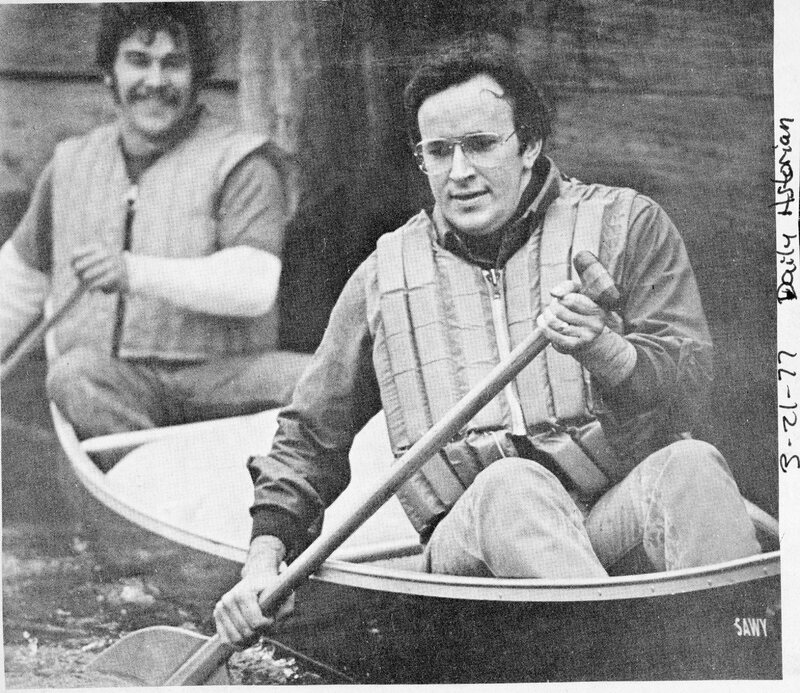
A photograph of US Congressman Les AuCoin in the Nehalem Bay Canoe Races near the Tillamook County Boat Landing. The photograph was published in the Daily Astorian newspaper on March 21, 1977.
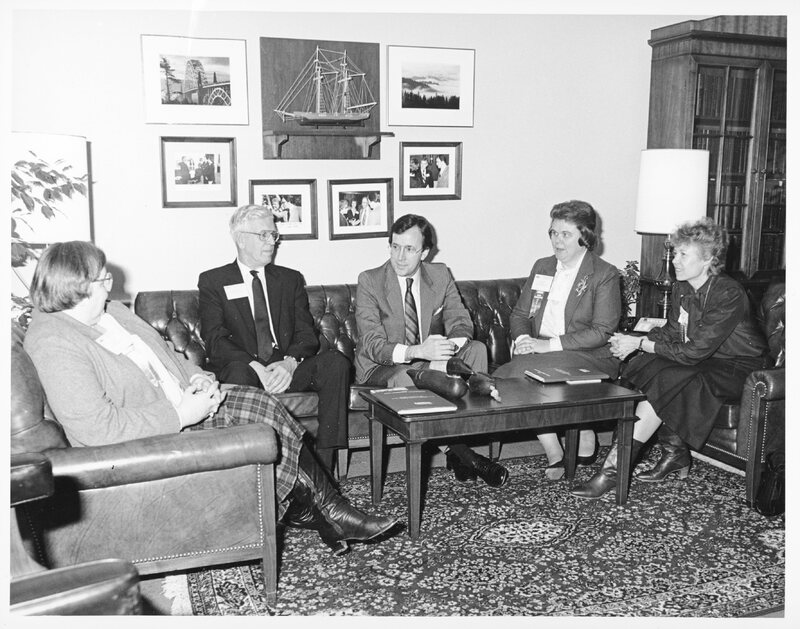
A photograph of US Congressman Les AuCoin meeting with members of the Oregon School Boards Association in his office in Washington, D.C. in the early to mid-1980s. An accompanying typewritten note states: "Edith Lippert, of Hillsboro (far left), joined other members of the Oregon School Boards Association in a Washington meeting January 28 with First District Congressman Les AuCoin. Ms. Lippert, who is President-Elect of the organization, is also a member of the Hillsboro Elementary School District. The Washington meeting focused on federal assistance for public education at the elementary and secondadry levels.
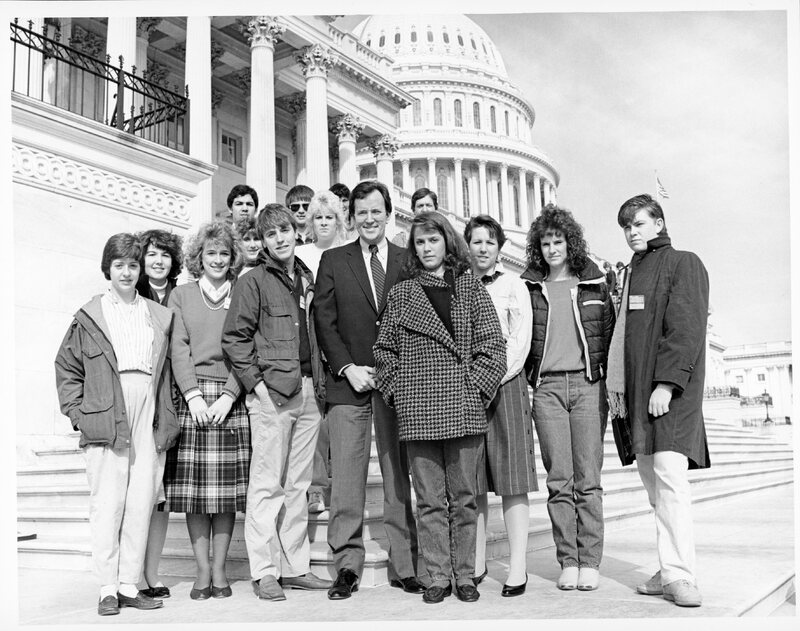
US Congressman AuCoin in front of the U.S. Capitol with Newberg and Hillsboro high school students in the 1980s. A typewritten note accompanying the photograph states: "Newberg and Hillsboro high school students visited the nation's capital for a first-hand look at the workings of the federal government. The trip included a meeting with Oregon Congressman Les AuCoin, who took them on a tour of the Capitol." The note additionally lists the students from Hillsboro as Sara Crisman, Mary Erwin, and William Harp, and the students from Newberg as Laura Mosier, Elizabeth Edwards, Gary Bertrand, Danna Kimball, Daven Rosener, Stephanie Johnson, Pamala Drysdale, Sean Kiache, and Kellie Hutchinson.
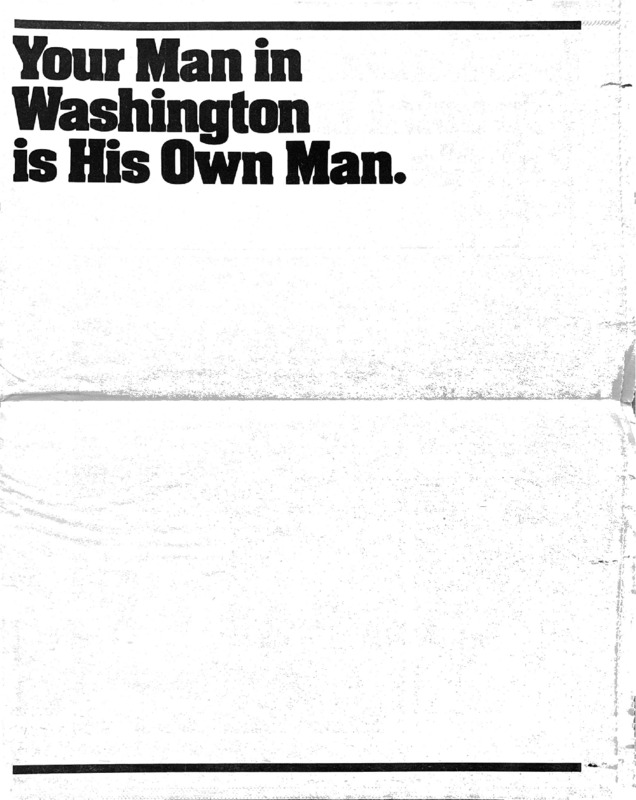
A booklet from US Congressman Les AuCoin's 1978 re-election campaign for Oregon's 1st District. Pat McCormick, Chief of Staff for Oregon House Majority Leader Les AuCoin (1973-1974), had noted in private communications that this booklet is "an example of a tabloid-size mini newspaper with large photos and major messages in headlines, one to a page. We 'borrowed' that format from Joe Biden who'd used in his first (1972) campaign for the Senate."
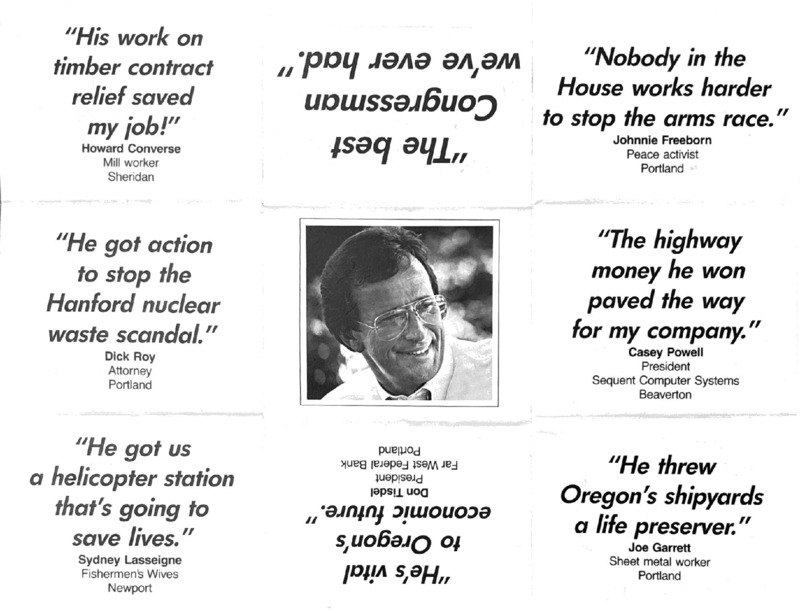
A pamphlet from US Congressman Les AuCoin's 1986 re-election campaign for Oregon's 1st District. The pamphlet features a candid portrait of Congressman AuCoin and a photograph of him and his family. Additionally, the pamphlet includes a description of his background and a list of his then recent accomplishments in Congress, including his work that stopped the federal government from dumping liquid nuclear waste into the soil in Hanford, Washington; passing legislation to help the US Coast Guard build a rescue helicopter station in Newport, Oregon; using his role in the Appropriations Committee to allocate $60 million in federal highway funds that created jobs in eastern Washington County; his help in passing a timber contract relief bill that prevented the bankruptcy of dozens of Oregon mills and the loss of hundreds of millworker jobs; using his role in the House Defense Appropriations Subcommittee to help establish Navy contracts for Portland shipyards; and convincing President Ronald Reagan and Congress to pass "the AuCoin amendment" which banned the testing of anti-satellite weapons.
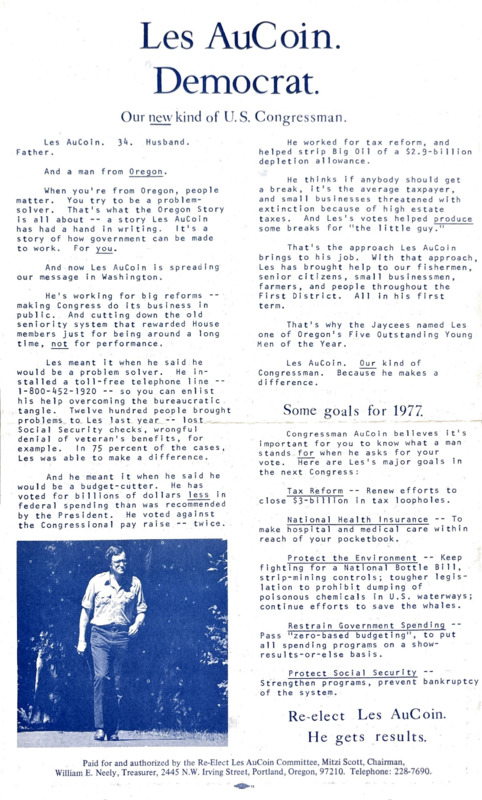
A flyer from US Congressman Les AuCoin's 1976 re-election campaign for Oregon's 1st District. The flyer features two photographs of Congressman AuCoin, a list of some of his then recent accomplishments, and some of his legislative goals for 1977-- including tax reform, establishing national health insurance, protecting the environment, restraining government spending, and protecting social security. The back of the flyer is titled "Les AuCoin makes a big difference in Clatsop County" and features a list of his accomplishments in the county, such as his work for the Knappa Water Association and passing legislation to finance public works projects.
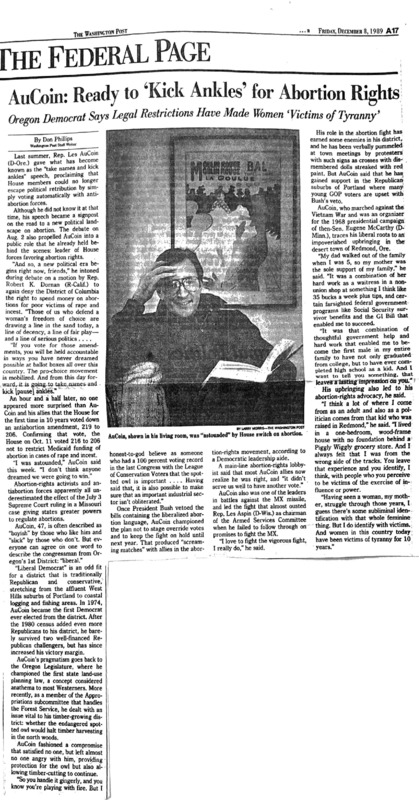
A photocopy of a Washington Post newspaper article tited "AuCoin: Ready to 'Kick Ankles' for Abortion Rights" by Don Phillips, published on December 8, 1989. The article describes US Congressman Les AuCoin's famous "take names and kick ankles" speech, delivered on the House floor in defense of abortion rights before the vote of an antibortion amendment (which did not pass) which would have restricted Medicaid funding of abortion in the cases of rape and incest. The article quotes a part of AuCoin's speech: "Those of us who defend a woman's freedom of choice are drawing a line in the sand today, a line of decency, a line of fair play-- and a line of serious politics....If you vote for those amendments, you will be held accountable in ways you have never dreamed possible at ballot boxes all over this county. The pro-choice movement is mobilized. And from this day forward, it is going to take names and kick ankles."
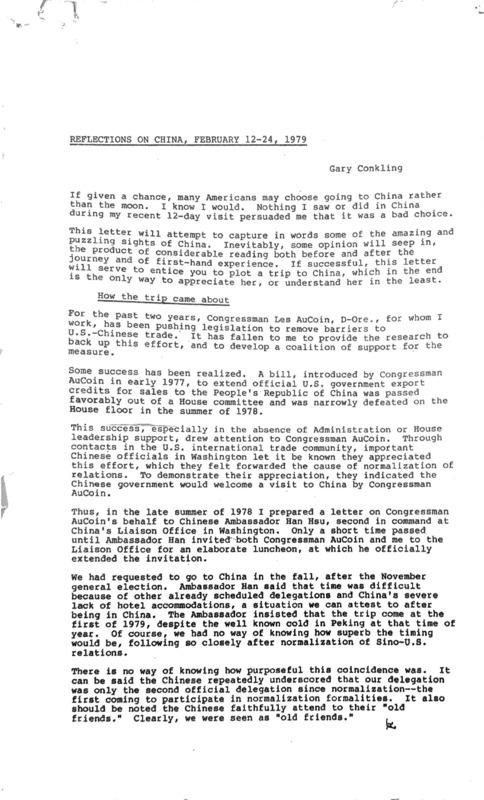
A written piece titled "Reflections on China" by Gary Conkling, the staff director for US Congressman Les AuCoin. In the 1970s, Representative AuCoin led efforts to normalize trade relations between the US and the People’s Republic of China. When the two countries normalized economic and diplomatic relations in January 1979, AuCoin led the first trade delegation to China just one month later, traveling with a group of Oregon business leaders. In his reflections on the trip, Gonkling details AuCoin's efforts to remove barriers to trade between the nations, his experience traveling and meeting Chinese politicians and citizens, making an appeal at the Peking Zoo for a rare animal exchange involving Giant Pandas to Portland's Washington Park Zoo, seeing a brain surgery with acupuncture at Huashan Hospital, visiting Peking University and being lectured on the Cultural Revolution by a Professor Hung, visiting Feng Pan People's Commune, attending a Peking opera show, and sightseeing and investigative research at the Great Wall, Ming Tombs, Summer Palace, Imperial Palace/The Forbidden City, the Great Hall of the People, Tiananmen Square, the Port of Shanghai, Ma Ling Canning Factory, the Shanghai Arts & Crafts Research Institute, Kwangchow, and Kweilin. Conkling also described his observations about the Chinese people, the economic conditions of the average Chinese citizen, and made notes about the food the group was exposed to and what they learned about the Sino-Vietnamese War, which was ongoing while the group was in China.
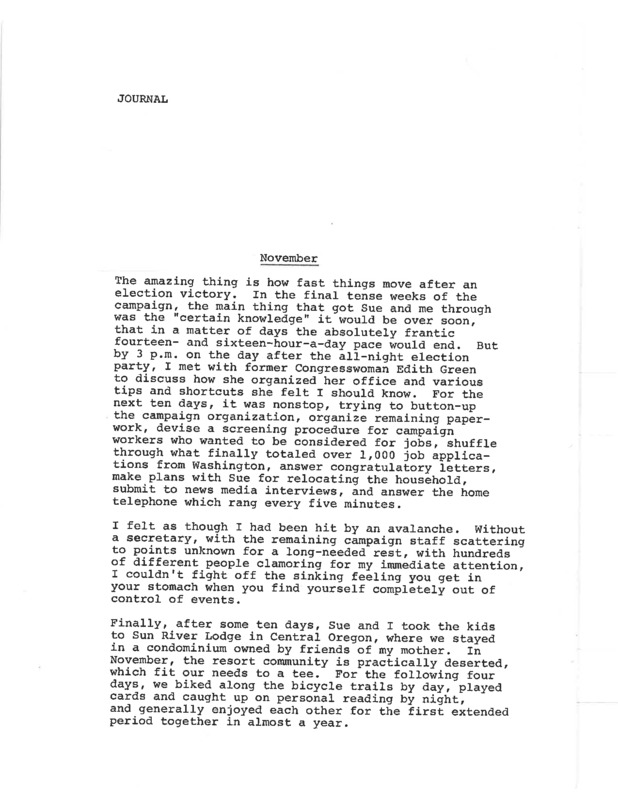
US Congressman Les AuCoin's 37-page-long journal describing the immediate months following his win in the 1974 US House of Representatives election. Providing a picture of how Congress operates behind the scenes, AuCoin writes in detail about his transition from Oregon to Washington, D.C.; the process of hiring congressional staff; attending the Democratic mini-Convention in Kansas City; him, his wife Sue, and their children Stacy and Kelly moving into a condominium apartment in Washington, D.C. from their house in Forest Grove, Oregon; the attention he received from the media and fellow politicians; the four-day train trip through America's heartland; his swearing-in ceremony on the US House floor; attending President Gerald Ford's State of the Union address; his first markup session in the Banking, Currency, and Housing Committee; his first time successfully legislating with the Emergency Middle-Income Housing Act in the Housing Subcommittee; scheduling town meetings back home for his constituents, writing a letter to one of his campaign staff's sons to encourage him to finish high school; his first embassy party with his wife Sue at the West Germany embassy; and congressional discussions on the Vietnam Humanitarian Assistance and Evacuation Act of 1975. On the Democratic Party in 1975, AuCoin stated: "All of which means, in my judgement, that there must be a new dogma in the Democratic Party -- a new impetus for cost-consciousness and performance accountability in government programs. The old pork chop vote of the New Deal days is gone forever. You just can't spend a million dollars for this, or that -- or create a new federal office for this, or that -- and win the hearts and minds of the voters in either party today.... People just distrust government -- they distrust its morality and ethics and they distrust its ability to solve problems....Certainly, the party cannot thrive in the '70s and '80s if, intellectually, it's still serving warmed-over New Dealism."
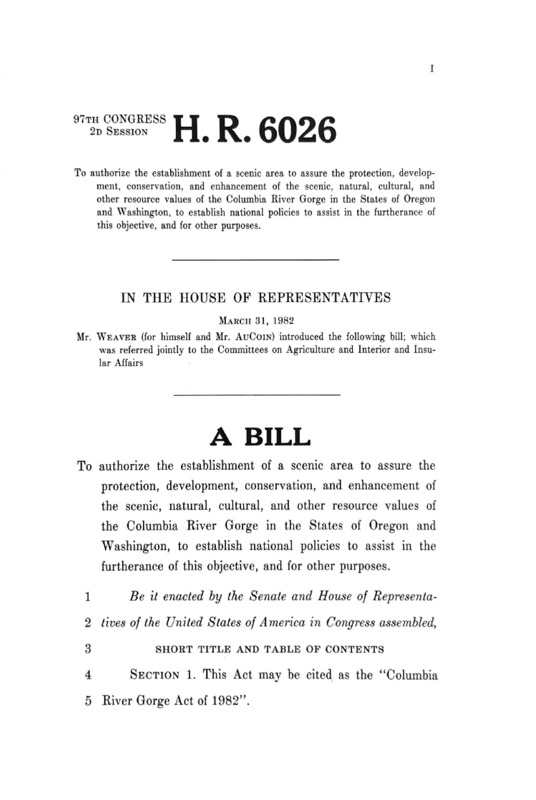
A photocopy of HR6026, the Columbia River Gorge Act of 1982. The bill was introduced by Representative James Weaver and supported by Representative Les AuCoin in the U.S. 97th Congress but never passed. A similiar bill introduced by Rep. Weaver passed and became law in 1986 in the 99th Congress as HR5705, the Columbia River Gorge National Scenic Area Act.
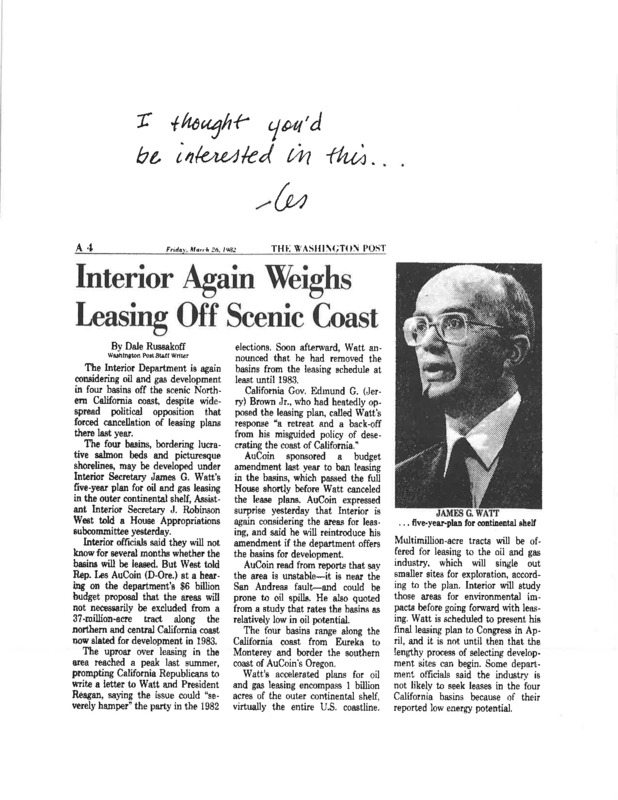
A Washington Post newspaper article clipping titled "Interior Again Weighs Leasing Off Scenic Coast" by Dale Russakoff published on March 26, 1982. The article describes the Interior Department's controversial consideration of allowing oil and gas development off of the Northern California coast. It notably mentions US Congressman Les AuCoin and his attempts to introduce legislation to ban leasing in the basins, with the article describing that "AuCoin read from reports that the area is unstable -- it is near the San Andreas fault -- and could be prone to oil spills. He also quoted from a study that rates the basins as relatively low in oil potential."
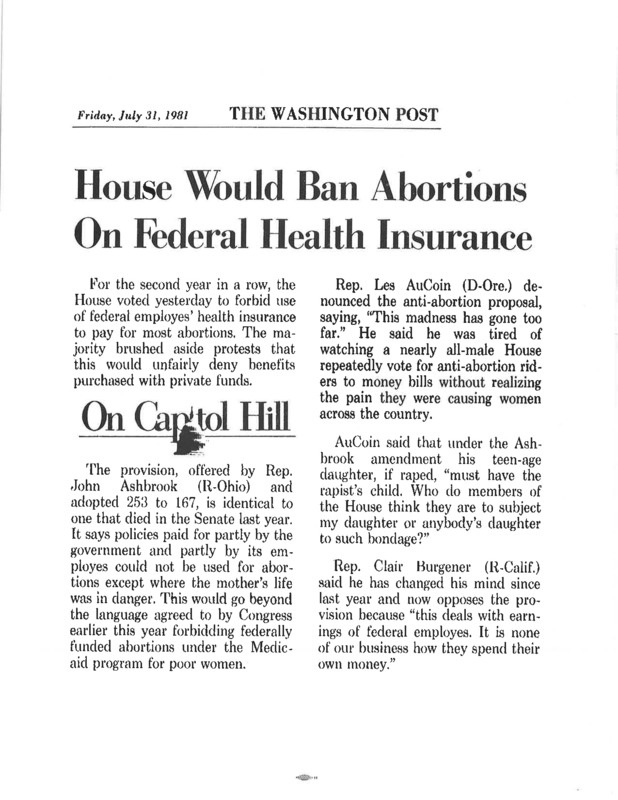
An excerpt of a Washington Post news article titled "House Would Ban Aborttions on Federal Health Insurance," published on July 31, 1981. The article describes how a bill introduced by Congressman John Ashbrook had prohibited federal employees from using their government provided health insurance to purchase abortions. The article also notes how Congressman Les AuCoin condemned the bill, stating "This madness has gone too far....Who do members of the House think they are to subject my daughter or anybody's daughter to such bondage?"
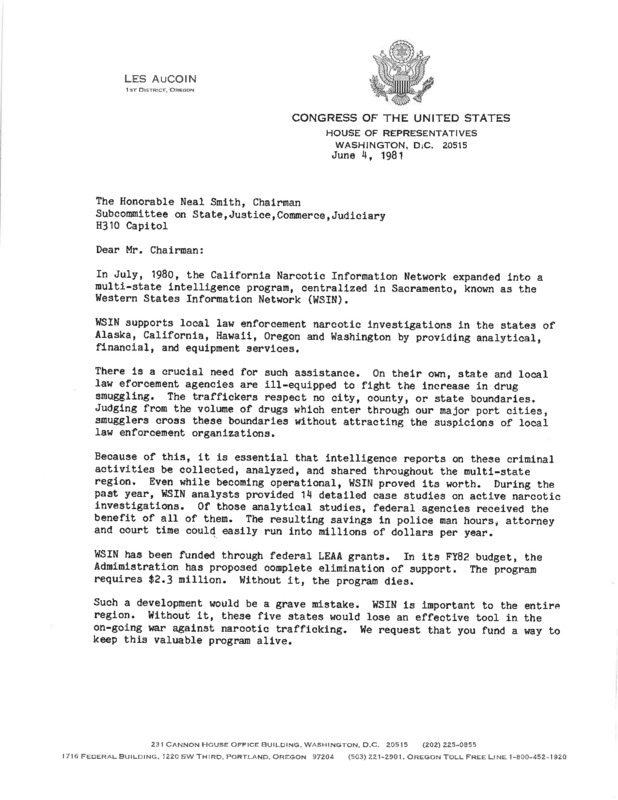
The rough draft of a letter to Chairman Neal Smith of the Subcommittee on State, Justice, Commerce, and Judiciary, from several US representatives advocating for the Western States Information Network (WSIN) to be included in the fiscal year 1982 federal budget following the news that the Reagan Administration planned to eliminate monetary support for the organization. The letter was dated June 4, 1981, and states that WSIN was crucial in supporting "local law enforcement narcotic investigations in the states of Alaska, California, Hawaii, Oregon, and Washington by providing analytical, financial, and equipment services."