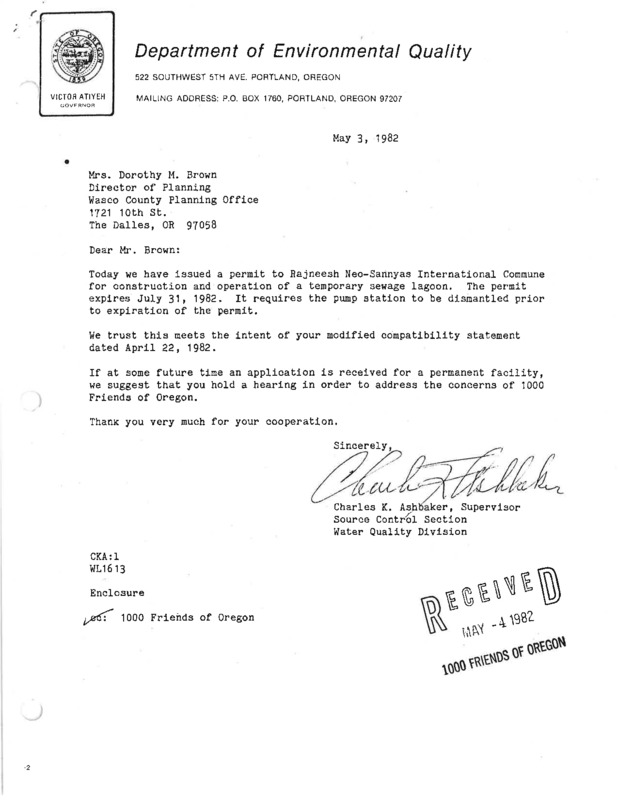
A May 3, 1982 letter from Charles K. Ashbaker, Supervisor of the Department of Environmental Quality (DEQ) Source Control Section, to Dorothy M. Brown, Director of Planning for Wasco County. The letter states that the DEQ had issued a permit to the Rajneesh Neo-Sannyas International Commune for construction and operation of a temporary sewage lagoon, expiring July 31, 1982. Ashbaker states that the permit required the pump station to be dismantled before the permit expired and suggests that Wasco County hold a hearing if an application was later received for a permanent facility.
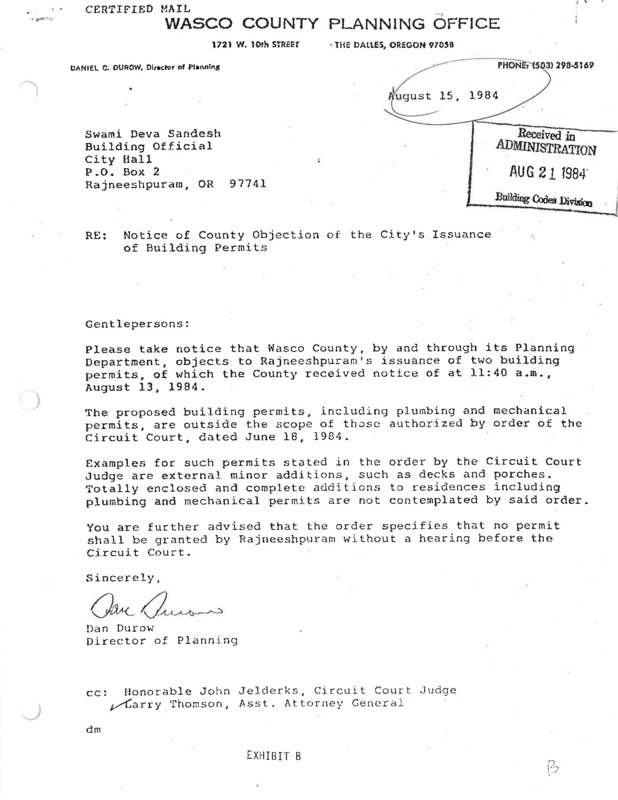
An August 15, 1984 certified mail letter from Dan Durow, Director of Planning for Wasco County, to Swami Deva Sandesh, Building Official for Rajneeshpuram. The letter states that Wasco County objected to Rajneeshpuram's issuance of two building permits, including plumbing and mechanical permits, which the county argued were outside the scope of a June 18, 1984 Circuit Court order. The letter states that the permits involved enclosed additions to residences rather than external minor additions such as decks and porches.
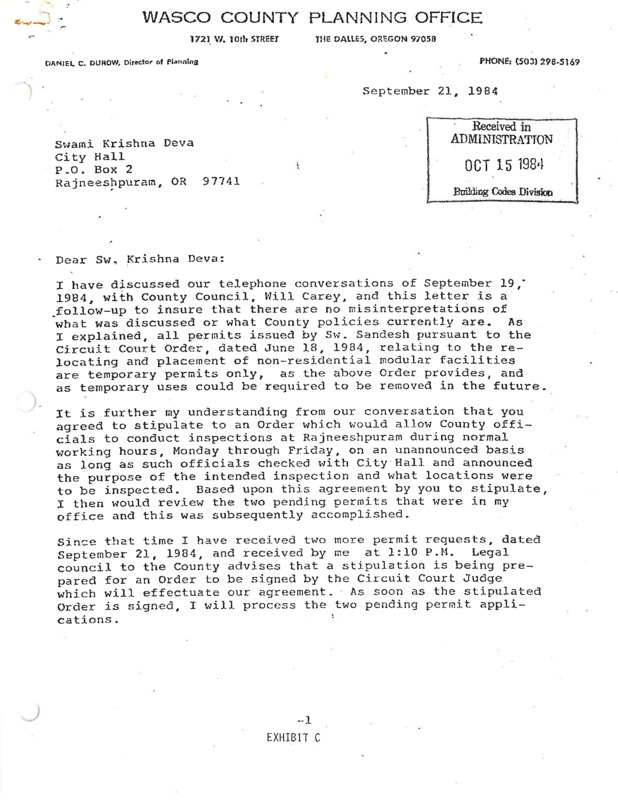
A September 21, 1984 letter from Dan Durow, Director of Planning for Wasco County, to Swami Krishna Deva of Rajneeshpuram. The letter follows up on telephone conversations about temporary permits issued under a June 18, 1984 Circuit Court order for the relocation and placement of non-residential modular facilities. Durow discusses an agreement allowing county officials to conduct unannounced inspections at Rajneeshpuram during normal working hours, pending permits, and the county's position that further permits would not be approved until a stipulated court order was signed.
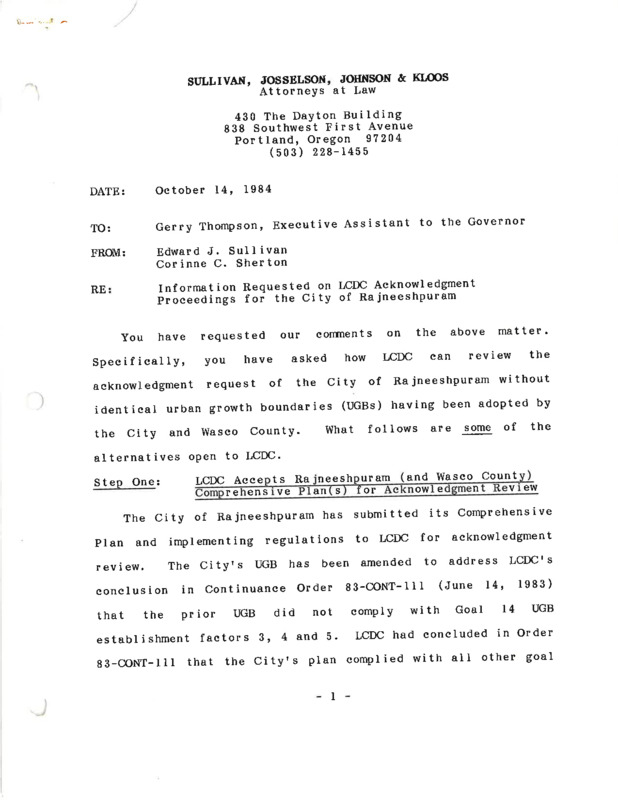
A seven-page October 14, 1984 memo from Edward J. Sullivan and Corinne C. Sherton to Gerry Thompson regarding Oregon's Land Conservation and Development Commission acknowledgment of proceedings for the City of Rajneeshpuram. The memo discusses how the LCDC could review Rajneeshpuram's acknowledgment request without identical urban growth boundaries having been adopted by the city and Wasco County. Topics include Rajneeshpuram's comprehensive plan, Wasco County's role, Goal 14, urban growth boundaries, limited acknowledgment orders, and possible LCDC action.
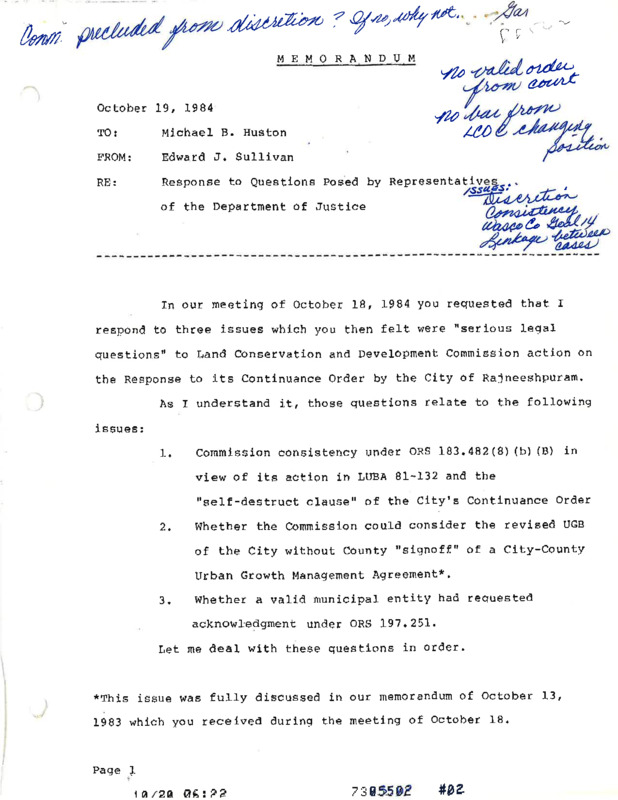
A thirteen-page October 19, 1984 memorandum from Edward J. Sullivan to Michael B. Huston regarding questions posed by representatives of the Department of Justice. The memo responds to legal questions concerning Land Conservation and Development Commission action on the City of Rajneeshpuram's response to a continuance order. Topics include consistency in LCDC decision-making, the revised urban growth boundary, city-county urban growth management issues, and whether a valid municipal entity had requested acknowledgment under Oregon land use law.
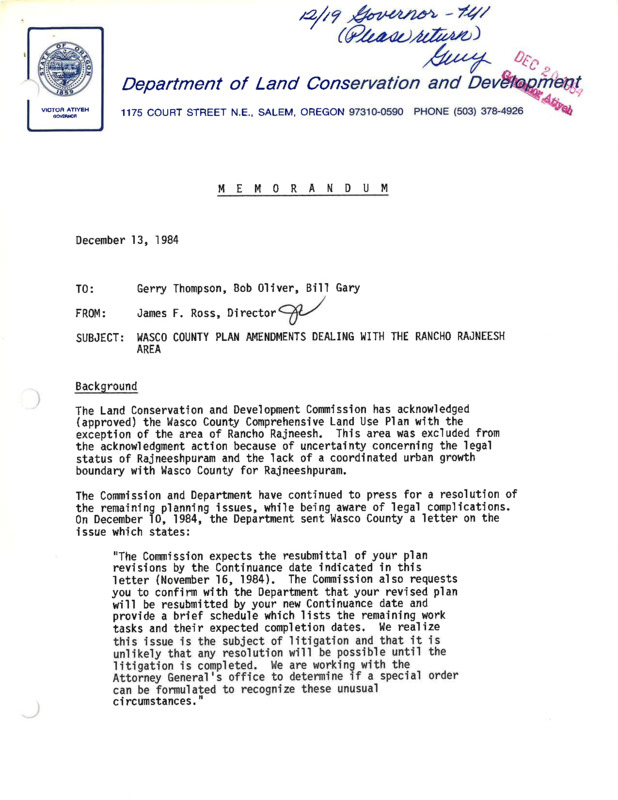
A two-page December 13, 1984 Department of Land Conservation and Development memo from James F. Ross to Gerry Thompson, Bob Oliver, and Bill Gary regarding Wasco County plan amendments dealing with the Rancho Rajneesh area. The memo discusses the uncertain legal status of Rajneeshpuram, Wasco County's comprehensive land use plan, post-acknowledgment amendments, urban growth boundary issues, pending litigation, and the department's cautious advice to the county.
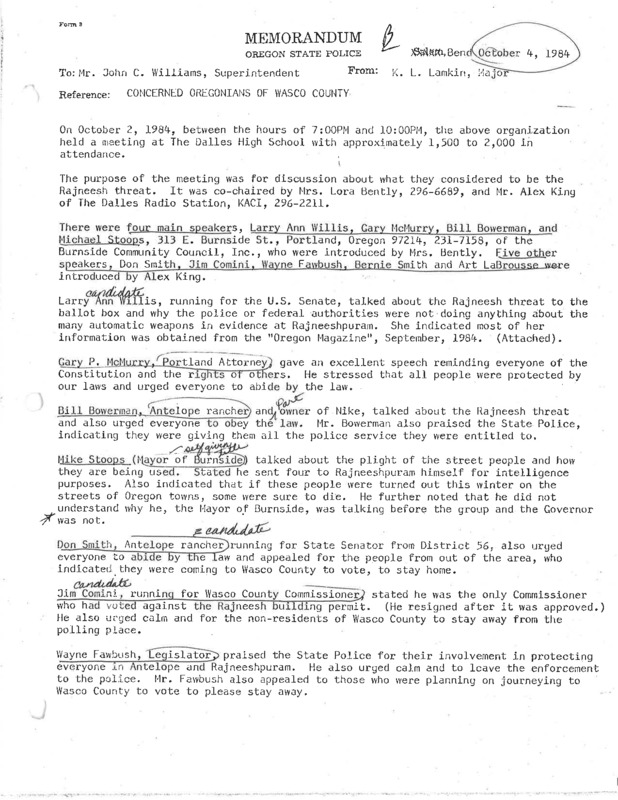
An October 4, 1984 Oregon State Police memorandum from Major K. L. Lamkin to Superintendent John C. Williams regarding a meeting of Concerned Oregonians of Wasco County held at The Dalles High School on October 2, 1984. The memo states that approximately 1,500 to 2,000 people attended the meeting, which concerned what participants viewed as the Rajneesh threat. Speakers discussed voting laws, firearms, "street people," law enforcement, and concerns about state and federal responses to the Rajneesh situation.
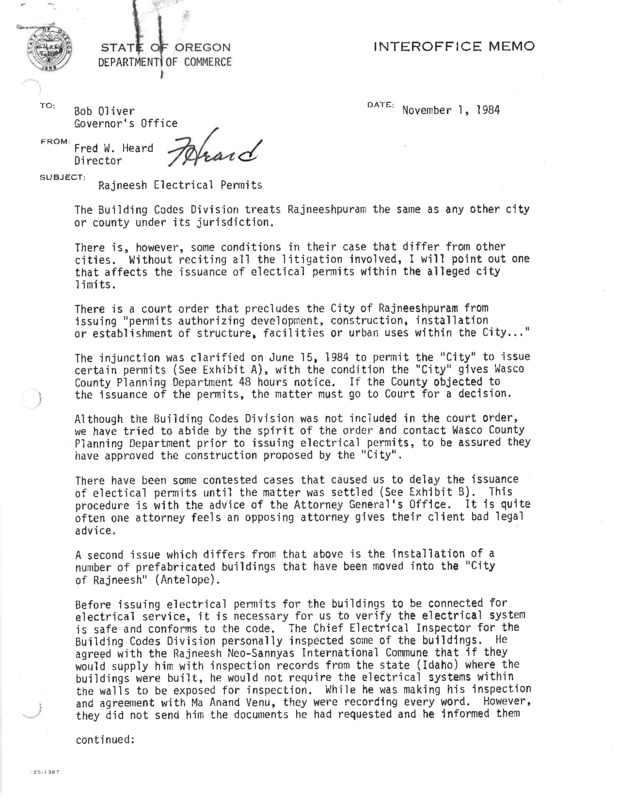
A two-page November 1, 1984 State of Oregon Department of Commerce interoffice memo from Fred W. Heard to Bob Oliver regarding Rajneesh electrical permits. The memo discusses Building Codes Division procedures for issuing electrical permits in Rajneeshpuram and Antelope, including the effect of court orders on permits within the alleged city limits, communication with the Wasco County Planning Department, and electrical permit issues involving prefabricated buildings moved into the City of Rajneesh. Heard states that electrical permits would be issued in the standard manner except where affected by court orders. The memo refers to attachments, but they are not included in this scan.
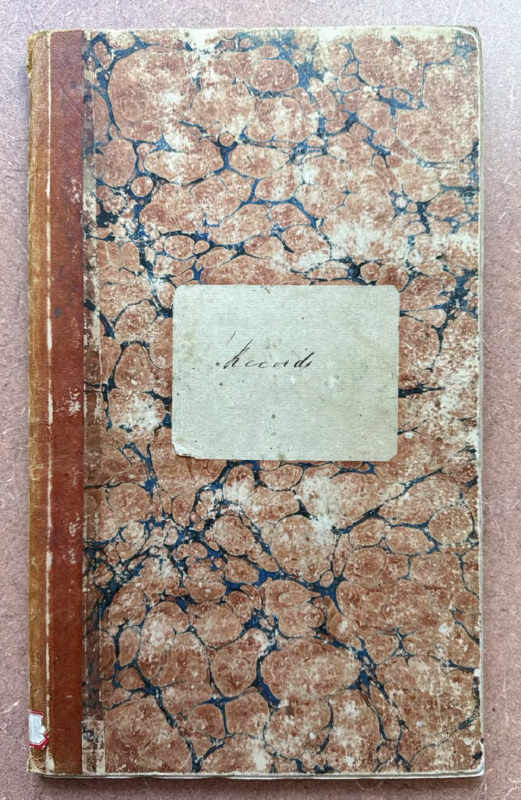
A handwritten notebook by John Smith Griffin of Oregon, relating to his ministerial work in what is now western Washington County between 1841-1853. Griffin was one of the earliest white settlers on the "Tualatin Plains," an area that now includes the towns of Hillsboro, Forest Grove, North Plains and Cornelius. While living between what is now the Glencoe neighborhood and the airport in Hillsboro, he served as a minister to many of the earliest immigrant families in the area, including several of mixed Native-European ancestry who were connected to the fur trade. After establishing what would eventually become the First Congregational Church of Forest Grove, he was removed as minister in favor of Reverend Harvey Clark circa 1845. During the 1840s, Griffin also participated in the Champoeg Meetings which established the first Euro-American government in Oregon, and operated one of the earliest printing presses in the state. He died in 1899.
The notebook's contents include: "Record of Land Claim" regarding Griffin's land near the Glencoe neighborhood of Hillsboro; -- "Record of Marriages by J. S. Griffin", describing the names, dates and locations of marriages he performed between 1842-1858; -- "Last will and testament" of Jacob Green; -- "Births in Tualatin Plains" documenting several births that occurred between 1842-1843; -- "Contract with James Belieu[?]" regarding an agreement to work for Griffin for one year beginning in 1845; -- "Record of Lucy Doughty's relation to us" documenting Griffin's guardianship over Lucy, the daughter of William Doughty, which was to continue until she turned 18 (note: Lucy Doughty was of Shoshone heritage through her mother; the journal also shows that the guardianship was terminated early); -- "Record of the Dissolution of the Mission in South Tualatin, Dec. 26th, 1842" describing splitting of the partnership between Alvin T. Smith and Harvey Clark, when they terminated their intention to found a mission to the Tualatin/Atfalati tribe in what is now the south side of Forest Grove in 1842; -- "Letters sent out of Oregon since 1840" listing dates and addressees of letters Griffin mailed between 1840-1850; -- Contract with John Davis in which Davis agreed to work for Griffin for 6 months in 1844; -- "Record of a resolution" Griffin attempted to offer at the Champoeg Meetings in 1843; -- "Record of Parish Library" listing books apparently owned by the Congregational Church of Tualatin Plains circa 1850.
Blank pages have been omitted from the scan. Note that while Griffin apparently intended to include a section titled "Settlers," he did not enter any information on those pages.
An interview of Peter Wong regarding Oregon's Governor Victor Atiyeh, recorded on August 4, 2015. Wong was a journalist who covered Oregon politics for over forty years while working for the Salem Statesman Journal and other newspapers. The interviewer, James Moore, was as professor of political science at Pacific University and was Atiyeh's biographer.
An interview of Judge Michael Sullivan regarding Oregon's Governor Victor Atiyeh, recorded on Sep. 8, 2015. Sullivan was the District Attorney of Jefferson County during the Rajneesh Crisis of the 1980s. The interviewer, James Moore, was as professor of political science at Pacific University and was Atiyeh's biographer.
An interview of Norm Smith regarding Oregon's Governor Victor Atiyeh, recorded on Apr. 28, 2015. Smith served as a Republican in the Oregon House of Representatives from 1979-1983. The interviewer, James Moore, was as professor of political science at Pacific University and was Atiyeh's biographer.
An interview of Tom Kennedy regarding Oregon's Governor Victor Atiyeh, recorded on Jan. 18, 2017. Kennedy served under Atiyeh as Director of Oregon's Economic Development Department. He also accompanied Atiyeh on at least one trade trip to East Asia. The interviewer, James Moore, was as professor of political science at Pacific University and was Atiyeh's biographer. This is one of two interviews between Moore and Kennedy; see also PUA_MS161_039.
An interview of Phil Keisling regarding Oregon's Governor Victor Atiyeh, recorded on Feb. 23, 2015. Keisling was a journalist during part of Atiyeh's governorship, and later served in the Oregon House of Representatives from 1989-1991, and as Oregon's Secretary of State from 1991-1999. The interviewer, James Moore, was as professor of political science at Pacific University and was Atiyeh's biographer.
An interview of former Oregon Governor Victor Atiyeh, recorded on June 3, 2014. The interviewer, James Moore, was a professor of political science at Pacific University and was Atiyeh's biographer. This was one of several interviews Moore conducted with Governor Atiyeh. Note: Atiyeh was 91 years old at the time of this recording; he died less than two months afterwards. His voice is relatively faint and thin compared to earlier recordings.
An interview of former Oregon Governor Victor Atiyeh, recorded on March 26, 2014. The interviewer, James Moore, was a professor of political science at Pacific University and was Atiyeh's biographer. This was one of several interviews Moore conducted with Governor Atiyeh. Note: Atiyeh was 91 years old at the time of this recording; he died about four months afterwards. His voice is relatively faint and thin compared to earlier recordings.
An interview of former Oregon Governor Victor Atiyeh, recorded on January 2, 2014. The interviewer, James Moore, was a professor of political science at Pacific University and was Atiyeh's biographer. This was one of several interviews Moore conducted with Governor Atiyeh. Note: Atiyeh was nearly 91 years old at the time of this recording; he died about six months afterwards. His voice is relatively faint and thin compared to earlier recordings.
An interview of former Oregon Governor Victor Atiyeh, recorded on December 19, 2013. The interviewer, James Moore, was a professor of political science at Pacific University and was Atiyeh's biographer. This was one of several interviews Moore conducted with Governor Atiyeh.
A video produced by Pacific University student Dean Croshere (Class of 2007), telling the history of Pacific's mascot, Boxer. Croshere, who serves as the narrator, interviews alumni from the classes of 1949-2008 regarding the original Boxer statue as well as Boxer II. Footage of a 1991 "Toss" involving Boxer II and scans of many historic photographs are also included.
Interviewees appearing on the video include: Ken Little (Class of 1951, Phi Beta Tau); Norm Larabee (Class of 1956, Phi Beta Tau); Lee Drew (Class of 1949, Phi Beta Tau; Bernie Cooper (Class of 1951, Phi Beta Tau); Rod Gilillan (Class of 1956, Gamma Sigma); Darrell Mapston (Class of 1972, Gamma Sigma); Jeff Grundon (Class of 1980 and later, Admissions Director); Billy Merck (Class of 1998); Greg McDaniel (Class of 2008, Gamma Sigma); and Pacific University President Phil Creighton.
This video was originally on a DVD produced in 2007. It was converted to MP4 format in 2025.
A 9 minute videorecording of Pacific University alumni from the 1930s-1960s, created by producer John Waller in 2007-2008. Alumni recount their memories of Pacific University during their time as students. Topics covered include: how students chose and came to Pacific; memories of President Giersbach; football games; the original "Boxer" mascot statue; dormitory life; and what Pacific meant to the alumni. Interviewees include: Kenneth Bragg (Class of 1945) and Margaret Bragg (1946); Fred Scheller (1943, MA 1954, Faculty); Dorothy Main (1935) and Kathy White (1963); Burton Huggett (1949, MSED 1956) and Margaret Huggett (1949, MA 1956); Del Judy (1946, MA ED 1975); Forrest Bump (1942) and Rosemary Bump (1960).
The video footage was recorded on June 21, 2007. Pacific University commissioned the video production company Uncage the Soul to "capture the heart of the Golden Guard experience at Pacific University and tell the story of the life and times of Pacific University during that generation" (as quoted from notes supplied by Pacific's Alumni Department). The company, led by producer John Waller, then edited the recordings into this short documentary video, which was completed in 2008. The title "Golden Guard" refers to Pacific University's honorary society for alumni who completed their time as students 50 or more years ago. Originally on DVD, the video has been converted to MP4 format for preservation purposes.
Butch Berquist, Ed Phillips, Jim MacMillan and Scott Harwood oral history interview on the Tualatin Valley Harmony Masters (TVHM) and Forest Grove’s barbershop history, recorded July 21, 2025 at the Friends of Historic Forest Grove Old Train Station Museum in Forest Grove, Oregon. Elle Griego, the interviewer, was a History and French undergraduate student at Pacific University from 2022-2026.
Tim Schauermann oral history interview on the Gay Nineties and Barbershop Ballad Contest, recorded June 26, 2025 at the Friends of Historic Forest Grove Old Train Station Museum in Forest Grove, Oregon. Elle Griego, the interviewer, was a History and French undergraduate student at Pacific University from 2022-2026.
Rosanna Steiner oral history interview on the Gay Nineties and Barbershop Ballad Contest, recorded June 12, 2025 at the Friends of Historic Forest Grove Old Train Station Museum in Forest Grove, Oregon. Elle Griego, the interviewer, was a History and French undergraduate student at Pacific University from 2022-2026.
Myra Beeler, Laura Frye, Jerry Frye, Jane Romig, and Peggy Alexander oral history interview on the Gay Nineties and Barbershop Ballad Contest, recorded July 11, 2025 at the United Church of Christ in Forest Grove, Oregon. Elle Griego, the interviewer, was a History and French undergraduate student at Pacific University from 2022-2026.