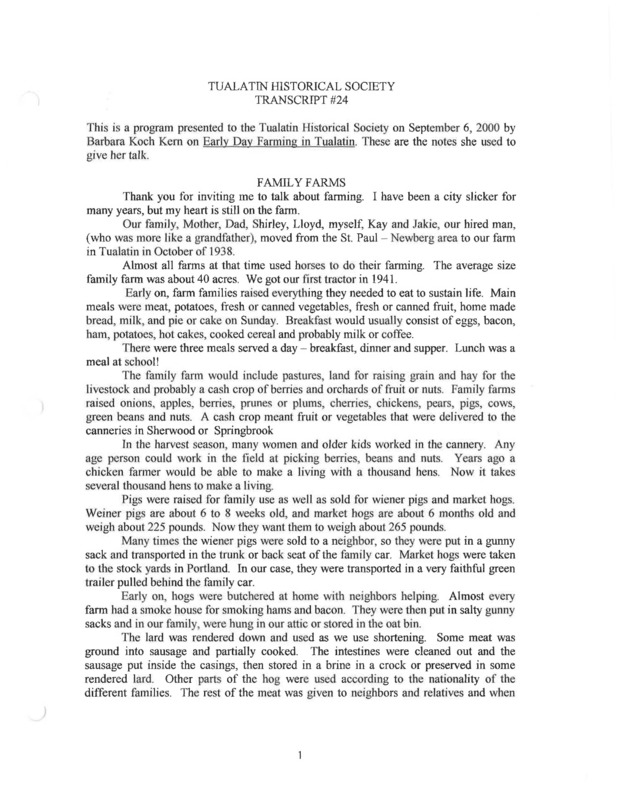
A transcript of a talk by Barbara Koch Kern on farming when she was growing up in Tualatin, Oregon, in the 1930s-1950s. Topics include: typical farm meals; division of farm lands into pasture, grain land and cash crop land; raising and butchering hogs; dairies; growing onions and other vegetables for market; 'truck gardening' (packing vegetables for market onto trucks); selling farm goods at markets in Portland; threshing grain with horses and machines; the arrival of freezers and their impact on farming.
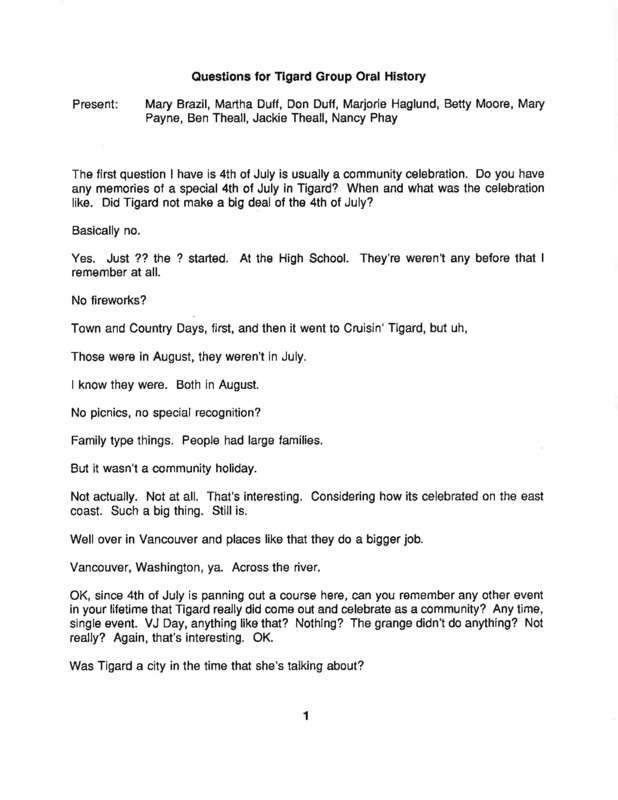
A transcript of an oral history of a group of nine long-time Tigard residents: Mary Brazil, Martha Duff, Don Duff, Marjorie Haglund, Betty Moore, Mary Payne, Ben Theall, Jackie Theall, and Nancy Phay. Individual speakers not identified in the transcript.
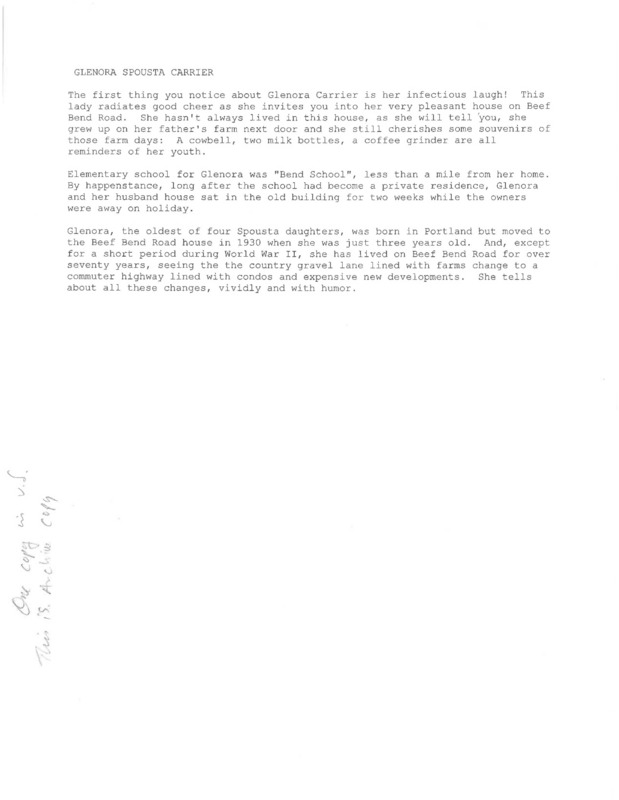
A transcript of an oral history of Glenora Spousta Carrier. Glenora discusses growing up in Tigard where she has lived for most of her life. She talks about her schooling, the community, and living on Beef Bend Road.
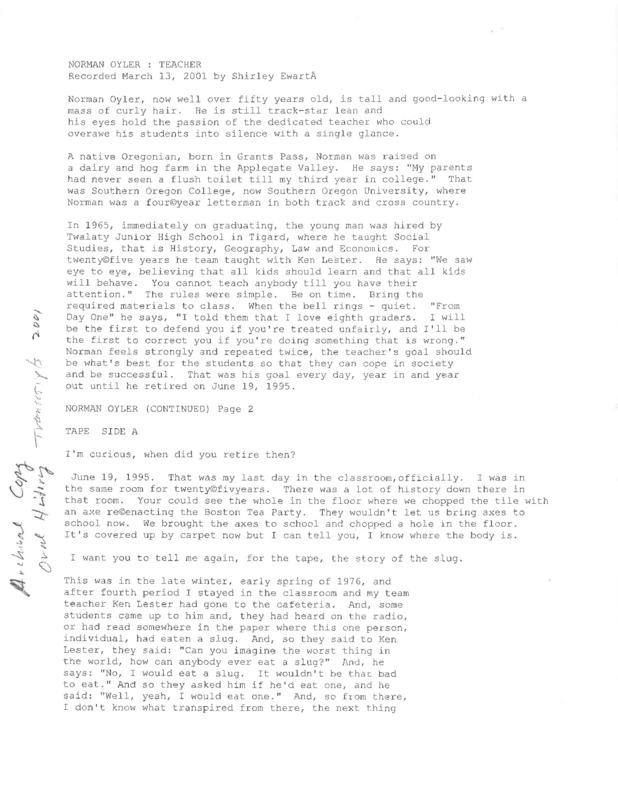
A transcript of an oral history of Norman Oyler, who started his teaching career at a junior high school in Tigard in 1965. Oyler reflects on his years of teaching and tells some unique stories that he has from his career.
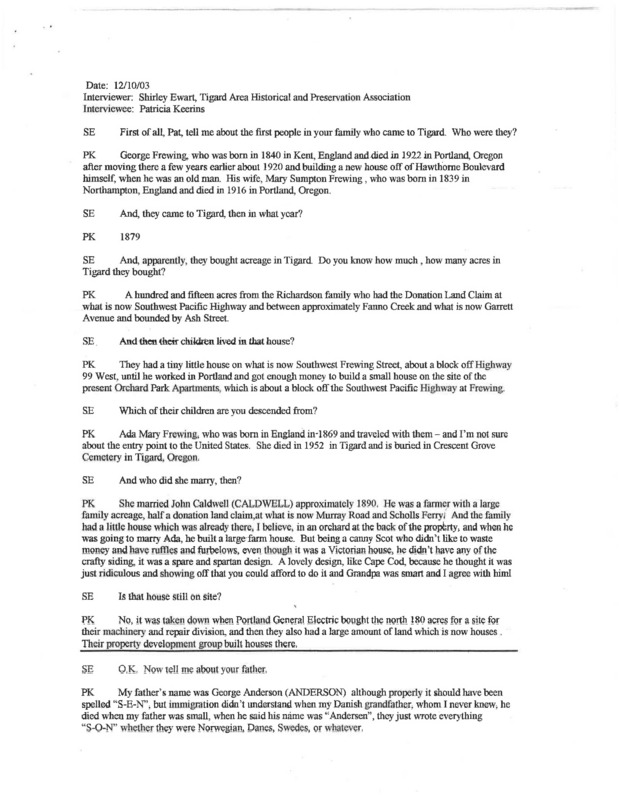
A transcript of an oral history of Patricia Keerins. She discusses living in the city of Tigard, how her family came to live in Tigard, her schooling, and watching the city grow over the years.
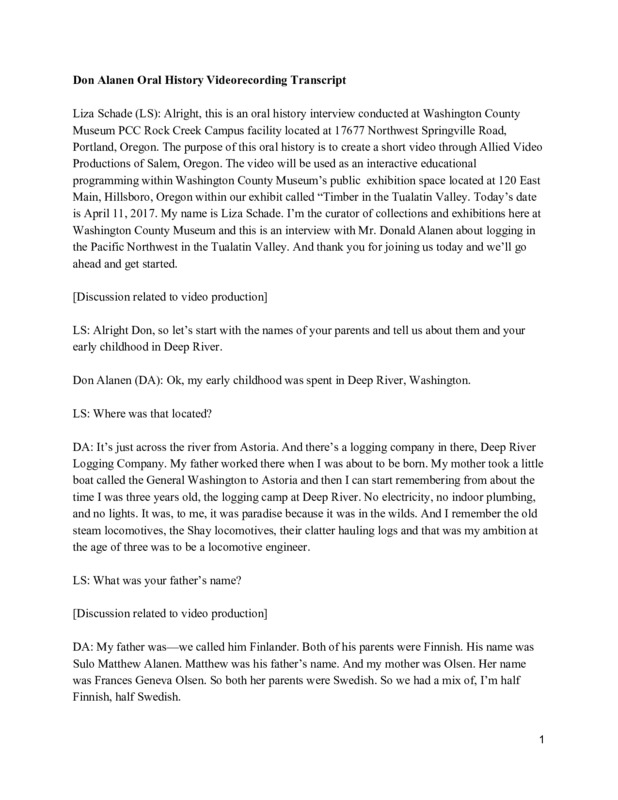
A videorecording of an oral history interview of Donald Alanen about his experience in logging communities in Deep River, Washington and Gales Creek, Oregon. Topics include: his father's Finnish immigrant background; his mother and women in the logging camps; the food and entertainment in the logging camps; Erickson's saloon in Portland; stores and banking for the loggers; the Tillamook Burn in the 1930s-1940s; seeing African Americans for the first time in the 1940s; evacuating Glenwood during a fire in 1945; his father's and grandfather's careers in logging; his own career in logging in the 1950s; changes in the logging industry over time; deaths and terrible injuries among loggers; unionization and the Wobblies. This oral history is accompanied by a transcript.
A video recording of a talk by an unidentified man. This talk was recorded for the 8th Air Force Historical Society, Oregon Chapter, based in Beaverton.
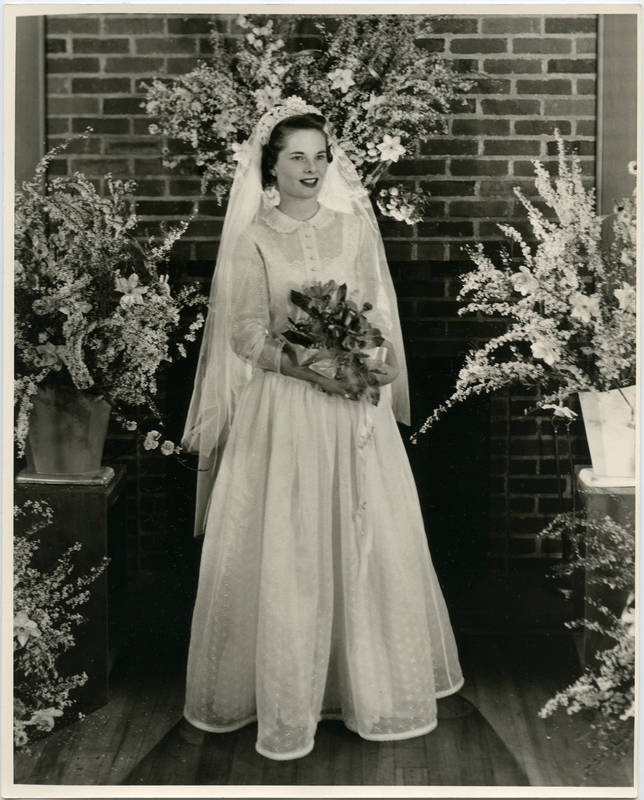
Black and white image of a young woman in a bridal gown, standing in front of a brick fireplace and surrounded by large bouquets of flowers. Her dress appears to made of sheer eyelet, and features a full, long skirt and a button-up blouse with a small, rounded collar and long sleeves. A double veil hands from her beaded, floral headpiece, and she holds a bouquet of large flowers. Her chin-length hair is softly curled and pulled back from her face. This image is part of the Herbert E. McMullen bequest. McMullen was a local photographer; he owned Hillsboro Studio and also collected photographs taken in the area by other photographers.
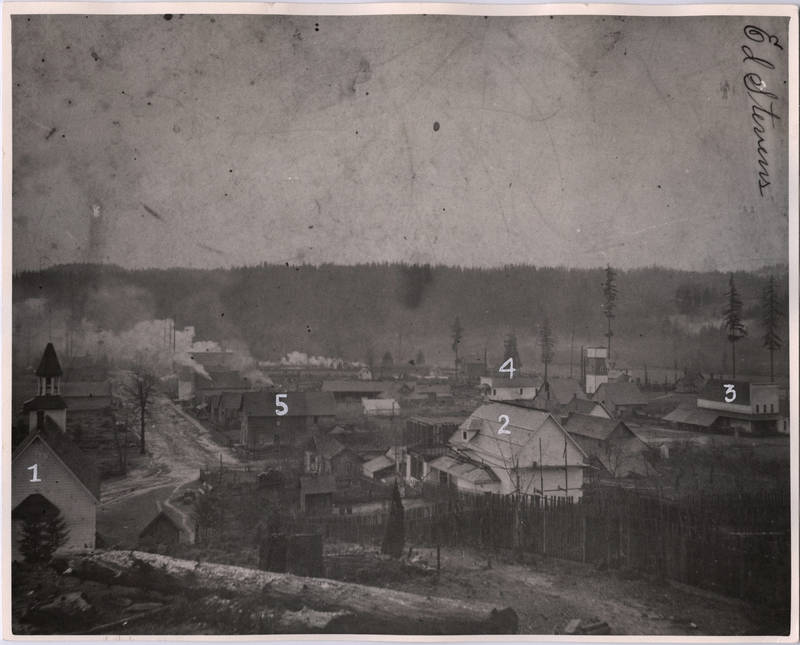
Photo of a town. Streets appear to be muddy and wet, and a path runs along a post and pole fence down from the foreground of the image into the town. A boardwalk runs partially along one side of the street in the foreground. A number of houses and buildings are visible, several with smoke coming from their chimneys. All appear to be wooden construction. Bare-branched and evergreen trees are scattered throughout the buildings. A number of buildings are numbered in white, identified by the legend on the back of the photo. Number one is a church, with a steep gabled roof and a steeple. Number two is a two-story building, white, with a single-story extension and a covered porch area extending from the first floor and a small dormer window on the far end of the roof. Scaffolding has been attached to the end of the building. Number three is a two-story gabled building, long, with a square store front with three double-hung windows above an awning-style roofline that runs above the first story of the building. This extends to a salt-box like roof on the back of the building. Number four is a long, single-story building, with a square front and a covered porch. Number five is a dark colored, gabled building with two visible stories. It is surrounded by a plank fence, and appears to have two entrances, one on the narrower front facing the road and one on the side of the building. Two double-hung windows appear on the second floor, and the door on the side is bracketed by a second pair of windows. Smoke is visible from the chimney towards the front of the building.
Dr. Baldmire sent this photo to Pacific University from Boston, Massachusetts in the early 1900s. The back of the photo says he was part of the Braille Society.
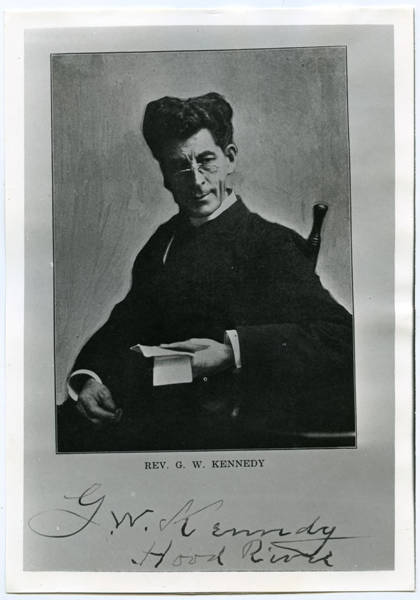
Pacific University graduate Reverend George Washington Kennedy in the 1900s. Kennedy was from Hood River, Oregon, but he was born in Illinois in September 1847. Kennedy traveled to Oregon from Illinois with his parents by ox team and wagon when he was a child. As an adult he preached at the Methodist Episcopal Church in Baker County, Oregon. Later, Kennedy returned to Hood River and was a Methodist minister and had a small farm near Ruthton Hill. He died on May 11, 1926 and is buried at the Idlewilde Cemetery in Hood River.
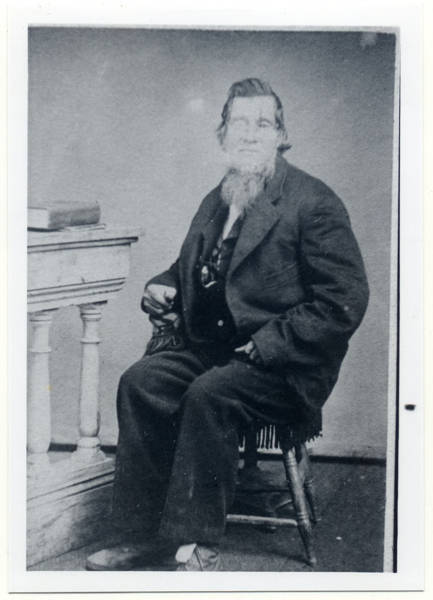
Copy of a portrait of Orus Brown, the son of Reverend Clark and Tabitha Brown, in his Sunday best. He came to Oregon between 1843 and 1846 and settled in Washington County. This photograph was most likely taken in the 1860s or 1870s. Text on back: "Orus Brown 1800-1874 (in his Sunday best) / Original held by Mrs. Ernestine Davidson. Copy provided by Craig A. Smith Salem, Ore 9-30-78"
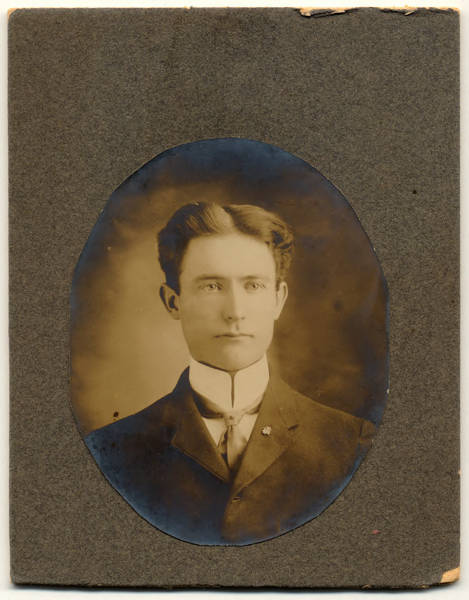
Copy of a portrait of Victor Emmanuel Emmel, from Schools, Oregon, who graduated from Pacific University in 1903 and went on to study at Brown University. After graduating with a Ph. D. in 1906 he taught 'Histology and Embryology' at Washington University in St. Louis, Missouri. There is a newspaper article about him pasted to the back of the photograph.
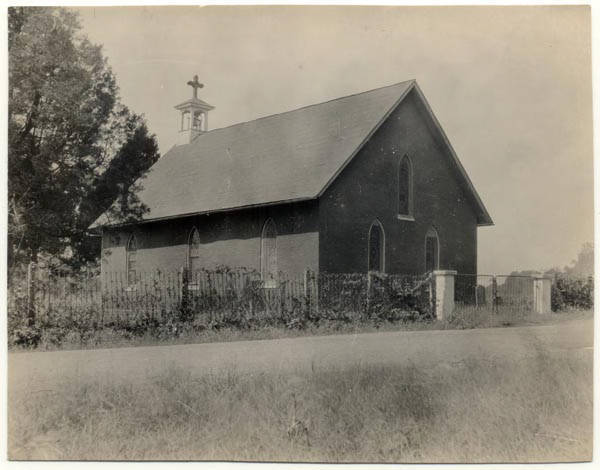
The Christ Church in Wayside (Newberg), Maryland is still standing today. This church is linked to Tabitha Brown, who helped found the Tualatin Academy which became Pacific University. Brown's husband Reverend Clark Brown is buried on the church grounds. The back of the photo reads As we parked the car on our left and looked back, this is the view we found.The church is red brick with a fireproof roof - gray, as I remember.
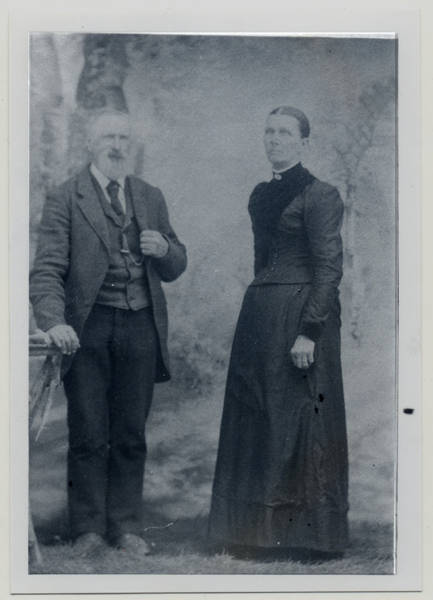
John Q. Zachary, 1827-1896, traveled overland to Oregon in 1843. John, along with his father Alexander Zachary, took out land donation claims in Washington County. Alexander owned Five Oaks Farm near West Union, Oregon. John's wife Theresa (Brown) Zachary, 1833-1908, was the granddaughter of Tabitha Brown, founder of Tualatin Academy. Theresa helped Tabitha with her first school. She traveled overland to Oregon in 1845. She is buried in Fossil, Oregon. Photo was taken in Fossil on September 30, 1878.