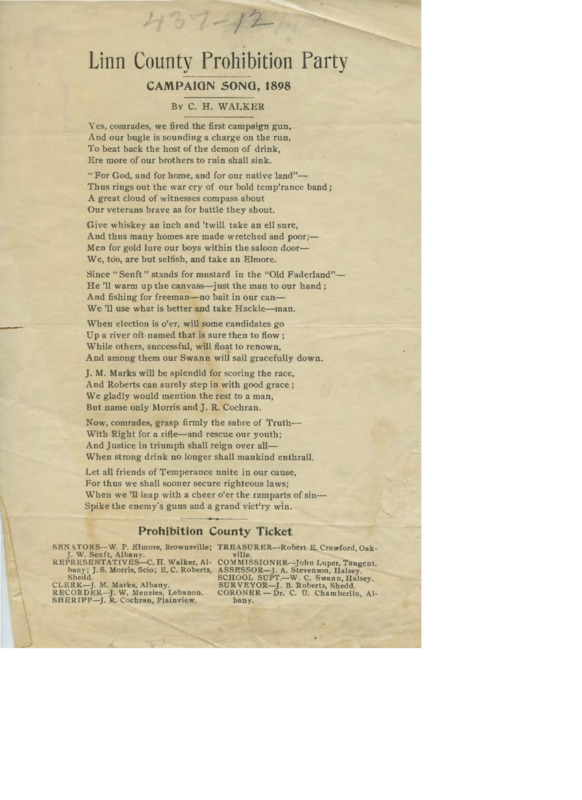
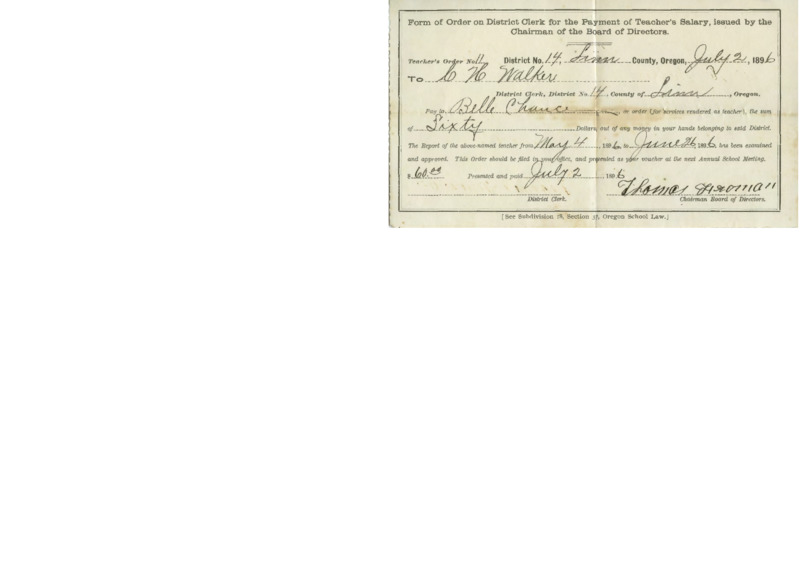
Cyrus Walker was the oldest son of the early Oregon Territory missionaries Elkanah and Mary Richardson Walker. He grew up at Tshimakain in the 1830s-40s, where he learned the native Spokane language. After joining the U.S. army during the Civil War and then attempting to make a living as a farmer, he became a teacher at the Warm Springs Indian Agency. These letters, documents and clippings shed light on his experiences as a missionary, a soldier, a pioneer and a teacher at Warm Springs. This collection was donated to Pacific University by Betty Thorne, a descendant of the Walkers.
Cyrus Walker was the oldest son of the early Oregon Territory missionaries Elkanah and Mary Richardson Walker. He grew up at Tshimakain in the 1830s-40s, where he learned the native Spokane language. After joining the U.S. army during the Civil War and then attempting to make a living as a farmer, he became a teacher at the Warm Springs Indian Agency. These letters, documents and clippings shed light on his experiences as a missionary, a soldier, a pioneer and a teacher at Warm Springs. This collection was donated to Pacific University by Betty Thorne, a descendant of the Walkers.
Cyrus Walker was the oldest son of the early Oregon Territory missionaries Elkanah and Mary Richardson Walker. He grew up at Tshimakain in the 1830s-40s, where he learned the native Spokane language. After joining the U.S. army during the Civil War and then attempting to make a living as a farmer, he became a teacher at the Warm Springs Indian Agency. These letters, documents and clippings shed light on his experiences as a missionary, a soldier, a pioneer and a teacher at Warm Springs. This collection was donated to Pacific University by Betty Thorne, a descendant of the Walkers.
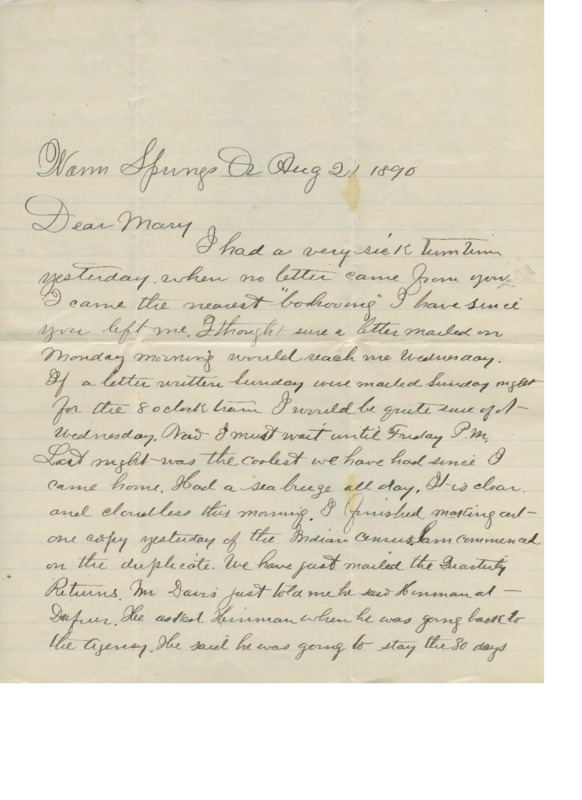
A letter from Cyrus Walker to his wife, Mary Wheeler Walker. At the time, Cyrus was a clerk at the Warm Springs Indian Agency, and his wife and their child were living temporarily in another county. Cyrus describes creating a final copy of the annual Indian Census, school employees, and other Agency business.
Cyrus Walker was the oldest son of the early Oregon Territory missionaries Elkanah and Mary Richardson Walker. He grew up at Tshimakain in the 1830s-40s, where he learned the native Spokane language. After joining the U.S. army during the Civil War and then attempting to make a living as a farmer, he became a teacher at the Warm Springs Indian Agency. These letters, documents and clippings shed light on his experiences as a missionary, a soldier, a pioneer and a teacher at Warm Springs. This collection was donated to Pacific University by Betty Thorne, a descendant of the Walkers.
A letter from Cyrus Walker to his wife, Mary Wheeler Walker. At the time, Cyrus was a clerk and school teacher at the Warm Springs Indian Agency, and his wife and their child were living temporarily in another county. Cyrus describes trying to persuade Native families at Warm Springs to leave their younger children at the on-reservation boarding school. The Native families apparently had been planning to bring their children with them as they took part in seasonal hop-picking work. He reports the words of one Native man in Chinook Jargon mixed with English: "Wake close wawa copa school okok Sun. Okok sure Sunday. Pose tomorrow wawa hear close." (Approximate translation: "Not good to talk about school today. [Maybe?: Let's talk Sunday.] I suppose tommorow we'll talk/hear well enough." The next day, the Native man said that he would go hop-picking and Cyrus thought that there would likely not be many students enrolled in school when it started.
Cyrus Walker was the oldest son of the early Oregon Territory missionaries Elkanah and Mary Richardson Walker. He grew up at Tshimakain in the 1830s-40s, where he learned the native Spokane language. After joining the U.S. army during the Civil War and then attempting to make a living as a farmer, he became a teacher at the Warm Springs Indian Agency. These letters, documents and clippings shed light on his experiences as a missionary, a soldier, a pioneer and a teacher at Warm Springs. This collection was donated to Pacific University by Betty Thorne, a descendant of the Walkers.
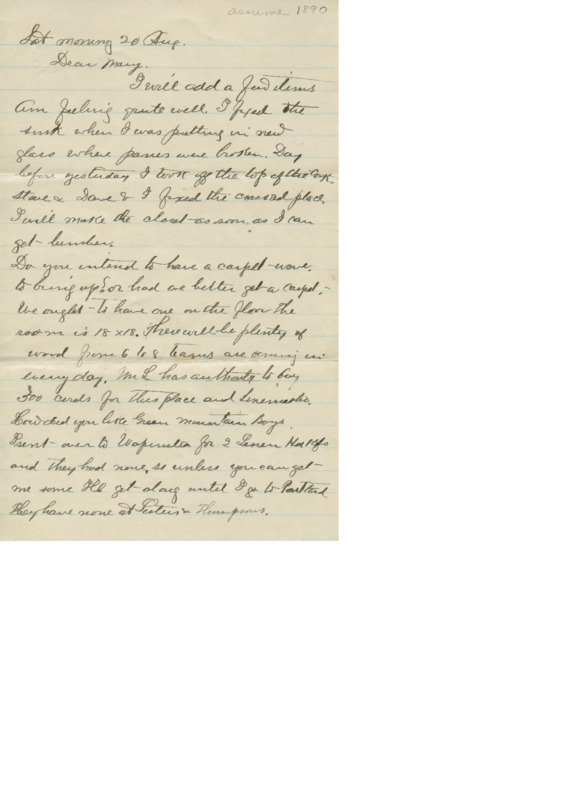
A letter from Cyrus Walker to his wife, Mary Wheeler Walker. At the time, Cyrus was a clerk at the Warm Springs Indian Agency, and his wife and their child were living temporarily in another county. The letter describes some house renovations and also the departure of the Agency doctor, "Dr. S." Cyrus Walker was the oldest son of the early Oregon Territory missionaries Elkanah and Mary Richardson Walker. He grew up at Tshimakain in the 1830s-40s, where he learned the native Spokane language. After joining the U.S. army during the Civil War and then attempting to make a living as a farmer, he became a teacher at the Warm Springs Indian Agency. These letters, documents and clippings shed light on his experiences as a missionary, a soldier, a pioneer and a teacher at Warm Springs. This collection was donated to Pacific University by Betty Thorne, a descendant of the Walkers.
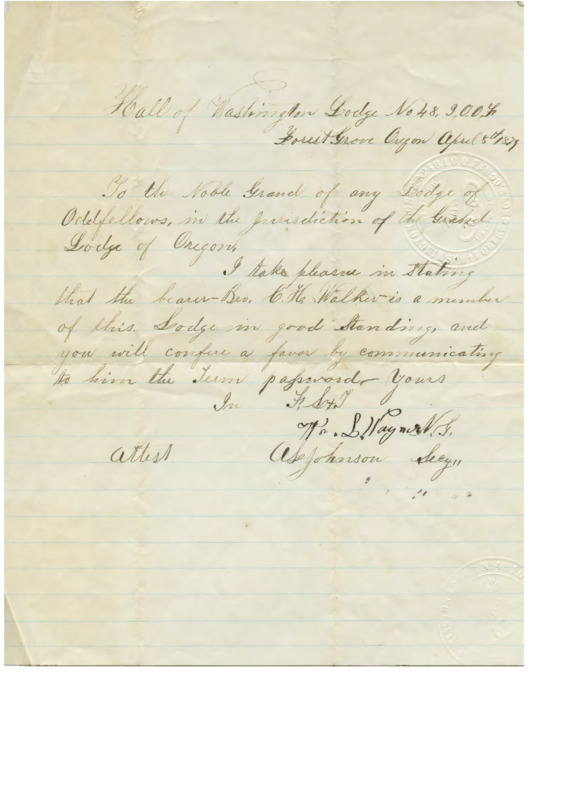
The Washington Lodge of the Oddfellows, which was in Forest Grove, issued this letter of introduction for Cyrus Walker in order to allow him to attend other Oddfellows' meetings within the state of Oregon.
Cyrus Walker was the oldest son of the early Oregon Territory missionaries Elkanah and Mary Richardson Walker. He grew up at Tshimakain in the 1830s-40s, where he learned the native Spokane language. After joining the U.S. army during the Civil War and then attempting to make a living as a farmer, he became a teacher at the Warm Springs Indian Agency. These letters, documents and clippings shed light on his experiences as a missionary, a soldier, a pioneer and a teacher at Warm Springs. This collection was donated to Pacific University by Betty Thorne, a descendant of the Walkers.
Cyrus Walker was the oldest son of the early Oregon Territory missionaries Elkanah and Mary Richardson Walker. He grew up at Tshimakain in the 1830s-40s, where he learned the native Spokane language. After joining the U.S. army during the Civil War and then attempting to make a living as a farmer, he became a teacher at the Warm Springs Indian Agency. These letters, documents and clippings shed light on his experiences as a missionary, a soldier, a pioneer and a teacher at Warm Springs. This collection was donated to Pacific University by Betty Thorne, a descendant of the Walkers.
Cyrus Walker was the oldest son of the early Oregon Territory missionaries Elkanah and Mary Richardson Walker. He grew up at Tshimakain in the 1830s-40s, where he learned the native Spokane language. After joining the U.S. army during the Civil War and then attempting to make a living as a farmer, he became a teacher at the Warm Springs Indian Agency. These letters, documents and clippings shed light on his experiences as a missionary, a soldier, a pioneer and a teacher at Warm Springs. This collection was donated to Pacific University by Betty Thorne, a descendant of the Walkers.
Cyrus Walker was the oldest son of the early Oregon Territory missionaries Elkanah and Mary Richardson Walker. He grew up at Tshimakain in the 1830s-40s, where he learned the native Spokane language. After joining the U.S. army during the Civil War and then attempting to make a living as a farmer, he became a teacher at the Warm Springs Indian Agency. These letters, documents and clippings shed light on his experiences as a missionary, a soldier, a pioneer and a teacher at Warm Springs. This collection was donated to Pacific University by Betty Thorne, a descendant of the Walkers.
Cyrus Walker was the oldest son of the early Oregon Territory missionaries Elkanah and Mary Richardson Walker. He grew up at Tshimakain in the 1830s-40s, where he learned the native Spokane language. After joining the U.S. army during the Civil War and then attempting to make a living as a farmer, he became a teacher at the Warm Springs Indian Agency. These letters, documents and clippings shed light on his experiences as a missionary, a soldier, a pioneer and a teacher at Warm Springs. This collection was donated to Pacific University by Betty Thorne, a descendant of the Walkers.
Cyrus Walker was the oldest son of the early Oregon Territory missionaries Elkanah and Mary Richardson Walker. He grew up at Tshimakain in the 1830s-40s, where he learned the native Spokane language. After joining the U.S. army during the Civil War and then attempting to make a living as a farmer, he became a teacher at the Warm Springs Indian Agency. These letters, documents and clippings shed light on his experiences as a missionary, a soldier, a pioneer and a teacher at Warm Springs. This collection was donated to Pacific University by Betty Thorne, a descendant of the Walkers.
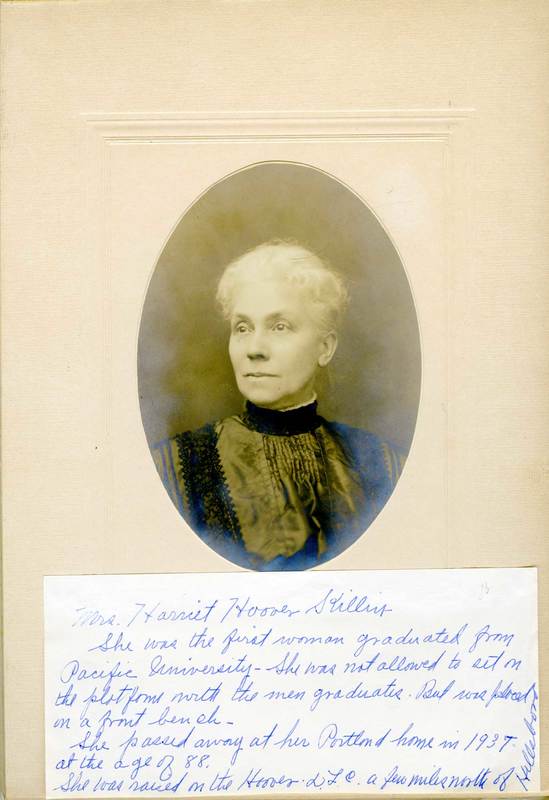
Harriet Hoover Killin was the first woman to graduate from Pacific University in 1869. The photo in this exhibit is one that was taken in 1937 when she was 88. It is believed that she is some how related to Herbert Hoover, because they both have family ties in Oregon.
Something important to note, is during graduation, classes were so small, every person was expected to give a speech. She was not allowed because she was a woman. Harriet Hoover Killin brought in a new wave to Pacific, and started the trend for all the rest of the woman after her.
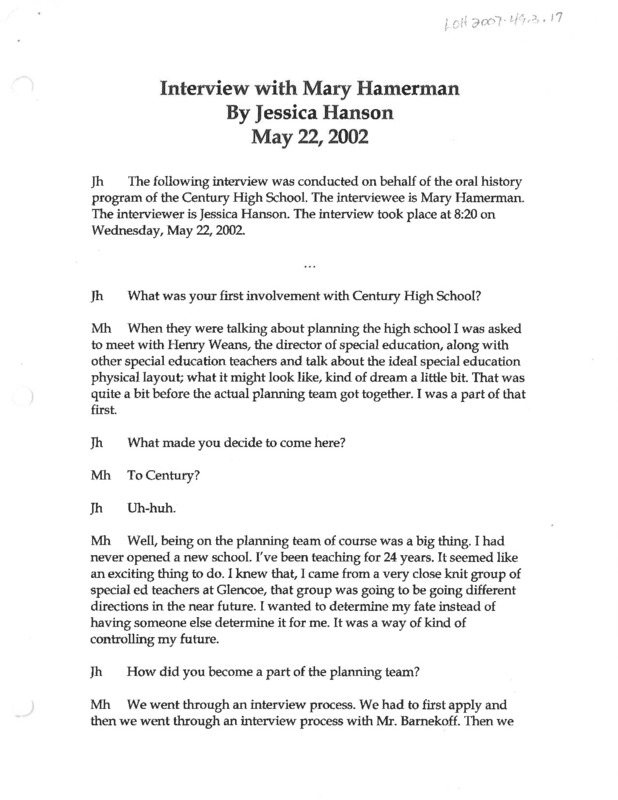
A transcript of an oral history of Mary Hamerman on Century High School. Ms. Hamerman was part of the planning team for Century High School. Prior to this she was a special education teacher at Glencoe High School. During the begining stages of the new high school, she was asked by the director of special education, Henry Weans, to help plan the physical layout of the special education department. Overall her vision was to integrate and not seperate, wanting all teachers teaching all kids.
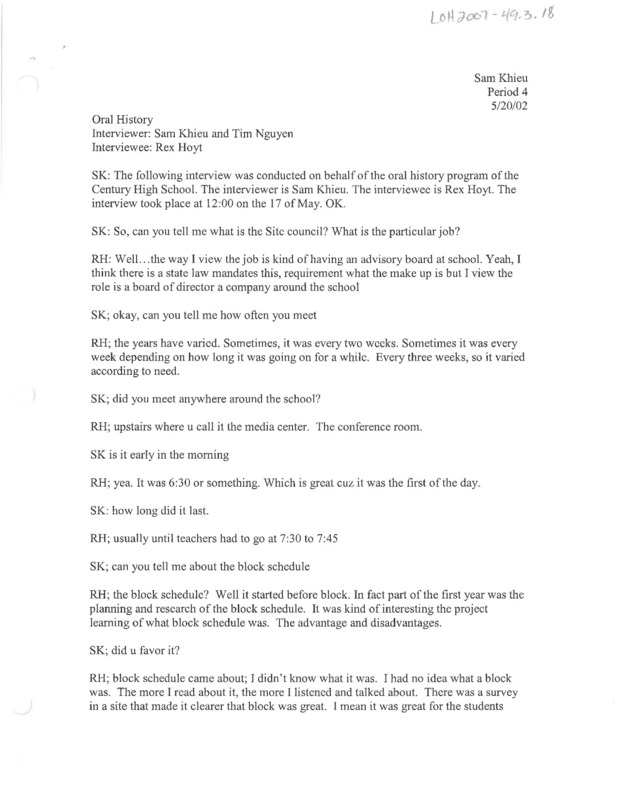
A transcript of an oral history of Rex Hoyt on Century High School. Rex Hoyt was one of the members of the site council for Century High School. The purpose of this council was to do the majority of the planning for the new high school, Mr. Hoyt specifically dealt a great deal with the research for the block schedule.
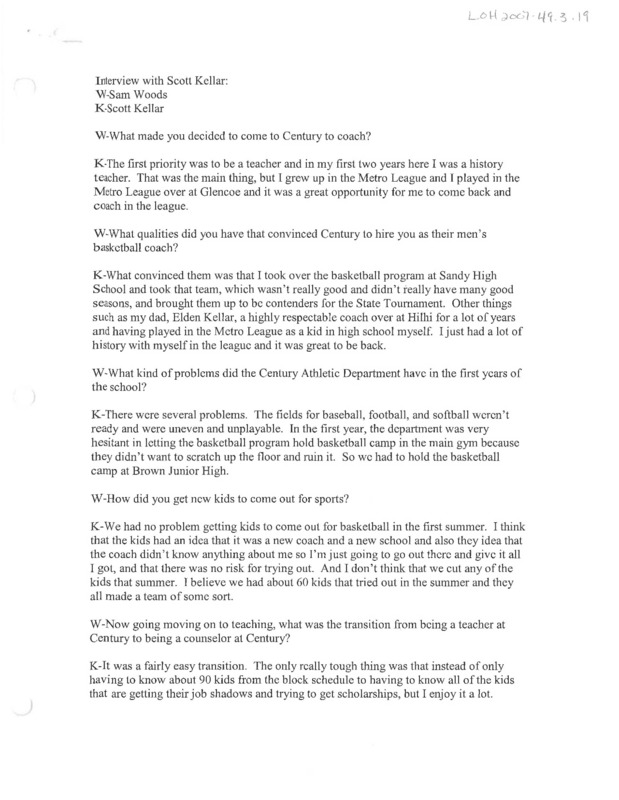
A transcript of an oral history of Scott Kellar on coaching men's basketball at Century High School. Scott Kellar began his time at Century High School as a history teacher and a men’s basketball coach. He previously had been a coach at Sandy High School. At the time of this interview, Scott Kellar was a counselor and a coach at Century High School.
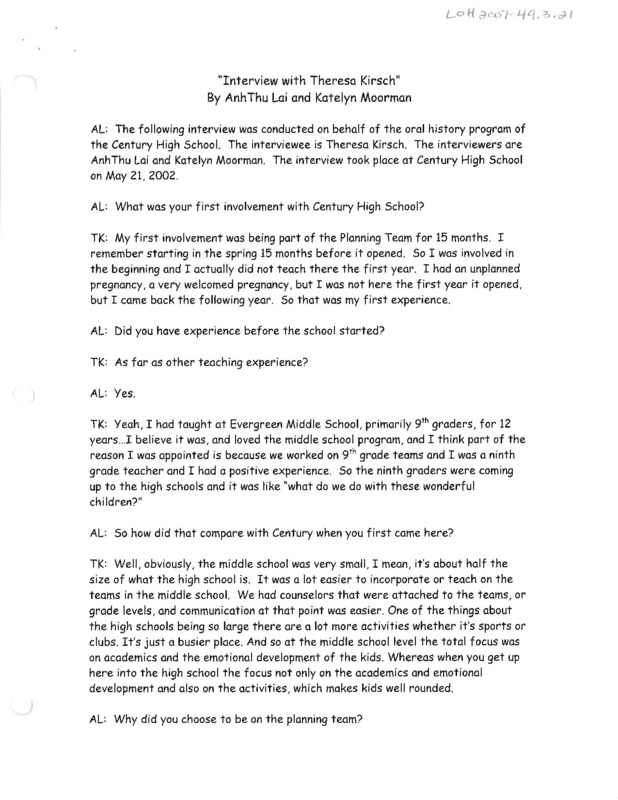
A transcript of an oral history of Theresa Kirsch on Century High School. Theresa Kirsch was on the planning team for Century High School. Before moving on to work at Century High School, she was teaching 9th graders at Evergreen Middle School. One of her goals for the new school was introducing an Interactive Math Program. Since opening, Century High School has focused on the CAM program, beginning with only three or four basic ones and having added Fame, Business, Health & Physiology, and Technology.
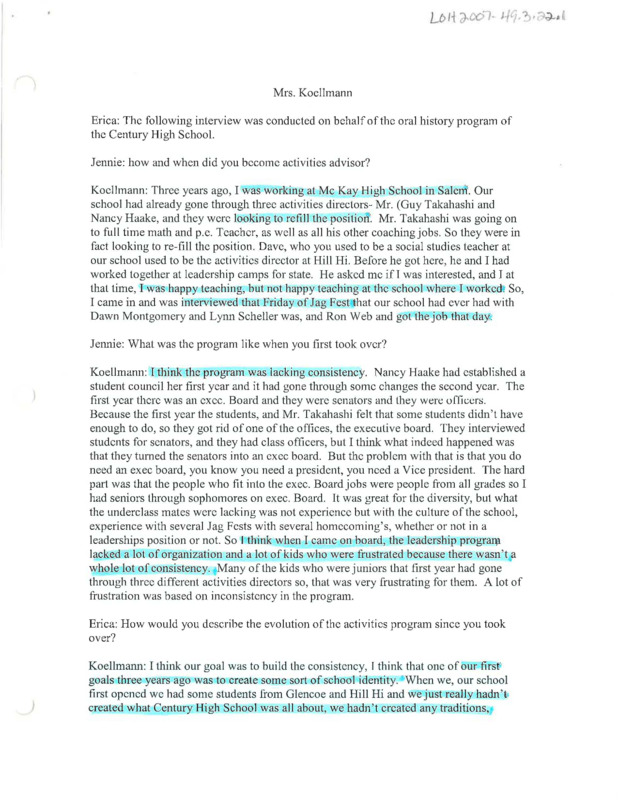
A transcript of an oral history of Mrs. Koellmann on being an advisor at Century High School. While working in Salem at McKay High School, Mrs. Koellmann was interviewed for the activities director position at Century High School. The interviewed was conducted with Dawn Montgomery, Lynn Scheller, and Ron Web and later in the day she was hired. The school had gone through three previous activities directors: Guy Takahashi, Nancy Haake, and Dave. As a result, her goal was to build consistency into the program and build school traditions.
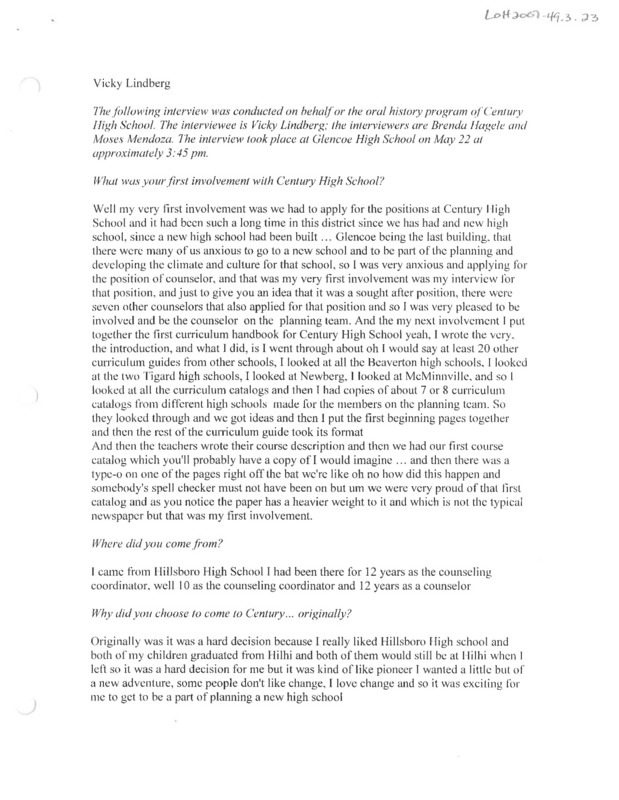
A transcript of an oral history of Vicky Lindberg on Century High School. Vicky Lindberg became the counselor on the planning team for Century High School and put together the first curriculum handbook. Earlier in her career she had been the counseling coordinator at Hillsboro High School for 10 years. During the interview she discusses the school’s diversity, the block schedule, as well as organizing curriculum and registration out of the district office with Mr. Barnekoff
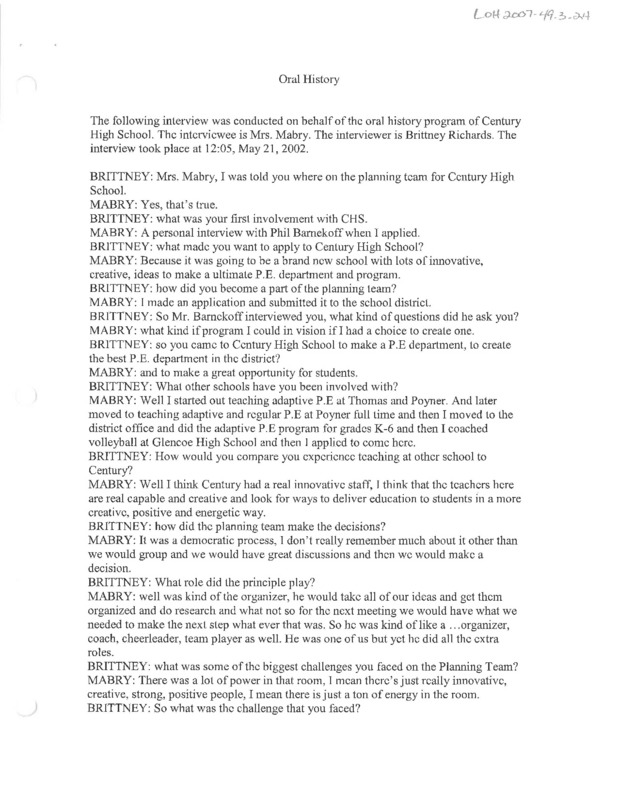
A transcript of an oral history of Mrs. Mabry on Century High School. Mrs. Mabry was hired by Phil Barnekoff with the intensive purpose of creating the Physical Education department at Century High School. Formerly, Mrs. Mabry had taught a form of adaptive physical education at Thomas and Poynter schools. Also throughout this time she coached volleyball at Glencoe High School. In the course of the interview, she recalls her experiences as part of the planning team as well as, working with other creative and like-minded individuals.
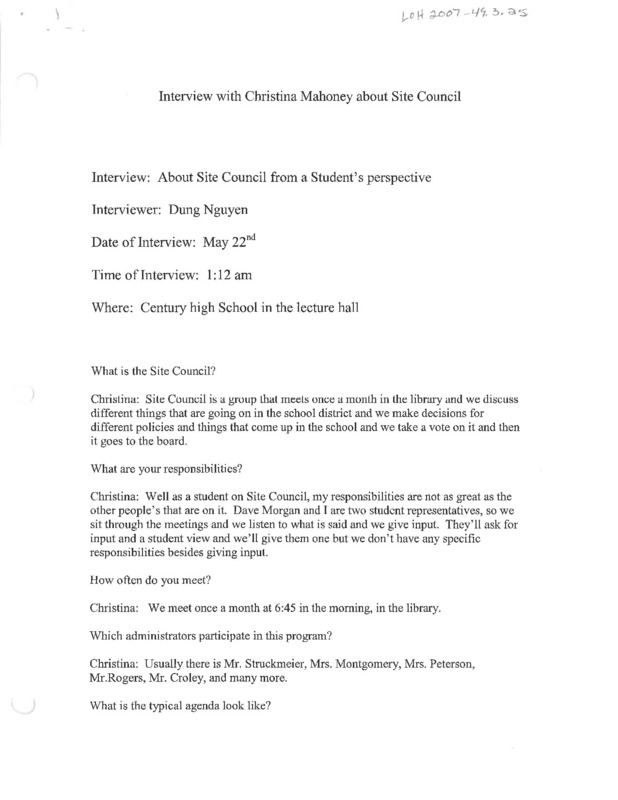
A transcript of an oral history of Christina Mahoney on Century High School Site Council. Miss Mahoney was at the time of the interview, a student representative along with Dave Morgan, on the Century High School Site Council. The responsibility and duties of these student representatives was to provide input from the student perspective. The administrators on the council are Mr. Struckmeier, Mrs. Montgomery, Mrs. Peterson, Mr. Croley, and others. For the duration of the interview, she discusses her role on the council and some decisions she has been involved in.