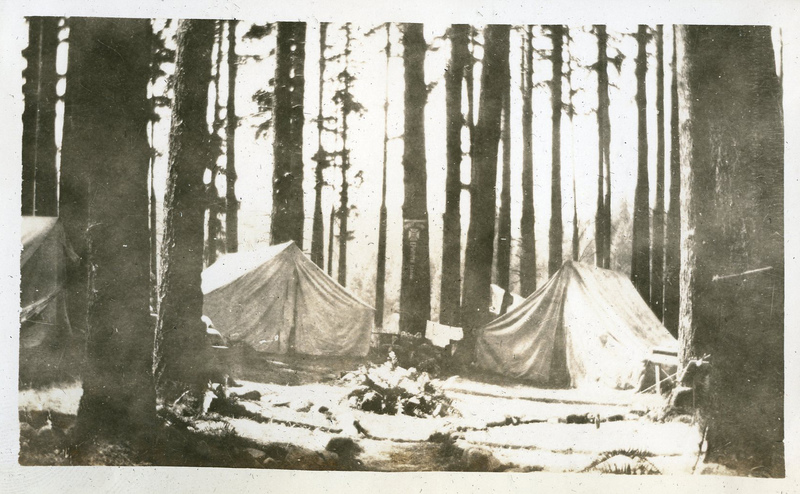
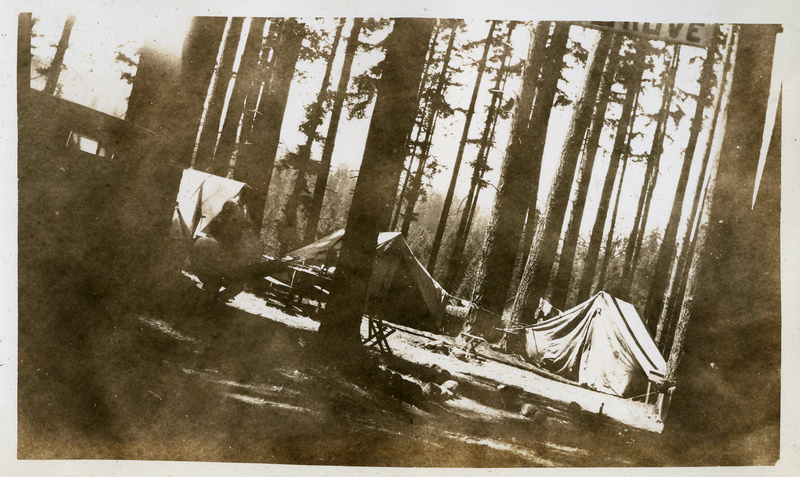
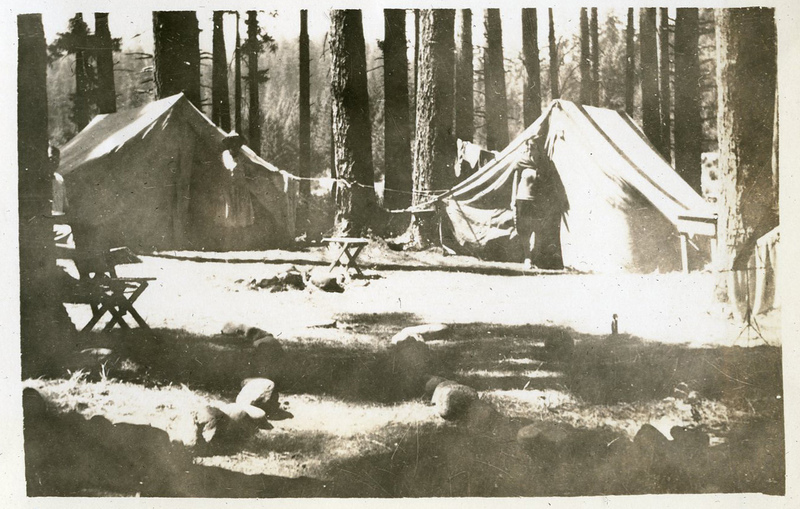
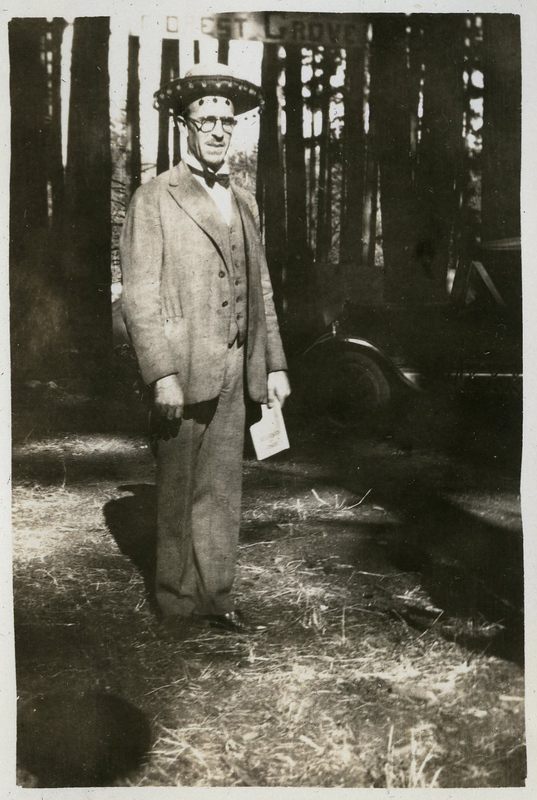
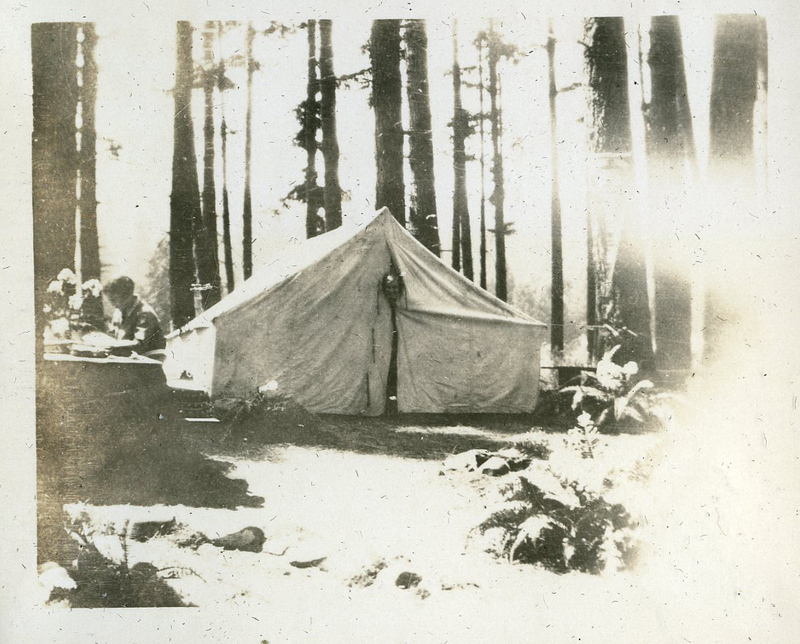
A photograph of the Forest Grove chapter of the Epworth League's campsite. The Epworth League was founded by Methodists in 1889 for young adults ages 18-35. Activities often included camping. There were several campgrounds in Oregon and Washington for different chapters of the Epworth League to enjoy. This photograph appears in an album that was compiled by Edith Hansen McGill, a 1930 Pacific University graduate.
A photograph of three tents at a campsite. It is possibly an Epworth League camping trip. The Epworth League was founded by Methodists in 1889 for young adults ages 18-35. Activities often included camping. There were several campgrounds in Oregon and Washington for different chapters of the Epworth League to enjoy. This photograph appears in an album that was compiled by Edith Hansen McGill, a 1930 Pacific University graduate.
A photograph of two tents at a campsite. Two people are next to the tents. It is possibly an Epworth League camping trip. The Epworth League was founded by Methodists in 1889 for young adults ages 18-35. Activities often included camping. There were several campgrounds in Oregon and Washington for different chapters of the Epworth League to enjoy. This photograph appears in an album that was compiled by Edith Hansen McGill, a 1930 Pacific University graduate.
A photograph of a man wearing a sombrero at a campout. It is probably an Epworth League camping trip. The Epworth League was founded by Methodists in 1889 for young adults ages 18-35. Activities often included camping. There were several campgrounds in Oregon and Washington for different chapters of the Epworth League to enjoy. This photograph appears in an album that was compiled by Edith Hansen McGill, a 1930 Pacific University graduate.
A photograph of a woman peeking out of a tent during a camping trip. It was probably during a Epworth League campout. The Epworth League was founded by Methodists in 1889 for young adults ages 18-35. Activities often included camping. There were several campgrounds in Oregon and Washington for different chapters of the Epworth League to enjoy. This photograph appears in an album that was compiled by Edith Hansen McGill, a 1930 Pacific University graduate.
A photograph of a man during an Epworth League camping trip. The Epworth League was founded by Methodists in 1889 for young adults ages 18-35. Activities often included camping. There were several campgrounds in Oregon and Washington for different chapters of the Epworth League to enjoy. This photograph appears in an album that was compiled by Edith Hansen McGill, a 1930 Pacific University graduate.
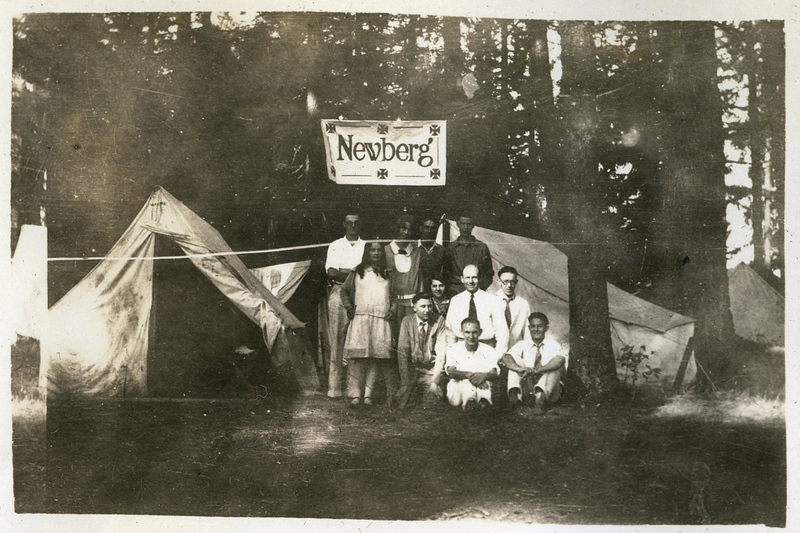
A photograph of the Newberg branch of an Epworth League at their campsite during a Epworth League campout. The Epworth League was founded by Methodists in 1889 for young adults ages 18-35. Activities often included camping. There were several campgrounds in Oregon and Washington for different chapters of the Epworth League to enjoy. This photograph appears in an album that was compiled by Edith Hansen McGill, a 1930 Pacific University graduate.
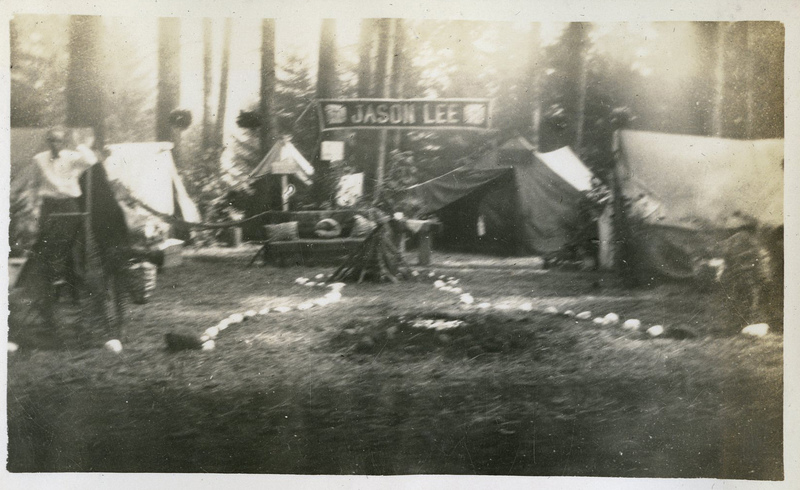
A photograph of the Jason Lee United Methodist Church camp during an Epworth League campout. The Epworth League was founded by Methodists in 1889 for young adults ages 18-35. Activities often included camping. There were several campgrounds in Oregon and Washington for different chapters of the Epworth League to enjoy. This photograph appears in an album that was compiled by Edith Hansen McGill, a 1930 Pacific University graduate.
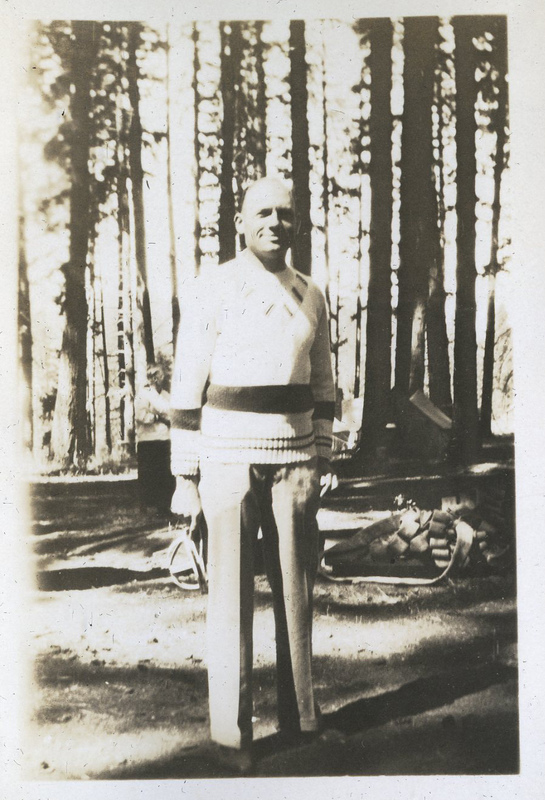
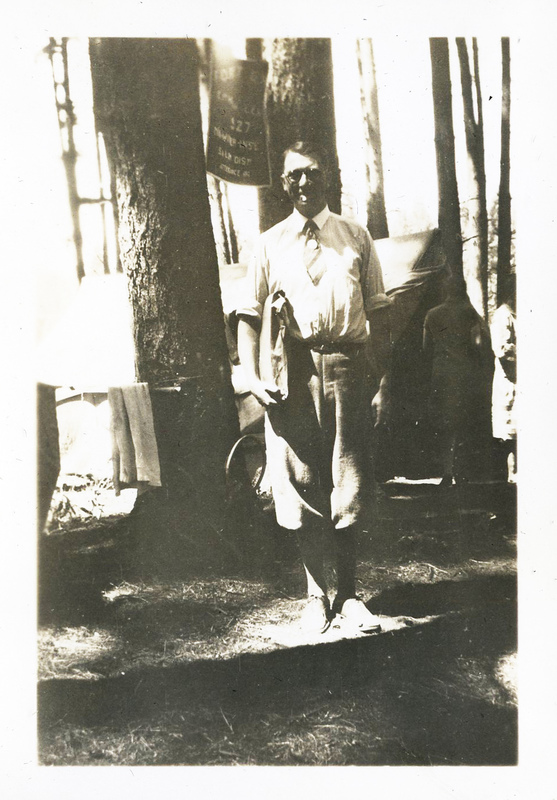
A photograph of a man wearing knickerbocker style pants. He is at an Epworth League campout. The Epworth League was founded by Methodists in 1889 for young adults ages 18-35. Activities often included camping. There were several campgrounds in Oregon and Washington for different chapters of the Epworth League to enjoy. This photograph appears in an album that was compiled by Edith Hansen McGill, a 1930 Pacific University graduate.
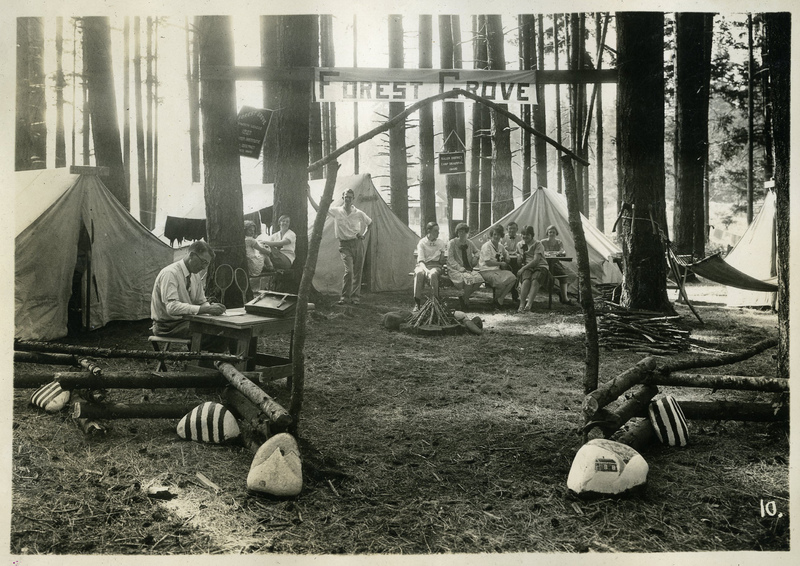
A photograph of the Forest Grove chapter of the Epworth League's campground. The Epworth League was founded by Methodists in 1889 for young adults ages 18-35. Activities often included camping. There were several campgrounds in Oregon and Washington for different chapters of the Epworth League to enjoy. This photograph appears in an album that was compiled by Edith Hansen McGill, a 1930 Pacific University graduate.
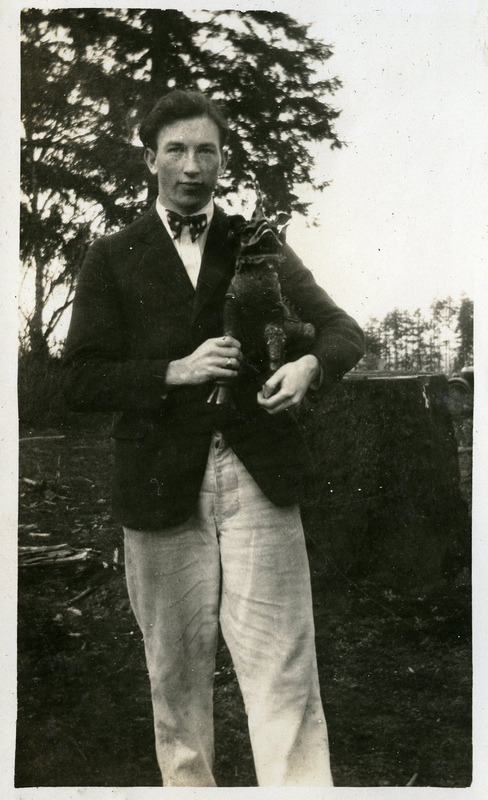
A photograph of Charles McGill holding Pacific University's Boxer mascot. Charles McGill was in the Pacific University class of 1930; he attended on a scholarship as a freshman, and then transferred to the University of Washington. He later became a doctor and married another Pacific University alum, Edith Hansen. The original Boxer mascot was a gift to the school from a missionary named Reverend J. E. Walker, who acquired Boxer while on a mission trip to China. This photograph appears in an album that was compiled by Edith Hansen McGill, a 1930 Pacific University graduate.
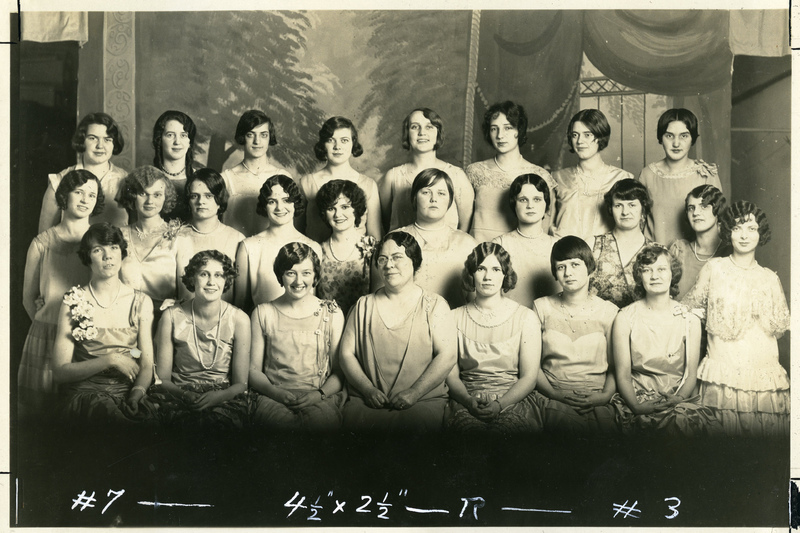
A photograph of the 1929 Pacific University Women's Glee Club. The members are listed as Inez Buchanan, Mildred Campbell, Erla Clark, Helen Deiman, Clara Drew, Harriett Fredrickson, Florence Gross, Katherine Gross, Jacqueline Honeywell, Mary Laack, Carna Peterson, Ida May Piper, Oral Portison, Roma Ralston, Fern Schlaf, Roberta Stanton, Dorothy Thompson, Clare Welsons, Grace Whitcomb, Doris Zook, Helen Creitz, Virginia Abrahma, Doris Knoebel and Billey Grace Ross. This photograph appears in an album that was compiled by Edith Hansen McGill, a 1930 Pacific University graduate.
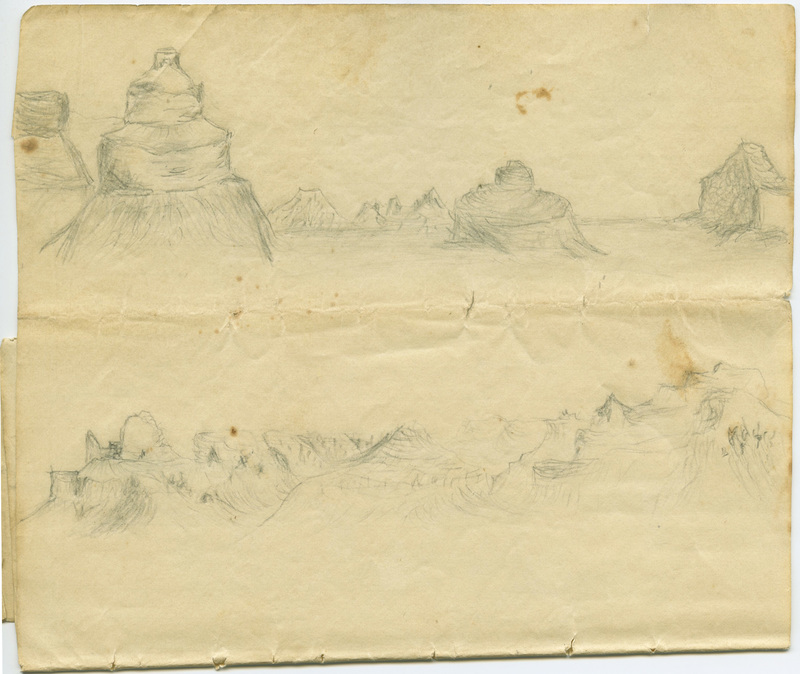
Drawings by Pherne Brown Pringle, the daughter of Tabitha Moffatt Brown, the 'Mother of Oregon.' These sketches feature rock formations in Nebraska, likely near Chimney Rock and Scotts Bluff, during her family's journey on the Oregon Trail. Copies of later drawings were accompanied in an album by journal entries of Pherne's husband, Virgil K. Pringle.
Virgil's journal described this area with awe on June 19th:
'Passed the Chimney in the forepart of the day; and the formation of the cliffs have a tendency to fill the mind with awe and grandeur. The Chimney might pass for one of the foundries in St. Louis were it blackened by burning stone coal. There is a marley bluff standing near it that reminds me of points that I have seen of the Capitol at Washington. Made 20 miles, and camped near Scott's Bluffs.'
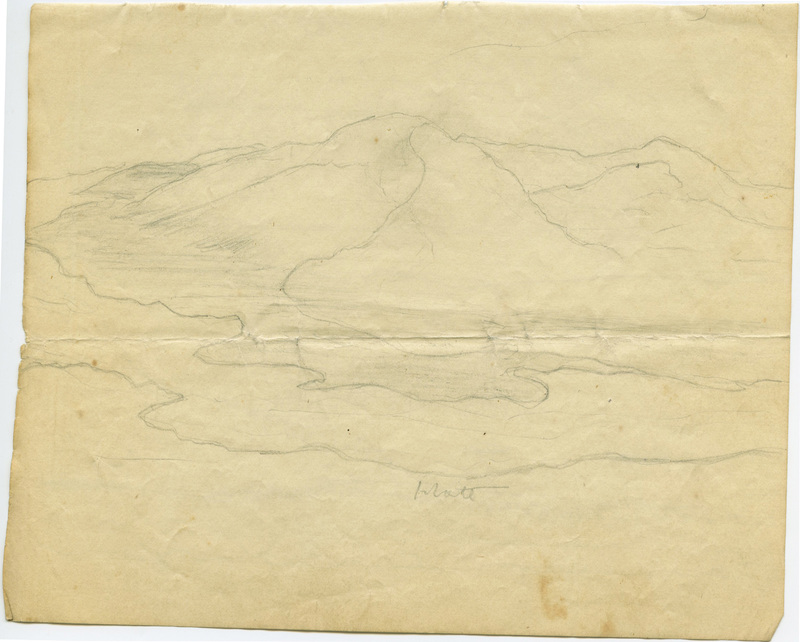
Drawing by Pherne Brown Pringle, the daughter of Tabitha Moffatt Brown, the 'Mother of Oregon.' This sketch features a view of the Platte River in Nebraska during her family's journey on the Oregon Trail. Copies of later drawings were accompanied in an album by journal entries of Pherne's husband, Virgil K. Pringle.
Virgil's journal indicates that their party passed through this area around June 3, facing cold weather and the death of a party member:
'The weather disagreeably cool; started in fine season, and came in sight of the sand hills of Platte, in about 3 miles and arrived on the borders of the bottom about ten o'clock. This the most romantic view I have ever seen. Made 18 miles, and camped by some willows on the banks -- the sluice of Grand Island. Mr. Shelton, from Franklin, had a daughter die this night, from a swelling on her throat, occasioned by the scarlet fever, before they left the state; having lost another child since they left home, which they buried in Jackson county.'
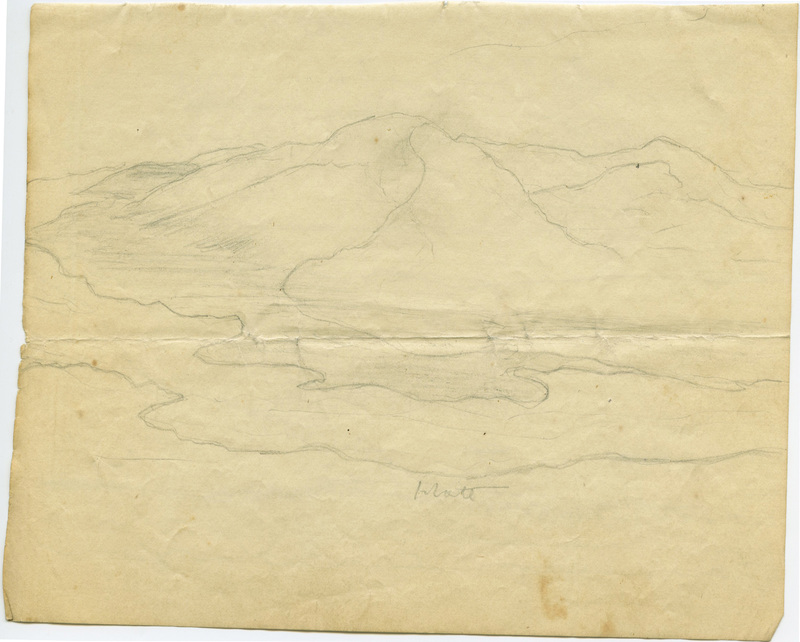
Drawing by Pherne Brown Pringle, the daughter of Tabitha Moffatt Brown, the 'Mother of Oregon.' This sketch features a view of the Platte River in Nebraska during her family's journey on the Oregon Trail. Copies of later drawings were accompanied in an album by journal entries of Pherne's husband, Virgil K. Pringle.
Virgil's journal indicates that their party passed through this area around June 3, facing cold weather and the death of a party member:
'The weather disagreeably cool; started in fine season, and came in sight of the sand hills of Platte, in about 3 miles and arrived on the borders of the bottom about ten o'clock. This the most romantic view I have ever seen. Made 18 miles, and camped by some willows on the banks -- the sluice of Grand Island. Mr. Shelton, from Franklin, had a daughter die this night, from a swelling on her throat, occasioned by the scarlet fever, before they left the state; having lost another child since they left home, which they buried in Jackson county.'
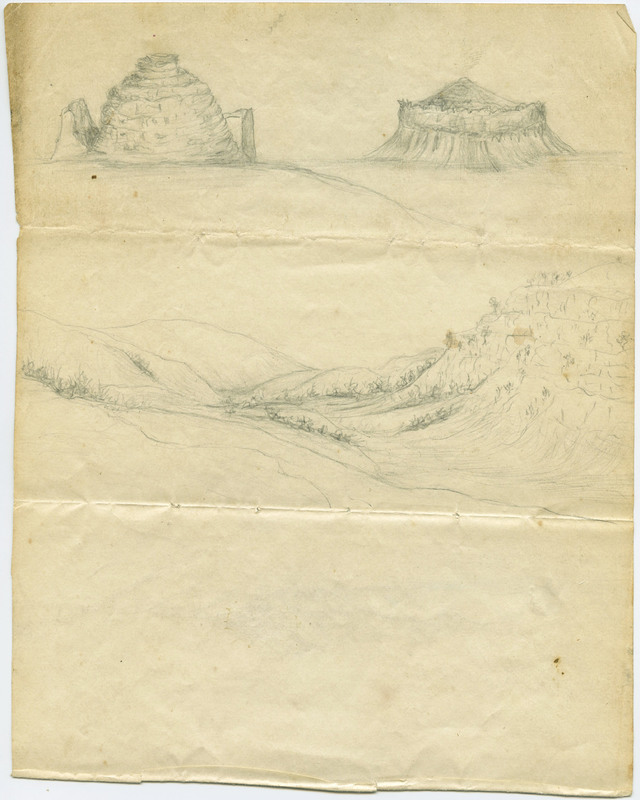
Drawings by Pherne Brown Pringle, the daughter of Tabitha Moffatt Brown, the 'Mother of Oregon.' These sketches feature the scenery of Scotts Bluff during her family's journey on the Oregon Trail. Copies of later drawings were accompanied in an album by journal entries of Pherne's husband, Virgil K. Pringle.
Virgil's journal indicates that they camped near Scotts Bluff on June 19th:
'Passed the Chimney in the forepart of the day; and the formation of the cliffs have a tendency to fill the mind with awe and grandeur. The Chimney might pass for one of the foundries in St. Louis were it blackened by burning stone coal. There is a marley bluff standing near it that reminds me of points that I have seen of the Capitol at Washington. Made 20 miles, and camped near Scott's Bluffs.'
A long open letter to Harvey Scott, the editor of The Oregonian newspaper, by his former classmate Cyrus Walker. Walker is writing to persuade Scott to back the Oregon Local Option Liquor Law, which was Measure 3 in the June 1904 election. Scott generally opposed the prohibition of liquor, while Walker had supported it since boyhood.
In order to bolster his case Walker provides testimony from his own biography, highlighting details that intersected with Scott's life. Some details include: their shared history as students at Tualatin Academy in Forest Grove in the 1850s; Walker leaving school to become a farmer; Scott visiting Walker's homestead in Umatilla County; Scott becoming the first graduate of Pacific University; Walker's disappointment that Clark opposed prohibition; Walker's earliest memories relating to liquor in the 1840s at his family's mission in Tshimakain contrasted with Oregon City; Walker joining the "Temple of Honor" temperance society and the Good Templars; voting for Lincoln and his thoughts on Republicans vs. Democrats; Walker being the first from his county to enlist in the Union Army in 1864; joining the federal Indian Service and working at the Warm Springs reservation in the 1870s-1890s; voting for earlier prohibition measures in Oregon; joining the Patrons of Husbandry (also known as The Grange) in 1873; his hopes for Scott to have a change of heart.
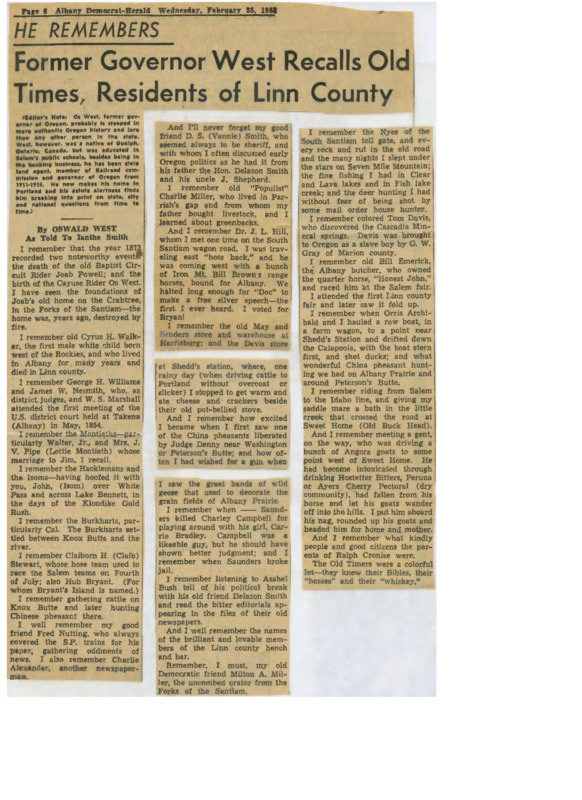
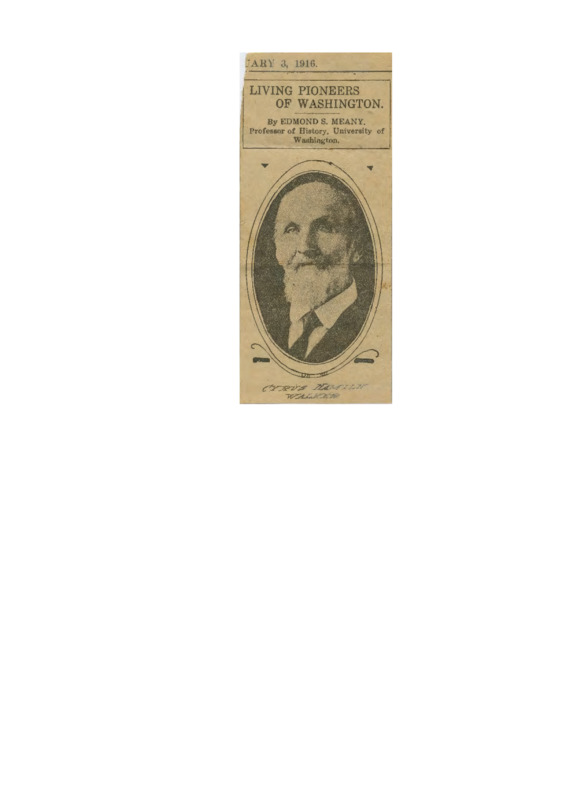
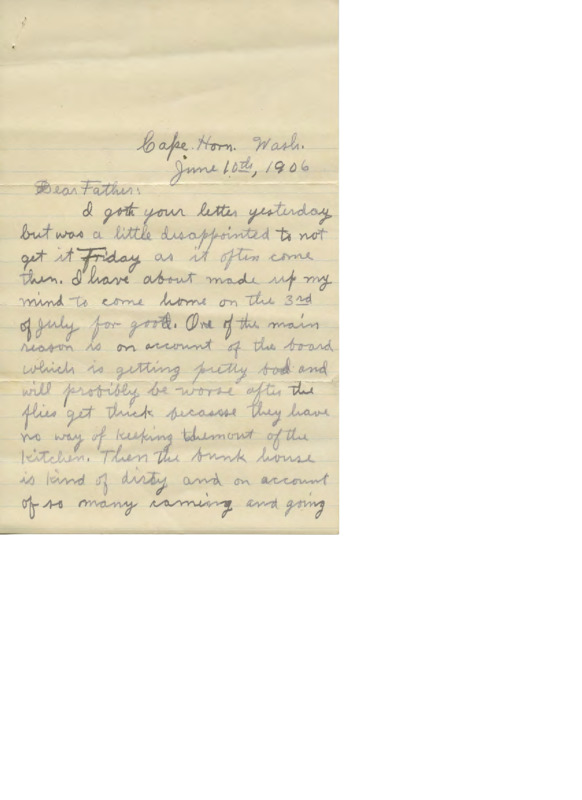
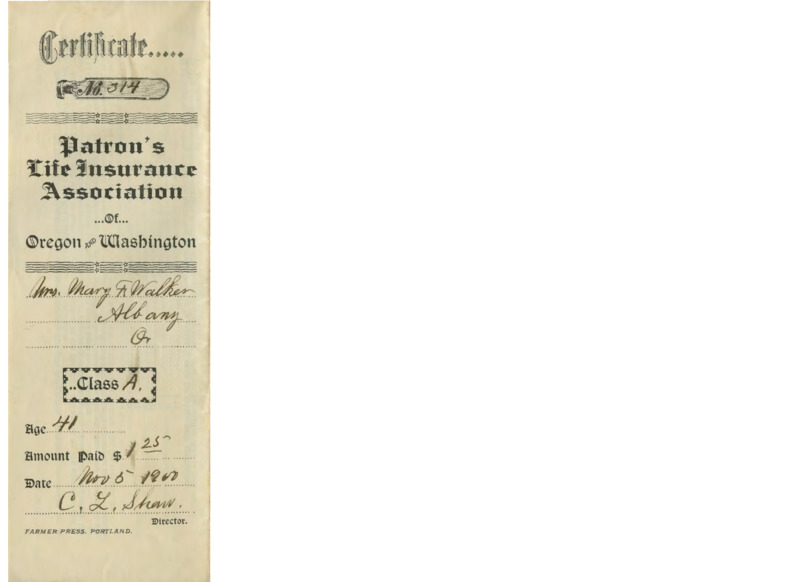
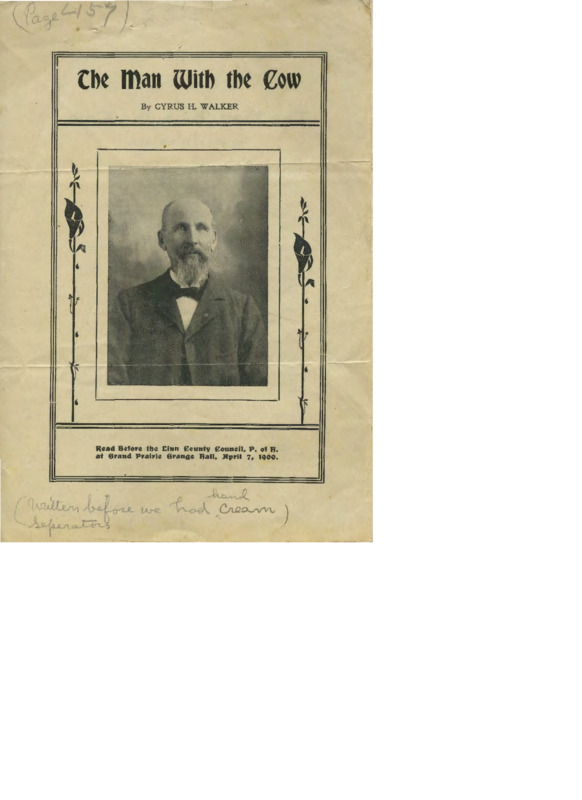
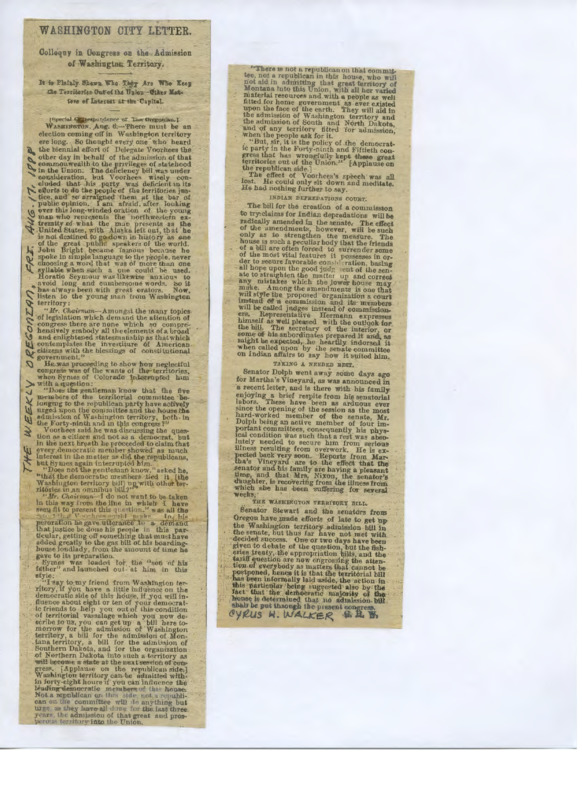
Cyrus Walker was the oldest son of the early Oregon Territory missionaries Elkanah and Mary Richardson Walker. He grew up at Tshimakain in the 1830s-40s, where he learned the native Spokane language. After joining the U.S. army during the Civil War and then attempting to make a living as a farmer, he became a teacher at the Warm Springs Indian Agency. These letters, documents and clippings shed light on his experiences as a missionary, a soldier, a pioneer and a teacher at Warm Springs. This collection was donated to Pacific University by Betty Thorne, a descendant of the Walkers.
Cyrus Walker was the oldest son of the early Oregon Territory missionaries Elkanah and Mary Richardson Walker. He grew up at Tshimakain in the 1830s-40s, where he learned the native Spokane language. After joining the U.S. army during the Civil War and then attempting to make a living as a farmer, he became a teacher at the Warm Springs Indian Agency. These letters, documents and clippings shed light on his experiences as a missionary, a soldier, a pioneer and a teacher at Warm Springs. This collection was donated to Pacific University by Betty Thorne, a descendant of the Walkers.
Cyrus Walker was the oldest son of the early Oregon Territory missionaries Elkanah and Mary Richardson Walker. He grew up at Tshimakain in the 1830s-40s, where he learned the native Spokane language. After joining the U.S. army during the Civil War and then attempting to make a living as a farmer, he became a teacher at the Warm Springs Indian Agency. These letters, documents and clippings shed light on his experiences as a missionary, a soldier, a pioneer and a teacher at Warm Springs. This collection was donated to Pacific University by Betty Thorne, a descendant of the Walkers.
Cyrus Walker was the oldest son of the early Oregon Territory missionaries Elkanah and Mary Richardson Walker. He grew up at Tshimakain in the 1830s-40s, where he learned the native Spokane language. After joining the U.S. army during the Civil War and then attempting to make a living as a farmer, he became a teacher at the Warm Springs Indian Agency. These letters, documents and clippings shed light on his experiences as a missionary, a soldier, a pioneer and a teacher at Warm Springs. This collection was donated to Pacific University by Betty Thorne, a descendant of the Walkers.
Cyrus Walker was the oldest son of the early Oregon Territory missionaries Elkanah and Mary Richardson Walker. He grew up at Tshimakain in the 1830s-40s, where he learned the native Spokane language. After joining the U.S. army during the Civil War and then attempting to make a living as a farmer, he became a teacher at the Warm Springs Indian Agency. These letters, documents and clippings shed light on his experiences as a missionary, a soldier, a pioneer and a teacher at Warm Springs. This collection was donated to Pacific University by Betty Thorne, a descendant of the Walkers.
Cyrus Walker was the oldest son of the early Oregon Territory missionaries Elkanah and Mary Richardson Walker. He grew up at Tshimakain in the 1830s-40s, where he learned the native Spokane language. After joining the U.S. army during the Civil War and then attempting to make a living as a farmer, he became a teacher at the Warm Springs Indian Agency. These letters, documents and clippings shed light on his experiences as a missionary, a soldier, a pioneer and a teacher at Warm Springs. This collection was donated to Pacific University by Betty Thorne, a descendant of the Walkers.
Cyrus Walker was the oldest son of the early Oregon Territory missionaries Elkanah and Mary Richardson Walker. He grew up at Tshimakain in the 1830s-40s, where he learned the native Spokane language. After joining the U.S. army during the Civil War and then attempting to make a living as a farmer, he became a teacher at the Warm Springs Indian Agency. These letters, documents and clippings shed light on his experiences as a missionary, a soldier, a pioneer and a teacher at Warm Springs. This collection was donated to Pacific University by Betty Thorne, a descendant of the Walkers.
Cyrus Walker was the oldest son of the early Oregon Territory missionaries Elkanah and Mary Richardson Walker. He grew up at Tshimakain in the 1830s-40s, where he learned the native Spokane language. After joining the U.S. army during the Civil War and then attempting to make a living as a farmer, he became a teacher at the Warm Springs Indian Agency. These letters, documents and clippings shed light on his experiences as a missionary, a soldier, a pioneer and a teacher at Warm Springs. This collection was donated to Pacific University by Betty Thorne, a descendant of the Walkers.