A one-page briefing sheet for Governor Victor Atiyeh titled "Election Wrapup, in brief," prepared for an Oregon Republican Women appearance on November 9, 1982. The document summarizes national and Oregon election results, Oregon congressional races, Washington state races, ballot measures, and commentary on the meaning of the election. A handwritten note reading "Denny" appears at the top of the page.
A twelve-page prepared text of a speech by Governor Vic Atiyeh for the Association of Oregon Counties 77th Annual Conference at the Valley River Inn in Eugene on November 19, 1982. The speech discusses Atiyeh's recent re-election, county government, tax reform, property tax limitation, land use planning, forestry, fish enhancement, anti-crime proposals, higher education, economic development, local government, and the state's budget and revenue situation.
A five-page prepared text of remarks by Governor Vic Atiyeh for the I-205 opening luncheon at the Thunderbird Inn at Jantzen Beach on December 15, 1982. The remarks discuss the opening of the Glenn L. Jackson Memorial Bridge, the history of planning for I-205, Oregon and Washington transportation connections, economic development, construction jobs, and the role of Glenn L. Jackson in Oregon transportation planning.
An eight-page prepared text of a speech by Governor Victor Atiyeh for the Roseburg Chamber of Commerce Outstanding Citizen Banquet at the Moose Lodge in Roseburg, Oregon, on January 25, 1983. The speech congratulates the outstanding citizen honoree and discusses the timber industry in Douglas County and Oregon, including the recession, housing starts, federal budget deficits, state use of Oregon forest products, proposed changes to the Board of Forestry, insect and disease management, timber marketing, sawmill improvement, and forest products recovery efforts.
A two-page statement by Governor Victor Atiyeh honoring Arthur P. Ireland, described as Oregon's oldest former legislator and a longtime friend and colleague of Atiyeh. The statement discusses Ireland's family farm, legislative service in the Oregon State Senate and Oregon House of Representatives, advocacy for crime victims, migrant workers, family farms, individual constituents, Washington County, and Pacific University.
A three-page set of documents regarding manufactured housing. The first page contains remarks by Governor Vic Atiyeh for the Oregon Manufactured Housing Industry "Governor's Night" Show at the Agriculture Building at the State Fairgrounds on February 10, 1983. The second page contains a statement by Atiyeh proclaiming May 1983 as "Manufactured Housing Month" in Oregon. The third page contains a September 15, 1982 State of Washington proclamation by Governor John Spellman proclaiming October 1982 as "Manufactured Housing Month" in Washington State.
A six-page prepared text of remarks by Governor Vic Atiyeh to the Oregon Transportation Commission on February 14, 1983. The remarks discuss Atiyeh's interest in preserving the scenic and historic values of the Columbia River Gorge, his work with Washington Governor John Spellman, the Columbia River Scenic Highway, restoration and preservation of abandoned highway sections, tourism, public access, and the role of the Transportation Commission in protecting the Gorge.
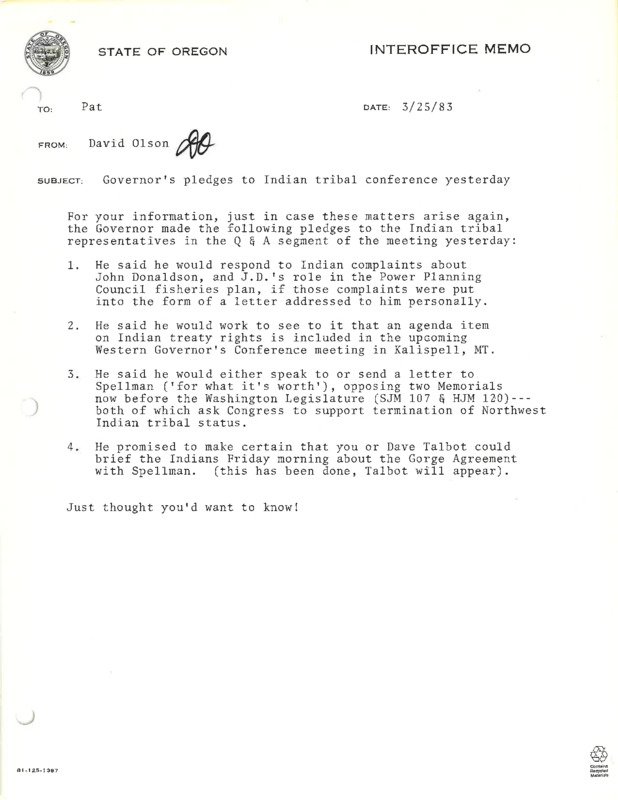
A one-page State of Oregon interoffice memo from David Olson to Pat, dated March 25, 1983, regarding Governor Atiyeh's pledges to Indian tribal representatives during a question-and-answer session the previous day. The memo lists pledges concerning complaints about John Donaldson and the Power Planning Council fisheries plan, Indian treaty rights at the Western Governors' Conference, opposition to Washington legislative memorials supporting termination of Northwest Indian tribal status, and a briefing on the Gorge Agreement with Governor John Spellman.
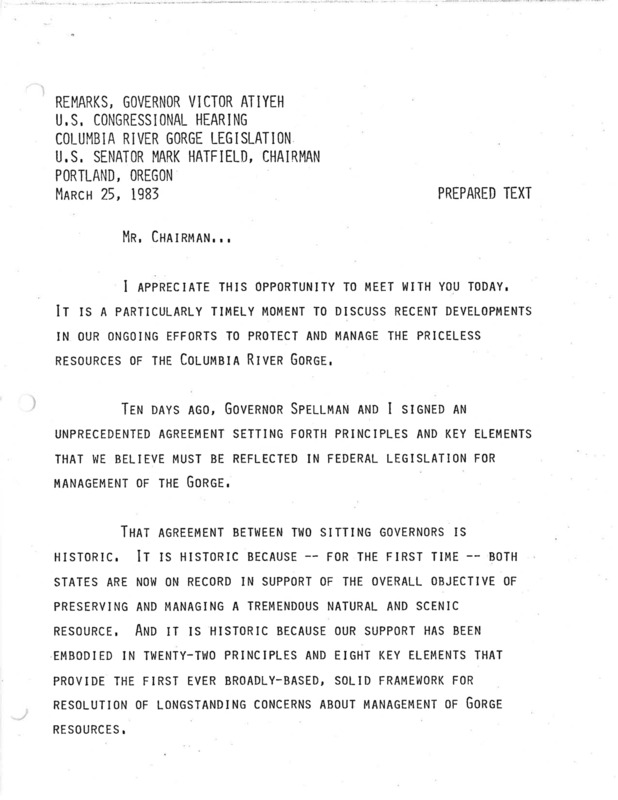
An eleven-page prepared text of remarks by Governor Victor Atiyeh for a U.S. congressional hearing on Columbia River Gorge legislation chaired by U.S. Senator Mark Hatfield in Portland, Oregon, on March 25, 1983. The remarks discuss the Columbia River Gorge, an agreement between Governor Atiyeh and Washington Governor John Spellman, proposed federal legislation, a joint state-federal management entity, a Gorge management plan, scenic preservation, existing communities and businesses, economic activity, and cooperation between Oregon, Washington, federal officials, and local governments.
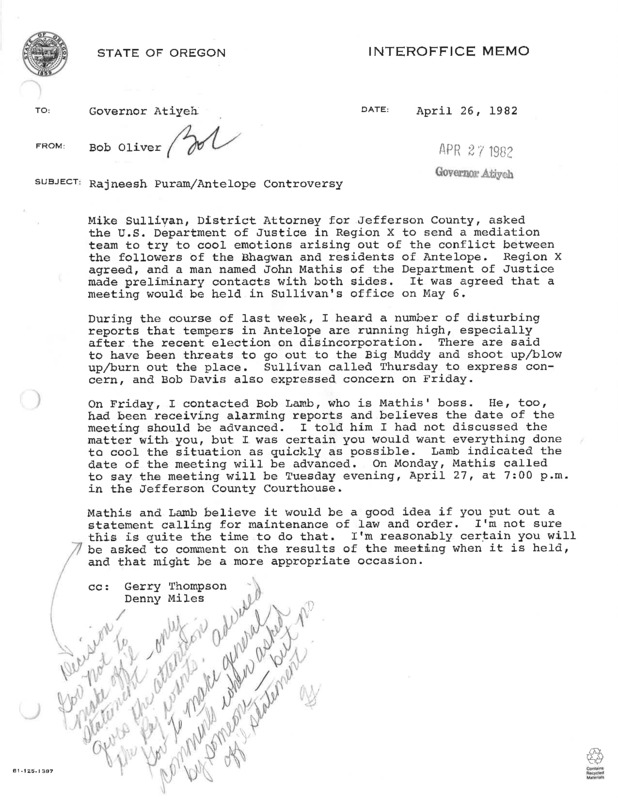
An April 26, 1982 State of Oregon interoffice memo from Bob Oliver to Governor Atiyeh regarding the "Rajneesh Puram/Antelope Controversy." The memo discusses a request by Jefferson County District Attorney Mike Sullivan for U.S. Department of Justice mediation, reports of rising tensions after the recent election on disincorporation in Antelope, and the possible timing of a public statement by the Governor. A stamped date of April 27, 1982 and handwritten notes are visible on the document. Oliver served as the legal counsel to Governors McCall and Atiyeh, playing a particularly important behind-the-scenes role as Public Safety Coordinator during the Rajneesh crisis.
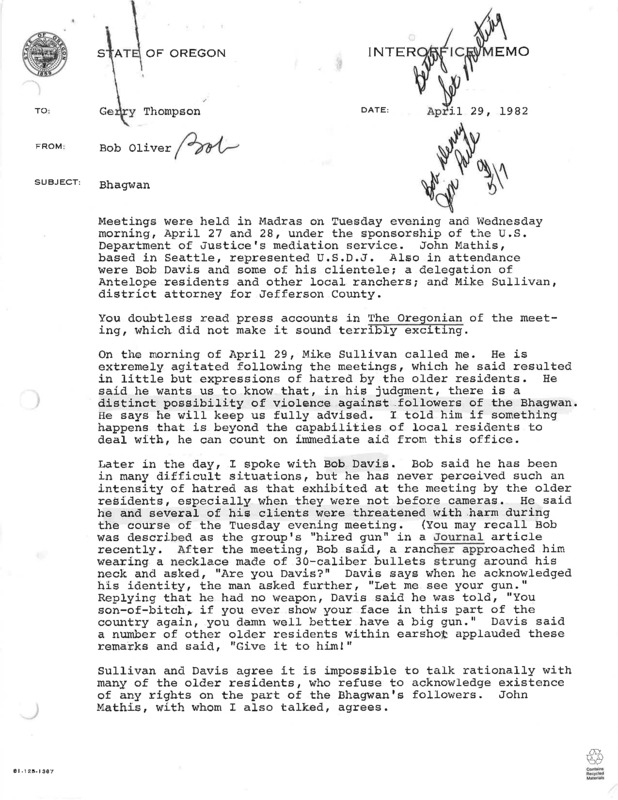
An April 29, 1982 State of Oregon interoffice memo from Bob Oliver to Gerry Thompson regarding meetings held in Madras under the sponsorship of the U.S. Department of Justice mediation service. The memo discusses tensions between older residents of Antelope and followers of Bhagwan Shree Rajneesh, concerns raised by Jefferson County District Attorney Mike Sullivan, reports from Bob Davis, and future meetings scheduled in The Dalles and Antelope. Handwritten notes are visible on both pages of the document. Oliver served as the legal counsel to Governor Atiyeh.
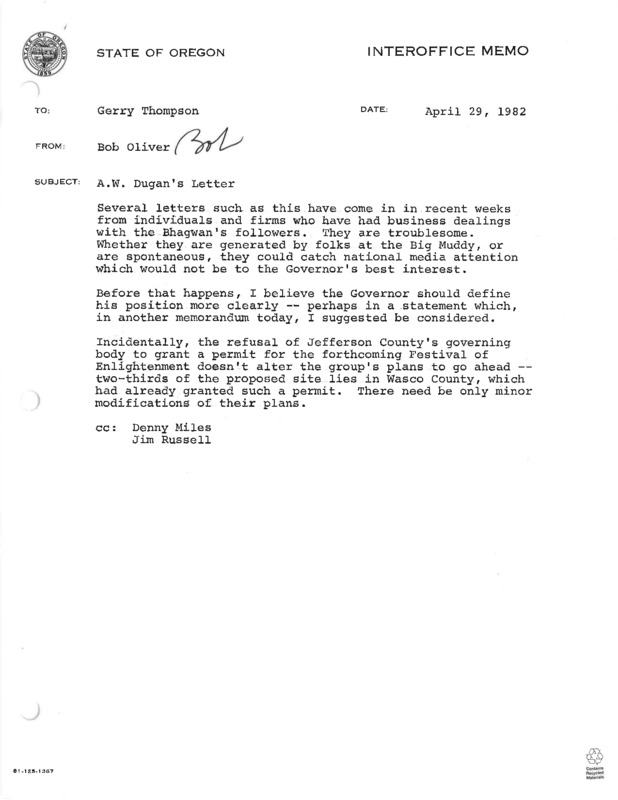
An April 29, 1982 State of Oregon interoffice memo from Bob Oliver to Gerry Thompson regarding "A.W. Dugan's Letter." The memo discusses letters received from individuals and businesses that had dealings with Bhagwan's followers, and the possibility that such letters could attract national media attention. The memo also discusses the Governor's public position and notes that the refusal of Jefferson County to grant a permit for the Festival of Enlightenment did not prevent the group from moving ahead with plans in Wasco County. Oliver served as the legal counsel to Governors McCall and Atiyeh, playing a particularly important behind-the-scenes role as Public Safety Coordinator during the Rajneesh crisis.
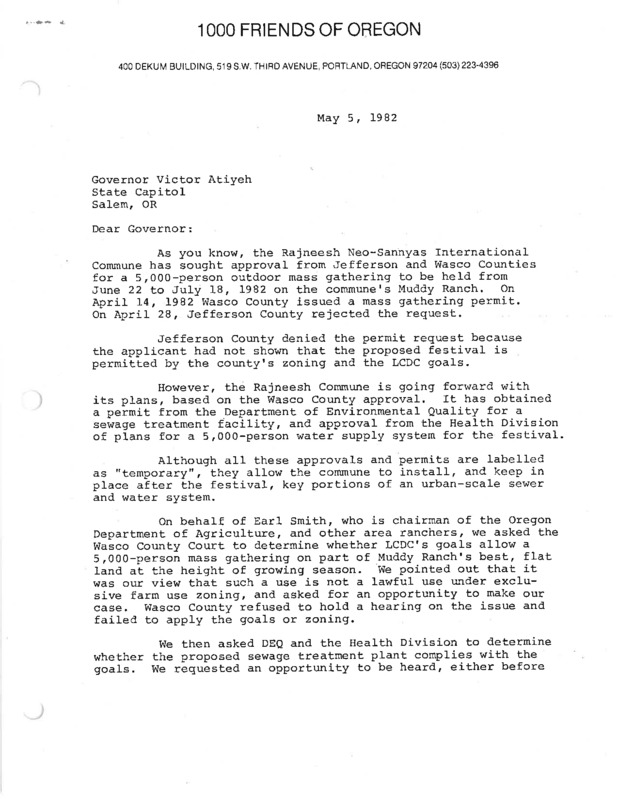
A May 5, 1982 letter from Henry R. Richmond, Executive Director of 1000 Friends of Oregon, to Governor Victor Atiyeh regarding the Rajneesh Neo-Sannyas International Commune's plans for a 5,000-person outdoor mass gathering at the commune's Muddy Ranch. The letter discusses Jefferson County's denial of a mass gathering permit, Wasco County's approval of a permit, temporary approvals for sewage treatment and water supply, and concerns about whether the proposed festival complied with land use goals and zoning. Richmond asks the Governor to involve state agencies and the Attorney General in reviewing the issue. 1000 Friends of Oregon was a nonprofit organization founded by Richmond that advocated for land use planning within the state.
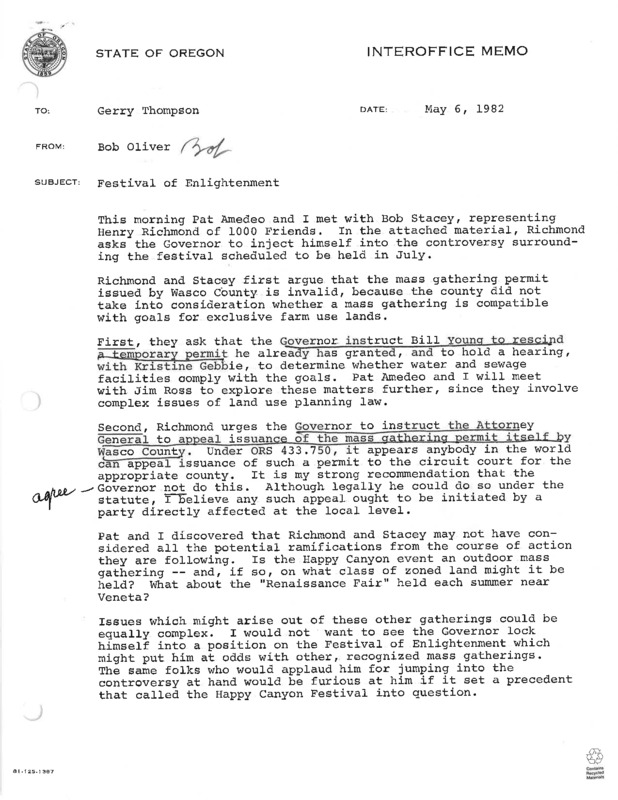
A May 6, 1982 State of Oregon interoffice memo from Bob Oliver to Gerry Thompson regarding the Festival of Enlightenment. The memo summarizes a meeting with Pat Amedeo and Bob Stacey, representing Henry Richmond of 1000 Friends of Oregon, about the controversy surrounding the festival scheduled for July. The memo discusses requests for the Governor to direct further review of water and sewage facilities and to instruct the Attorney General to appeal Wasco County's issuance of the mass gathering permit. A handwritten note reading "agree" is visible in the margin. Oliver served as the legal counsel to Governors McCall and Atiyeh, playing a particularly important behind-the-scenes role as Public Safety Coordinator during the Rajneesh crisis.
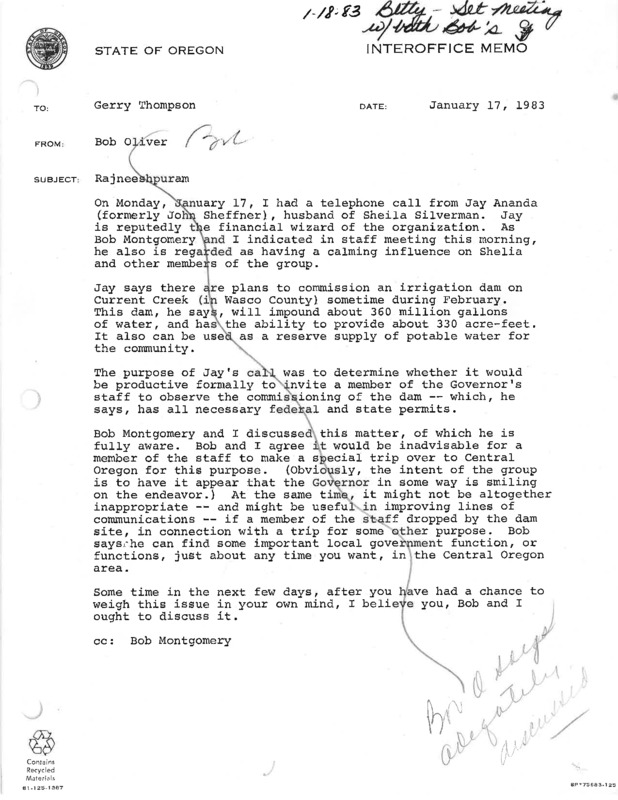
A January 17, 1983 State of Oregon interoffice memo from Bob Oliver to Gerry Thompson regarding Rajneeshpuram. The memo describes a telephone call from Rajneeshee Jayananda (formerly John Sheffner), concerning plans to commission an irrigation dam on Current Creek in Wasco County. Jayananda was a leader within the Rajneeshpuram community in Oregon. Oliver reports that Jayananda asked whether a member of the Governor's staff would attend the commissioning, and discusses concerns about whether such a visit would appear to suggest the Governor's support for the project. Handwritten notes are visible on the document. Oliver served as the legal counsel to Governors McCall and Atiyeh, playing a particularly important behind-the-scenes role as Public Safety Coordinator during the Rajneesh crisis.
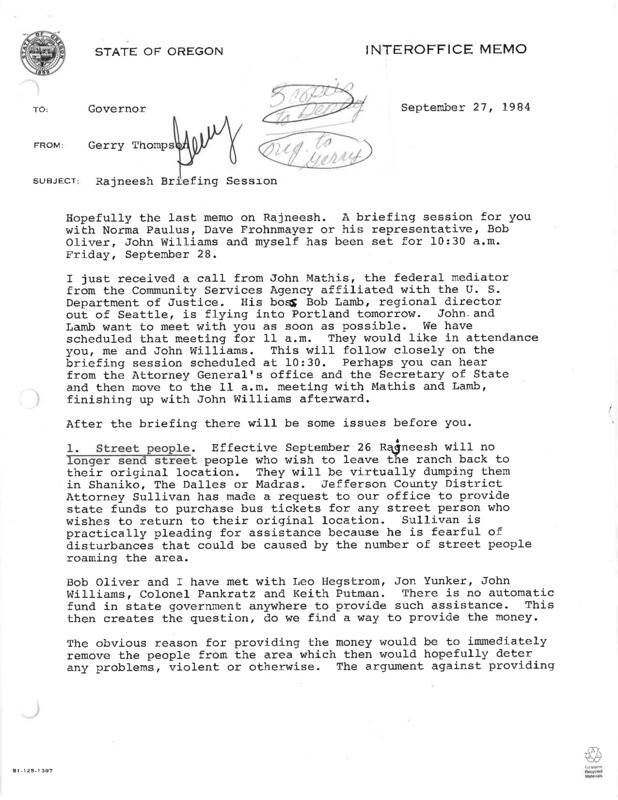
A three-page September 27, 1984 State of Oregon interoffice memo from Gerry Thompson to Governor Atiyeh regarding a planned Rajneesh briefing session. The memo discusses scheduled meetings with state officials and federal mediators, as well as issues likely to come before the Governor, including "street people" leaving the ranch, a proposed interagency team, a possible rumor control center, election monitoring, hunting season preparations, a possible visit to Wasco County, and pressure for the Governor and Attorney General Frohnmayer to meet with K. D. (or Krishna Deva) and Ma Anand Sheela, two leaders within the Rajneesh community. Handwritten notes are visible on the document.
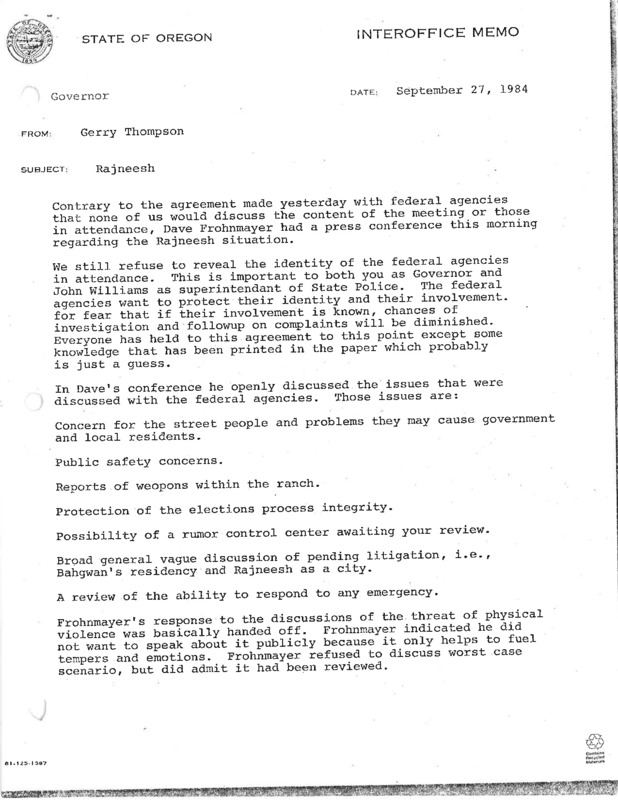
A two-page September 27, 1984 State of Oregon interoffice memo from Gerry Thompson to Governor Atiyeh regarding a press conference held by Attorney General Dave Frohnmayer on the Rajneesh situation. The memo states that Frohnmayer discussed issues from a federal agency meeting, including concerns about "street people" (i.e. homeless people), public safety, weapons at the ranch, election integrity, a possible rumor control center, pending litigation, and emergency response. The memo also summarizes press questions about the Governor's awareness of the meeting, possible disarmament of Rajneesh peace officers, and whether the Governor should visit Wasco County.
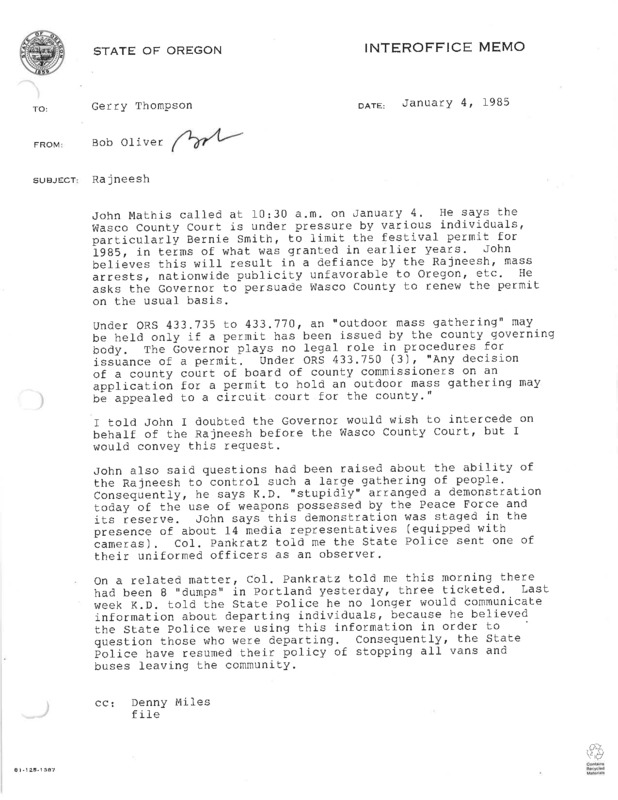
A January 4, 1985 State of Oregon interoffice memo from Bob Oliver to Gerry Thompson regarding the Rajneesh. The memo discusses a call from John Mathis about pressure on the Wasco County Court to limit the Rajneesh festival permit for 1985 and Mathis's request that the Governor intervene. The memo also discusses a weapons demonstration by K. D. (or Krishna Deva, a Rajneesh leader) for the media, recent "dumps" of street (i.e. homeless) people in Portland, and Oregon State Police stops of vans and buses leaving the community. A second page includes brief notes regarding street people arriving in Portland and communication with K. D. Oliver served as the legal counsel to Governors McCall and Atiyeh, playing a particularly important behind-the-scenes role as Public Safety Coordinator during the Rajneesh crisis.
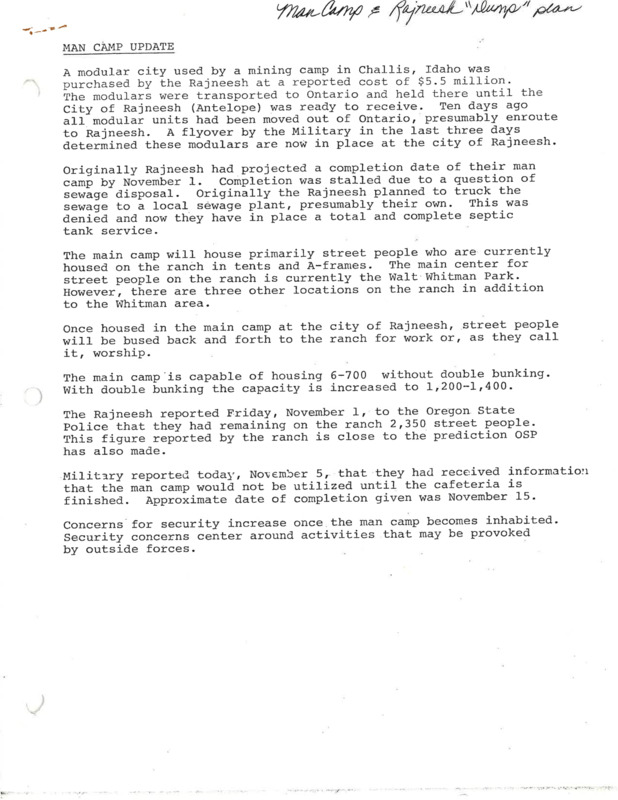
A nine-page typed document beginning with a section titled "Man Camp Update." The document discusses a modular housing camp purchased by the Rajneesh, its movement from Ontario to the city of Rajneesh, projected housing capacity, and security concerns once the camp became inhabited. Later sections discuss shelter and food planning, transportation issues, security, possible emergency declaration by the Governor, and procedures for different levels of "street people" departures or "dumping." The final page contains a notification chart showing lines of communication among Oregon State Police, city and county officials, the Governor, Gerry Thompson, Dave Fiskum, Bob Oliver, emergency services, the military, facilities, and the Public Utility Commissioner. It was likely written by a member of Governor Atiyeh's staff.
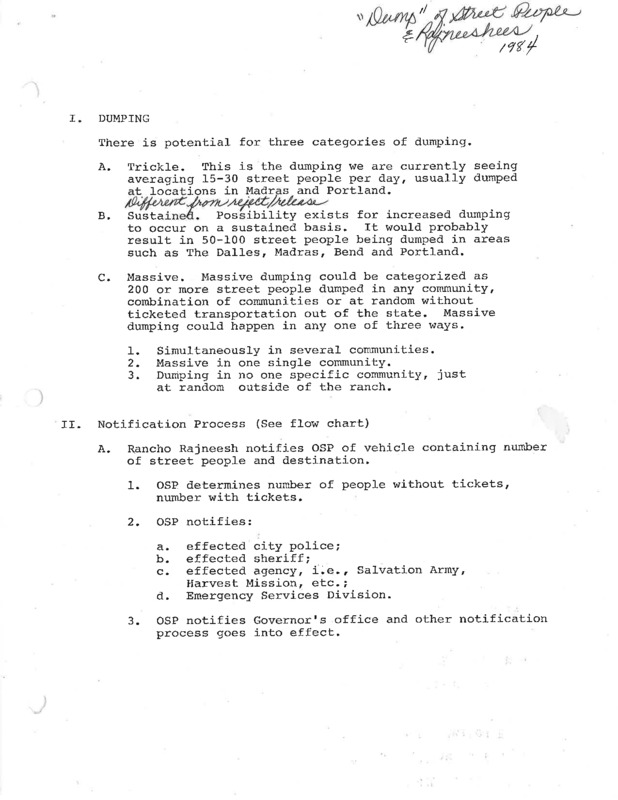
A four-page typed planning document concerning potential "dumping" of "street people" (i.e. homeless people) by the Rajneesh in 1984. The document categorizes possible "dumping" scenarios as "trickle," "sustained," and "massive," and outlines notification processes, shelter and feeding issues, security concerns, transportation needs, and possible emergency response. The final page contains a flow chart showing lines of notification among Oregon State Police, city and county officials, the Governor's office, Gerry Thompson, Bob Oliver, facilities, emergency services, the military, and the Public Utility Commissioner. Handwritten notes are visible on the document. It was likely written by a member of Governor Atiyeh's staff.
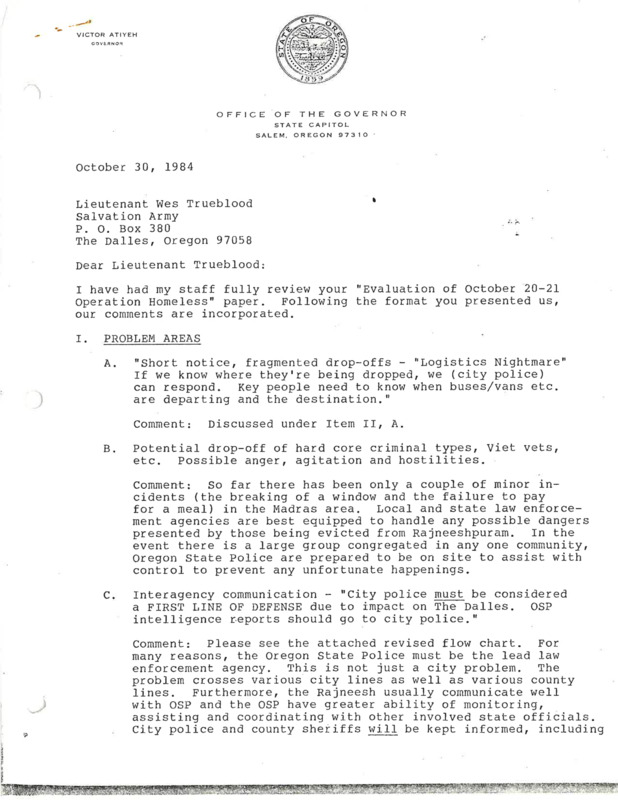
A six-page letter dated October 30, 1984 from Governor Victor Atiyeh to Lieutenant Wes Trueblood of the Salvation Army in The Dalles regarding Trueblood's "Evaluation of October 20-21 Operation Homeless" paper. The letter provides comments on problem areas and needs assessment, including communication, interagency coordination, overcrowding, screening, media handling, funding, food networks, overflow locations, transportation, emergency telephone planning, medical needs, and public safety. The final page contains a revised flow chart showing communication among Oregon State Police, the Wasco County Sheriff, The Dalles city police, the Salvation Army, the Ministerial Association, Judson Baptist College, and other local contacts. This letter was written in the context of the Rajneesh crisis, during which the Rajneesh first brought in and then abandoned many homeless people.
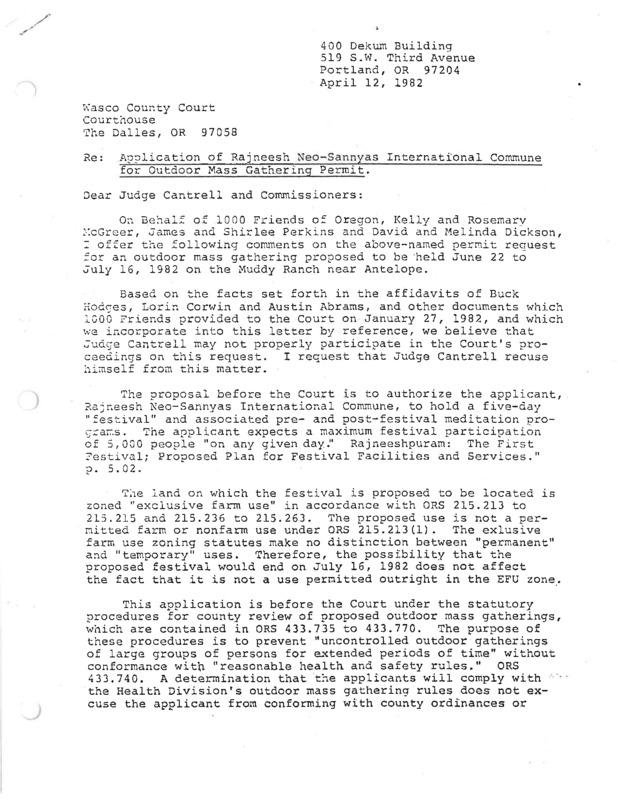
An April 12, 1982 letter from Robert E. Stacey, Jr., Staff Attorney for 1000 Friends of Oregon, to the Wasco County Court regarding the Rajneesh Neo-Sannyas International Commune's application for an outdoor mass gathering permit, which would be called the "First Annual World Celebration." The letter presents comments on the proposed festival at Muddy Ranch near Antelope, asks that Judge Cantrell recuse himself from the matter, and argues that the proposed gathering and related utility facilities were not permitted uses in an exclusive farm use zone. The letter also discusses the Health Division's outdoor mass gathering rules, utility facilities, water and sewage systems, and possible permit conditions.
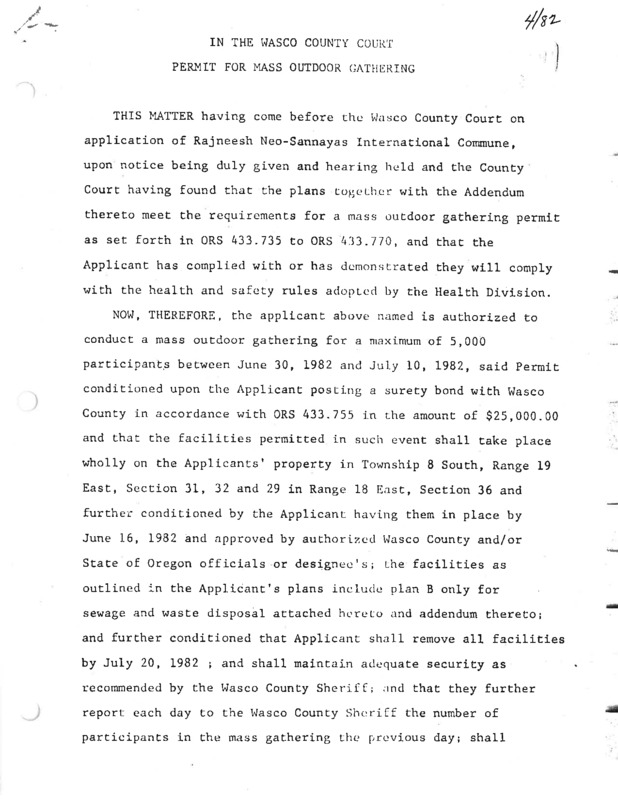
A two-page Wasco County Court permit form for a mass outdoor gathering by the Rajneesh Neo-Sannyas International Commune. The document authorizes a gathering of up to 5,000 participants between June 30 and July 10, 1982, conditioned on a $25,000 surety bond, placement and approval of facilities, removal of facilities by July 20, maintenance of security, daily reporting to the Wasco County Sheriff, and road improvements on the petitioner's property. The document appears to be an unsigned or incomplete copy, with blank signature lines for the Wasco County Court and a signature approving the form. The festival did eventually take place on July 3-7, 1982, and was called the "First Annual World Celebration".
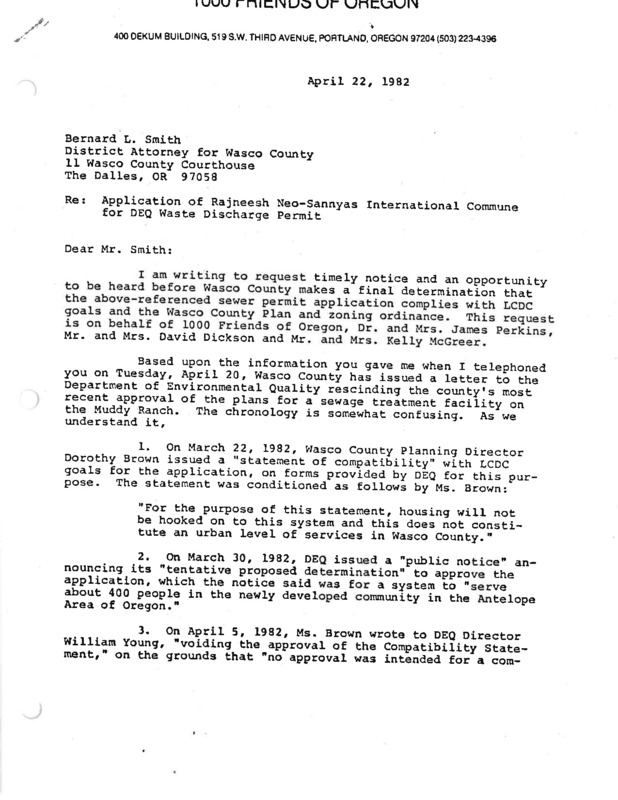
An April 22, 1982 letter from Robert E. Stacey, Jr., Staff Attorney for 1000 Friends of Oregon, to Bernard L. Smith, Wasco County District Attorney, regarding the Rajneesh Neo-Sannyas International Commune's application for a Department of Environmental Quality waste discharge permit. 1000 Friends of Oregon was a nonprofit organization that advocated for land use planning within the state. The letter requests notice and an opportunity to be heard before Wasco County makes a final determination on whether the proposed sewer facilities comply with LCDC goals, the Wasco County plan, and zoning ordinances. Stacey discusses the proposed sewage treatment facility on the Muddy Ranch, county compatibility statements, the possible capacity of the system, and concerns about agricultural land and public facilities goals.