The Victor Atiyeh Papers contain materials from his business, political, and personal activities, dating from 1923-2012, as well as collected materials and family papers predating the primary body of the collection. The bulk of the materials pertain to his campaigns for and his service in political office, particularly his two terms as Governor of Oregon, 1979-1987, and to the international consulting business he established after leaving office in 1987. Collection materials include appointment books, audio cassettes, awards, budgets, campaign materials, certificates, correspondence, directories, memoranda, memorabilia, notes, photographs, poll results, posters, press clippings, publications, receipts, reports, schedules, scrapbooks, speeches, and video tapes.
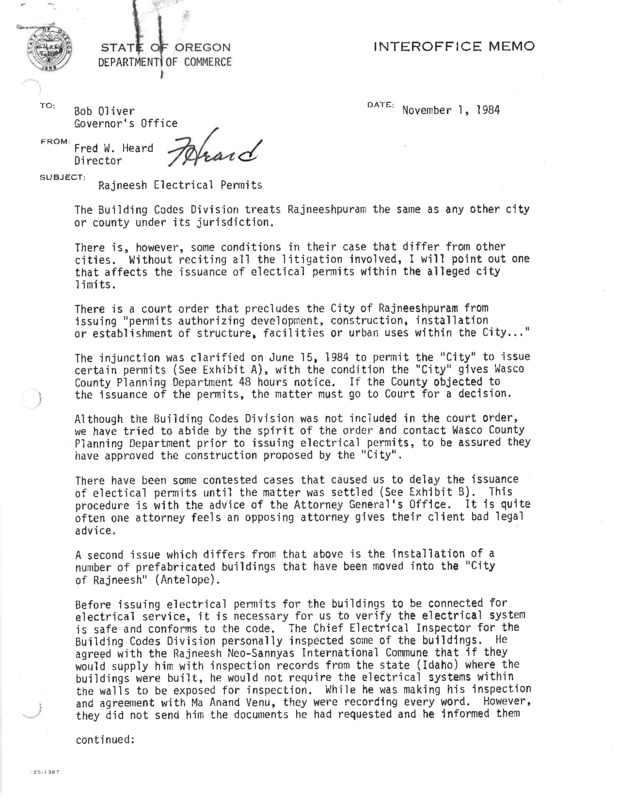
A two-page November 1, 1984 State of Oregon Department of Commerce interoffice memo from Fred W. Heard to Bob Oliver regarding Rajneesh electrical permits. The memo discusses Building Codes Division procedures for issuing electrical permits in Rajneeshpuram and Antelope, including the effect of court orders on permits within the alleged city limits, communication with the Wasco County Planning Department, and electrical permit issues involving prefabricated buildings moved into the City of Rajneesh. Heard states that electrical permits would be issued in the standard manner except where affected by court orders. The memo refers to attachments, but they are not included in this scan.
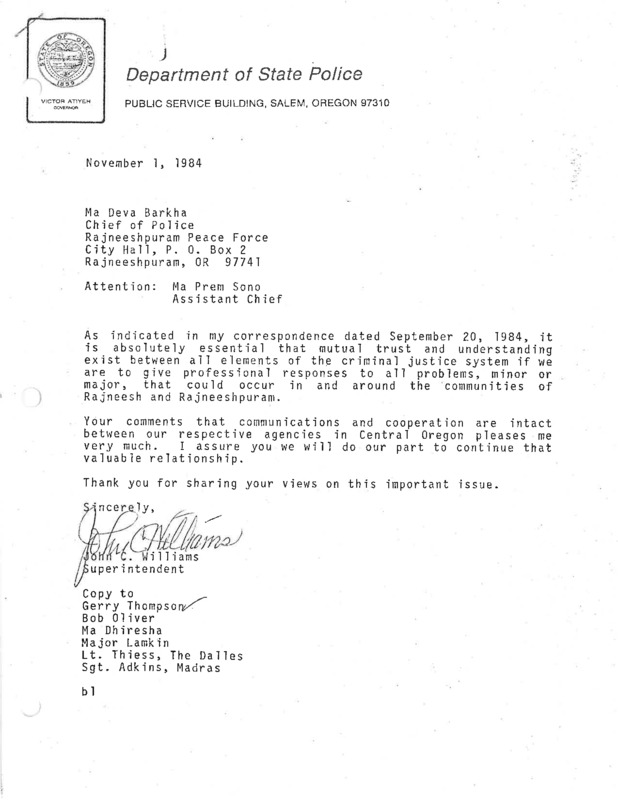
A two-page set of correspondence between the Oregon State Police and the Rajneeshpuram Peace Force. The first page is a November 1, 1984 letter from Oregon State Police Superintendent John C. Williams to Ma Deva Barkha, Chief of Police for the Rajneeshpuram Peace Force, with attention to Ma Prem Sono, Assistant Chief. Williams emphasizes the importance of mutual trust and professional communication between agencies. The second page is an October 31, 1984 letter from Ma Prem Sono to Williams regarding recent communication problems between the Rajneeshpuram Peace Force and Oregon State Police, including an upsetting telephone call, an unannounced flight over downtown Rajneeshpuram, and concerns following a reported threat against the city.
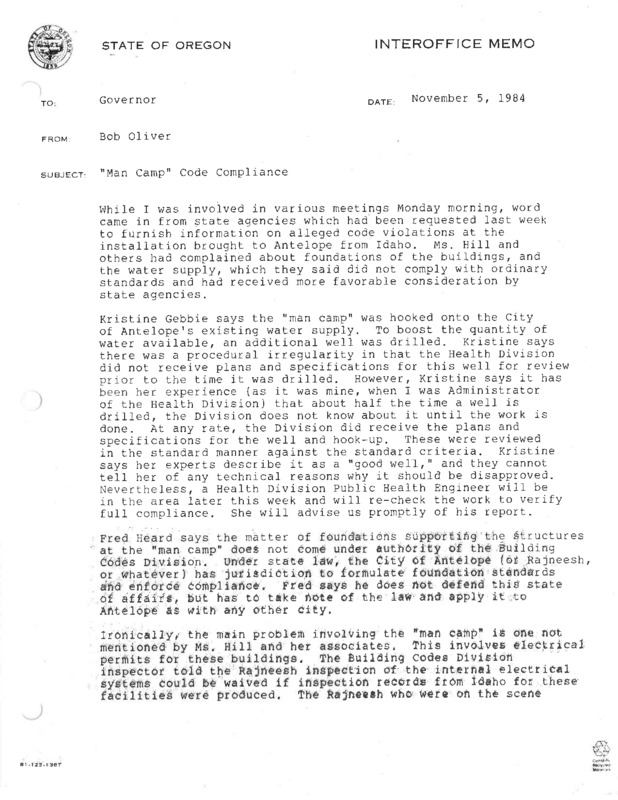
A two-page November 5, 1984 State of Oregon interoffice memo from Bob Oliver to Governor Atiyeh regarding "'Man Camp' Code Compliance." Oliver served as Atiyeh's legal counsel. The memo discusses information from state agencies about alleged code violations involving installations brought to Antelope from Idaho. Topics include the man camp's connection to the City of Antelope's water supply, an additional well, foundations for the buildings, electrical permits, inspection records, and Building Codes Division procedures. Oliver states that the main issue involved electrical permits and that a copy of Fred Heard's memorandum and other materials were attached.
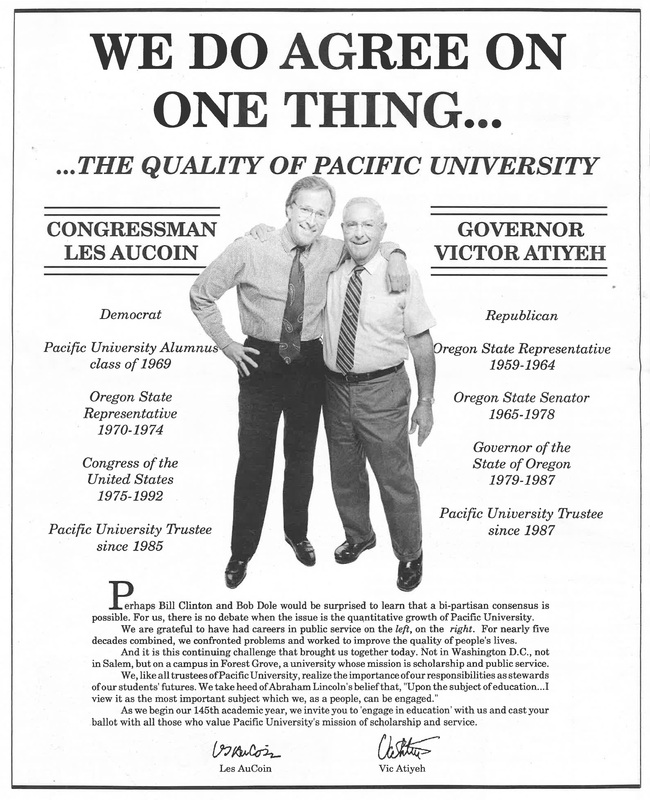
An advertisement for Pacific University featuring two Oregon politicians: Congressman Les AuCoin (Democrat) and Governor Vic Atiyeh (Republican). The advertisement, which is captioned, "We do agree on one thing... The quality of Pacific University", celebrates the spirit of bipartisanship, service and scholarship by highlighting these two members of Pacific's Board of Trustees.
This advertisement was created by Pacific's Marketing Department and appeared in local publications such as The Forest Grove News-Times in 1993.
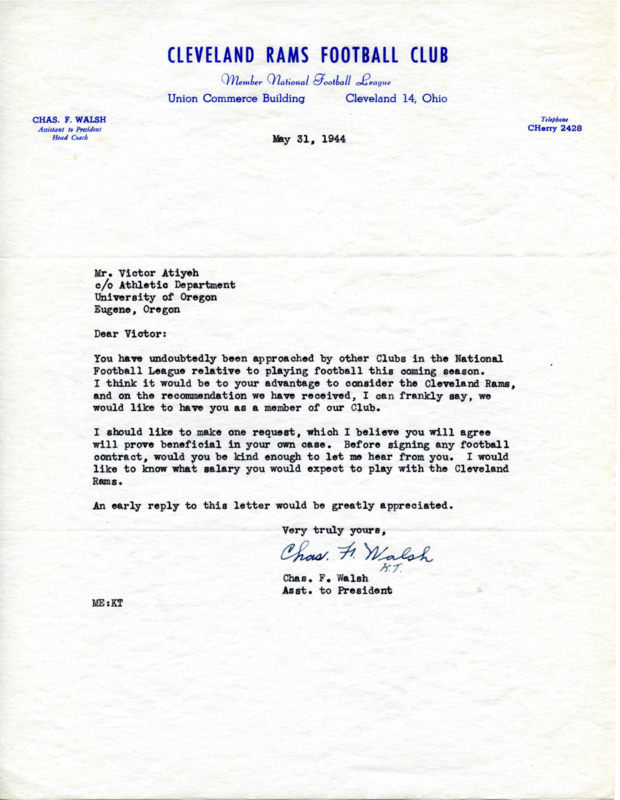
A letter to Victor Atiyeh from the Cleveland Rams. In the letter, the Rams offer Atiyeh a postion on their team. The Cleveland Rams were based in Cleveland until 1945. They moved to Los Angeles after World War II. The Rams moved to St. Louis in 1994, playing twenty one season there. In 2015, the Rams returned to Los Angeles and have remained there ever since.
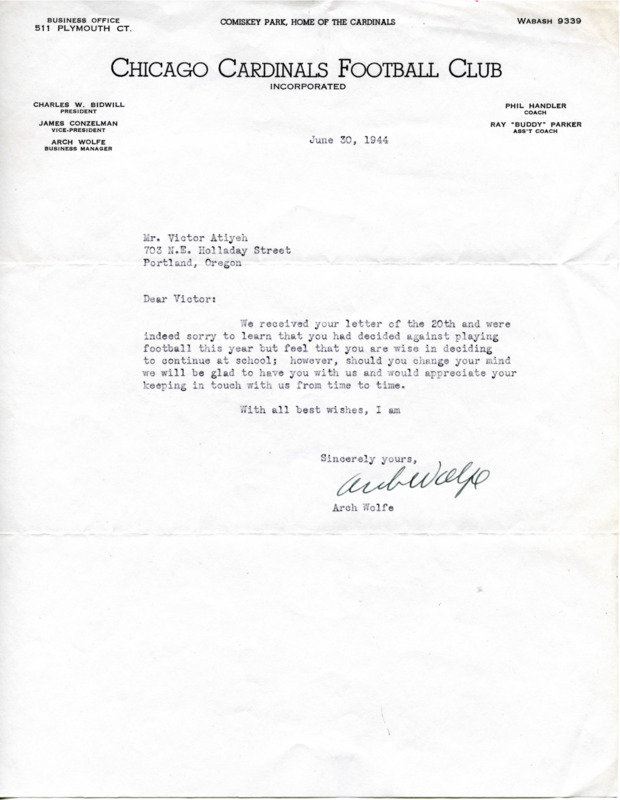
A letter to Victor Atiyeh from Chicago Cardinals general manager, Arch Wolfe. In the letter, Wolfe commends Atiyeh for continuing his education. He also indicates that if Atiyeh changes his mind, he should contact Wolfe.
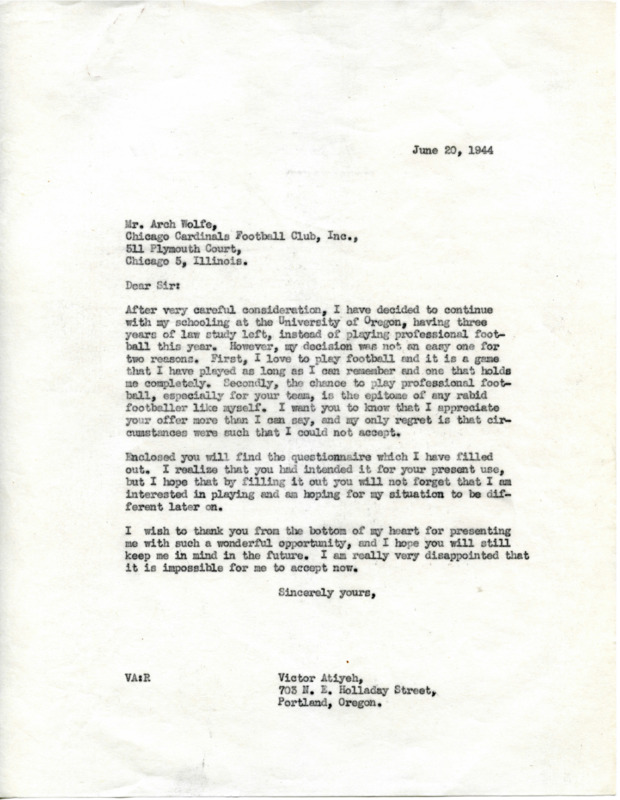
A letter from Victor Atiyeh to the Chicago Cardinals football team. In the letter, Atiyeh rejects the Chicago Cardinals offer to play for them, stating he wishes to continue with his education at the University of Oregon.
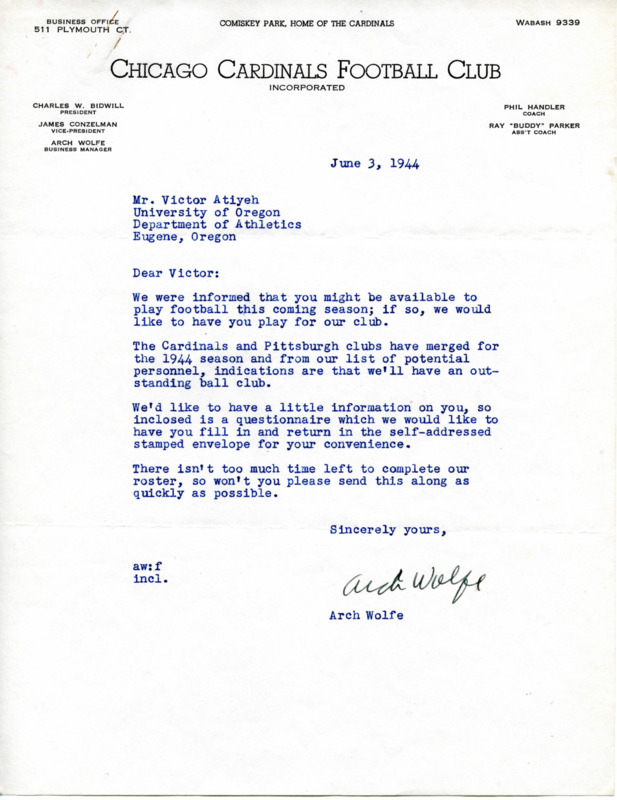
A letter to Victor Atiyeh from the Chicago Cardinals football team. In the letter, the Cardinals ask Atiyeh to answer some questions as they are interested in having Atiyeh play for their team. The Chicago Cardinals were established in 1898 and remained in Chicago until 1959. The team moved several times between 1959 and 1993, before settling Phoenix, Arizona. They have been known as the Arizona Cardinals since 1993.
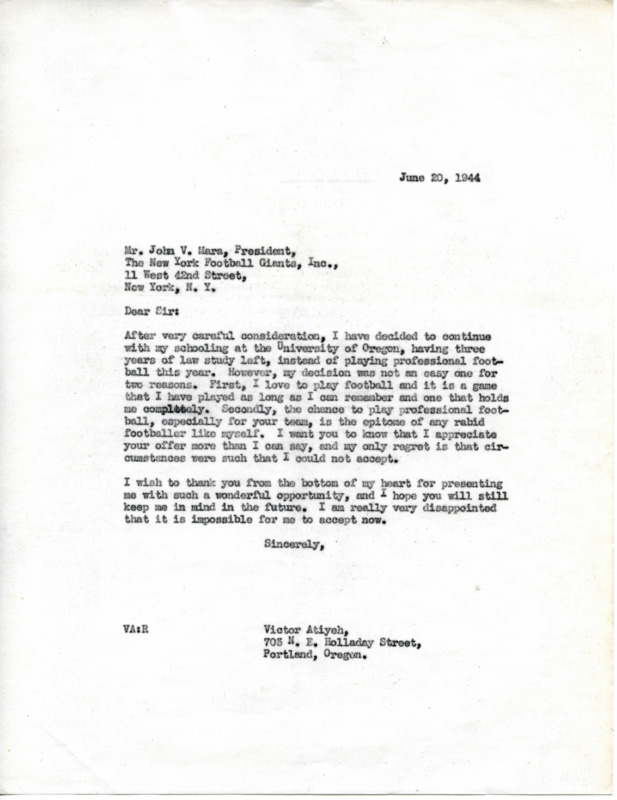
A letter from Victor Atiyeh to the New York Giants football team. In the letter, Atiyeh rejects the New York Giants offer to play for them, stating that he wishes to continue with his education at the University of Oregon.
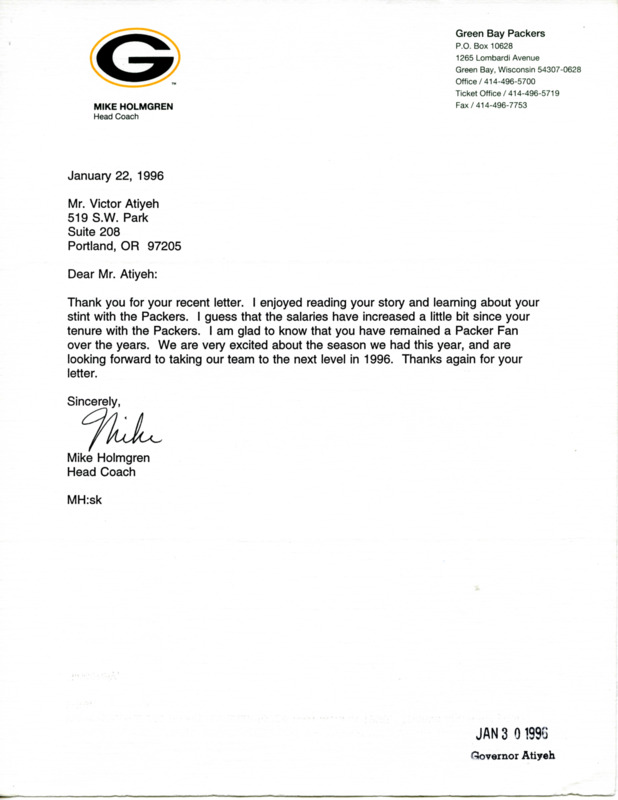
A letter from Green Bay Packers head coach, Mike Holmgren. In the letter, Holmgren thanks Atiyeh for sharing the story of how Atiyeh was persued by the Packers in the 1940s.
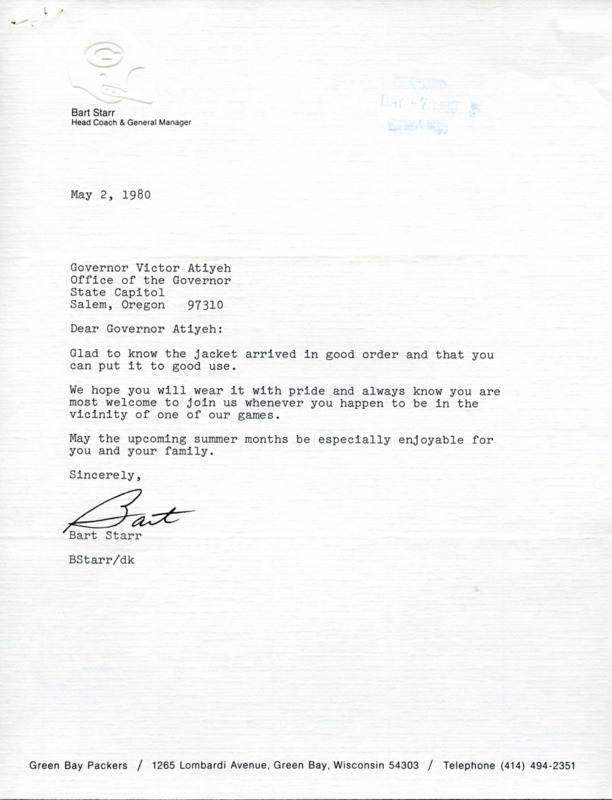
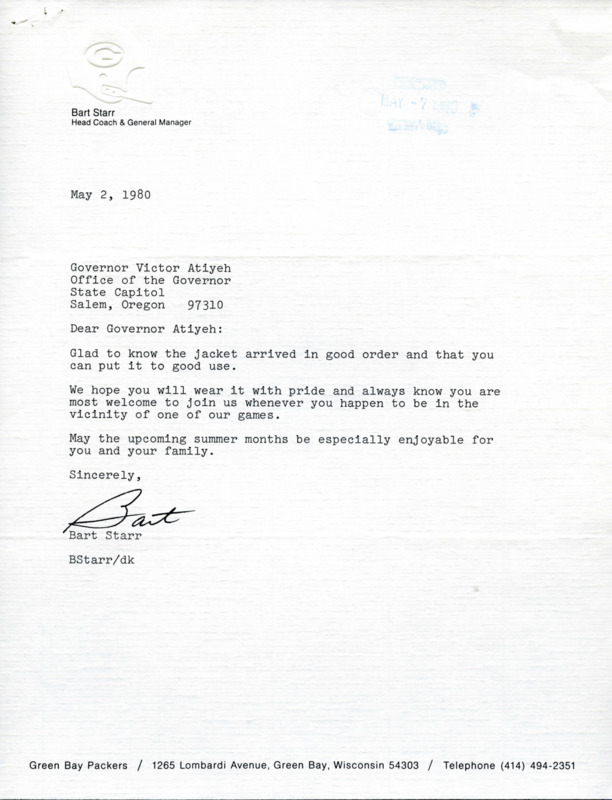
A letter from Green Bay Packers head coach, Bart Starr. In the letter, Starr discusses the Green Bay Packers jacket that Atiyeh received as a gift from the team.
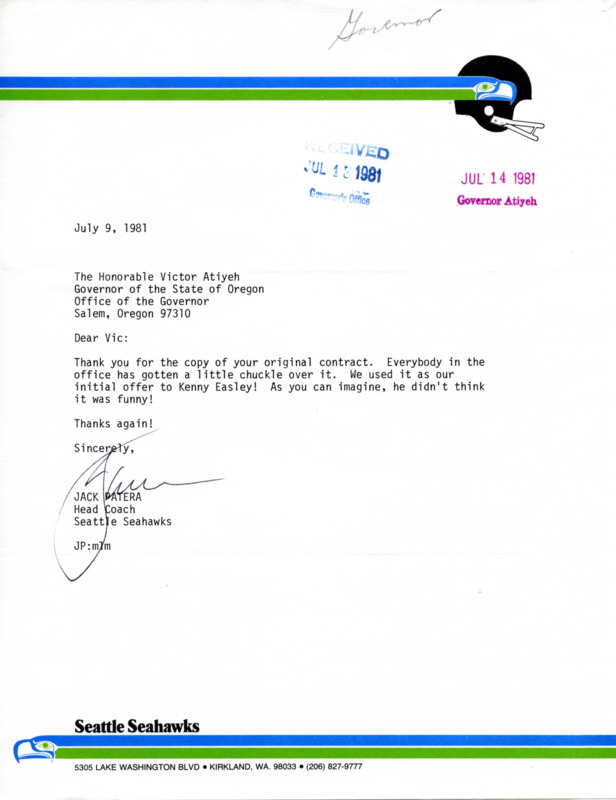
A letter to Victor Atiyeh from Seattle Seahawks coach, Jack Patera. In the letter Patera thanks Atiyeh for sharing a copy of Atiyeh's Green Bay Packers contract with him.
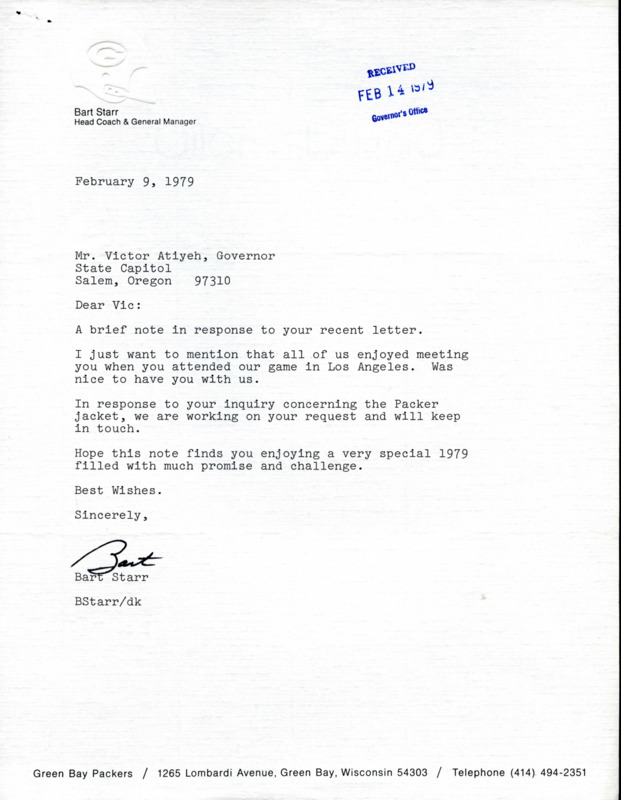
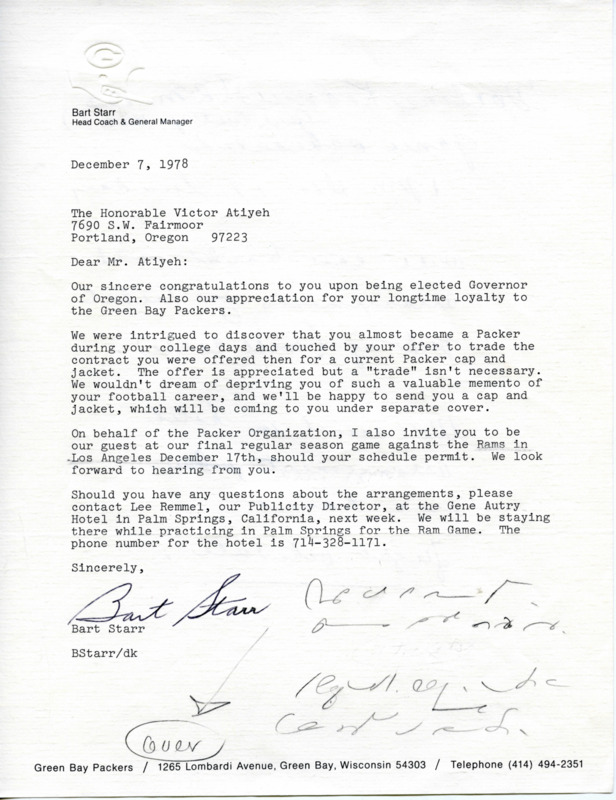
A letter to Victor Atiyeh from Green Bay Packers coach and former player, Bart Starr. In the letter Starr congratulates Atiyeh on being elected Oregon Governor and extends an invitation for Atieyh to attend the Green Bay Packers and Los Angeles Rams game on December 17, 1978.
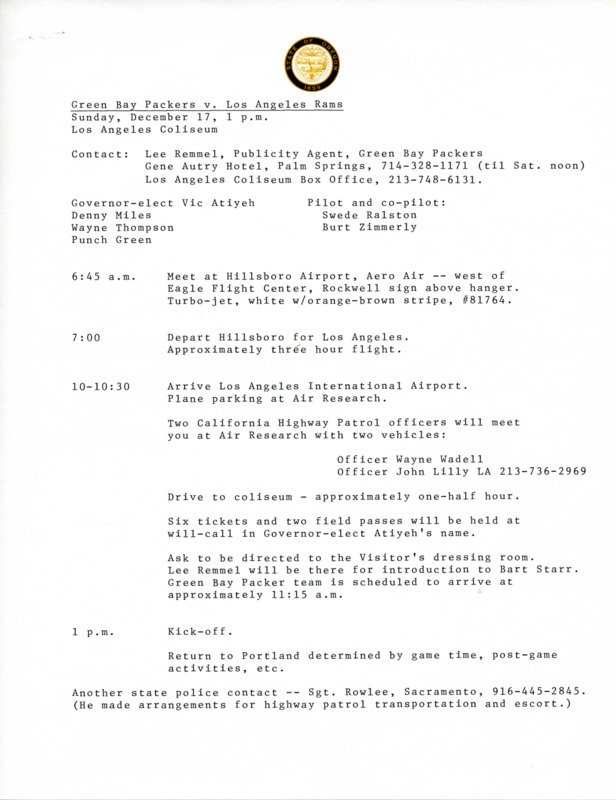
Victor Atiyeh's itinerary for the Green Bay Packers versus Los Angeles Rams game. The game was held on December 17, 1978. Atiyeh met with Green Bay Packers coach and former player, Bart Starr, after the game.
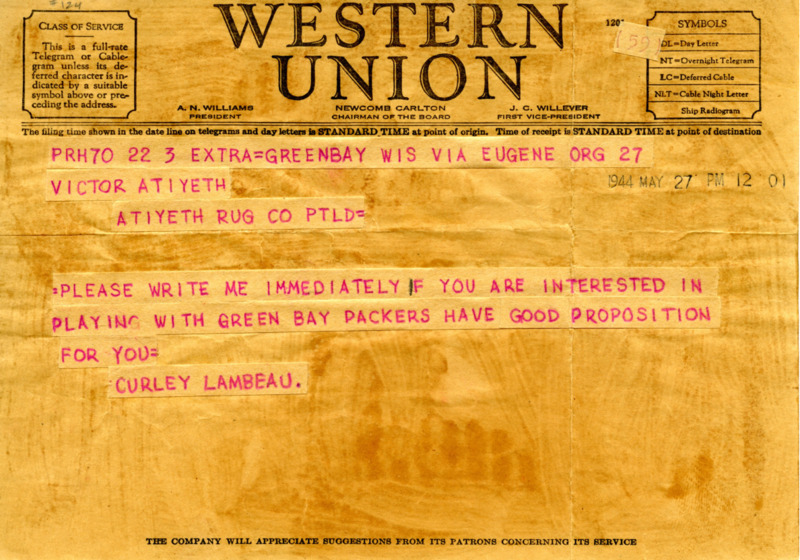
A telegram sent to Victor Atiyeh from Green Bay Packers owner, Curley Lambeau. In it, Curley Lambeau writes that he has a good offer for Atiyeh to play in Green Bay. The telegram was sent on June 6, 1944, the same day as the D-Day invasion on the beaches of Normandy, France.
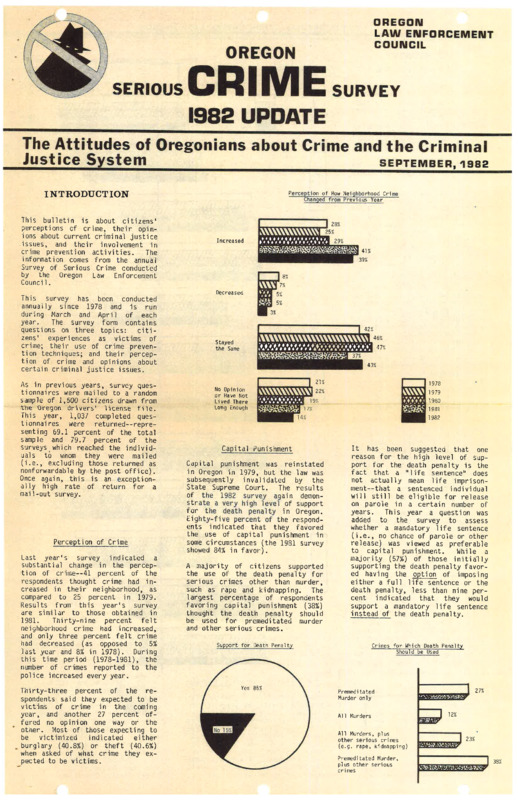
The September 1982 update to the 'Oregon Serious Crime Survey,' a bulletin issued by the Oregon Law Enforcement Council. This issue is on 'The Attitudes of Oregonians about Crime and the Criminal Justice System.' The survey supplying the data was administered and processed by Stan Woodwell and awarded by the Bureau of Justice Statistics. Topics addressed include: Oregon death penalty and capital punishment; the 1977 Community Corrections Act; community correctional programs; juvenile programs and correctional institutions; parole release decision; the insanity defense; and crime prevention. This is one document from a binder containing selected daily reports to the Governor, which was compiled by Gerry Thompson.
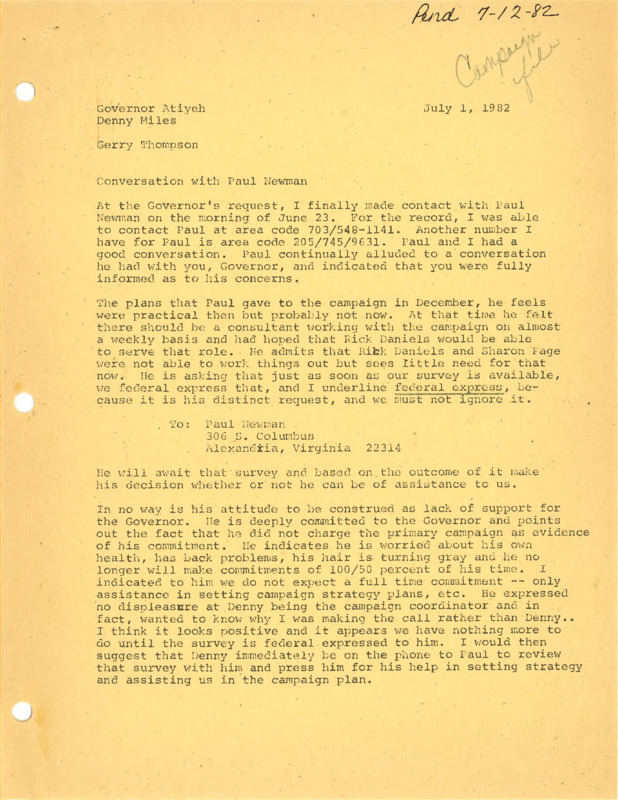
A memo prepared by Gerry Thompson on July 1, 1982 reporting to Denny Miles, newly appointed campaign coordinator. The outcome of the federal express survey will determine if Paul Newman can be of assistance to the campaign committee. Hank Crawford and Bob Dernedde were helpful in tracking Paul Newman and exemplified loyalty to Gov. Atiyeh. This is one document from a binder containing selected daily reports to the Governor, which was compiled by Gerry Thompson.
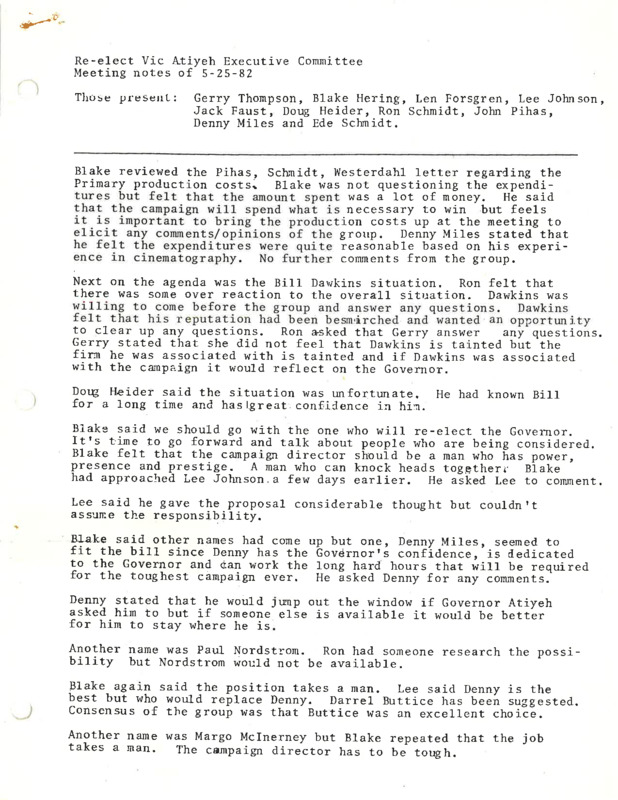
A memo on the conversations discussed leading to the primary election that took place on May 25, 1982. Topics addressed by the Re-elect Victor Atiyeh Executive Committee include: primary production costs; Lee Johnson and Denny Miles involvement in campaign, in-depth probe survey; Ted Kulongoski vs Packwood race; Ford visit; Executive Committee retreat at Gearhart; Paul Newman; position papers and a media campaign with the Tourism and Economic Development money. This is one document from a binder containing selected daily reports to the Governor, which was compiled by Gerry Thompson.
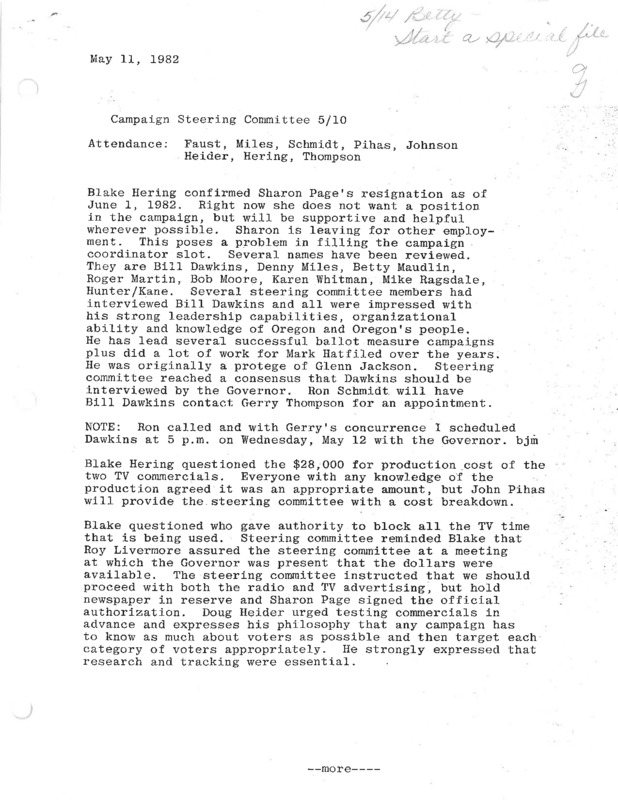
A memo on a meeting that took place on May 11, 1982. Topics addressed by the Campaign Steering Committee include: Bill Dawkins as the new campaign coordinator to replace Sharon Page; production cost for TV commercials and research for further advertisement; C&E Reporting; Paul Newman assisting in the campaign; and the Welcome to Oregon sign. This is one document from a binder containing selected daily reports to the Governor, which was compiled by Gerry Thompson.