The Victor Atiyeh Papers contain materials from his business, political, and personal activities, dating from 1923-2012, as well as collected materials and family papers predating the primary body of the collection. The bulk of the materials pertain to his campaigns for and his service in political office, particularly his two terms as Governor of Oregon, 1979-1987, and to the international consulting business he established after leaving office in 1987. Collection materials include appointment books, audio cassettes, awards, budgets, campaign materials, certificates, correspondence, directories, memoranda, memorabilia, notes, photographs, poll results, posters, press clippings, publications, receipts, reports, schedules, scrapbooks, speeches, and video tapes.
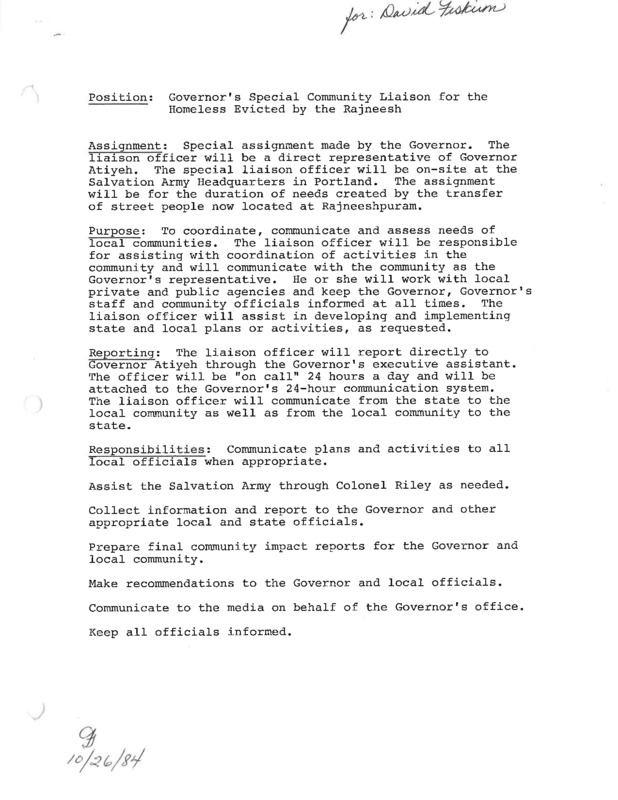
A one-page typed position description for the "Governor's Special Community Liaison for the Homeless Evicted by the Rajneesh." The document describes the liaison as a direct representative of Governor Atiyeh, assigned to work on-site at the Salvation Army headquarters in Portland for the duration of needs created by the transfer of "street people" from Rajneeshpuram. The position description outlines the liaison's assignment, purpose, reporting structure, and responsibilities, including coordination with local communities, communication with public and private agencies, reporting to the Governor's office, and communicating with the media. A handwritten note identifies the document as being for David Fiskum (Atiyeh's Acting Press Secretary) and includes the date October 26, 1984.
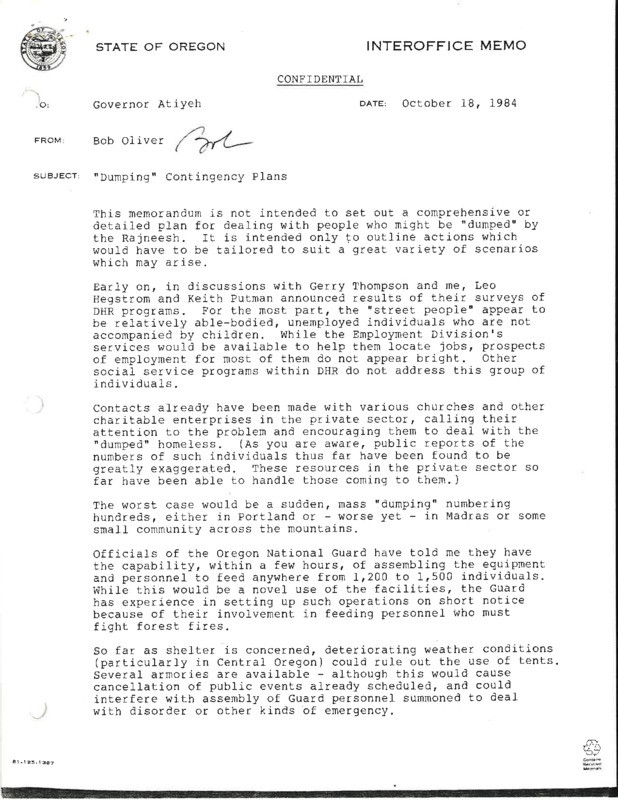
A two-page October 18, 1984 confidential State of Oregon interoffice memo from Bob Oliver to Governor Atiyeh regarding "Dumping Contingency Plans." The memo discusses planning for homeless people who might be "dumped" by the Rajneesh, including Department of Human Resources surveys, private charitable resources, possible mass "dumping" scenarios, National Guard capabilities, shelter concerns, transportation costs, and possible Emergency Board funding. Handwritten edits are visible on the document. Oliver served as the legal counsel to Governors McCall and Atiyeh, playing a particularly important behind-the-scenes role as Public Safety Coordinator during the Rajneesh crisis.
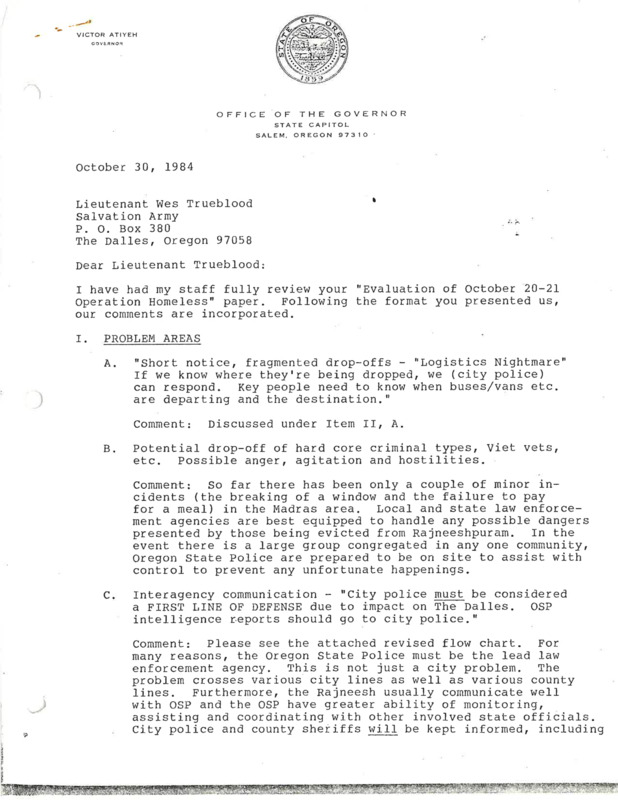
A six-page letter dated October 30, 1984 from Governor Victor Atiyeh to Lieutenant Wes Trueblood of the Salvation Army in The Dalles regarding Trueblood's "Evaluation of October 20-21 Operation Homeless" paper. The letter provides comments on problem areas and needs assessment, including communication, interagency coordination, overcrowding, screening, media handling, funding, food networks, overflow locations, transportation, emergency telephone planning, medical needs, and public safety. The final page contains a revised flow chart showing communication among Oregon State Police, the Wasco County Sheriff, The Dalles city police, the Salvation Army, the Ministerial Association, Judson Baptist College, and other local contacts. This letter was written in the context of the Rajneesh crisis, during which the Rajneesh first brought in and then abandoned many homeless people.
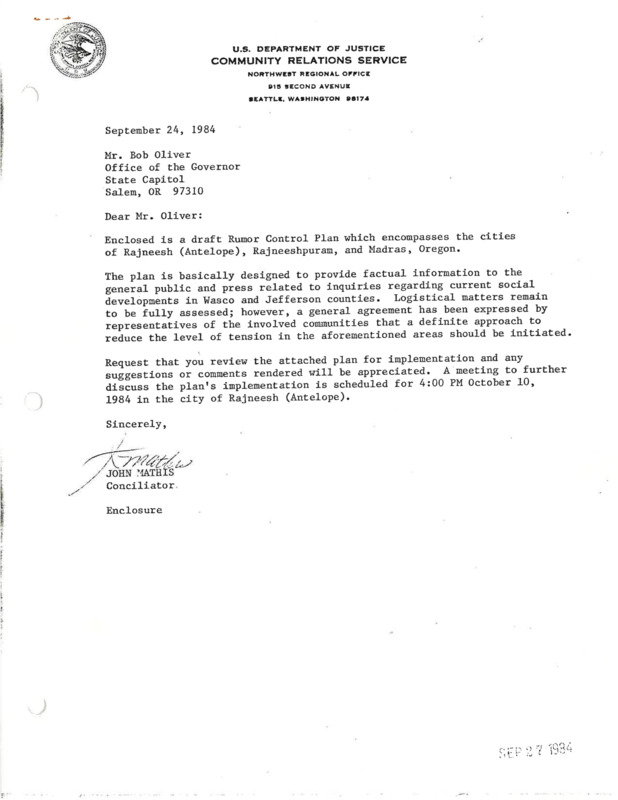
A four-page September 24, 1984 letter from John Mathis of the U.S. Department of Justice Community Relations Service to Governor Atiyeh's legal advisor Bob Oliver, enclosing a draft "Rumor Control Plan" for Antelope, Rajneeshpuram, and Madras, Oregon. The letter was written within the context of the Rajneesh crisis. The plan is dated September 19, 1984 and was intended to provide factual information to the public and press during periods of community tension. The draft plan discusses rumor control centers, publicity, physical equipment, staffing, procedures, communication with police and fire departments, and the use of verifiers. The final page contains a flow chart for rumor control communication in Rajneeshpuram, Madras, and Antelope.
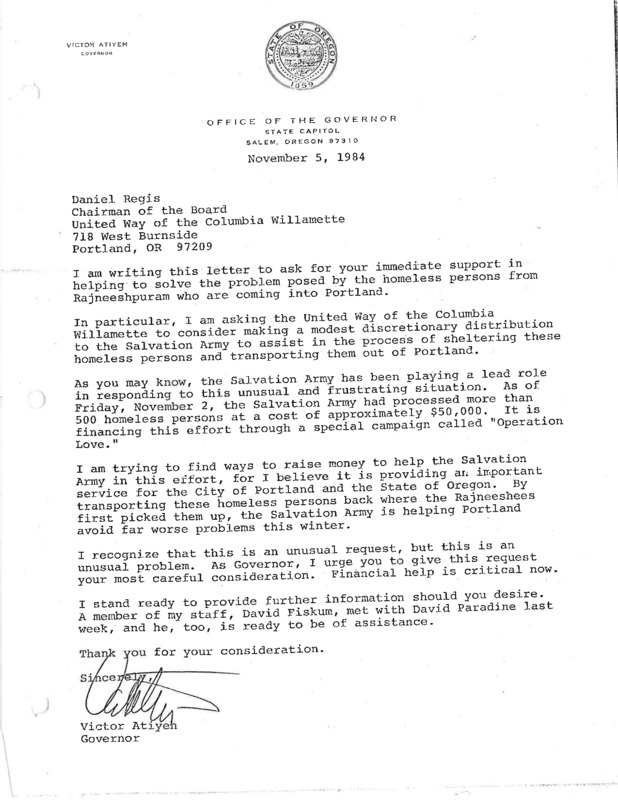
A November 5, 1984 letter from Governor Victor Atiyeh to Daniel Regis, Chairman of the Board of the United Way of the Columbia Willamette. The letter asks the United Way to consider providing a discretionary distribution to the Salvation Army to assist in sheltering and transporting homeless people from Rajneeshpuram who were coming into Portland. Atiyeh notes that the Salvation Army had processed more than 500 homeless people by November 2 and was financing the effort through a special campaign called "Operation Love."
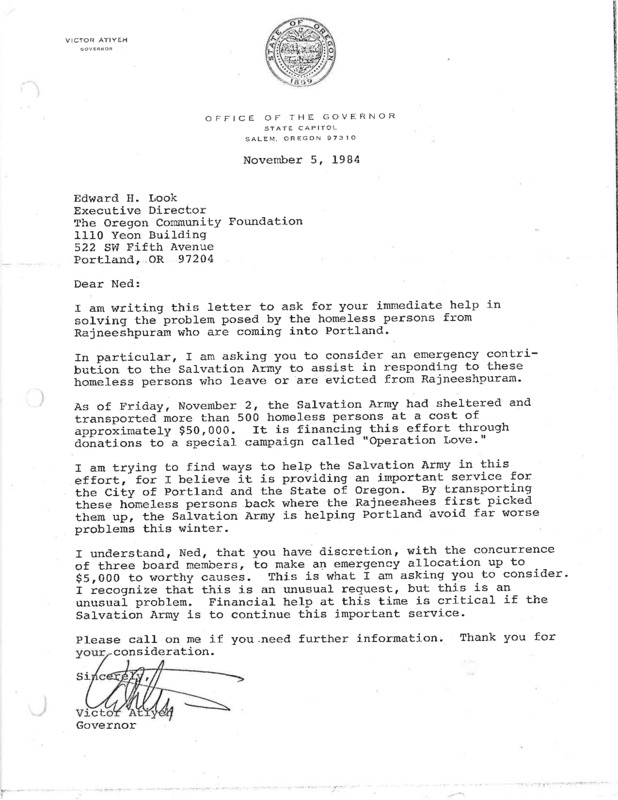
A November 5, 1984 letter from Governor Victor Atiyeh to Edward H. Look, Executive Director of The Oregon Community Foundation. The letter asks Look to consider an emergency contribution to the Salvation Army to assist homeless people who had left or been evicted from Rajneeshpuram. Atiyeh states that the Salvation Army had sheltered and transported more than 500 homeless people at a cost of approximately $50,000 and asks Look to consider an emergency allocation of up to $5,000.
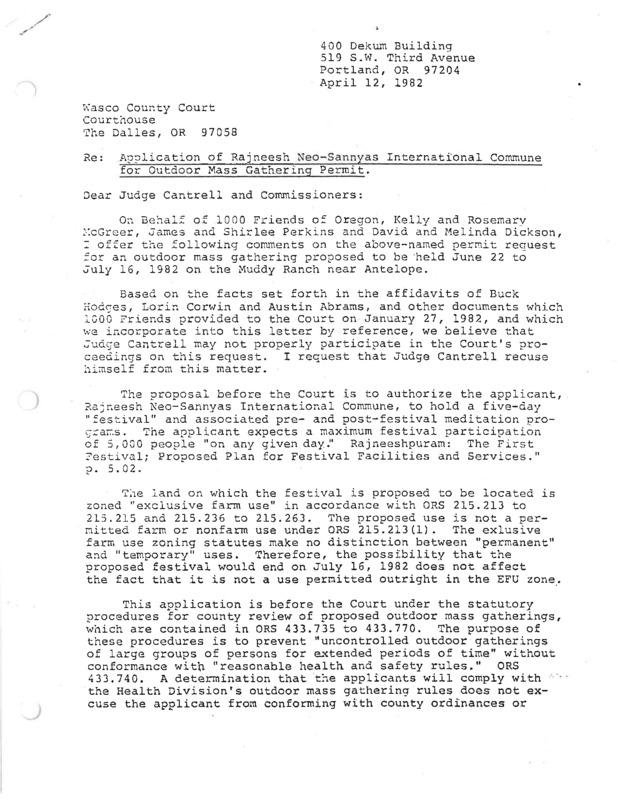
An April 12, 1982 letter from Robert E. Stacey, Jr., Staff Attorney for 1000 Friends of Oregon, to the Wasco County Court regarding the Rajneesh Neo-Sannyas International Commune's application for an outdoor mass gathering permit, which would be called the "First Annual World Celebration." The letter presents comments on the proposed festival at Muddy Ranch near Antelope, asks that Judge Cantrell recuse himself from the matter, and argues that the proposed gathering and related utility facilities were not permitted uses in an exclusive farm use zone. The letter also discusses the Health Division's outdoor mass gathering rules, utility facilities, water and sewage systems, and possible permit conditions.
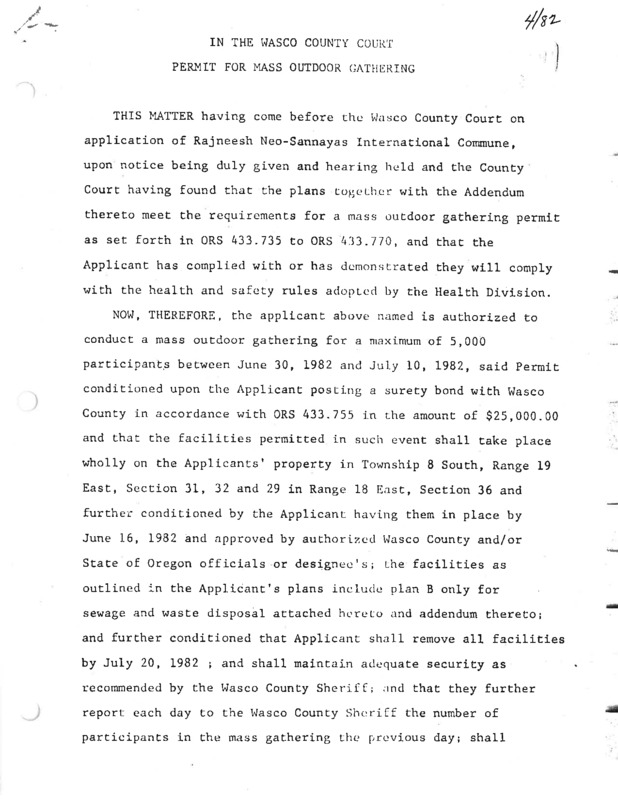
A two-page Wasco County Court permit form for a mass outdoor gathering by the Rajneesh Neo-Sannyas International Commune. The document authorizes a gathering of up to 5,000 participants between June 30 and July 10, 1982, conditioned on a $25,000 surety bond, placement and approval of facilities, removal of facilities by July 20, maintenance of security, daily reporting to the Wasco County Sheriff, and road improvements on the petitioner's property. The document appears to be an unsigned or incomplete copy, with blank signature lines for the Wasco County Court and a signature approving the form. The festival did eventually take place on July 3-7, 1982, and was called the "First Annual World Celebration".
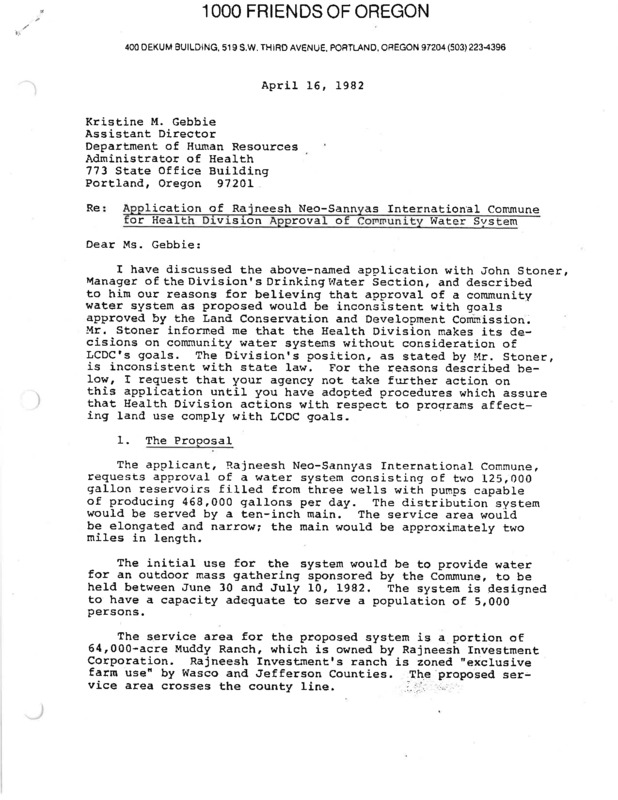
An April 16, 1982 letter from Robert E. Stacey, Jr., Staff Attorney for 1000 Friends of Oregon, to Kristine M. Gebbie, Assistant Director of the Department of Human Resources and Administrator of Health. 1000 Friends of Oregon was a nonprofit organization that advocated for land use planning within the state. The letter concerns the Rajneesh Neo-Sannyas International Commune's application for Health Division approval of a community water system. Stacey argues that approval of the proposed water system would be inconsistent with Land Conservation and Development Commission goals and state land use law, and asks the Health Division not to take further action on the application until appropriate review procedures were adopted. The letter discusses the proposed water system, exclusive farm use zoning, the pending Rajneeshpuram incorporation dispute, LCDC goals, and Health Division responsibilities.
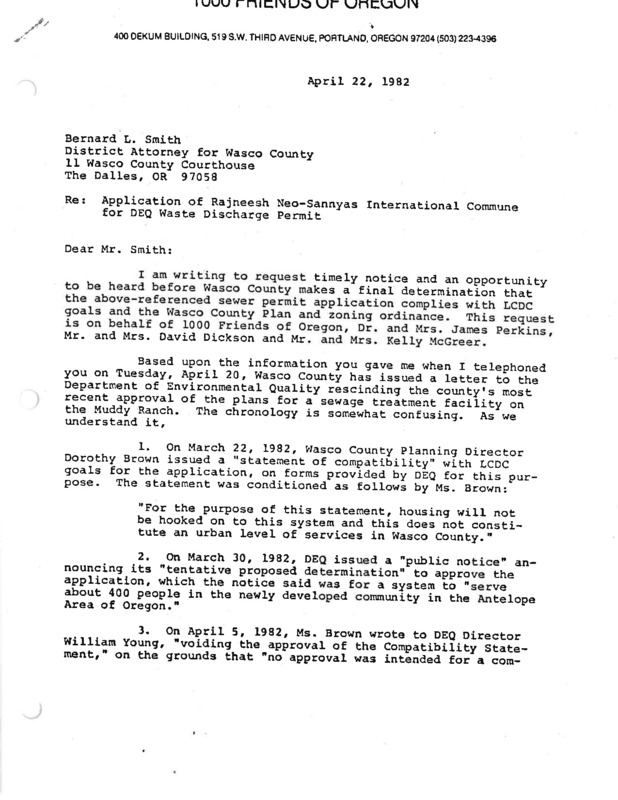
An April 22, 1982 letter from Robert E. Stacey, Jr., Staff Attorney for 1000 Friends of Oregon, to Bernard L. Smith, Wasco County District Attorney, regarding the Rajneesh Neo-Sannyas International Commune's application for a Department of Environmental Quality waste discharge permit. 1000 Friends of Oregon was a nonprofit organization that advocated for land use planning within the state. The letter requests notice and an opportunity to be heard before Wasco County makes a final determination on whether the proposed sewer facilities comply with LCDC goals, the Wasco County plan, and zoning ordinances. Stacey discusses the proposed sewage treatment facility on the Muddy Ranch, county compatibility statements, the possible capacity of the system, and concerns about agricultural land and public facilities goals.
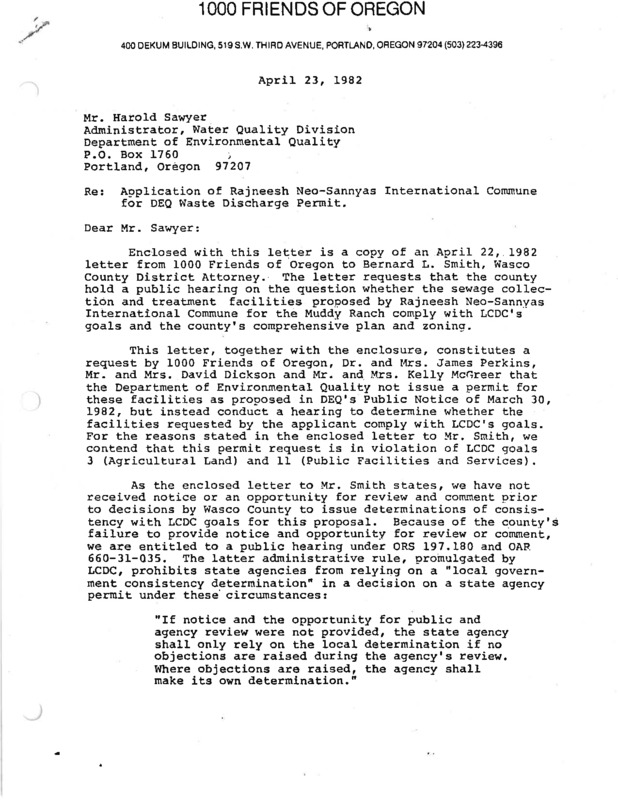
An April 23, 1982 letter from Robert E. Stacey, Jr., Staff Attorney for 1000 Friends of Oregon, to Harold Sawyer, Administrator of the Department of Environmental Quality Water Quality Division. 1000 Friends of Oregon was a nonprofit organization that advocated for land use planning within the state. The letter requests that DEQ not issue a waste discharge permit for proposed sewage facilities at the Muddy Ranch without holding a hearing to determine whether the facilities complied with LCDC goals. Stacey argues that the proposed lagoon facility could have an urban-level capacity and discusses concerns about agricultural land, public facilities and services, and ongoing litigation over the formation of Rajneeshpuram.
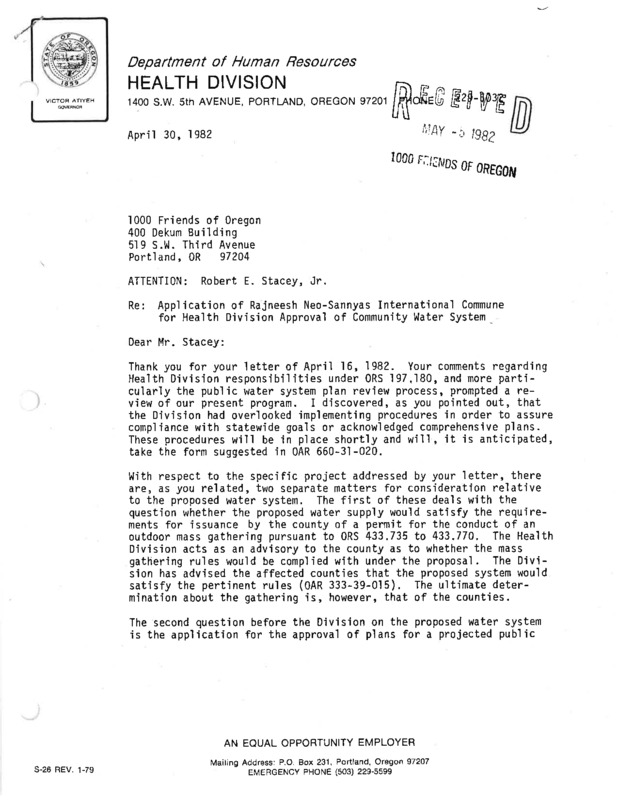
An April 30, 1982 letter from Kristine M. Gebbie, Assistant Director of Human Resources and Administrator of the Health Division, to Robert E. Stacey, Jr. of 1000 Friends of Oregon. 1000 Friends of Oregon was a nonprofit organization that advocated for land use planning within the state. The letter responds to Stacey's concerns about the Rajneesh Neo-Sannyas International Commune's application for Health Division approval of a community water system. Gebbie states that the Health Division had overlooked procedures for assuring compliance with statewide goals or acknowledged comprehensive plans, and explains that those procedures would be applied to the proposed public water system.
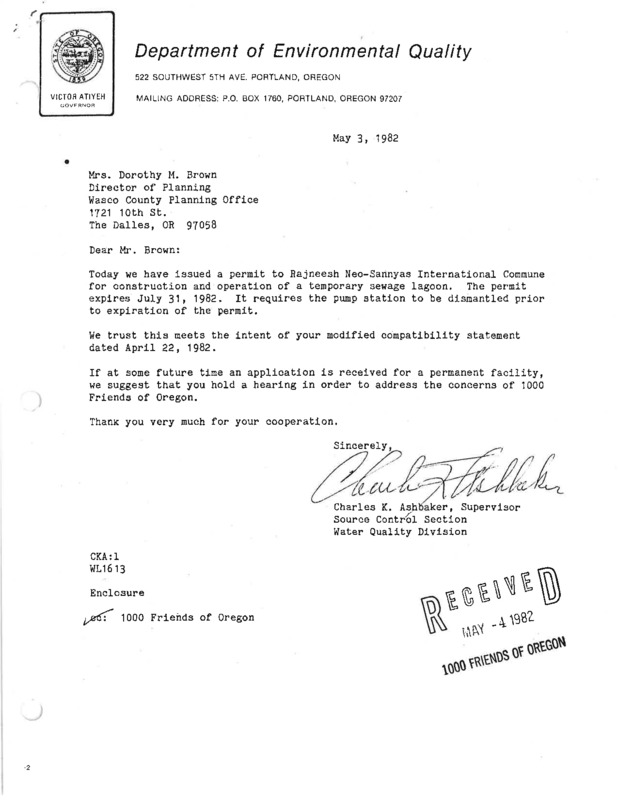
A May 3, 1982 letter from Charles K. Ashbaker, Supervisor of the Department of Environmental Quality (DEQ) Source Control Section, to Dorothy M. Brown, Director of Planning for Wasco County. The letter states that the DEQ had issued a permit to the Rajneesh Neo-Sannyas International Commune for construction and operation of a temporary sewage lagoon, expiring July 31, 1982. Ashbaker states that the permit required the pump station to be dismantled before the permit expired and suggests that Wasco County hold a hearing if an application was later received for a permanent facility.
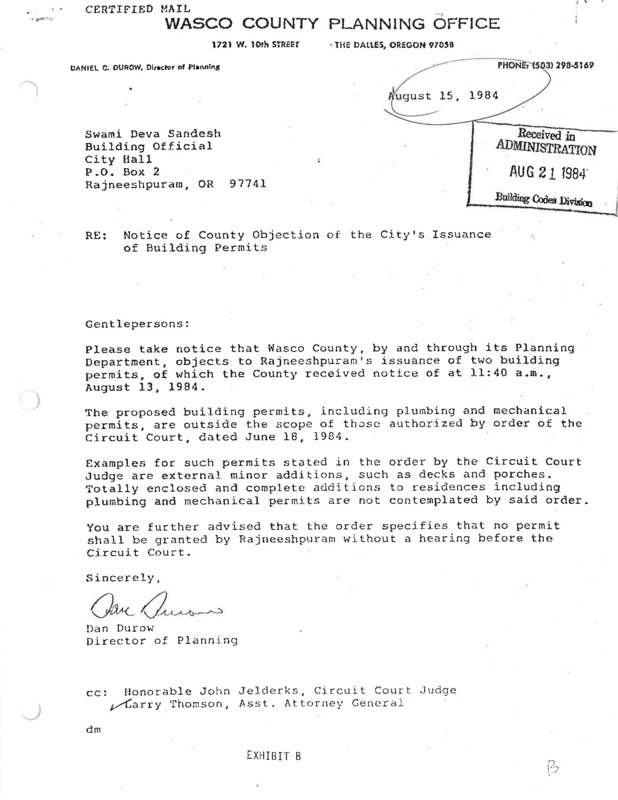
An August 15, 1984 certified mail letter from Dan Durow, Director of Planning for Wasco County, to Swami Deva Sandesh, Building Official for Rajneeshpuram. The letter states that Wasco County objected to Rajneeshpuram's issuance of two building permits, including plumbing and mechanical permits, which the county argued were outside the scope of a June 18, 1984 Circuit Court order. The letter states that the permits involved enclosed additions to residences rather than external minor additions such as decks and porches.
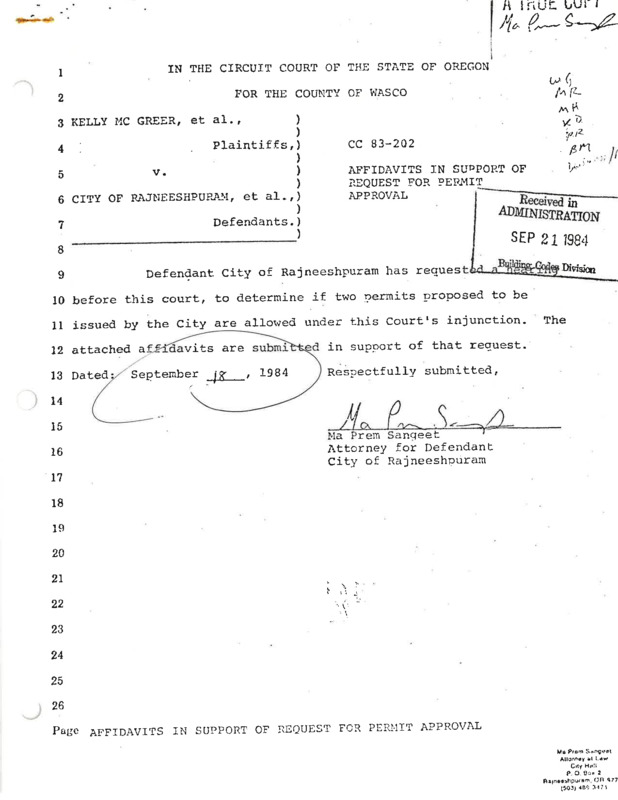
An eight-page September 1984 court filing in Kelly McGreer, et al. v. City of Rajneeshpuram, et al., titled "Affidavits in Support of Request for Permit Approval." The filing was submitted by Ma Prem Sangeet, attorney for the City of Rajneeshpuram, and concerns two building permits proposed by the city. The attached affidavits by Ma Dolma, Swami Krishna Deva, and Ma Prem Sangeet discuss proposed extensions to two existing structures, earlier discussions about the court's injunction, and whether additions under 500 square feet were allowed under the court's order. A received stamp from the Building Codes Division is dated September 21, 1984.
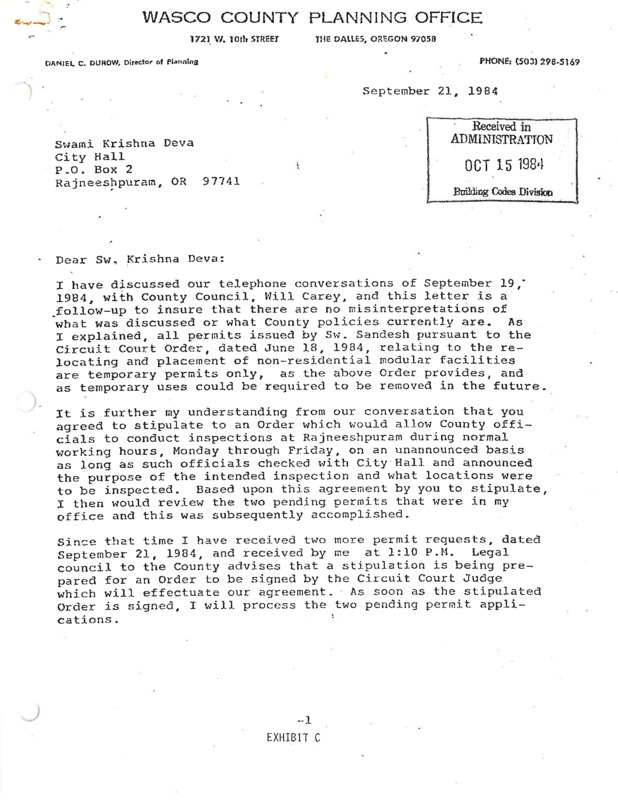
A September 21, 1984 letter from Dan Durow, Director of Planning for Wasco County, to Swami Krishna Deva of Rajneeshpuram. The letter follows up on telephone conversations about temporary permits issued under a June 18, 1984 Circuit Court order for the relocation and placement of non-residential modular facilities. Durow discusses an agreement allowing county officials to conduct unannounced inspections at Rajneeshpuram during normal working hours, pending permits, and the county's position that further permits would not be approved until a stipulated court order was signed.
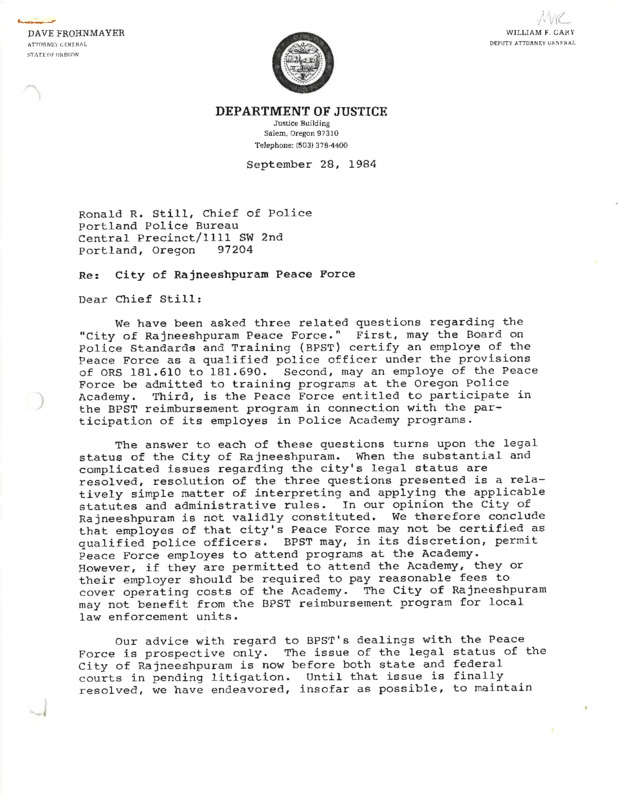
A September 28, 1984 letter from William F. Gary, Deputy Attorney General, to Ronald R. Still, Chief of the Portland Police Bureau, regarding the City of Rajneeshpuram Peace Force. The letter responds to questions about the legal status of Rajneeshpuram, certification of Peace Force employees by the Board on Police Standards and Training, admission to the Oregon Police Academy, and reimbursement for local law enforcement training. Gary discusses the pending legal challenges to Rajneeshpuram's municipal status and states that the city and its Peace Force did not appear eligible for certain police training reimbursement programs.
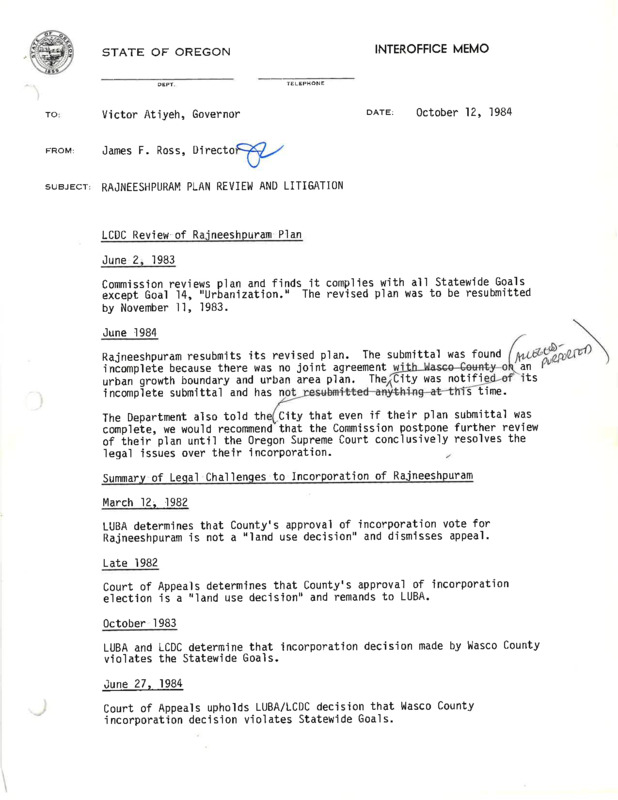
An October 12, 1984 State of Oregon interoffice memo from James F. Ross of Oregon's Land Conservation and Development Commission to Governor Victor Atiyeh, regarding "Rajneeshpuram Plan Review and Litigation." The memo summarizes the LCDC review of the Rajneeshpuram plan and legal challenges to Rajneeshpuram's incorporation. It notes dates including the Commission's June 2, 1983 review, Rajneeshpuram's June 1984 resubmission, earlier LUBA and court decisions, and the Oregon Supreme Court's October 9, 1984 acceptance of review of the Court of Appeals decision. A handwritten note appears on the first page.
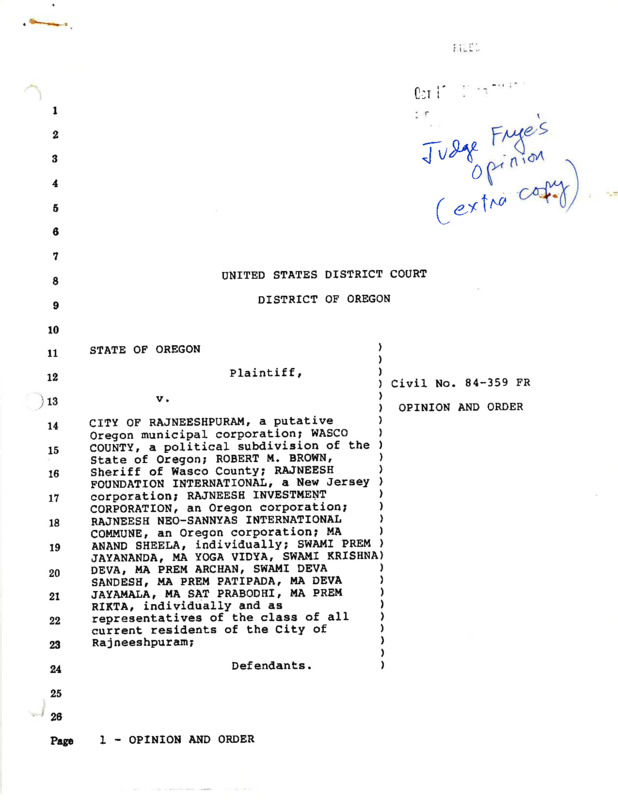
An October 12, 1984 opinion and order by United States District Judge Helen J. Frye in State of Oregon v. City of Rajneeshpuram, et al. The order concerns defendants' motions to strike portions of the State of Oregon's complaint, which alleged that the City of Rajneeshpuram and its operation as a city constituted an unconstitutional establishment of religion. The opinion discusses arguments concerning establishment clause claims, quo warranto, statute of limitations, and allegedly scandalous or impertinent material. The court denied the defendants' motions to strike.
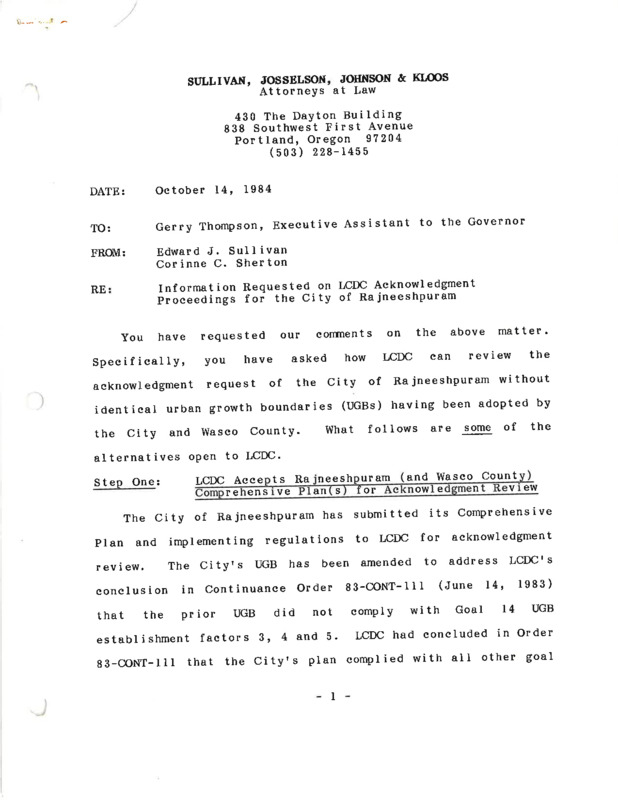
A seven-page October 14, 1984 memo from Edward J. Sullivan and Corinne C. Sherton to Gerry Thompson regarding Oregon's Land Conservation and Development Commission acknowledgment of proceedings for the City of Rajneeshpuram. The memo discusses how the LCDC could review Rajneeshpuram's acknowledgment request without identical urban growth boundaries having been adopted by the city and Wasco County. Topics include Rajneeshpuram's comprehensive plan, Wasco County's role, Goal 14, urban growth boundaries, limited acknowledgment orders, and possible LCDC action.
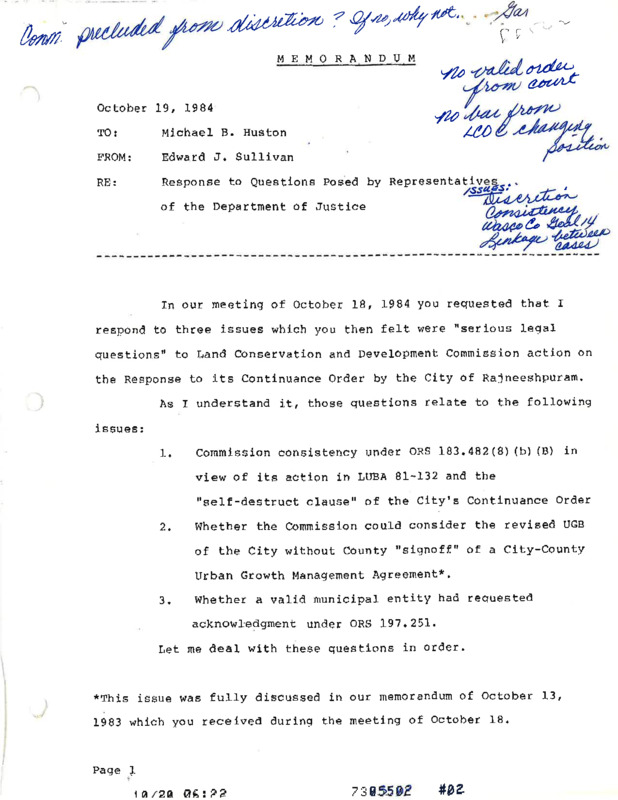
A thirteen-page October 19, 1984 memorandum from Edward J. Sullivan to Michael B. Huston regarding questions posed by representatives of the Department of Justice. The memo responds to legal questions concerning Land Conservation and Development Commission action on the City of Rajneeshpuram's response to a continuance order. Topics include consistency in LCDC decision-making, the revised urban growth boundary, city-county urban growth management issues, and whether a valid municipal entity had requested acknowledgment under Oregon land use law.
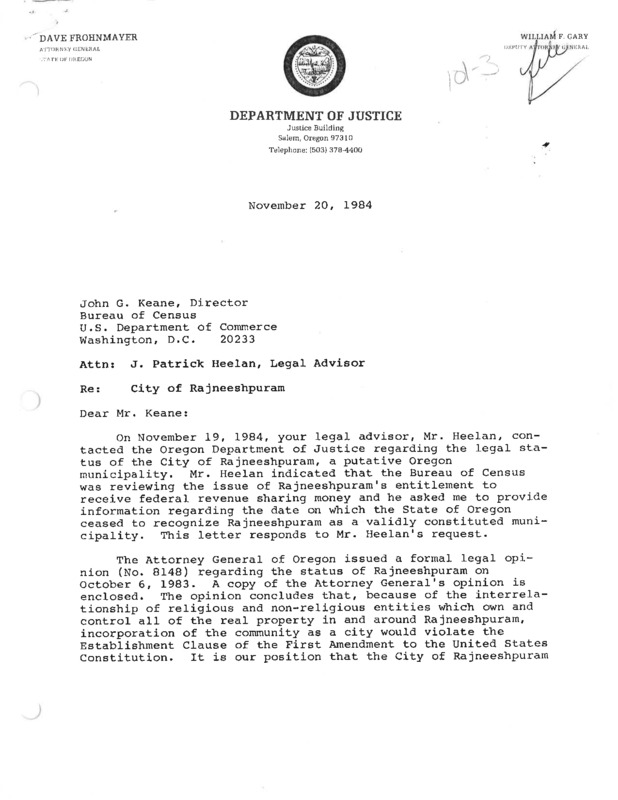
A November 20, 1984 letter from William F. Gary, Deputy Attorney General, to John G. Keane, Director of the U.S. Bureau of the Census, regarding the City of Rajneeshpuram. The letter responds to a request for information about Rajneeshpuram's legal status in connection with federal revenue sharing. Gary states that the Oregon Attorney General's office considered Rajneeshpuram never to have been validly constituted as a municipal government, based on the Attorney General's October 6, 1983 formal legal opinion.
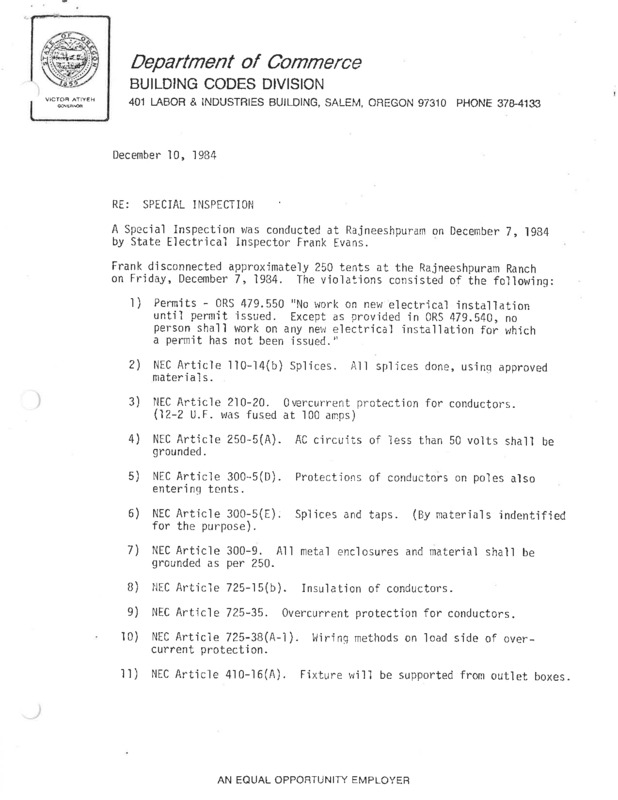
A two-page December 10, 1984 Department of Commerce Building Codes Division report regarding a special inspection at Rajneeshpuram. The report states that State Electrical Inspector Frank Evans disconnected approximately 250 tents at the Rajneeshpuram Ranch on December 7, 1984. The document lists electrical code violations involving permits, splices, overcurrent protection, grounding, underground cables, junction boxes, and related wiring issues.
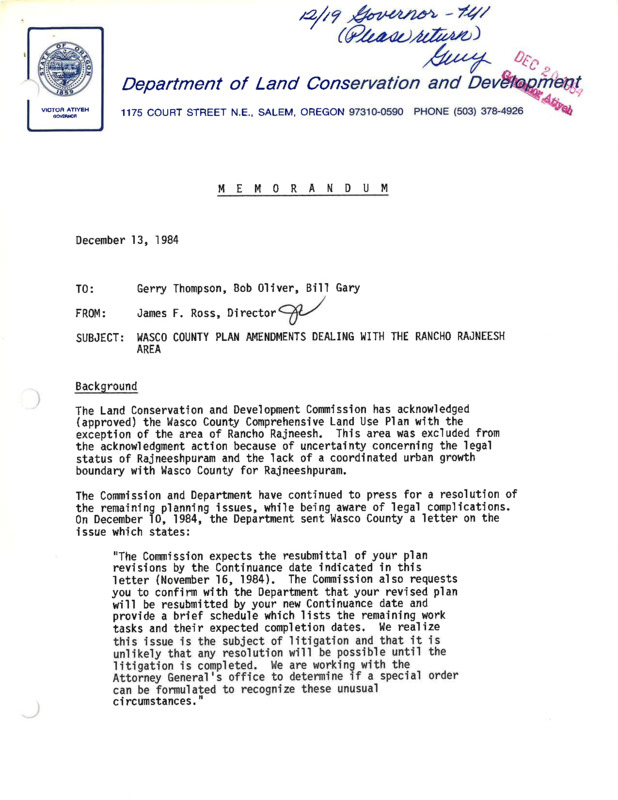
A two-page December 13, 1984 Department of Land Conservation and Development memo from James F. Ross to Gerry Thompson, Bob Oliver, and Bill Gary regarding Wasco County plan amendments dealing with the Rancho Rajneesh area. The memo discusses the uncertain legal status of Rajneeshpuram, Wasco County's comprehensive land use plan, post-acknowledgment amendments, urban growth boundary issues, pending litigation, and the department's cautious advice to the county.