The Victor Atiyeh Papers contain materials from his business, political, and personal activities, dating from 1923-2012, as well as collected materials and family papers predating the primary body of the collection. The bulk of the materials pertain to his campaigns for and his service in political office, particularly his two terms as Governor of Oregon, 1979-1987, and to the international consulting business he established after leaving office in 1987. Collection materials include appointment books, audio cassettes, awards, budgets, campaign materials, certificates, correspondence, directories, memoranda, memorabilia, notes, photographs, poll results, posters, press clippings, publications, receipts, reports, schedules, scrapbooks, speeches, and video tapes.
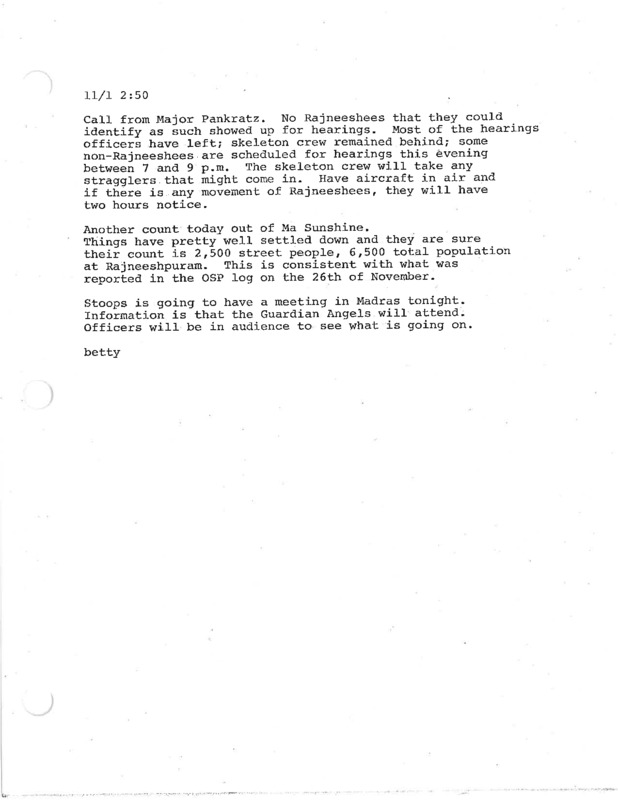
A typed November 1, 1984 note, signed "Betty," summarizing a call from Major Pankratz. Pankratz served as an officer of the Oregon State Police. The note discusses efforts to identify Rajneeshees who had been scheduled for hearings, reports that some individuals did not know they had been registered, the number of people still at the ranch, and a meeting scheduled in Madras. The note also mentions "stops" going to Madras and the expectation that the Governor would be advised of the situation.
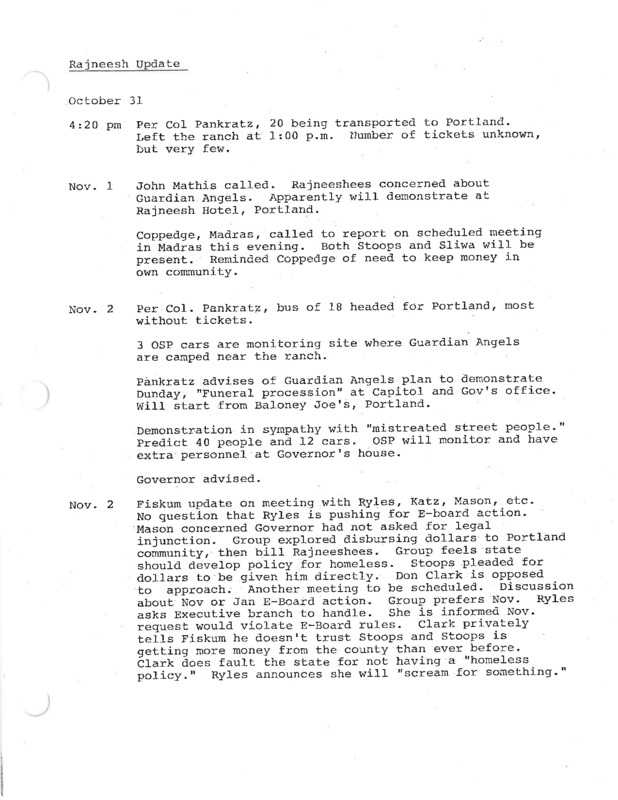
An eight-page set of typed notes titled "Rajneesh Update," covering events from October 31 to November 8, 1984. The notes summarize calls and reports involving John Mathis, Colonel Pankratz, Bob Oliver, Gerry Thompson, and others. Topics include "street people" (homeless people) leaving the ranch for Portland and Madras, bus tickets and shelters, Guardian Angels activity and demonstrations, Oregon State Police monitoring, election-related concerns, weapons and explosives information, and the Governor's possible response to events.
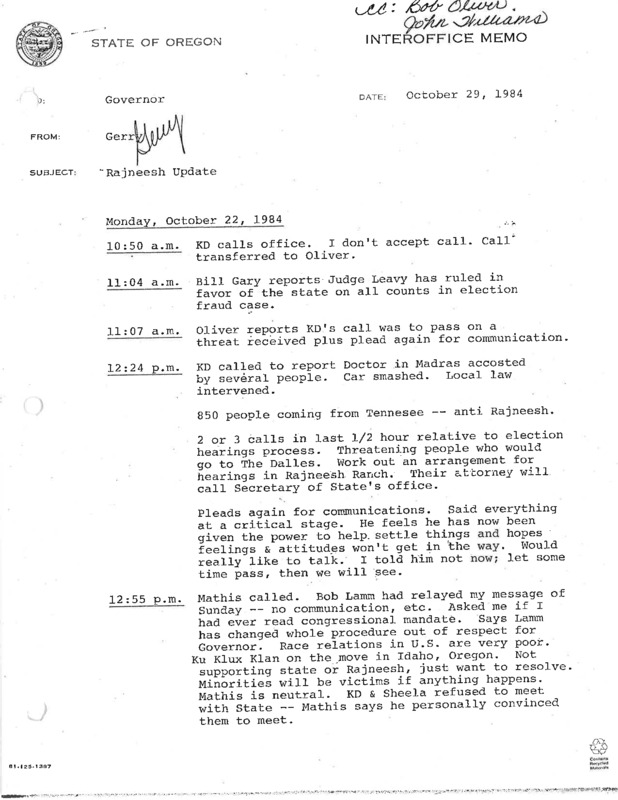
A five-page set of State of Oregon interoffice memo pages from Gerry Thompson to Governor Atiyeh regarding Rajneesh updates. The pages include updates dated October 29 and November 1, 1984, summarizing events and communications from October 22-31. Topics include election hearings, the departure of "street people" (homeless people) from the ranch, threats and security concerns, possible meetings with Rajneesh representatives, state and local coordination, media attention, and proposals for handling shelter and transportation costs.
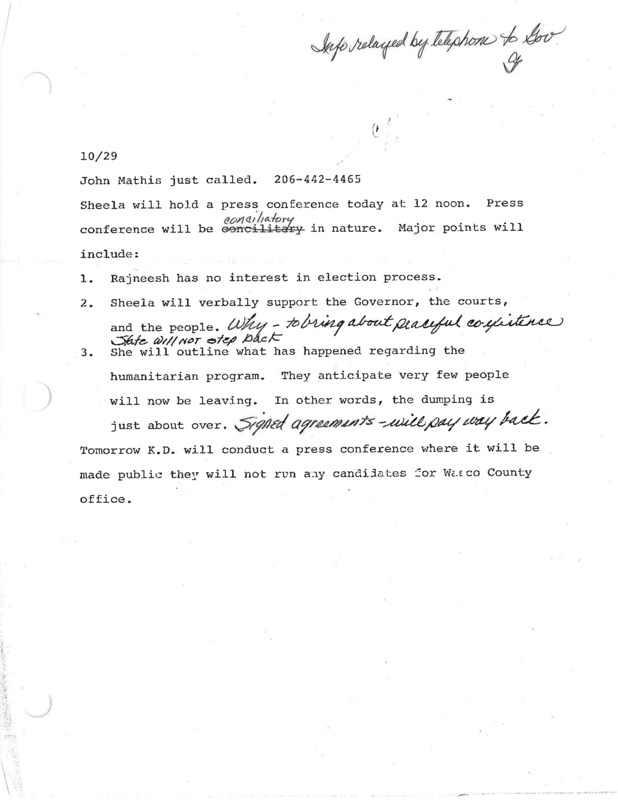
A set of typed notes dated October 29, November 21, and November 27, 1984. The first note summarizes a call from John Mathis about a planned press conference by Ma Anand Sheela and K. D. (or Krishna Deva), two leaders in the Rajneesh community; including points about election concerns, support for the Governor and courts, and the humanitarian program. The later notes summarize calls from Dave Fiskum regarding Salvation Army and Harvest Mission assistance for people connected to the Rajneesh situation, including funding and allocation of assistance.
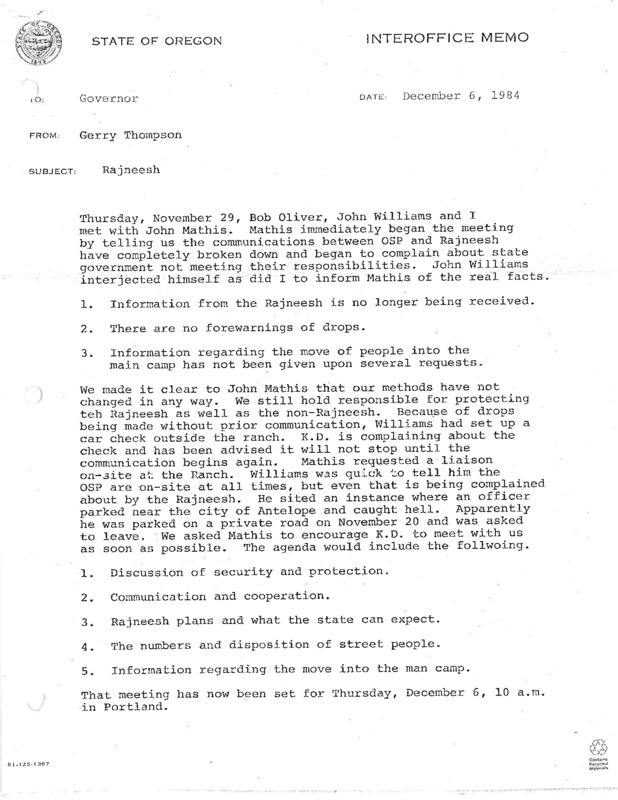
A December 6, 1984 State of Oregon interoffice memo from Gerry Thompson to Governor Atiyeh regarding the Rajneesh. The memo discusses a November 29 meeting with Bob Oliver, John Williams, and John Mathis, including the reported breakdown in communication between Oregon State Police and the Rajneesh, the lack of advance notice about "drops," a car check outside the ranch, and a request for an on-site liaison. The memo also lists proposed agenda items for a meeting with K. D. (or Krishna Deva, a Rajneesh leader), including security, communication, Rajneesh plans, street (i.e. homeless) people, and the move into the "man camp".
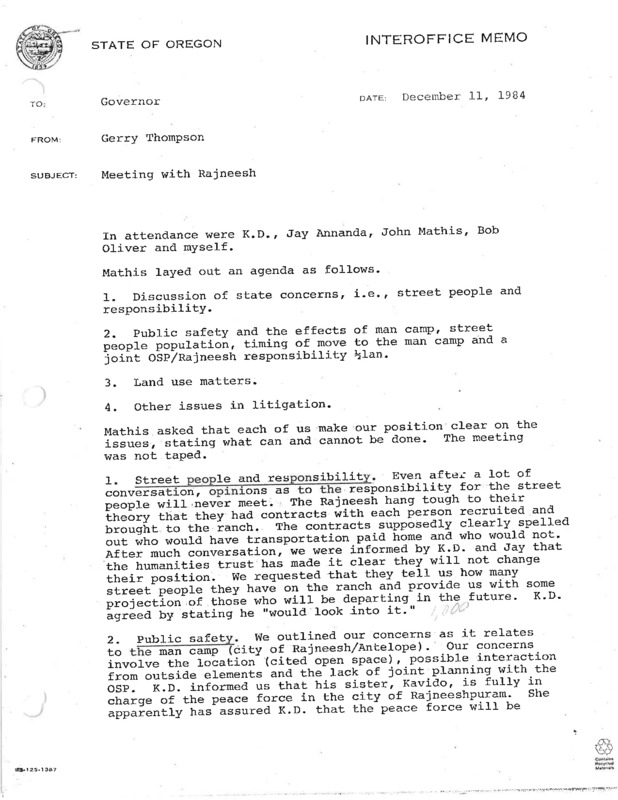
A four-page December 11, 1984 State of Oregon interoffice memo from Gerry Thompson to Governor Atiyeh regarding a meeting with Rajneesh representatives. The memo states that K. D. (or Krishna Deva), Jayananda, John Mathis, Bob Oliver, and Thompson were in attendance. Topics include responsibility for "street people" (i.e. homeless people), public safety concerns related to the "Man Camp," Oregon State Police coordination, land use issues, church/state litigation, expectations from the Rajneesh, "Pperation Mongoose," tent dwellings, and state building code questions.
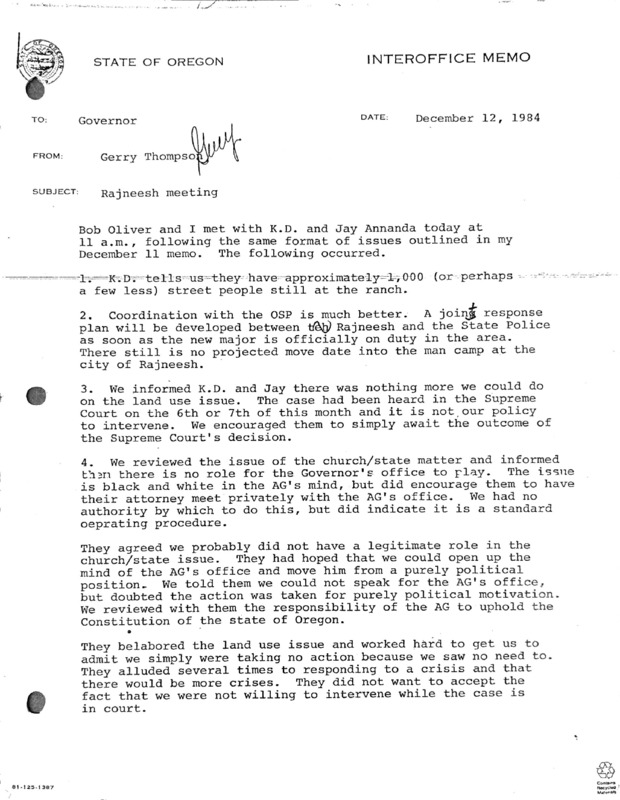
A two-page December 12, 1984 State of Oregon interoffice memo from Gerry Thompson to Governor Atiyeh regarding a meeting with K. D. (or Krishna Deva) and Jayananda, two leaders in the Rajneesh community. The memo discusses the number of "street people" (i.e. homeless people) still at the ranch, improved coordination with Oregon State Police, the land use case before the Oregon Supreme Court, and the church/state issue. The memo also discusses electrical inspections, tent dwellings at the ranch, and possible court action by the Attorney General's office regarding building code enforcement.
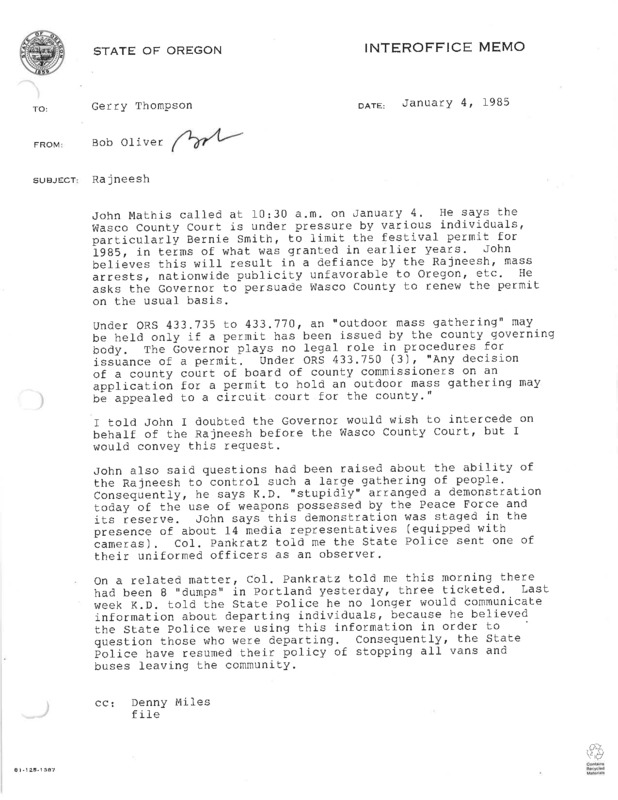
A January 4, 1985 State of Oregon interoffice memo from Bob Oliver to Gerry Thompson regarding the Rajneesh. The memo discusses a call from John Mathis about pressure on the Wasco County Court to limit the Rajneesh festival permit for 1985 and Mathis's request that the Governor intervene. The memo also discusses a weapons demonstration by K. D. (or Krishna Deva, a Rajneesh leader) for the media, recent "dumps" of street (i.e. homeless) people in Portland, and Oregon State Police stops of vans and buses leaving the community. A second page includes brief notes regarding street people arriving in Portland and communication with K. D. Oliver served as the legal counsel to Governors McCall and Atiyeh, playing a particularly important behind-the-scenes role as Public Safety Coordinator during the Rajneesh crisis.
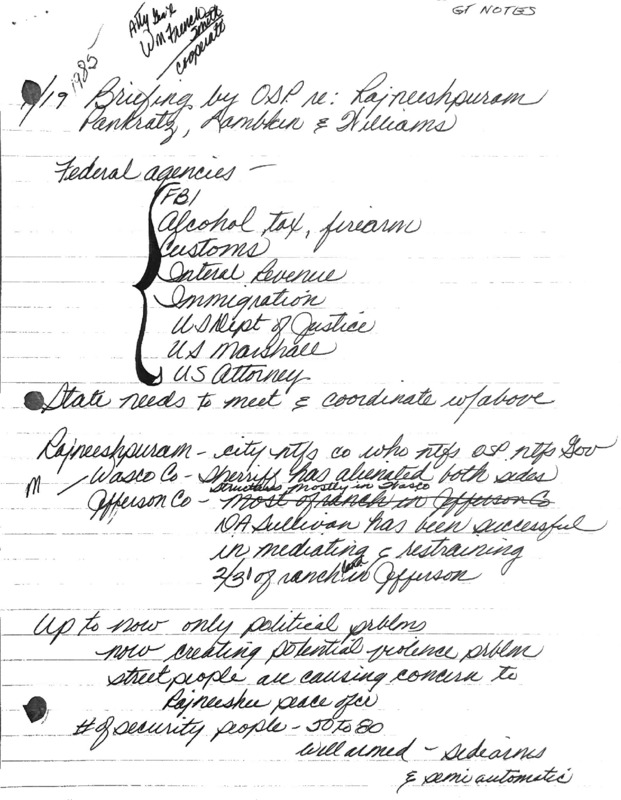
A 42-page set of mostly handwritten notes on legal letter notepad paper, labeled "GT NOTES" on the first page. The notes appear to document briefings, meetings, and calls concerning Rajneeshpuram and the state government's response to the Rajneesh movement. Topics include federal and state agency coordination, Oregon State Police, public safety, weapons, street people, the man camp, land use, church/state issues, elections, bus transportation, court actions, and communication with Rajneesh representatives. Dates visible in the notes range from 1983 to 1985.
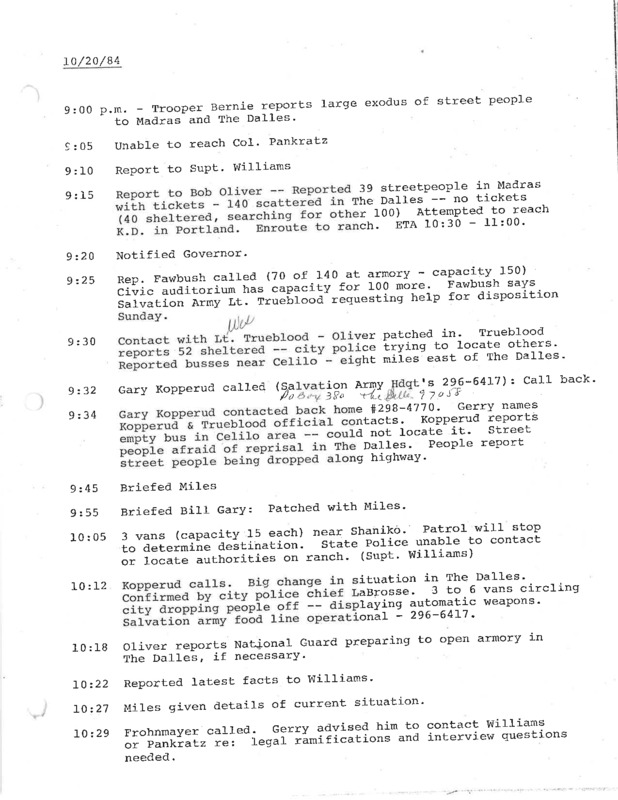
A six-page typed call log or set of notes beginning on October 20, 1984 and continuing into October 21, 1984. The document records calls and reports concerning a large departure of "street people" (i.e. homeless people) from Rajneeshpuram to The Dalles and Madras. The Rajneesh had brought homeless people to their community in hopes of registering them to vote in local elections. Entries mention Oregon State Police, Bob Oliver, Governor Atiyeh, K. D. (Krishna Deva), the Salvation Army, local officials, bus arrangements, community donations, possible additional departures, and efforts to move people out of The Dalles without further incident.
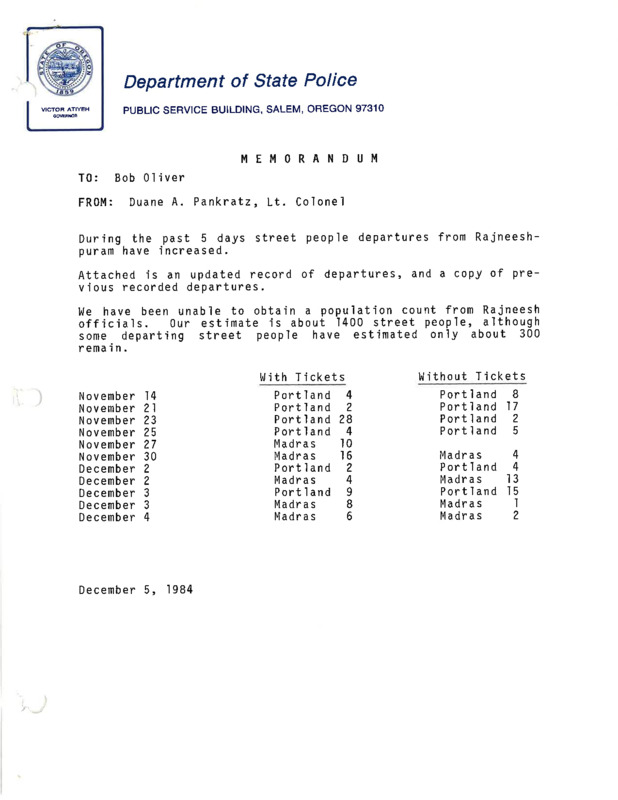
An Oregon Department of State Police memorandum from Duane A. Pankratz to Bob Oliver regarding departures of "street people" (i.e. homeless people) from Rajneeshpuram. The memo states that departures had increased over the previous five days and includes updated and previous records of departures, with separate counts for people leaving with and without tickets. The document also lists bus tickets purchased by the Rajneesh, the Salvation Army, Harvest Mission, and Social Services, and estimates the number of people who departed without arranged transportation.
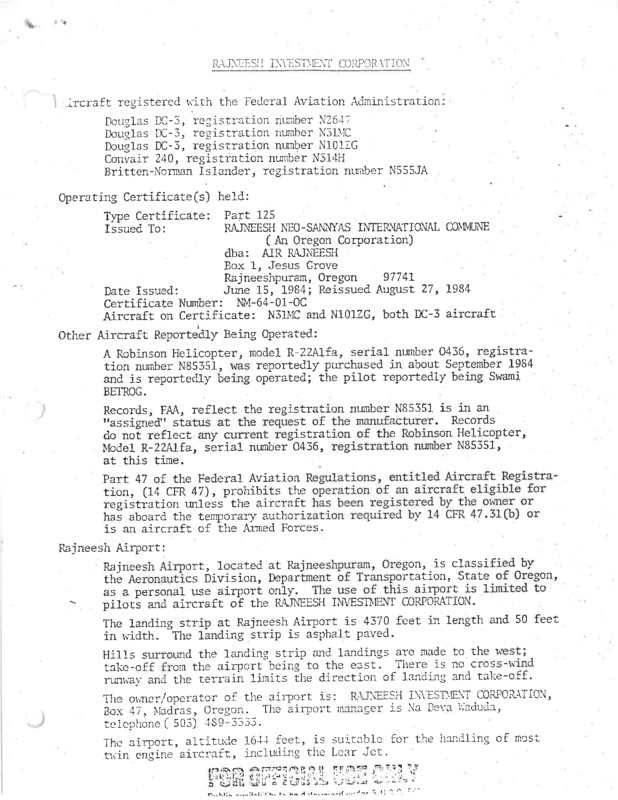
A typed document titled "Rajneesh Investment Corporation." The document lists aircraft registered with the Federal Aviation Administration, operating certificate information for Air Rajneesh, information about a reportedly operated Robinson helicopter, and details about Rajneesh Airport. The airport section describes the airport as a personal use airport at Rajneeshpuram, Oregon, and includes information about the runway, terrain, owner/operator, airport manager, and types of aircraft the airport could handle. This document was likely created by a state or federal law enforcement agency.
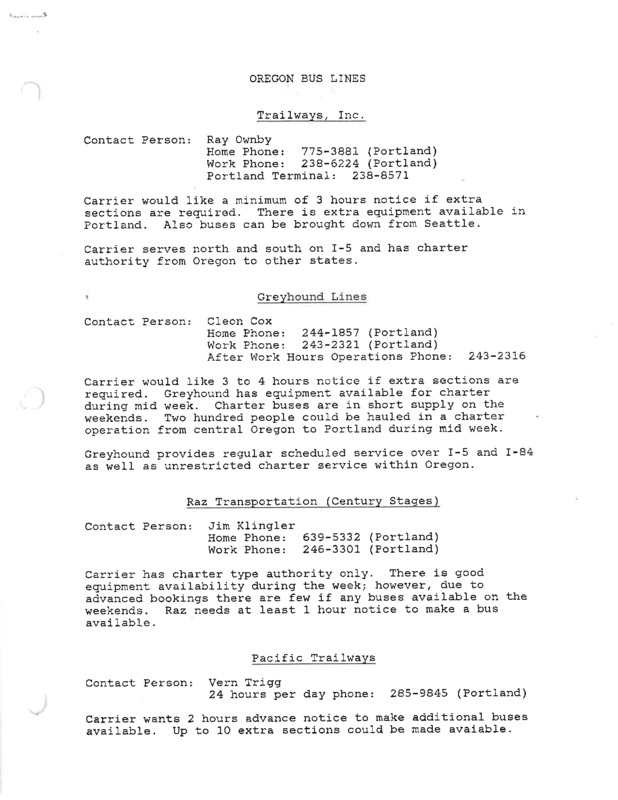
A two-page typed reference list titled "Oregon Bus Lines." The document lists several bus companies, including Trailways, Greyhound Lines, Raz Transportation, Pacific Trailways, The Gray Line Company, and Resort Bus Lines. Entries include contact names, phone numbers, service areas, charter authority, equipment availability, and the amount of advance notice needed to arrange additional buses. The author of this document is unknown, but it was likely created by a state or federal agency as part of their investigation into the Rajneeshpuram community.
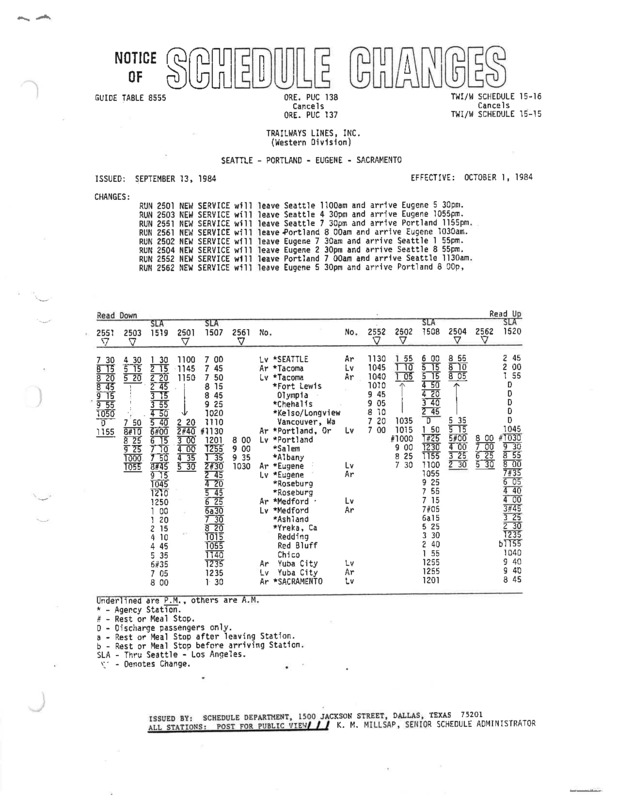
A September 13, 1984 notice of schedule changes from Trailways Lines, Inc. for the Seattle-Portland-Eugene-Sacramento route. The notice lists changes effective October 1, 1984, including new service between Seattle and Eugene, Portland and Eugene, Portland and Seattle, and Eugene and Portland. The document includes a detailed read-down and read-up schedule table. This document was likely collected by a state or federal agency as part of their investigation into the Rajneeshpuram community.
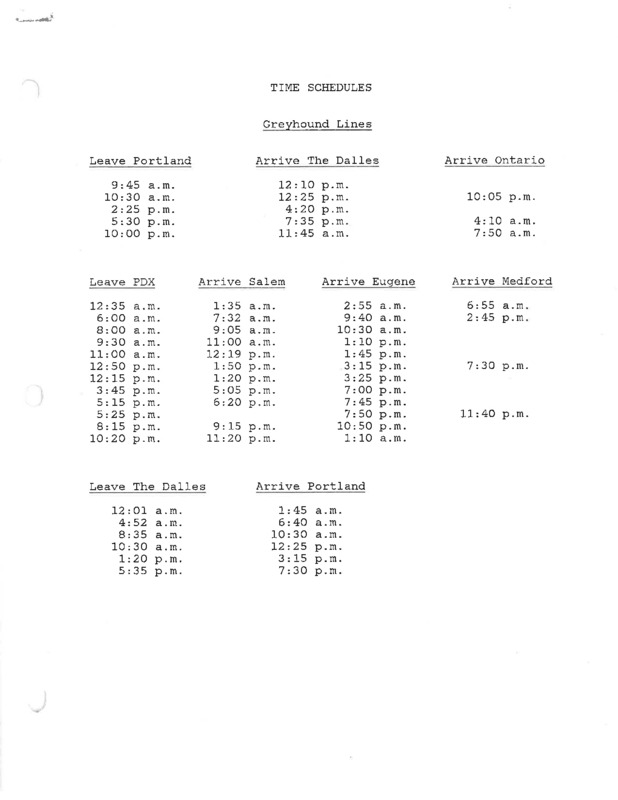
A two-page typed document titled "Time Schedules." The document lists departure and arrival times for Greyhound Lines, Trailways, Pacific Trailways, and Resort Bus Line routes. Locations listed include Portland, The Dalles, Ontario, Salem, Eugene, Medford, Bend, Madras, and Redmond. The author of this document is unknown, but it may have been created by a state or federal agency as part of their investigation into the Rajneeshpuram community in 1984.
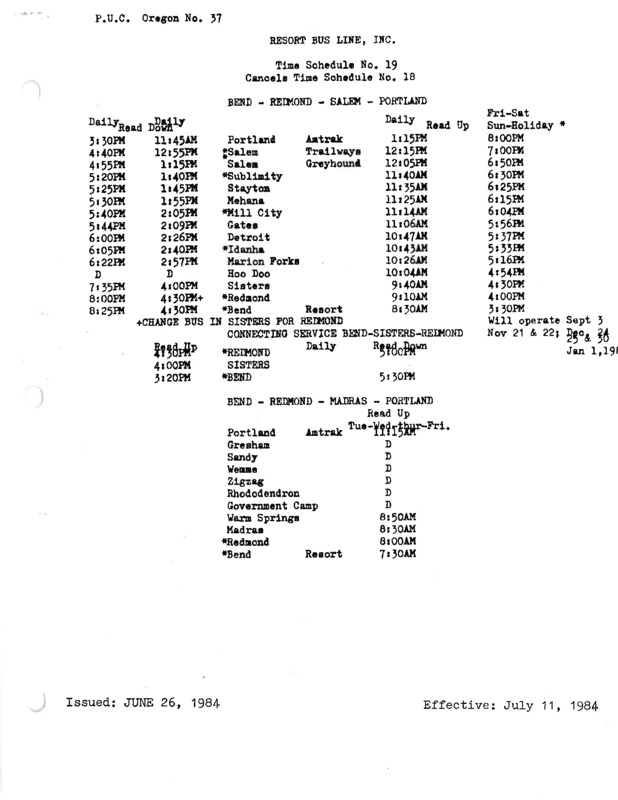
A June 26, 1984 Resort Bus Line, Inc. time schedule for the Bend-Redmond-Salem-Portland route, effective July 11, 1984. The schedule lists stops including Bend, Redmond, Sisters, Stayton, Salem, Tigard, and Portland, along with connection notes for Amtrak, Trailways, and Greyhound. A section at the bottom lists read-up schedules for Portland, Gresham, Sandy, Warm Springs, Madras, Redmond, and Bend. This document was likely collected by a state or federal agency as part of their investigation into the Rajneeshpuram community.
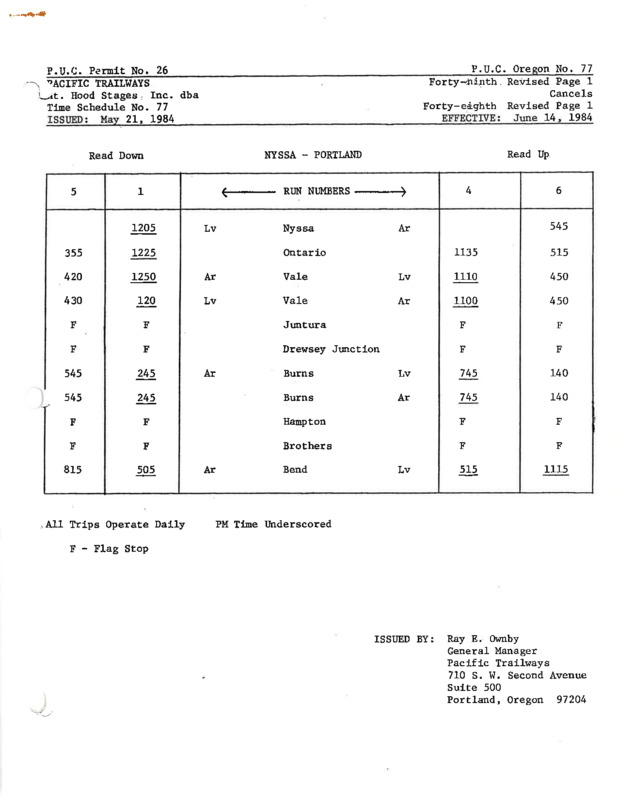
A five-page set of Pacific Trailways time schedules for routes in Oregon and the surrounding region. The schedules include routes between Nyssa and Portland, Bend and Portland, Bend and Eugene, and The Dalles and Klamath Falls. One page notes that the Madras-Prineville-Redmond service had been cancelled and was being provided by BJD, Inc. The schedules include issue dates ranging from 1983 to 1984. This document was likely collected by a state or federal agency as part of their investigation into the Rajneeshpuram community.
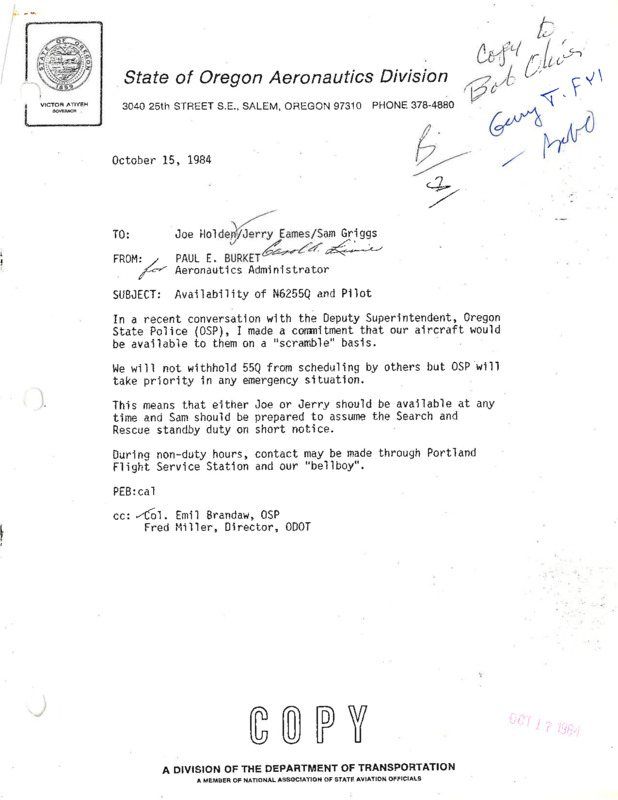
An October 15, 1984 State of Oregon Aeronautics Division memo from Paul E. Burket, Aeronautics Administrator, to Joe Holdey, Jerry Eames, and Sam Griggs regarding the availability of aircraft N625SO and a pilot. The memo states that the aircraft would be available to the Oregon State Police on a "scramble" basis and that Oregon State Police needs would take priority in an emergency situation or rescue standby duty. Handwritten routing notes are visible on the document. This memo was written within the context of the state's response to the Rajneesh crisis.
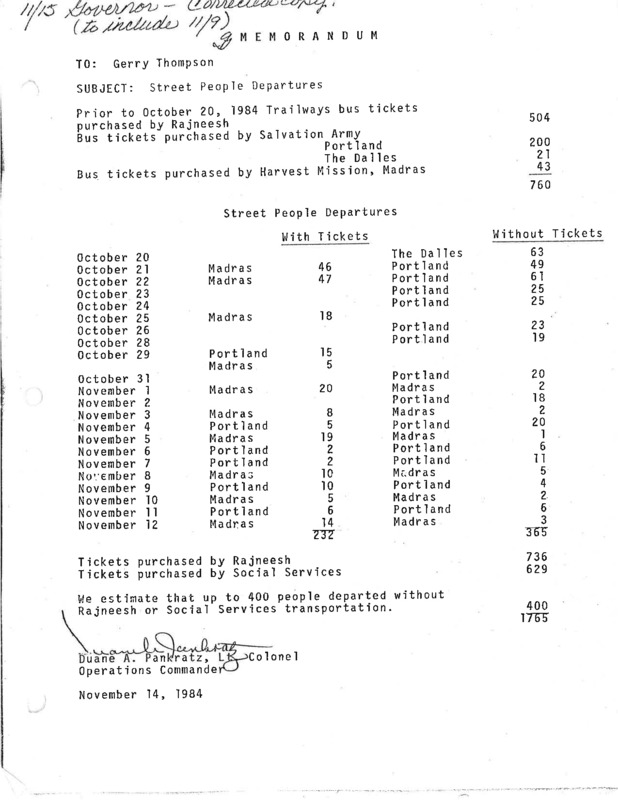
A November 14, 1984 memorandum from Oregon State Police officer Duane Pankratz to Gerry Thompson, regarding "Street People Departures" from Rajneeshpuram. The Rajneesh community had previously brought homeless people to their community with the intention of registering them to vote in local elections, but by the time that this memo was written, they had abandoned the plan and were moving them back out. The memorandum lists bus tickets purchased by the Rajneesh, the Salvation Army, and Harvest Mission, along with dated counts of people departing with and without tickets between October 20 and November 12, 1984. The document states that an estimated 400 people departed without Rajneesh or Social Services transportation.
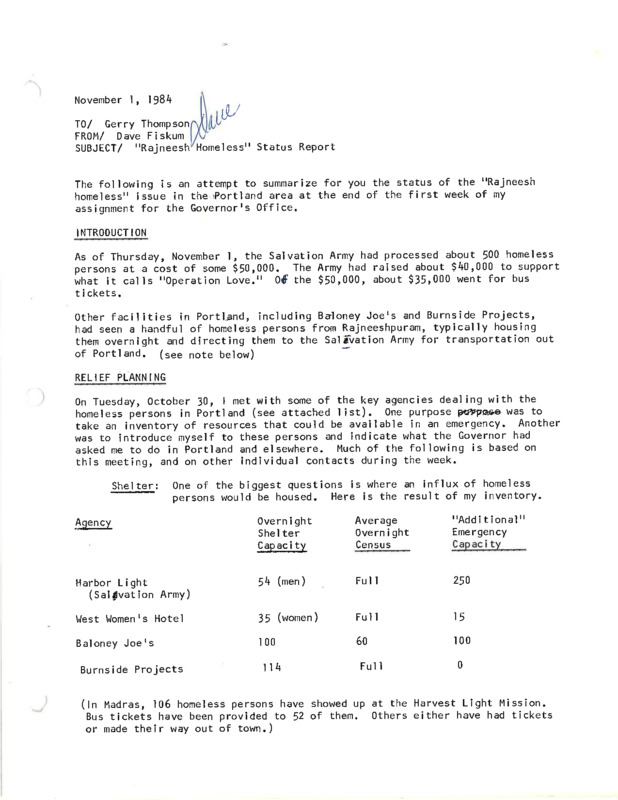
An eight-page November 1, 1984 report from Dave Fiskum to Gerry Thompson titled "'Rajneesh Homeless' Status Report." The Rajneesh community had brought homeless people to their community in Oregon with the intention of registering them to vote in local elections, but by the time that this report was written, they had abandoned the plan and were moving them back out. Fiskum was Oregon Governor Atiyeh's Acting Press Secretary; Thompson was Atiyeh's Chief of Staff. The report summarizes the status of the "Rajneesh homeless" issue in the Portland area at the end of Fiskum's first week of assignment for the Governor's Office. Topics include shelter capacity, transportation out of Portland, food availability, security, the role of the Salvation Army and other relief groups, possible state action, and concerns about a larger influx of people. Attachments include lists of meeting attendees and agency contacts.
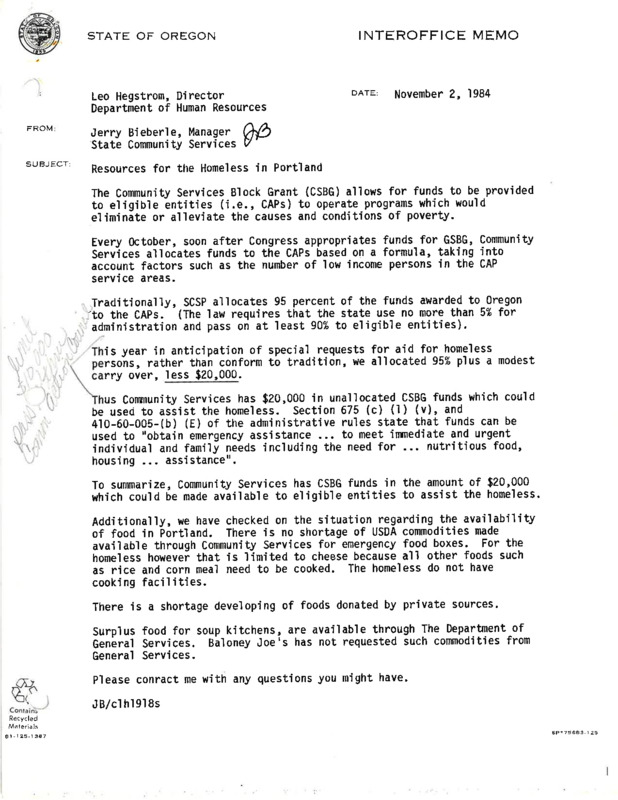
A November 2, 1984 State of Oregon interoffice memo from Jerry Bieberle, Manager of State Community Services, to Leo Hegstrom, Director of the Department of Human Resources. The memo discusses resources available for homeless people in Portland, including Community Services Block Grant funds, emergency assistance rules, food availability, and possible use of surplus food for soup kitchens. A second page contains handwritten notes regarding food, transportation, and possible assistance. This memo was written within the context of the Rajneesh crisis, during which the Rajneesh first brought homeless people to their community in order to register them to vote, and then later sent them away.
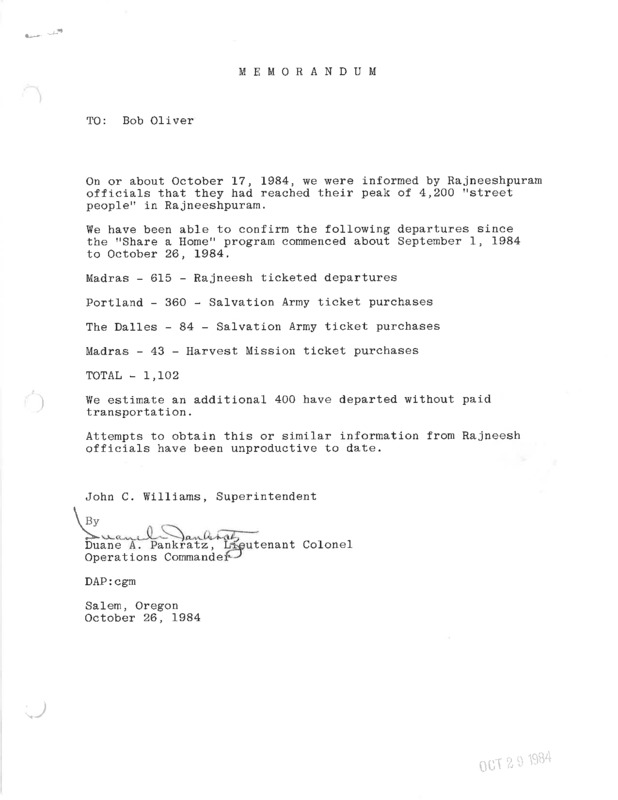
An October 26, 1984 memorandum to Bob Oliver from John C. Williams, Superintendent of the Oregon State Police, by Duane A. Pankratz, Operations Commander. The memo states that Rajneeshpuram officials had reported a peak of 4,200 "street people" (i.e. homeless people) at Rajneeshpuram and lists confirmed departures since the Share-A-Home program began around September 1, 1984. The memo includes departure counts for Madras, Portland, and The Dalles, and estimates that an additional 400 people had departed without paid transportation.
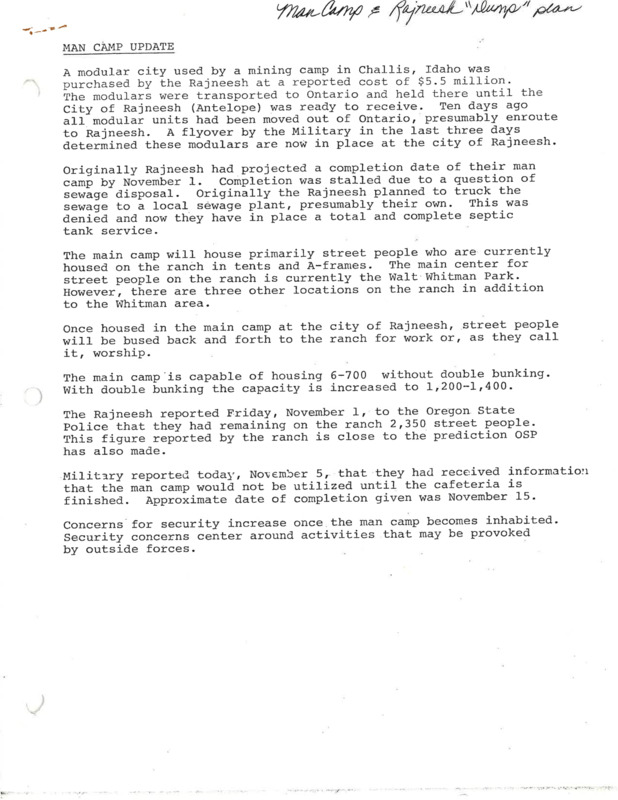
A nine-page typed document beginning with a section titled "Man Camp Update." The document discusses a modular housing camp purchased by the Rajneesh, its movement from Ontario to the city of Rajneesh, projected housing capacity, and security concerns once the camp became inhabited. Later sections discuss shelter and food planning, transportation issues, security, possible emergency declaration by the Governor, and procedures for different levels of "street people" departures or "dumping." The final page contains a notification chart showing lines of communication among Oregon State Police, city and county officials, the Governor, Gerry Thompson, Dave Fiskum, Bob Oliver, emergency services, the military, facilities, and the Public Utility Commissioner. It was likely written by a member of Governor Atiyeh's staff.
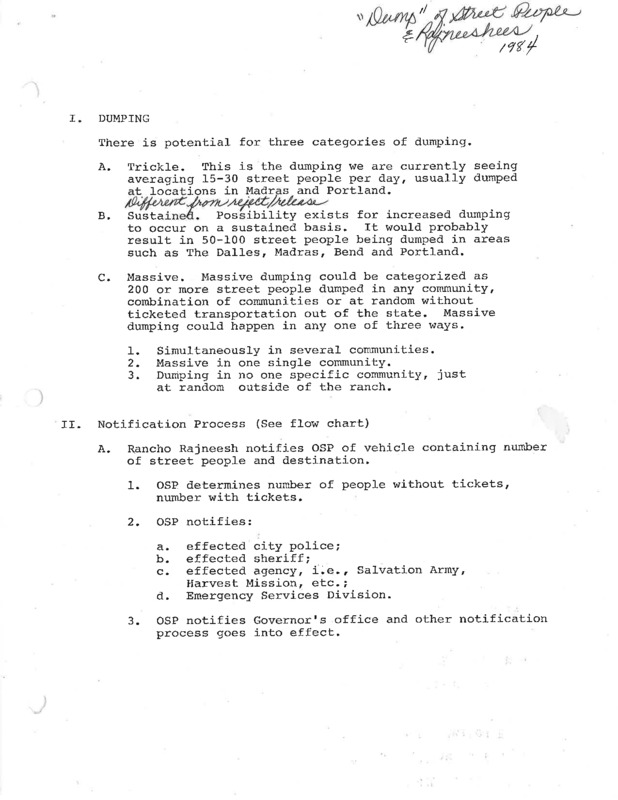
A four-page typed planning document concerning potential "dumping" of "street people" (i.e. homeless people) by the Rajneesh in 1984. The document categorizes possible "dumping" scenarios as "trickle," "sustained," and "massive," and outlines notification processes, shelter and feeding issues, security concerns, transportation needs, and possible emergency response. The final page contains a flow chart showing lines of notification among Oregon State Police, city and county officials, the Governor's office, Gerry Thompson, Bob Oliver, facilities, emergency services, the military, and the Public Utility Commissioner. Handwritten notes are visible on the document. It was likely written by a member of Governor Atiyeh's staff.