The Victor Atiyeh Papers contain materials from his business, political, and personal activities, dating from 1923-2012, as well as collected materials and family papers predating the primary body of the collection. The bulk of the materials pertain to his campaigns for and his service in political office, particularly his two terms as Governor of Oregon, 1979-1987, and to the international consulting business he established after leaving office in 1987. Collection materials include appointment books, audio cassettes, awards, budgets, campaign materials, certificates, correspondence, directories, memoranda, memorabilia, notes, photographs, poll results, posters, press clippings, publications, receipts, reports, schedules, scrapbooks, speeches, and video tapes.
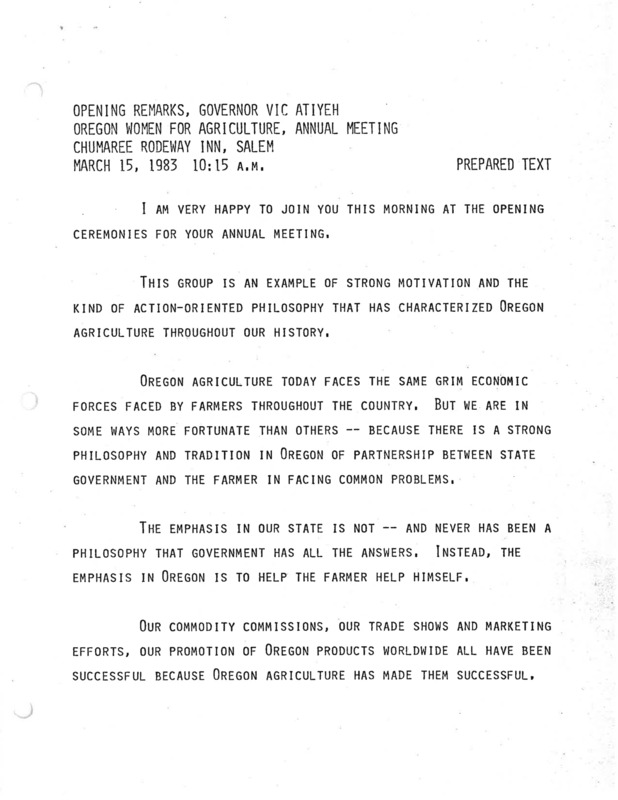
A three-page prepared text of opening remarks by Governor Vic Atiyeh for the Oregon Women for Agriculture annual meeting at the Chumaree-Rodeway Inn in Salem, Oregon, on March 15, 1983. The remarks discuss Oregon agriculture, the economic challenges facing farmers, commodity commissions, trade shows, marketing efforts, Oregon agricultural products, farm jobs, and state efforts to support agricultural recovery.
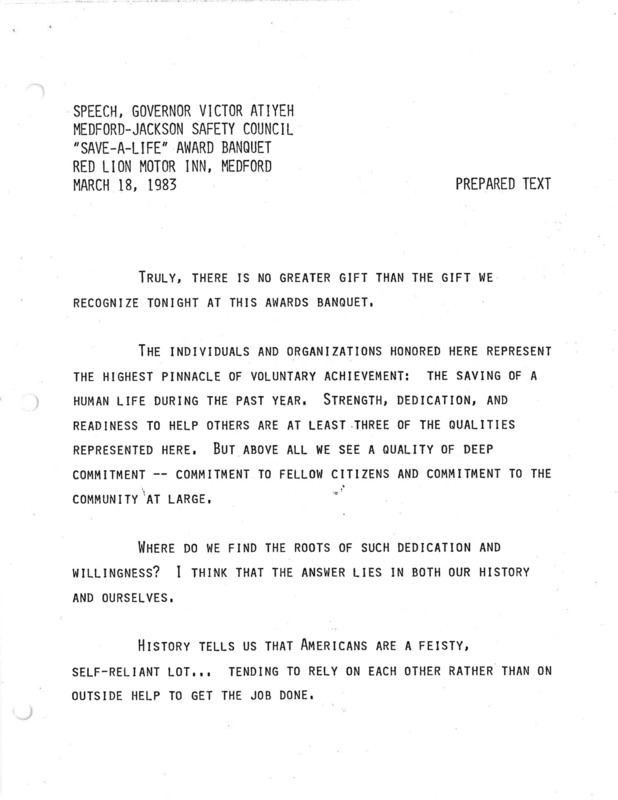
A nine-page prepared text of a speech by Governor Victor Atiyeh for the Medford-Jackson Safety Council "Save-A-Life" Award Banquet at the Red Lion Motor Inn in Medford, Oregon, on March 18, 1983. The speech honors individuals and organizations recognized for lifesaving actions and discusses volunteerism, community service, self-reliance, public responsibility, government services, safety programs, and the importance of citizens helping one another.
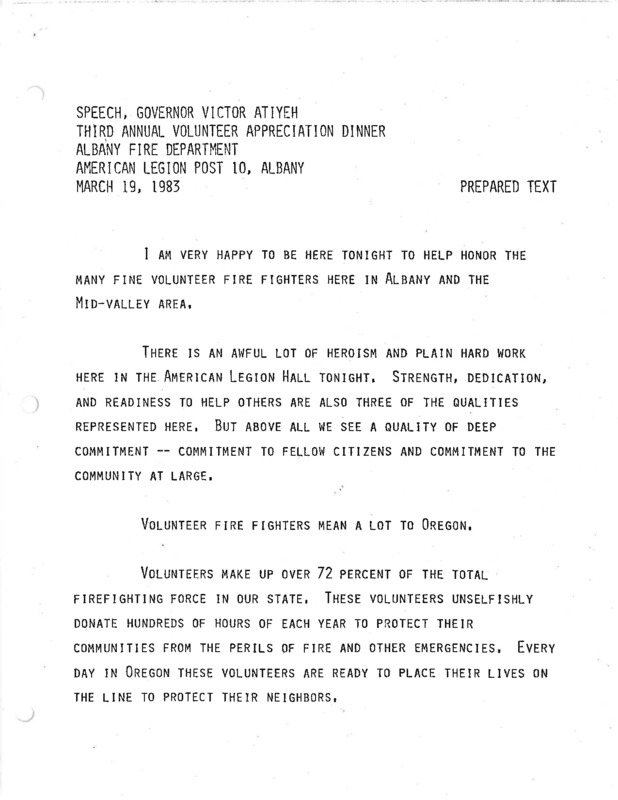
A ten-page prepared text of a speech by Governor Victor Atiyeh for the Third Annual Volunteer Appreciation Dinner for the Albany Fire Department at American Legion Post 10 in Albany, Oregon, on March 19, 1983. The speech honors volunteer firefighters and discusses volunteer fire service in Oregon, community protection, personal sacrifice, training, family support, volunteerism, public responsibility, and the broader value of citizens serving their communities.
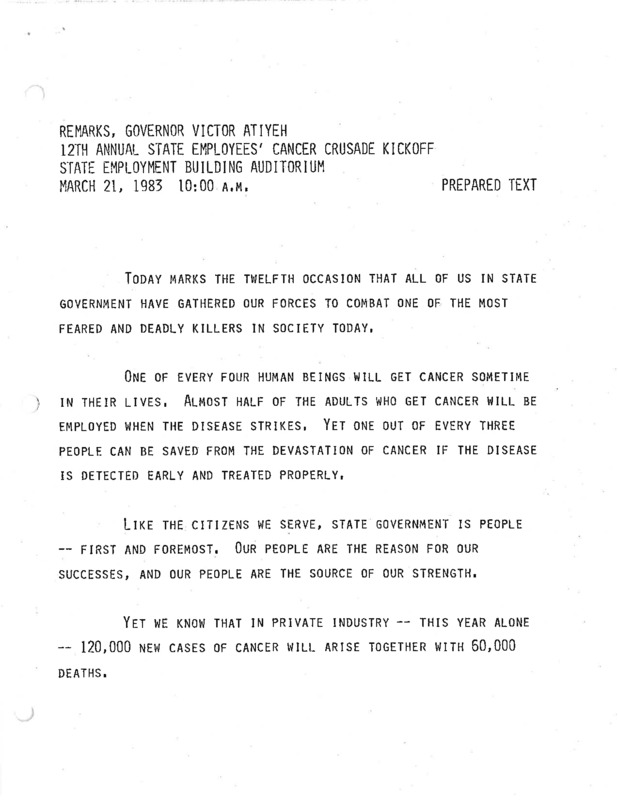
A three-page prepared text of remarks by Governor Victor Atiyeh for the 12th Annual State Employees' Cancer Crusade kickoff at the State Employment Building Auditorium on March 21, 1983. The remarks discuss cancer awareness, prevention, early detection, the American Cancer Society, employee contributions, workplace education, and the role of state employees in supporting cancer research and public health efforts.
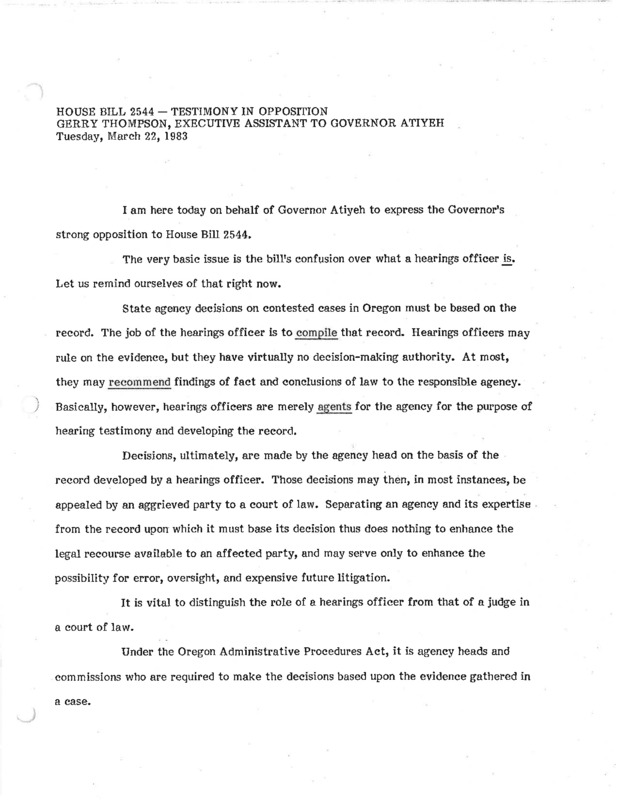
A two-page prepared testimony by Gerry Thompson, Executive Assistant to Governor Atiyeh, opposing House Bill 2544 on March 22, 1983. The testimony argues against changing the role and title of hearings officers under the Oregon Administrative Procedures Act, stating that hearings officers compile records and make recommendations but do not replace agency heads or commissions as final decision-makers. The testimony discusses contested case hearings, administrative law judges, agency expertise, public understanding, legal appeals, and the Governor's opposition to the bill.
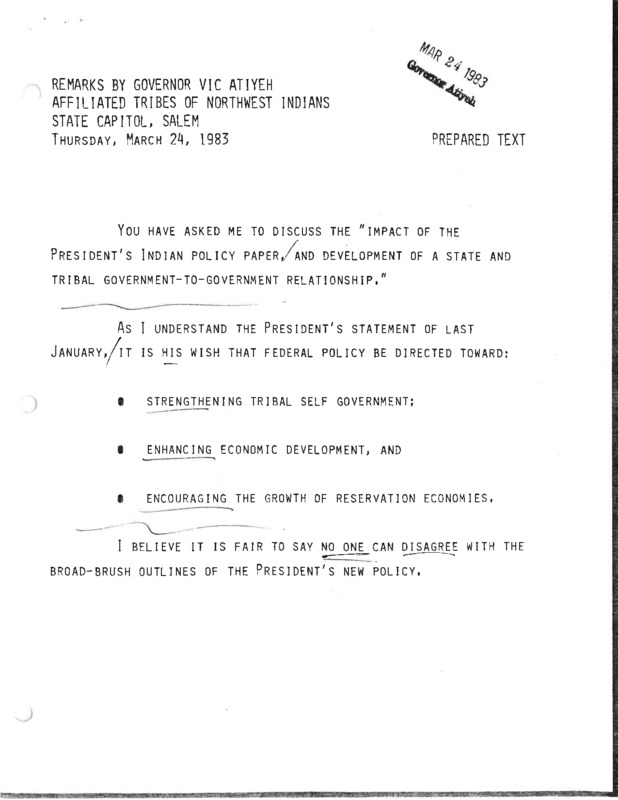
A six-page prepared text of remarks by Governor Vic Atiyeh for the Affiliated Tribes of Northwest Indians at the State Capitol in Salem, Oregon, on March 24, 1983. The remarks discuss the President's Indian policy paper, tribal self-government, economic development, reservation economies, federal Indian policy, tribal sovereignty, state and tribal government-to-government relationships, treaty rights, and issues affecting Northwest tribes. Handwritten edits are visible on the document.
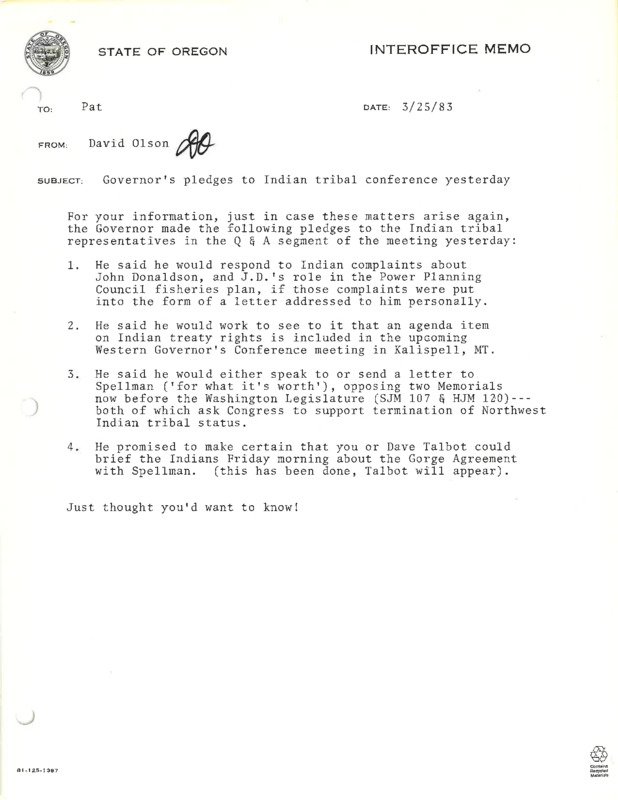
A one-page State of Oregon interoffice memo from David Olson to Pat, dated March 25, 1983, regarding Governor Atiyeh's pledges to Indian tribal representatives during a question-and-answer session the previous day. The memo lists pledges concerning complaints about John Donaldson and the Power Planning Council fisheries plan, Indian treaty rights at the Western Governors' Conference, opposition to Washington legislative memorials supporting termination of Northwest Indian tribal status, and a briefing on the Gorge Agreement with Governor John Spellman.
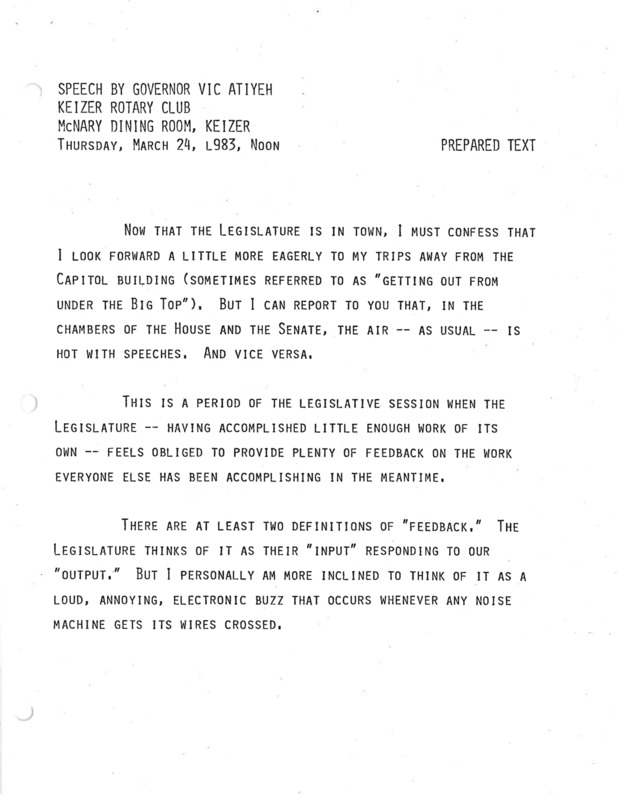
A nine-page prepared text of a speech by Governor Vic Atiyeh for the Keizer Rotary Club at the McNary Dining Room in Keizer, Oregon, on March 24, 1983. The speech discusses the Oregon Legislature, state budget difficulties, economic recovery, community involvement, public service, partnerships between citizens and government, and the need for Oregonians to work together during an economic transition.
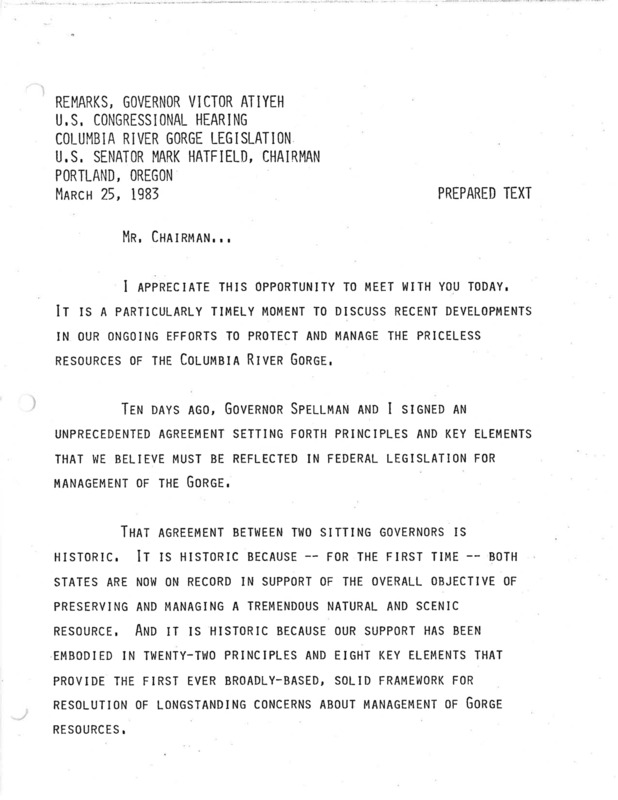
An eleven-page prepared text of remarks by Governor Victor Atiyeh for a U.S. congressional hearing on Columbia River Gorge legislation chaired by U.S. Senator Mark Hatfield in Portland, Oregon, on March 25, 1983. The remarks discuss the Columbia River Gorge, an agreement between Governor Atiyeh and Washington Governor John Spellman, proposed federal legislation, a joint state-federal management entity, a Gorge management plan, scenic preservation, existing communities and businesses, economic activity, and cooperation between Oregon, Washington, federal officials, and local governments.
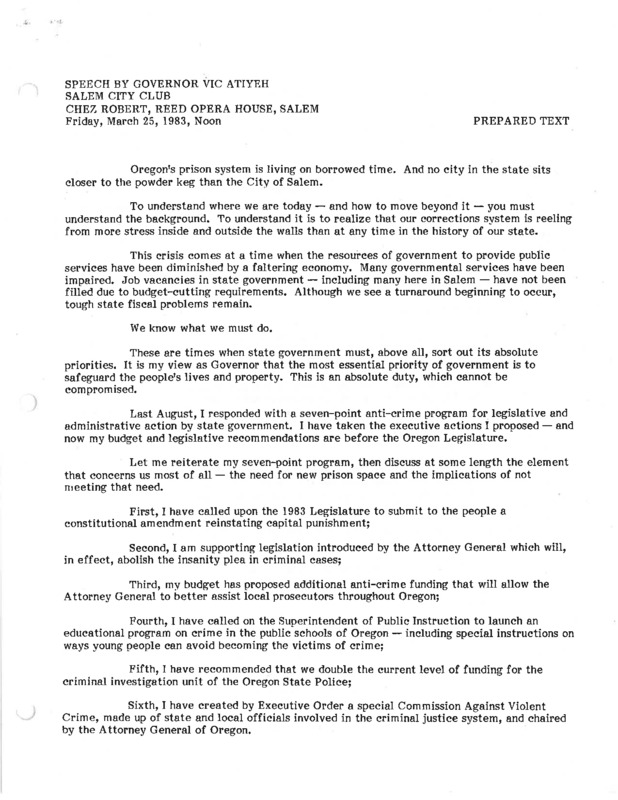
An eleven-page prepared text of a speech by Governor Vic Atiyeh for the Salem City Club at Chez Robert in the Reed Opera House in Salem, Oregon, on March 25, 1983. The speech discusses Oregon's prison system, corrections overcrowding, public safety, budget constraints, Atiyeh's seven-point anti-crime program, capital punishment, the insanity defense, support for prosecutors, crime education in public schools, the Commission Against Violent Crime, and the need for additional prison space.
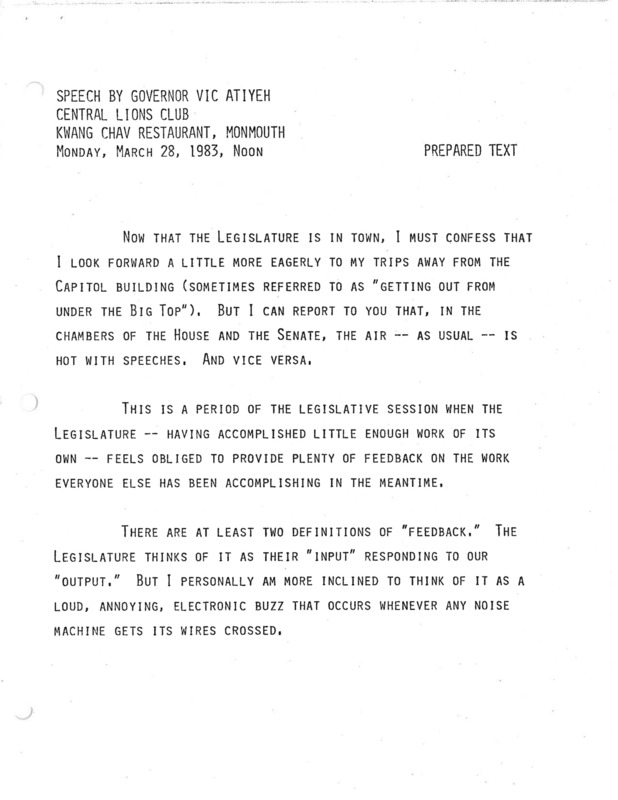
A nine-page prepared text of a speech by Governor Vic Atiyeh for the Central Lions Club at the Kwang Chav Restaurant in Monmouth, Oregon, on March 28, 1983. The speech discusses the Oregon Legislature, state budget difficulties, economic recovery, hard decisions made by state government, community involvement, public service, partnerships between citizens and government, and the need to build a stronger economy for Oregon.
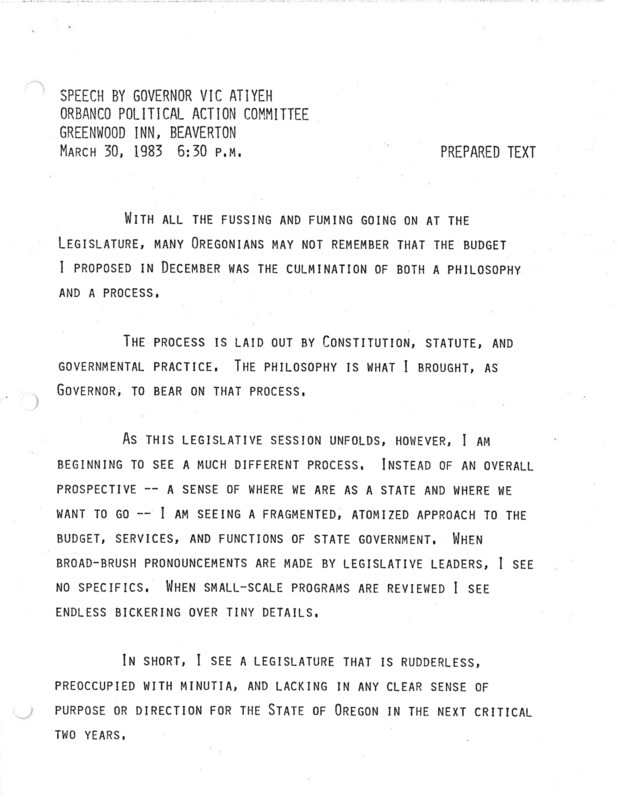
A fifteen-page prepared text of a speech by Governor Vic Atiyeh for the ORBANCO Political Action Committee at the Greenwood Inn in Beaverton, Oregon, on March 30, 1983. The speech discusses Atiyeh's budget proposal, the state budget process, legislative debate, media coverage, tax limitations, tax reductions, tax increases, Oregon's tax base, higher education, public safety, economic development, prison space, and the Governor's argument for his 1983-1985 budget plan.
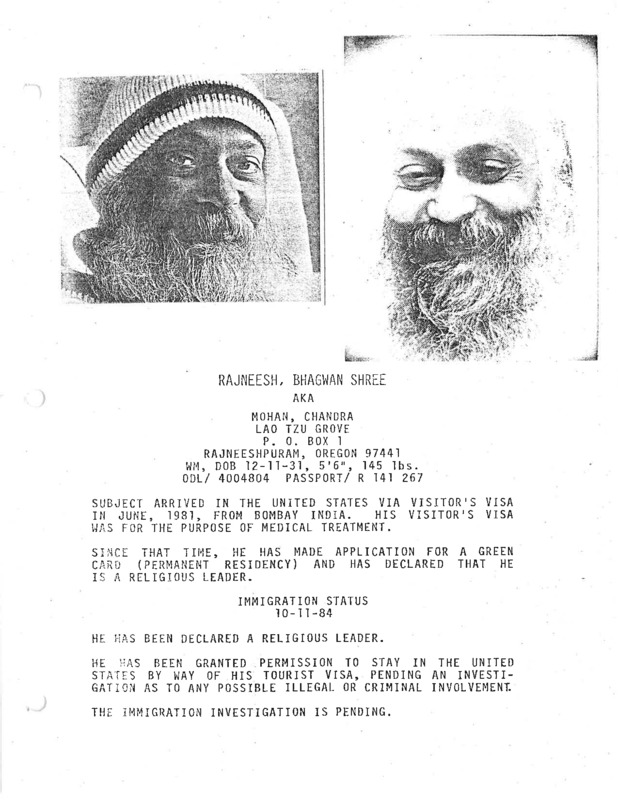
A photocopied information sheet featuring two images of Bhagwan Shree Rajneesh and identifying information. The document states that Rajneesh arrived in the United States in June 1981 on a visitor's visa for medical treatment, later applied for permanent residency, and had been granted permission to stay under his tourist visa while an immigration investigation was pending. The document is dated October 11, 1984.
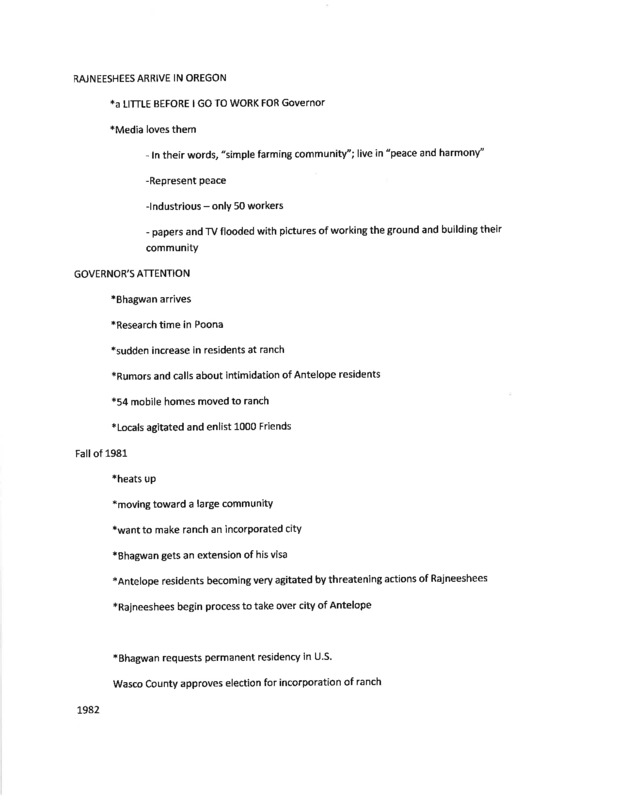
A five-page set of typed notes titled "Rajneeshees Arrive in Oregon." The notes outline the Rajneesh movement's arrival in Oregon, the attention it received from Governor Atiyeh's office, the incorporation of Rajneeshpuram, conflict over Antelope, land use and church/state issues, voter registration concerns, the Share-A-Home program, meetings with Rajneesh leaders and federal mediators, and the handling of people leaving the ranch in 1984. These notes may have been written by Gerry Thompson, probably some time after the events occured.
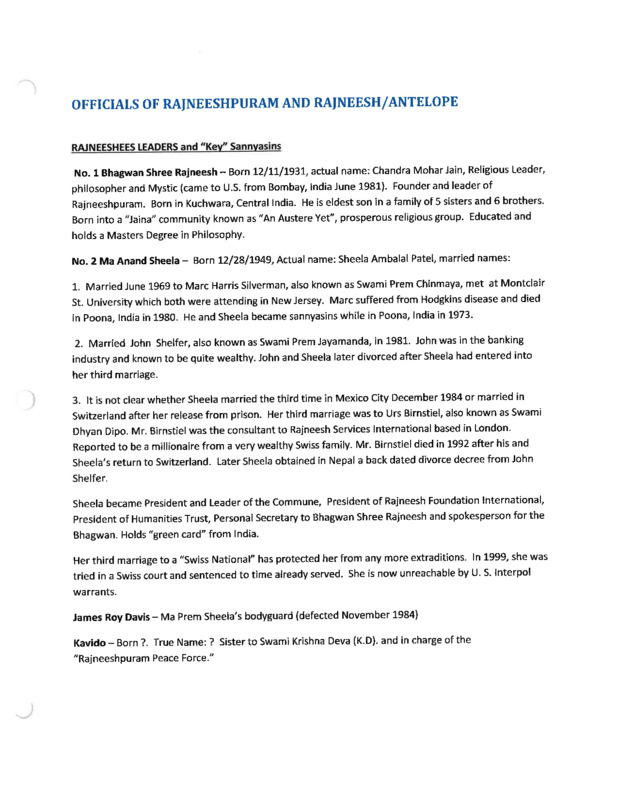
A ten-page reference document titled "Officials of Rajneeshpuram and Rajneesh/Antelope." The document lists Rajneeshee leaders and "key" sannyasins, local and state officials, agency contacts, attorneys, media contacts, and other individuals connected to Rajneeshpuram and Rajneesh/Antelope. Entries include names, alternate names, roles, and, in some cases, brief biographical or legal notes. This document may have been written by Gerry Thompson, and was probably created some time after the Rajneesh crisis occured.
A 59-page document containing a typed background summary and a detailed timeline titled "Rajneesh Timeline, 1981-1986, Governor and Staff Involvement." The timeline concerns state government involvement with the Rajneesh movement, including Rajneeshpuram, Antelope, land use disputes, church/state issues, state and federal agencies, voter registration concerns, criminal investigations, and the departure of Bhagwan Shree Rajneesh. This document was likely created by Gerry Thompson, Governor Atiyeh's Chief of Staff, some time after the events occured.
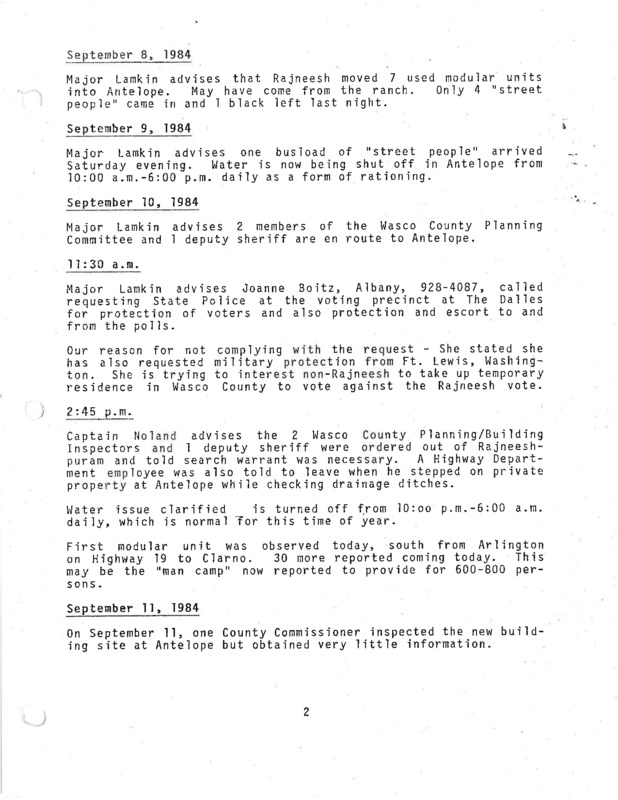
A 62-page collection of typed dated notes titled "Rajneeshpuram - Antelope" and, on some pages, "Rajneesh File." The notes appear to document communications and reports involving state officials, Oregon State Police, local officials, and others regarding Rajneeshpuram and Antelope from September 1984 to January 1985. Topics include construction in Antelope, the arrival and departure of "street people" (i.e. homeless people), election and voter registration concerns, security planning, media attention, transportation and shelter efforts, ammunition purchases, and conflict between Rajneesh followers and local residents or opposition groups.
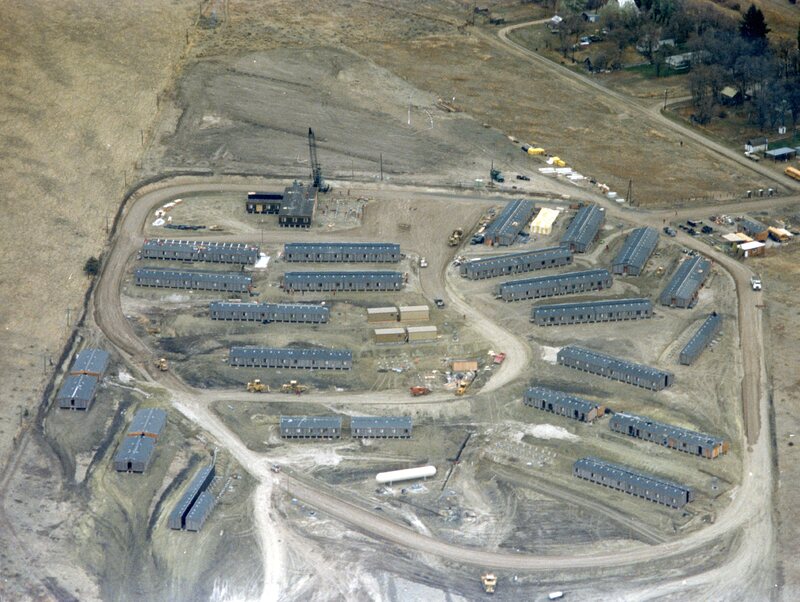
A color aerial photograph of Antelope, Oregon, with Rajneesh-era development buildings visible. By the time the photograph was taken, followers of the Bhagwan Shree Rajneesh had outvoted Antelope's original residents and taken control of the city government, officially renaming the town "Rajneesh." A note attached to this and similar photographs labels it as the "man camp," likely a large housing complex intended to hold thousands of potential new followers.
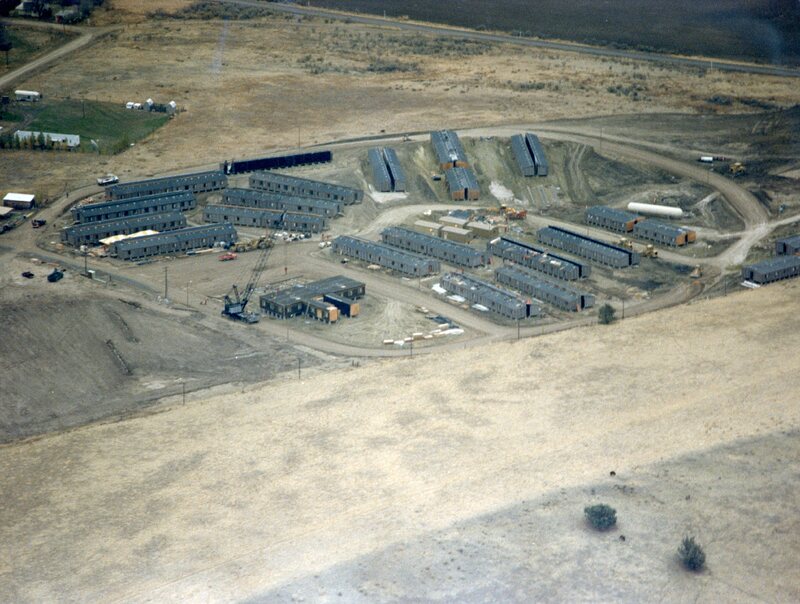
A color aerial photograph showing modular buildings and construction activity near Antelope, Oregon. The photograph appears to show the same Rajneesh-era housing development visible in related aerial photographs, with surrounding roads, vehicles, and rural land. A note associated with this and similar photographs identifies the development as the "man camp," likely a large housing complex intended to hold thousands of potential new followers.
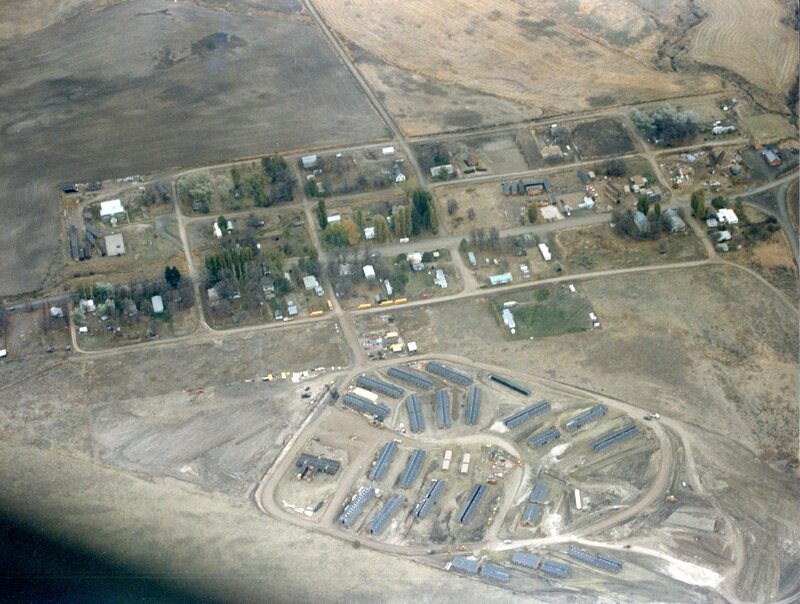
A color aerial photograph showing Antelope, Oregon, with a large modular housing development visible at the lower edge of the photograph. A note associated with this and similar photographs identifies the development as the "man camp," likely a large housing complex intended to hold thousands of potential new followers. The photograph shows the development's proximity to Antelope, which was renamed Rajneesh during the period of Rajneeshee political control.
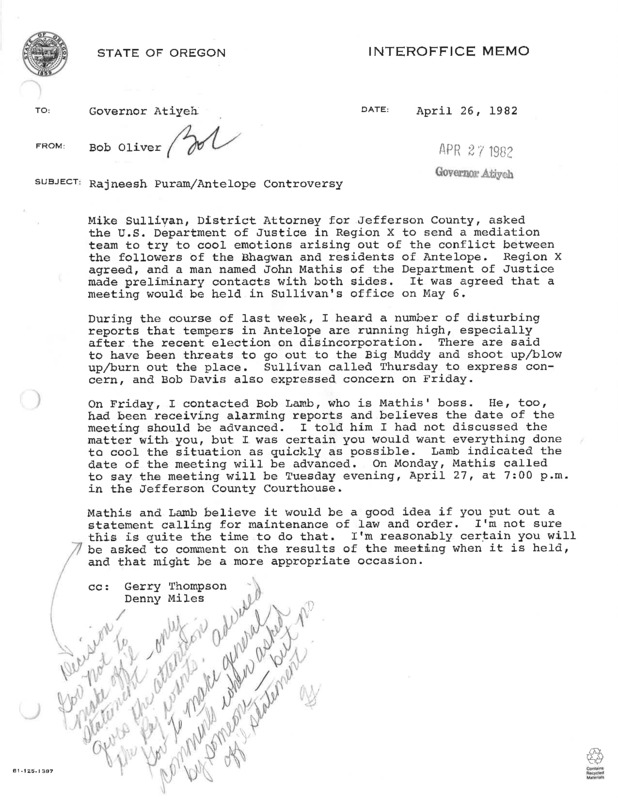
An April 26, 1982 State of Oregon interoffice memo from Bob Oliver to Governor Atiyeh regarding the "Rajneesh Puram/Antelope Controversy." The memo discusses a request by Jefferson County District Attorney Mike Sullivan for U.S. Department of Justice mediation, reports of rising tensions after the recent election on disincorporation in Antelope, and the possible timing of a public statement by the Governor. A stamped date of April 27, 1982 and handwritten notes are visible on the document. Oliver served as the legal counsel to Governors McCall and Atiyeh, playing a particularly important behind-the-scenes role as Public Safety Coordinator during the Rajneesh crisis.
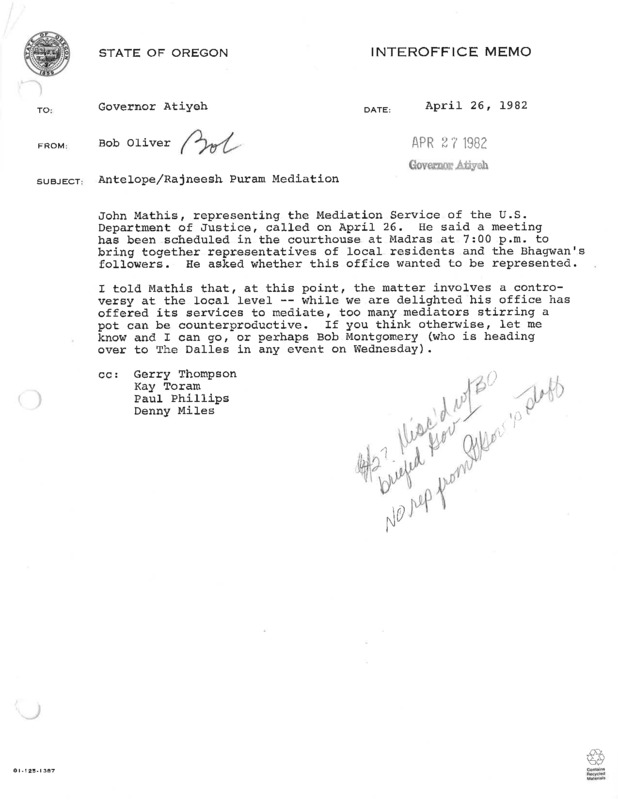
An April 26, 1982 State of Oregon interoffice memo from Bob Oliver to Governor Atiyeh regarding "Antelope/Rajneesh Puram Mediation." The memo reports that John Mathis of the U.S. Department of Justice Mediation Service had scheduled a meeting at the courthouse in Madras with local residents and Bhagwan's followers, and asked whether the Governor's office wanted to be represented. The memo states Oliver's view that the matter was a local-level controversy and that too many mediators could be counterproductive. A stamped date of April 27, 1982 and a handwritten note are visible on the document. Oliver served as the legal counsel to Governors McCall and Atiyeh, playing a particularly important behind-the-scenes role as Public Safety Coordinator during the Rajneesh crisis.
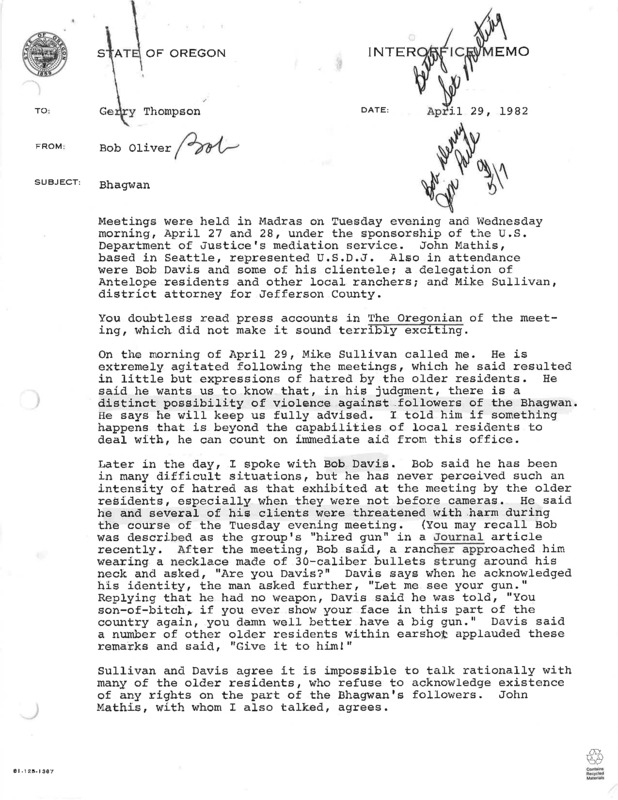
An April 29, 1982 State of Oregon interoffice memo from Bob Oliver to Gerry Thompson regarding meetings held in Madras under the sponsorship of the U.S. Department of Justice mediation service. The memo discusses tensions between older residents of Antelope and followers of Bhagwan Shree Rajneesh, concerns raised by Jefferson County District Attorney Mike Sullivan, reports from Bob Davis, and future meetings scheduled in The Dalles and Antelope. Handwritten notes are visible on both pages of the document. Oliver served as the legal counsel to Governor Atiyeh.
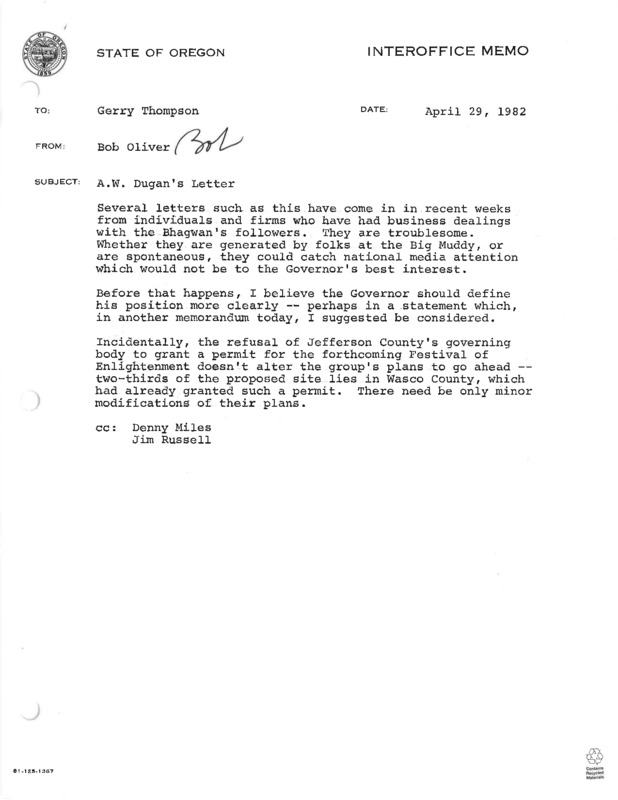
An April 29, 1982 State of Oregon interoffice memo from Bob Oliver to Gerry Thompson regarding "A.W. Dugan's Letter." The memo discusses letters received from individuals and businesses that had dealings with Bhagwan's followers, and the possibility that such letters could attract national media attention. The memo also discusses the Governor's public position and notes that the refusal of Jefferson County to grant a permit for the Festival of Enlightenment did not prevent the group from moving ahead with plans in Wasco County. Oliver served as the legal counsel to Governors McCall and Atiyeh, playing a particularly important behind-the-scenes role as Public Safety Coordinator during the Rajneesh crisis.