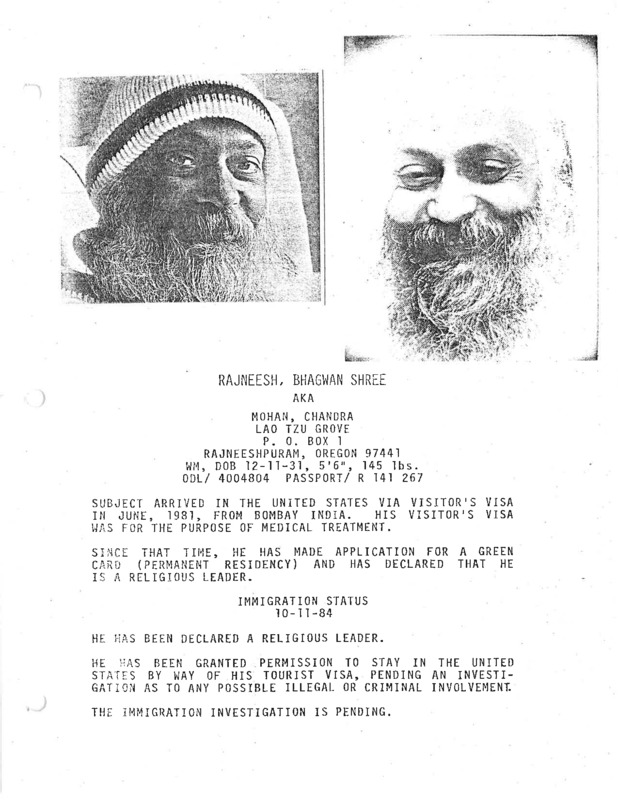
A photocopied information sheet featuring two images of Bhagwan Shree Rajneesh and identifying information. The document states that Rajneesh arrived in the United States in June 1981 on a visitor's visa for medical treatment, later applied for permanent residency, and had been granted permission to stay under his tourist visa while an immigration investigation was pending. The document is dated October 11, 1984.
A five-page set of typed notes titled "Rajneeshees Arrive in Oregon." The notes outline the Rajneesh movement's arrival in Oregon, the attention it received from Governor Atiyeh's office, the incorporation of Rajneeshpuram, conflict over Antelope, land use and church/state issues, voter registration concerns, the Share-A-Home program, meetings with Rajneesh leaders and federal mediators, and the handling of people leaving the ranch in 1984. These notes may have been written by Gerry Thompson, probably some time after the events occured.
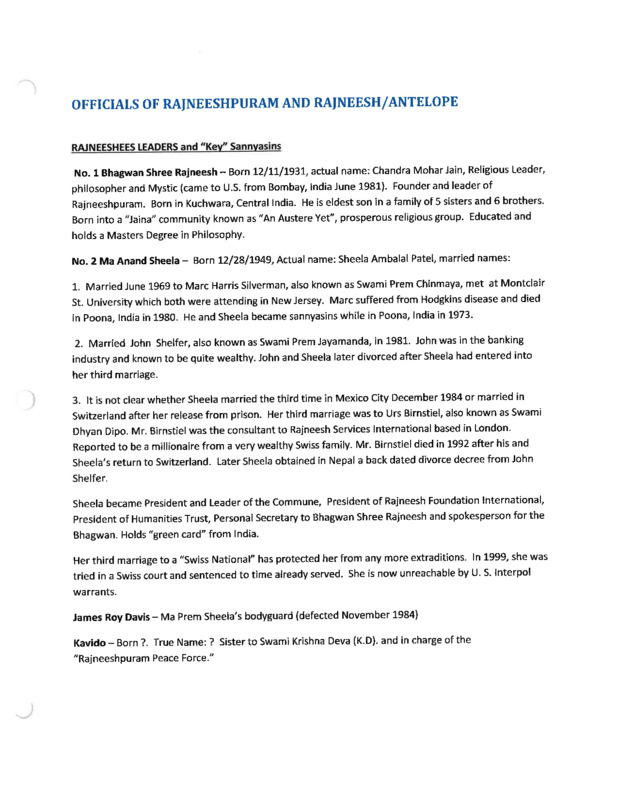
A ten-page reference document titled "Officials of Rajneeshpuram and Rajneesh/Antelope." The document lists Rajneeshee leaders and "key" sannyasins, local and state officials, agency contacts, attorneys, media contacts, and other individuals connected to Rajneeshpuram and Rajneesh/Antelope. Entries include names, alternate names, roles, and, in some cases, brief biographical or legal notes. This document may have been written by Gerry Thompson, and was probably created some time after the Rajneesh crisis occured.
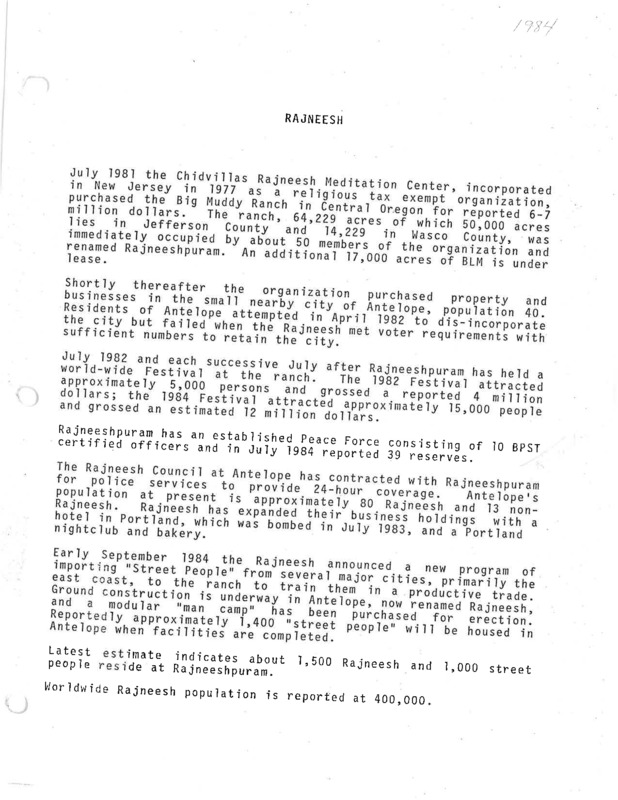
A 59-page document containing a typed background summary and a detailed timeline titled "Rajneesh Timeline, 1981-1986, Governor and Staff Involvement." The timeline concerns state government involvement with the Rajneesh movement, including Rajneeshpuram, Antelope, land use disputes, church/state issues, state and federal agencies, voter registration concerns, criminal investigations, and the departure of Bhagwan Shree Rajneesh. This document was likely created by Gerry Thompson, Governor Atiyeh's Chief of Staff, some time after the events occured.
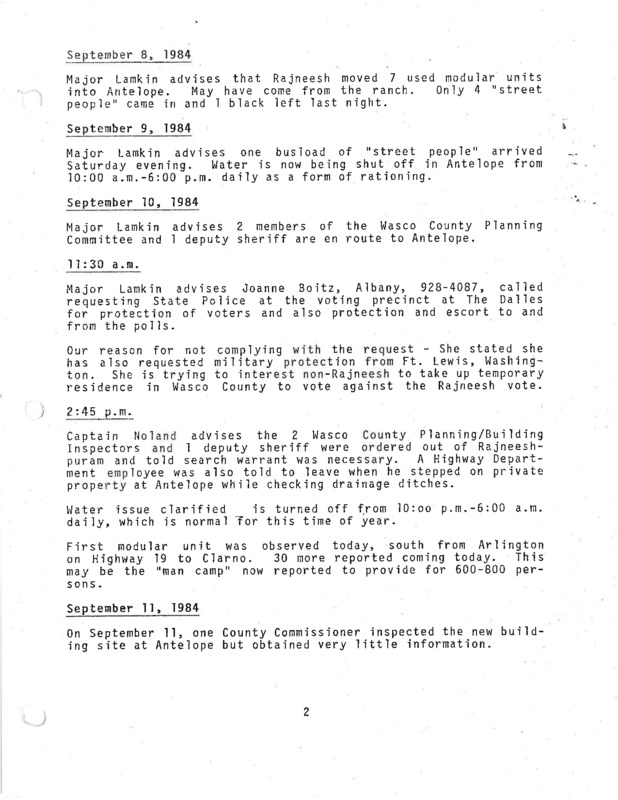
A 62-page collection of typed dated notes titled "Rajneeshpuram - Antelope" and, on some pages, "Rajneesh File." The notes appear to document communications and reports involving state officials, Oregon State Police, local officials, and others regarding Rajneeshpuram and Antelope from September 1984 to January 1985. Topics include construction in Antelope, the arrival and departure of "street people" (i.e. homeless people), election and voter registration concerns, security planning, media attention, transportation and shelter efforts, ammunition purchases, and conflict between Rajneesh followers and local residents or opposition groups.
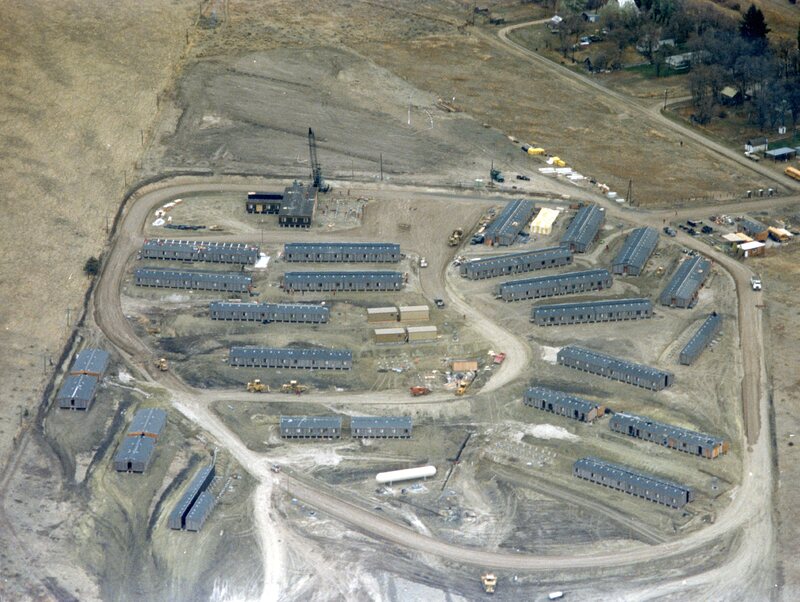
A color aerial photograph of Antelope, Oregon, with Rajneesh-era development buildings visible. By the time the photograph was taken, followers of the Bhagwan Shree Rajneesh had outvoted Antelope's original residents and taken control of the city government, officially renaming the town "Rajneesh." A note attached to this and similar photographs labels it as the "man camp," likely a large housing complex intended to hold thousands of potential new followers.
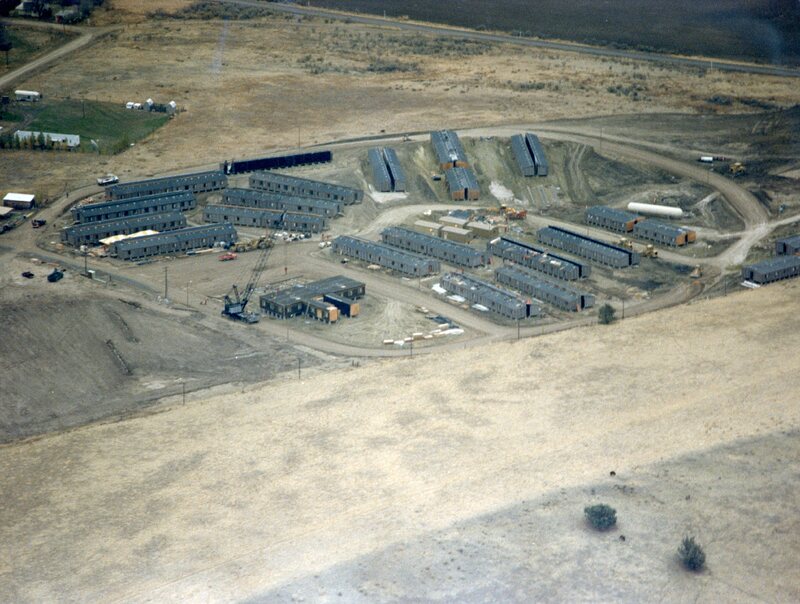
A color aerial photograph showing modular buildings and construction activity near Antelope, Oregon. The photograph appears to show the same Rajneesh-era housing development visible in related aerial photographs, with surrounding roads, vehicles, and rural land. A note associated with this and similar photographs identifies the development as the "man camp," likely a large housing complex intended to hold thousands of potential new followers.
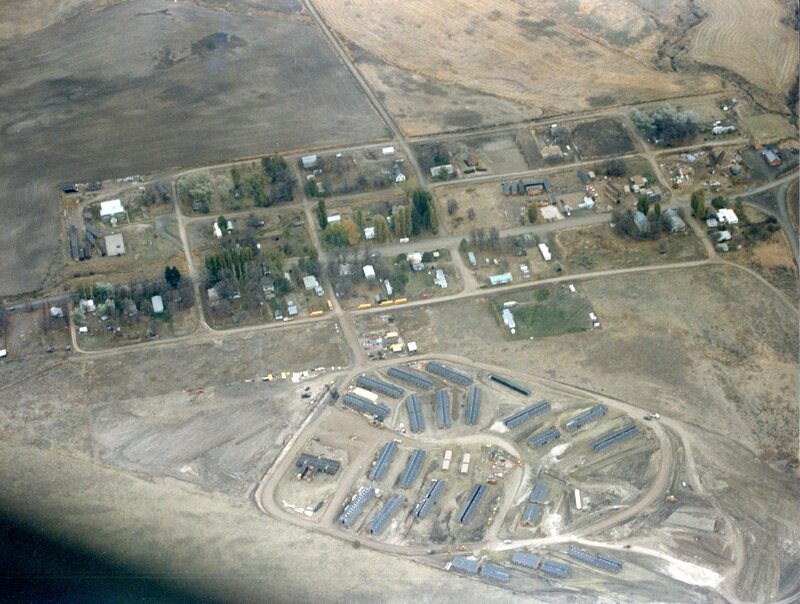
A color aerial photograph showing Antelope, Oregon, with a large modular housing development visible at the lower edge of the photograph. A note associated with this and similar photographs identifies the development as the "man camp," likely a large housing complex intended to hold thousands of potential new followers. The photograph shows the development's proximity to Antelope, which was renamed Rajneesh during the period of Rajneeshee political control.
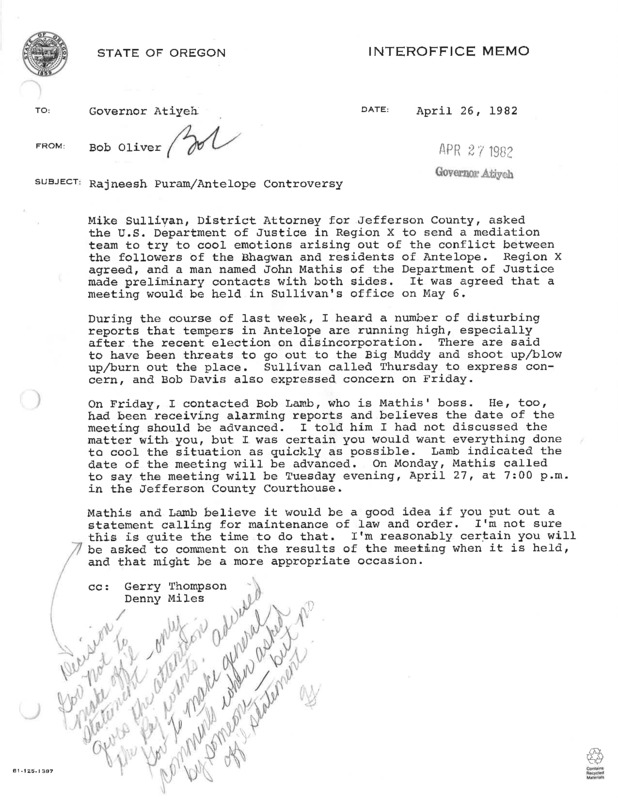
An April 26, 1982 State of Oregon interoffice memo from Bob Oliver to Governor Atiyeh regarding the "Rajneesh Puram/Antelope Controversy." The memo discusses a request by Jefferson County District Attorney Mike Sullivan for U.S. Department of Justice mediation, reports of rising tensions after the recent election on disincorporation in Antelope, and the possible timing of a public statement by the Governor. A stamped date of April 27, 1982 and handwritten notes are visible on the document. Oliver served as the legal counsel to Governors McCall and Atiyeh, playing a particularly important behind-the-scenes role as Public Safety Coordinator during the Rajneesh crisis.
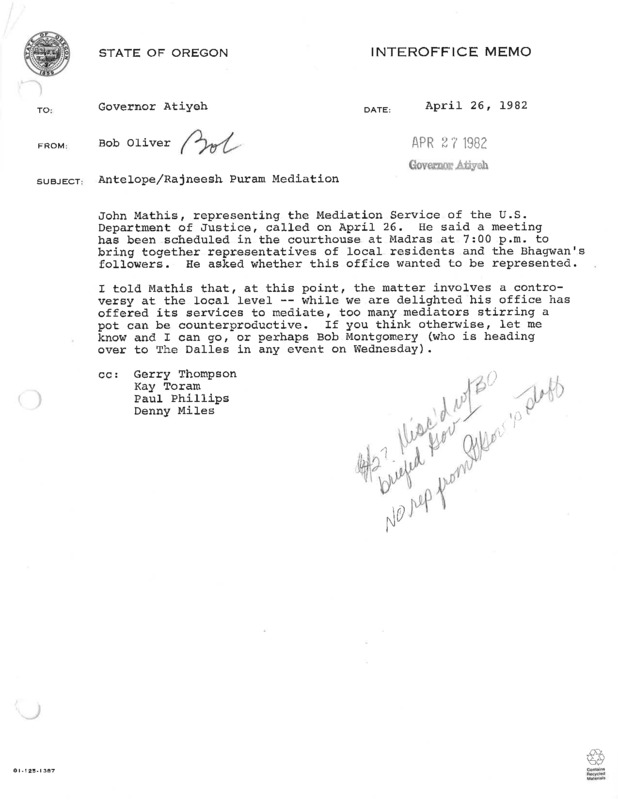
An April 26, 1982 State of Oregon interoffice memo from Bob Oliver to Governor Atiyeh regarding "Antelope/Rajneesh Puram Mediation." The memo reports that John Mathis of the U.S. Department of Justice Mediation Service had scheduled a meeting at the courthouse in Madras with local residents and Bhagwan's followers, and asked whether the Governor's office wanted to be represented. The memo states Oliver's view that the matter was a local-level controversy and that too many mediators could be counterproductive. A stamped date of April 27, 1982 and a handwritten note are visible on the document. Oliver served as the legal counsel to Governors McCall and Atiyeh, playing a particularly important behind-the-scenes role as Public Safety Coordinator during the Rajneesh crisis.
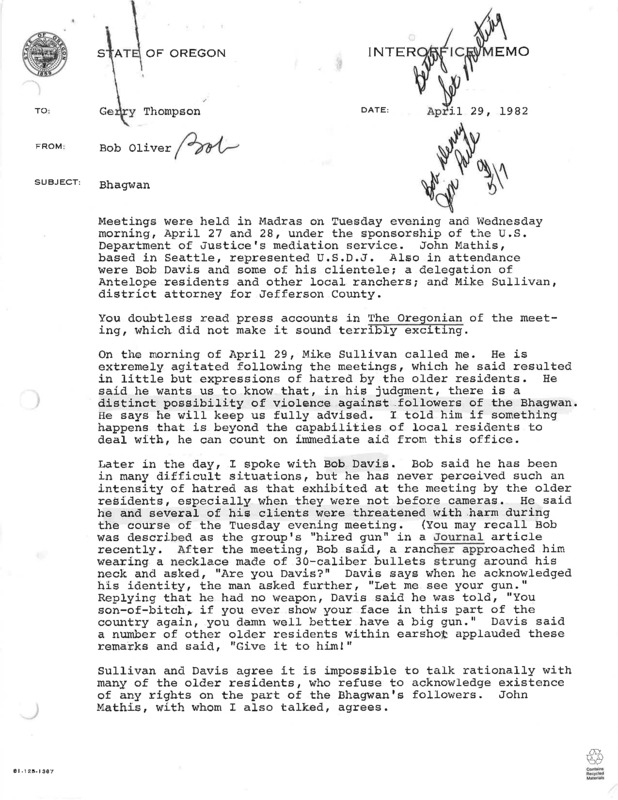
An April 29, 1982 State of Oregon interoffice memo from Bob Oliver to Gerry Thompson regarding meetings held in Madras under the sponsorship of the U.S. Department of Justice mediation service. The memo discusses tensions between older residents of Antelope and followers of Bhagwan Shree Rajneesh, concerns raised by Jefferson County District Attorney Mike Sullivan, reports from Bob Davis, and future meetings scheduled in The Dalles and Antelope. Handwritten notes are visible on both pages of the document. Oliver served as the legal counsel to Governor Atiyeh.
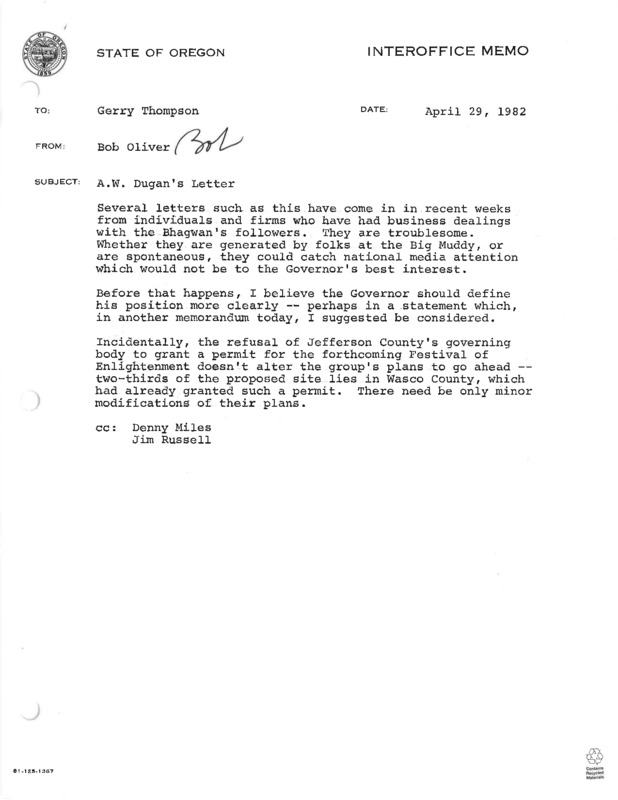
An April 29, 1982 State of Oregon interoffice memo from Bob Oliver to Gerry Thompson regarding "A.W. Dugan's Letter." The memo discusses letters received from individuals and businesses that had dealings with Bhagwan's followers, and the possibility that such letters could attract national media attention. The memo also discusses the Governor's public position and notes that the refusal of Jefferson County to grant a permit for the Festival of Enlightenment did not prevent the group from moving ahead with plans in Wasco County. Oliver served as the legal counsel to Governors McCall and Atiyeh, playing a particularly important behind-the-scenes role as Public Safety Coordinator during the Rajneesh crisis.
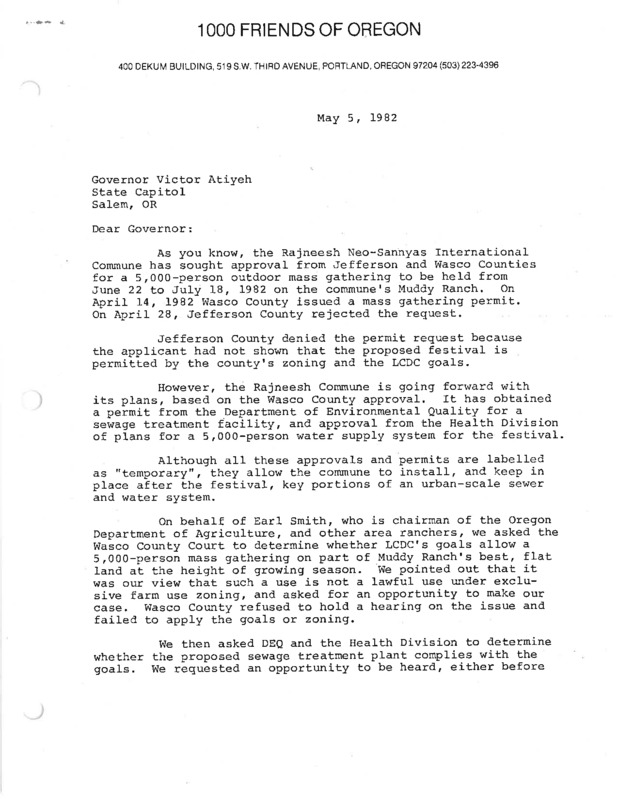
A May 5, 1982 letter from Henry R. Richmond, Executive Director of 1000 Friends of Oregon, to Governor Victor Atiyeh regarding the Rajneesh Neo-Sannyas International Commune's plans for a 5,000-person outdoor mass gathering at the commune's Muddy Ranch. The letter discusses Jefferson County's denial of a mass gathering permit, Wasco County's approval of a permit, temporary approvals for sewage treatment and water supply, and concerns about whether the proposed festival complied with land use goals and zoning. Richmond asks the Governor to involve state agencies and the Attorney General in reviewing the issue. 1000 Friends of Oregon was a nonprofit organization founded by Richmond that advocated for land use planning within the state.
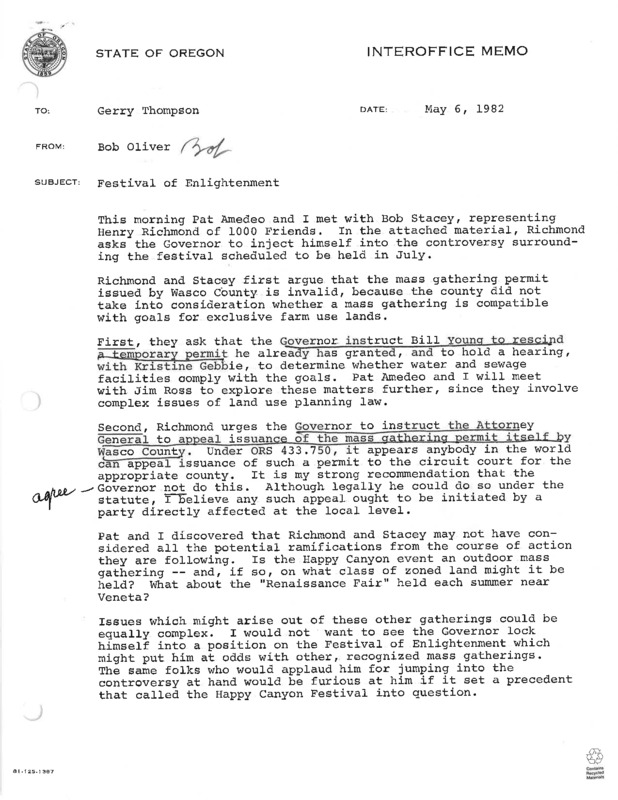
A May 6, 1982 State of Oregon interoffice memo from Bob Oliver to Gerry Thompson regarding the Festival of Enlightenment. The memo summarizes a meeting with Pat Amedeo and Bob Stacey, representing Henry Richmond of 1000 Friends of Oregon, about the controversy surrounding the festival scheduled for July. The memo discusses requests for the Governor to direct further review of water and sewage facilities and to instruct the Attorney General to appeal Wasco County's issuance of the mass gathering permit. A handwritten note reading "agree" is visible in the margin. Oliver served as the legal counsel to Governors McCall and Atiyeh, playing a particularly important behind-the-scenes role as Public Safety Coordinator during the Rajneesh crisis.
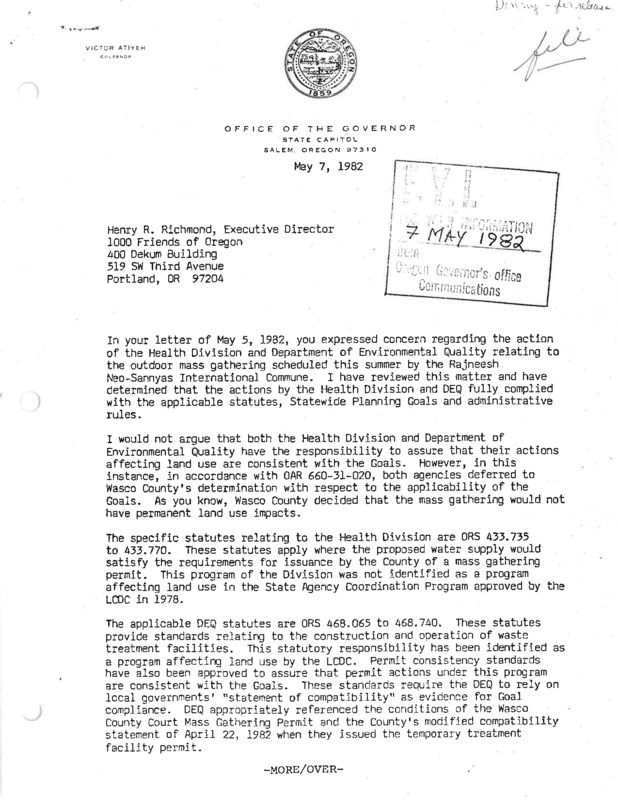
A May 7, 1982 letter from Governor Victor Atiyeh to Henry R. Richmond, Executive Director of 1000 Friends of Oregon, regarding concerns about state agency action connected to the Rajneesh Neo-Sannyas International Commune's planned outdoor mass gathering. 1000 Friends of Oregon was a nonprofit organization founded by Richmond that advocated for land use planning within the state. The visible page of the letter discusses Health Division and Department of Environmental Quality responsibilities, mass gathering permit statutes, temporary water supply approval, and sewage treatment facilities. The scan also includes pages from Richmond's May 5, 1982 letter to the Governor.
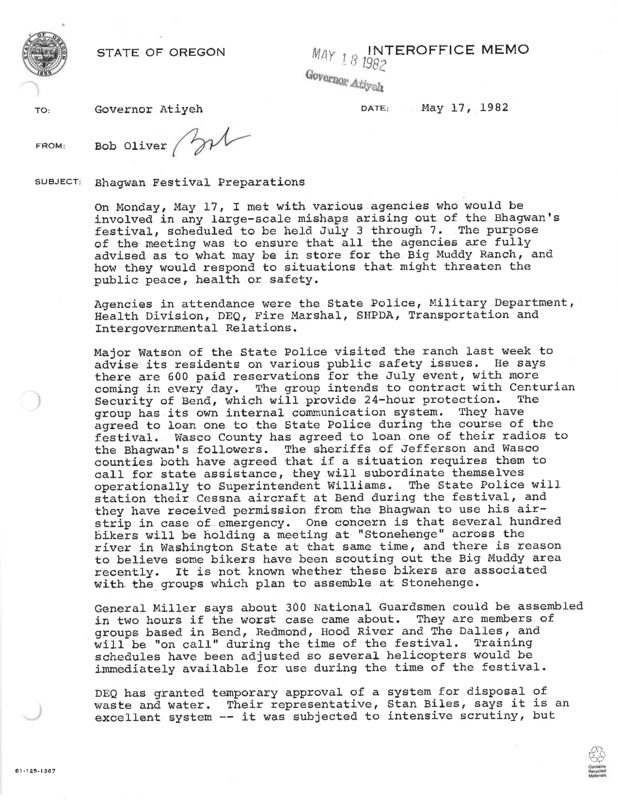
A May 17, 1982 State of Oregon interoffice memo from Bob Oliver to Governor Atiyeh regarding preparations for Bhagwan's festival, scheduled for the area of the Big Muddy Ranch. The memo summarizes a meeting with state agencies concerning public peace, health, and safety, including the State Police, Military Department, Health Division, Department of Environmental Quality, Fire Marshal, Transportation Division, and Intergovernmental Relations. Topics include expected attendance, security, National Guard readiness, waste and water systems, fire danger, medical care, traffic, and emergency operations planning. Oliver served as the legal counsel to Governors McCall and Atiyeh, playing a particularly important behind-the-scenes role as Public Safety Coordinator during the Rajneesh crisis.
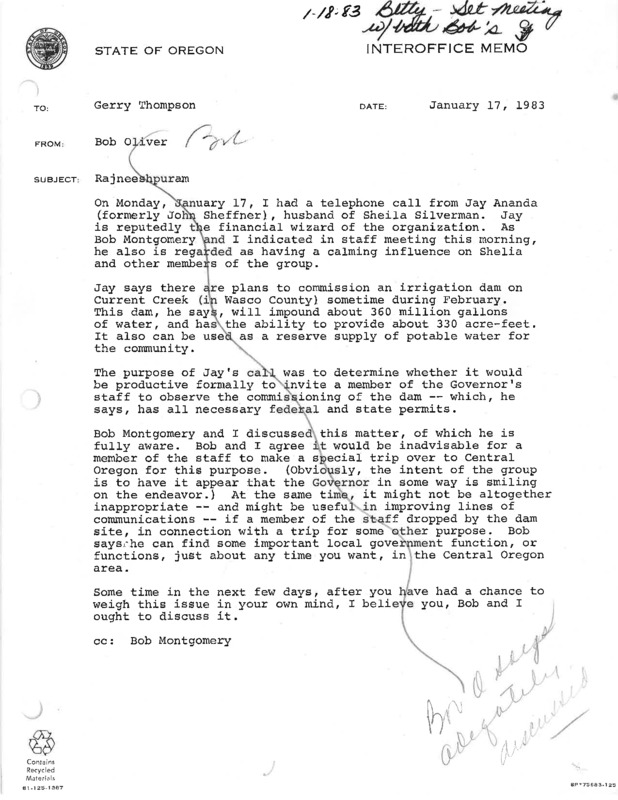
A January 17, 1983 State of Oregon interoffice memo from Bob Oliver to Gerry Thompson regarding Rajneeshpuram. The memo describes a telephone call from Rajneeshee Jayananda (formerly John Sheffner), concerning plans to commission an irrigation dam on Current Creek in Wasco County. Jayananda was a leader within the Rajneeshpuram community in Oregon. Oliver reports that Jayananda asked whether a member of the Governor's staff would attend the commissioning, and discusses concerns about whether such a visit would appear to suggest the Governor's support for the project. Handwritten notes are visible on the document. Oliver served as the legal counsel to Governors McCall and Atiyeh, playing a particularly important behind-the-scenes role as Public Safety Coordinator during the Rajneesh crisis.
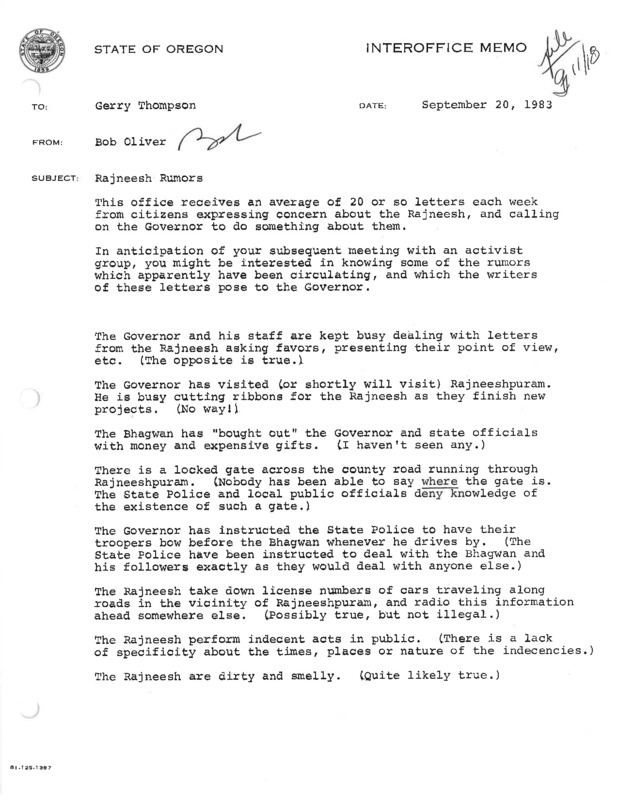
A September 20, 1983 State of Oregon interoffice memo from Bob Oliver to Gerry Thompson regarding rumors about the Rajneesh. The memo states that the Governor's office was receiving about twenty letters each week from citizens expressing concern about the Rajneesh, and lists rumors that writers had raised. Topics include claims about the Governor and state officials, gates and roads near Rajneeshpuram, State Police conduct, license plate numbers, public behavior, land purchases, welfare, weapons, and fears that the Rajneesh planned to take over Oregon. Oliver served as the legal counsel to Governors McCall and Atiyeh, playing a particularly important behind-the-scenes role as Public Safety Coordinator during the Rajneesh crisis.
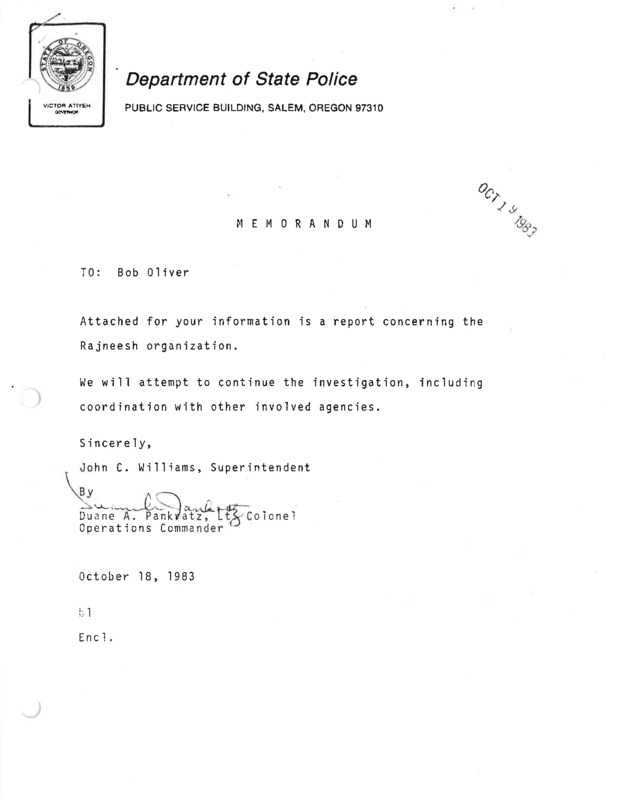
A three-page set of Oregon Department of State Police memoranda dated October 13 and October 18, 1983. A cover memorandum to Bob Oliver from Superintendent John C. Williams, by Duane A. Pankratz of the Oregon State Police, attaches a report concerning the Rajneesh organization. The attached report summarizes interviews and agency communications regarding alleged criminal activity involving drugs, including statements from a former member of the Rajneesh organization and contacts with U.S. Customs and the Attorney General's office. Oliver served as the legal counsel to Governors McCall and Atiyeh, playing a particularly important behind-the-scenes role as Public Safety Coordinator during the Rajneesh crisis.
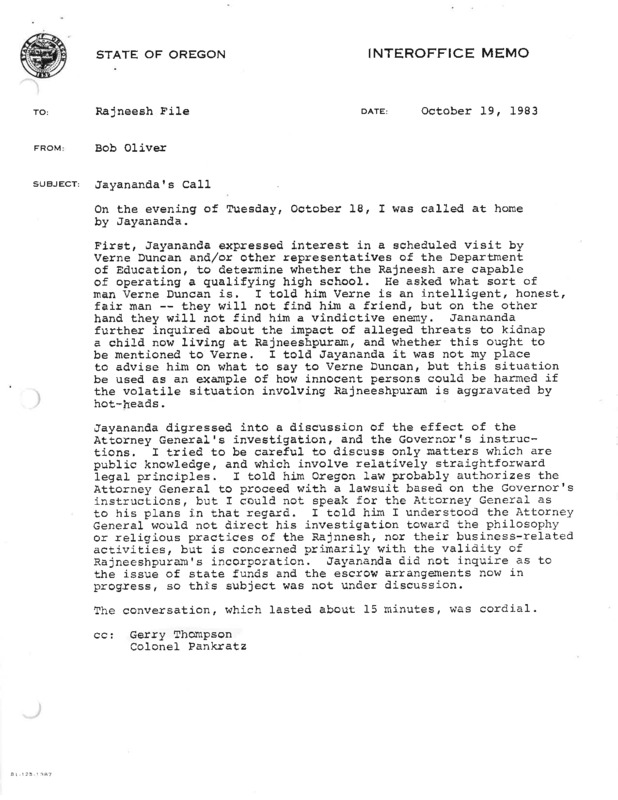
An October 19, 1983 State of Oregon interoffice memo from Bob Oliver to the Rajneesh File regarding a telephone call from Jayananda. Jayananda was a leader within the Rajneeshpuram community in Oregon. The memo discusses Jayananda's questions about a possible Department of Education visit to Rajneeshpuram, whether the Rajneesh could operate a qualifying high school, alleged threats to kidnap a child living at Rajneeshpuram, and the effect of the Attorney General's investigation. Oliver states that the conversation lasted about fifteen minutes and was cordial. Oliver served as the legal counsel to Governors McCall and Atiyeh, playing a particularly important behind-the-scenes role as Public Safety Coordinator during the Rajneesh crisis.
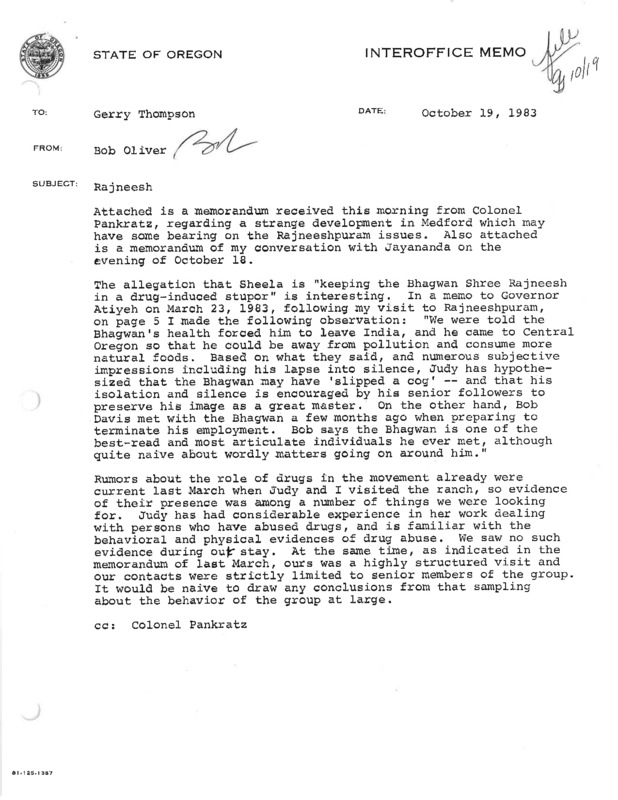
An October 19, 1983 State of Oregon interoffice memo from Bob Oliver to Gerry Thompson regarding the Rajneesh. The memo refers to attached memoranda from Oregon State Police officer Colonel Pankratz and Oliver's conversation with Jayananda, and discusses an allegation that Ma Anand Sheela was keeping Bhagwan Shree Rajneesh in a "drug-induced stupor." Jayananda and Ma Anand Sheela were leaders within the Rajneeshpuram community in Oregon. Oliver also references his March 1983 visit to Rajneeshpuram and notes that he and Judy did not observe evidence of drug abuse during their structured visit. Handwritten notes are visible on the document. Oliver served as the legal counsel to Governors McCall and Atiyeh, playing a particularly important behind-the-scenes role as Public Safety Coordinator during the Rajneesh crisis.
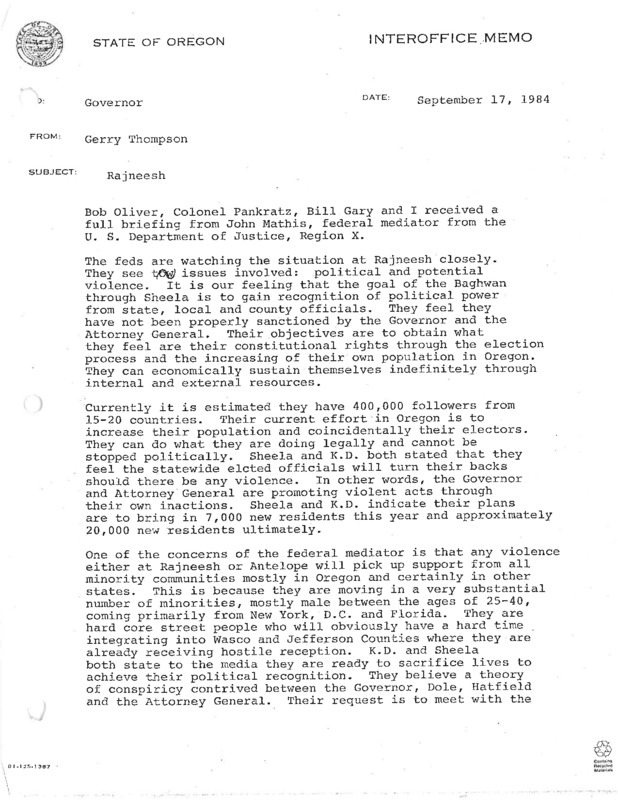
A September 17, 1984 State of Oregon interoffice memo from Gerry Thompson to Governor Atiyeh regarding a briefing from John Mathis, a federal mediator from the U.S. Department of Justice. The memo discusses political and public safety concerns relating to Rajneeshpuram and Antelope, including Rajneesh leaders' requests to meet with the Governor and Attorney General, the arrival of "street people" (i.e. homeless people) at the ranch, possible violence, state police involvement, and concerns among legislators.
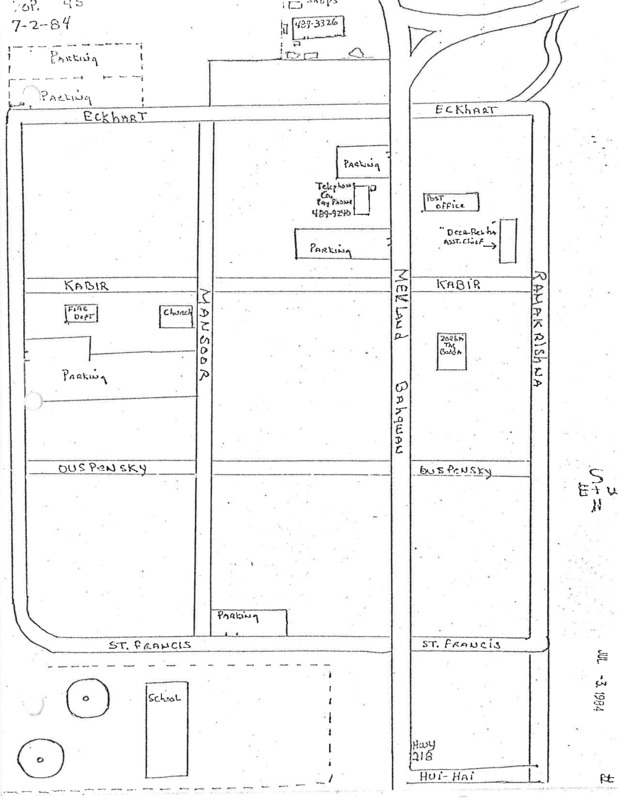
A hand-drawn map, apparently dated July 2, 1984, showing streets, parking areas, and buildings in the town Rajneesh, also known as Antelope. The small town of Antelope was renamed by the followers of Bhagwan Shree Rajneesh in the 1980s, before it reverted to its original name. Labeled streets include E. Khar, Kabir, Ouspensky, St. Francis, Mansoor, Mela Bhagwan, and Rankisha. The map also includes labels for parking areas, a school, and other marked buildings or sites. The creator and exact purpose of the map are not stated.
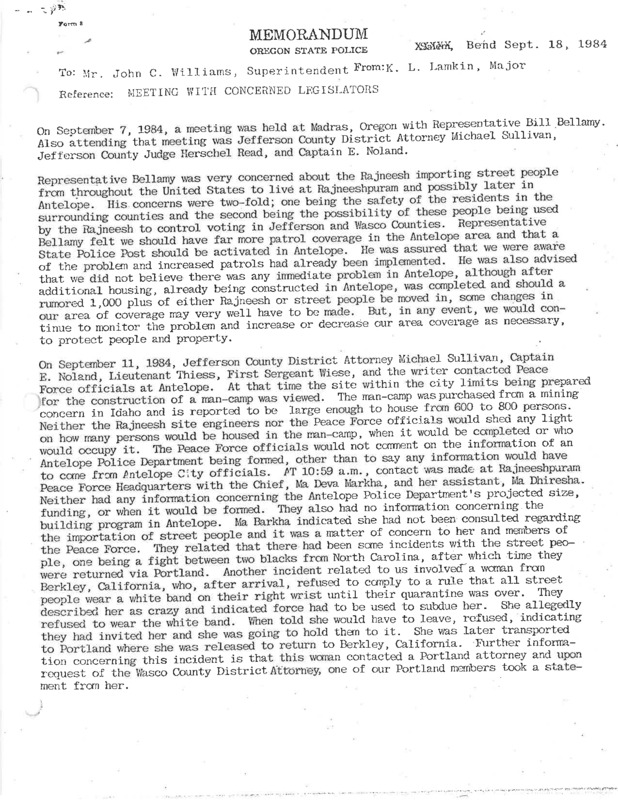
A three-page September 18, 1984 Oregon State Police memorandum from Major K. L. Lamkin to Superintendent John C. Williams regarding meetings with concerned legislators and officials. The memorandum discusses concerns about the Rajneesh bringing "street people" (i.e. homeless people) to Rajneeshpuram and possibly Antelope, the effect on voting in Jefferson and Wasco Counties, State Police patrol coverage, the construction of a "man-camp" in Antelope, the possible formation of an Antelope Police Department, and concerns raised by local residents and legislators.